SSC CHSL 17 November 2025 · Shift 1 · English Language — questions with answers · ShikshaSphere
Chapter 48 of 200
17 November 2025 · Shift 1
English Language
25 questions ~25 min readFree
25 questions
A
1
Identify the part of the sentence that contains a grammatical error.
A. The ancient manuscript's fragile pages
B. were carefully handled, but it's binding
C. had deteriorated significantly
D. over the centuries.
A.The ancient manuscript's fragile pages
B.were carefully handled, but it's binding
C.had deteriorated significantly
D.over the centuries.
Solution
Possessive 'its' vs 'it's'
The part to be tested is B, where a word is needed to show that the binding belongs to the manuscript.
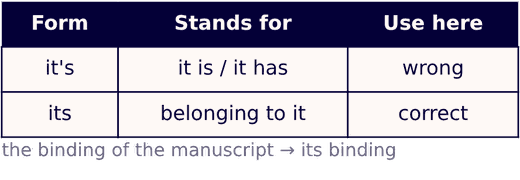
'It's' is only the short form of 'it is' or 'it has'; the possessive adjective is 'its', written without an apostrophe.
Expanding part B gives 'but it is binding had deteriorated', which is not a sentence at all — so the contraction cannot stand there.
Part B should read 'were carefully handled, but its binding'; hence the error lies in option (b).
2
Identify the part of the sentence that contains a grammatical error.
A. Yesterday, I B. seen a fantastic film
C. at the new cinema D. down the street.
A.Yesterday, I
B.seen a fantastic film
C.at the new cinema
D.down the street.
Solution
Simple past tense verb
The adverb 'Yesterday' fixes the sentence in the simple past tense.
'Seen' is the past participle of 'see'; a past participle can never work as the main verb by itself — it needs 'have', 'has' or 'had' before it.
The simple past form is 'saw', so part B must read 'saw a fantastic film'.
Hence the error lies in option (b).
3
Fill in the blank with the most appropriate preposition:
The children went out to play finishing all their homework.
A.during
B.for
C.after
D.until
Solution
Preposition of time
The blank joins two actions — finishing the homework and going out to play — and must show which came first.
'After' marks the later action, which is the natural order here: the homework was finished first, then the play began.
'During' would need the two to overlap, 'for' shows purpose or duration, and 'until' would mean the playing stopped when the homework ended.
So the sentence reads 'went out to play after finishing all their homework' — option (c).
4
Fill in the blank with the most appropriate conjunction:
She wanted to attend the concert; . she had to work late and missed it.
A.moreover
B.however
C.therefore
D.similarly
Solution
Contrast conjunction
The two clauses carry opposite ideas: she wanted to attend the concert, but she could not.
Such a contrast after a semicolon needs the conjunctive adverb 'however'.
'Moreover' adds a similar idea, 'therefore' states a result and 'similarly' shows likeness — none of these can join two opposed ideas.
Hence option (b) is correct.
5
Choose the correctly spelt word:
A.Campain
B.Campagin
C.Campaign
D.Campign
Solution
Correct spelling
The correct spelling is 'Campaign' — an organised course of action, as in an election campaign.
It keeps the silent 'g' before the 'n', exactly like 'sign', 'design' and 'foreign', so the word ends in -aign.
'Campain', 'Campagin' and 'Campign' each drop or misplace that silent 'g'.
Hence option (c) is correct.
6
Which of the following sentences uses the word "wind" with the same meaning as in the following sentence?
"The cold wind howled through the barren trees.'
A.You need to wind the clock every day to keep it accurate.
B.He watched the kite gracefully wind its way up into the sky.
C.The path began to wind through the dense forest.
D.A strong gust of wind nearly blew off his hat.
Solution
Homograph: word meaning
In the given sentence 'wind' is a noun meaning moving air — it is the wind that howls through the trees.
In options (a), (b) and (c) 'wind' is a verb meaning to turn, to coil, or to follow a curving path.
Only 'A strong gust of wind nearly blew off his hat' uses the noun for moving air, the same sense as in the given sentence.
Hence option (d) is correct.
7
Choose the correctly spelt word:
A.Durable
B.Durible
C.Dewrable
D.Dureable
Solution
Correct spelling
The correct spelling is 'Durable' — able to last a long time without wearing out.
It is formed from the root 'dur-' (to last, as in 'duration') plus the common suffix -able, so nothing is inserted between them.
'Durible' uses the wrong suffix, while 'Dewrable' and 'Dureable' add letters that the root does not carry.
Hence option (a) is correct.
8
Directions (Qs. 8-12): Read the following passage carefully and answer the questions that follow.
As democratic processes increasingly rely on digital infrastructure, elections have become more efficient but also
more vulnerable to cybersecurity threats. Voter registration systems, electronic voting technologies, and online result transmission platforms now form critical components of electoral administration. Any disruption to these systems, whether through hacking, data manipulation, or coordinated cyber intrusions, can interfere with the smooth conduct of elections and weaken public trust in democratic institutions. The mere perception that electoral systems are insecure can be as damaging as actual interference.
A growing concern is the involvement of foreign actors seeking to influence electoral outcomes indirectly. Rather than altering vote counts, such interference often aims to spread confusion, amplify political divisions, or cast doubt on the legitimacy of the electoral process. Cyberattacks may be combined with strategic information campaigns to exploit existing social tensions and undermine confidence in democratic outcomes. Addressing these challenges requires a comprehensive approach that goes beyond technical defences. Governments must strengthen cybersecurity protocols, ensure transparent verification of results, and promote digital literacy among voters so that misinformation and manipulation can be identified and resisted. The long-term stability of democratic systems depends on elections that are not only free and fair in principle but also secure and credible in practice.
What is the main drawback of increased reliance on digital systems in elections?
A.Higher operational costs
B.Reduced efficiency in vote counting
C.Greater exposure to cyber threats
D.Limited voter participation
Solution
Comprehension: stated detail
The first paragraph says that as democratic processes rely more on digital infrastructure, elections become more efficient 'but also more vulnerable to cybersecurity threats'.
The very next lines name the danger — hacking, data manipulation and coordinated cyber intrusions — which is exactly a greater exposure to cyber threats.
Higher cost, slower counting and lower turnout are nowhere given as drawbacks; the passage in fact calls digital systems more efficient.
Hence option (c) is correct.
9
Directions (Qs. 8-12): Read the following passage carefully and answer the questions that follow.
As democratic processes increasingly rely on digital infrastructure, elections have become more efficient but also
more vulnerable to cybersecurity threats. Voter registration systems, electronic voting technologies, and online result transmission platforms now form critical components of electoral administration. Any disruption to these systems, whether through hacking, data manipulation, or coordinated cyber intrusions, can interfere with the smooth conduct of elections and weaken public trust in democratic institutions. The mere perception that electoral systems are insecure can be as damaging as actual interference.
A growing concern is the involvement of foreign actors seeking to influence electoral outcomes indirectly. Rather than altering vote counts, such interference often aims to spread confusion, amplify political divisions, or cast doubt on the legitimacy of the electoral process. Cyberattacks may be combined with strategic information campaigns to exploit existing social tensions and undermine confidence in democratic outcomes. Addressing these challenges requires a comprehensive approach that goes beyond technical defences. Governments must strengthen cybersecurity protocols, ensure transparent verification of results, and promote digital literacy among voters so that misinformation and manipulation can be identified and resisted. The long-term stability of democratic systems depends on elections that are not only free and fair in principle but also secure and credible in practice.
Why does the passage state that the perception of insecurity is harmful?
A.It increases the likelihood of legal disputes
B.It discourages political campaigning
C.It undermines public trust in elections
D.It delays the declaration of results
Solution
Comprehension: inference
The passage ends its first paragraph by saying that the mere perception that electoral systems are insecure can be as damaging as actual interference.
The damage it describes is to belief, not to machinery: the same paragraph says disruption 'weakens public trust in democratic institutions'.
So doubt alone is harmful because it undermines public trust in elections.
Legal disputes, campaigning and delayed results are never discussed, so option (c) is correct.
10
Directions (Qs. 8-12): Read the following passage carefully and answer the questions that follow.
As democratic processes increasingly rely on digital infrastructure, elections have become more efficient but also
more vulnerable to cybersecurity threats. Voter registration systems, electronic voting technologies, and online result transmission platforms now form critical components of electoral administration. Any disruption to these systems, whether through hacking, data manipulation, or coordinated cyber intrusions, can interfere with the smooth conduct of elections and weaken public trust in democratic institutions. The mere perception that electoral systems are insecure can be as damaging as actual interference.
A growing concern is the involvement of foreign actors seeking to influence electoral outcomes indirectly. Rather than altering vote counts, such interference often aims to spread confusion, amplify political divisions, or cast doubt on the legitimacy of the electoral process. Cyberattacks may be combined with strategic information campaigns to exploit existing social tensions and undermine confidence in democratic outcomes. Addressing these challenges requires a comprehensive approach that goes beyond technical defences. Governments must strengthen cybersecurity protocols, ensure transparent verification of results, and promote digital literacy among voters so that misinformation and manipulation can be identified and resisted. The long-term stability of democratic systems depends on elections that are not only free and fair in principle but also secure and credible in practice.
What strategy is commonly used by foreign actors to influence elections, according to the passage ?
A.Directly changing vote totals
B.Spreading confusion and doubt
C.Reforming electoral laws
D.Funding political parties
Solution
Comprehension: stated detail
The second paragraph says foreign actors seek to influence outcomes indirectly, 'rather than altering vote counts'.
Their method is to spread confusion, amplify political divisions and cast doubt on the legitimacy of the electoral process.
That phrase 'rather than altering vote counts' rules out option (a) directly, and reforming laws or funding parties is never mentioned.
Hence option (b) is correct.
11
Directions (Qs. 8-12): Read the following passage carefully and answer the questions that follow.
As democratic processes increasingly rely on digital infrastructure, elections have become more efficient but also
more vulnerable to cybersecurity threats. Voter registration systems, electronic voting technologies, and online result transmission platforms now form critical components of electoral administration. Any disruption to these systems, whether through hacking, data manipulation, or coordinated cyber intrusions, can interfere with the smooth conduct of elections and weaken public trust in democratic institutions. The mere perception that electoral systems are insecure can be as damaging as actual interference.
A growing concern is the involvement of foreign actors seeking to influence electoral outcomes indirectly. Rather than altering vote counts, such interference often aims to spread confusion, amplify political divisions, or cast doubt on the legitimacy of the electoral process. Cyberattacks may be combined with strategic information campaigns to exploit existing social tensions and undermine confidence in democratic outcomes. Addressing these challenges requires a comprehensive approach that goes beyond technical defences. Governments must strengthen cybersecurity protocols, ensure transparent verification of results, and promote digital literacy among voters so that misinformation and manipulation can be identified and resisted. The long-term stability of democratic systems depends on elections that are not only free and fair in principle but also secure and credible in practice.
Which measure is suggested to counter cybersecurity threats to elections?
A.Eliminating online communication during elections
B.Strengthening security and promoting digital awareness
C.Reducing media access to election data
D.Limiting voter access to technology
Solution
Comprehension: suggested measure
The passage says that meeting these challenges 'requires a comprehensive approach that goes beyond technical defences'.
It then names the measures: strengthen cybersecurity protocols, ensure transparent verification of results, and promote digital literacy among voters.
Option (b) covers both halves of that — stronger security plus digital awareness.
The other three options cut off communication, media or technology, which the passage never suggests; hence option (b).
12
Directions (Qs. 8-12): Read the following passage carefully and answer the questions that follow.
As democratic processes increasingly rely on digital infrastructure, elections have become more efficient but also
more vulnerable to cybersecurity threats. Voter registration systems, electronic voting technologies, and online result transmission platforms now form critical components of electoral administration. Any disruption to these systems, whether through hacking, data manipulation, or coordinated cyber intrusions, can interfere with the smooth conduct of elections and weaken public trust in democratic institutions. The mere perception that electoral systems are insecure can be as damaging as actual interference.
A growing concern is the involvement of foreign actors seeking to influence electoral outcomes indirectly. Rather than altering vote counts, such interference often aims to spread confusion, amplify political divisions, or cast doubt on the legitimacy of the electoral process. Cyberattacks may be combined with strategic information campaigns to exploit existing social tensions and undermine confidence in democratic outcomes. Addressing these challenges requires a comprehensive approach that goes beyond technical defences. Governments must strengthen cybersecurity protocols, ensure transparent verification of results, and promote digital literacy among voters so that misinformation and manipulation can be identified and resisted. The long-term stability of democratic systems depends on elections that are not only free and fair in principle but also secure and credible in practice.
In the passage, the word "credible" most nearly means:
A.Questionable
B.Believable
C.Temporary
D.Complicated
Solution
Vocabulary in context
The closing line asks for elections that are 'not only free and fair in principle but also secure and credible in practice'.
The paragraph before it is about public trust and belief, so 'credible' must mean able to be believed, convincing.
'Believable' carries exactly that sense.
'Questionable' is its opposite, while 'temporary' and 'complicated' are unrelated to trust; hence option (b) is correct.
13
Choose the correct meaning of the idiom: Sweetener
A.A type of candy
B.An incentive or additional benefit offered to make a deal more attractive
C.A compliment given to flatter someone
D.A sugary drink
Solution
Idiom meaning
A 'sweetener' is something extra thrown into an offer to make it more attractive — it 'sweetens' the deal.
For example: The company offered a large signing bonus as a sweetener to attract top talent.
The other options take the word literally — candy, a sugary drink, or flattery — and miss the idiomatic sense of an added incentive.
Hence option (b) is correct.
14
Choose the correct meaning of the idiom: Flogging a dead horse
A.To revive a lost cause
B.To waste effort on something where there is no chance of succeeding.
C.To exhaust oneself unnecessarily
D.To beat an animal mercilessly
Solution
Idiom meaning
'Flogging a dead horse' means wasting effort on something that can no longer give any result.
The image explains it: whipping a horse that is already dead will never make it move, however hard one tries.
For example: Arguing about that decision now is like flogging a dead horse — it has already been made.
It is not about reviving a cause (a) or about cruelty to animals (d), so option (b) is correct.
15
Select the most appropriate antonym of the word: EXPLICIT
A.Clear
B.Precise
C.Vague
D.Obvious
Solution
Antonym
'Explicit' means stated clearly and in full detail, leaving no room for doubt.
Its antonym must therefore mean unclear or ill-defined — that is 'vague'.
'Clear', 'precise' and 'obvious' all repeat the sense of 'explicit', so they are synonyms, not antonyms.
Hence option (c) is correct.
16
Choose the correct one-word substitute for:
A substance that induces insensitivity to pain.
A.Anaesthetic
B.Stimulant
C.Pyretic
D.Antacid
Solution
One-word substitution
The word wanted is the one for a substance that takes away the feeling of pain — what a surgeon uses before an operation.
'Anaesthetic' comes from Greek 'an-' (without) + 'aisthesis' (sensation), so it literally means 'without feeling'.
A 'stimulant' raises physiological or nervous activity, a 'pyretic' produces fever, and an 'antacid' neutralises stomach acidity — none of them removes pain.
Hence option (a) is correct.
17
Select the most appropriate antonym of the word:
INAUSPICIOUS
A.Unpromising
B.Ominous
C.Propitious
D.Threatening
Solution
Antonym
'Inauspicious' means not conducive to success — showing signs that things will turn out badly.
The antonym must therefore mean favourable, giving a good chance of success: that word is 'propitious'.
'Unpromising', 'ominous' and 'threatening' all carry the same negative sense as 'inauspicious', so they are synonyms of it.
Hence option (c) is correct.
18
Choose the correct one-word substitute for:
A person who looks at the stars.
A.Prophet
B.Stargazer
C.Soothsayer
D.Oracle
Solution
One-word substitution
A 'stargazer' is literally one who gazes at the stars — an observer of the night sky.
The word is transparent: 'star' + 'gaze', so it needs no further definition.
The other three all deal with foretelling the future — a prophet proclaims the will of God, a soothsayer predicts events, and an oracle delivers divine advice.
Hence option (b) is correct.
19
Change the following sentence into the Active form.
The mysterious treasure chest was thought to have been hidden by ancient pirates.
A.Ancient pirates hid the mysterious treasure chest, it was thought.
B.People thought that ancient pirates had hidden the mysterious treasure chest.
C.The mysterious treasure chest had been hidden by ancient pirates, it was thought.
D.Ancient pirates were thought to have hidden the mysterious treasure chest.
Solution
Passive to active voice
The given sentence contains two passives, one inside the other: 'was thought' and 'to have been hidden'.
'It was thought…' has no stated doer, so the active version supplies the general subject 'People thought…'.
The inner passive then turns round with the pirates as subject, and the perfect infinitive 'to have been hidden' becomes the past perfect 'had hidden' after the past reporting verb.
Option (d) still says 'were thought', so it remains passive, while (a) and (c) simply hang the passive tag 'it was thought' at the end.
Hence option (b) is correct.
20
Select the option that expresses the given sentence in indirect voice. "Where did you leave your keys?" he inquired.
A.He inquired where you left your keys.
B.He inquired where I had left my keys.
C.He inquired where did I leave my keys.
D.He inquired where I left my keys.
Solution
Direct to indirect speech
The quoted words form a 'wh-' question, so the reported form keeps 'where' as the link, drops the question order and drops the question mark.
After the past reporting verb 'inquired', the past simple 'did … leave' moves one step back and becomes the past perfect 'had left'.
The pronouns shift to the reporter's point of view, so 'you' becomes 'I' and 'your' becomes 'my'.
Option (c) keeps the interrogative order 'did I leave', while (a) keeps the wrong pronoun and (d) keeps the un-shifted tense.
Hence option (b) is correct.
21
Choose the most suitable option to replace the highlighted part of the sentence: Ten miles are a long distance to walk in this heat.
A.are a long distance
B.is a long distance
C.has a long distance
D.were a long distance
Solution
Subject-verb agreement, distance
The subject 'Ten miles' looks plural, but here it names one single distance, not ten separate things.
Rule: an expression of distance, money, time or weight that is treated as one whole unit takes a singular verb.
So the verb must be 'is', and the highlighted part becomes 'is a long distance'.
'are' and 'were' would treat the miles as ten separate items, and 'has' cannot go with 'a long distance' here.
Hence the correct option is (b).
22
Choose the correct passive voice transformation of the sentence: The brilliant scientists have recently discovered a new subatomic particle in their advanced laboratory.
A.A new subatomic particle was recently discovered in their advanced laboratory by the brilliant scientists.
B.A new subatomic particle has recently discovered in their advanced laboratory by the brilliant scientists.
C.A new subatomic particle has recently been discovered in their advanced laboratory by the brilliant scientists.
D.A new subatomic particle is recently discovered in their advanced laboratory by the brilliant scientists.
Solution
Passive voice, present perfect
The active verb 'have discovered' is in the present perfect tense and its object is 'a new subatomic particle'.
Rule: an active 'have/has + V3' becomes 'has/have + been + V3' in the passive; the object becomes the new subject.
The new subject 'A new subatomic particle' is singular, so the auxiliary is 'has': 'has recently been discovered'.
The doer moves to the end after 'by': '... by the brilliant scientists.'
Option (b) drops the essential 'been', while (a) 'was discovered' and (d) 'is discovered' change the tense.
Hence the correct option is (c).
23
Select the option that expresses the given sentence in direct voice. The expert explained that the ancient text was more complex than initially deciphered and that new linguistic tools had been gradually revealing its true meaning for decades.
A.The expert explained, 'The ancient text was more complex than initially deciphered, and new linguistic tools have been gradually revealing its true meaning for decades."
B.The expert explained, ''The ancient text was more complex than initially deciphered, and new linguistic tools had been gradually revealing its true meaning for decades."
C.The expert explained, "The ancient text is more complex than initially deciphered, and new linguistic tools had been gradually revealing its true meaning for decades."
D.The expert explained, "The ancient text is more complex than initially deciphered, and new linguistic tools have been gradually revealing its true meaning for decades."
Solution
Direct speech conversion
The reporting verb 'explained' is followed by 'that', so the sentence is in indirect speech; in direct speech the reported words go inside quotation marks and 'that' is dropped.
When the sentence was made indirect the tenses were pushed one step back, so now they must be brought one step forward again.
'was more complex' comes forward to the present: 'is more complex'.
'had been gradually revealing' (past perfect continuous) comes forward to 'have been gradually revealing' (present perfect continuous).
The direct form is: The expert explained, "The ancient text is more complex than initially deciphered, and new linguistic tools have been gradually revealing its true meaning for decades."
Hence the correct option is (d).
24
Rearrange the following sentences to form a meaningful and grammatically correct paragraph:
P. His meticulous observational skills were paramount in differentiating subtle variations.
Q. Dr. Aris Thorne was a renowned astrophysicist specializing in exoplanetary atmospheric composition.
R. He spent countless nights at the observatory, calibrating powerful new telescopes.
S. His research aimed to identify biosignatures, hinting at life beyond Earth.
A.QSRP
B.QRPS
C.SQRP
D.RQPS
Solution
Para-jumble, sentence order
First find the opening sentence: it must name the person for the first time, with the full name.
Q does exactly that - 'Dr. Aris Thorne was a renowned astrophysicist...' - while P, R and S all begin with 'He' or 'His', so Q comes first.
S then states the purpose behind that specialisation: his research aimed to identify biosignatures, i.e. signs of life beyond Earth.
R gives the work done for that aim (countless nights at the observatory, calibrating telescopes), and P explains why the work succeeded - his observational skills told subtle variations apart.
P must follow R, because 'observational skills' picks up the observing described in R.
The order is QSRP, so the correct option is (a).
25
Rearrange the following sentence parts to form a meaningful and grammatically correct paragraph:
P. He rehearsed the scenes repeatedly, refining dialogue delivery and stage movement.
Q. The play was eventually performed before a live audience and received praise.
R. He wrote the script, shaping the plot and defining each character's role.
S. He guided the actors during renearsais, correcting timing and emotional expression.
A.R, S, P, Q
B.S, R, P, Q
C.R, P, S, Q
D.P, R, S, Q
Solution
Para-jumble, process order
The four parts describe how a play is made, so they must follow the natural order of the work.
R opens the paragraph: the script is written first, because the plot and the characters must exist before anything can be staged.
P follows, since rehearsals can start only once the script is ready - 'He rehearsed the scenes repeatedly...'
S then adds detail inside those rehearsals; 'during rehearsals' points back to the rehearsals first mentioned in P, so S cannot stand before P.
Q closes the paragraph - 'eventually performed before a live audience' is the outcome of all this preparation.
The order is R, P, S, Q, so the correct option is (c).
Finished reading? Now test yourself.
The same 25 questions, but with a timer and the answers hidden — 15 minutes.

 'It's' is only the short form of 'it is' or 'it has'; the possessive adjective is 'its', written without an apostrophe.
Expanding part B gives 'but it is binding had deteriorated', which is not a sentence at all — so the contraction cannot stand there.
Part B should read 'were carefully handled, but its binding'; hence the error lies in option (b).
'It's' is only the short form of 'it is' or 'it has'; the possessive adjective is 'its', written without an apostrophe.
Expanding part B gives 'but it is binding had deteriorated', which is not a sentence at all — so the contraction cannot stand there.
Part B should read 'were carefully handled, but its binding'; hence the error lies in option (b).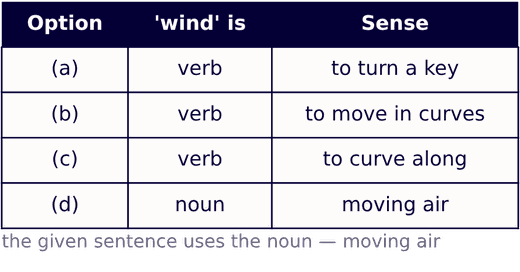 In options (a), (b) and (c) 'wind' is a verb meaning to turn, to coil, or to follow a curving path.
Only 'A strong gust of wind nearly blew off his hat' uses the noun for moving air, the same sense as in the given sentence.
Hence option (d) is correct.
In options (a), (b) and (c) 'wind' is a verb meaning to turn, to coil, or to follow a curving path.
Only 'A strong gust of wind nearly blew off his hat' uses the noun for moving air, the same sense as in the given sentence.
Hence option (d) is correct.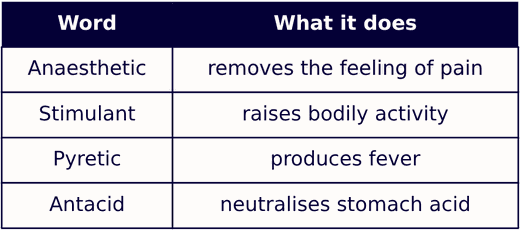 'Anaesthetic' comes from Greek 'an-' (without) + 'aisthesis' (sensation), so it literally means 'without feeling'.
A 'stimulant' raises physiological or nervous activity, a 'pyretic' produces fever, and an 'antacid' neutralises stomach acidity — none of them removes pain.
Hence option (a) is correct.
'Anaesthetic' comes from Greek 'an-' (without) + 'aisthesis' (sensation), so it literally means 'without feeling'.
A 'stimulant' raises physiological or nervous activity, a 'pyretic' produces fever, and an 'antacid' neutralises stomach acidity — none of them removes pain.
Hence option (a) is correct.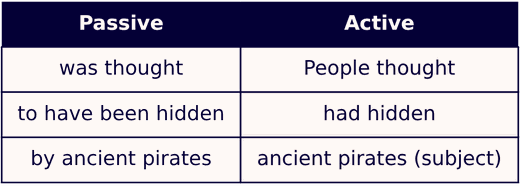 'It was thought…' has no stated doer, so the active version supplies the general subject 'People thought…'.
The inner passive then turns round with the pirates as subject, and the perfect infinitive 'to have been hidden' becomes the past perfect 'had hidden' after the past reporting verb.
Option (d) still says 'were thought', so it remains passive, while (a) and (c) simply hang the passive tag 'it was thought' at the end.
Hence option (b) is correct.
'It was thought…' has no stated doer, so the active version supplies the general subject 'People thought…'.
The inner passive then turns round with the pirates as subject, and the perfect infinitive 'to have been hidden' becomes the past perfect 'had hidden' after the past reporting verb.
Option (d) still says 'were thought', so it remains passive, while (a) and (c) simply hang the passive tag 'it was thought' at the end.
Hence option (b) is correct.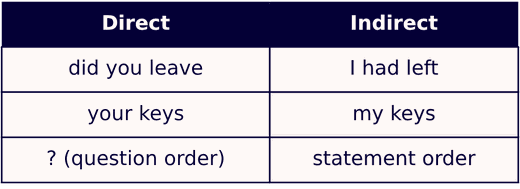 After the past reporting verb 'inquired', the past simple 'did … leave' moves one step back and becomes the past perfect 'had left'.
The pronouns shift to the reporter's point of view, so 'you' becomes 'I' and 'your' becomes 'my'.
Option (c) keeps the interrogative order 'did I leave', while (a) keeps the wrong pronoun and (d) keeps the un-shifted tense.
Hence option (b) is correct.
After the past reporting verb 'inquired', the past simple 'did … leave' moves one step back and becomes the past perfect 'had left'.
The pronouns shift to the reporter's point of view, so 'you' becomes 'I' and 'your' becomes 'my'.
Option (c) keeps the interrogative order 'did I leave', while (a) keeps the wrong pronoun and (d) keeps the un-shifted tense.
Hence option (b) is correct.