SSC CHSL 17 November 2025 · Shift 2 · General Intelligence — questions with answers · ShikshaSphere
Chapter 49 of 200
17 November 2025 · Shift 2
General Intelligence
25 questions ~25 min readFree
25 questions
A
26
A mixture contains acid and water in the ratio of . If the quantity of water in the mixture is 12 liters, what is the total quantity of the mixture ?
A.35 liters
B.40 liters
C.42 liters
D.50 liters
Solution
Ratio and mixture
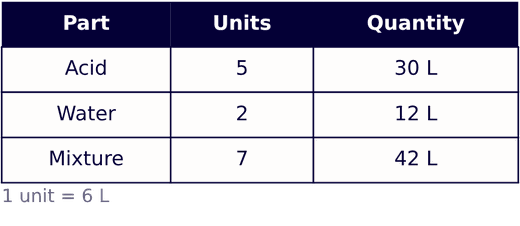
Let acid =5x litres and water =2x litres, so that acid : water =5:2.
Water is given: 2x=12, so x=6 litres per unit of the ratio.
Total mixture litres.
Shortcut: water is of the mixture, so the mixture litres.
Hence, option (c) is the most appropriate answer.
27
Find the next term in the series: C, F, J, O, U, ?
A.A
B.B
C.Z
D.Y
Solution
Letter series
Write the position number of every letter: C = 3, F = 6, J = 10, O = 15, U = 21.
The gaps are 6-3=3, 10-6=4, 15-10=5, 21-15=6 — they increase by 1 each time, so the next gap is +7.
Required position =21+7=28.
The alphabet has only 26 letters, so continue in a cycle: 28-26=2, and the 2nd letter is B.
Hence, option (b) is the most appropriate answer.
28
In a certain code, 'NAPS'' is written as "PANS". How is "TONE" written in that code?
A.ETNO
B.ETON
C.NOET
D.NOTE
Solution
Coding by letter swap
Compare the two words letter by letter: N A P S becomes P A N S.
The 2nd and the 4th letters (A and S) stay where they are, while the 1st and the 3rd letters change places — N and P are simply interchanged.
Apply the same rule to TONE: keep O in place 2 and E in place 4, and swap T (place 1) with N (place 3).
This gives N, O, T, E, that is NOTE.
Hence, option (d) is the most appropriate answer.
29
In a certain code, "JOINED" is written as "DENIOJ". How is "ALLIED" written in that code?
A.DEILLA
B.IEDLLA
C.DIELLA
D.DELILA
Solution
Reverse-order coding
Read the code backwards: D-E-N-I-O-J read from the right is J-O-I-N-E-D, the original word itself.
So no letter is changed at all; the whole word is simply written in reverse order.
ALLIED has the letters A, L, L, I, E, D; reversing them gives D, E, I, L, L, A.
The code is therefore DEILLA — note that the two L's must stay together in the middle, which rules out DELILA.
Hence, option (a) is the most appropriate answer.
30
In a certain code, "STOOL" is written as 'VWRRO". How is "BENCH" written in that code?
A.EHQFK
B.EHQKF
C.EFQKH
D.EHQIK
Solution
Forward letter shift
Compare STOOL with VWRRO letter by letter: S → V, T → W, O → R, O → R, L → O.
Each letter has moved 3 places forward in the alphabet, since 19+3=22 (S → V) and 20+3=23 (T → W).
Apply +3 to BENCH: B → E, E → H, N → Q, C → F, H → K.
The code is EHQFK.
Hence, option (a) is the most appropriate answer.
31
In a certain code, "TRAIN" is written as "VTCKP". How is "PLANE" written in that code?
A.RNCPG
B.RNCPI
C.QMCPI
D.QMDPH
Solution
Forward letter shift
Match TRAIN with VTCKP: T → V, R → T, A → C, I → K, N → P.
Every letter has advanced by 2 places, e.g. 20+2=22 (T → V) and 1+2=3 (A → C).
Apply +2 to PLANE: P → R, L → N, A → C, N → P, E → G.
The code is RNCPG.
Hence, option (a) is the most appropriate answer.
32
What is the value of ?
A.62
B.63
C.57
D.58
Solution
BODMAS simplification
Follow the BODMAS order: brackets first, then division and multiplication, then addition and subtraction.
Bracket: , so the expression becomes .
Multiplication: , giving 60-5+7.
Addition and subtraction are done from left to right: 60-5=55 and 55+7=62.
So .
Hence, option (a) is the most appropriate answer.
33
A shop offers a 20% discount on an item priced at ₹1500. What is the selling price after the discount?
A.₹1300
B.₹1200
C.₹1060
D.₹1100
Solution
Discount and selling price
Formula: Selling price = Marked price .
Substituting: SP .
Arithmetic: .
Check with the discount itself: of , and 1500-300=1200.
So the selling price is ₹1,200.
Hence, option (b) is the most appropriate answer.
34
Pick the correct options from the given alternatives 18 : 324 :: 21:?
A.400
B.484
C.441
D.440
Solution
Number analogy (squares)
Test the given pair for a simple relation: , so the second number is the square of the first.
Logic: (1st number) = (2nd number).
Applying it to 21: .
The other options fail — , and 440 is not a perfect square at all.
Hence, option (c) is the most appropriate answer.
35
Pick the correct options from the given alternatives 14 : 210 :: 23 :?
A.541
B.560
C.570
D.552
Solution
Number analogy (n × (n+1))
Look for the pattern in 14 : 210. Since , the square alone is not enough; try the next consecutive number.
, which matches exactly.
Logic: (1st number) (1st number ) = (2nd number), i.e. n(n+1).
For 23: .
A quick way is .
Hence, option (d) is the most appropriate answer.
36
Find the number of terms in the following series. 20,25,30,35,40,45, 80
A.12
B.13
C.18
D.24
Solution
Number of terms in an AP
The series is an AP with first term a=20, common difference d=25-20=5 and last term l=80.
Formula: number of terms .
Substituting: .
Arithmetic: n=12+1=13.
The '+1' must not be forgotten — it counts the first term 20 itself, which is why 12 is the trap option.
Hence, option (b) is the most appropriate answer.
37
Which of the following are twin prime numbers?
A.
B.
C.
D.
Solution
Twin prime numbers
Twin primes are a pair of prime numbers whose difference is exactly 2, such as (3,5), (11,13) and (41,43).
So two conditions must hold together: both numbers must be prime, and the gap must be 2.
In (17,19) both numbers are prime and 19-17=2, so the condition is satisfied.
Every other pair is prime but too far apart: 11-5=6, 23-17=6 and 37-29=8.
Hence, option (a) is the most appropriate answer.
38
Pick the odd one out from these classifications.
A.Lizard
B.Snake
C.Crocodile
D.Dolphin
Solution
Odd one out (animal class)
Group the four animals by the class they belong to.
Lizard, snake and crocodile are reptiles — cold-blooded, scaly-skinned animals that lay eggs.
The dolphin, although it lives in water, is a mammal: it is warm-blooded, breathes air through lungs, gives birth to live young and feeds them milk.
So the dolphin is the only one outside the reptile group.
Hence, option (d) is the most appropriate answer.
39
Which of the following is the odd one out from the cat family?
A.Lion
B.Tiger
C.Leopard
D.Hyena
Solution
Odd one out (cat family)
The cat family is the biological family Felidae, to which the lion, the tiger and the leopard all belong — all three are big cats of the genus Panthera.
The hyena belongs to a separate family, Hyaenidae; it looks dog-like and is in fact more closely related to mongooses and civets than to cats.
So the hyena is the only animal here that is not a member of the cat family.
Hence, option (d) is the most appropriate answer.
40
Choose the odd one out from these given options.
A.Sphere
B.Cone
C.Cube
D.Painting
Solution
Odd one out (3-D solids)
Classify the four items by the number of dimensions they occupy.
A sphere, a cone and a cube are all three-dimensional solids — each has length, breadth and height, and therefore a volume.
A painting is a two-dimensional work of art on a flat surface; it has only length and breadth and no volume.
So the painting is the one that does not fit the group of solid figures.
Hence, option (d) is the most appropriate answer.
41
Find the next term in the following series.
B3, E6, H12, K24, ?
A.N36
B.N48
C.N42
D.N30
Solution
Alphanumeric series
Split every term into its letter part and its number part and read the two as separate series.
Letters: B (2), E (5), H (8), K (11) — each letter moves 3 places forward, so the next letter is 11+3=14, i.e. N.
Numbers: 3, 6, 12, 24 — each number is double the one before it, so the next number is .
Putting the two parts together, the next term is N48.
Hence, option (b) is the most appropriate answer.
42
Which of the following should be the next term in the given series?
x67, w71, v73, u79, ?
A.v89
B.t83
C.u93
D.v97
Solution
Alphanumeric series
Read the small letter and the number as two independent series.
Letters: x, w, v, u run backwards one step at a time, so the letter after u is t.
Numbers: 67, 71, 73, 79 are not in an arithmetic pattern — they are consecutive prime numbers.
The prime that comes just after 79 is 83 (80, 81, 82 and 84 are all composite).
So the next term is t83.
Hence, option (b) is the most appropriate answer.
43
Find the missing term.
FBFA, HDHA, JFJA, ?, NLNA
A.LAHL
B.LHLA
C.ALLH
D.LKNA
Solution
Letter cluster series
Each cluster has four letters, so compare the four positions one by one.
1st and 3rd letters are always the same and move 2 places forward: F, H, J, L.
The 2nd letter also moves 2 places forward: B, D, F, H; the 4th letter stays A throughout.
Applying these steps to JFJA gives J+2=L, F+2=H, J+2=L and A unchanged, i.e. LHLA.
Hence, option (b) is the most appropriate answer.
44
Which of the following letter will come next to the series?
W, O, I, E, C, ?
A.C
B.B
C.A
D.D
Solution
Letter series
Write the position value of each letter: W = 23, O = 15, I = 9, E = 5, C = 3.
The gaps are 23-15=8, 15-9=6, 9-5=4, 5-3=2 — every gap is 2 less than the one before it.
So the next gap must be 2-2=0; the letter therefore does not move at all: 3-0=3, which is C.
Hence, option (a) is the most appropriate answer.
45
Which letter cluster will come next to the series?
XA, UD, QG, LJ, ?
A.FM
B.FO
C.FQ
D.FS
Solution
Letter cluster series
Take the two letters of a cluster as two separate series.
First letters: X (24), U (21), Q (17), L (12) — the falls are -3, -4, -5, so they grow by one each time.
The next fall is -6, giving 12-6=6, i.e. F.
Second letters: A (1), D (4), G (7), J (10) — a steady +3, so the next is 10+3=13, i.e. M.
The required cluster is therefore FM.
Hence, option (a) is the most appropriate answer.
46
Find the next term in the letter cluster sequence.
WAXE, VBVG, UCTI, ?
A.TDRK
B.EWJU
C.EWJT
D.TSEK
Solution
Letter cluster series
Compare each cluster with the next one, position by position.
1st letter: W, V, U — a step of -1; 2nd letter: A, B, C — a step of +1.
3rd letter: X, V, T — a step of -2; 4th letter: E, G, I — a step of +2.
Applying the same four steps to UCTI gives U-1=T, C+1=D, T-2=R, I+2=K, i.e. TDRK.
Hence, option (a) is the most appropriate answer.
47
If + means x, x means z, - means +, then evaluate: ?
A.50
B.52
C.40
D.56
Solution
Substitution of signs
Replace every sign written in the expression by the operation it actually stands for.
So has to be read as .
Now apply BODMAS — multiplication first: .
Value =48-4+6=50.
Hence, option (a) is the most appropriate answer.
48
Which of the following terms follows the trend of the given list?
ACBABABAB, ABCABABAB, ABACBABAB, ABABCABAB, ABABACBAB, ?
A.ABABABCAB
B.ABABABACB
C.ABABABABAC
D.ABABABABCA
Solution
Letter pattern series
Every term is nine letters long, and each one carries exactly one C.
Delete that C from any term and the very same eight-letter string ABABABAB is left behind.
So the only thing that changes from term to term is the place where the C is pushed in: 2nd, 3rd, 4th, 5th, 6th place.
In the next term the C must stand in the 7th place: ABABAB + C + AB = ABABABCAB.
Options (c) and (d) are ten letters long, and (b) puts the C in the 8th place, so only (a) keeps the trend.
Hence, option (a) is the most appropriate answer.
49
Which letter cluster will complete the given series?
EJKT, FIMR, GHOP, IFSL, JEUJ
A.KJQT
B.KHQT
C.KJRU
D.HGQN
Solution
Letter cluster series
Every cluster has four letters, so four separate series run side by side.
1st letter: E, F, G, … moves +1; 2nd letter: J, I, H, … moves -1.
3rd letter: K, M, O, … moves +2; 4th letter: T, R, P, … moves -2.
The missing fourth cluster is therefore G+1=H, H-1=G, O+2=Q, P-2=N, i.e. HGQN.
The check works: one more step gives I, F, S, L and then J, E, U, J, exactly the last two terms printed.
Hence, option (d) is the most appropriate answer.
50
A series is given with one term missing. Select the correct alternative from the given ones that will complete the series.
JFT, NEY, RDD, VCI, ?
A.ZBJ
B.BYN
C.ZBN
D.BNC
Solution
Letter cluster series
Treat the three letters of a cluster as three independent series.
1st letter: J (10), N (14), R (18), V (22) — a jump of +4, so the next is 22+4=26, i.e. Z.
2nd letter: F, E, D, C — a step of -1, so the next is B.
3rd letter: T (20), Y (25), D (4), I (9) — a jump of +5 counted round the alphabet, so the next is 9+5=14, i.e. N.
The missing term is therefore ZBN.
Hence, option (c) is the most appropriate answer.
Finished reading? Now test yourself.
The same 25 questions, but with a timer and the answers hidden — 15 minutes.

 Shortcut: water is of the mixture, so the mixture litres.
Hence, option (c) is the most appropriate answer.
Shortcut: water is of the mixture, so the mixture litres.
Hence, option (c) is the most appropriate answer.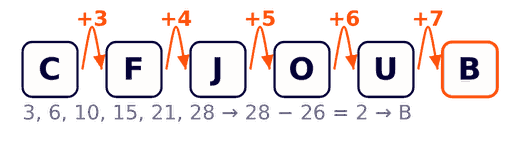 Required position =21+7=28.
The alphabet has only 26 letters, so continue in a cycle: 28-26=2, and the 2nd letter is B.
Hence, option (b) is the most appropriate answer.
Required position =21+7=28.
The alphabet has only 26 letters, so continue in a cycle: 28-26=2, and the 2nd letter is B.
Hence, option (b) is the most appropriate answer.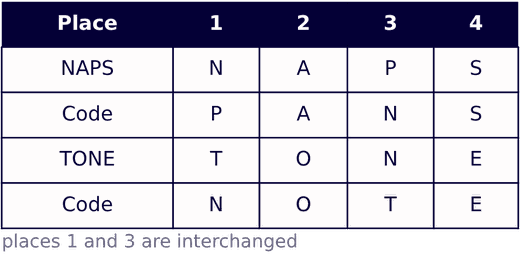 Apply the same rule to TONE: keep O in place 2 and E in place 4, and swap T (place 1) with N (place 3).
This gives N, O, T, E, that is NOTE.
Hence, option (d) is the most appropriate answer.
Apply the same rule to TONE: keep O in place 2 and E in place 4, and swap T (place 1) with N (place 3).
This gives N, O, T, E, that is NOTE.
Hence, option (d) is the most appropriate answer.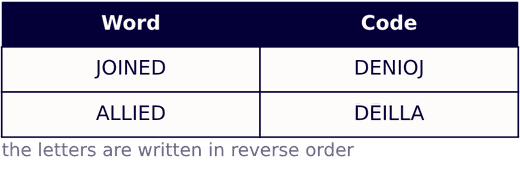 ALLIED has the letters A, L, L, I, E, D; reversing them gives D, E, I, L, L, A.
The code is therefore DEILLA — note that the two L's must stay together in the middle, which rules out DELILA.
Hence, option (a) is the most appropriate answer.
ALLIED has the letters A, L, L, I, E, D; reversing them gives D, E, I, L, L, A.
The code is therefore DEILLA — note that the two L's must stay together in the middle, which rules out DELILA.
Hence, option (a) is the most appropriate answer.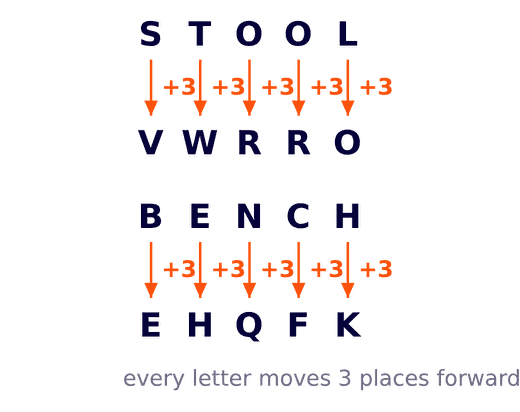 Apply +3 to BENCH: B → E, E → H, N → Q, C → F, H → K.
The code is EHQFK.
Hence, option (a) is the most appropriate answer.
Apply +3 to BENCH: B → E, E → H, N → Q, C → F, H → K.
The code is EHQFK.
Hence, option (a) is the most appropriate answer.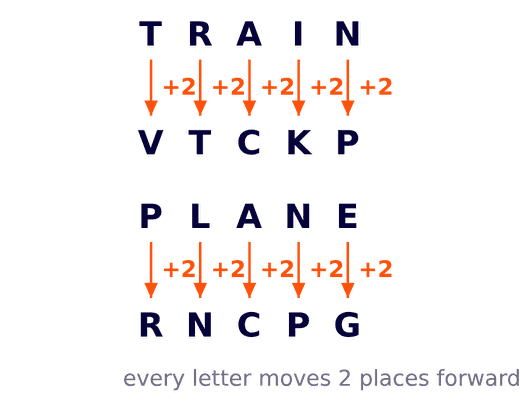 Apply +2 to PLANE: P → R, L → N, A → C, N → P, E → G.
The code is RNCPG.
Hence, option (a) is the most appropriate answer.
Apply +2 to PLANE: P → R, L → N, A → C, N → P, E → G.
The code is RNCPG.
Hence, option (a) is the most appropriate answer.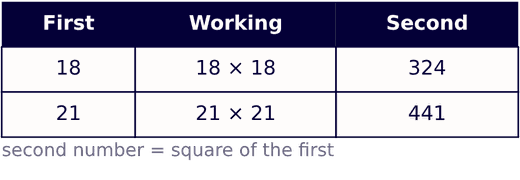 Applying it to 21: .
The other options fail — , and 440 is not a perfect square at all.
Hence, option (c) is the most appropriate answer.
Applying it to 21: .
The other options fail — , and 440 is not a perfect square at all.
Hence, option (c) is the most appropriate answer.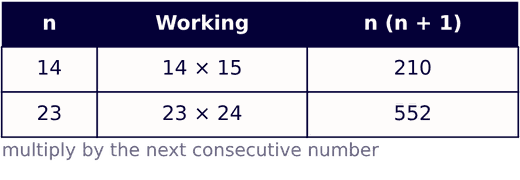 For 23: .
A quick way is .
Hence, option (d) is the most appropriate answer.
For 23: .
A quick way is .
Hence, option (d) is the most appropriate answer.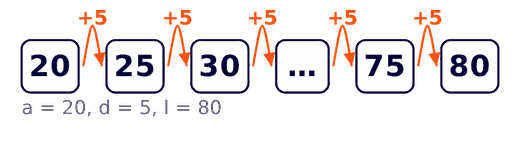 Formula: number of terms .
Substituting: .
Arithmetic: n=12+1=13.
The '+1' must not be forgotten — it counts the first term 20 itself, which is why 12 is the trap option.
Hence, option (b) is the most appropriate answer.
Formula: number of terms .
Substituting: .
Arithmetic: n=12+1=13.
The '+1' must not be forgotten — it counts the first term 20 itself, which is why 12 is the trap option.
Hence, option (b) is the most appropriate answer.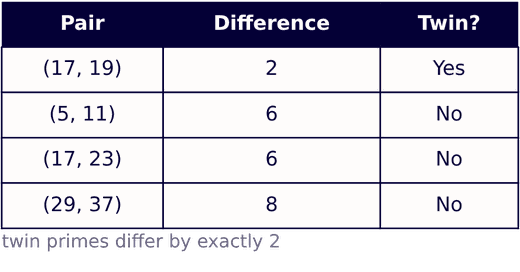 In (17,19) both numbers are prime and 19-17=2, so the condition is satisfied.
Every other pair is prime but too far apart: 11-5=6, 23-17=6 and 37-29=8.
Hence, option (a) is the most appropriate answer.
In (17,19) both numbers are prime and 19-17=2, so the condition is satisfied.
Every other pair is prime but too far apart: 11-5=6, 23-17=6 and 37-29=8.
Hence, option (a) is the most appropriate answer.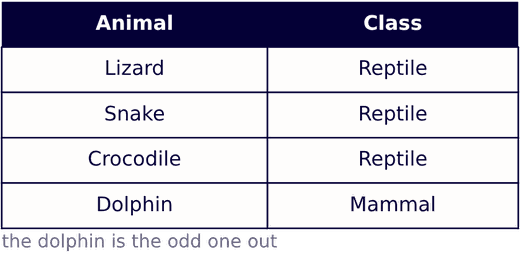 The dolphin, although it lives in water, is a mammal: it is warm-blooded, breathes air through lungs, gives birth to live young and feeds them milk.
So the dolphin is the only one outside the reptile group.
Hence, option (d) is the most appropriate answer.
The dolphin, although it lives in water, is a mammal: it is warm-blooded, breathes air through lungs, gives birth to live young and feeds them milk.
So the dolphin is the only one outside the reptile group.
Hence, option (d) is the most appropriate answer.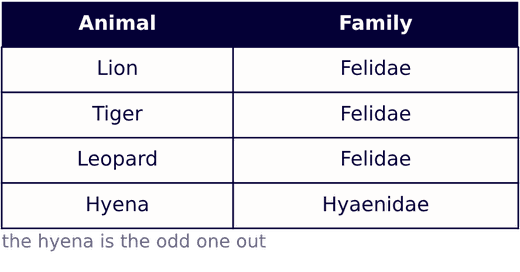 The hyena belongs to a separate family, Hyaenidae; it looks dog-like and is in fact more closely related to mongooses and civets than to cats.
So the hyena is the only animal here that is not a member of the cat family.
Hence, option (d) is the most appropriate answer.
The hyena belongs to a separate family, Hyaenidae; it looks dog-like and is in fact more closely related to mongooses and civets than to cats.
So the hyena is the only animal here that is not a member of the cat family.
Hence, option (d) is the most appropriate answer.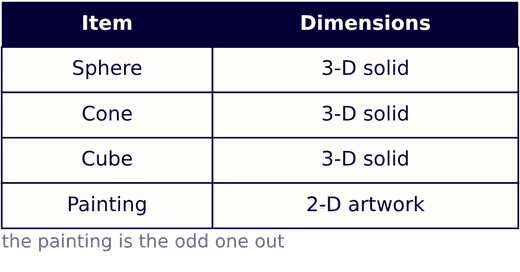 A painting is a two-dimensional work of art on a flat surface; it has only length and breadth and no volume.
So the painting is the one that does not fit the group of solid figures.
Hence, option (d) is the most appropriate answer.
A painting is a two-dimensional work of art on a flat surface; it has only length and breadth and no volume.
So the painting is the one that does not fit the group of solid figures.
Hence, option (d) is the most appropriate answer.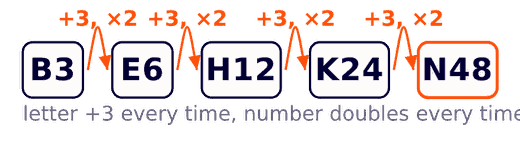 Putting the two parts together, the next term is N48.
Hence, option (b) is the most appropriate answer.
Putting the two parts together, the next term is N48.
Hence, option (b) is the most appropriate answer.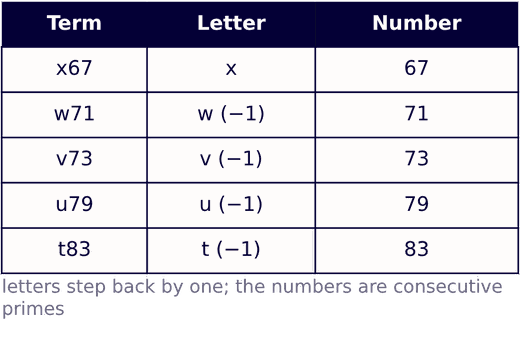 So the next term is t83.
Hence, option (b) is the most appropriate answer.
So the next term is t83.
Hence, option (b) is the most appropriate answer.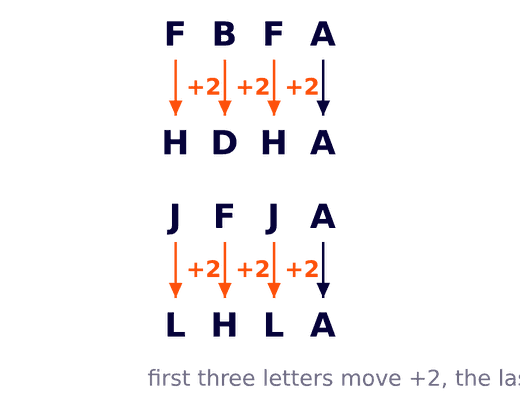 Applying these steps to JFJA gives J+2=L, F+2=H, J+2=L and A unchanged, i.e. LHLA.
Hence, option (b) is the most appropriate answer.
Applying these steps to JFJA gives J+2=L, F+2=H, J+2=L and A unchanged, i.e. LHLA.
Hence, option (b) is the most appropriate answer.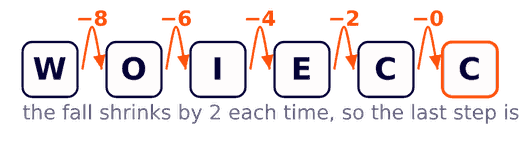 So the next gap must be 2-2=0; the letter therefore does not move at all: 3-0=3, which is C.
Hence, option (a) is the most appropriate answer.
So the next gap must be 2-2=0; the letter therefore does not move at all: 3-0=3, which is C.
Hence, option (a) is the most appropriate answer.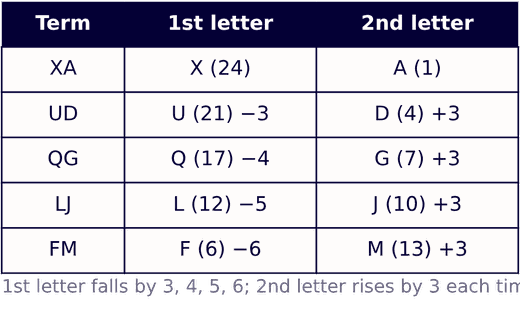 The required cluster is therefore FM.
Hence, option (a) is the most appropriate answer.
The required cluster is therefore FM.
Hence, option (a) is the most appropriate answer.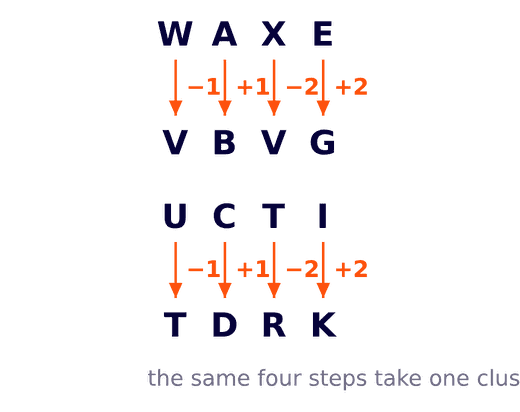 Applying the same four steps to UCTI gives U-1=T, C+1=D, T-2=R, I+2=K, i.e. TDRK.
Hence, option (a) is the most appropriate answer.
Applying the same four steps to UCTI gives U-1=T, C+1=D, T-2=R, I+2=K, i.e. TDRK.
Hence, option (a) is the most appropriate answer.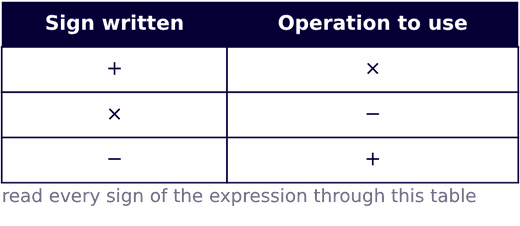 So has to be read as .
Now apply BODMAS — multiplication first: .
Value =48-4+6=50.
Hence, option (a) is the most appropriate answer.
So has to be read as .
Now apply BODMAS — multiplication first: .
Value =48-4+6=50.
Hence, option (a) is the most appropriate answer.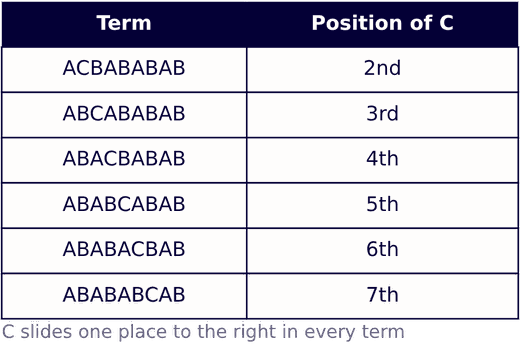 In the next term the C must stand in the 7th place: ABABAB + C + AB = ABABABCAB.
Options (c) and (d) are ten letters long, and (b) puts the C in the 8th place, so only (a) keeps the trend.
Hence, option (a) is the most appropriate answer.
In the next term the C must stand in the 7th place: ABABAB + C + AB = ABABABCAB.
Options (c) and (d) are ten letters long, and (b) puts the C in the 8th place, so only (a) keeps the trend.
Hence, option (a) is the most appropriate answer.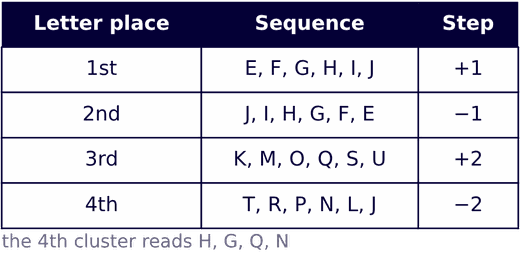 The missing fourth cluster is therefore G+1=H, H-1=G, O+2=Q, P-2=N, i.e. HGQN.
The check works: one more step gives I, F, S, L and then J, E, U, J, exactly the last two terms printed.
Hence, option (d) is the most appropriate answer.
The missing fourth cluster is therefore G+1=H, H-1=G, O+2=Q, P-2=N, i.e. HGQN.
The check works: one more step gives I, F, S, L and then J, E, U, J, exactly the last two terms printed.
Hence, option (d) is the most appropriate answer.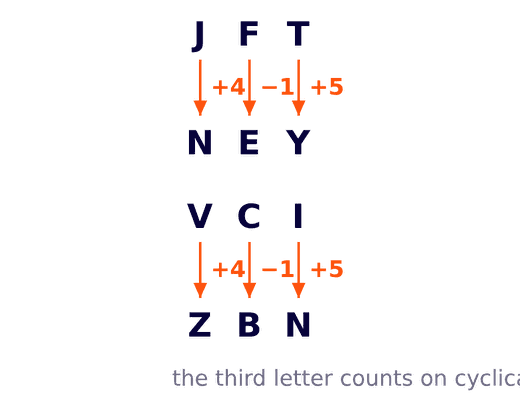 The missing term is therefore ZBN.
Hence, option (c) is the most appropriate answer.
The missing term is therefore ZBN.
Hence, option (c) is the most appropriate answer.