SSC CHSL 17 November 2025 · Shift 2 · Quantitative Aptitude — questions with answers · ShikshaSphere
Chapter 51 of 200
17 November 2025 · Shift 2
Quantitative Aptitude
25 questions ~25 min readFree
25 questions
A
51
A trader sells two articles at ₹840 each. On one, he gains 25%, and on the other, he loses 25%. What is his overall profit or loss percentage?
A. Profit
B. Loss
C.5% Profit
D.5% Loss
Solution
Overall loss percentage
The two selling prices are equal, but the two cost prices are not, so find each cost price first.
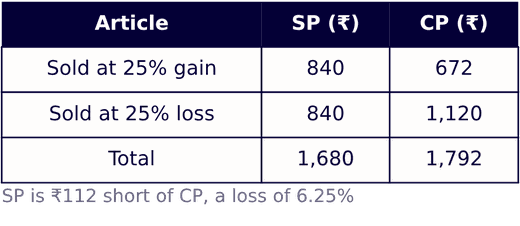
Gain of : CP .
Loss of : CP .
Total CP =672+1120=1792, total SP , so there is a loss of 1792-1680=112.
Loss .
Shortcut worth remembering: equal selling prices with the same gain and loss of always end in a loss of .
Hence, option (b) is the most appropriate answer.
52
A chair has a marked price of Rs. 750. Shikha pays Rs. 450 for it because she got 2 successive discounts, one of 25% and the other of:
A.25%
B.15%
C.12.5%
D.20%
Solution
Successive discounts
In successive discounts the second discount is worked out on the price left after the first one, never on the marked price.
Price after the first discount .
This ₹562.50 falls to ₹450, so the second reduction is 562.5-450=112.5.
Second discount .
Hence, option (d) is the most appropriate answer.
53
A seller marks his goods 30% above their cost price but allows a 12% discount for cash payment. His percentage of profit when sold in cash is:
A.19.12%
B.12.25%
C.
D.15.5%
Solution
Discount and profit
No amount is given, so take the cost price as ₹100 — percentages will not change.
Marked price of 100=130.
Discount of on the marked price leaves SP .
Profit =114.4-100=14.4 on a cost of 100, so profit .
The same result comes from the successive-change formula: .
Hence, option (c) is the most appropriate answer.
54
A company had 5 departments with an average of 50 employees each. Later, a sixth department was added with 80 employees. Due to restructuring, 20 employees from each of the original five departments were transferred to the new department. What is the new average number of employees per department?
A.54
B.50
C.55
D.57
Solution
Average of groups
Total of the five old departments employees.
The sixth department adds 80 more, so the company now has 250+80=330 employees.
The transfer of employees only moves people from one department to another — the company total stays 330.
New average employees per department.
Hence, option (c) is the most appropriate answer.
55
A savings scheme offers compound interest annually. A man deposits ₹ 20,000 . At the end of the first year, the interest rate is 20%. In the second year, due to inflation, the interest rate rises to 25%, and in the third year, it drops to 10 %. Calculate the total interest he earned at the end of 3 years.
A.₹14,000
B.₹13,000
C.₹15,000
D.₹11,000
Solution
Compound interest, varying rate
When the rate changes every year, multiply the principal by one growth factor for each year.
Formula: Amount .
After year 1: .
After year 2: .
After year 3: .
Total interest =33000-20000=13000, i.e. ₹13,000.
Hence, option (b) is the most appropriate answer.
56
What is the square of 119 ?
A.15161
B.14161
C.16641
D.15861
Solution
Square of a number
Bring the number close to a round figure and use with a=120, b=1.
.
=14400-240+1=14161.
Check: must be a little less than , and 14161 is the only option that fits.
Hence, option (b) is the most appropriate answer.
57
A perfect square between 40 and 60 is:
A.51
B.64
C.49
D.59
Solution
Perfect squares
A perfect square is the square of a whole number, so list the squares lying near the given range.
(below 40), (between 40 and 60), (above 60).
So 49 is the only perfect square between 40 and 60; 51 and 59 are not squares at all and 64 lies outside the range.
Hence, option (c) is the most appropriate answer.
58
P and Q started a business with investments of ₹2000 and ₹3000, respectively. After 6 months, P added ₹2000 and Q added ₹ . If the profit ratio is 12 : 19, find .
A.₹1900
B.₹1200
C.₹3500
D.₹1500
Solution
Partnership with added capital
Profits are shared in the ratio of capital time, so add up each partner's month-wise capital over the 12 months.
P: .
Q: .
Therefore .
Cross-multiplying: , i.e. 684000=432000+72y.
72y=252000, so y=3500.
Hence, option (c) is the most appropriate answer.
59
P started a business with ₹20,000. Q joined after 4 months with ₹30,000. At the end of the year, the total profit was ₹70,000. What is the share of ?
A.₹25000
B.₹32000
C.₹35000
D.₹29000
Solution
Partnership profit share
Profit is divided in the ratio of capital number of months for which it worked.
P kept ₹20,000 for the whole year: .
Q joined 4 months late, so his money worked for only 8 months: .
Ratio of shares =240000:240000=1:1.
P's share , i.e. ₹35,000.
Hence, option (c) is the most appropriate answer.
60
P, Q, and R start a business. P invests ₹3000 for 6 months, Q ₹2000 for 12 months, and R ₹4000 for 9 months. If the total profit is ₹390000, find P's profit share.
A.₹50000
B.₹90000
C.₹60000
D.₹70000
Solution
Partnership profit share
Each partner's share is proportional to capital time.
P: ; Q: ; R: .
Ratio =18000:24000:36000=3:4:6, which makes 3+4+6=13 equal parts.
P's share , i.e. ₹90,000.
Hence, option (b) is the most appropriate answer.
61
A circular iron plate of radius 20 cm is heated, and its radius increases by . What is the approximate percentage increase in its area?
A.2.8%
B.
C.
D.3.5%
Solution
Percentage change in area
The area of a circle is , so the area depends on the square of the radius; the actual value 20 cm is not needed.
New radius .
New area .
Increase .
Shortcut: if the radius rises by , the area rises by .
Hence, option (c) is the most appropriate answer.
62
If and , then find the value of .
A.421
B.363
C.481
D.327
Solution
Algebraic identities
Square the first equation: .
Put in it: 25+2xy=49, so 2xy=24 and xy=12.
Use the identity , since .
Substituting: .
Hence, option (c) is the most appropriate answer.
63
If and , then find the value of .
A.145
B.107
C.179
D.144
Solution
Square identities
The two squares differ only in the middle term: .
From 24ab=48 we get ab=2, so .
Therefore .
Required value .
Hence, option (a) is the most appropriate answer.
64
If , then the value of is:
A.
B.
C.
D.
Solution
Trigonometric identities
Identity: , i.e. .
Given , so .
Adding the two: , so .
Subtracting them: , so .
Product .
Hence, option (d) is the most appropriate answer.
65
If and
, then what is the value of ?
A.1160
B.1020
C.1175
D.1014
Solution
Trigonometric identities
Square the first: .
Square the second: .
Add them; the terms cancel: .
Since , .
So .
Note the pattern: for and , always .
Hence, option (d) is the most appropriate answer.
66
Ramesh pulls a rope tied to a flagpole at ground level. The rope is 30 meters long and makes an angle of 30° with the ground. How high up the flagpole is the point where the rope is tied? Also, find the horizontal distance between the Ramesh and the base of the flagpole.
A.9 meters and 15 meters
B.11 meters and 26 meters
C.15 meters and 26 meters
D.12 meters and 29 meters
Solution
Heights and distances
The rope, the flagpole and the ground form a right triangle: the rope is the hypotenuse (30 m) and the angle at Ramesh is .
Height of the tie point metres.
Horizontal distance .
metres.
So the rope is tied 15 m up the pole and Ramesh stands about 26 m from its base.
Hence, option (c) is the most appropriate answer.
67
An amount of Rs. ' ' is invested in two different schemes-one offers simple interest at p.a. for 5 years, and the other offers compound interest at p.a. compounded annually for 2 years. If the total amount from the simple interest scheme exceeds the compound interest scheme by Rs. 88, then find the value of Y.
A.Rs. 900
B.Rs. 800
C.Rs. 720
D.Rs. 630
Solution
Simple and compound interest
Simple interest for 5 years at is of the sum, so that amount of Y=1.55Y.
Compound interest at for 2 years multiplies the sum by , so that amount =1.44Y.
The simple-interest amount exceeds the compound-interest amount by 1.55Y-1.44Y=0.11Y.
.
Check: and , and 1240-1152=88.
Hence, option (b) is the most appropriate answer.
68
A sum of Rs. 5,000 is invested in a scheme offering compound interest for 2 years. Find the value of ' ' if the difference in the simple interest and compound interest for the same amount at the same rate of interest after 2 years is Rs. 800.
A.30%
B.36%
C.40%
D.24%
Solution
CI and SI difference
For 2 years the whole gap between compound and simple interest is just the interest earned on the first year's interest.
Formula: .
.
, so and x=40.
Check: CI and SI ; the difference is ₹800.
Hence, option (c) is the most appropriate answer.
69
Neeraj invested Rs. 'y' in a scheme offering 11% compound interest for three years. Nikhil invested Rs. 20,000 in a scheme offering simple interest for two years. Find the interest earned by Neeraj if the interest earned by Nikhil is Rs. '3y-700'.
A.Rs. 1,008
B.Rs. 1,078
C.Rs. 1,012
D.Rs. 1,066
Solution
Interest and equations
Nikhil's interest is simple: , i.e. ₹8,000.
This is given as 3y-700, so .
So Neeraj invested ₹2,900 at compound interest for 3 years.
Growth factor , so the effective interest for 3 years is .
Interest .
Hence, option (d) is the most appropriate answer.
70
The sum of three numbers is 169 . If the numbers are in a ratio of 3 : 6 : 4, find the largest number.
A.76
B.78
C.56
D.48
Solution
Ratio and division
Let the numbers be 3x, 6x and 4x.
Their sum: 3x+6x+4x=13x=169.
.
The largest ratio term is 6, so the largest number .
Hence, option (b) is the most appropriate answer.
71
Box , contains coffee worth Rs. 400 per kg and in box Y contains coffee worth Rs. 500 per kg. If both box and are mixed in the ratio 3 : 7 then the price of the mixture per kg is approximately:
A.410/-
B.450/-
C.470/-
D.340/-
Solution
Mixture and alligation
Take the ratio as actual quantities: 3 kg from box X and 7 kg from box Y, a total of 10 kg.
Total cost .
Price per kg of the mixture .
By alligation the mean lies nearer the costlier coffee, because more of it (7 parts) is used.
Hence, option (c) is the most appropriate answer.
72
A recipe for a juice calls for 3 cups of sugar and 4 cups of water. With this recipe, juice was made using 16 cups of water. How many cups of sugar were required?
A.9 cups
B.6 cups
C.12 cups
D.18 cups
Solution
Proportion in recipes
The recipe fixes sugar : water =3:4, whatever quantity of juice is made.
Water used is 16 cups, and water is 4 parts, so 1 part cups.
Sugar is 3 parts cups.
In proportion form: .
Hence, option (c) is the most appropriate answer.
73
Train A can cross a pole in 10 seconds, while train B takes 10 seconds to cross train when they travel in opposite directions on parallel tracks. If the ratio of the length of train to train is 4 : 3 and the speed of train A is 72 , then find the speed of train B.
A.
B.15 m/s
C.
D.14 m/s
Solution
Trains crossing each other
Speed of train A =72 km/h m/s.
Crossing a pole means covering only its own length: length of A m.
Lengths are in the ratio 4:3, so length of B m.
In opposite directions the relative speed is the sum of the speeds, and the trains together cover 200+150=350 m in 10 seconds.
, so v=35-20=15 m/s.
Hence, option (b) is the most appropriate answer.
74
A thief is 1,000 metres ahead of a policeman when the policeman starts a chase by running at . If the thief is running at , then find the time taken by the policeman to catch the thief.
A.105 seconds
B.140 seconds
C.125 seconds
D.110 seconds
Solution
Relative speed and chase
Both run in the same direction, so the gap closes at the relative speed =32-24=8 m/s.
The gap to be closed is 1,000 m.
Time seconds.
Hence, option (c) is the most appropriate answer.
75
An item undergoes two successive discounts: 10% and then 12.5%. After those discounts, a tax of 12% is applied on the reduced price, and the final amount the customer pays is ₹748. What was the original price of the item? (Give exact value and a rounded amount to two decimal places)
A.Rs. 800
B.Rs. 750
C.Rs. 650
D.Rs. 848
Solution
Successive discount and tax
Let the original price be P.
After a 10% discount the price is 0.9P; after a further 12.5% discount it is .
Adding 12% tax multiplies it by 1.12: .
(to two decimal places).
Rounded to the nearest rupee the original price is ₹848.
Hence, option (d) is the most appropriate answer.
Finished reading? Now test yourself.
The same 25 questions, but with a timer and the answers hidden — 15 minutes.

 Total CP =672+1120=1792, total SP , so there is a loss of 1792-1680=112.
Loss .
Shortcut worth remembering: equal selling prices with the same gain and loss of always end in a loss of .
Hence, option (b) is the most appropriate answer.
Total CP =672+1120=1792, total SP , so there is a loss of 1792-1680=112.
Loss .
Shortcut worth remembering: equal selling prices with the same gain and loss of always end in a loss of .
Hence, option (b) is the most appropriate answer.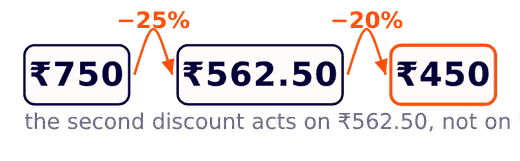 This ₹562.50 falls to ₹450, so the second reduction is 562.5-450=112.5.
Second discount .
Hence, option (d) is the most appropriate answer.
This ₹562.50 falls to ₹450, so the second reduction is 562.5-450=112.5.
Second discount .
Hence, option (d) is the most appropriate answer.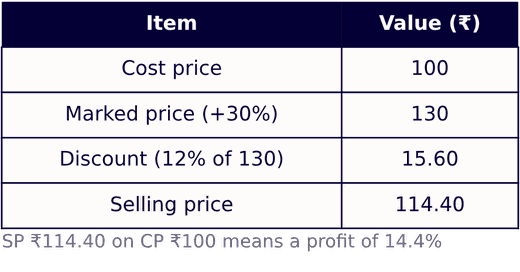 Profit =114.4-100=14.4 on a cost of 100, so profit .
The same result comes from the successive-change formula: .
Hence, option (c) is the most appropriate answer.
Profit =114.4-100=14.4 on a cost of 100, so profit .
The same result comes from the successive-change formula: .
Hence, option (c) is the most appropriate answer.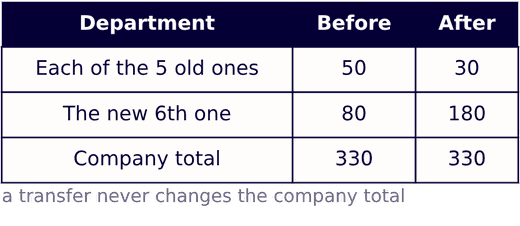 New average employees per department.
Hence, option (c) is the most appropriate answer.
New average employees per department.
Hence, option (c) is the most appropriate answer. Total interest =33000-20000=13000, i.e. ₹13,000.
Hence, option (b) is the most appropriate answer.
Total interest =33000-20000=13000, i.e. ₹13,000.
Hence, option (b) is the most appropriate answer.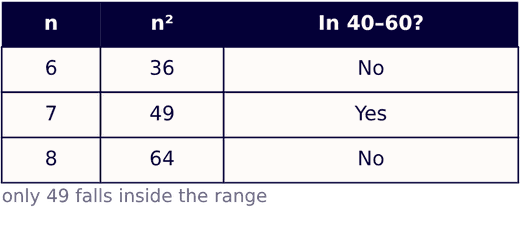 So 49 is the only perfect square between 40 and 60; 51 and 59 are not squares at all and 64 lies outside the range.
Hence, option (c) is the most appropriate answer.
So 49 is the only perfect square between 40 and 60; 51 and 59 are not squares at all and 64 lies outside the range.
Hence, option (c) is the most appropriate answer.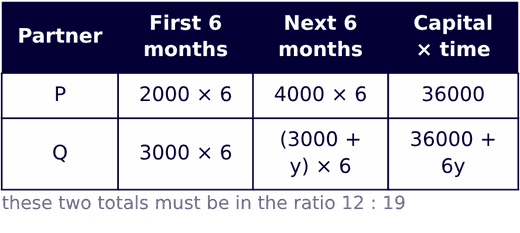 Therefore .
Cross-multiplying: , i.e. 684000=432000+72y.
72y=252000, so y=3500.
Hence, option (c) is the most appropriate answer.
Therefore .
Cross-multiplying: , i.e. 684000=432000+72y.
72y=252000, so y=3500.
Hence, option (c) is the most appropriate answer.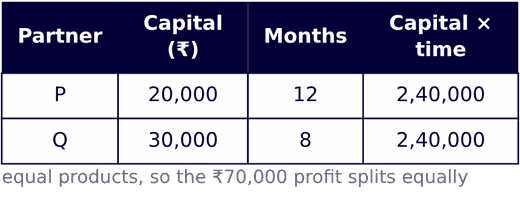 Ratio of shares =240000:240000=1:1.
P's share , i.e. ₹35,000.
Hence, option (c) is the most appropriate answer.
Ratio of shares =240000:240000=1:1.
P's share , i.e. ₹35,000.
Hence, option (c) is the most appropriate answer.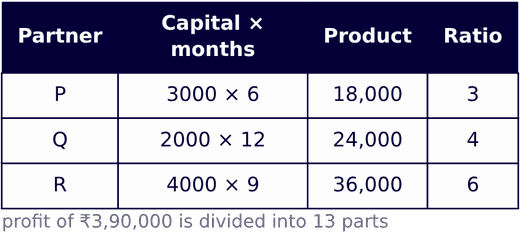 Ratio =18000:24000:36000=3:4:6, which makes 3+4+6=13 equal parts.
P's share , i.e. ₹90,000.
Hence, option (b) is the most appropriate answer.
Ratio =18000:24000:36000=3:4:6, which makes 3+4+6=13 equal parts.
P's share , i.e. ₹90,000.
Hence, option (b) is the most appropriate answer.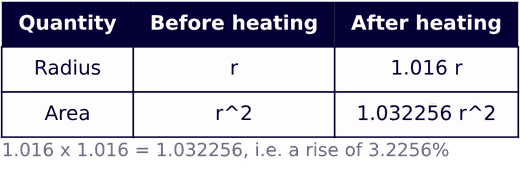 Increase .
Shortcut: if the radius rises by , the area rises by .
Hence, option (c) is the most appropriate answer.
Increase .
Shortcut: if the radius rises by , the area rises by .
Hence, option (c) is the most appropriate answer.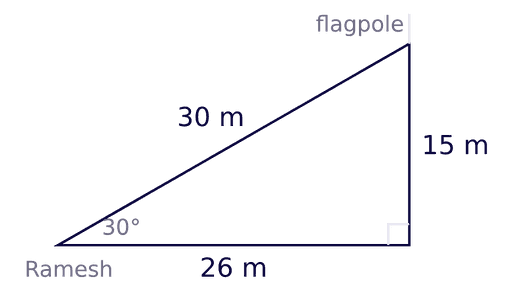 Height of the tie point metres.
Horizontal distance .
metres.
So the rope is tied 15 m up the pole and Ramesh stands about 26 m from its base.
Hence, option (c) is the most appropriate answer.
Height of the tie point metres.
Horizontal distance .
metres.
So the rope is tied 15 m up the pole and Ramesh stands about 26 m from its base.
Hence, option (c) is the most appropriate answer.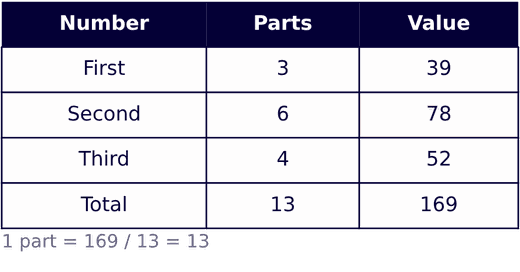 The largest ratio term is 6, so the largest number .
Hence, option (b) is the most appropriate answer.
The largest ratio term is 6, so the largest number .
Hence, option (b) is the most appropriate answer.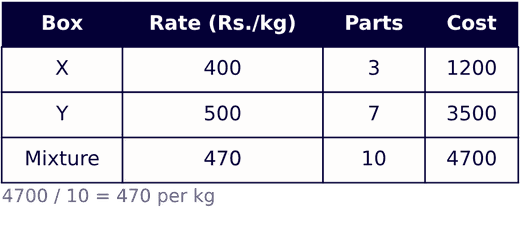 By alligation the mean lies nearer the costlier coffee, because more of it (7 parts) is used.
Hence, option (c) is the most appropriate answer.
By alligation the mean lies nearer the costlier coffee, because more of it (7 parts) is used.
Hence, option (c) is the most appropriate answer.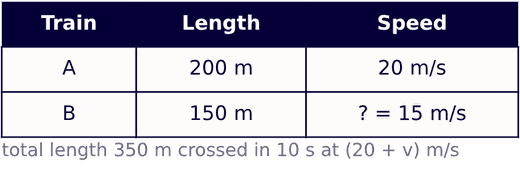 In opposite directions the relative speed is the sum of the speeds, and the trains together cover 200+150=350 m in 10 seconds.
, so v=35-20=15 m/s.
Hence, option (b) is the most appropriate answer.
In opposite directions the relative speed is the sum of the speeds, and the trains together cover 200+150=350 m in 10 seconds.
, so v=35-20=15 m/s.
Hence, option (b) is the most appropriate answer.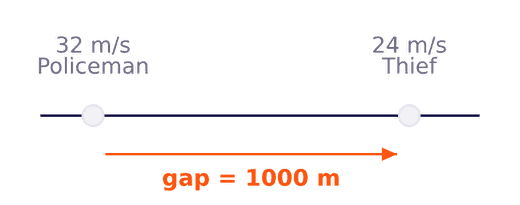 Both run in the same direction, so the gap closes at the relative speed =32-24=8 m/s.
The gap to be closed is 1,000 m.
Time seconds.
Hence, option (c) is the most appropriate answer.
Both run in the same direction, so the gap closes at the relative speed =32-24=8 m/s.
The gap to be closed is 1,000 m.
Time seconds.
Hence, option (c) is the most appropriate answer.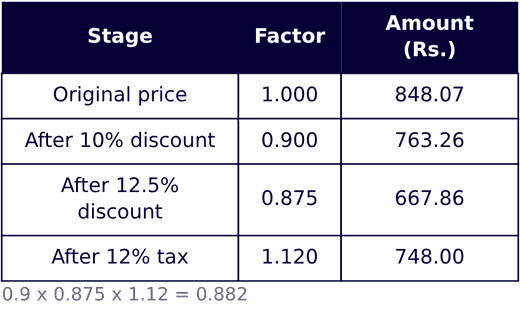 Rounded to the nearest rupee the original price is ₹848.
Hence, option (d) is the most appropriate answer.
Rounded to the nearest rupee the original price is ₹848.
Hence, option (d) is the most appropriate answer.