SSC CHSL 17 November 2025 · Shift 2 · English Language — questions with answers · ShikshaSphere
Chapter 52 of 200
17 November 2025 · Shift 2
English Language
25 questions ~25 min readFree
25 questions
A
1
Identify the part of the sentence that contains a grammatical error.
A. It is essential that she
B. prepares for the upcoming interview
C. and that she makes
D. a prompt, professional, and polite entrance at the venue.
A.It is essential that she
B.prepares for the upcoming interview
C.and that she makes
D.a prompt, professional, and polite entrance at the venue.
Solution
Subjunctive after 'essential'
The error lies in part B — 'prepares' cannot stand after 'It is essential that'.
Rule: expressions of necessity such as 'It is essential / important / necessary / imperative that' are followed by the subjunctive, i.e. the bare base form of the verb, whatever the subject may be.
So the clause must read 'It is essential that she prepare for the upcoming interview'; the -s of the third person singular is dropped.
Verbs like 'suggest', 'demand', 'insist' and 'recommend' trigger the very same pattern, which is why the tempting-looking 'prepares' is wrong.
Hence, option (b) is the most appropriate answer.
2
Identify the part of the sentence that contains a grammatical error.
A. The tall player
B. proves to be
C. a good shooter
D. and more stronger than the rest.
A.The tall player
B.proves to be
C.a good shooter
D.and more stronger than the rest
Solution
Double comparative
The error lies in part D — 'and more stronger than the rest'.
Rule: a short one-syllable adjective forms its comparative by adding -er, so 'strong' becomes 'stronger'; 'more' is used only with longer adjectives such as 'more careful'.
Putting 'more' before a form that is already comparative creates a double comparative, which English does not allow.
The correct part is therefore 'and stronger than the rest'; parts A, B and C are grammatically sound.
Hence, option (d) is the most appropriate answer.
3
Fill in the blank with the most appropriate preposition:
He fought the changes and trends, holding his ground firm.
A.against
B.across
C.through
D.despite
Solution
Preposition with 'fight'
'Fight' takes the preposition 'against' when it means to oppose or resist something.
The clause 'holding his ground firm' shows that the man refused to yield, so the blank needs the sense of opposition: 'He fought against the changes and trends.'
'Across' and 'through' describe movement over or inside something, and 'despite' is a preposition of concession which cannot follow 'fought' in this structure.
Hence, option (a) is the most appropriate answer.
4
Fill in the blank with the most appropriate phrasal verb:
The locals refused to the loud noise they had endured for years.
A.put down to
B.put across
C.put up with
D.put aside
Solution
Phrasal verb 'put'
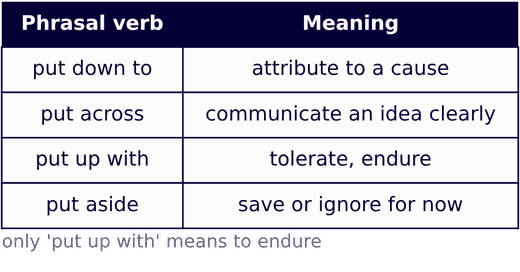
'Put up with' means to tolerate or endure something unpleasant without complaining.
The locals had endured the loud noise for years and now refused to go on tolerating it, so only 'put up with' completes the idea.
Hence, option (c) is the most appropriate answer.
5
Choose the correctly spelt word:
A.Acommplice
B.Accomplise
C.Acoomplice
D.Accomplice
Solution
Spelling
The correctly spelt word is 'Accomplice', which means a person who helps another to commit a crime.
Split it as AC-COM-PLICE: the doubled letter is 'cc' (never 'mm'), the 'm' stays single, and the word ends in -ice, not -ise.
Options (a) and (c) double or misplace the wrong letters, and (b) gives the wrong ending, so none of them is a real word.
Hence, option (d) is the most appropriate answer.
6
Which of the following sentences uses the word "fine" with the same meaning as in the following sentence?
"The heavy fine was paid in court"
A.It was a fine day for a walk.
B.The driver's fine cost him his wage.
C.The sand was extremely fine to the touch.
D.She felt fine after taking the medicine.
Solution
Homonym 'fine'
In 'The heavy fine was paid in court', 'fine' is a noun meaning a sum of money imposed as a punishment.
Option (b), 'The driver's fine cost him his wage', uses the word in exactly that sense — a penalty charged for a traffic offence.
In (a) and (d) 'fine' is an adjective meaning 'pleasant' and 'in good health', while in (c) it means 'made of very small particles'.
Hence, option (b) is the most appropriate answer.
7
Choose the correctly spelt word:
A.Perspicuous
B.Prespicuous
C.Perspisuous
D.Perspicuuos
Solution
Spelling
The correctly spelt word is 'Perspicuous', which describes writing or speech that is clearly expressed and easy to understand.
Fix three points: the word opens with PER- (not PRE-), the middle syllable is -cu- spelt with 'c', and the ending is -ous.
Option (b) reverses the first two letters, (c) replaces 'c' with 's', and (d) swaps the vowels of the ending.
Do not confuse it with 'perspicacious', which means having keen insight.
Hence, option (a) is the most appropriate answer.
8
Directions (Qs. 8-12): Read the following passage carefully and answer the questions that follow.
One of the most significant moral quandaries of the modern era is the
advancement of genetic engineering, specifically the use of CRISPR technology for germline editing in humans. The potential for eradicating hereditary diseases is pitted against deep-seated ethical fears regarding the creation of "designer babies." Proponents argue that gene editing could eliminate suffering caused by conditions like cystic fibrosis or Huntington's disease, effectively removing genetic defects before birth. They suggest it offers a future where preventative medicine reaches the DNA level, ensuring healthier generations and reducing the burden on healthcare systems.
The ethical repercussions are serious, nonetheless. The most compelling argument is the shift from therapy to enhancement, creating a permanent societal divide. Critics fear a future where genetic modifications are purchased by the wealthy, leading to a "genobility" with superior physical and cognitive traits. This raises critical questions of consent: since future generations cannot consent to these edits, do we have the right to permanently alter the human genome? The phenomenon known as "off-target effects," where editing one gene inadvertently damages another, also adds to the difficulty in assessing safety. This built-in uncertainty of long-term biological consequences tests the very foundations of bioethics. Essentially, the debate about germline editing forces us to confront not only the technology but also human ambition, equity, and the ethical limits we are prepared to place on our own evolution.
Which of the following is the most compelling ethical argument against germline editing mentioned in the passage ?
A.The potential for increased healthcare costs
B.The speed at which genetic changes occur
C.The shift from medical therapy to genetic enhancement
D.The lack of technological precision
Solution
Reading comprehension
The second paragraph states it directly: 'The most compelling argument is the shift from therapy to enhancement, creating a permanent societal divide.'
Editing a gene to cure a disease is therapy; editing it to improve an already healthy person is enhancement, and once the wealthy can buy such enhancement the division it creates is inherited and permanent.
That is exactly what option (c) states.
Healthcare cost and the speed of change are never offered as objections, and imprecision ('off-target effects') is raised later as a safety difficulty, not as the most compelling ethical argument.
Hence, option (c) is the most appropriate answer.
9
Directions (Qs. 8-12): Read the following passage carefully and answer the questions that follow.
One of the most significant moral quandaries of the modern era is the
advancement of genetic engineering, specifically the use of CRISPR technology for germline editing in humans. The potential for eradicating hereditary diseases is pitted against deep-seated ethical fears regarding the creation of "designer babies." Proponents argue that gene editing could eliminate suffering caused by conditions like cystic fibrosis or Huntington's disease, effectively removing genetic defects before birth. They suggest it offers a future where preventative medicine reaches the DNA level, ensuring healthier generations and reducing the burden on healthcare systems.
The ethical repercussions are serious, nonetheless. The most compelling argument is the shift from therapy to enhancement, creating a permanent societal divide. Critics fear a future where genetic modifications are purchased by the wealthy, leading to a "genobility" with superior physical and cognitive traits. This raises critical questions of consent: since future generations cannot consent to these edits, do we have the right to permanently alter the human genome? The phenomenon known as "off-target effects," where editing one gene inadvertently damages another, also adds to the difficulty in assessing safety. This built-in uncertainty of long-term biological consequences tests the very foundations of bioethics. Essentially, the debate about germline editing forces us to confront not only the technology but also human ambition, equity, and the ethical limits we are prepared to place on our own evolution.
According to the passage, what is the primary concern regarding the rights of future generations?
A.They will not have access to healthcare
B.They cannot provide consent for permanent genetic alterations
C.They will be immune to all diseases
D.They will be forced to use CRISPR technology
Solution
Reading comprehension
The passage raises the question: 'since future generations cannot consent to these edits, do we have the right to permanently alter the human genome?'
The concern is therefore consent — the people whose DNA is changed are not yet born, so they can neither agree nor object, yet the change they inherit is permanent.
Option (b) reproduces this idea; access to healthcare, immunity to all diseases and any compulsion to use CRISPR are nowhere claimed in the passage.
Hence, option (b) is the most appropriate answer.
10
Directions (Qs. 8-12): Read the following passage carefully and answer the questions that follow.
One of the most significant moral quandaries of the modern era is the
advancement of genetic engineering, specifically the use of CRISPR technology for germline editing in humans. The potential for eradicating hereditary diseases is pitted against deep-seated ethical fears regarding the creation of "designer babies." Proponents argue that gene editing could eliminate suffering caused by conditions like cystic fibrosis or Huntington's disease, effectively removing genetic defects before birth. They suggest it offers a future where preventative medicine reaches the DNA level, ensuring healthier generations and reducing the burden on healthcare systems.
The ethical repercussions are serious, nonetheless. The most compelling argument is the shift from therapy to enhancement, creating a permanent societal divide. Critics fear a future where genetic modifications are purchased by the wealthy, leading to a "genobility" with superior physical and cognitive traits. This raises critical questions of consent: since future generations cannot consent to these edits, do we have the right to permanently alter the human genome? The phenomenon known as "off-target effects," where editing one gene inadvertently damages another, also adds to the difficulty in assessing safety. This built-in uncertainty of long-term biological consequences tests the very foundations of bioethics. Essentially, the debate about germline editing forces us to confront not only the technology but also human ambition, equity, and the ethical limits we are prepared to place on our own evolution.
In the passage, the term "genobility" refers to:
A.A genetic defect caused by CRISPR
B.A social class defined by superior genetic traits
C.The ability to edit genes quickly
D.The scientists who perform gene editing
Solution
Vocabulary in context
The passage coins the word while describing a future in which 'genetic modifications are purchased by the wealthy, leading to a genobility with superior physical and cognitive traits'.
'Genobility' blends 'gene' with 'nobility', so it names a privileged social class marked out by bought-in genetic advantages.
Option (b) captures this; it is not a defect, not a speed of editing and not the scientists themselves.
Hence, option (b) is the most appropriate answer.
11
Directions (Qs. 8-12): Read the following passage carefully and answer the questions that follow.
One of the most significant moral quandaries of the modern era is the
advancement of genetic engineering, specifically the use of CRISPR technology for germline editing in humans. The potential for eradicating hereditary diseases is pitted against deep-seated ethical fears regarding the creation of "designer babies." Proponents argue that gene editing could eliminate suffering caused by conditions like cystic fibrosis or Huntington's disease, effectively removing genetic defects before birth. They suggest it offers a future where preventative medicine reaches the DNA level, ensuring healthier generations and reducing the burden on healthcare systems.
The ethical repercussions are serious, nonetheless. The most compelling argument is the shift from therapy to enhancement, creating a permanent societal divide. Critics fear a future where genetic modifications are purchased by the wealthy, leading to a "genobility" with superior physical and cognitive traits. This raises critical questions of consent: since future generations cannot consent to these edits, do we have the right to permanently alter the human genome? The phenomenon known as "off-target effects," where editing one gene inadvertently damages another, also adds to the difficulty in assessing safety. This built-in uncertainty of long-term biological consequences tests the very foundations of bioethics. Essentially, the debate about germline editing forces us to confront not only the technology but also human ambition, equity, and the ethical limits we are prepared to place on our own evolution.
What is the primary safety concern raised by the "off-target effects" of gene editing?
A.It makes the process too expensive
B.It slows down the editing process
C.It involves inadvertent damage to other genes
D.It prevents the elimination of hereditary diseases
Solution
Reading comprehension
The passage itself defines the term: 'off-target effects', 'where editing one gene inadvertently damages another'.
The safety worry is thus accidental collateral damage to genes that were never meant to be touched, which is why long-term consequences are hard to assess.
Cost and speed are not mentioned in this connection, and the phenomenon does not stop hereditary diseases from being removed — it only makes the procedure risky.
Hence, option (c) is the most appropriate answer.
12
Directions (Qs. 8-12): Read the following passage carefully and answer the questions that follow.
One of the most significant moral quandaries of the modern era is the
advancement of genetic engineering, specifically the use of CRISPR technology for germline editing in humans. The potential for eradicating hereditary diseases is pitted against deep-seated ethical fears regarding the creation of "designer babies." Proponents argue that gene editing could eliminate suffering caused by conditions like cystic fibrosis or Huntington's disease, effectively removing genetic defects before birth. They suggest it offers a future where preventative medicine reaches the DNA level, ensuring healthier generations and reducing the burden on healthcare systems.
The ethical repercussions are serious, nonetheless. The most compelling argument is the shift from therapy to enhancement, creating a permanent societal divide. Critics fear a future where genetic modifications are purchased by the wealthy, leading to a "genobility" with superior physical and cognitive traits. This raises critical questions of consent: since future generations cannot consent to these edits, do we have the right to permanently alter the human genome? The phenomenon known as "off-target effects," where editing one gene inadvertently damages another, also adds to the difficulty in assessing safety. This built-in uncertainty of long-term biological consequences tests the very foundations of bioethics. Essentially, the debate about germline editing forces us to confront not only the technology but also human ambition, equity, and the ethical limits we are prepared to place on our own evolution.
Which argument in favor of germline editing is most strongly supported by proponents?
A.It allows for the creation of designer babies
B.It reduces the need for all doctors
C.It eliminates suffering caused by hereditary diseases
D.It guarantees superior cognitive abilities for all
Solution
Reading comprehension
The first paragraph sets out the supporters' case: gene editing 'could eliminate suffering caused by conditions like cystic fibrosis or Huntington's disease, effectively removing genetic defects before birth'.
Their strongest claim is therefore the removal of suffering caused by inherited disorders, which is option (c).
'Designer babies' and superior cognitive traits belong to the critics' fears, and no line promises that doctors will become unnecessary.
Hence, option (c) is the most appropriate answer.
13
Choose the correct meaning of the idiom: Foul play
A.A bad smelling theatre or playground
B.Unfair and dishonest behaviour
C.Unpleasant weather for playing
D.A drama which is badly produced
Solution
Idiom
The idiom 'foul play' means unfair, dishonest or criminal behaviour, and is used especially when a death or a loss is suspected to be the work of a wrongdoer.
Example: The sudden disappearance of the evidence made the investigators suspect foul play.
The other options read the two words literally, as though the idiom were about a bad smell, bad weather or a badly produced drama.
Hence, option (b) is the most appropriate answer.
14
Choose the correct meaning of the idiom: Grasp at straws
A.To collect dry grass
B.To hold something firmly
C.To try any possible means in a desperate situation
D.To waste time on useless work
Solution
Idiom
'Grasp (or clutch) at straws' means to try any remote possibility because one is desperate and has nothing better left.
The picture behind it is that of a drowning man snatching at a floating straw that cannot possibly hold him up.
Example: The lawyer was grasping at straws to defend his client.
The other options take 'straws' literally or confuse the idiom with mere time-wasting.
Hence, option (c) is the most appropriate answer.
15
Select the most appropriate antonym of the word: Transient
A.Temporary
B.Fleeting
C.Permanent
D.Brief
Solution
Antonym
'Transient' means lasting only for a short time, so its opposite must mean lasting for a very long time or for ever.
'Permanent' carries exactly that sense, whereas 'temporary', 'fleeting' and 'brief' are all synonyms of 'transient' and are placed there only as traps.
Hence, option (c) is the most appropriate answer.
16
Choose the correct one-word substitute for:
A post-mortem examination to discover the cause of death or the extent of disease.
A.Biopsy
B.Forensic
C.Autopsy
D.Crematorium
Solution
One-word substitution
'Autopsy' is the examination of a dead body carried out to establish the cause of death or the extent of a disease; it is also called a post-mortem.
The word is literally 'seeing for oneself' (Greek autos 'self' + opsis 'sight'), which fixes the idea of the examiner looking inside the body himself.
A 'biopsy' examines tissue taken from a living person, 'forensic' is an adjective for science applied to crime, and a 'crematorium' is the place where a body is burnt.
Hence, option (c) is the most appropriate answer.
17
Select the most appropriate antonym of the word: Amicable
A.Affable
B.Tolerant
C.Uncongenial
D.Genial
Solution
Antonym
'Amicable' means friendly and free from ill will, as in 'an amicable settlement between the two parties'.
'Uncongenial' means unfriendly or unpleasant to be with, so it reverses that sense; the prefix un- is the clue.
'Affable' and 'genial' are synonyms of 'amicable', and 'tolerant' only means willing to accept views one does not share, which is not the opposite of friendliness.
Hence, option (c) is the most appropriate answer.
18
Choose the correct one-word substitute for:
A speech delivered without preparation
A.Monologue
B.Dialogue
C.Extempore
D.Oration
Solution
One-word substitution
'Extempore' means spoken or done on the spur of the moment, without any prior preparation.
The definition given in the question stresses the absence of preparation, and that is the one feature 'extempore' carries.
A 'monologue' is a long speech by a single speaker, a 'dialogue' is an exchange between two or more people, and an 'oration' is a formal, carefully prepared public speech — the very opposite of what is asked.
Hence, option (c) is the most appropriate answer.
19
Change the following sentence into the Active form.
The market's sudden crash is believed to be caused by panic selling traders.
A.Panic selling traders believe that the market's sudden crash is caused.
B.Panic selling traders are believed to cause the market's sudden crash.
C.People believe that panic selling traders caused the market's sudden crash.
D.The market believes that panic selling traders caused the sudden crash.
Solution
Passive to active voice
The sentence carries a double passive: 'is believed' reports the opinion, and 'to be caused by ...' states what is believed.
'Is believed' has no stated doer, so in the active voice the general subject 'People' is supplied, giving 'People believe that ...'.
Inside the that-clause the agent 'panic selling traders' becomes the subject and the object 'the market's sudden crash' follows the active verb 'caused'.
This yields: People believe that panic selling traders caused the market's sudden crash.
Option (a) makes the traders do the believing, (b) keeps the passive 'are believed', and (d) makes the market itself the believer, so all three fail.
Hence, option (c) is the most appropriate answer.
20
Select the option that expresses the given sentence in indirect voice.
The captain said, 'We will be climbing the mountain all day.*
A.The captain said that they would be climbing the mountain all day.
B.The captain said that they will be climbing the mountain all day.
C.The captain said that we would be climbing the mountain all day.
D.The captain said that they were climbing the mountain all day.
Solution
Direct to indirect speech
The reporting verb 'said' is in the past tense, so the reported verb must be back-shifted one step: the future continuous 'will be climbing' becomes 'would be climbing'.
The speaker is the captain and the reporter is someone else, so the pronoun 'we' changes to 'they'.
The inverted commas are dropped and the two clauses are joined by 'that'.
This gives: The captain said that they would be climbing the mountain all day.
Option (b) keeps 'will', (c) keeps 'we', and (d) replaces the future continuous with a past continuous, which changes the meaning.
Hence, option (a) is the most appropriate answer.
21
Choose the most suitable option to replace the highlighted part of the sentence:Except for him and her, everyone passed the test.
A.Except for he and she, everyone passed the test
B.Except for him and her, everyone passed the test
C.Except he and she, everyone passed the test
D.Except for she and he, everyone passed the test
Solution
Pronoun after a preposition
'Except for' is a prepositional phrase, and every pronoun that follows a preposition must stand in the objective case.
The objective forms of 'he' and 'she' are 'him' and 'her', so 'Except for him and her' is the only grammatical opening.
Options (a) and (d) use the subjective forms 'he' and 'she', which can only work as the subject of a verb, not as the object of 'for'.
Option (c) drops 'for' and also keeps the subjective forms, so it repeats the same case error.
The sentence therefore needs no change at all.
Hence, option (b) is the most appropriate answer.
22
Choose the correct passive voice transformation of the sentence:
Why did the famous chef quickly cook the delicious meal?
A.Why was the delicious meal quickly cooked by the famous chef?
B.Why was the delicious meal quickly been cooked by the famous chef?
C.Why has the delicious meal been quickly cooked by the famous chef?
D.Why did the delicious meal be cooked by the famous chef?
Solution
Passive of a past interrogative
The active sentence is in the simple past interrogative: 'Why did + subject + V1 + object?'
Rule: the passive of the simple past is 'was/were + V3', and in a question the auxiliary comes before the new subject: 'Why + was/were + object + V3 + by + agent?'
The object 'the delicious meal' is singular, so the auxiliary is 'was' and the verb becomes 'cooked'; the adverb 'quickly' stays just before the main verb.
This gives 'Why was the delicious meal quickly cooked by the famous chef?'
Option (b) adds a needless 'been', option (c) shifts the tense to the present perfect, and option (d) keeps 'did' with a bare 'be', all of which break the tense pattern.
Hence, option (a) is the most appropriate answer.
23
Select the option that expresses the given sentence in direct voice.
The director explained that he was going to shoot several action scenes for his movie.
A.The director said, "He was going to shoot several action scenes for his movie."
B.The director said, "He is going to shoot several action scenes for his movie."
C.The director explained, "I was going to shoot several action scenes for my movie."
D.The director said, "I am going to shoot several action scenes for my movie."
Solution
Indirect to direct speech
Turning indirect speech back into direct speech means undoing every change that the reporting made.
The reported pronouns 'he' and 'his' stand for the speaker himself, so inside the quotation they go back to the first person 'I' and 'my'.
The past-tense 'was going' is the back-shifted form of the speaker's original words, so it is restored to the present 'am going'.
The conjunction 'that' is dropped, a comma is placed after the reporting verb and the exact words are put inside inverted commas with a capital letter.
This yields: The director said, "I am going to shoot several action scenes for my movie."
Options (a) and (b) keep the third-person 'he/his', and option (c) fails to undo the back-shift of the verb.
Hence, option (d) is the most appropriate answer.
24
Rearrange the following sentences to form a meaningful and grammatically correct paragraph:
P. He analyzed the complex code with focus, flagging each error clearly.
Q. He rewrote the scripts to the proper syntax, fixed the bugs, and optimized the loops.
R. After compiling the program, he uploaded it to the server and connected all of the databases.
S. On the first click of the mouse, the app launched to life and worked without issues.
A.R, Q, P, S
B.P, Q, R, S
C.S, Q, R, P
D.Q, P, R, S
Solution
Para jumble (time order)
The paragraph narrates a programmer's work, so the sentences must follow the natural order of the job.
P is the opener: the errors are first found — 'analyzed the complex code ... flagging each error clearly'.
Q comes next, because you can rewrite the scripts and 'fixed the bugs' only after the bugs have been flagged in P.
R follows Q, since 'After compiling the program' presupposes that the corrected code already exists.
S is the closing line — the app finally 'launched to life and worked without issues', which is the result of R.
The chain is therefore P → Q → R → S.
Hence, option (b) is the most appropriate answer.
25
Rearrange the following sentences to form a meaningful and grammatically correct paragraph:
P: As a consequence, the vaccine dramatically reduced infection rates worldwide.
Q: The scientists worked diligently, analyzing the data and running clinical trials.
R: It was formulated to target the protein spike and trigger an immune response.
S: A revolutionary new vaccine was created to combat the virus and save lives.
A.S, R, Q, P
B.P, R, Q, S
C.R, S, Q, P
D.S, P, Q, R
Solution
Para jumble (cause to effect)
S must open the paragraph: it alone introduces the topic with a full noun phrase, 'A revolutionary new vaccine'.
R follows S because its pronoun 'It' has no antecedent unless the vaccine has already been named.
Q comes next — once the vaccine has been formulated, the scientists test it by 'analyzing the data and running clinical trials'.
P is the last line, since 'As a consequence' signals the final outcome of all that work.
The chain is therefore S → R → Q → P.
Hence, option (a) is the most appropriate answer.
Finished reading? Now test yourself.
The same 25 questions, but with a timer and the answers hidden — 15 minutes.

 The locals had endured the loud noise for years and now refused to go on tolerating it, so only 'put up with' completes the idea.
Hence, option (c) is the most appropriate answer.
The locals had endured the loud noise for years and now refused to go on tolerating it, so only 'put up with' completes the idea.
Hence, option (c) is the most appropriate answer.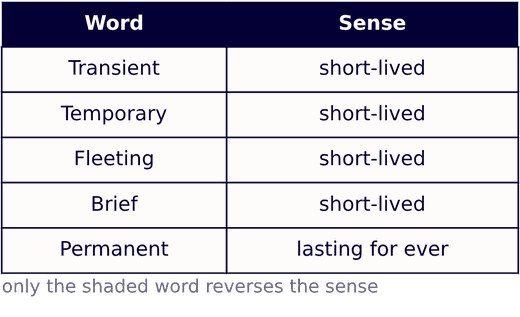 'Permanent' carries exactly that sense, whereas 'temporary', 'fleeting' and 'brief' are all synonyms of 'transient' and are placed there only as traps.
Hence, option (c) is the most appropriate answer.
'Permanent' carries exactly that sense, whereas 'temporary', 'fleeting' and 'brief' are all synonyms of 'transient' and are placed there only as traps.
Hence, option (c) is the most appropriate answer.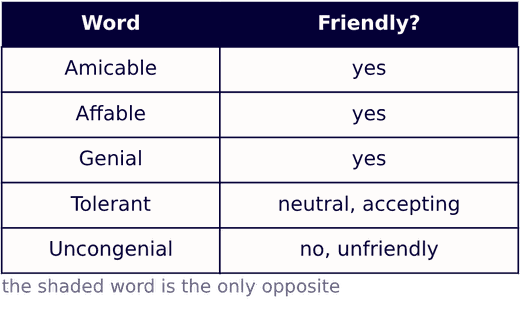 'Uncongenial' means unfriendly or unpleasant to be with, so it reverses that sense; the prefix un- is the clue.
'Affable' and 'genial' are synonyms of 'amicable', and 'tolerant' only means willing to accept views one does not share, which is not the opposite of friendliness.
Hence, option (c) is the most appropriate answer.
'Uncongenial' means unfriendly or unpleasant to be with, so it reverses that sense; the prefix un- is the clue.
'Affable' and 'genial' are synonyms of 'amicable', and 'tolerant' only means willing to accept views one does not share, which is not the opposite of friendliness.
Hence, option (c) is the most appropriate answer.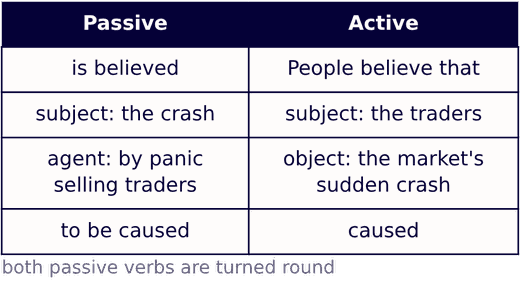 'Is believed' has no stated doer, so in the active voice the general subject 'People' is supplied, giving 'People believe that ...'.
Inside the that-clause the agent 'panic selling traders' becomes the subject and the object 'the market's sudden crash' follows the active verb 'caused'.
This yields: People believe that panic selling traders caused the market's sudden crash.
Option (a) makes the traders do the believing, (b) keeps the passive 'are believed', and (d) makes the market itself the believer, so all three fail.
Hence, option (c) is the most appropriate answer.
'Is believed' has no stated doer, so in the active voice the general subject 'People' is supplied, giving 'People believe that ...'.
Inside the that-clause the agent 'panic selling traders' becomes the subject and the object 'the market's sudden crash' follows the active verb 'caused'.
This yields: People believe that panic selling traders caused the market's sudden crash.
Option (a) makes the traders do the believing, (b) keeps the passive 'are believed', and (d) makes the market itself the believer, so all three fail.
Hence, option (c) is the most appropriate answer.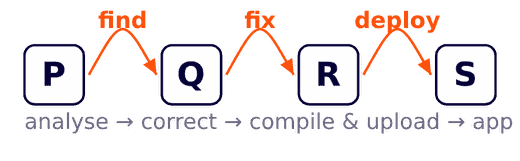 Hence, option (b) is the most appropriate answer.
 Hence, option (a) is the most appropriate answer.