SSC CHSL 17 November 2025 · Shift 3 · General Intelligence — questions with answers · ShikshaSphere
Chapter 53 of 200
17 November 2025 · Shift 3
General Intelligence
25 questions ~25 min readFree
25 questions
A
26
A person avoids eye contact, keeps their arms crossed, and maintains a rigid posture during a discussion. What do these non-verbal cues most likely indicate?
A.Confidence and openness
B.Nervousness or defensiveness
C.High enthusiasm
D.Complete agreement
Solution
Non-verbal communication
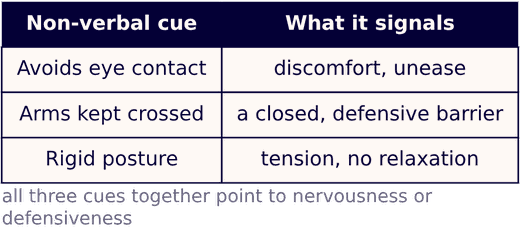
Body language is read as a cluster of signs, not one sign at a time, and here all three cues point the same way.
Avoiding eye contact shows discomfort, crossed arms form a closed 'barrier' posture, and a rigid body shows tension.
Taken together they indicate nervousness or defensiveness, so option (b) is correct.
Confidence and openness would show as steady eye contact and open arms, enthusiasm as animated gestures and leaning forward, and agreement as nodding — none of these is described.
27
Find the next term in the series: 4, 7, 13, 25, 49, ?
A.67
B.87
C.95
D.97
Solution
Number series
Take the successive differences: 7-4=3, 13-7=6, 25-13=12, 49-25=24.
The differences themselves double each time, so the next difference is .
Next term =49+48=97.
The same rule can be written as , since every term is twice the previous term minus 1.
Hence option (d) is correct.
28
If "SISTER" is coded as "ISTSRE", how is "MOTHER" written in that code?
A.OMHTER
B.OMTHRE
C.OMHTRE
D.OHMTRE
Solution
Letter coding
Break the six-letter word into three pairs: SI | ST | ER, and do the same with the code: IS | TS | RE.
Pair by pair, the two letters have simply changed places; no letter value is altered.
Apply the same swap to MOTHER: MO → OM, TH → HT, ER → RE.
Joining them gives OMHTRE, so option (c) is correct.
Option (a) leaves the last pair unswapped and option (d) swaps across the wrong pair boundary.
29
A recipe requires 2.5 cups of sugar for 20 muffins. How many cups of sugar are needed for 40 muffins?
A.4.0 cups
B.5.25 cups
C.5.0 cups
D.3.75 cups
Solution
Direct proportion
Sugar and the number of muffins are in direct proportion.
Sugar for one muffin cups.
Sugar for 40 muffins cups.
The short cut: 40 is twice 20, so the sugar is simply doubled — cups, option (c).
30
Pick the correct options from the given alternatives 987 : 1098 :: 1263 : ?
A.1363
B.1374
C.1463
D.1376
Solution
Number analogy
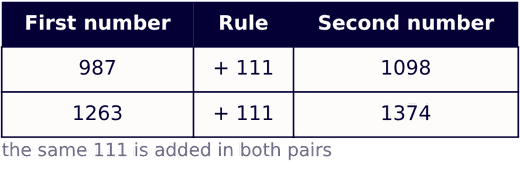
Compare the two numbers of the given pair: 1098-987=111.
So the rule is second number = first number .
Applying the same rule: 1263+111=1374.
Hence option (b) is correct; option (a) adds only 100 and option (d) adds 113.
31
Which of the following are twin prime numbers?
A.
B.
C.
D.
Solution
Twin prime numbers
Twin primes are a pair of prime numbers whose difference is exactly 2.
For the first pair, 13-11=2 and both 11 and 13 are prime, so this is a twin-prime pair.
In the other pairs 47-43=4, 67-59=8 and 23-19=4 — every difference is more than 2, even though the numbers themselves are prime.
Hence option (a) is correct.
32
Find the number of terms in the following series. 7, 14, 21, 28, 140
A.10
B.20
C.22
D.13
Solution
Number of terms in an AP
The series is an AP with first term a=7 and common difference d=7.
Formula: .
.
Since every term is a multiple of 7, the count is simply — option (b).
33
Find out the next term in the following series. 3223, 33333, 344443, 3555553, ?
A.366663
B.3666663
C.36666663
D.36663
Solution
Number pattern series
Every term begins with 3 and ends with 3; the digits in between are all the same digit.
In the 1st term the middle digit 2 is repeated twice, in the 2nd term 3 is repeated three times, in the 3rd term 4 is repeated four times and in the 4th term 5 is repeated five times.
So the 5th term is 3, then the digit 6 repeated six times, then 3 — that is 36666663.
The digit count also grows as , which confirms an eight-digit answer.
Hence option (c) is correct.
34
Which of the following should be the next term in the given series ?
C61, E67, G71, I73, ?
A.K83
B.J79
C.K79
D.L91
Solution
Alphanumeric series
Split each term into its letter part and its number part and treat them separately.
Letters: C(3), E(5), G(7), I(9) — each moves 2 places forward, so the next letter is K(11).
Numbers: are consecutive prime numbers, so the next number is the prime just after 73, i.e. 79.
Putting the two together, the next term is K79 — option (c).
Option (b) breaks the letter pattern with J, and option (a) skips the prime 79 to reach 83.
35
Select the option which fills both the blanks in a correct manner such that the given pair are related to each other:
?
S:?::C:G
A.V, V
B.W,W
C.W, U
D.S, S
Solution
Letter analogy
Work with the positions of the letters in the alphabet.
First analogy: M(13) P(16), a jump of +3; so T(20) +3= W(23).
Second analogy: C(3) G(7), a jump of +4; so S(19) +4= W(23).
Both blanks are therefore filled by W, which is option (b).
Option (a) uses +2 in the first pair and option (c) moves backwards in the second pair, so neither keeps the given relation.
36
Kavya is elder to Pooja. Prerna is younger to both Riya and Kavita . Swati is younger to Prerna and elder to Kavya . Anshika is younger to Swati, but not the youngest. How many persons are younger to Kavita ?
A.5
B.Either 4 or 5
C.Either 5 or 6
D.6
Solution
Ranking and order
Write every clue as an inequality, reading 'elder' as greater.
Kavya > Pooja; Riya > Prerna and Kavita > Prerna; Prerna > Swati > Kavya.
Chaining these gives Riya, Kavita > Prerna > Swati > Kavya > Pooja.
Anshika is younger than Swati but is not the youngest, so she lies somewhere between Swati and Pooja; in every case she is younger than Kavita.
Certainly younger than Kavita: Prerna, Swati, Anshika, Kavya and Pooja — that is 5 persons.
The clues never compare Riya with Kavita, so Riya may also be younger than Kavita, making the count 6.
Hence the answer is either 5 or 6 — option (c).
37
Read the given statement and the following assumptions and decide which of the assumptions is implicit in the statement.Statement: The municipal corporation has announced free health check-ups for senior citizens in all government hospitals.
Assumptions:
I. The municipal corporation has adequate medical staff and facilities to conduct health check-ups.
II. Senior citizens will be willing to avail themselves of free health check-ups.
A.Only assumption I is implicit.
B.Only assumption II is implicit.
C.Both assumption I and II are implicit
D.Neither assumption I nor II is implicit.
Solution
Statement and assumptions
An assumption is something the speaker must already take for granted for the statement to make sense.
The corporation has promised check-ups in all government hospitals; such a promise can be made only if it believes the medical staff and facilities are adequate, so assumption I is implicit.
A welfare scheme is announced for people who are expected to use it; without the belief that senior citizens will come forward, the announcement would serve no purpose, so assumption II is implicit too.
Hence both assumptions are implicit — option (c).
38
The given question consists of a statement, followed by two courses of action numbered I and II. You have to decide which of the course(s) of action logically follows.Statement: Due to heavy rainfall, several areas of a city are waterlogged, causing traffic jams and inconvenience to residents.
Course of actions:
I. The city administration should immediately plan a drainage improvement project.
II. Residents should be advised to avoid unnecessary travel during heavy rains.
A.Only I follow.
B.Only II follows.
C.Both I and II follow.
D.Neither I nor II follows.
Solution
Course of action
A course of action follows if it either removes the cause of the problem or reduces the hardship it is causing right now.
Waterlogging happens because the drains cannot carry the rainwater away, so planning a drainage improvement project attacks the root cause — I follows.
Until that work is done, advising residents to avoid unnecessary travel cuts down the traffic jams and the inconvenience immediately — II follows.
The two are the long-term and short-term halves of the same solution and neither is impractical, so option (c) is correct.
39
Find out the next term of the Letter cluster.
BEF, EHI, HKL, ?
A.KNP
B.KNO
C.KMO
D.KMP
Solution
Letter cluster series
Compare the first two clusters letter by letter: B E, E H, F I.
Every letter has moved 3 places forward, and EHI HKL obeys the same +3 rule.
Apply +3 to HKL: H K, K N, L O.
The next cluster is KNO — option (b); options (a) and (d) move the last letter 4 places instead of 3.
40
Which of the following letter from given four alternatives will come next to the series?
D, F, J, P, ?
A.V
B.W
C.X
D.T
Solution
Letter series
Replace each letter by its place in the alphabet: D(4), F(6), J(10), P(16).
The gaps are 6-4=2, 10-6=4, 16-10=6 — they increase by 2 every time, so the next gap is 8.
Next position =16+8=24, and the 24th letter of the alphabet is X.
Hence option (c) is correct; option (a) V is the 22nd letter, which would need a gap of only 6.
41
Complete the given series of letter clusters.
CEGI, GIKM, KMOQ, ?
A.ORQT
B.ONPR
C.OQSU
D.OQRU
Solution
Letter cluster series
Inside every cluster the letters rise in steps of 2: C, E, G, I and G, I, K, M.
From one cluster to the next each letter moves 4 places forward: C→G→K, E→I→M, and so on.
So the fourth cluster starts at K+4 = O and then continues in steps of 2: O, Q, S, U.
The required cluster is OQSU, so option (c) is the answer.
42
If % means *add both numbers and multiply by 3 ", and means "subtract second from first and square the result", then find: 8 $ 6 % 2
A.12
B.18
C.14
D.16
Solution
Symbol substitution
Two symbols are defined, so work through the expression from left to right, one symbol at a time.
The first symbol says: subtract the second number from the first and square the result, so it gives .
The expression is now 4 % 2.
The symbol % says: add the two numbers and multiply by 3, so it gives .
Hence option (b) is the answer.
43
Which of the following shows a correlation, not causation?
A.Students who sit in the front rows score higher marks.
B.Drinking contaminated water causes cholera.
C.Lack of insulin causes diabetes.
D.Bacteria cause food poisoning.
Solution
Correlation and causation
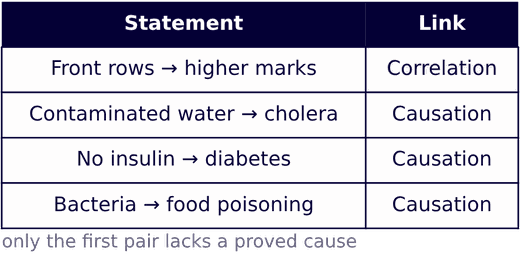
Causation means one event actually produces the other; correlation means the two merely occur together, with no proof that one produces the other.
Contaminated water and cholera, insulin deficiency and diabetes, and bacteria and food poisoning are all established cause-and-effect links proved by medical evidence.
Front-row seating and high marks only travel together: the more attentive and motivated students choose the front rows, so motivation — not the seat itself — is what raises the marks.
Only that statement is a correlation, so option (a) is the answer.
44
A series is given with one term missing. Select the correct alternative from the given ones that will complete the series.
BSF, EPI, KJO, NGR
A.HML
B.HNL
C.HAZ
D.GHN
Solution
Letter cluster series
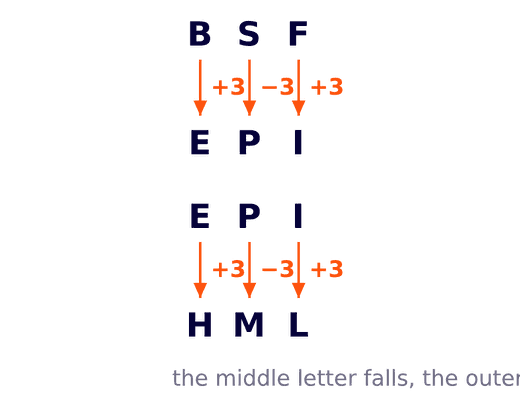
Compare the clusters position by position.
1st letters: B, E, ?, K, N — a jump of +3 each time, so the missing letter is H.
2nd letters: S, P, ?, J, G — a jump of -3 each time, so the missing letter is M.
3rd letters: F, I, ?, O, R — a jump of +3 each time, so the missing letter is L.
The missing cluster is HML, so option (a) is the answer.
45
A series is given with one wrong term from the given series.
NVK, JRG, FNC, BJY, XFW
A.FNC
B.XFW
C.JRG
D.BJY
Solution
Wrong term in series
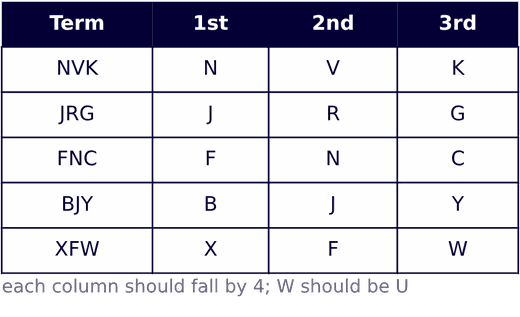
Check each of the three positions separately as the clusters advance.
1st letters: N, J, F, B, X — every letter is 4 places back (B goes back past A and wraps to X). Correct throughout.
2nd letters: V, R, N, J, F — again 4 places back each time. Correct throughout.
3rd letters: K, G, C, Y, ? — 4 places back from Y is U, but the series shows W.
The faulty cluster is XFW, which should be XFU, so option (b) is the answer.
46
A series is given with one term missing. Select the correct alternative from the given ones that will complete the series.
HYV, JUB, ?, NMN , PIT
A.LQH
B.GHK
C.GOL
D.LPG
Solution
Letter cluster series
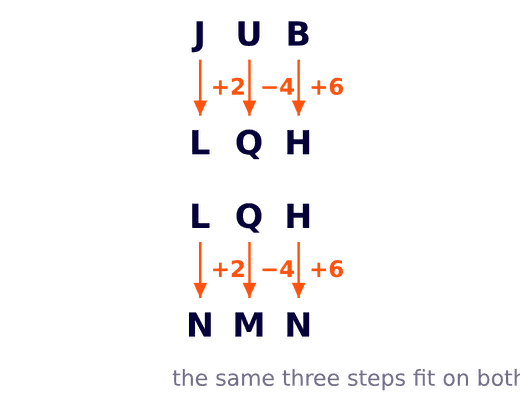
Take the three letter positions one at a time.
1st letters: H, J, ?, N, P — a step of +2, so the missing letter is L.
2nd letters: Y, U, ?, M, I — a step of -4, so the missing letter is Q.
3rd letters: V, B, ?, N, T — a step of +6 (V +6 passes Z and lands on B), so the missing letter is H.
The missing cluster is LQH, so option (a) is the answer.
47
A series is given with one term missing. Select the correct alternative from the given ones that will complete the series.
GPQ, KLM, ?, SDE, WZA
A.HOJ
B.JCl
C.OHI
D.OGJ
Solution
Letter cluster series
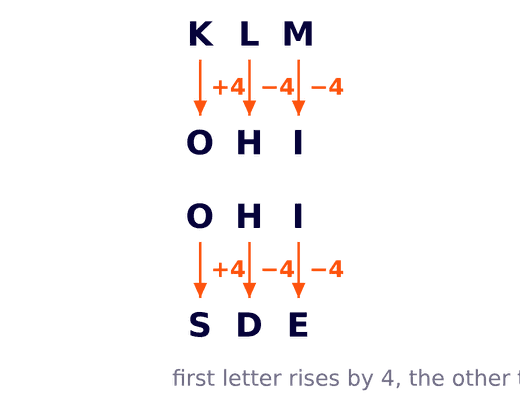
Handle the three positions separately.
1st letters: G, K, ?, S, W — a step of +4, so the missing letter is O.
2nd letters: P, L, ?, D, Z — a step of -4 (D -4 wraps back to Z), so the missing letter is H.
3rd letters: Q, M, ?, E, A — a step of -4, so the missing letter is I.
The missing cluster is OHI, so option (c) is the answer.
48
A series is given with one wrong term. Select the wrong term from the given series.
DMR, FOT, BKP, HQW, ZIN
A.FOT
B.HQW
C.ZIN
D.BKP
Solution
Wrong term in series
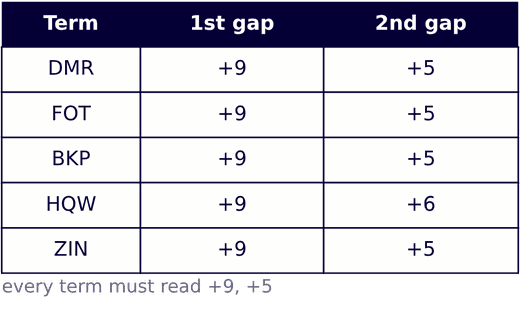
Here the rule sits inside each cluster, so measure the two gaps within every term.
DMR: D +9 = M, M +5 = R. FOT: F +9 = O, O +5 = T. BKP: B +9 = K, K +5 = P.
ZIN: Z +9 = I (counting past Z back to A), I +5 = N — also correct.
HQW: H +9 = Q is right, but Q +5 = V, not W.
HQW breaks the pattern and should be HQV, so option (b) is the answer.
49
Which of the following words can be formed using the letters only once?
ADMINISTRATION
Word I: RATION
Word II: DOMINANT
Word III: TRANSMIT
A.Only word I can be formed using the letters only once
B.Only word I and II can be formed using the letters only once
C.Only words I and III can be formed using the letters only once
D.All the words can be formed using the letters only once.
Solution
Word formation
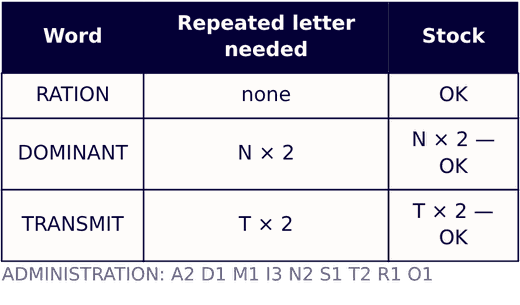
First count the stock of letters in ADMINISTRATION: A–2, D–1, M–1, I–3, N–2, S–1, T–2, R–1, O–1.
RATION needs R, A, T, I, O, N — one of each, and every one of them is in stock.
DOMINANT needs D, O, M, I, A, T and N twice; two N's are available, so it can be formed.
TRANSMIT needs T twice plus R, A, N, S, M, I; two T's are available, so it can be formed.
All three words can be formed, so option (d) is the answer.
50
Identify the pattern in the following sequence.
2, 6, 15, 40, 89, 210
What is the next number in the sequence?
A.414
B.356
C.379
D.489
Solution
Number series
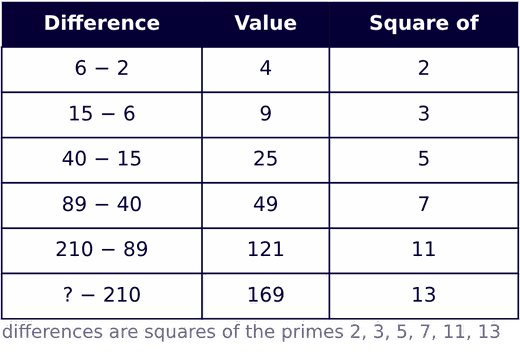
Take the differences between consecutive terms: 6-2=4, 15-6=9, 40-15=25, 89-40=49, 210-89=121.
These differences are , , , , — the squares of the successive prime numbers.
The prime after 11 is 13, so the next difference must be .
Next term =210+169=379, so option (c) is the answer.
Finished reading? Now test yourself.
The same 25 questions, but with a timer and the answers hidden — 15 minutes.

 Avoiding eye contact shows discomfort, crossed arms form a closed 'barrier' posture, and a rigid body shows tension.
Taken together they indicate nervousness or defensiveness, so option (b) is correct.
Confidence and openness would show as steady eye contact and open arms, enthusiasm as animated gestures and leaning forward, and agreement as nodding — none of these is described.
Avoiding eye contact shows discomfort, crossed arms form a closed 'barrier' posture, and a rigid body shows tension.
Taken together they indicate nervousness or defensiveness, so option (b) is correct.
Confidence and openness would show as steady eye contact and open arms, enthusiasm as animated gestures and leaning forward, and agreement as nodding — none of these is described.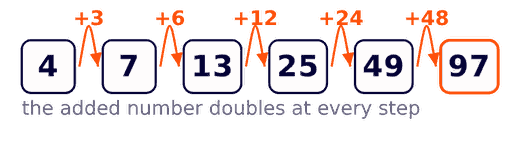 Next term =49+48=97.
The same rule can be written as , since every term is twice the previous term minus 1.
Hence option (d) is correct.
Next term =49+48=97.
The same rule can be written as , since every term is twice the previous term minus 1.
Hence option (d) is correct.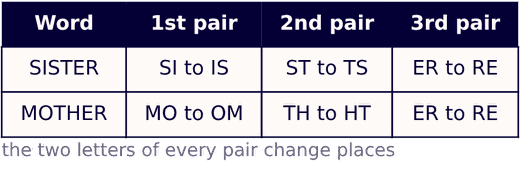 Apply the same swap to MOTHER: MO → OM, TH → HT, ER → RE.
Joining them gives OMHTRE, so option (c) is correct.
Option (a) leaves the last pair unswapped and option (d) swaps across the wrong pair boundary.
Apply the same swap to MOTHER: MO → OM, TH → HT, ER → RE.
Joining them gives OMHTRE, so option (c) is correct.
Option (a) leaves the last pair unswapped and option (d) swaps across the wrong pair boundary.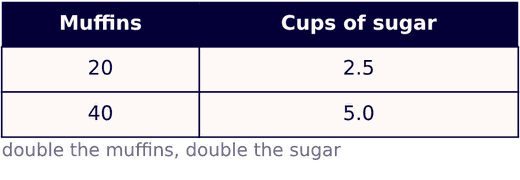 The short cut: 40 is twice 20, so the sugar is simply doubled — cups, option (c).
 Applying the same rule: 1263+111=1374.
Hence option (b) is correct; option (a) adds only 100 and option (d) adds 113.
Applying the same rule: 1263+111=1374.
Hence option (b) is correct; option (a) adds only 100 and option (d) adds 113.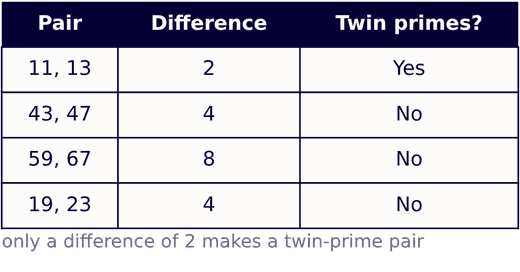 For the first pair, 13-11=2 and both 11 and 13 are prime, so this is a twin-prime pair.
In the other pairs 47-43=4, 67-59=8 and 23-19=4 — every difference is more than 2, even though the numbers themselves are prime.
Hence option (a) is correct.
For the first pair, 13-11=2 and both 11 and 13 are prime, so this is a twin-prime pair.
In the other pairs 47-43=4, 67-59=8 and 23-19=4 — every difference is more than 2, even though the numbers themselves are prime.
Hence option (a) is correct.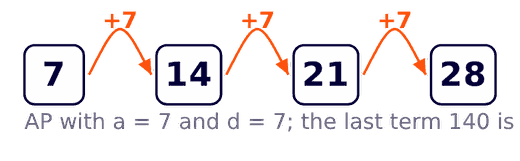 Formula: .
.
Since every term is a multiple of 7, the count is simply — option (b).
Formula: .
.
Since every term is a multiple of 7, the count is simply — option (b).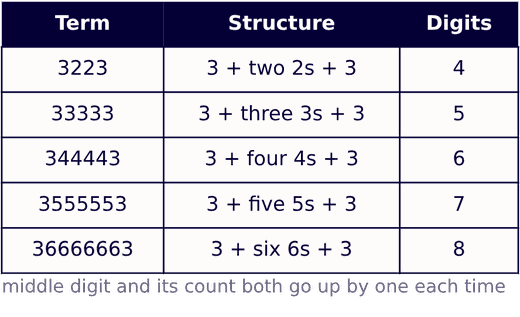 So the 5th term is 3, then the digit 6 repeated six times, then 3 — that is 36666663.
The digit count also grows as , which confirms an eight-digit answer.
Hence option (c) is correct.
So the 5th term is 3, then the digit 6 repeated six times, then 3 — that is 36666663.
The digit count also grows as , which confirms an eight-digit answer.
Hence option (c) is correct.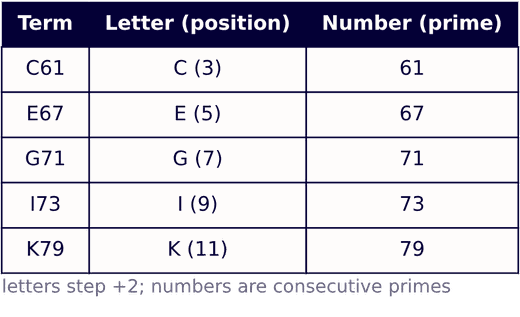 Putting the two together, the next term is K79 — option (c).
Option (b) breaks the letter pattern with J, and option (a) skips the prime 79 to reach 83.
Putting the two together, the next term is K79 — option (c).
Option (b) breaks the letter pattern with J, and option (a) skips the prime 79 to reach 83.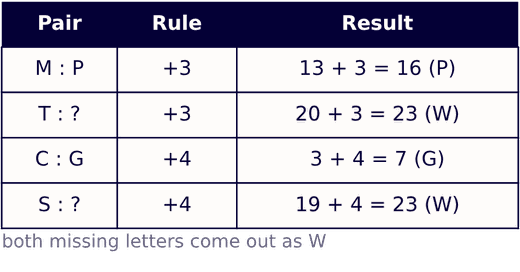 Both blanks are therefore filled by W, which is option (b).
Option (a) uses +2 in the first pair and option (c) moves backwards in the second pair, so neither keeps the given relation.
Both blanks are therefore filled by W, which is option (b).
Option (a) uses +2 in the first pair and option (c) moves backwards in the second pair, so neither keeps the given relation.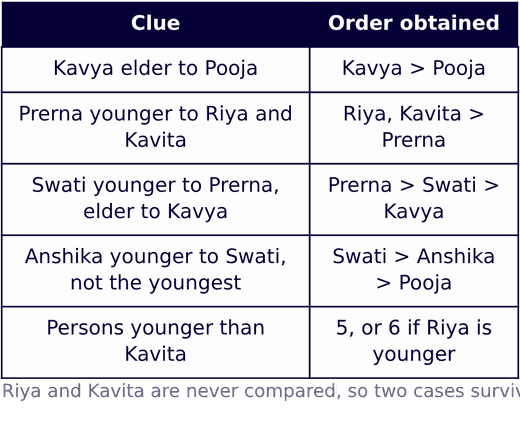 Chaining these gives Riya, Kavita > Prerna > Swati > Kavya > Pooja.
Anshika is younger than Swati but is not the youngest, so she lies somewhere between Swati and Pooja; in every case she is younger than Kavita.
Certainly younger than Kavita: Prerna, Swati, Anshika, Kavya and Pooja — that is 5 persons.
The clues never compare Riya with Kavita, so Riya may also be younger than Kavita, making the count 6.
Hence the answer is either 5 or 6 — option (c).
Chaining these gives Riya, Kavita > Prerna > Swati > Kavya > Pooja.
Anshika is younger than Swati but is not the youngest, so she lies somewhere between Swati and Pooja; in every case she is younger than Kavita.
Certainly younger than Kavita: Prerna, Swati, Anshika, Kavya and Pooja — that is 5 persons.
The clues never compare Riya with Kavita, so Riya may also be younger than Kavita, making the count 6.
Hence the answer is either 5 or 6 — option (c).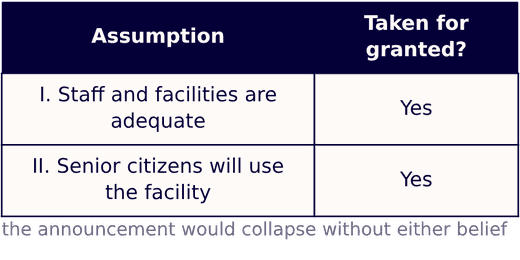 The corporation has promised check-ups in all government hospitals; such a promise can be made only if it believes the medical staff and facilities are adequate, so assumption I is implicit.
A welfare scheme is announced for people who are expected to use it; without the belief that senior citizens will come forward, the announcement would serve no purpose, so assumption II is implicit too.
Hence both assumptions are implicit — option (c).
The corporation has promised check-ups in all government hospitals; such a promise can be made only if it believes the medical staff and facilities are adequate, so assumption I is implicit.
A welfare scheme is announced for people who are expected to use it; without the belief that senior citizens will come forward, the announcement would serve no purpose, so assumption II is implicit too.
Hence both assumptions are implicit — option (c).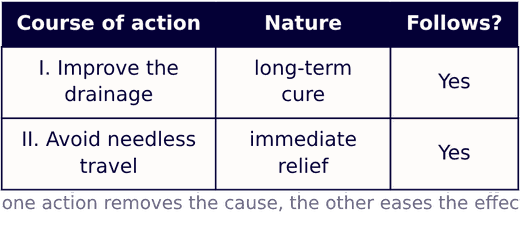 Waterlogging happens because the drains cannot carry the rainwater away, so planning a drainage improvement project attacks the root cause — I follows.
Until that work is done, advising residents to avoid unnecessary travel cuts down the traffic jams and the inconvenience immediately — II follows.
The two are the long-term and short-term halves of the same solution and neither is impractical, so option (c) is correct.
Waterlogging happens because the drains cannot carry the rainwater away, so planning a drainage improvement project attacks the root cause — I follows.
Until that work is done, advising residents to avoid unnecessary travel cuts down the traffic jams and the inconvenience immediately — II follows.
The two are the long-term and short-term halves of the same solution and neither is impractical, so option (c) is correct.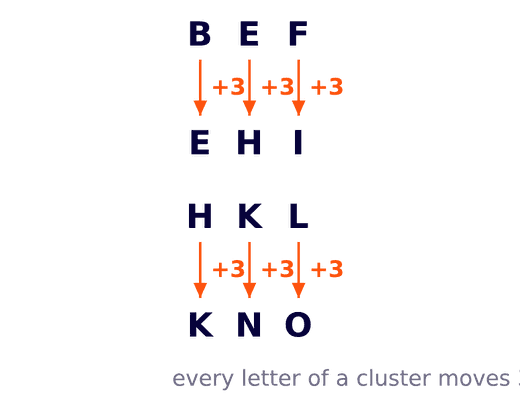 Apply +3 to HKL: H K, K N, L O.
The next cluster is KNO — option (b); options (a) and (d) move the last letter 4 places instead of 3.
Apply +3 to HKL: H K, K N, L O.
The next cluster is KNO — option (b); options (a) and (d) move the last letter 4 places instead of 3.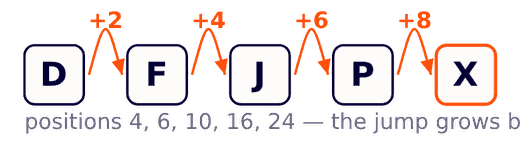 Next position =16+8=24, and the 24th letter of the alphabet is X.
Hence option (c) is correct; option (a) V is the 22nd letter, which would need a gap of only 6.
Next position =16+8=24, and the 24th letter of the alphabet is X.
Hence option (c) is correct; option (a) V is the 22nd letter, which would need a gap of only 6.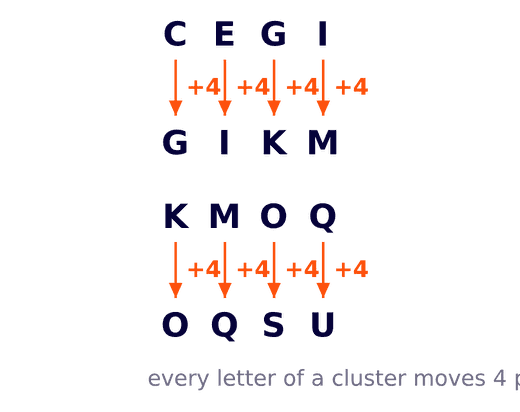 So the fourth cluster starts at K+4 = O and then continues in steps of 2: O, Q, S, U.
The required cluster is OQSU, so option (c) is the answer.
So the fourth cluster starts at K+4 = O and then continues in steps of 2: O, Q, S, U.
The required cluster is OQSU, so option (c) is the answer.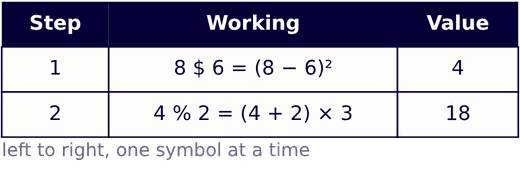 Hence option (b) is the answer.
 Only that statement is a correlation, so option (a) is the answer.
 The missing cluster is HML, so option (a) is the answer.
 The faulty cluster is XFW, which should be XFU, so option (b) is the answer.
 The missing cluster is LQH, so option (a) is the answer.
 The missing cluster is OHI, so option (c) is the answer.
 HQW breaks the pattern and should be HQV, so option (b) is the answer.
 All three words can be formed, so option (d) is the answer.
 Next term =210+169=379, so option (c) is the answer.