SSC CHSL 17 November 2025 · Shift 3 · English Language — questions with answers · ShikshaSphere
Chapter 56 of 200
17 November 2025 · Shift 3
English Language
25 questions ~25 min readFree
25 questions
A
1
Identify the part of the sentence that contains a grammatical error.
A. The new policy
B. states that employees suggestions
C. will be reviewed
D. at the monthly meeting.
A.The new policy
B.that employee's suggestions
C.will be reviewed
D.at the monthly meeting.
Solution
Possessive apostrophe
The error lies in part B.
The suggestions belong to the employees, so the noun must stand in the possessive case, which English marks with an apostrophe.
A plural noun that already ends in -s takes only the apostrophe, no second s: employees becomes employees'.
Correct sentence: The new policy states that employees' suggestions will be reviewed at the monthly meeting.
Parts A, C and D contain no error, so option (b) is the answer.
2
Identify the part of the sentence that contains a grammatical error.
A. During the presentation,
B. she forgot to
C. mention about the
D. key findings of her research.
A.During the presentation
B.she forgot to
C.mention about the
D.key findings of her research
Solution
Transitive verb, no preposition
The error lies in part C.
"Mention" is a transitive verb: it takes its object directly and never needs the preposition "about" before it.
The same rule governs discuss, describe, enter, resemble, order and approach — none of them allows a preposition between the verb and its object.
Correct sentence: During the presentation, she forgot to mention the key findings of her research.
Hence option (c) is the answer.
3
Fill in the blank with the most appropriate verb:
The speaker briefly while answering the difficult question, sensing doubt in the audience.
A.persisted
B.hesitated
C.declared
D.repeated
Solution
Contextual verb
The clue is "sensing doubt in the audience" — the speaker faltered for a moment before going on.
"Hesitated" means to pause or waver because of uncertainty, which fits that brief break exactly.
"Persisted" means to carry on steadily, "declared" means to announce firmly and "repeated" means to say again — all three show confidence or continuation, not a pause caused by doubt.
Hence option (b) is the answer.
4
Select the most appropriate synonym of the word: FORTUITY
A.Destiny
B.Chance
C.Design
D.Certainty
Solution
Synonym
FORTUITY means the quality of happening by accident — an occurrence with no planned cause behind it.
Chance carries exactly that sense: something that comes about without design or intention.
Destiny and Certainty point to what is fixed or bound to happen, which is the opposite of an accident.
Design means a deliberate plan, again the reverse of fortuity.
Hence option (b) is the answer.
5
Select the most appropriate synonym of the word: LUGUBRIOUS
A.Cheerful
B.Mournful
C.Lively
D.Optimistic
Solution
Synonym
LUGUBRIOUS describes someone or something that looks or sounds sad and gloomy, often in an exaggerated way.
Mournful means full of grief or sorrow, so it matches that sense of dismal sadness.
Cheerful, Lively and Optimistic all suggest happiness, energy or hope, so they are antonyms of lugubrious, not synonyms.
Hence option (b) is the answer.
6
Choose the correctly spelt word:
A.Smartton
B.Smartun
C.Smarten
D.Smartenne
Solution
Correct spelling
The correct spelling is "Smarten", the verb meaning to make or become smarter, neater or brisker.
It is built by adding the verb-forming suffix -en to the adjective smart, exactly as in sharp → sharpen and short → shorten.
"Smartton", "Smartun" and "Smartenne" follow no such pattern and are not English words.
Hence option (c) is the answer.
7
Directions (Qs. 7-11): Read the following passage carefully and answer the questions that follow.
The growing reliance on online learning platforms has reshaped the educational experience of students worldwide. Digital classrooms offer flexibility and access to vast resources, allowing learners to study at their own pace and revisit complex material. However, this shift has also exposed structural weaknesses in education systems, particularly for students who lack reliable internet access or suitable learning environments at home. As a result, the promise of
equal educational opportunity through technology often remains unfulfilled. Apart from access issues, prolonged virtual learning can affect student motivation and social development. The absence of face-to-face interaction reduces opportunities for collaborative learning, spontaneous discussion, and emotional connection with peers and teachers. Many educators report that students engaged in long-term online instruction struggle with discipline, participation, and a sense of belonging. Addressing these challenges requires investment in digital infrastructure, teacher training, and hybrid learning models that balance technological convenience with the social benefits of traditional classrooms. Education, therefore, must evolve thoughtfully to ensure that innovation strengthens rather than fragments the learning experience.
What is a key limitation of online learning highlighted in the passage ?
A.Limited availability of digital content
B.Inflexibility in learning schedules
C.Unequal access to resources
D.Excessive teacher supervision
Solution
Reading comprehension
The passage says the shift to digital classrooms has "exposed structural weaknesses in education systems, particularly for students who lack reliable internet access or suitable learning environments at home".
A shortage of connectivity and of a fit place to study is precisely unequal access to resources.
Flexibility and access to vast resources are named as strengths of digital classrooms, which rules out (a) and (b); the passage never speaks of excessive teacher supervision, which rules out (d).
Hence option (c) is the answer.
8
Directions (Qs. 7-11): Read the following passage carefully and answer the questions that follow.
The growing reliance on online learning platforms has reshaped the educational experience of students worldwide. Digital classrooms offer flexibility and access to vast resources, allowing learners to study at their own pace and revisit complex material. However, this shift has also exposed structural weaknesses in education systems, particularly for students who lack reliable internet access or suitable learning environments at home. As a result, the promise of
equal educational opportunity through technology often remains unfulfilled. Apart from access issues, prolonged virtual learning can affect student motivation and social development. The absence of face-to-face interaction reduces opportunities for collaborative learning, spontaneous discussion, and emotional connection with peers and teachers. Many educators report that students engaged in long-term online instruction struggle with discipline, participation, and a sense of belonging. Addressing these challenges requires investment in digital infrastructure, teacher training, and hybrid learning models that balance technological convenience with the social benefits of traditional classrooms. Education, therefore, must evolve thoughtfully to ensure that innovation strengthens rather than fragments the learning experience.
According to the passage, what aspect of student development may be affected by prolonged virtual learning?
A.Physical fitness
B.Social interaction and motivation
C.Technical skills
D.Language acquisition
Solution
Reading comprehension
The passage states plainly that prolonged virtual learning "can affect student motivation and social development".
It then explains how: the absence of face-to-face interaction cuts down collaborative learning, spontaneous discussion and emotional connection, and students struggle with participation and a sense of belonging.
Both strands together give social interaction and motivation.
Physical fitness, technical skills and language acquisition are nowhere discussed in the passage.
Hence option (b) is the answer.
9
Directions (Qs. 7-11): Read the following passage carefully and answer the questions that follow.
The growing reliance on online learning platforms has reshaped the educational experience of students worldwide. Digital classrooms offer flexibility and access to vast resources, allowing learners to study at their own pace and revisit complex material. However, this shift has also exposed structural weaknesses in education systems, particularly for students who lack reliable internet access or suitable learning environments at home. As a result, the promise of
equal educational opportunity through technology often remains unfulfilled. Apart from access issues, prolonged virtual learning can affect student motivation and social development. The absence of face-to-face interaction reduces opportunities for collaborative learning, spontaneous discussion, and emotional connection with peers and teachers. Many educators report that students engaged in long-term online instruction struggle with discipline, participation, and a sense of belonging. Addressing these challenges requires investment in digital infrastructure, teacher training, and hybrid learning models that balance technological convenience with the social benefits of traditional classrooms. Education, therefore, must evolve thoughtfully to ensure that innovation strengthens rather than fragments the learning experience.
Why does the passage suggest that equal educational opportunity is not fully realised through online learning ?
A.Digital platforms are poorly designed
B.Teachers resist technological change
C.Students lack uniform access and environments
D.Online courses are too expensive
Solution
Reading comprehension
The sentence about the unfulfilled promise follows directly from the one before it: some students lack reliable internet access or suitable learning environments at home.
Because the starting conditions differ from learner to learner, the same online course does not reach every student equally, so technology alone cannot deliver equal opportunity.
The passage never blames the design of the platforms, resistance from teachers or the cost of courses, so (a), (b) and (d) lie outside it.
Hence option (c) is the answer.
10
Directions (Qs. 7-11): Read the following passage carefully and answer the questions that follow.
The growing reliance on online learning platforms has reshaped the educational experience of students worldwide. Digital classrooms offer flexibility and access to vast resources, allowing learners to study at their own pace and revisit complex material. However, this shift has also exposed structural weaknesses in education systems, particularly for students who lack reliable internet access or suitable learning environments at home. As a result, the promise of
equal educational opportunity through technology often remains unfulfilled. Apart from access issues, prolonged virtual learning can affect student motivation and social development. The absence of face-to-face interaction reduces opportunities for collaborative learning, spontaneous discussion, and emotional connection with peers and teachers. Many educators report that students engaged in long-term online instruction struggle with discipline, participation, and a sense of belonging. Addressing these challenges requires investment in digital infrastructure, teacher training, and hybrid learning models that balance technological convenience with the social benefits of traditional classrooms. Education, therefore, must evolve thoughtfully to ensure that innovation strengthens rather than fragments the learning experience.
What approach does the passage recommend to address challenges in online education ?
A.Eliminating online learning systems
B.Relying solely on digital instruction
C.Combining technology with traditional classroom methods
D.Reducing teacher involvement
Solution
Reading comprehension
The remedy is stated near the end: investment in digital infrastructure, teacher training and "hybrid learning models that balance technological convenience with the social benefits of traditional classrooms".
A hybrid model is exactly the combining of technology with traditional classroom methods.
The passage wants education to evolve, not to be abandoned (a) or to rest on digital instruction alone (b); and it asks for more teacher training, not less teacher involvement (d).
Hence option (c) is the answer.
11
Directions (Qs. 7-11): Read the following passage carefully and answer the questions that follow.
The growing reliance on online learning platforms has reshaped the educational experience of students worldwide. Digital classrooms offer flexibility and access to vast resources, allowing learners to study at their own pace and revisit complex material. However, this shift has also exposed structural weaknesses in education systems, particularly for students who lack reliable internet access or suitable learning environments at home. As a result, the promise of
equal educational opportunity through technology often remains unfulfilled. Apart from access issues, prolonged virtual learning can affect student motivation and social development. The absence of face-to-face interaction reduces opportunities for collaborative learning, spontaneous discussion, and emotional connection with peers and teachers. Many educators report that students engaged in long-term online instruction struggle with discipline, participation, and a sense of belonging. Addressing these challenges requires investment in digital infrastructure, teacher training, and hybrid learning models that balance technological convenience with the social benefits of traditional classrooms. Education, therefore, must evolve thoughtfully to ensure that innovation strengthens rather than fragments the learning experience.
In the passage, the word "fragment" most nearly means:
A.Strengthen
B.Divide
C.Simplify
D.Preserve
Solution
Word meaning in context
The closing line sets two verbs against each other: innovation should strengthen "rather than fragment" the learning experience.
"Rather than" signals a contrast, so fragment must mean the opposite of strengthen — to break something into pieces, that is, to divide.
Strengthen is the very word it is contrasted with, and Simplify and Preserve carry no sense of breaking up.
Hence option (b) is the answer.
12
Which of the following sentences uses the word "firm" with a different meaning from the others ?
A.The company is a well-established law firm.
B.She gave him a firm handshake.
C.The market showed a firm resolve to recover.
D.The ground was firm after the dry spell.
Solution
Homonym in context
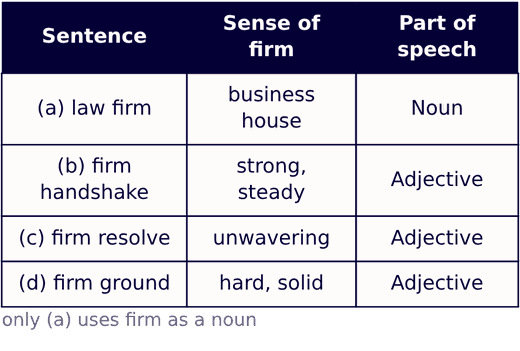
In (b), (c) and (d) "firm" is an adjective meaning solid, steady or unwavering — a firm handshake, a firm resolve, firm ground after a dry spell.
In (a) "firm" is a noun naming a business house; a law firm is a partnership of lawyers, not something that is hard or steady.
So three sentences share one adjectival sense and only one uses the word as a noun.
Hence option (a) is the answer.
13
Choose the correct meaning of the idiom: Living in a bubble
A.To reside in a futuristic, transparent house
B.To be isolated from reality and diverse perspectives
C.To enjoy a carefree and fun-filled life
D.To work in a challenging and competitive environment
Solution
Idiom
"Living in a bubble" means being cut off from the real world, so that one meets only familiar ideas and never hears different points of view.
The image is of a thin transparent sphere: the person inside can see out, but nothing outside actually touches him.
Example: Some politicians are accused of living in a bubble, unaware of the struggles of ordinary people.
Options (a), (c) and (d) read the words literally or invent a sense the idiom never carries.
Hence option (b) is the answer.
14
Choose the correct meaning of the idiom: Cash cow
A.A farm animal that produces milk
B.A business, product, or asset that provides a steady income or profit
C.A worthless investment
D.A difficult or troublesome employee
Solution
Idiom
"Cash cow" means a business, product or asset that keeps yielding a steady profit with little further effort or investment.
The image is of a cow that is milked day after day — the earnings keep flowing in the same way.
Example: Their flagship software has been a cash cow for the company for over a decade.
Option (a) is only the literal picture behind the idiom, and a cash cow is the opposite of the worthless investment in (c).
Hence option (b) is the answer.
15
Choose the correct one-word substitute for:
A person who works with and shapes metal.
A.Carpenter
B.Mason
C.Blacksmith
D.Weaver
Solution
One-word substitution
A Blacksmith is the craftsman who heats iron and other metals in a forge and hammers them into shape.
The name itself is a clue: the "smith" works on the "black" metal, that is iron.
A Carpenter works with wood, a Mason builds with stone or brick, and a Weaver makes cloth on a loom — none of them shapes metal.
Hence option (c) is the answer.
16
Select the most appropriate antonym of the word: ADORE
A.Reverent
B.Loathe
C.Appreciate
D.Idolize
Solution
Antonym
ADORE means to love and admire someone or something very deeply.
Its opposite must express strong dislike, and Loathe means to feel intense hatred or disgust for something.
Reverent (showing deep respect), Appreciate (recognise the worth of) and Idolize (admire excessively) all lie on the same positive side as adore, so they are near-synonyms, not antonyms.
Hence option (b) is the answer.
17
Choose the correct one-word substitute for:
A feeling of intense longing for something.
A.Indifference
B.Apathy
C.Yearning
D.Detachment
Solution
One-word substitution
The definition asks for a single word meaning a deep, aching desire for something one does not have.
Yearning carries exactly that sense of intense longing.
Indifference and Apathy both mean an absence of interest or concern, and Detachment means emotional distance — all three are the very opposite of longing.
Hence option (c) is the answer.
18
Change the following sentence into the Active form.
The athlete is thought to be recovering well after the injury.
A.The injury is thought to be recovering the athlete well.
B.People think that the athlete is recovering well after the injury.
C.The athlete is recovering well after the injury, it is thought.
D.Someone thought that the athlete was recovering well after the injury.
Solution
Passive to active voice
The sentence uses the impersonal passive pattern "X is thought to be ...", whose active counterpart is "People think that X is ...".
The passive names no agent, so the active must supply the general agent "People" as its subject.
The reporting verb is in the present tense (is thought), so the active verb must stay present — think, not thought.
Option (d) back-shifts to the past, option (a) swaps the roles of athlete and injury and changes the meaning, and option (c) is still passive.
Correct sentence: People think that the athlete is recovering well after the injury.
Hence option (b) is the answer.
19
Select the option that expresses the given sentence in indirect voice.
She says, "I am planning to visit Paris next year."
A.She says that she is planning to visit Paris the following year.
B.She says that she was planning to visit Paris next year.
C.She said that she planned to visit Paris the following year.
D.She says that Paris is planned to be visited by her next year.
Solution
Direct to indirect speech
The reporting verb "says" is in the present tense, so the tense of the reported speech is not back-shifted: "I am planning" simply becomes "she is planning".
The first-person pronoun "I" changes to "she", matching the subject of the reporting clause.
The conjunction "that" replaces the inverted commas.
Option (b) wrongly back-shifts to "was planning", option (c) wrongly changes the reporting verb to "said", and option (d) turns the sentence into a clumsy passive.
Hence option (a) is the answer.
20
Choose the most suitable option to replace the highlighted part of the sentence:
Neither of the students has completed their homework neatly.
A.has completed his homework
B.have completed their homework
C.have completed his homework
D.is completed his homework
Solution
Subject-verb-pronoun agreement
"Neither of the students" is a singular subject: "neither" means "not one of the two", and the plural noun after "of" does not change its number.
So the singular verb "has" is already correct; the fault is the plural possessive "their", which must also become singular — "his".
Correct sentence: Neither of the students has completed his homework neatly.
Options (b) and (c) wrongly make the verb plural, and (d) produces an ungrammatical passive "is completed his homework".
Hence option (a) is the answer.
21
Choose the most suitable option to replace the highlighted part of the sentence:
She took of her jacket and folded it neatly before settling down to continue her work.
A.takes on her jacket
B.take off her jacket
C.took on her jacket
D.took off her jacket
Solution
Phrasal verb 'take off'
The sentence needs a phrasal verb meaning 'to remove a piece of clothing', and that verb is 'take off', not 'take of' — 'of' is a preposition and cannot form this phrasal verb.
The rest of the sentence is in the past tense ('folded'), so this verb must also be in the past form: 'took off'.
The highlighted part therefore becomes 'took off her jacket', which is option (d).
Option (b) has the right phrasal verb but the wrong tense, and options (a) and (c) use 'take on', which means 'to accept a responsibility' — the opposite of removing a jacket.
22
Choose the correct passive voice transformation of the sentence:
Workers are repairing the bridge.
A.The bridge was being repaired.
B.The bridge has been repaired.
C.The bridge is being repaired.
D.The bridge is repaired.
Solution
Active to passive voice
The active sentence is in the present continuous tense — 'are repairing'.
Rule: active 'is/are + V-ing' becomes passive 'is/are being + V3'.
The object 'the bridge' becomes the subject; it is singular, so the helping verb is 'is', giving 'The bridge is being repaired.' — option (c).
Option (a) pushes the action into the past, option (b) makes it a present perfect passive, and option (d) drops 'being' and turns a continuing action into a simple present passive.
23
Select the option that expresses the given sentence in direct speech.
The sage advised that they must seek inner peace, and he had always found solace in meditation.
A.The sage advised, 'You must seek inner peace, and I have always found solace in meditation."
B.The sage advised that you must seek inner peace, and he had always found solace in meditation.
C.The sage advised, "They should seek inner peace, and I always found solace in meditation."
D.The sage advised, "They must seek inner peace, and he has always found solace in meditation."
Solution
Indirect to direct speech
To move from indirect to direct speech, drop 'that', put the speaker's own words inside inverted commas and undo the backshift of pronouns and tense.
'They must seek inner peace' was addressed to the listeners, so in the sage's own words the pronoun becomes the second person — 'You must seek inner peace'.
'He had always found solace' refers to the sage himself, so in his own words it becomes the first-person present perfect — 'I have always found solace'.
Option (a) makes exactly these two changes: The sage advised, "You must seek inner peace, and I have always found solace in meditation."
Option (b) is still indirect speech, option (c) keeps 'They' and weakens 'must' to 'should', and option (d) keeps both 'They' and 'he' unchanged.
24
Rearrange the following sentence parts to form a meaningful and grammatically correct paragraph:
P. She lifted the steaming cup and took a slow, careful sip.
Q. Rain began to fall heavily outside, tapping against the glass in steady beats.
R. The room was filled with the rich aroma of freshly brewed coffee.
S. It felt like the perfect evening to sit indoors and unwind.
A.RQPS
B.QSRP
C.SRQP
D.RSPQ
Solution
Para jumble
The paragraph must open with the setting, and only R does that — the room filled with the rich aroma of freshly brewed coffee.
Q adds the second detail of the same scene, the rain tapping against the glass outside, so Q follows R.
P then brings in the action: she lifts the steaming cup of that coffee and takes a slow sip.
S is the closing remark on everything described before it — 'It felt like the perfect evening to sit indoors and unwind.'
The order is therefore R-Q-P-S, i.e. option (a) RQPS.
25
Rearrange the following sentence parts to form a meaningful and grammatically correct paragraph:
P. A cool breeze brushed his face as night slowly settled in.
Q. He stood silently at the edge of the cliff, gazing at the vast sea below.
R. The sky darkened, and the first stars began to appear overhead.
S. Distant lights from passing ships flickered faintly on the horizon.
A.QPRS
B.PQRS
C.SQPR
D.QSRP
Solution
Para jumble
Q is the only sentence that introduces the person and the place, so the paragraph must begin with it.
P continues with what he feels while standing there — the cool breeze and the approach of night — so P follows Q.
R carries the falling night one step further: the sky darkens and the first stars appear.
S closes the description by moving the eye to the far horizon, where the lights of passing ships flicker.
The sequence is Q-P-R-S, i.e. option (a) QPRS.
Finished reading? Now test yourself.
The same 25 questions, but with a timer and the answers hidden — 15 minutes.

 So three sentences share one adjectival sense and only one uses the word as a noun.
Hence option (a) is the answer.
So three sentences share one adjectival sense and only one uses the word as a noun.
Hence option (a) is the answer.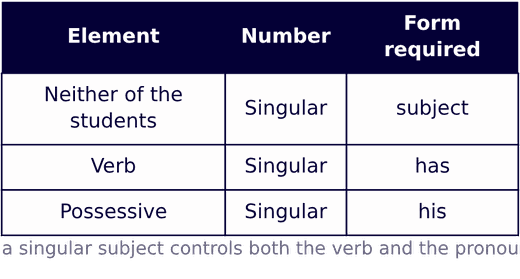 Correct sentence: Neither of the students has completed his homework neatly.
Options (b) and (c) wrongly make the verb plural, and (d) produces an ungrammatical passive "is completed his homework".
Hence option (a) is the answer.
Correct sentence: Neither of the students has completed his homework neatly.
Options (b) and (c) wrongly make the verb plural, and (d) produces an ungrammatical passive "is completed his homework".
Hence option (a) is the answer.