SSC CHSL 18 November 2025 · Shift 1 · General Intelligence — questions with answers · ShikshaSphere
Chapter 57 of 200
18 November 2025 · Shift 1
General Intelligence
25 questions ~25 min readFree
25 questions
A
26
Two numbers differ by 20. If their product is increased by the square of their difference, the result is 1200 . Find the larger number.
A.28
B.34
C.40
D.46
Solution
Numbers from sum and product
Let the larger number be x and the smaller be y, so that x-y=20.
The square of their difference is .
Given: xy+400=1200, hence xy=800.
Use the identity .
, so x+y=60.
Adding x-y=20 and x+y=60 gives 2x=80, i.e. x=40 and y=20.
Check: , so the larger number is 40 and option (c) is correct.
27
The average score of 5 students in a test is 82. If the scores of four students are , and 80 , what is the score of the fifth student?
A.68
B.90
C.85
D.80
Solution
Average: missing value
Total of all five scores .
Total of the four known scores =75+85+90+80=330.
Score of the fifth student =410-330=80.
So option (d) is correct.
28
P, Q, and R started a business by investing ₹5000, ₹3000, and ₹2000 respectively. If the total profit at the end of the year was ₹2000, what is Q's share of the profit ?
A.₹500
B.₹600
C.₹700
D.₹1000
Solution
Partnership: profit sharing
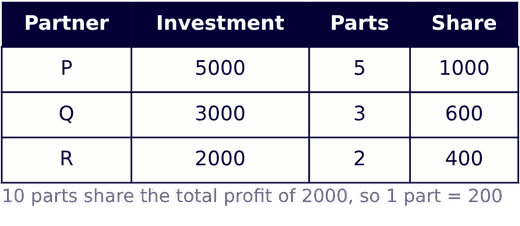
All three invest for the same period of one year, so the profit is divided in the ratio of the investments alone.
P:Q:R=5000:3000:2000=5:3:2.
Total number of parts =5+3+2=10.
Q's share , i.e. ₹600.
So option (b) is correct.
29
What is the average of the following numbers: ?
A.24.2
B.25.4
C.29.2
D.27.2
Solution
Average of numbers
Formula: .
Sum =14+20+34+32+46=146.
There are 5 numbers, so the average .
So option (c) is correct.
30
If a car travels 220 km in 5 hours, what is its average speed in km/hr ?
A.
B.
C.
D.48 km/hr
Solution
Average speed
Formula: .
Substituting, km/hr.
So option (c) is correct.
31
If a number is increased by 20% and then decreased by , what is the net change ?
A.4% increase
B.4% decrease
C.No change
D. decrease
Solution
Successive percentage change
Take the number as 100 — any convenient starting value gives the same percentage answer.
After the increase: 100+20=120.
The decrease is now taken on 120, not on 100: , so the value becomes 120-24=96.
Net change =96-100=-4 on a base of 100, i.e. a decrease of 4%.
Shortcut for two successive changes: net , and with a=20, b=-20 this gives .
So option (b) is correct.
32
During Diwali, Mira decorates 60 candles in a row. The red candle is 20th from the left and 41st from the right. The blue candle is 15th from the left and 46th from the right. How many candles are there between the red and blue candles ?
A.4
B.3
C.This arrangement is impossible
D.1
Solution
Position in a row
Rule: for one object in a row, position from the left + position from the right = total + 1.
Red candle: 20+41=61=60+1, so this information is consistent.
Blue candle: 15+46=61=60+1, so this too is consistent — the arrangement is possible.
Both positions are now counted from the same end, so the number of candles between them =20-15-1=4.
These are the candles standing at places 16, 17, 18 and 19, so option (a) is correct.
33
A shop offers a 20% discount on the marked price of an item. If the selling price is 2800 , what is the marked price ?
A.₹1100
B.₹1000
C.₹950
D.₹1250
Solution
Discount and marked price
A discount of 20% is always taken on the marked price, so the selling price is the remaining 80% of it.
, and therefore .
With the selling price of ₹800, , i.e. ₹1000.
Check: 20% of ₹1000 is ₹200, and ₹1000 − ₹200 = ₹800, the selling price.
So option (b) is correct.
34
A person walks 18 km west, then 24 km north, and finally 18 km east. In which direction is he from his starting point ?
A.North
B.South
C.East
D.West
Solution
Direction sense
The first leg of 18 km is towards the west and the last leg of 18 km is towards the east.
They are equal in length and exactly opposite in direction, so they cancel each other out completely.
Only the 24 km walked towards the north is left as the net displacement.
Hence he ends up 24 km due north of his starting point, and option (a) is correct.
35
A person walks 16 km north, then 18 km west, and finally 16 km South . In which direction is he from his starting point ?
A.North
B.South
C.East
D.West
Solution
Direction sense
The 16 km walked towards the north and the 16 km walked towards the south are equal and opposite.
They cancel out, so the man is back on the same east–west line as his starting point.
What remains is the 18 km walked towards the west.
Hence he is 18 km due west of his starting point, and option (d) is correct.
36
Few of the letters are given followed by a question mark (?) these letters are following a specific pattern you have to give the correct option which can replace question mark.
Complete the sequence: F, C, Z, W, ?
A.M
B.N
C.T
D.Q
Solution
Letter series
Write the alphabet position of each letter: F = 6, C = 3, Z = 26, W = 23.
Every step moves back 3 places, counting round the alphabet: 6-3=3 gives C, and 3-3=0 wraps round to 26, which is Z.
Continuing, 26-3=23 gives W, so the next term is 23-3=20.
The 20th letter of the alphabet is T, so option (c) is correct.
37
What will come in place of the question mark (?) in the following number series?
55, 89, 144, 233, 377 , ?
A.560
B.610
C.577
D.630
Solution
Fibonacci number series
Test the simplest additive rule: is each term the sum of the two before it?
55+89=144, 89+144=233 and 144+233=377 — the rule holds throughout, so this is a Fibonacci-type series.
Therefore the missing term =233+377=610.
So option (b) is correct.
38
Identify the missing number in the following number sequence.
22, 18, 44, 36, 132, 108, ?, 432
A.528
B.436
C.480
D.580
Solution
Alternating number series
No single rule joins neighbouring terms, so split the series into the terms at the odd places and the terms at the even places.
Odd places: 22, 44, 132, ? — here and .
Even places: 18, 36, 108, 432 — here , and .
Both chains follow the same rule: multiply by 2, then by 3, then by 4.
So the missing term , and option (a) is correct.
39
Which one of the following number pairs is not divisible by both 11 and 17 ?
A.
B.
C.
D.
Solution
Divisibility by 11 and 17
11 and 17 are both prime, so a number divisible by both must be a multiple of .
The test therefore reduces to a single question: is the number a multiple of 187?
, , and — all four clear the test.
But , so it is divisible by 11 and not by 17; 198=187+11 is not a multiple of 187.
Hence the pair (198, 374) fails, and option (d) is correct.
40
Complete the following series from the given options.
k_Imml_mk_mmk_lkkl_m
A.I, k, m, k, k
B.k, l, m, k, k
C.k, l, k, l, m
D.k, m, m, k, l
Solution
Letter-cluster series
Only the three letters k, l and m are used and the string has 20 places, so read it in four groups of five.
Filling the five blanks with k, l, k, l, m gives: kklmm / llmkk / mmkll / kklmm.
Now the rule is visible — each group is the previous group with every letter moved one step along the cycle k to l, l to m, m back to k.
The fourth group returns to kklmm, which is exactly what the last five given letters demand.
No other option produces this pattern, so option (c) is correct.
41
Which of the following options will replace the question mark (?) in the given series?
W1, U2, S3, Q4, ?
A.05
B.M5
C.R6
D.J5
Solution
Alternating letter-number series
Every term has two independent parts — a letter and a number — so track them separately.
Letters: W, U, S, Q. Each letter moves 2 places backward, so the next letter is Q minus 2, i.e. O.
Numbers: 1, 2, 3, 4. Each number increases by 1, so the next number is 5.
Putting the two parts together, the missing term is O5.
Hence, option (a) is the most appropriate answer.
42
What should come next in the following series?
P4, R16, T36, V64, ?
A.X 100
B.M100
C.Z100
D.Y100
Solution
Letter-number series
Split every term into its letter part and its number part.
Letters: P, R, T, V — each letter moves 2 places forward, so the next letter is X.
Numbers: , , , — squares of consecutive even numbers.
The next even number is 10, so the next number is .
The missing term is therefore X100.
Hence, option (a) is the most appropriate answer.
43
If in a certain code, 'GUITAR' is written as 'FETSHGSRZYQP', what is the code of MANGO' ?
A.LKZYMLFENM
B.LKZYMLFEMN
C.LKZYLMFENM
D.LZKYMLFENM
Solution
Letter coding
The word has 6 letters but the code has 12, so every single letter of the word becomes a pair of letters.
Break the code into pairs: FE, TS, HG, SR, ZY, QP.
For each letter the pair is (letter − 1, letter − 2), i.e. the two letters that come just before it, written in that order.
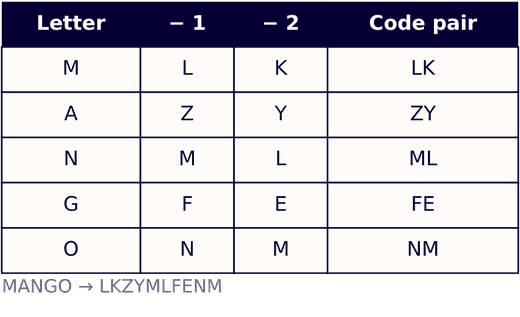
Apply exactly the same rule to MANGO, moving backward past A to Z when needed.
Joining the pairs, MANGO becomes LK + ZY + ML + FE + NM = LKZYMLFENM.
Hence, option (a) is the most appropriate answer.
44
In the question given below, an assertion(A) is given, followed by a reason(R) which may or may not explain the assertion. From the given options, choose the right answer.
A) Regular exercise helps a person stay healthy.
R) Exercise improves blood circulation and increases the body's immunity.
A.Both A and R are true, and R is the correct explanation for A .
B.Both A and R are true, but R is not the correct explanation for A.
C.A is true, while R is false.
D.A is false, while R is true.
Solution
Assertion and Reason
Step 1 — test A on its own: regular exercise is universally accepted as a way of staying healthy, so A is true.
Step 2 — test R on its own: exercise makes the heart pump more efficiently and strengthens the body's defence system, so R is also true.
Step 3 — test the link: better blood circulation and stronger immunity are precisely the mechanisms through which exercise produces good health, so R answers the question 'why is A true?'.
Both statements are true and R is the correct explanation of A.
Hence, option (a) is the most appropriate answer.
45
Based on the statement(s) given below, choose the best possible conclusion(s) that follows:Statements:
Only those students who score 60% or more marks in Mathematics will be given admission to the Science
Conclusions:
I. Mathematics is a compulsory subject to get admission to the Science stream.
II. A student who scores 55% marks in Mathematics will not be given admission to the Science stream.
A.Only conclusion I follows
B.Only conclusion II follows
C.Both conclusion I and II follow
D.Neither conclusion I nor II follows
Solution
Statement and conclusions
The key word is 'Only'. It turns the Mathematics score into a necessary condition: no student can enter the Science stream without 60% or more in Mathematics.
Conclusion I: since admission is impossible without a Mathematics score, Mathematics has to be studied and cleared — it is compulsory for admission, so I follows.
Conclusion II: 55% is below the 60% cut-off, so such a student lies outside the admitted group and will not be given admission — so II follows.
Both conclusions therefore follow from the statement.
Hence, option (c) is the most appropriate answer.
46
Carefully examine the Reference Statement. Then, identify the single option among the four alternatives (a, b, c, d) that is an EXACT AND COMPLETE REPLICATION of the Reference Statement. Pay exceptionally close attention to every character, number, symbol, space, and punctuation mark.
Reference: New Delhi, 26/11/2008, 09:30 PM.
A.New Delhi, 26/11/2008, 09:30 AM.
B.New Delhi, 26/11/2008, 09:30 PM.
C.New Delhi, 26/11/2008, 9:30 PM.
D.New Delhi, 26/11/2008, 09:25 PM.
Solution
Exact replication check
Compare each option with the reference 'New Delhi, 26/11/2008, 09:30 PM.' block by block: city, date, time, and the closing full stop.
Option (a) changes the meridian marker PM to AM, option (c) drops the leading zero and writes 9:30, and option (d) changes the minutes from 30 to 25.
Only option (b) repeats every character, digit, symbol and space exactly as in the reference.
Hence, option (b) is the most appropriate answer.
47
For the question below, carefully examine the Reference Statement. Then, identify the single option among the four alternatives (a, b, c, d) that is an EXACT AND COMPLETE REPLICATION of the Reference Statement. Pay exceptionally close attention to every character, number, symbol, space, and punctuation mark.
Reference: 3rd Flr., Sunrise Bus. Tower,Plot 18,Sec. 62, Noida - 201309, UP, India
Exact replication check
Break the long address into its four checkable numbers — Plot 18, Sec. 62, PIN 201309 — and compare option by option.
Option (a) shows Plot 19, option (c) shows Sec. 63 and option (d) shows the PIN 201319; each differs from the reference by a single digit.
Option (b) reproduces the address exactly, including the missing spaces after 'Tower,' and 'Plot 18,'.
Hence, option (b) is the most appropriate answer.
48
For the question below, carefully examine the Reference Statement. Then, identify the single option among the four alternatives (a, b, c, d) that is an EXACT AND COMPLETE REPLICATION of the Reference Statement. Pay exceptionally close attention to every character, number, symbol, space, and punctuation mark.
Reference: Oxford: 15th March, 1892
A.Oxford: 15th March, 1893
B.Oxford: 16th March, 1892
C.Oxford: 15th March, 1892
D.Oxford: 15th March, 1992
Solution
Exact replication check
The reference has three checkable pieces: the day 15th, the month March and the year 1892.
Option (a) changes the year to 1893, option (b) changes the day to 16th and option (d) changes the year to 1992.
Option (c) matches the reference in every character, including the colon after Oxford and the comma before the year.
Hence, option (c) is the most appropriate answer.
49
In the following question, select the number which can be placed at the sign of question mark (?) from the given alternatives.
A.83
B.85
C.87
D.89
Solution
Number matrix
The three numbers of each column produce the number written below that column, so read the grid column-wise.
First column: .
Second column: .
The rule is therefore (product of the three numbers) -1.
Third column: .
Hence, option (d) is the most appropriate answer.
50
In the following question, select the number which can be placed at the sign of question mark (?) from the given alternatives.
Matrix:
A.191
B.185
C.190
D.187
Solution
Number matrix
Again the bottom entry of each column is built from the three numbers standing above it.
First column: .
Second column: .
Both fit the rule (product of the three numbers) -1.
Third column: .
Hence, option (a) is the most appropriate answer.
Finished reading? Now test yourself.
The same 25 questions, but with a timer and the answers hidden — 15 minutes.

 Total number of parts =5+3+2=10.
Q's share , i.e. ₹600.
So option (b) is correct.
Total number of parts =5+3+2=10.
Q's share , i.e. ₹600.
So option (b) is correct.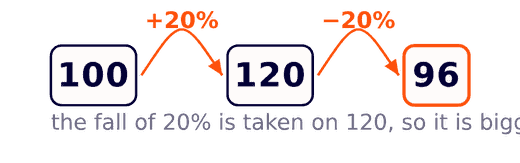 The decrease is now taken on 120, not on 100: , so the value becomes 120-24=96.
Net change =96-100=-4 on a base of 100, i.e. a decrease of 4%.
Shortcut for two successive changes: net , and with a=20, b=-20 this gives .
So option (b) is correct.
The decrease is now taken on 120, not on 100: , so the value becomes 120-24=96.
Net change =96-100=-4 on a base of 100, i.e. a decrease of 4%.
Shortcut for two successive changes: net , and with a=20, b=-20 this gives .
So option (b) is correct.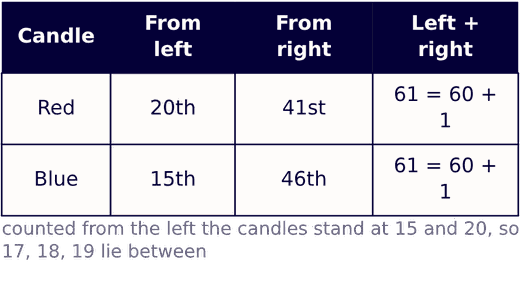 Red candle: 20+41=61=60+1, so this information is consistent.
Blue candle: 15+46=61=60+1, so this too is consistent — the arrangement is possible.
Both positions are now counted from the same end, so the number of candles between them =20-15-1=4.
These are the candles standing at places 16, 17, 18 and 19, so option (a) is correct.
Red candle: 20+41=61=60+1, so this information is consistent.
Blue candle: 15+46=61=60+1, so this too is consistent — the arrangement is possible.
Both positions are now counted from the same end, so the number of candles between them =20-15-1=4.
These are the candles standing at places 16, 17, 18 and 19, so option (a) is correct.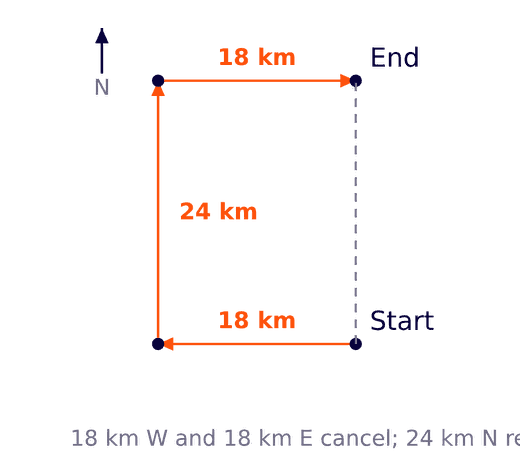 The first leg of 18 km is towards the west and the last leg of 18 km is towards the east.
They are equal in length and exactly opposite in direction, so they cancel each other out completely.
Only the 24 km walked towards the north is left as the net displacement.
Hence he ends up 24 km due north of his starting point, and option (a) is correct.
The first leg of 18 km is towards the west and the last leg of 18 km is towards the east.
They are equal in length and exactly opposite in direction, so they cancel each other out completely.
Only the 24 km walked towards the north is left as the net displacement.
Hence he ends up 24 km due north of his starting point, and option (a) is correct.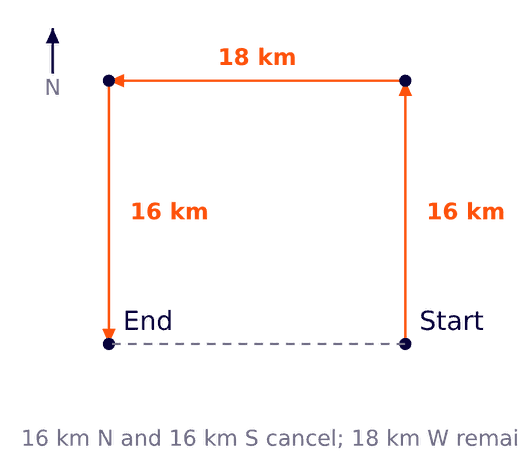 The 16 km walked towards the north and the 16 km walked towards the south are equal and opposite.
They cancel out, so the man is back on the same east–west line as his starting point.
What remains is the 18 km walked towards the west.
Hence he is 18 km due west of his starting point, and option (d) is correct.
The 16 km walked towards the north and the 16 km walked towards the south are equal and opposite.
They cancel out, so the man is back on the same east–west line as his starting point.
What remains is the 18 km walked towards the west.
Hence he is 18 km due west of his starting point, and option (d) is correct.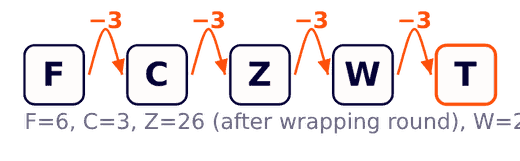 Every step moves back 3 places, counting round the alphabet: 6-3=3 gives C, and 3-3=0 wraps round to 26, which is Z.
Continuing, 26-3=23 gives W, so the next term is 23-3=20.
The 20th letter of the alphabet is T, so option (c) is correct.
Every step moves back 3 places, counting round the alphabet: 6-3=3 gives C, and 3-3=0 wraps round to 26, which is Z.
Continuing, 26-3=23 gives W, so the next term is 23-3=20.
The 20th letter of the alphabet is T, so option (c) is correct.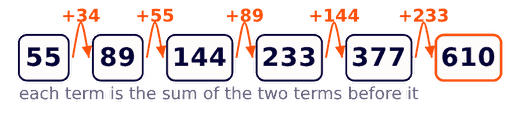 Therefore the missing term =233+377=610.
So option (b) is correct.
Therefore the missing term =233+377=610.
So option (b) is correct.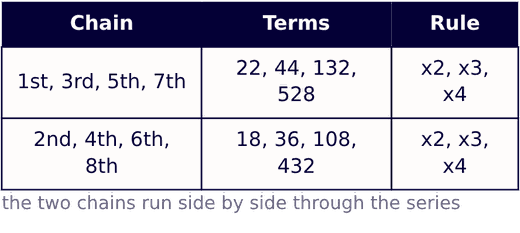 Both chains follow the same rule: multiply by 2, then by 3, then by 4.
So the missing term , and option (a) is correct.
Both chains follow the same rule: multiply by 2, then by 3, then by 4.
So the missing term , and option (a) is correct.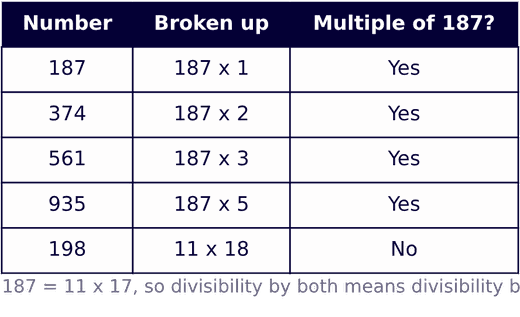 , , and — all four clear the test.
But , so it is divisible by 11 and not by 17; 198=187+11 is not a multiple of 187.
Hence the pair (198, 374) fails, and option (d) is correct.
, , and — all four clear the test.
But , so it is divisible by 11 and not by 17; 198=187+11 is not a multiple of 187.
Hence the pair (198, 374) fails, and option (d) is correct.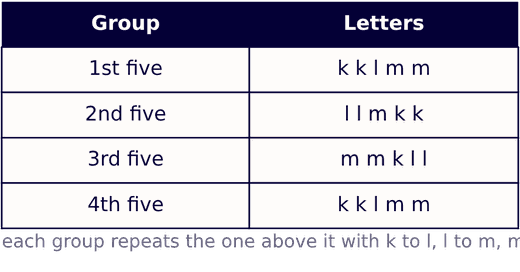 Now the rule is visible — each group is the previous group with every letter moved one step along the cycle k to l, l to m, m back to k.
The fourth group returns to kklmm, which is exactly what the last five given letters demand.
No other option produces this pattern, so option (c) is correct.
Now the rule is visible — each group is the previous group with every letter moved one step along the cycle k to l, l to m, m back to k.
The fourth group returns to kklmm, which is exactly what the last five given letters demand.
No other option produces this pattern, so option (c) is correct.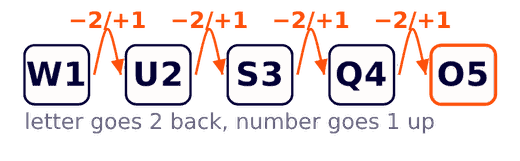 Putting the two parts together, the missing term is O5.
Hence, option (a) is the most appropriate answer.
Putting the two parts together, the missing term is O5.
Hence, option (a) is the most appropriate answer.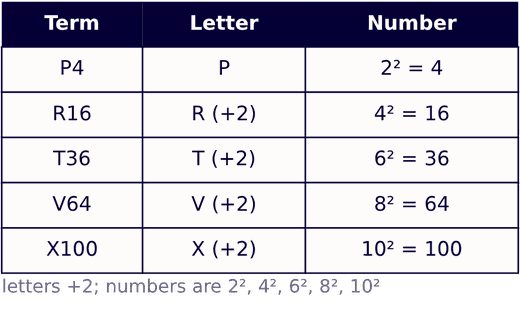 The missing term is therefore X100.
Hence, option (a) is the most appropriate answer.
The missing term is therefore X100.
Hence, option (a) is the most appropriate answer.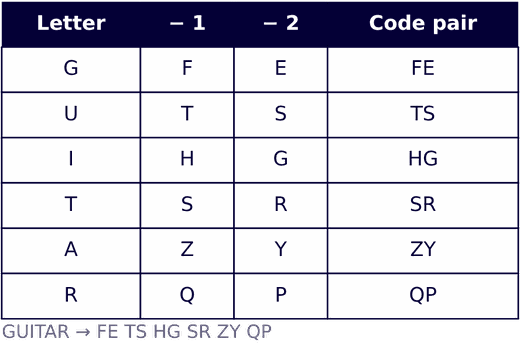 Apply exactly the same rule to MANGO, moving backward past A to Z when needed.
 Joining the pairs, MANGO becomes LK + ZY + ML + FE + NM = LKZYMLFENM.
Hence, option (a) is the most appropriate answer.
Joining the pairs, MANGO becomes LK + ZY + ML + FE + NM = LKZYMLFENM.
Hence, option (a) is the most appropriate answer.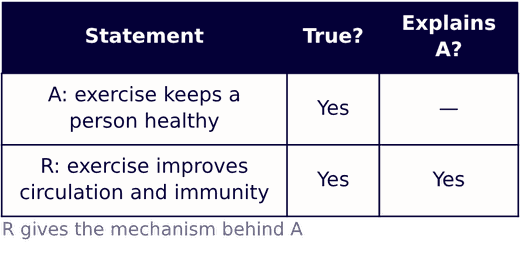 Both statements are true and R is the correct explanation of A.
Hence, option (a) is the most appropriate answer.
Both statements are true and R is the correct explanation of A.
Hence, option (a) is the most appropriate answer.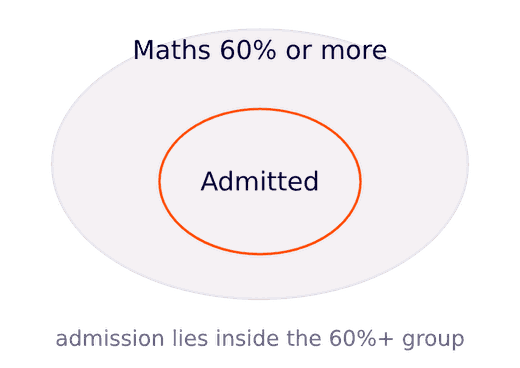 Conclusion I: since admission is impossible without a Mathematics score, Mathematics has to be studied and cleared — it is compulsory for admission, so I follows.
Conclusion II: 55% is below the 60% cut-off, so such a student lies outside the admitted group and will not be given admission — so II follows.
Both conclusions therefore follow from the statement.
Hence, option (c) is the most appropriate answer.
Conclusion I: since admission is impossible without a Mathematics score, Mathematics has to be studied and cleared — it is compulsory for admission, so I follows.
Conclusion II: 55% is below the 60% cut-off, so such a student lies outside the admitted group and will not be given admission — so II follows.
Both conclusions therefore follow from the statement.
Hence, option (c) is the most appropriate answer.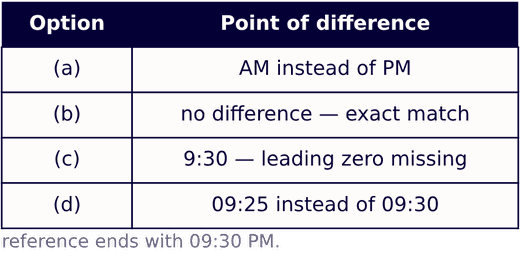 Option (a) changes the meridian marker PM to AM, option (c) drops the leading zero and writes 9:30, and option (d) changes the minutes from 30 to 25.
Only option (b) repeats every character, digit, symbol and space exactly as in the reference.
Hence, option (b) is the most appropriate answer.
Option (a) changes the meridian marker PM to AM, option (c) drops the leading zero and writes 9:30, and option (d) changes the minutes from 30 to 25.
Only option (b) repeats every character, digit, symbol and space exactly as in the reference.
Hence, option (b) is the most appropriate answer.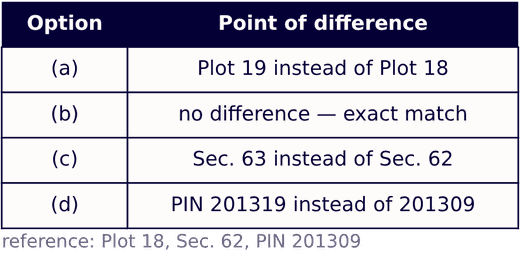 Option (a) shows Plot 19, option (c) shows Sec. 63 and option (d) shows the PIN 201319; each differs from the reference by a single digit.
Option (b) reproduces the address exactly, including the missing spaces after 'Tower,' and 'Plot 18,'.
Hence, option (b) is the most appropriate answer.
Option (a) shows Plot 19, option (c) shows Sec. 63 and option (d) shows the PIN 201319; each differs from the reference by a single digit.
Option (b) reproduces the address exactly, including the missing spaces after 'Tower,' and 'Plot 18,'.
Hence, option (b) is the most appropriate answer.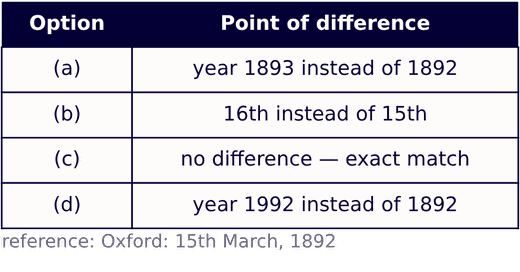 Option (a) changes the year to 1893, option (b) changes the day to 16th and option (d) changes the year to 1992.
Option (c) matches the reference in every character, including the colon after Oxford and the comma before the year.
Hence, option (c) is the most appropriate answer.
Option (a) changes the year to 1893, option (b) changes the day to 16th and option (d) changes the year to 1992.
Option (c) matches the reference in every character, including the colon after Oxford and the comma before the year.
Hence, option (c) is the most appropriate answer.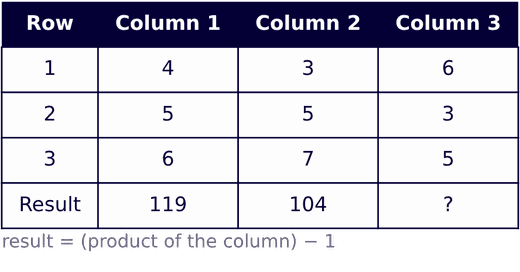 First column: .
Second column: .
The rule is therefore (product of the three numbers) -1.
Third column: .
Hence, option (d) is the most appropriate answer.
First column: .
Second column: .
The rule is therefore (product of the three numbers) -1.
Third column: .
Hence, option (d) is the most appropriate answer.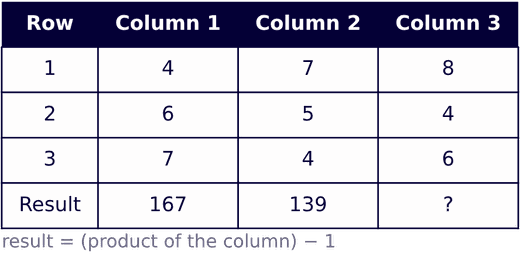 First column: .
Second column: .
Both fit the rule (product of the three numbers) -1.
Third column: .
Hence, option (a) is the most appropriate answer.
First column: .
Second column: .
Both fit the rule (product of the three numbers) -1.
Third column: .
Hence, option (a) is the most appropriate answer.