SSC CHSL 18 November 2025 · Shift 1 · English Language — questions with answers · ShikshaSphere
Chapter 60 of 200
18 November 2025 · Shift 1
English Language
25 questions ~25 min readFree
25 questions
A
1
Identify the part of the sentence that contains a grammatical error.
A. The team of doctors, B. along with the intern, C . were treating the sick patient D . in the emergency room.
A.The team of doctors
B.along with the intern
C.were treating the sick patient
D.in the emergency room.
Solution
Subject-verb agreement
The error is in part C: 'were treating' must be 'was treating'.
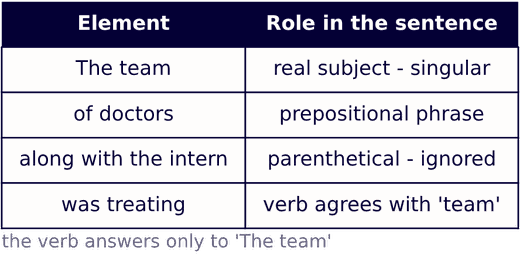
Phrases such as along with, together with, as well as and in addition to are parenthetical — they add information but never join a second subject to the sentence.
The real subject is 'The team', a singular collective noun taken as one unit, so the verb stays singular.
'of doctors' is only a prepositional phrase; the plural noun inside it never controls the verb.
Correct sentence: The team of doctors, along with the intern, was treating the sick patient in the emergency room.
2
Identify the part of the sentence that contains a grammatical error.
A. The bird flew B. so highly that C. it vanished into D. the blue sky.
A.The bird flew
B.so highly that
C.it vanished into
D.the blue sky.
Solution
Adverb form: high / highly
Part B is wrong: 'so highly that' should be 'so high that'.
'High' is the adverb of physical height or distance — fly high, jump high, climb high.
'Highly' means 'to a great degree' and is used figuratively — highly qualified, highly paid, highly respected.
A bird's flight is literal height, so the correct sentence is: The bird flew so high that it vanished into the blue sky.
3
Fill in the blank with the most appropriate preposition:
The builders adhered safety standards while constructing the high tower.
A.on
B.for
C.to
D.by
Solution
Preposition with 'adhere'
'Adhere' is always followed by the preposition 'to'.
Adhere to = to stick to or follow rules, standards or principles strictly.
'On', 'for' and 'by' do not collocate with 'adhere' at all.
So the sentence reads: The builders adhered to safety standards while constructing the high tower.
4
Fill in the blank with the most appropriate verb:
He his involvement in the crime only after facing pressure from the police.
A.denies
B.confessed
C.rejects
D.claims
Solution
Appropriate verb choice
The blank needs a verb meaning 'admitted his guilt'.
'Confessed' = admitted to a crime or wrongdoing, and its past form matches 'only after facing pressure from the police'.
'Denies', 'rejects' and 'claims' are present-tense and carry the opposite sense — a man who yields to police pressure admits, he does not deny.
So: He confessed his involvement in the crime only after facing pressure from the police.
5
Select the most appropriate synonym of the word: Eloquent
A.Silent
B.Fluent
C.Hesitant
D.Awkward
Solution
Synonym: Eloquent
Eloquent = fluent, expressive and persuasive in speaking or writing.
So 'Fluent' is the closest synonym.
Silent = making no sound; Hesitant = unsure and halting while speaking; Awkward = clumsy or uneasy.
Memory hook: an eloquent speaker never stumbles — the words simply flow.
6
Select the most appropriate synonym of the word: Sanguine
A.Pessimistic
B.Hopeful
C.Fearful
D.Anxious
Solution
Synonym: Sanguine
Sanguine = cheerfully optimistic, hopeful even in a difficult situation.
So 'Hopeful' is the synonym.
Pessimistic, Fearful and Anxious all carry a negative expectation, so they are opposites here.
Sanguine literally means 'blood-red'; a ruddy, healthy face was once believed to show a cheerful temperament.
7
Choose the correct meaning of the idiom: Up and about
A.Feeling lazy and tired
B.Active again after illness or rest
C.Feeling angry or upset
D.Sleeping deeply
Solution
Idiom: Up and about
'Up and about' = out of bed and active again after an illness or a period of rest.
Example: After a week of fever, she is finally up and about.
Hence 'Active again after illness or rest' is the correct meaning.
The idiom stresses recovery, so 'lazy and tired', 'angry' and 'sleeping deeply' are all opposite in sense.
8
Select the most appropriate antonym of the word: Vacant
A.Occupied
B.Empty
C.Blank
D.Hollow
Solution
Antonym: Vacant
Vacant = empty, unfilled, with nobody in it.
Its opposite is 'Occupied' = being used or filled by someone or something.
Empty, Blank and Hollow are synonyms of vacant, not antonyms — a classic trap in antonym questions.
A 'vacant seat' becomes an 'occupied seat' the moment someone sits on it.
9
Select the most appropriate antonym of the word: Probity
A.Dishonesty
B.Integrity
C.Rectitude
D.Virtue
Solution
Antonym: Probity
Probity = complete honesty, uprightness and strong moral principles.
The opposite of honesty is 'Dishonesty'.
Integrity, Rectitude and Virtue all denote moral goodness, so all three are synonyms of probity.
Probity comes from Latin probus, 'good, honest' — the same root that gives 'probe' and 'prove'.
10
Choose the correct one-word substitute for:
A style of writing characterized by excessive display of learning
A.Didacticism
B.Pedantry
C.Satire
D.Intellectualism
Solution
One-word substitution
Pedantry = an ostentatious parade of learning; a fussy, over-scholarly display of bookish knowledge and rules.
That is exactly 'a style of writing characterized by excessive display of learning'.
Didacticism = writing meant to teach a moral lesson; Satire = humour, irony or ridicule used to expose folly; Intellectualism = devotion to intellectual pursuits.
Remember the difference: a pedant parades knowledge, a didactic writer teaches with it.
11
Which sentence contains a misspelled word?
A.It is definite that they will separate the two departments by next week.
B.She gave a definite answer when asked if she wanted to separate the accounts.
C.They need to seperate the recyclable items before they can get a definite count.
D.Please separate the files so we can make a definite plan for the merger.
Solution
Spelling: separate
Option (c) carries the misspelling: 'seperate'.
The correct spelling is 'separate' — there is 'a rat' hidden in sep-a-rate.
'Definite' is spelt correctly in all four sentences, so only the other word decides the answer.
Correct sentence: They need to separate the recyclable items before they can get a definite count.
12
Select the option that expresses the given sentence in indirect voice. The manager said, "I have been reviewing this proposal for a week, but I still do not see the benefit, which is the main goal.'
A.The manager said that he had been reviewing that proposal for a week, but he still did not see the benefit, which was the main goal.
B.The manager said that he has been reviewing this proposal for a week, but he still does not see the benefit, which is the main goal.
C.The manager said that he had been reviewing this proposal for a week, but he still did not see the benefit, which was the main goal.
D.The manager said that he had been reviewing that proposal for a week, but he still does not see the benefit, which is the main goal.
Solution
Direct to indirect speech
The reporting verb 'said' is in the past tense, so every verb inside the quotation moves one step back and the near demonstrative changes.
'I' becomes 'he' (the manager) and 'this proposal' becomes 'that proposal'.
Only option (a) makes all of these changes; (c) keeps 'this', while (b) and (d) leave some verbs unshifted.
So: The manager said that he had been reviewing that proposal for a week, but he still did not see the benefit, which was the main goal.
13
Select the option that expresses the given sentence in indirect voice. The teacher said, "If you study hard, you will pass the exam."
A.The teacher said that if you studied hard, you would pass the exam.
B.The teacher said that if he/she studied hard, he/she would pass the exam.
C.The teacher said that if one studies hard, one will pass the exam.
D.The teacher said that if one studied hard, one would pass the exam.
Solution
Reported conditional sentence
The quoted sentence is a first conditional; after the past reporting verb 'said' it shifts to the second conditional.
No listener is named in the sentence, so 'you' can neither be kept nor safely become 'he/she'; the neutral pronoun 'one' is used, and once chosen it must be repeated in both halves.
Option (c) leaves 'studies … will' in the present, so the backshift rule is broken.
Hence: The teacher said that if one studied hard, one would pass the exam.
14
Which sentence contains a misspelled word?
A.The company offers a full guarantee on all products.
B.Can you gaurantee that the package will arrive today?
C.There is no guarantee that the plan will succeed.
D.I can guarantee he will be there on time.
Solution
Spelling: guarantee
Option (b) is misspelt: 'gaurantee'.
The correct spelling is 'guarantee' — the 'u' comes straight after the 'g', as in guard, guest and guide.
The other three sentences spell the word correctly.
Correct sentence: Can you guarantee that the package will arrive today?
15
Choose the most suitable option to replace the highlighted part of the sentence:All the board members was varied in their views.
A.All the board member were varied
B.All the board members were varied
C.All the board were varied between their views
D.All boards have varied in their views
Solution
Subject-verb agreement
The subject of the highlighted part is 'members', a plural noun, so the verb must be plural too.
'was' is singular; replacing it with 'were' repairs the agreement and nothing else in the segment needs changing.
Option (a) wrongly makes the noun singular ('member'); (c) drops 'members' and needlessly alters the phrase; (d) changes both the meaning and the tense.
Hence: All the board members were varied in their views.
16
Choose the most suitable option to replace the highlighted part of the sentence:One must keep ones' word.
A.One must keep one's word
B.One must keep once words
C.One must keep once word
D.One must keep their word
Solution
Possessive of 'one'
The pronoun 'one' takes the possessive form 'one's' — apostrophe before the s, exactly like a singular noun.
'ones'' is the plural possessive of the noun 'one' and has no place here.
'Once' is an adverb meaning 'one time' and has no possessive form at all, so (b) and (c) fail; (d) pairs the singular 'one' with the plural 'their'.
Correct sentence: One must keep one's word.
17
Choose the correct passive voice transformation of the sentence:
You must pay the bill.
A.The bill must be paid by you.
B.The bill must being paid by you.
C.The bill must have been paid by you.
D.The bill is must be paid by you.
Solution
Passive voice with modal
Active pattern: subject + modal + V1 + object. Passive pattern: object + modal + be + V3 + by + agent.
So 'must pay' becomes 'must be paid', 'the bill' moves to the front and 'you' becomes 'by you'.
'must being paid' is not a possible verb form, and 'must have been paid' shifts the sense to a completed past action.
Hence: The bill must be paid by you.
18
Choose the correct passive voice transformation of the sentence:
The night watchman had forgotten to shut the factory gate before dawn.
A.The factory gate was forgotten to be shut by the night watchman before dawn.
B.The factory gate had been forgotten to be shut by the night watchman before dawn.
C.The factory gate has been forgotten to be shut by the night watchman before dawn.
D.The factory gate had forgotten to shut by the night watchman before dawn.
Solution
Passive of past perfect
The active verb is 'had forgotten' — past perfect — so the passive auxiliary must be 'had been'.
Rule: object + had been + V3 + by + agent.
The infinitive that follows also turns passive: 'to shut' becomes 'to be shut'.
Option (a) drops the perfect tense, (c) turns it into the present perfect, and (d) keeps the active 'had forgotten' while adding a 'by' agent.
Hence: The factory gate had been forgotten to be shut by the night watchman before dawn.
19
Select the option that expresses the given sentence in direct voice.
The employee told his boss that he needed to leave early that day because he had been working continuously since the day before, and his wife was calling him.
A."I need to leave early today because I have been working continuously since yesterday, and my wife is calling me," the employee said to his boss.
B."I needed to leave early that day because I had been working continuously since the day before, and my wife was calling me,' the employee said to his boss.
C."I need to leave early today because I was working continuously since yesterday, and my wife was calling me," the employee said to his boss.
D."I need to leave early that day because I had been working continuously since the day before, and my wife is calling me," the employee said to his boss.
Solution
Indirect to direct speech
Turning indirect speech into direct speech reverses the backshift: past perfect continuous returns to present perfect continuous and the past simple returns to the present.
The distance words come back as well, and inside the quotation 'he/his' becomes 'I/my'.
Only option (a) reverses every change; (b) keeps the reported forms, (c) breaks 'have been working', and (d) mixes shifted and unshifted verbs.
Hence: "I need to leave early today because I have been working continuously since yesterday, and my wife is calling me," the employee said to his boss.
20
Directions (Qs. 20-24): Read the following passage carefully and answer the questions that follow.
India's engagement with the cosmos is deeply rooted in its scientific heritage, for the study of astronomy originally known as "jyotisha" flourished on the subcontinent centuries ago. Initially established to foster indigenous space technology, the Indian Space Research Organisation (ISRO) evolved through determined self-reliance before propelling itself skyward, ultimately becoming a global space giant.
In the modern era, India's reputation on the celestial stage began with the successful launch of Aryabhata in the late 20th century. ISRO's unique operational philosophy, combining frugal engineering with technological precision, earned it the admiration of space agencies worldwide and inspired a nation of scientists. This success catalysed government support for exploration, leading to an increase in satellite launches, lunar missions, and interplanetary probes across the solar system.
The 21st century has witnessed the execution of landmark missions such as Chandrayaan-3 and Mangalyaan, whose triumphs in deep space have positioned India as a dominant force in cost-effective space travel. Private sector participation has further accelerated technological innovation, allowing startups to collaborate with seasoned scientists, thus honing their technical ingenuity from an early stage.
Today, India stands not merely as a participant in space exploration but as a pioneering leader shaping its direction. This progression from ancient observation to modern execution underscores the nation's soaring ambition in the cosmic arena.
The phrase "allowing startups to collaborate with seasoned scientists" functions as:
A.Noun clause
B.Adverbial phrase
C.Participle phrase
D.Absolute phrase
Solution
Participle phrase
The phrase opens with 'allowing', the present participle (-ing) form of a verb, and it has no subject and no finite verb of its own.
A word group built round a participle and used to modify is called a participle phrase.
Here it modifies the whole preceding clause, telling us what private-sector participation did.
It is not a noun clause, because a clause needs a subject and a finite verb; and it is not an absolute phrase, which would carry its own noun subject, as in 'startups being free to collaborate'.
Hence the phrase functions as a participle phrase.
21
Directions (Qs. 20-24): Read the following passage carefully and answer the questions that follow.
India's engagement with the cosmos is deeply rooted in its scientific heritage, for the study of astronomy originally known as "jyotisha" flourished on the subcontinent centuries ago. Initially established to foster indigenous space technology, the Indian Space Research Organisation (ISRO) evolved through determined self-reliance before propelling itself skyward, ultimately becoming a global space giant.
In the modern era, India's reputation on the celestial stage began with the successful launch of Aryabhata in the late 20th century. ISRO's unique operational philosophy, combining frugal engineering with technological precision, earned it the admiration of space agencies worldwide and inspired a nation of scientists. This success catalysed government support for exploration, leading to an increase in satellite launches, lunar missions, and interplanetary probes across the solar system.
The 21st century has witnessed the execution of landmark missions such as Chandrayaan-3 and Mangalyaan, whose triumphs in deep space have positioned India as a dominant force in cost-effective space travel. Private sector participation has further accelerated technological innovation, allowing startups to collaborate with seasoned scientists, thus honing their technical ingenuity from an early stage.
Today, India stands not merely as a participant in space exploration but as a pioneering leader shaping its direction. This progression from ancient observation to modern execution underscores the nation's soaring ambition in the cosmic arena.
Identify the voice in "Initially established to foster indigenous space technology".
A.Active voice
B.Passive voice
C.Middle voice
D.Causative voice
Solution
Voice identification
The phrase is a past-participle clause — 'established' is the V3 form, and it tells what was done to ISRO, not what ISRO did.
Written out in full it reads: 'ISRO was initially established (by its founders) to foster indigenous space technology.'
The subject receives the action instead of performing it, and that is the defining mark of the passive voice.
In the active voice the doer would have to come first: 'The government initially established ISRO to foster indigenous space technology.'
'Middle voice' and 'causative voice' are not voices of English grammar at all — English has only the active and the passive.
22
Directions (Qs. 20-24): Read the following passage carefully and answer the questions that follow.
India's engagement with the cosmos is deeply rooted in its scientific heritage, for the study of astronomy originally known as "jyotisha" flourished on the subcontinent centuries ago. Initially established to foster indigenous space technology, the Indian Space Research Organisation (ISRO) evolved through determined self-reliance before propelling itself skyward, ultimately becoming a global space giant.
In the modern era, India's reputation on the celestial stage began with the successful launch of Aryabhata in the late 20th century. ISRO's unique operational philosophy, combining frugal engineering with technological precision, earned it the admiration of space agencies worldwide and inspired a nation of scientists. This success catalysed government support for exploration, leading to an increase in satellite launches, lunar missions, and interplanetary probes across the solar system.
The 21st century has witnessed the execution of landmark missions such as Chandrayaan-3 and Mangalyaan, whose triumphs in deep space have positioned India as a dominant force in cost-effective space travel. Private sector participation has further accelerated technological innovation, allowing startups to collaborate with seasoned scientists, thus honing their technical ingenuity from an early stage.
Today, India stands not merely as a participant in space exploration but as a pioneering leader shaping its direction. This progression from ancient observation to modern execution underscores the nation's soaring ambition in the cosmic arena.
The word "frugal" most nearly means:
A.Extravagant and wasteful
B.Economical and thrifty
C.Complex and difficult
D.Weak and fragile
Solution
Vocabulary from context
'Frugal' means careful with money and resources — achieving the goal while spending as little as possible and wasting nothing.
In the passage 'frugal engineering' is set beside 'cost-effective space travel', which fixes the sense as low-cost and resource-saving.
'Economical and thrifty' carries exactly that meaning, so option (b) is correct.
'Extravagant and wasteful' is the direct opposite of frugal; 'complex and difficult' and 'weak and fragile' speak of difficulty and strength, not of cost.
23
Directions (Qs. 20-24): Read the following passage carefully and answer the questions that follow.
India's engagement with the cosmos is deeply rooted in its scientific heritage, for the study of astronomy originally known as "jyotisha" flourished on the subcontinent centuries ago. Initially established to foster indigenous space technology, the Indian Space Research Organisation (ISRO) evolved through determined self-reliance before propelling itself skyward, ultimately becoming a global space giant.
In the modern era, India's reputation on the celestial stage began with the successful launch of Aryabhata in the late 20th century. ISRO's unique operational philosophy, combining frugal engineering with technological precision, earned it the admiration of space agencies worldwide and inspired a nation of scientists. This success catalysed government support for exploration, leading to an increase in satellite launches, lunar missions, and interplanetary probes across the solar system.
The 21st century has witnessed the execution of landmark missions such as Chandrayaan-3 and Mangalyaan, whose triumphs in deep space have positioned India as a dominant force in cost-effective space travel. Private sector participation has further accelerated technological innovation, allowing startups to collaborate with seasoned scientists, thus honing their technical ingenuity from an early stage.
Today, India stands not merely as a participant in space exploration but as a pioneering leader shaping its direction. This progression from ancient observation to modern execution underscores the nation's soaring ambition in the cosmic arena.
The word "ingenuity" means:
A.Cleverness and inventiveness
B.Physical endurance
C.Honest behavior
D.A type of engine
Solution
Vocabulary from context
'Ingenuity' is the noun formed from 'ingenious' and means skill at devising clever, original solutions.
The passage says startups collaborate with seasoned scientists, 'thus honing their technical ingenuity' — that is, sharpening their inventive skill.
So 'cleverness and inventiveness' is the meaning, and option (a) is correct.
Do not confuse it with the look-alike 'ingenuousness', which means innocence or honest simplicity — that is the trap hidden in option (c).
24
Directions (Qs. 20-24): Read the following passage carefully and answer the questions that follow.
India's engagement with the cosmos is deeply rooted in its scientific heritage, for the study of astronomy originally known as "jyotisha" flourished on the subcontinent centuries ago. Initially established to foster indigenous space technology, the Indian Space Research Organisation (ISRO) evolved through determined self-reliance before propelling itself skyward, ultimately becoming a global space giant.
In the modern era, India's reputation on the celestial stage began with the successful launch of Aryabhata in the late 20th century. ISRO's unique operational philosophy, combining frugal engineering with technological precision, earned it the admiration of space agencies worldwide and inspired a nation of scientists. This success catalysed government support for exploration, leading to an increase in satellite launches, lunar missions, and interplanetary probes across the solar system.
The 21st century has witnessed the execution of landmark missions such as Chandrayaan-3 and Mangalyaan, whose triumphs in deep space have positioned India as a dominant force in cost-effective space travel. Private sector participation has further accelerated technological innovation, allowing startups to collaborate with seasoned scientists, thus honing their technical ingenuity from an early stage.
Today, India stands not merely as a participant in space exploration but as a pioneering leader shaping its direction. This progression from ancient observation to modern execution underscores the nation's soaring ambition in the cosmic arena.
According to the passage, what factor has further accelerated technological innovation in recent years ?
A.The discovery of ancient texts
B.Private sector participation
C.A decrease in government funding
D.The launch of Aryabhata
Solution
Direct detail from passage
The third paragraph states it word for word: 'Private sector participation has further accelerated technological innovation …'
The question repeats the passage's own signal word 'further', so the factor asked for is private sector participation — option (b).
The discovery of ancient texts and the launch of Aryabhata belong to the historical part of the passage, not to the recent acceleration.
The passage speaks of increased government support after Aryabhata's success, so a 'decrease in government funding' contradicts the text.
25
Which of the following pairs of homonyms can be used to fill in the blanks most suitably ?
The steep down the mountain path was treacherous, yet there was not a single word of among the group.
A.dissent, descent
B.descent, dissent
C.descent, descent
D.dissent, dissent
Solution
Homonyms: descent / dissent
The two words sound almost alike but mean entirely different things.
The first blank comes after 'The steep' and before 'down the mountain path', so it names a downward slope — that is 'descent'.
The second blank comes after 'not a single word of', and one can utter a word only of disagreement — that is 'dissent'.
Hence the correct pair is descent, dissent, and option (b) is correct.
Option (a) reverses the two, and options (c) and (d) repeat one word in both blanks, which makes one half of the sentence meaningless.
Finished reading? Now test yourself.
The same 25 questions, but with a timer and the answers hidden — 15 minutes.

 The real subject is 'The team', a singular collective noun taken as one unit, so the verb stays singular.
'of doctors' is only a prepositional phrase; the plural noun inside it never controls the verb.
Correct sentence: The team of doctors, along with the intern, was treating the sick patient in the emergency room.
The real subject is 'The team', a singular collective noun taken as one unit, so the verb stays singular.
'of doctors' is only a prepositional phrase; the plural noun inside it never controls the verb.
Correct sentence: The team of doctors, along with the intern, was treating the sick patient in the emergency room.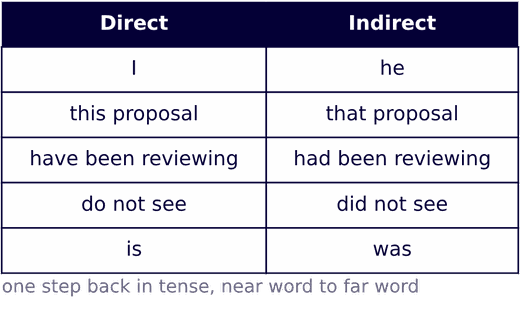 'I' becomes 'he' (the manager) and 'this proposal' becomes 'that proposal'.
Only option (a) makes all of these changes; (c) keeps 'this', while (b) and (d) leave some verbs unshifted.
So: The manager said that he had been reviewing that proposal for a week, but he still did not see the benefit, which was the main goal.
'I' becomes 'he' (the manager) and 'this proposal' becomes 'that proposal'.
Only option (a) makes all of these changes; (c) keeps 'this', while (b) and (d) leave some verbs unshifted.
So: The manager said that he had been reviewing that proposal for a week, but he still did not see the benefit, which was the main goal.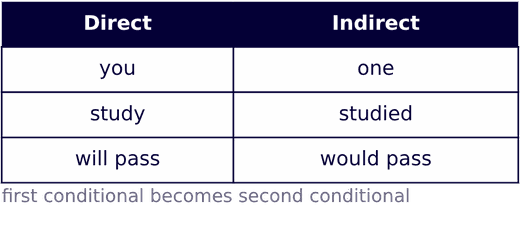 No listener is named in the sentence, so 'you' can neither be kept nor safely become 'he/she'; the neutral pronoun 'one' is used, and once chosen it must be repeated in both halves.
Option (c) leaves 'studies … will' in the present, so the backshift rule is broken.
Hence: The teacher said that if one studied hard, one would pass the exam.
No listener is named in the sentence, so 'you' can neither be kept nor safely become 'he/she'; the neutral pronoun 'one' is used, and once chosen it must be repeated in both halves.
Option (c) leaves 'studies … will' in the present, so the backshift rule is broken.
Hence: The teacher said that if one studied hard, one would pass the exam.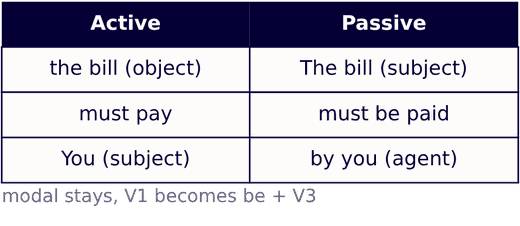 So 'must pay' becomes 'must be paid', 'the bill' moves to the front and 'you' becomes 'by you'.
'must being paid' is not a possible verb form, and 'must have been paid' shifts the sense to a completed past action.
Hence: The bill must be paid by you.
So 'must pay' becomes 'must be paid', 'the bill' moves to the front and 'you' becomes 'by you'.
'must being paid' is not a possible verb form, and 'must have been paid' shifts the sense to a completed past action.
Hence: The bill must be paid by you.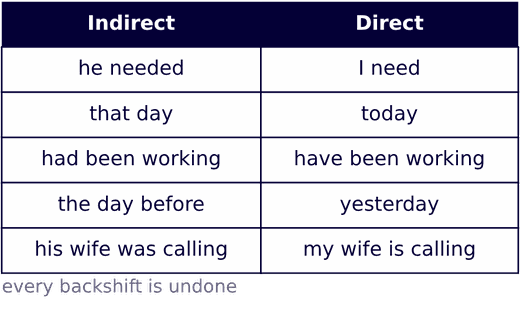 The distance words come back as well, and inside the quotation 'he/his' becomes 'I/my'.
Only option (a) reverses every change; (b) keeps the reported forms, (c) breaks 'have been working', and (d) mixes shifted and unshifted verbs.
Hence: "I need to leave early today because I have been working continuously since yesterday, and my wife is calling me," the employee said to his boss.
The distance words come back as well, and inside the quotation 'he/his' becomes 'I/my'.
Only option (a) reverses every change; (b) keeps the reported forms, (c) breaks 'have been working', and (d) mixes shifted and unshifted verbs.
Hence: "I need to leave early today because I have been working continuously since yesterday, and my wife is calling me," the employee said to his boss.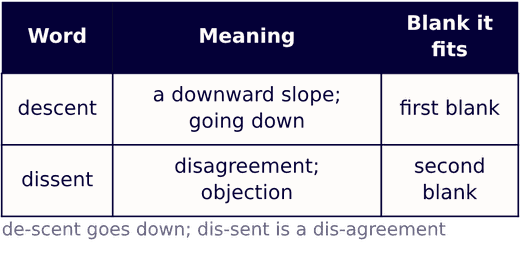 The first blank comes after 'The steep' and before 'down the mountain path', so it names a downward slope — that is 'descent'.
The second blank comes after 'not a single word of', and one can utter a word only of disagreement — that is 'dissent'.
Hence the correct pair is descent, dissent, and option (b) is correct.
Option (a) reverses the two, and options (c) and (d) repeat one word in both blanks, which makes one half of the sentence meaningless.
The first blank comes after 'The steep' and before 'down the mountain path', so it names a downward slope — that is 'descent'.
The second blank comes after 'not a single word of', and one can utter a word only of disagreement — that is 'dissent'.
Hence the correct pair is descent, dissent, and option (b) is correct.
Option (a) reverses the two, and options (c) and (d) repeat one word in both blanks, which makes one half of the sentence meaningless.