SSC CHSL 18 November 2025 · Shift 1 · Quantitative Aptitude — questions with answers · ShikshaSphere
Chapter 59 of 200
18 November 2025 · Shift 1
Quantitative Aptitude
25 questions ~25 min readFree
25 questions
A
51
The intersection of Natural numbers and Whole numbers is:
A.Natural
B.Whole
C.Integers
D.Empty
Solution
Sets of numbers
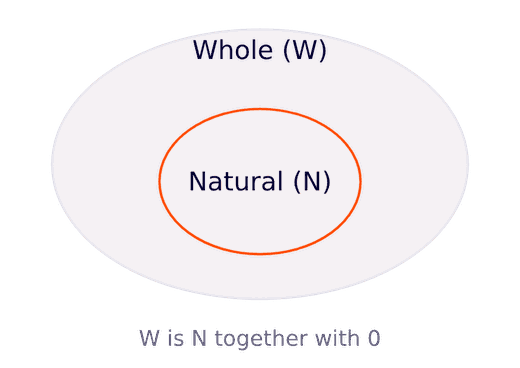
Natural numbers start from 1:
Whole numbers are the natural numbers together with 0:
So every natural number is also a whole number — the set of natural numbers lies completely inside the set of whole numbers.
The intersection of a set with a larger set that contains it is the smaller set itself, so the common part is exactly the set of natural numbers.
Hence, option (a) is the most appropriate answer.
52
Which number is NOT real ?
A.
B.
C.
D.
Solution
Real and imaginary numbers
A square root gives a real number only when the quantity under the root sign is zero or positive.
, and — all three are irrational, but every one of them is a real number.
In the number under the root is negative, and no real number multiplied by itself can give -8.
It equals , which is imaginary, not real.
Hence, option (b) is the most appropriate answer.
53
The number of irrational numbers between any two rational numbers is:
A.0
B.1
C.Finite
D.Infinite
Solution
Density of irrational numbers
Take any two rational numbers a and b with a<b.
The number lies between a and b, because .
It is irrational, since a non-zero rational divided by is irrational and rational + irrational is always irrational.
The same construction can now be repeated inside the smaller gap a to that new number, and so on without end.
For example, between 1 and 2 we already have , , , , and endlessly many more.
So the number of irrational numbers between two rational numbers is infinite.
Hence, option (d) is the most appropriate answer.
54
In triangle ABC, two medians, AE and BF, intersect each other at 0 at right angles. If and , then find the length of .
A.
B.
C.
D.
Solution
Medians and centroid
The medians of a triangle meet at the centroid, and the centroid divides every median in the ratio 2:1 measured from the vertex.
So cm.
And cm.
The medians cut at right angles, so triangle AOB is right-angled at O and Pythagoras applies.
cm
Hence, option (a) is the most appropriate answer.
55
If 18 men can do a piece of work in 25 days, the time taken by 15 men to do the same piece of work will be:
A.25 days
B.28 days
C.26 days
D.30 days
Solution
Men and days (inverse proportion)
For a fixed amount of work, men and days are inversely proportional, so .
Total work man-days.
With 15 men, days required days.
The check is that fewer men must take more days, and 30 is indeed larger than 25.
Hence, option (d) is the most appropriate answer.
56
A does of the work in 14 days. He then calls in B, and they together finish the remaining work in 3 days. How long would B alone take to do the whole work ?
A.22 days
B.20 days
C.28 days
D.25 days
Solution
Time and work
Let the whole work be 100 units.
A finishes 70 units in 14 days, so A's one day's work units.
Work still left =100-70=30 units, and A and B together clear it in 3 days.
So (A + B)'s one day's work units.
B's one day's work =10-5=5 units.
Time taken by B alone days.
Hence, option (b) is the most appropriate answer.
57
If the difference of the radii of two circles is equal to the distance between their centres, then:
A.the circles are concentric
B.the circles touch externally
C.the circles touch internally
D.the circles intersect each other
Solution
Position of two circles
Let the radii be R and r with R>r, and let d be the distance between the two centres.
The standard comparisons are: d=R+r means the circles touch externally; d=R-r means they touch internally; R-r<d<R+r means they cut at two points; and d=0 means they are concentric.
Here we are given d=R-r.
The smaller circle then lies inside the bigger one and the two boundaries meet at exactly one point, which is internal contact.
Hence, option (c) is the most appropriate answer.
58
In a circle, chord AB subtends 80° at the center. The angle between the tangents at A and B is:
A.70°
B.100°
C.140°
D.130°
Solution
Angle between two tangents
Let O be the centre and let the tangents drawn at A and at B meet at the external point C.
A radius is always perpendicular to the tangent at the point of contact, so .
OACB is a quadrilateral, and the four angles of a quadrilateral add up to .
Useful shortcut: the angle between the two tangents (angle subtended at the centre).
Hence, option (b) is the most appropriate answer.
59
The radius of the circle passing through the vertices of a triangle with sides , and 17 cm is:
A.7.5 cm
B.8 cm
C.7.8 cm
D.8.5 cm
Solution
Circumradius of a right triangle
First test the sides with the converse of Pythagoras' theorem: and .
Since the two sums agree, the triangle is right-angled and 17 cm is its hypotenuse.
The circle through all three vertices is the circumcircle. An angle in a semicircle is , so in a right-angled triangle the hypotenuse itself is the diameter of the circumcircle.
Circumradius cm.
Hence, option (d) is the most appropriate answer.
60
The circumference of a circle is 176 cm . The radius of the given circle is equal to the radius of a cone having height 14 cm . Find the approximate volume of the cone. (Take )
A.
B.
C.
D.
Solution
Volume of a cone
The cone has the same radius as the circle, so first pull the radius out of the circumference.
Circumference , which gives cm, and the height is h=14 cm.
Volume of a cone
So the volume is approximately 8803 cm³.
Hence, option (a) is the most appropriate answer.
61
A circle is inscribed in , touching and PR at the points A , and , respectively. If , and the perimeter of , then (in cm) is:
A.13
B.11
C.16
D.15
Solution
Incircle tangent lengths
Tangents drawn to a circle from an external point are equal, so let PA=PC=x, QA=QB=y and RB=RC=z.
Then PQ=x+y, QR=y+z and PR=x+z.
Perimeter =(x+y)+(y+z)+(x+z)=2(x+y+z)=39, so x+y+z=19.5.
PQ-QR=(x+y)-(y+z)=x-z=4 and PQ-PR=(x+y)-(x+z)=y-z=2.
Substituting x=z+4 and y=z+2: .
Hence x=4.5+4=8.5 and y=4.5+2=6.5.
AQ+PC=y+x=6.5+8.5=15, so the required value is 15 cm and option (d) is correct.
62
A man lends out a sum of money by putting 30% of it at 7.5% p.a. simple interest and the remaining 70% at 11.25% p.a. simple interest. After years ( 2.5 years) his total interest income is ₹7,825. What was the original sum (principal) he lent?
A.Rs. 30,916 . 63
B.Rs. 34,916 . 63
C.Rs.
D.Rs. 30 , 916 . 36
Solution
Simple interest in two parts
Let the whole sum lent be P; of it earns p.a. and of it earns p.a.
Replace the two rates by one equivalent rate on the whole sum: per annum.
For 2.5 years the interest is of P, i.e. about 0.2531P.
So .
, so the sum lent was about Rs. 30,916.63 and option (a) is correct.
63
Ankush spends 85% of his income, whereas Ankit spends 70% of his income. Both of them save Rs. 9,000 each. The income of Mohit is one-third of the sum of the income of Ankush and Ankit . If Mohit spends th of his income, then find his savings.
A.Rs. 6666.67
B.Rs. 8676.67
C.Rs. 7666.67
D.Rs. 7665.67
Solution
Income, expenditure and savings
Ankush spends , so he saves of his income, and that saving is Rs. 9,000.
Income of Ankush , i.e. Rs. 60,000.
Ankit spends , so he saves of his income, again Rs. 9,000.
Income of Ankit , i.e. Rs. 30,000.
Income of Mohit , i.e. Rs. 30,000.
Mohit spends of his income, so he saves of it.
Savings of Mohit , so option (a) is correct.
64
In a partnership, the capital ratio between P and Q is . If P invested Rs 80,000 , how much did Q invest ?
A.Rs 60,000
B.Rs 67,000
C.Rs 85,000
D.Rs 65,000
Solution
Partnership capital ratio
The capitals of P and Q are in the ratio 8:6, which reduces to 4:3.
Let the capital of Q be x, so .
.
Hence Q invested Rs 60,000 and option (a) is correct.
65
Two students' scores are 70% and 80% of a test's total score. What is the ratio of the first student's score to the second student's score?
A.8 : 7
B.7 : 8
C.7 : 6
D.6 : 8
Solution
Ratio from percentages
Let the total score of the test be T.
First student's score of ; second student's score of .
Required ratio .
Dividing both terms by 10 gives 7:8, so option (b) is correct.
Note the order asked for — first to second — which rules out the reversed option 8:7.
66
The average age of 12 players of a cricket team is the same as it was 3 years ago because 4 players, whose current average age is 30 years, have been replaced by 4 new players. What is the average age of new players ?
A.26 years
B.21 years
C.24 years
D.17 years
Solution
Average age with replacement
In 3 years the same 12 people grow older by years in total.
The average today equals the average of 3 years ago, so the total age today equals the total age of 3 years ago.
Therefore the replacement must wipe out that gain of 36 years.
The 4 players who left have a present total age years.
Total age of the 4 new players =120-36=84 years.
Average age of the new players years, so option (b) is correct.
67
The average of 17 numbers is 32 . If each number is doubled and then 8 is added to each, what will be the new average ?
A.68
B.72
C.71
D.74
Solution
Change in average
Average of the 17 numbers =32, so their sum .
Doubling every number doubles the sum: new sum .
Adding 8 to each of the 17 numbers adds , so the final sum =1088+136=1224.
New average .
Shortcut: whatever is done to every number is done to the average as well, so the new average and option (b) is correct.
68
A flight covers in 4 hours. By what percent should its speed be decreased to cover the same distance in 5 hours?
A.25 %
B.20 %
C.23%
D.28%
Solution
Speed, time and percentage
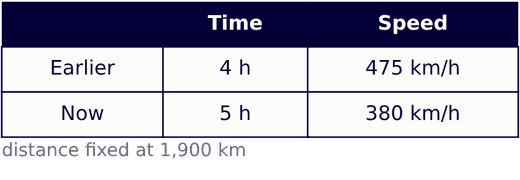
Original speed km/h.
Speed needed to cover the same distance in 5 hours km/h.
Decrease in speed =475-380=95 km/h.
Percentage decrease .
Shortcut: distance being fixed, speed varies inversely with time, so time 4:5 gives speed 5:4 and the drop is , so option (b) is correct.
69
A shopkeeper offers a 30% discount on the marked price of an article. If the marked price of the article is ₹3,500 and the shopkeeper further gives a discount on the already reduced price, what is the final selling price of the article?
A.₹2082.5
B.₹2182.5
C.₹3082.5
D.₹2242.5
Solution
Successive discounts
Marked price = ₹3,500 and the first discount is , so of the marked price is paid.
Price after the first discount , i.e. ₹2,450.
The second discount of is given on this already reduced price, so of it remains.
Final selling price .
Hence the article is finally sold for ₹2,082.5 and option (a) is correct.
70
A shopkeeper offers two successive discounts of 20% and 30% on a laptop priced at ₹50,000. What is the final selling price after both discounts?
A.₹32,000
B.₹30,600
C.₹28,000
D.₹34,000
Solution
Successive discounts
Successive discounts multiply, they do not add — the second one acts on the reduced price.
Price after the discount , i.e. ₹40,000.
Price after the further discount .
Check with the single equivalent discount: , and .
So the final selling price is ₹28,000 and option (c) is correct.
71
A 80 -litre container is filled with a solution of wine and water, with the ratio of wine to water being . If 16 litres of the solution is removed and replaced with 16 litres of pure water, what is the new ratio of wine to water ?
A.2 : 3
B.1 : 1
C.3 : 4
D.7 : 3
Solution
Removal and replacement in a mixture
In 80 litres with wine : water =5:3, wine litres and water litres.
The 16 litres taken out is of the mixture, so it carries away one-fifth of each liquid and of each is left.
Wine left litres; water left litres.
Now 16 litres of pure water is poured in, so water =24+16=40 litres while the wine stays 40 litres.
New ratio of wine to water =40:40=1:1, so option (b) is correct.
72
Arrange in ascending order: .
A.
B.
C.
D.
Solution
Comparing surds
Roots of different orders cannot be compared directly; raise them all to the LCM of the orders.
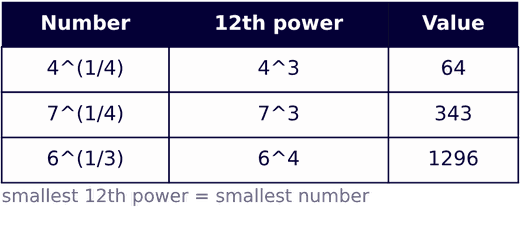
, so compare the 12th power of each number.
, , .
Since 64<343<1296, the same order holds for the numbers themselves: .
So the ascending order is and option (a) is correct.
73
Find the equation of the line with slope -3 passing through the point .
A.
B.
C.
D.
Solution
Equation of a line
Use the point-slope form of a straight line: .
Here m=-3 and .
y-6=-3(x-4)
y-6=-3x+12
y=-3x+18, so option (a) is correct.
A quick check: putting x=4 gives y=-12+18=6, so the line does pass through (4,6).
74
Two similar triangles have areas of and . If the perimeter of the smaller triangle is 30 meters, what is the perimeter of the larger triangle ?
A.40 m
B.35 m
C.33 m
D.42 m
Solution
Similar triangles: area and perimeter
In similar triangles the ratio of the areas equals the square of the ratio of any pair of corresponding lengths.
.
Ratio of corresponding sides .
Perimeters are corresponding lengths, so they are also in the ratio 3:4.
.
Hence the perimeter of the larger triangle is 40 m and option (a) is correct.
75
In triangle and are points on sides and such that . If , and , what is the ratio of the area of triangle to the area of triangle ABC ?
A.
B.1 : 16
C.5 : 9
D.8 : 12
Solution
Basic proportionality and areas
AB=AD+DB=5+15=20 cm and AC=AE+EC=4+12=16 cm.
and , which agrees with .
Because , and , so by AA similarity.
For similar triangles the areas are in the square of the ratio of corresponding sides: .
Hence the required ratio is 1:16 and option (b) is correct.
Finished reading? Now test yourself.
The same 25 questions, but with a timer and the answers hidden — 15 minutes.

 The intersection of a set with a larger set that contains it is the smaller set itself, so the common part is exactly the set of natural numbers.
Hence, option (a) is the most appropriate answer.
The intersection of a set with a larger set that contains it is the smaller set itself, so the common part is exactly the set of natural numbers.
Hence, option (a) is the most appropriate answer.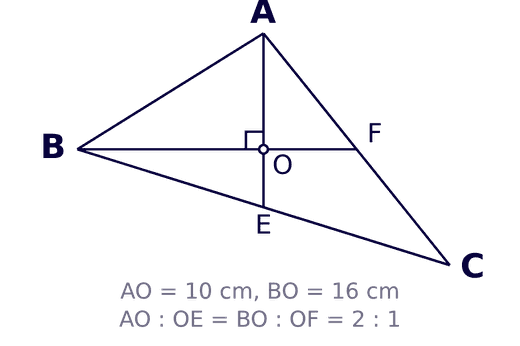 So cm.
And cm.
The medians cut at right angles, so triangle AOB is right-angled at O and Pythagoras applies.
cm
Hence, option (a) is the most appropriate answer.
So cm.
And cm.
The medians cut at right angles, so triangle AOB is right-angled at O and Pythagoras applies.
cm
Hence, option (a) is the most appropriate answer.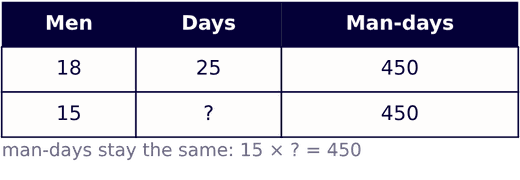 With 15 men, days required days.
The check is that fewer men must take more days, and 30 is indeed larger than 25.
Hence, option (d) is the most appropriate answer.
With 15 men, days required days.
The check is that fewer men must take more days, and 30 is indeed larger than 25.
Hence, option (d) is the most appropriate answer.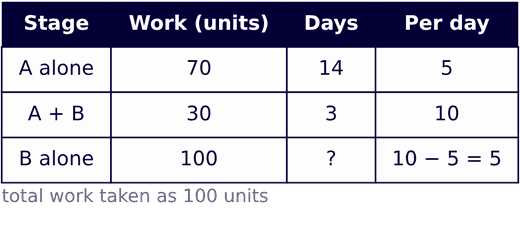 B's one day's work =10-5=5 units.
Time taken by B alone days.
Hence, option (b) is the most appropriate answer.
B's one day's work =10-5=5 units.
Time taken by B alone days.
Hence, option (b) is the most appropriate answer.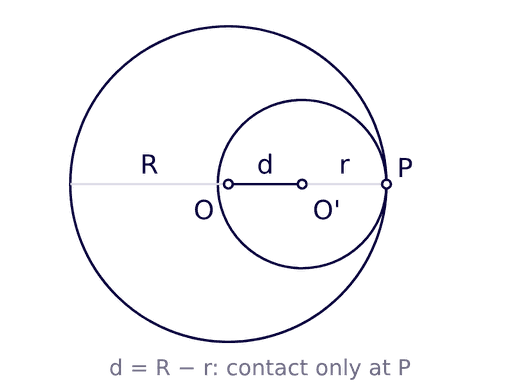 The smaller circle then lies inside the bigger one and the two boundaries meet at exactly one point, which is internal contact.
Hence, option (c) is the most appropriate answer.
The smaller circle then lies inside the bigger one and the two boundaries meet at exactly one point, which is internal contact.
Hence, option (c) is the most appropriate answer.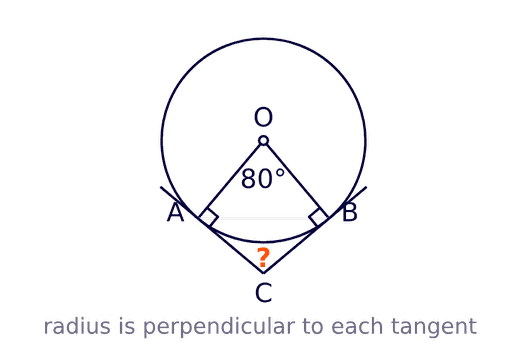 A radius is always perpendicular to the tangent at the point of contact, so .
OACB is a quadrilateral, and the four angles of a quadrilateral add up to .
Useful shortcut: the angle between the two tangents (angle subtended at the centre).
Hence, option (b) is the most appropriate answer.
A radius is always perpendicular to the tangent at the point of contact, so .
OACB is a quadrilateral, and the four angles of a quadrilateral add up to .
Useful shortcut: the angle between the two tangents (angle subtended at the centre).
Hence, option (b) is the most appropriate answer.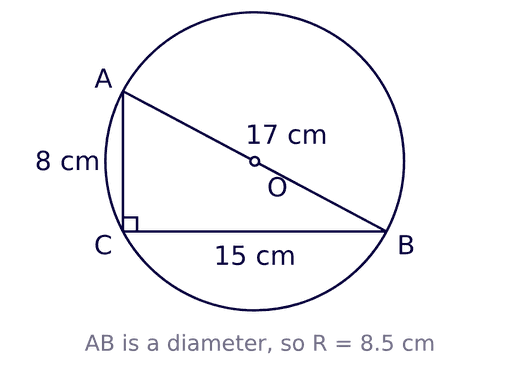 The circle through all three vertices is the circumcircle. An angle in a semicircle is , so in a right-angled triangle the hypotenuse itself is the diameter of the circumcircle.
Circumradius cm.
Hence, option (d) is the most appropriate answer.
The circle through all three vertices is the circumcircle. An angle in a semicircle is , so in a right-angled triangle the hypotenuse itself is the diameter of the circumcircle.
Circumradius cm.
Hence, option (d) is the most appropriate answer.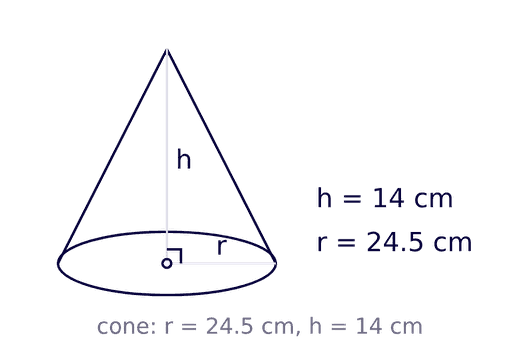 Volume of a cone
So the volume is approximately 8803 cm³.
Hence, option (a) is the most appropriate answer.
Volume of a cone
So the volume is approximately 8803 cm³.
Hence, option (a) is the most appropriate answer.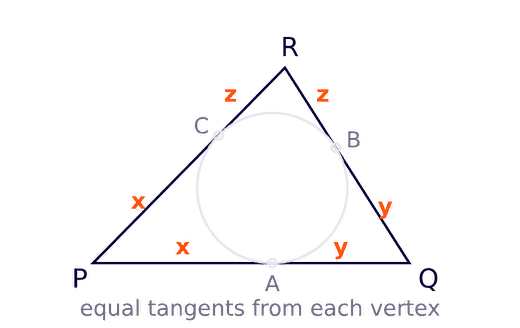 Then PQ=x+y, QR=y+z and PR=x+z.
Perimeter =(x+y)+(y+z)+(x+z)=2(x+y+z)=39, so x+y+z=19.5.
PQ-QR=(x+y)-(y+z)=x-z=4 and PQ-PR=(x+y)-(x+z)=y-z=2.
Substituting x=z+4 and y=z+2: .
Hence x=4.5+4=8.5 and y=4.5+2=6.5.
AQ+PC=y+x=6.5+8.5=15, so the required value is 15 cm and option (d) is correct.
Then PQ=x+y, QR=y+z and PR=x+z.
Perimeter =(x+y)+(y+z)+(x+z)=2(x+y+z)=39, so x+y+z=19.5.
PQ-QR=(x+y)-(y+z)=x-z=4 and PQ-PR=(x+y)-(x+z)=y-z=2.
Substituting x=z+4 and y=z+2: .
Hence x=4.5+4=8.5 and y=4.5+2=6.5.
AQ+PC=y+x=6.5+8.5=15, so the required value is 15 cm and option (d) is correct.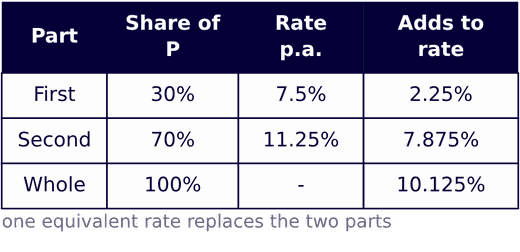 For 2.5 years the interest is of P, i.e. about 0.2531P.
So .
, so the sum lent was about Rs. 30,916.63 and option (a) is correct.
For 2.5 years the interest is of P, i.e. about 0.2531P.
So .
, so the sum lent was about Rs. 30,916.63 and option (a) is correct.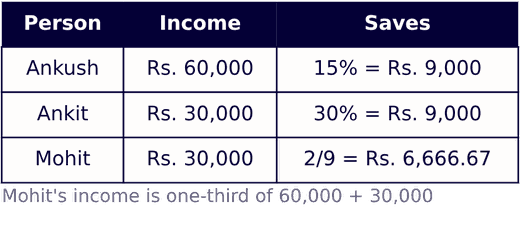 Mohit spends of his income, so he saves of it.
Savings of Mohit , so option (a) is correct.
Mohit spends of his income, so he saves of it.
Savings of Mohit , so option (a) is correct.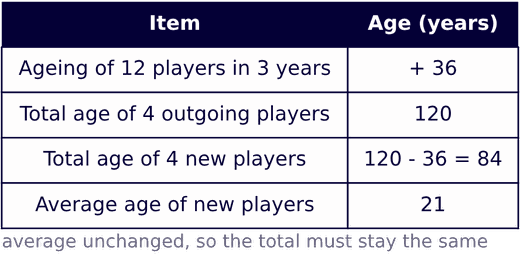 Average age of the new players years, so option (b) is correct.
 Decrease in speed =475-380=95 km/h.
Percentage decrease .
Shortcut: distance being fixed, speed varies inversely with time, so time 4:5 gives speed 5:4 and the drop is , so option (b) is correct.
Decrease in speed =475-380=95 km/h.
Percentage decrease .
Shortcut: distance being fixed, speed varies inversely with time, so time 4:5 gives speed 5:4 and the drop is , so option (b) is correct.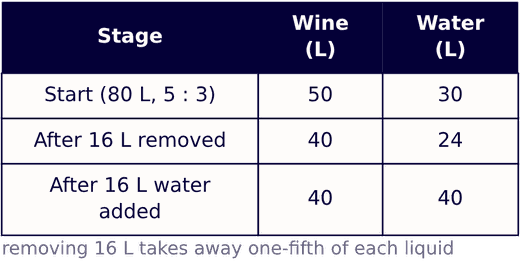 New ratio of wine to water =40:40=1:1, so option (b) is correct.
 Since 64<343<1296, the same order holds for the numbers themselves: .
So the ascending order is and option (a) is correct.
Since 64<343<1296, the same order holds for the numbers themselves: .
So the ascending order is and option (a) is correct.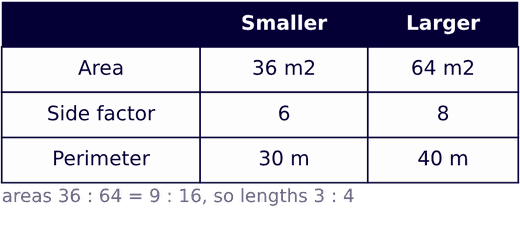 .
Hence the perimeter of the larger triangle is 40 m and option (a) is correct.
.
Hence the perimeter of the larger triangle is 40 m and option (a) is correct.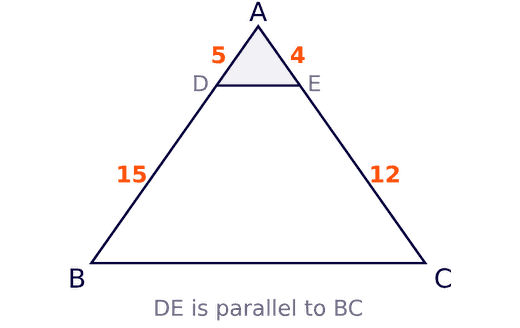 AB=AD+DB=5+15=20 cm and AC=AE+EC=4+12=16 cm.
and , which agrees with .
Because , and , so by AA similarity.
For similar triangles the areas are in the square of the ratio of corresponding sides: .
Hence the required ratio is 1:16 and option (b) is correct.
AB=AD+DB=5+15=20 cm and AC=AE+EC=4+12=16 cm.
and , which agrees with .
Because , and , so by AA similarity.
For similar triangles the areas are in the square of the ratio of corresponding sides: .
Hence the required ratio is 1:16 and option (b) is correct.