
1
Identify the part of the sentence that contains a grammatical error.
A. The jury, B. after a long period of intense deliberation, C. were united in its verdict D. to convict the man, which shocked the public.
- A.The jury
- B.after a long period of intense deliberation
- C.were united in its verdict
- D.to convict the man, which shocked the public.
Solution
Collective noun agreement
A collective noun such as 'jury', 'team' or 'committee' takes a plural verb only when its members are thought of as acting separately.
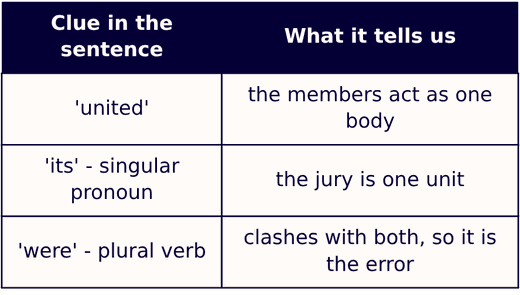 Here the word 'united' and the singular pronoun 'its' both show that the jury is being treated as one single body, so the verb must be singular too.
Therefore the plural verb 'were' is wrong; part C should read 'was united in its verdict'.
Parts A, B and D contain no error, so the error lies in part C.
Correct sentence: The jury, after a long period of intense deliberation, was united in its verdict to convict the man, which shocked the public.
Here the word 'united' and the singular pronoun 'its' both show that the jury is being treated as one single body, so the verb must be singular too.
Therefore the plural verb 'were' is wrong; part C should read 'was united in its verdict'.
Parts A, B and D contain no error, so the error lies in part C.
Correct sentence: The jury, after a long period of intense deliberation, was united in its verdict to convict the man, which shocked the public.
Here the word 'united' and the singular pronoun 'its' both show that the jury is being treated as one single body, so the verb must be singular too.
Therefore the plural verb 'were' is wrong; part C should read 'was united in its verdict'.
Parts A, B and D contain no error, so the error lies in part C.
Correct sentence: The jury, after a long period of intense deliberation, was united in its verdict to convict the man, which shocked the public.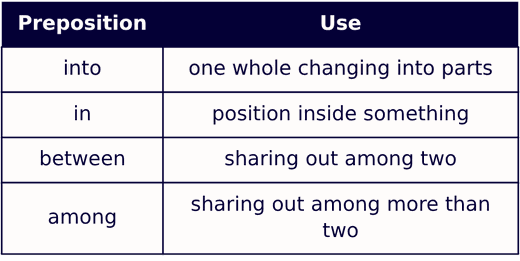 Cutting one pizza so that it becomes eight slices is exactly this change of a whole into parts, so 'cut the pizza into eight slices' is right.
'In' would show only position, while 'between' (two) and 'among' (more than two) are used for sharing something out, not for cutting.
Hence, option (c) is the most appropriate answer.
Cutting one pizza so that it becomes eight slices is exactly this change of a whole into parts, so 'cut the pizza into eight slices' is right.
'In' would show only position, while 'between' (two) and 'among' (more than two) are used for sharing something out, not for cutting.
Hence, option (c) is the most appropriate answer.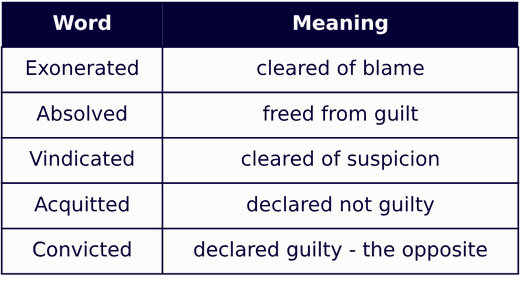 'Convicted' means formally declared guilty by a court, which is the exact reverse of being cleared.
The trap here is that 'Absolved', 'Vindicated' and 'Acquitted' all mean freed from blame, so they are synonyms of 'exonerated', not antonyms.
Hence, option (b) is the most appropriate answer.
'Convicted' means formally declared guilty by a court, which is the exact reverse of being cleared.
The trap here is that 'Absolved', 'Vindicated' and 'Acquitted' all mean freed from blame, so they are synonyms of 'exonerated', not antonyms.
Hence, option (b) is the most appropriate answer.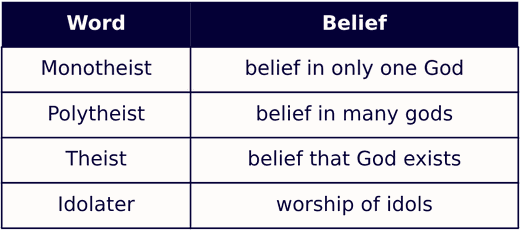 'Polytheist' comes from 'poly-' (many) and so believes in many gods, a 'Theist' merely believes that God exists without fixing the number, and an 'Idolater' worships images.
Only 'Monotheist' carries the idea of 'only one'.
Hence, option (b) is the most appropriate answer.
'Polytheist' comes from 'poly-' (many) and so believes in many gods, a 'Theist' merely believes that God exists without fixing the number, and an 'Idolater' worships images.
Only 'Monotheist' carries the idea of 'only one'.
Hence, option (b) is the most appropriate answer.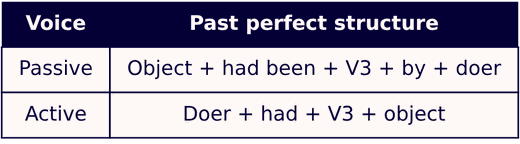 In the active form the doer 'the general' becomes the subject, 'had been awarded' becomes 'had awarded', and the tense must remain past perfect.
That gives 'the general had awarded the brave soldier a distinct medal', which is exactly option (c) with the time phrase simply moved to the front.
Option (a) shifts to the past perfect continuous, (b) drops the perfect tense altogether, and (d) is still in the passive voice.
Hence, option (c) is the most appropriate answer.
In the active form the doer 'the general' becomes the subject, 'had been awarded' becomes 'had awarded', and the tense must remain past perfect.
That gives 'the general had awarded the brave soldier a distinct medal', which is exactly option (c) with the time phrase simply moved to the front.
Option (a) shifts to the past perfect continuous, (b) drops the perfect tense altogether, and (d) is still in the passive voice.
Hence, option (c) is the most appropriate answer.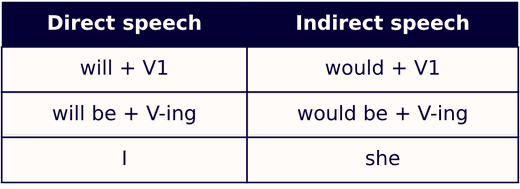 'Will be painting' is the future continuous; on back-shift it becomes 'would be painting', and the pronoun 'I' changes to 'she' to agree with the speaker.
So the sentence becomes: She said that she would be painting the wall.
Option (b) keeps 'will', (c) changes it to the past continuous, and (d) drops 'be' and so loses the continuous sense.
Hence, option (a) is the most appropriate answer.
'Will be painting' is the future continuous; on back-shift it becomes 'would be painting', and the pronoun 'I' changes to 'she' to agree with the speaker.
So the sentence becomes: She said that she would be painting the wall.
Option (b) keeps 'will', (c) changes it to the past continuous, and (d) drops 'be' and so loses the continuous sense.
Hence, option (a) is the most appropriate answer.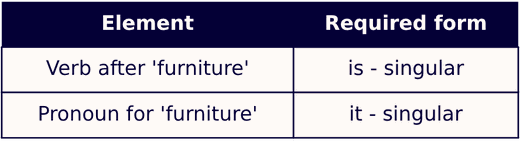 So 'are' must become 'is', and the pronoun referring back to the furniture must be 'it', not 'them'.
The phrase 'in the new offices' is only a modifier; the plural noun 'offices' inside it can never decide the verb.
Only option (c) makes both corrections - (a) fixes the verb alone, (b) fixes the pronoun alone, and (d) simply repeats the original sentence.
Hence, option (c) is the most appropriate answer.
So 'are' must become 'is', and the pronoun referring back to the furniture must be 'it', not 'them'.
The phrase 'in the new offices' is only a modifier; the plural noun 'offices' inside it can never decide the verb.
Only option (c) makes both corrections - (a) fixes the verb alone, (b) fixes the pronoun alone, and (d) simply repeats the original sentence.
Hence, option (c) is the most appropriate answer.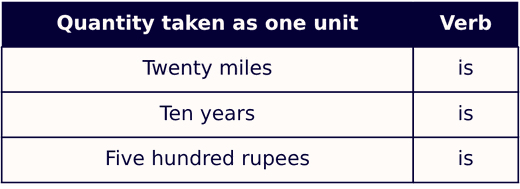 'Twenty miles' here names one stretch of distance, not twenty separate miles, so the verb must be 'is' and not 'are'.
The noun itself stays plural - 'twenty mile' is never correct - which rules out options (a) and (d).
Hence, option (c) is the most appropriate answer.
'Twenty miles' here names one stretch of distance, not twenty separate miles, so the verb must be 'is' and not 'are'.
The noun itself stays plural - 'twenty mile' is never correct - which rules out options (a) and (d).
Hence, option (c) is the most appropriate answer.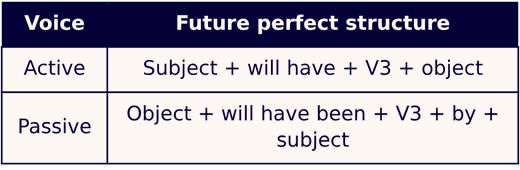 In the passive the object 'the task' becomes the subject, 'will have finished' becomes 'will have been finished', and the doer takes 'by' before it.
That gives: The task will have been finished by us by next month.
Option (b) drops the perfect form, (c) replaces 'will' with 'would', and (d) shifts to the present perfect.
Hence, option (a) is the most appropriate answer.
In the passive the object 'the task' becomes the subject, 'will have finished' becomes 'will have been finished', and the doer takes 'by' before it.
That gives: The task will have been finished by us by next month.
Option (b) drops the perfect form, (c) replaces 'will' with 'would', and (d) shifts to the present perfect.
Hence, option (a) is the most appropriate answer.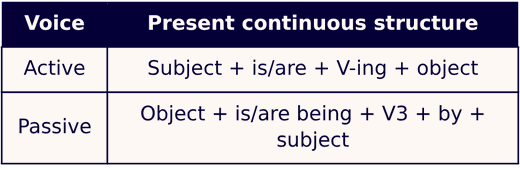 In the passive the object 'the vintage cars' becomes the subject, the verb takes the form 'are being repaired', and 'by the mechanics' follows it.
Option (a) leaves out 'being' and so becomes the simple present, (c) shifts to the past continuous, and (d) shifts to the present perfect.
Hence, option (b) is the most appropriate answer.
In the passive the object 'the vintage cars' becomes the subject, the verb takes the form 'are being repaired', and 'by the mechanics' follows it.
Option (a) leaves out 'being' and so becomes the simple present, (c) shifts to the past continuous, and (d) shifts to the present perfect.
Hence, option (b) is the most appropriate answer.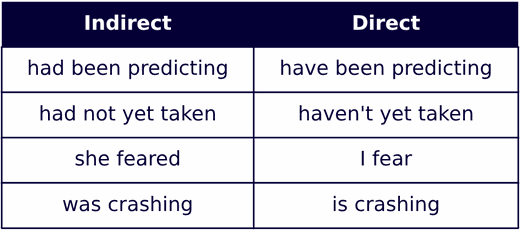 So 'had been predicting' returns to 'have been predicting', 'had not yet taken' to 'haven't yet taken', 'she feared' to 'I fear', and 'was crashing' to 'is crashing'.
The conjunction 'that' is dropped, the speaker refers to herself as 'I', and the whole speech is enclosed in a matching pair of quotation marks.
Option (b) makes every one of these changes; (a) turns the perfect continuous into a plain past continuous, while (c) and (d) leave the verbs still back-shifted.
Hence, option (b) is the most appropriate answer.
So 'had been predicting' returns to 'have been predicting', 'had not yet taken' to 'haven't yet taken', 'she feared' to 'I fear', and 'was crashing' to 'is crashing'.
The conjunction 'that' is dropped, the speaker refers to herself as 'I', and the whole speech is enclosed in a matching pair of quotation marks.
Option (b) makes every one of these changes; (a) turns the perfect continuous into a plain past continuous, while (c) and (d) leave the verbs still back-shifted.
Hence, option (b) is the most appropriate answer.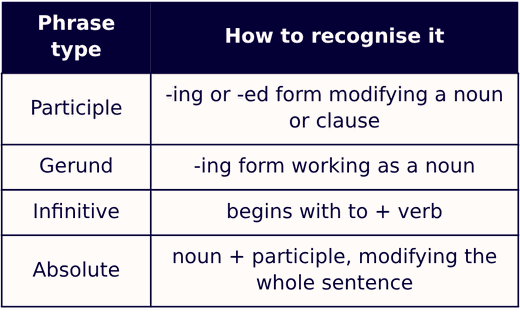 The phrase begins with 'facilitating', an -ing form placed after a comma to describe the result of the action in the main clause; such a group is a participle phrase.
A gerund phrase works as a noun, that is, as a subject or an object; here the phrase names no thing at all, it only modifies the clause, so it cannot be a gerund phrase.
An infinitive phrase would have to begin with 'to + verb', and an absolute phrase would carry its own noun before the participle, so neither fits.
Hence, option (b) is the most appropriate answer.
The phrase begins with 'facilitating', an -ing form placed after a comma to describe the result of the action in the main clause; such a group is a participle phrase.
A gerund phrase works as a noun, that is, as a subject or an object; here the phrase names no thing at all, it only modifies the clause, so it cannot be a gerund phrase.
An infinitive phrase would have to begin with 'to + verb', and an absolute phrase would carry its own noun before the participle, so neither fits.
Hence, option (b) is the most appropriate answer.