
26
The sum of the ages of A and B is 45 years. A is 15 years older than B. What is the age of ?
- A.15 years
- B.20 years
- C.25 years
- D.30 years
Solution
Ages: sum and difference
Let the age of B be x years; then A, being 15 years older, is x+15 years.
Their sum is 45 years, so x+(x+15)=45.
2x+15=45
2x=30, hence x=15.
Check: B is 15 years and A is 15+15=30 years, and 15+30=45.
So B is 15 years old and option (a) is correct.
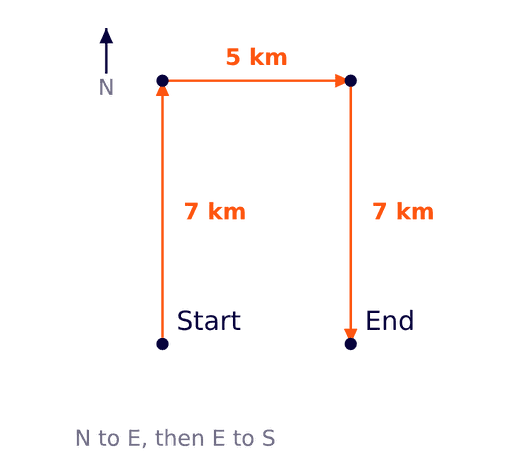 A second right turn takes him one more quarter-turn clockwise, from east to south, and the last 7 km are walked facing south.
Walking does not change the direction faced, so he is finally facing south.
Hence, option (b) is correct.
A second right turn takes him one more quarter-turn clockwise, from east to south, and the last 7 km are walked facing south.
Walking does not change the direction faced, so he is finally facing south.
Hence, option (b) is correct.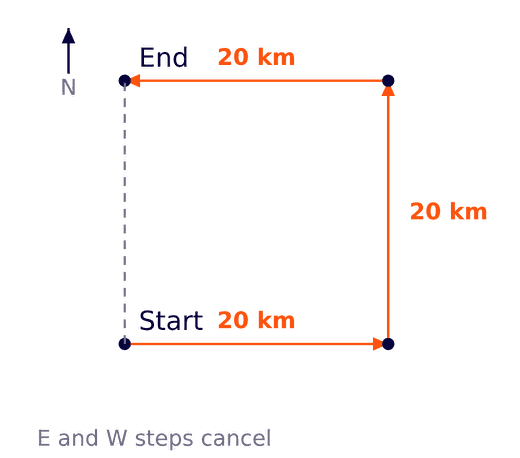 The 20 km walked east and the 20 km walked west are equal and opposite, so together they bring him back to the vertical line through the start.
Only the 20 km walked north is left over, so the finishing point lies straight north of the starting point.
Therefore the required distance is 20 km.
Hence, option (c) is correct.
The 20 km walked east and the 20 km walked west are equal and opposite, so together they bring him back to the vertical line through the start.
Only the 20 km walked north is left over, so the finishing point lies straight north of the starting point.
Therefore the required distance is 20 km.
Hence, option (c) is correct.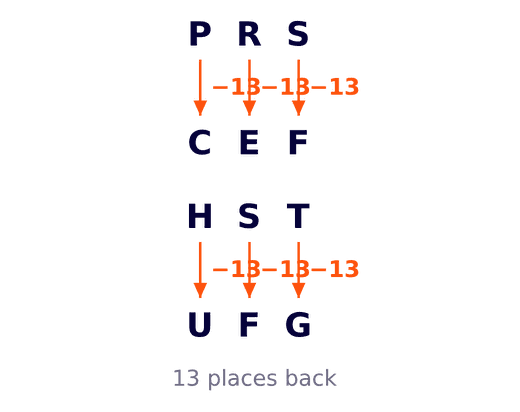 Apply the same rule to H = 8, S = 19, T = 20, treating the alphabet as a cycle of 26.
8-13=-5, and -5+26=21, which is U; 19-13=6 is F; 20-13=7 is G.
So HST becomes UFG, and option (b) is correct.
Apply the same rule to H = 8, S = 19, T = 20, treating the alphabet as a cycle of 26.
8-13=-5, and -5+26=21, which is U; 19-13=6 is F; 20-13=7 is G.
So HST becomes UFG, and option (b) is correct.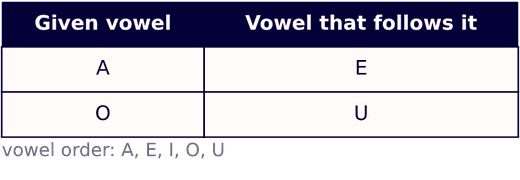 In A : E, the second letter is simply the vowel that comes immediately after the first.
The vowel immediately after O in the same series is U, so O : U completes the analogy.
Hence, option (b) is correct.
In A : E, the second letter is simply the vowel that comes immediately after the first.
The vowel immediately after O in the same series is U, so O : U completes the analogy.
Hence, option (b) is correct.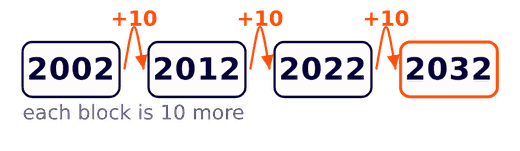 So the next block must be 2022+10=2032.
Hence, option (b) is correct.
So the next block must be 2022+10=2032.
Hence, option (b) is correct.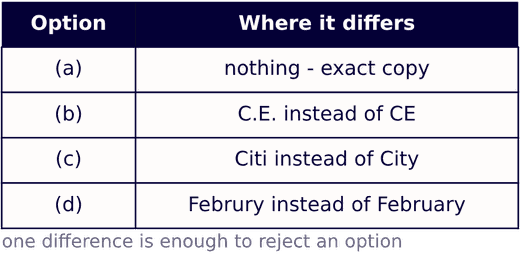 In (b) the era is written 'C.E.' with two full stops, while the reference has plain 'CE'.
In (c) the city is spelt 'Mexico Citi' instead of 'Mexico City'.
In (d) the month is spelt 'Februry' — the letter 'a' of 'February' is missing.
Only (a) agrees with the reference in every letter, number and punctuation mark, so option (a) is correct.
In (b) the era is written 'C.E.' with two full stops, while the reference has plain 'CE'.
In (c) the city is spelt 'Mexico Citi' instead of 'Mexico City'.
In (d) the month is spelt 'Februry' — the letter 'a' of 'February' is missing.
Only (a) agrees with the reference in every letter, number and punctuation mark, so option (a) is correct.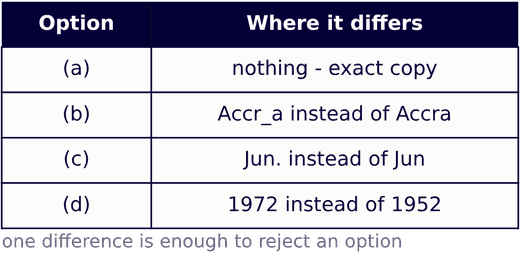 In (b) the city name carries a stray underscore — 'Accr_a' instead of 'Accra'.
In (c) the month is written 'Jun.' with a full stop, which the reference does not have.
In (d) the year has been altered from 1952 to 1972.
Option (a) alone repeats the city, the code in brackets, the month, the date and the year exactly as given, so option (a) is correct.
In (b) the city name carries a stray underscore — 'Accr_a' instead of 'Accra'.
In (c) the month is written 'Jun.' with a full stop, which the reference does not have.
In (d) the year has been altered from 1952 to 1972.
Option (a) alone repeats the city, the code in brackets, the month, the date and the year exactly as given, so option (a) is correct.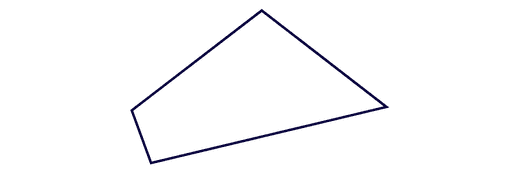




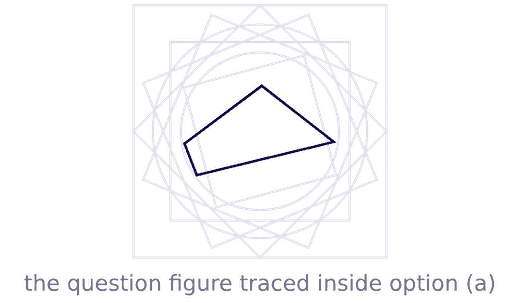 In option (a) those four strokes are all present and in that very position — the sharp peak, the long right side, the long base sloping down to the left and the short left side.
In options (b), (c) and (d) the corresponding inner quadrilateral is far more even-sided: the peak is blunt and the long sloping base is missing, so the given shape cannot be traced in them without turning it.
Hence, option (a) is correct.
In option (a) those four strokes are all present and in that very position — the sharp peak, the long right side, the long base sloping down to the left and the short left side.
In options (b), (c) and (d) the corresponding inner quadrilateral is far more even-sided: the peak is blunt and the long sloping base is missing, so the given shape cannot be traced in them without turning it.
Hence, option (a) is correct.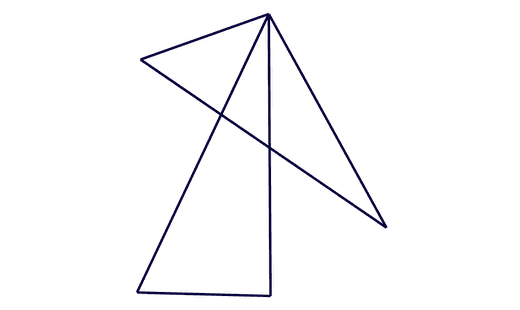
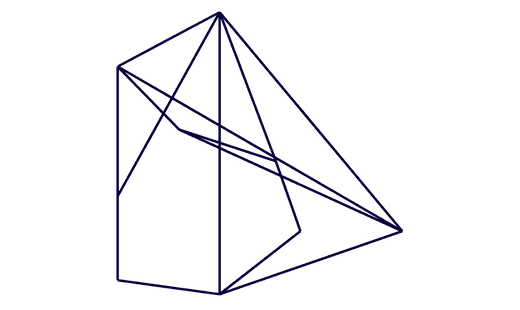
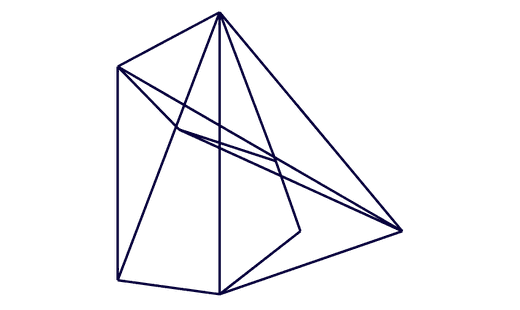
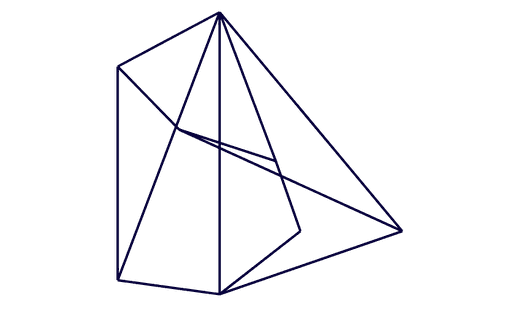
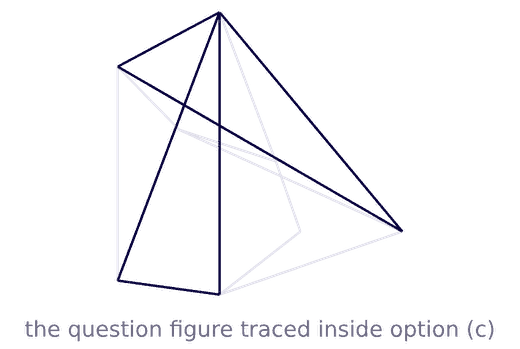 The fingerprint of the figure is the crossing: the line from the left point and the line from the peak to the bottom-left corner must cut each other on the way, with the vertical running the full height between them.
Option (c) carries all six strokes in exactly that position, so the whole figure can be traced on it without any turning.
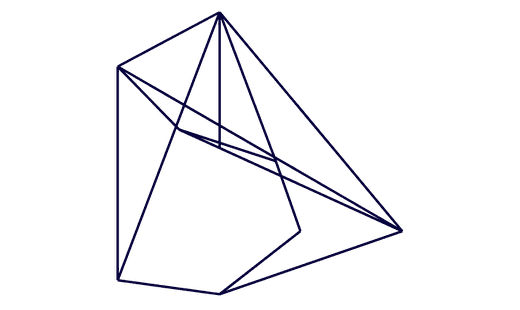
In option (a) the stroke from the peak stops on the left edge and never reaches the bottom-left corner; in option (b) the vertical stops half-way down and does not touch the base; in option (d) there is no line running from the left point across to the right point.
Hence, option (c) is correct.
The fingerprint of the figure is the crossing: the line from the left point and the line from the peak to the bottom-left corner must cut each other on the way, with the vertical running the full height between them.
Option (c) carries all six strokes in exactly that position, so the whole figure can be traced on it without any turning.
In option (a) the stroke from the peak stops on the left edge and never reaches the bottom-left corner; in option (b) the vertical stops half-way down and does not touch the base; in option (d) there is no line running from the left point across to the right point.
Hence, option (c) is correct.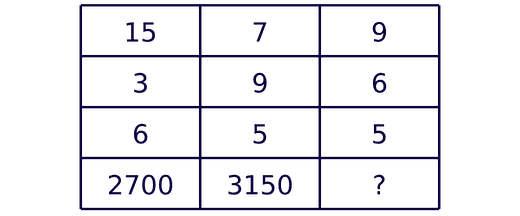
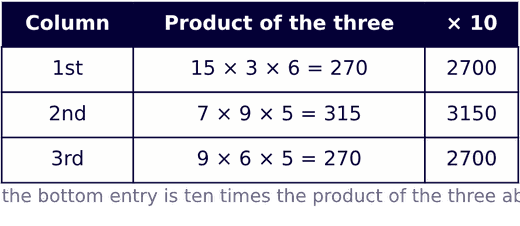 So the rule is (first) (second) (third) .
Third column: , hence .
Hence, option (c) is correct.
So the rule is (first) (second) (third) .
Third column: , hence .
Hence, option (c) is correct.
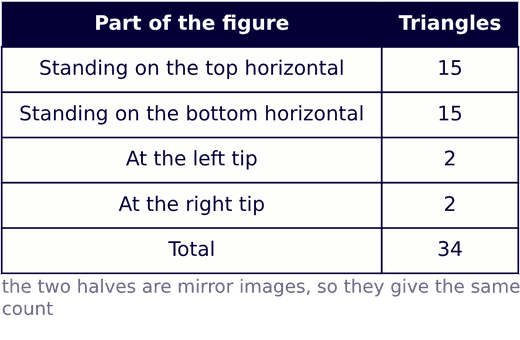 Total =15+15+2+2=34.
Hence, option (d) is correct.
Total =15+15+2+2=34.
Hence, option (d) is correct.
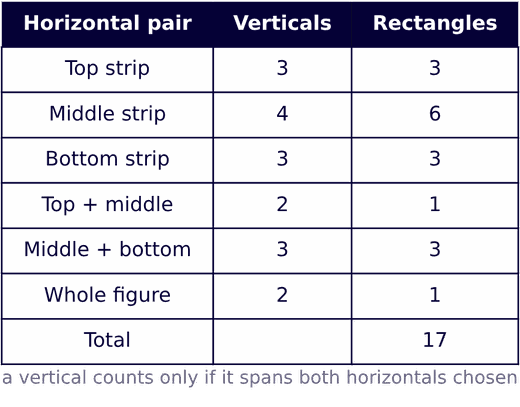 Total =3+6+3+1+3+1=17.
Hence, option (c) is correct.
Total =3+6+3+1+3+1=17.
Hence, option (c) is correct.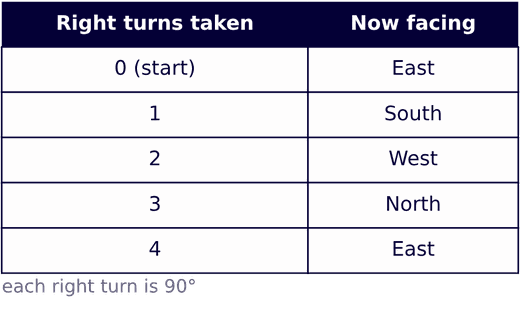 The fourth right turn brings her back to East, because is one full turn.
Any smaller number of right turns leaves her facing South, West or North, so 4 is the least number that works.
Hence, option (a) is correct.
The fourth right turn brings her back to East, because is one full turn.
Any smaller number of right turns leaves her facing South, West or North, so 4 is the least number that works.
Hence, option (a) is correct.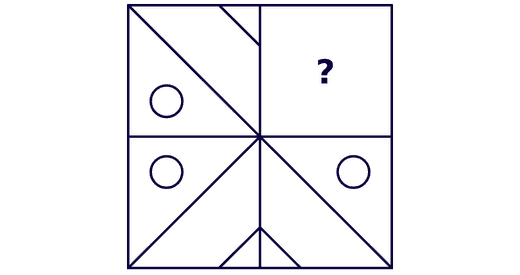
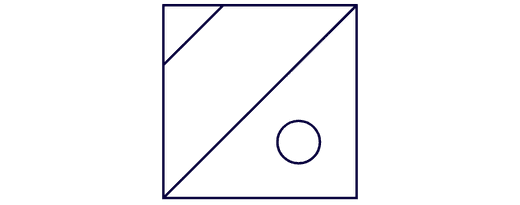
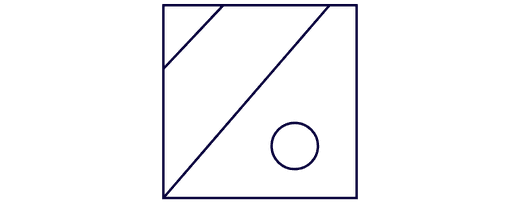
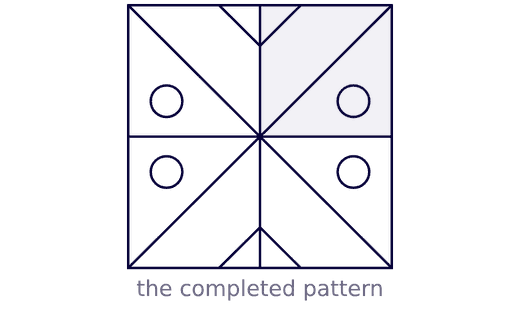 So the missing top-right quarter must be the top-left quarter turned over about the vertical middle line: the long line from the top-right corner of the square down to the centre, the short line cutting the corner at the top of the middle line, and the circle in the lower-right part.
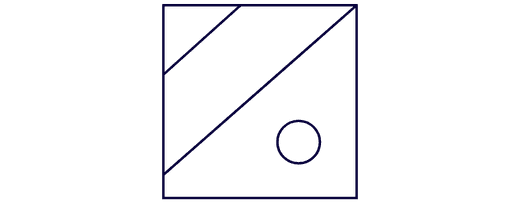
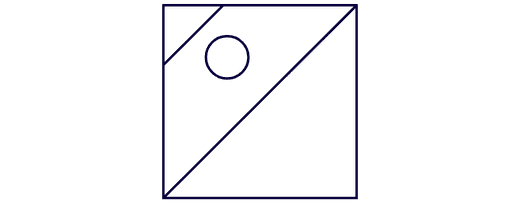
Option (a) is exactly that; in (b) an extra parallel line appears, in (c) the circle lies on the wrong side of the long line, and in (d) the long line stops short of the corner.
Hence, option (a) is correct.
So the missing top-right quarter must be the top-left quarter turned over about the vertical middle line: the long line from the top-right corner of the square down to the centre, the short line cutting the corner at the top of the middle line, and the circle in the lower-right part.
Option (a) is exactly that; in (b) an extra parallel line appears, in (c) the circle lies on the wrong side of the long line, and in (d) the long line stops short of the corner.
Hence, option (a) is correct.




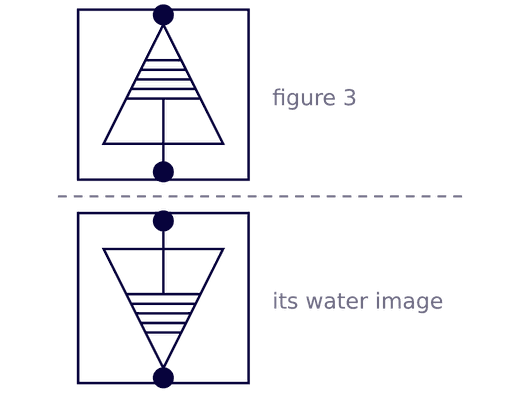 Turning the third figure over in the same way makes the triangle point downwards with its dotted tip at the bottom, lifts the stalk and its dot above the (now upper) base, and moves the band of stripes into the lower half.
That is option (b); (a) and (c) leave the triangle standing upright and (d) pushes the stalk away from the middle.
Hence, option (b) is correct.
Turning the third figure over in the same way makes the triangle point downwards with its dotted tip at the bottom, lifts the stalk and its dot above the (now upper) base, and moves the band of stripes into the lower half.
That is option (b); (a) and (c) leave the triangle standing upright and (d) pushes the stalk away from the middle.
Hence, option (b) is correct.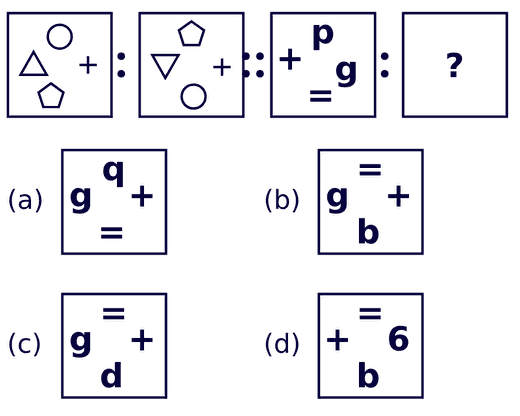
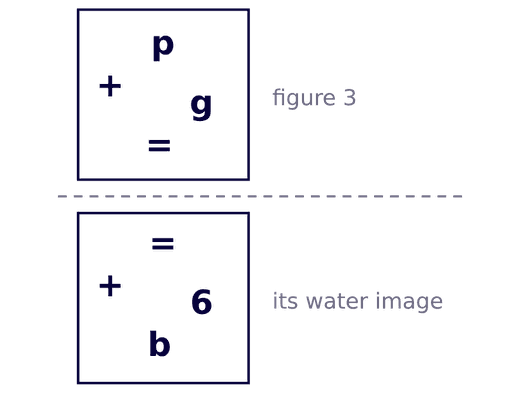 Apply the same to the third figure: the '=' at the bottom rises to the top, and the '+' stays on the left, because a mirror in a horizontal line never moves anything sideways.
The 'p' at the top turns over into a 'b' at the bottom, and the 'g' on the right turns over into a '6' on the right.
So the answer must show '=' at the top, '+' on the left, '6' on the right and 'b' at the bottom.
Hence, option (d) is correct.
Apply the same to the third figure: the '=' at the bottom rises to the top, and the '+' stays on the left, because a mirror in a horizontal line never moves anything sideways.
The 'p' at the top turns over into a 'b' at the bottom, and the 'g' on the right turns over into a '6' on the right.
So the answer must show '=' at the top, '+' on the left, '6' on the right and 'b' at the bottom.
Hence, option (d) is correct.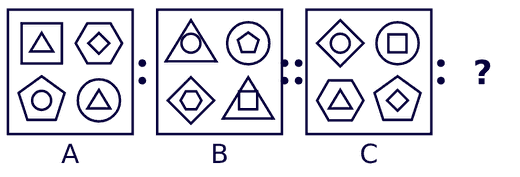



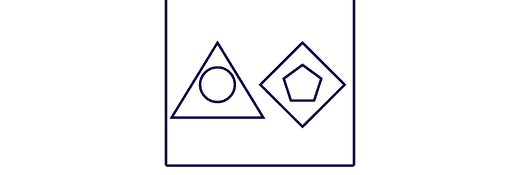
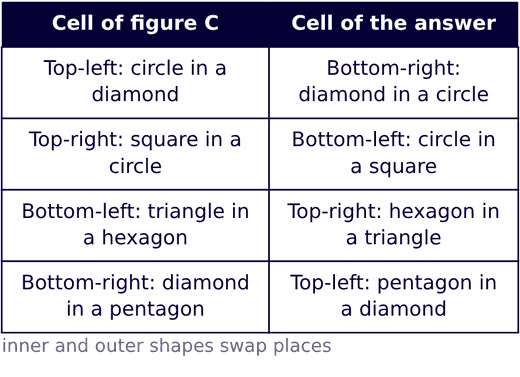 Figure C holds a circle inside a diamond (top-left), a square inside a circle (top-right), a triangle inside a hexagon (bottom-left) and a diamond inside a pentagon (bottom-right).
Swapping each pair and sending it to the opposite cell gives a pentagon inside a diamond at the top-left, a hexagon inside a triangle at the top-right, a circle inside a square at the bottom-left and a diamond inside a circle at the bottom-right.
Hence, option (a) is correct.
Figure C holds a circle inside a diamond (top-left), a square inside a circle (top-right), a triangle inside a hexagon (bottom-left) and a diamond inside a pentagon (bottom-right).
Swapping each pair and sending it to the opposite cell gives a pentagon inside a diamond at the top-left, a hexagon inside a triangle at the top-right, a circle inside a square at the bottom-left and a diamond inside a circle at the bottom-right.
Hence, option (a) is correct.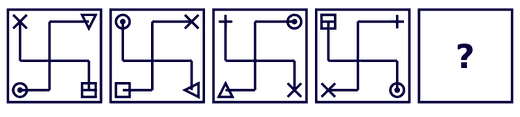




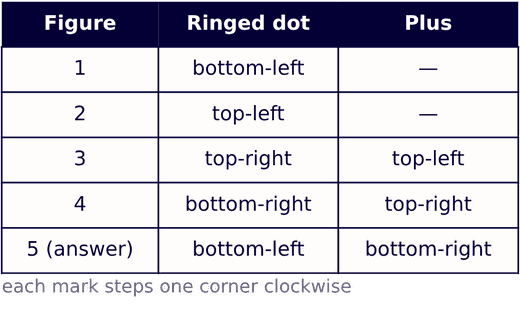 One more clockwise step brings it back to the bottom-left, so the missing figure must carry the ringed dot at the bottom-left; that rules out options (a) and (c).
Now follow the plus: it is at the top-left in the third figure and at the top-right in the fourth, again one corner clockwise, so in the fifth figure it must be at the bottom-right.
Option (b) has a cross there, not a plus, while option (d) has the ringed dot at the bottom-left and the plus at the bottom-right, exactly as required.
Hence, option (d) is correct.
One more clockwise step brings it back to the bottom-left, so the missing figure must carry the ringed dot at the bottom-left; that rules out options (a) and (c).
Now follow the plus: it is at the top-left in the third figure and at the top-right in the fourth, again one corner clockwise, so in the fifth figure it must be at the bottom-right.
Option (b) has a cross there, not a plus, while option (d) has the ringed dot at the bottom-left and the plus at the bottom-right, exactly as required.
Hence, option (d) is correct.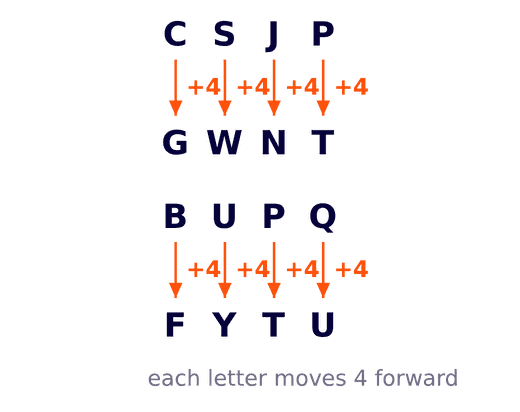 Apply +4 to 'BUPQ': B+4=F, U+4=Y, P+4=T and Q+4=U.
So the code is 'FYTU'.
Hence, option (d) is correct.
Apply +4 to 'BUPQ': B+4=F, U+4=Y, P+4=T and Q+4=U.
So the code is 'FYTU'.
Hence, option (d) is correct.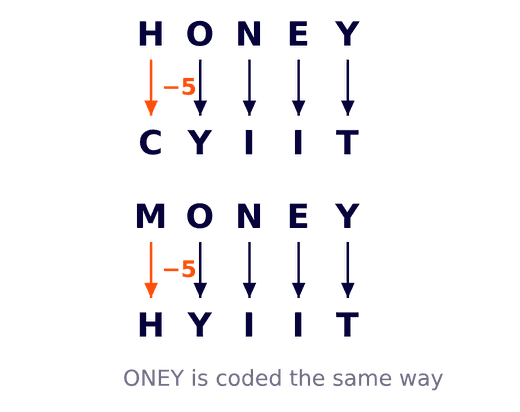 Only the first letter is new: M is the 13th letter and 13-5=8, which is H.
So 'MONEY' becomes 'HYIIT'.
Hence, option (b) is correct.
Only the first letter is new: M is the 13th letter and 13-5=8, which is H.
So 'MONEY' becomes 'HYIIT'.
Hence, option (b) is correct.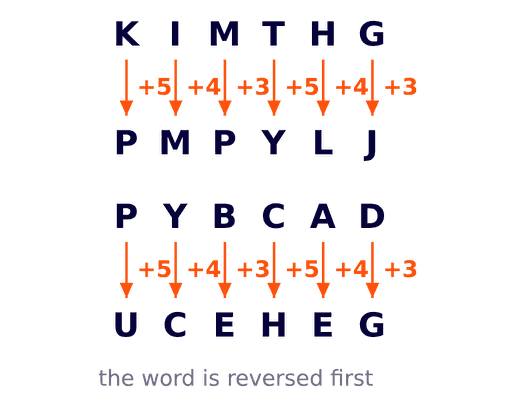 The second pair obeys the same rule: 'NEATLY' reversed is 'YLTAEN', and +5,+4,+3,+5,+4,+3 gives D,P,W,F,I,Q — exactly 'DPWFIQ'.
'DACBYP' reversed is 'PYBCAD', so P+5=U, Y+4=C, B+3=E, C+5=H, A+4=E and D+3=G.
The code is 'UCEHEG'.
Hence, option (c) is correct.
The second pair obeys the same rule: 'NEATLY' reversed is 'YLTAEN', and +5,+4,+3,+5,+4,+3 gives D,P,W,F,I,Q — exactly 'DPWFIQ'.
'DACBYP' reversed is 'PYBCAD', so P+5=U, Y+4=C, B+3=E, C+5=H, A+4=E and D+3=G.
The code is 'UCEHEG'.
Hence, option (c) is correct.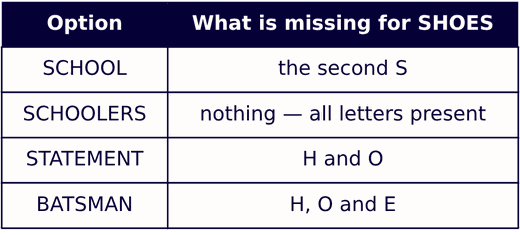 'SCHOOLERS' is made of S, C, H, O, O, L, E, R and S — it carries two S's, an H, an O and an E, which is everything 'SHOES' needs.
Hence, option (b) is correct.
'SCHOOLERS' is made of S, C, H, O, O, L, E, R and S — it carries two S's, an H, an O and an E, which is everything 'SHOES' needs.
Hence, option (b) is correct.