SSC CHSL 19 November 2025 · Shift 1 · General Awareness — questions with answers · ShikshaSphere
Chapter 70 of 200
19 November 2025 · Shift 1
General Awareness
25 questions ~25 min readFree
25 questions
A
76
After gaining control over the Kaveri delta, which of the following steps were taken by Vijayalaya Chola?
I. Establishment of Thanjavur as a town
II. Construction of a temple dedicated to Goddess Nishumbhasudini
A.Only II
B.Only I
C.Both I and II
D.Neither I nor II
Solution
Vijayalaya Chola
Vijayalaya, the founder of the imperial Chola line, seized the Kaveri delta from the Muttaraiyar chiefs in the middle of the ninth century.
He then built up Thanjavur as a town and made it his capital, so statement I is correct.
At Thanjavur he also built a temple for the goddess Nishumbhasudini, a form of Durga, so statement II is correct as well.
Temple building was the standard way a new Chola ruler announced his power, and this temple set the pattern later carried forward by Rajaraja I's Brihadeshvara temple.
Hence both I and II are correct and option (c) is correct.
77
Which of the following Rajput clans refused to accept the authority of the Mughal Empire for a prolonged period, maintaining political independence?
A.Sisodiya
B.Chauhan
C.Rathore
D.Kachhwaha
Solution
Rajputs and the Mughals
The Sisodiya Rajputs of Mewar are the clan that refused Mughal overlordship for the longest period.
Rana Sanga fought Babur at Khanwa in 1527 and Rana Pratap refused Akbar's terms, meeting him at Haldighati in 1576.
The Kachhwahas of Amber and the Rathores of Marwar, by contrast, accepted Mughal service and entered into matrimonial alliances with the imperial family.
The Chauhans had already lost their power in north India long before the Mughals arrived.
Hence, option (a) is correct.
78
'Al Kiran' in India is a pioneering initiative aimed at promoting gender inclusion and leadership of women in Artificial Intelligence.
The initiative is co-led by which of the following institutions?
A.Office of the Principal Scientific Adviser
B.Department of Science and Technology
C.Ministry of Skill Development and Entrepreneurship
D.Digital India Corporation
Solution
AI Kiran initiative
AI Kiran is a national movement to bring far more women into artificial intelligence — into AI skilling, research and leadership roles.
It is co-led by the Office of the Principal Scientific Adviser (PSA) to the Government of India, together with partners such as Verix and INK Women.
The PSA's office is the body that coordinates science and technology missions across ministries, which is why a cross-sector AI mission of this kind sits with it.
The Department of Science and Technology, the Ministry of Skill Development and Digital India Corporation run their own programmes, but none of them co-leads AI Kiran.
Hence, option (a) is correct.
79
For an NPS Vatsalya account launched in September 2024, what is the least amount a parent/guardian must deposit annually to keep the account active?
A.Rs 750
B.Rs 1500
C.Rs 1000
D.Rs 2000
Solution
NPS Vatsalya scheme
NPS Vatsalya, launched in September 2024, is a pension account opened and operated by a parent or guardian in the name of a minor.
It needs ₹1,000 to open, and a contribution of at least ₹1,000 every year to keep the account active.
When the child turns 18 the account is converted into a regular NPS account, and the pension itself begins only after the age of 60.
The scheme is regulated by the PFRDA, which issues a PRAN card to the minor subscriber.
Hence, option (c) is correct.
80
Which of the following components are considered while calculating India's Financial Inclusion Index?
I. Access to financial services
II. Usage of financial products
A.Only I
B.Only II
C.Both I and II
D.Neither I nor II
Solution
Financial Inclusion Index
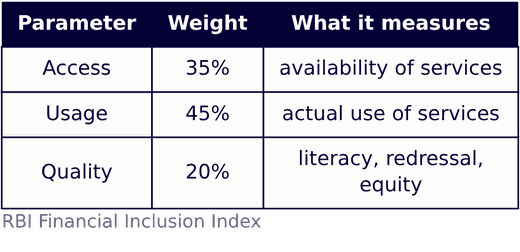
The RBI's Financial Inclusion Index (FI-Index) is built from three parameters — Access, Usage and Quality.
Access, with a weight of 35%, measures the availability of banking points such as branches, ATMs and business correspondents, so statement I is counted.
Usage, with the largest weight of 45%, measures how far people actually use accounts, credit, insurance, investment and remittance services, so statement II is counted as well.
Quality carries the remaining 20% and looks at financial literacy, grievance redressal and inequality in service.
Hence both components are used and option (c) is correct.
81
In the 2025 World Press Freedom Index, what is the global ranking of India in terms of press freedom?
A.173rd
B.132nd
C.151st
D.119th
Solution
Indices and reports
The World Press Freedom Index is brought out every year by Reporters Without Borders (RSF), which ranks 180 countries.
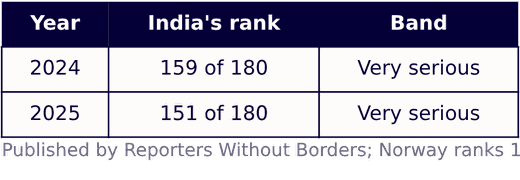
In the 2025 Index India is placed 151st out of 180 countries.
India climbed eight places from 159th in 2024, but its score keeps it in the 'very serious' band; Norway again stood first.
The rank is built from five indicators: political, economic, legislative, social and security context.
Hence, option (c) is correct.
82
Consider the Export Preparedness Index of India. How many pillars constitute this index?
A.12
B.9
C.3
D.4
Solution
Export Preparedness Index
The Export Preparedness Index (EPI) is released by NITI Aayog to rank States and Union Territories on how ready they are to export.
It is a composite index built on 4 pillars, which are further broken into 10 sub-pillars.
So the number of pillars asked for is 4.
Hence, option (d) is correct.
83
On 2 February 2025, World Wetlands Day was observed in Uttar Pradesh at:
A.Lucknow Ramsar Site
B.Gonda's Parvati Arga Ramsar Site
C.Noida Wetland Park
D.Ayodhya Eco-park
Solution
World Wetlands Day
World Wetlands Day is observed on 2 February, the day the Ramsar Convention on Wetlands was signed in Ramsar, Iran, in 1971.
In 2025 the Uttar Pradesh observance was held at the Parvati Arga Ramsar Site in Gonda district, a lake famous for its winter migratory birds.
The theme for 2025 was 'Protecting Wetlands for Our Common Future'.
Lucknow, Noida and Ayodhya in the other options carry no Ramsar site of this name, so they can be ruled out.
Hence, option (b) is correct.
84
Bandipur Tiger Reserve, one of the earliest tiger reserves established under Project Tiger, is located in which Indian state?
A.Uttar Pradesh
B.Karnataka
C.Maharashtra
D.Jharkhand
Solution
Tiger reserves
Bandipur Tiger Reserve lies in the Chamarajanagar district of Karnataka, on the Mysuru-Ooty road at the foot of the Western Ghats.
It was among the first nine reserves notified in 1973 when Project Tiger was launched.
Together with Nagarahole, Mudumalai and Wayanad it forms the Nilgiri Biosphere Reserve, the largest tiger habitat block in India.
Karnataka's other tiger reserves are Nagarahole, Bhadra, Kali and Biligiri Ranganatha Temple (BRT).
Hence, option (b) is correct.
85
The working principle behind a satellite launch vehicle is based on:
A.Newton's third law of motion
B.Newton's first law of motion
C.Newton's second law of motion
D.Bernoulli's principle
Solution
Newton's laws of motion
A launch vehicle burns fuel and throws hot gases downward at high speed through its nozzle; this is the action.
By Newton's third law, for every action there is an equal and opposite reaction, so the gases push the rocket upward with the same force.
The same law explains the recoil of a gun, walking on the ground and the rowing of a boat.
The second law only tells how much acceleration that thrust produces, and Bernoulli's principle explains aircraft wings, not rocket lift-off.
Hence, option (a) is correct.
86
Which country developed the world's first wooden satellite, LignoSat, in 2024?
A.India
B.USA
C.Japan
D.South Korea
Solution
Space technology
LignoSat, the world's first wooden satellite, was built in Japan by Kyoto University together with Sumitomo Forestry.
The palm-sized CubeSat, made of magnolia wood, was sent to the International Space Station in November 2024 and released into orbit.
Its purpose is to test wood as a space material: a wooden body burns up completely on re-entry and leaves no metal particles or debris behind.
Hence, option (c) is correct.
87
Which of the following demonstrates cooling caused by evaporation?
I. Pouring acetone on the palm
II. Sprinkling water on the roof after a hot day
A.Only I
B.Only II
C.Both I and II
D.Neither I nor II
Solution
Evaporation and cooling
When a liquid evaporates, its fastest molecules escape and the latent heat of vaporisation needed for this is drawn from the surface below.
That surface loses heat, so its temperature falls - this is evaporative cooling.
Acetone is highly volatile, so on the palm it evaporates at once and the skin feels distinctly cold.
Water sprinkled on a hot roof also evaporates and takes heat away from the roof, cooling it.
Both statements therefore describe cooling by evaporation.
Hence, option (c) is correct.
88
The plundering of Delhi by Nadir Shah took place in which of the following years?
A.1739
B.1745
C.1725
D.1717
Solution
Later Mughal period
Nadir Shah, the ruler of Persia, defeated the Mughal emperor Muhammad Shah at the Battle of Karnal in February 1739.
He then entered Delhi and plundered the city in March 1739, ordering a general massacre after a riot broke out.
He carried away the Peacock Throne and the Koh-i-Noor diamond, a blow from which Mughal prestige never recovered.
Hence, option (a) is correct.
89
Sawai Jai Singh of Amber founded which of the following cities as his capital?
A.Jaipur
B.Alwar
C.Kota
D.Udaipur
Solution
Rajput states
Sawai Jai Singh II of Amber founded Jaipur in 1727 and shifted his capital there from the hill fort of Amber.
Laid out by Vidyadhar Bhattacharya on a grid of nine blocks following Vastu and Shilpa Shastra, it is one of India's earliest planned cities.
The same ruler built the Jantar Mantar observatories at Jaipur, Delhi, Ujjain, Mathura and Varanasi.
Alwar, Kota and Udaipur were capitals of other Rajput houses, not of Amber.
Hence, option (a) is correct.
90
Under the Fiscal Responsibility and Budget Management (FRBM) Act, how many policy statements must be presented along with the Union Budget?
A.5
B.3
C.4
D.6
Solution
FRBM Act
The Fiscal Responsibility and Budget Management (FRBM) Act, 2003 was passed to bring discipline and transparency to government finances.
Under it the Central Government must lay three policy statements before Parliament along with the Union Budget.
These statements set out the fiscal targets, the strategy behind them and the macro-economic assumptions on which the Budget rests.
Hence, option (b) is correct.
91
The Competition Act, aimed at promoting fair trade practices in India, was enacted in which year?
A.2002
B.2001
C.1999
D.2003
Solution
Competition Act
The Competition Act was enacted in 2002 to keep Indian markets competitive and to protect the interests of consumers.
It replaced the Monopolies and Restrictive Trade Practices (MRTP) Act, 1969, whose focus on the size of firms had become outdated after liberalisation.
The Act set up the Competition Commission of India (CCI), which curbs anti-competitive agreements, abuse of dominance and harmful combinations.
Hence, option (a) is correct.
92
Which crop is typically grown under dryland farming conditions in India?
A.Ragi
B.Rice
C.Sugarcane
D.Jute
Solution
Dryland farming
Dryland farming is practised where annual rainfall is low and uncertain, roughly below 75 cm, and no assured irrigation exists.
Such land can carry only hardy, drought-resistant crops, and ragi (finger millet) is a typical example, along with jowar, bajra, gram and pulses.
Rice, sugarcane and jute all need heavy and steady water, so they belong to irrigated or high-rainfall tracts.
Hence, option (a) is correct.
93
Over 97% of India's coal reserves are concentrated in which of the following valleys?
A.Damodar, Sone, Mahanadi, and Godavari
B.Ganga and Yamuna
C.Indus, Jhelum, Chenab, and Sutlej
D.Narmada and Tapi
Solution
Coal reserves of India
Almost all of India's coal is Gondwana coal, laid down in ancient river basins of peninsular India.
Over 97% of the reserves lie in the valleys of the Damodar, Sone, Mahanadi and Godavari rivers.
The Ganga-Yamuna plain, the Indus system and the Narmada-Tapi valleys carry no such Gondwana coal measures, so the other options fail.
Hence, option (a) is correct.
94
According to the Economic Survey 2023-24, by 2030, what percentage of India's population is expected to reside in urban areas?
A.40%
B.80%
C.65%
D.90%
Solution
Urbanisation in India
The Economic Survey 2023-24 projects that about 40% of India's population will live in urban areas by 2030.
The figure fits the long trend: 17.3% urban in 1951, 27.8% in 2001 and 31.2% in Census 2011.
A jump to 65% or 80% within a few years would be impossible at the present pace, which rules out the larger options.
Hence, option (a) is correct.
95
Regarding the Rashtriya Vayoshri Yojana (RVY), which of the following statements is correct?
I. It is funded through the Senior Citizens' Welfare Fund.
II. It is a Central Sector Scheme.
A.Only I
B.Only II
C.Both I and II
D.Neither I nor II
Solution
Welfare schemes
The Rashtriya Vayoshri Yojana was launched on 1 April 2017 by the Ministry of Social Justice and Empowerment.
It gives free assistive aids - walking sticks, hearing aids, spectacles, wheelchairs, artificial dentures - to elderly persons of the BPL and low-income category.
The whole cost is met by the Centre from the Senior Citizens' Welfare Fund, which is built from unclaimed amounts lying in small savings and similar accounts, so statement I is correct.
Because the Centre bears the entire expenditure with no State share, it is a Central Sector Scheme, so statement II is also correct.
Hence, option (c) is correct.
96
According to the MOSPI report 2024, by 2036, what percentage of India's total population is expected to be female?
A.48.8%
B.
C.58.8%
D.61.8%
Solution
Population projections
The report 'Women and Men in India' brought out by the Ministry of Statistics and Programme Implementation (MoSPI) in 2024 carries population projections for 2036.
It expects India's population to touch about 152.2 crore by 2036, with women forming 48.8% of it, against 48.5% in 2011.
The same projection raises the sex ratio to 952 females per 1,000 males, a slow rise that a share of 58.8% or 61.8% could never match.
Hence, option (a) is correct.
97
According to Buddha, the primary roots of human suffering are:
A.Ignorance and Attachment
B.Poverty and Disease
C.Violence and Disease
D.War and Poverty
Solution
Teachings of Buddha
The Second Noble Truth of Buddhism traces suffering (dukkha) to craving or attachment (trishna), which in turn springs from ignorance (avidya) of the true nature of things.
Ignorance makes a person treat the impermanent as permanent, and attachment binds him to it; together they keep the cycle of rebirth going.
Removing them through the Eightfold Path ends suffering and leads to nirvana.
Poverty, disease, violence and war are outward troubles, not the root causes Buddha identified.
Hence, option (a) is correct.
98
Who among the following rulers is regarded as the founder of the Nanda Dynasty in ancient India?
A.Chanakya
B.Chandragupta Maurya
C.Mahapadma Nanda
D.Dhanananda
Solution
Nanda dynasty
Mahapadma Nanda founded the Nanda dynasty of Magadha by overthrowing the last Shishunaga ruler, with Pataliputra as his capital.
The Puranas call him Ekarat, the sole sovereign, and Sarva-kshatrantaka, the destroyer of all Kshatriyas, for uprooting the older ruling houses.
Dhanananda, named in another option, was the last Nanda king, defeated by Chandragupta Maurya with the guidance of Chanakya.
Hence, option (c) is correct.
99
The Indus-Sarasvati Civilization is known by several names. Identify the incorrect one.
A.Indus Civilization
B.Harappan Civilization
C.Sindhu-Sarasvati Civilization
D.Mesopotamian Civilization
Solution
Harappan civilisation
The question asks for the name that does NOT belong to this civilisation.
Indus Civilization, Harappan Civilization and Sindhu-Sarasvati Civilization are three names of the same Bronze Age culture of the north-western subcontinent - named after the river, after the first excavated site Harappa, and after the two river systems along which its sites lie.
The Mesopotamian Civilization grew in the Tigris-Euphrates basin of West Asia; it traded with the Harappans but was an entirely separate civilisation.
Hence, option (d) is correct.
100
During the Gupta age, Bhagvatism emphasizing bhakti and ahimsa was associated with the worship of which god?
A.Vishnu
B.Indra
C.Brahma
D.Kartikeya
Solution
Religion in Gupta age
Bhagvatism grew around the worship of Vasudeva-Krishna, who came to be identified with Vishnu, and it stressed bhakti (loving devotion) and ahimsa in place of costly Vedic sacrifice.
The Gupta rulers were themselves Vaishnavas and used the title Parama Bhagavata, which is why the movement flourished in their age; Garuda, the vahana of Vishnu, appears on their coins and seals.
The doctrine of the ten avataras of Vishnu also took firm shape in this period.
Indra, Brahma and Kartikeya were worshipped, but Bhagvatism was never centred on them.
Hence, option (a) is correct.
Finished reading? Now test yourself.
The same 25 questions, but with a timer and the answers hidden — 15 minutes.

 Hence both components are used and option (c) is correct.
 India climbed eight places from 159th in 2024, but its score keeps it in the 'very serious' band; Norway again stood first.
The rank is built from five indicators: political, economic, legislative, social and security context.
Hence, option (c) is correct.
India climbed eight places from 159th in 2024, but its score keeps it in the 'very serious' band; Norway again stood first.
The rank is built from five indicators: political, economic, legislative, social and security context.
Hence, option (c) is correct.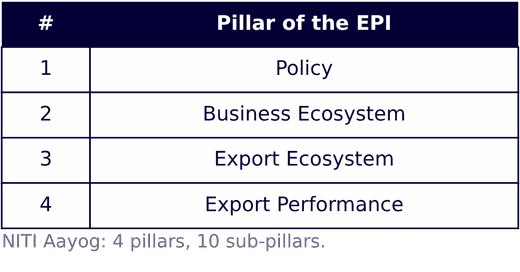 So the number of pillars asked for is 4.
Hence, option (d) is correct.
So the number of pillars asked for is 4.
Hence, option (d) is correct.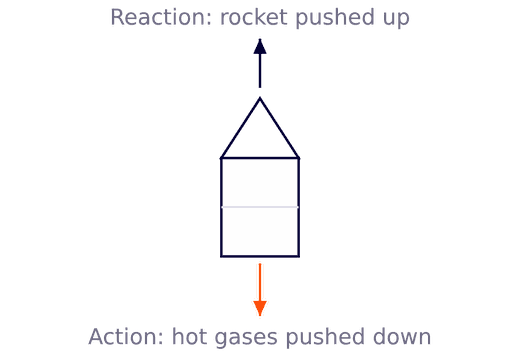 The same law explains the recoil of a gun, walking on the ground and the rowing of a boat.
The second law only tells how much acceleration that thrust produces, and Bernoulli's principle explains aircraft wings, not rocket lift-off.
Hence, option (a) is correct.
The same law explains the recoil of a gun, walking on the ground and the rowing of a boat.
The second law only tells how much acceleration that thrust produces, and Bernoulli's principle explains aircraft wings, not rocket lift-off.
Hence, option (a) is correct.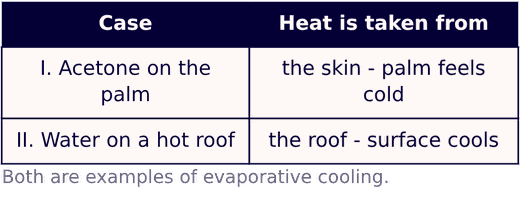 Acetone is highly volatile, so on the palm it evaporates at once and the skin feels distinctly cold.
Water sprinkled on a hot roof also evaporates and takes heat away from the roof, cooling it.
Both statements therefore describe cooling by evaporation.
Hence, option (c) is correct.
Acetone is highly volatile, so on the palm it evaporates at once and the skin feels distinctly cold.
Water sprinkled on a hot roof also evaporates and takes heat away from the roof, cooling it.
Both statements therefore describe cooling by evaporation.
Hence, option (c) is correct.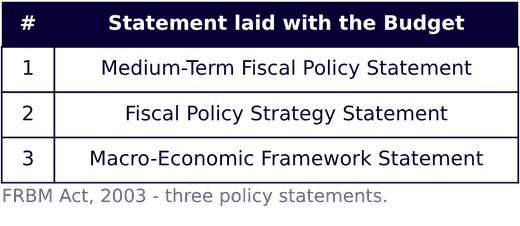 These statements set out the fiscal targets, the strategy behind them and the macro-economic assumptions on which the Budget rests.
Hence, option (b) is correct.
These statements set out the fiscal targets, the strategy behind them and the macro-economic assumptions on which the Budget rests.
Hence, option (b) is correct.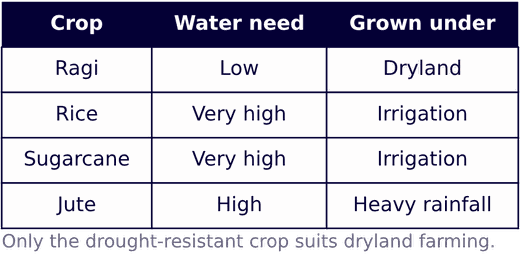 Rice, sugarcane and jute all need heavy and steady water, so they belong to irrigated or high-rainfall tracts.
Hence, option (a) is correct.
Rice, sugarcane and jute all need heavy and steady water, so they belong to irrigated or high-rainfall tracts.
Hence, option (a) is correct.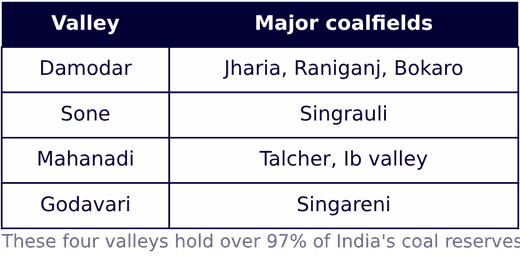 The Ganga-Yamuna plain, the Indus system and the Narmada-Tapi valleys carry no such Gondwana coal measures, so the other options fail.
Hence, option (a) is correct.
The Ganga-Yamuna plain, the Indus system and the Narmada-Tapi valleys carry no such Gondwana coal measures, so the other options fail.
Hence, option (a) is correct.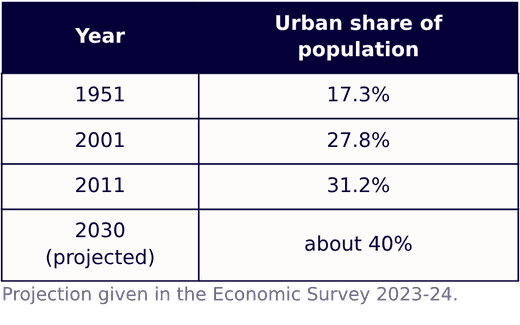 The figure fits the long trend: 17.3% urban in 1951, 27.8% in 2001 and 31.2% in Census 2011.
A jump to 65% or 80% within a few years would be impossible at the present pace, which rules out the larger options.
Hence, option (a) is correct.
The figure fits the long trend: 17.3% urban in 1951, 27.8% in 2001 and 31.2% in Census 2011.
A jump to 65% or 80% within a few years would be impossible at the present pace, which rules out the larger options.
Hence, option (a) is correct.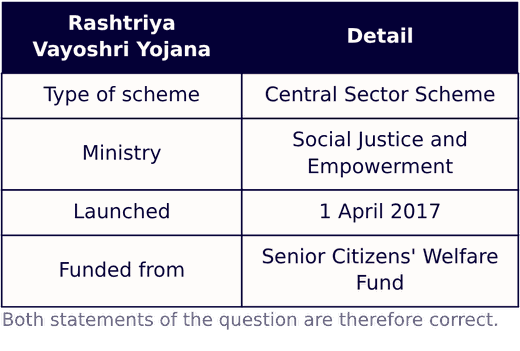 The whole cost is met by the Centre from the Senior Citizens' Welfare Fund, which is built from unclaimed amounts lying in small savings and similar accounts, so statement I is correct.
Because the Centre bears the entire expenditure with no State share, it is a Central Sector Scheme, so statement II is also correct.
Hence, option (c) is correct.
The whole cost is met by the Centre from the Senior Citizens' Welfare Fund, which is built from unclaimed amounts lying in small savings and similar accounts, so statement I is correct.
Because the Centre bears the entire expenditure with no State share, it is a Central Sector Scheme, so statement II is also correct.
Hence, option (c) is correct.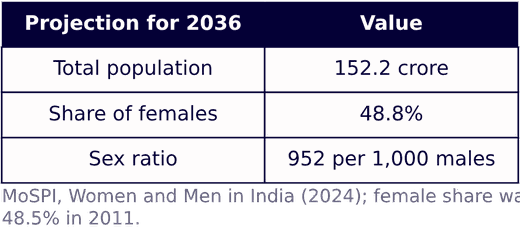 The same projection raises the sex ratio to 952 females per 1,000 males, a slow rise that a share of 58.8% or 61.8% could never match.
Hence, option (a) is correct.
The same projection raises the sex ratio to 952 females per 1,000 males, a slow rise that a share of 58.8% or 61.8% could never match.
Hence, option (a) is correct.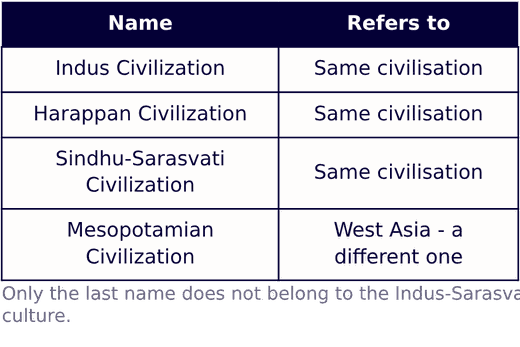 The Mesopotamian Civilization grew in the Tigris-Euphrates basin of West Asia; it traded with the Harappans but was an entirely separate civilisation.
Hence, option (d) is correct.
The Mesopotamian Civilization grew in the Tigris-Euphrates basin of West Asia; it traded with the Harappans but was an entirely separate civilisation.
Hence, option (d) is correct.