SSC CHSL 19 November 2025 · Shift 3 · English Language — questions with answers · ShikshaSphere
Chapter 80 of 200
19 November 2025 · Shift 3
English Language
25 questions ~25 min readFree
25 questions
A
1
Identify the part of the sentence that contains a grammatical error.
A. The students denied B. having excess to . the exam papers . before the test.
A.The students denied
B.having excess to
C.the exam papers
D.before the test
Solution
Confusable words: access/excess
Part B is faulty: 'excess' means a surplus or extra amount, which makes no sense with 'denied having … to the exam papers'.
The sentence is about permission to reach or use the papers, so the noun needed is 'access' — the right to enter, use or obtain something.
Correct part: 'having access to'.
The other parts are sound: 'deny + V-ing' is the right pattern, and 'the exam papers' and 'before the test' are idiomatic.
2
Identify the part of the sentence that contains a grammatical error.
A. This strategy B. is the most perfect C. solution for D. our current problem.
A.This strategy
B.is the most perfect
C.solution for
D.our current problem
Solution
Absolute adjectives
Part B is faulty: 'perfect' is an absolute (non-gradable) adjective — a thing is either perfect or it is not.
Such adjectives — perfect, unique, complete, final, supreme — take no 'more' or 'most' before them.
So 'is the most perfect' must be reduced to 'is the perfect'.
Parts A, C and D are grammatical: 'solution for … problem' and the possessive 'our current problem' are correct usage.
3
Select the most appropriate meaning of the word: Lugubrious
A.Cheerful
B.Optimistic
C.Mournful
D.Joyous
Solution
Meaning of a word
'Lugubrious' means looking or sounding sad, gloomy and dismal, often in an exaggerated way.
'Mournful' — full of sorrow or grief — carries exactly that sense, so it is the meaning asked for.
Cheerful, Optimistic and Joyous all express happiness or hope, i.e. the very opposite of the given word.
Memory hook: a lugubrious face is the long, drooping face seen at a funeral.
4
Select the most appropriate synonym of the word: INTRANSIGENT
A.Compliant
B.Uncompromising
C.Flexible
D.Submissive
Solution
Synonym
'Intransigent' means refusing to change one's views or to reach a compromise — 'in-' (not) + 'transigent' (coming to terms).
'Uncompromising' says exactly this: unwilling to make any concession.
Compliant, Flexible and Submissive all describe someone who yields easily, so they are antonyms, not synonyms.
5
Choose the correctly spelt word:
A.Receit
B.Reciept
C.Receipt
D.Receet
Solution
Correct spelling
The correct spelling is 'Receipt' — a written acknowledgement of something received.
It follows the 'i before e except after c' rule (rec-EI-pt) and keeps the silent 'p' inherited from Latin 'recepta'.
Receit and Receet drop the 'p', and Reciept reverses the 'ei', so all three are wrong.
6
Choose the correctly spelt word:
A.Perspicacious
B.Perspicasious
C.Perspisacious
D.Perspicacoius
Solution
Correct spelling
The correct spelling is 'Perspicacious', meaning having keen insight or sharp judgement.
Break it up as per-spi-ca-cious: both /s/-sounds after 'per' are written with 'c' and 'sp', and the ending is '-cious', never '-sious' or '-coius'.
Do not confuse it with 'perspicuous', which means clearly expressed and easily understood.
7
Fill in the blank with the most appropriate idiom:
The impending investigation hung over the Senator's re-election campaign like
causing anxiety among his staff.
A.the Sword of Damocles
B.a primrose path
C.a Parthian shot
D.a stalking horse
Solution
Idiom in context
The blank needs an idiom for a danger that hangs over someone constantly and keeps them uneasy.
'The Sword of Damocles' is exactly that — from the legend of a sword suspended by a single hair above Damocles' head — so the looming investigation fits it.
'A primrose path' is an easy, pleasant way of life; 'a Parthian shot' is a sharp remark made while leaving; 'a stalking horse' is a person or thing used to hide one's real intention.
Only option (a) supplies the constant threat that explains the anxiety among the staff.
8
Choose the correct one-word substitute for:
The study of the development, structure, and functioning of human society.
A.Sociology
B.Pathology
C.Theology
D.Philology
Solution
One-word substitution
The definition given — the development, structure and functioning of human society — names the subject 'Sociology' ('socio-' society + '-logy' study).
Pathology studies diseases and their causes, Theology studies God and religious belief, and Philology studies the structure and history of languages.
Hence (a) is the required one-word substitute.
9
Select the most appropriate antonym of the word: Concealed
A.Covered
B.Hidden
C.Masked
D.Revealed
Solution
Antonym
'Concealed' means kept hidden or out of sight, so its antonym must mean 'made known'.
'Revealed' — to disclose information that was previously secret — is the exact opposite.
Covered, Hidden and Masked are all synonyms of 'concealed', so none of them can be the answer.
10
Choose the correct indirect narration of the following statement from the given alternatives:
The stranger said, "Can you show me the way to the station?"
A.The stranger requested if he can show him the way to the station.
B.The stranger requested if he could show him the way to the station.
C.The stranger requested if he can showed him the way to the station.
D.The stranger requests if he could show him the way to the station.
Solution
Direct to indirect narration
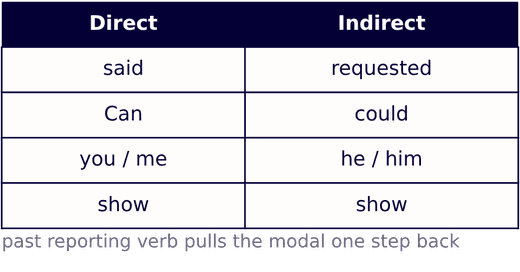
The reported sentence is a request beginning with 'Can you …', so the reporting verb becomes 'requested' and the clause is joined with 'if'.
'Said' is in the past tense, so the modal back-shifts: 'can' becomes 'could'.
After the modal 'could' the base verb 'show' is used, never 'showed'.
Only option (b) keeps the past reporting verb 'requested', the back-shifted 'could' and the base form 'show'.
11
Select the most appropriate antonym of the word: Acrimonious
A.Bitter
B.Rancorous
C.Harmonious
D.Caustic
Solution
Antonym
'Acrimonious' describes speech or a dispute that is angry and bitter in tone.
Its antonym must suggest peace and agreement, which is 'Harmonious' — friendly and free from conflict.
Bitter, Rancorous and Caustic all repeat the idea of resentment or sharp criticism, so they are synonyms of the given word.
12
Which sentence contains a misspelled word?
A.It is a great privilege to address this audience today.
B.Education should be a right, not just a privilege.
C.He grew up with every advantage and privilege imaginable.
D.She lost the priviledge of driving the company car.
Solution
Misspelt word in a sentence
The correct spelling is 'privilege' — there is no 'd' before the final '-ge'.
Option (d) writes 'priviledge', so that is the sentence containing the misspelling.
Sentences (a), (b) and (c) all spell the word correctly.
13
Which sentence contains a misspelled word?
A.The accident occurred late at night on the highway.
B.A strange thought occurred to me while I was driving.
C.The problem never occured during the testing phase.
D.Several changes have occurred since the last update.
Solution
Misspelt word in a sentence
A verb ending in a single consonant with the stress on the last syllable doubles that consonant before '-ed': occur → occurred.
Option (c) writes 'occured' with a single 'r', which is the misspelling.
The other three sentences use the correct form 'occurred'.
14
Change the following sentence into the Active form.
The syllabus will have been completed by the teacher before the exam starts.
A.The teacher will complete the syllabus before the exam starts.
B.The teacher will have completed the syllabus before the exam starts.
C.The syllabus will had be completed by the teacher before the exam starts.
D.The exam will have completed the syllabus.
Solution
Passive to active voice
The given sentence is passive and in the future perfect tense: 'will have been' + 'completed' (V3).
Rule: passive 'S + will have been + V3 + by O' becomes active 'O + will have + V3 + S'.
The agent 'the teacher' becomes the subject, and the tense must stay future perfect: 'will have completed'.
Hence: 'The teacher will have completed the syllabus before the exam starts.'
Option (a) drops 'have' and slips into the simple future, while (c) is still a faulty passive, so both change the tense.
15
Select the option that expresses the given sentence in indirect voice.
The announcer said, "The show will start in five minutes."
A.The announcer said that the show will start in five minutes.
B.The announcer said that the show started in five minutes.
C.The announcer said that the show would start in five minutes.
D.The announcer said that the show is starting in five minutes.
Solution
Direct to indirect narration
The reporting verb 'said' is in the past tense, so the tense inside the reported clause must back-shift.
The 'will' of the quotation therefore becomes 'would'.
A statement is linked by 'that' and the rest of the wording stays as it is: 'that the show would start in five minutes'.
Option (a) leaves 'will' unchanged, (b) turns the verb into a simple past, and (d) rewrites it as a present continuous.
16
Choose the most suitable option to replace the highlighted part of the sentence:
The trespasser was persecuted by the authorities for entering the restricted zone.
A.prosecuted with
B.persecuted with
C.prosecuted by
D.persecuted to
Solution
Confusable words: persecute/prosecute
'Persecute' means to harass or oppress someone, usually for their beliefs, race or identity.
'Prosecute' means to institute legal proceedings against someone — precisely what authorities do to a trespasser who enters a restricted zone.
In this passive structure the doer is still introduced by 'by': 'was prosecuted by the authorities'.
So the highlighted part becomes 'prosecuted by'; the options with 'with' or 'to' break the passive pattern, and those keeping 'persecuted' keep the wrong word.
17
Choose the correct passive voice transformation of the sentence:
The hunter killed the lion.
A.The lion is killed by the hunter.
B.The lion was killed by the hunter.
C.The lion has been killed by the hunter.
D.The lion had been killed by the hunter.
Solution
Active to passive voice
The active sentence 'The hunter killed the lion' is in the simple past tense.
Rule: active 'S + V2 + O' becomes passive 'O + was/were + V3 + by S'.
The object 'the lion' is singular, so the helping verb is 'was' and the past participle is 'killed'.
Hence: 'The lion was killed by the hunter.'
Options (a), (c) and (d) shift the tense to simple present, present perfect and past perfect respectively, which the rule does not allow.
18
Choose the correct passive voice transformation of the sentence:
The committee has promised to award the winning team a gold trophy at the ceremony.
A.The winning team has been promised a gold trophy at the ceremony by the committee.
B.A gold trophy have been promised to the winning team by the committee.
C.The winning team will be awarded a gold trophy at the ceremony by the committee.
D.A gold trophy will be promised to the winning team by the committee at the ceremony.
Solution
Active to passive voice
The finite verb is 'has promised' — present perfect — and the sentence carries two objects: 'the winning team' (person) and 'a gold trophy' (thing).
It is 'promised' that must be turned passive; 'to award' is only an infinitive and stays as part of the promise.
Passive of the present perfect is 'has/have been + V3', and with two objects the person is normally made the subject.
So: 'The winning team has been promised a gold trophy at the ceremony by the committee.'
Option (b) puts plural 'have' with a singular subject, while (c) and (d) shift the tense to a simple future.
19
Select the option that expresses the given sentence in direct voice.
The CEO confirmed that she would not approve the budget which was proposed by the department that had been overspending for consecutive quarters.
A."I will not approve the budget which was proposed by the department that had been overspending for consecutive quarters," the CEO confirmed.
B."I would not approve the budget which was proposed by the department that was overspending for consecutive quarters," the CEO confirmed.
C.'I will not approve the budget which is proposed by the department that has been overspending for consecutive quarters," the CEO confirmed.
D."She would not approve the budget which was proposed by the department that had been overspending for consecutive quarters," the CEO confirmed.
Solution
Indirect to direct narration
Moving from indirect to direct speech, 'that' is replaced by inverted commas and every back-shifted verb is moved one step forward again.
'she would not approve' therefore becomes 'I will not approve', the pronoun turning into the speaker's own 'I'.
The subordinate clauses reverse in the same way: 'which was proposed' → 'which is proposed' and 'that had been overspending' → 'that has been overspending'.
Only option (c) reverses all three verbs; (a) and (b) leave the subordinate clauses back-shifted, and (d) keeps the third-person 'She' inside the quotation.
20
Directions (Qs. 20-24): Read the following passage carefully and answer the questions that follow.
Electronic waste recycling is a critical but frequently neglected issue in the modern digital age. Households, offices, and factories discard huge numbers of devices every year, including old
smartphones, laptops, cables, and other gadgets that might be toxic. If not collected and processed correctly, this debris can cause severe damage to public health and the ecosystem.
Effective e-waste recycling involves dismantling, sorting, and responsibly recovering valuable materials from the scrap. Numerous recycling centers adhere to rigorous standards to guarantee that toxic components are not dumped with ordinary trash. Shredding, magnetic separation, and acid baths are some standard techniques utilized to recover metals like gold and copper.
Nevertheless, inadequate infrastructure and limited knowledge often result in dangerous dumping habits in many regions. Specialists argue that educating consumers, stringent application of laws, and corporate responsibility are vital to upgrading e-waste recycling and shielding populations from lingering danger.
Identify the voice (active or passive) and the tense of the verb in the sentence:
"Numerous recycling centers adhere to rigorous standards to guarantee that toxic components are not dumped with ordinary trash."
A.Passive voice, simple past
B.Active voice, present perfect
C.Active voice, simple present
D.Passive voice, present continuous
Solution
Identifying voice and tense
First locate the main clause: 'Numerous recycling centers adhere to rigorous standards'.
Its subject itself performs the action of 'adhere', so the main clause is in the active voice.
'adhere' is the base form used with a plural subject — the simple present — stating a habitual, general practice.
The passive 'are not dumped' sits inside a subordinate 'that'-clause and does not decide the voice of the sentence's main verb.
Hence the sentence is in the active voice, simple present tense.
21
Directions (Qs. 20-24): Read the following passage carefully and answer the questions that follow.
Electronic waste recycling is a critical but frequently neglected issue in the modern digital age. Households, offices, and factories discard huge numbers of devices every year, including old
smartphones, laptops, cables, and other gadgets that might be toxic. If not collected and processed correctly, this debris can cause severe damage to public health and the ecosystem.
Effective e-waste recycling involves dismantling, sorting, and responsibly recovering valuable materials from the scrap. Numerous recycling centers adhere to rigorous standards to guarantee that toxic components are not dumped with ordinary trash. Shredding, magnetic separation, and acid baths are some standard techniques utilized to recover metals like gold and copper.
Nevertheless, inadequate infrastructure and limited knowledge often result in dangerous dumping habits in many regions. Specialists argue that educating consumers, stringent application of laws, and corporate responsibility are vital to upgrading e-waste recycling and shielding populations from lingering danger.
Identify the part of speech of the word "correctly" in the sentence:
"If not collected and processed correctly, this debris can cause severe damage to public health and the ecosystem."
A.Adjective
B.Adverb
C.Preposition
D.Pronoun
Solution
Parts of speech: adverb
'Correctly' tells us HOW the debris is collected and processed, so it answers the question 'in what manner?'.
A word that modifies a verb and answers how / when / where is an adverb; here it modifies the verbs 'collected' and 'processed'.
The -ly ending formed from the adjective 'correct' is the usual adverb-forming suffix in English.
An adjective would have to describe a noun ('the correct method'), and a preposition or a pronoun cannot do this work at all.
Hence the part of speech is Adverb, option (b).
22
Directions (Qs. 20-24): Read the following passage carefully and answer the questions that follow.
Electronic waste recycling is a critical but frequently neglected issue in the modern digital age. Households, offices, and factories discard huge numbers of devices every year, including old
smartphones, laptops, cables, and other gadgets that might be toxic. If not collected and processed correctly, this debris can cause severe damage to public health and the ecosystem.
Effective e-waste recycling involves dismantling, sorting, and responsibly recovering valuable materials from the scrap. Numerous recycling centers adhere to rigorous standards to guarantee that toxic components are not dumped with ordinary trash. Shredding, magnetic separation, and acid baths are some standard techniques utilized to recover metals like gold and copper.
Nevertheless, inadequate infrastructure and limited knowledge often result in dangerous dumping habits in many regions. Specialists argue that educating consumers, stringent application of laws, and corporate responsibility are vital to upgrading e-waste recycling and shielding populations from lingering danger.
The word "toxic" means:
A.Healthy and safe
B.Cleaned thoroughly
C.Poisonous or harmful
D.Newly manufactured
Solution
Vocabulary from passage
In the passage 'toxic' describes old gadgets whose materials can injure people and the environment.
'Toxic' comes from the Greek 'toxikon' (arrow poison) and means containing poison, i.e. poisonous or harmful.
'Healthy and safe' is the exact opposite of the word, so it cannot be the meaning.
'Cleaned thoroughly' and 'newly manufactured' say nothing about harm and do not fit the warning tone of the line.
Hence option (c) is correct.
23
Directions (Qs. 20-24): Read the following passage carefully and answer the questions that follow.
Electronic waste recycling is a critical but frequently neglected issue in the modern digital age. Households, offices, and factories discard huge numbers of devices every year, including old
smartphones, laptops, cables, and other gadgets that might be toxic. If not collected and processed correctly, this debris can cause severe damage to public health and the ecosystem.
Effective e-waste recycling involves dismantling, sorting, and responsibly recovering valuable materials from the scrap. Numerous recycling centers adhere to rigorous standards to guarantee that toxic components are not dumped with ordinary trash. Shredding, magnetic separation, and acid baths are some standard techniques utilized to recover metals like gold and copper.
Nevertheless, inadequate infrastructure and limited knowledge often result in dangerous dumping habits in many regions. Specialists argue that educating consumers, stringent application of laws, and corporate responsibility are vital to upgrading e-waste recycling and shielding populations from lingering danger.
The word "severe" means:
A.Mild and gentle
B.Serious and intense
C.Easily fixable
D.Beneficial
Solution
Vocabulary from passage
The passage says badly handled e-waste 'can cause severe damage to public health and the ecosystem'.
'Severe' describes something very great in degree — serious, harsh and intense.
'Serious and intense' therefore carries exactly the required sense.
'Mild and gentle' is the opposite, while 'easily fixable' and 'beneficial' would make the warning meaningless.
Hence option (b) is correct.
24
Directions (Qs. 20-24): Read the following passage carefully and answer the questions that follow.
Electronic waste recycling is a critical but frequently neglected issue in the modern digital age. Households, offices, and factories discard huge numbers of devices every year, including old
smartphones, laptops, cables, and other gadgets that might be toxic. If not collected and processed correctly, this debris can cause severe damage to public health and the ecosystem.
Effective e-waste recycling involves dismantling, sorting, and responsibly recovering valuable materials from the scrap. Numerous recycling centers adhere to rigorous standards to guarantee that toxic components are not dumped with ordinary trash. Shredding, magnetic separation, and acid baths are some standard techniques utilized to recover metals like gold and copper.
Nevertheless, inadequate infrastructure and limited knowledge often result in dangerous dumping habits in many regions. Specialists argue that educating consumers, stringent application of laws, and corporate responsibility are vital to upgrading e-waste recycling and shielding populations from lingering danger.
What is the main idea of the passage?
A.Electronic devices should never be used
B.E-waste recycling is essential to protect health and environment
C.Households can throw old phones in the regular trash
D.Acid baths are the only way to clean metals
Solution
Main idea of passage
The main idea must cover the whole passage, not one detail from it.
Paragraph 1 states the danger of discarded devices, paragraph 2 explains proper recycling, paragraph 3 asks for awareness, law and corporate responsibility.
The single thread running through all three is that e-waste must be recycled properly to protect health and the environment.
Option (a) is never suggested, (c) is the very habit the passage warns against, and (d) turns one technique mentioned in passing into the 'only' method.
Hence option (b) is correct.
25
What term describes a detailed analysis and assessment of something, especially a literary, philosophical, or political theory ?
A.Summary
B.Abstract
C.Critique
D.Excerpt
Solution
One-word substitution
The definition asks for a word that means a detailed analysis AND an assessment — that is, examination plus judgement.
A 'critique' is exactly that: a careful, reasoned evaluation of a literary, philosophical or political work.
A 'summary' only restates the main points; it passes no judgement.
An 'abstract' is a short overview placed before a research paper, and an 'excerpt' is merely a passage lifted from a longer text.
Hence option (c) is correct.
Finished reading? Now test yourself.
The same 25 questions, but with a timer and the answers hidden — 15 minutes.

 After the modal 'could' the base verb 'show' is used, never 'showed'.
Only option (b) keeps the past reporting verb 'requested', the back-shifted 'could' and the base form 'show'.
After the modal 'could' the base verb 'show' is used, never 'showed'.
Only option (b) keeps the past reporting verb 'requested', the back-shifted 'could' and the base form 'show'.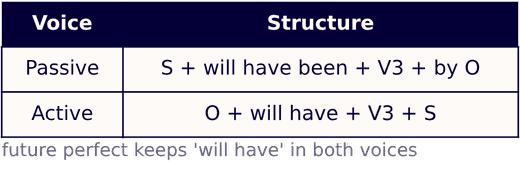 The agent 'the teacher' becomes the subject, and the tense must stay future perfect: 'will have completed'.
Hence: 'The teacher will have completed the syllabus before the exam starts.'
Option (a) drops 'have' and slips into the simple future, while (c) is still a faulty passive, so both change the tense.
The agent 'the teacher' becomes the subject, and the tense must stay future perfect: 'will have completed'.
Hence: 'The teacher will have completed the syllabus before the exam starts.'
Option (a) drops 'have' and slips into the simple future, while (c) is still a faulty passive, so both change the tense.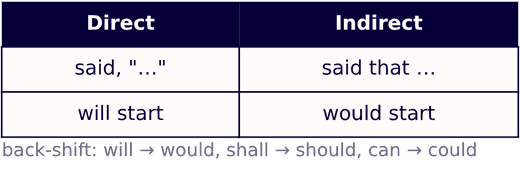 A statement is linked by 'that' and the rest of the wording stays as it is: 'that the show would start in five minutes'.
Option (a) leaves 'will' unchanged, (b) turns the verb into a simple past, and (d) rewrites it as a present continuous.
A statement is linked by 'that' and the rest of the wording stays as it is: 'that the show would start in five minutes'.
Option (a) leaves 'will' unchanged, (b) turns the verb into a simple past, and (d) rewrites it as a present continuous.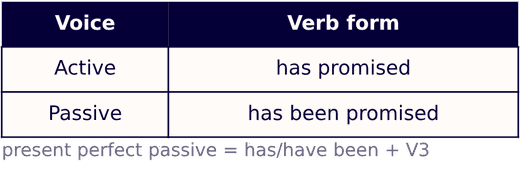 So: 'The winning team has been promised a gold trophy at the ceremony by the committee.'
Option (b) puts plural 'have' with a singular subject, while (c) and (d) shift the tense to a simple future.
So: 'The winning team has been promised a gold trophy at the ceremony by the committee.'
Option (b) puts plural 'have' with a singular subject, while (c) and (d) shift the tense to a simple future.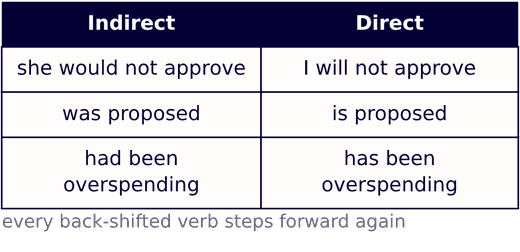 The subordinate clauses reverse in the same way: 'which was proposed' → 'which is proposed' and 'that had been overspending' → 'that has been overspending'.
Only option (c) reverses all three verbs; (a) and (b) leave the subordinate clauses back-shifted, and (d) keeps the third-person 'She' inside the quotation.
The subordinate clauses reverse in the same way: 'which was proposed' → 'which is proposed' and 'that had been overspending' → 'that has been overspending'.
Only option (c) reverses all three verbs; (a) and (b) leave the subordinate clauses back-shifted, and (d) keeps the third-person 'She' inside the quotation.