
26
Select the related letter from the given alternatives.
Pen : Write :: Knife : ?
- A.Cut
- B.Sharp
- C.Steel
- D.Food
Solution
Tool and its function
In each pair the first word is an instrument and the second is the action that the instrument is meant to perform.
A pen is the instrument used to write.
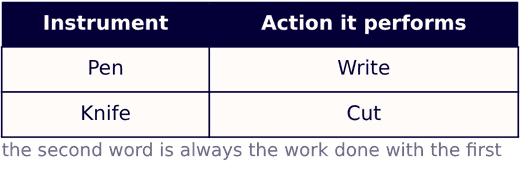 In the same way a knife is the instrument used to cut, so 'Cut' completes the analogy.
'Sharp' is only a property of a knife and 'Steel' is the material it is made of, while 'Food' is merely one of the things a knife may cut — none of these is the action it performs.
In the same way a knife is the instrument used to cut, so 'Cut' completes the analogy.
'Sharp' is only a property of a knife and 'Steel' is the material it is made of, while 'Food' is merely one of the things a knife may cut — none of these is the action it performs.
In the same way a knife is the instrument used to cut, so 'Cut' completes the analogy.
'Sharp' is only a property of a knife and 'Steel' is the material it is made of, while 'Food' is merely one of the things a knife may cut — none of these is the action it performs.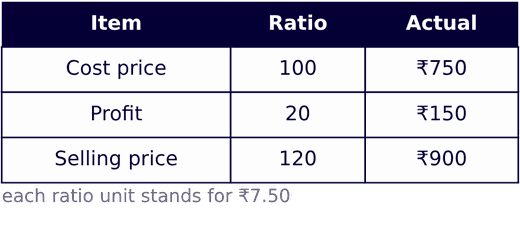
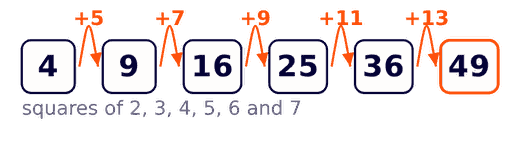 The next term must therefore be the square of 7, that is .
The same thing is seen in the gaps +5, +7, +9, +11, which grow by 2 each time, so the next gap is +13 and 36+13=49.
The next term must therefore be the square of 7, that is .
The same thing is seen in the gaps +5, +7, +9, +11, which grow by 2 each time, so the next gap is +13 and 36+13=49.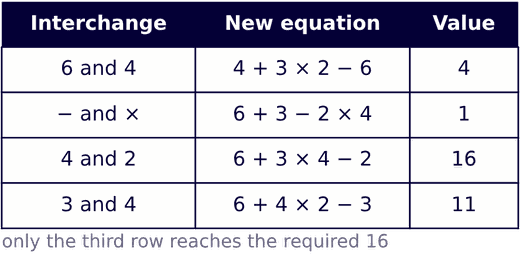 The other interchanges fail: , and .
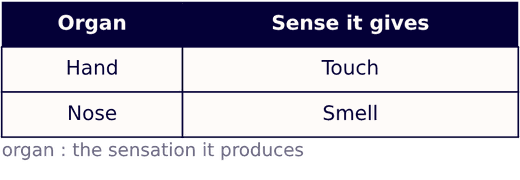 In the same way the nose is the organ through which we smell, so 'Smell' completes the analogy.
Taste belongs to the tongue, sight to the eye and hearing to the ear, so each of the other options names the sense of a different organ.
In the same way the nose is the organ through which we smell, so 'Smell' completes the analogy.
Taste belongs to the tongue, sight to the eye and hearing to the ear, so each of the other options names the sense of a different organ.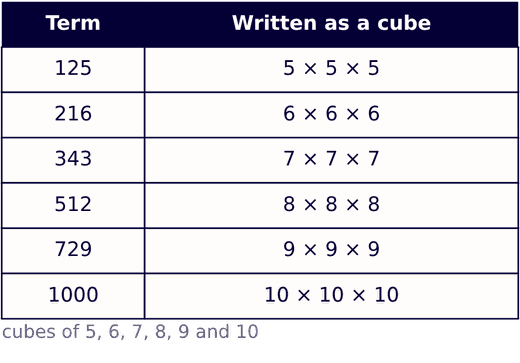 The next term is therefore .
Among the other choices 2197 is and 2744 is , so they come far later in the pattern, while 1029 is not a cube at all.
The next term is therefore .
Among the other choices 2197 is and 2744 is , so they come far later in the pattern, while 1029 is not a cube at all.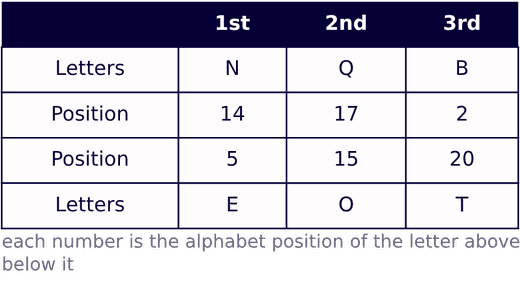 Now read the numbers 5-15-20 back as letters: the 5th letter is E, the 15th is O and the 20th is T.
So the group that stands for 5-15-20 is EOT.
Now read the numbers 5-15-20 back as letters: the 5th letter is E, the 15th is O and the 20th is T.
So the group that stands for 5-15-20 is EOT.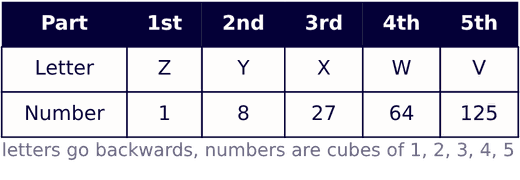 The fifth number is therefore , and joining the two parts gives V125.
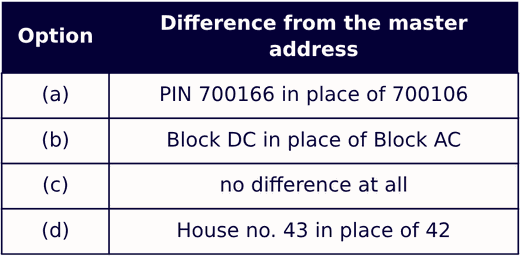 Option (a) changes the PIN code from 700106 to 700166.
Option (b) changes the block from AC to DC.
Option (d) changes the house number from 42 to 43.
Only option (c) reproduces every field, every comma and every space exactly as in the master address, so it is the correct match.
Option (a) changes the PIN code from 700106 to 700166.
Option (b) changes the block from AC to DC.
Option (d) changes the house number from 42 to 43.
Only option (c) reproduces every field, every comma and every space exactly as in the master address, so it is the correct match.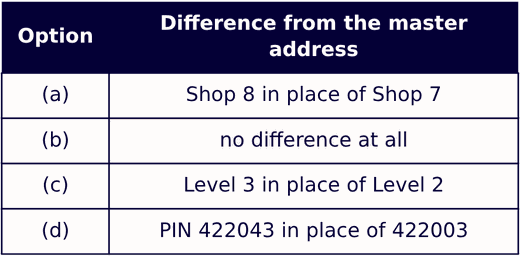 Option (a) has Shop 8 in place of Shop 7.
Option (c) has Level 3 in place of Level 2.
Option (d) has the PIN code 422043 in place of 422003.
Option (b) agrees with the master address in every field and in every punctuation mark, so it is the exact match.
Option (a) has Shop 8 in place of Shop 7.
Option (c) has Level 3 in place of Level 2.
Option (d) has the PIN code 422043 in place of 422003.
Option (b) agrees with the master address in every field and in every punctuation mark, so it is the exact match.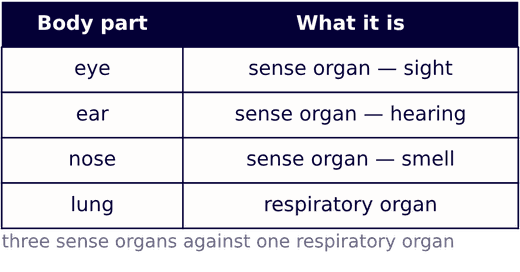 The lung is not a sense organ at all; it belongs to the respiratory system and exchanges oxygen and carbon dioxide.
So the lung does not fit the group and is the odd one out.
The lung is not a sense organ at all; it belongs to the respiratory system and exchanges oxygen and carbon dioxide.
So the lung does not fit the group and is the odd one out.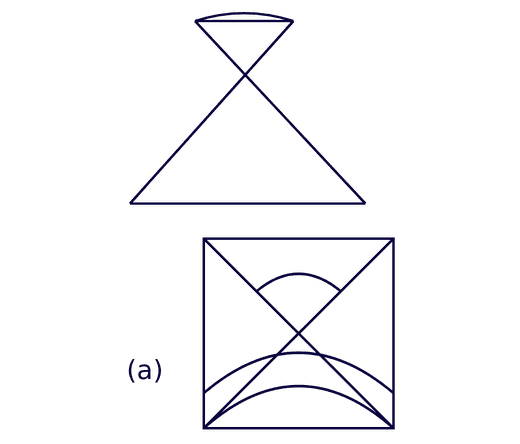
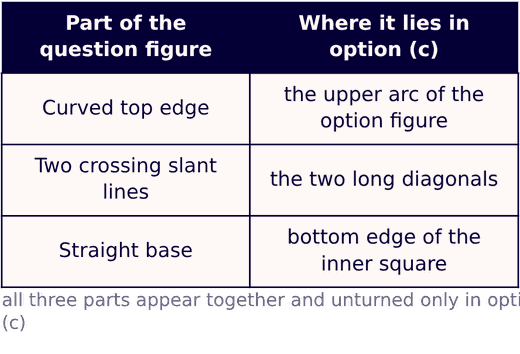 In option (c) the upper arc supplies the curved top, the bottom edge of the inner square supplies the straight base, and the two long slanting lines cross exactly as in the question figure.
The piece of the arc caught between the two slanting lines is shorter than the base, which is precisely the shape the question figure shows.
In option (a) the base is missing and the curves bend the other way, option (b) has no curve at all above the crossing point, and in option (d) the arcs sag downwards instead of arching upwards.
Hence the question figure is hidden in option (c).
In option (c) the upper arc supplies the curved top, the bottom edge of the inner square supplies the straight base, and the two long slanting lines cross exactly as in the question figure.
The piece of the arc caught between the two slanting lines is shorter than the base, which is precisely the shape the question figure shows.
In option (a) the base is missing and the curves bend the other way, option (b) has no curve at all above the crossing point, and in option (d) the arcs sag downwards instead of arching upwards.
Hence the question figure is hidden in option (c).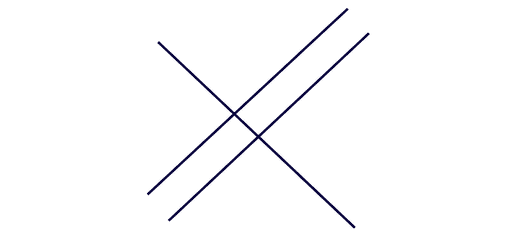
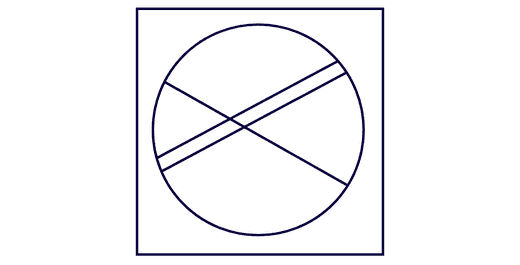
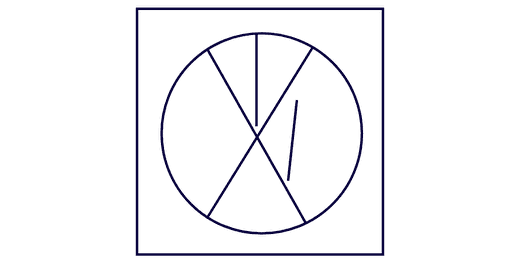
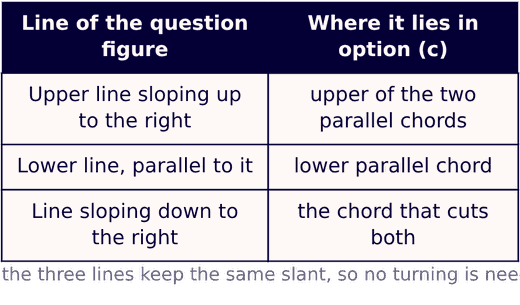 Option (c) shows exactly this: two parallel chords running from the lower left to the upper right, and one chord running from the upper left to the lower right that cuts both of them.
The two points of crossing lie one below the other, just as in the question figure, so the three lines sit together in the same way.
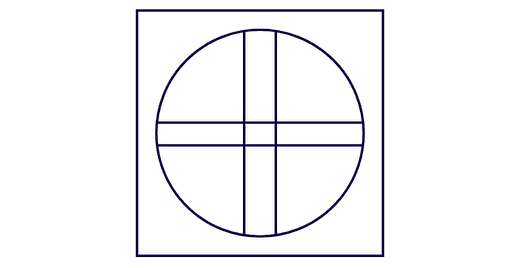
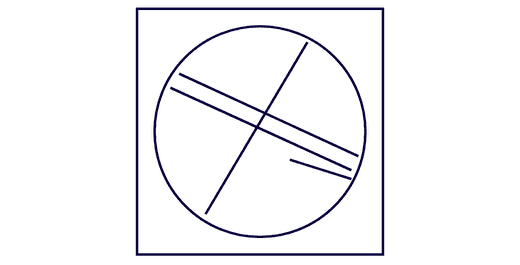
Option (a) has only vertical and horizontal lines, option (b) replaces one of the parallel lines by a short stroke placed elsewhere, and option (d) has a vertical line but no pair of parallel slanting lines.
Hence the question figure is embedded in option (c).
Option (c) shows exactly this: two parallel chords running from the lower left to the upper right, and one chord running from the upper left to the lower right that cuts both of them.
The two points of crossing lie one below the other, just as in the question figure, so the three lines sit together in the same way.
Option (a) has only vertical and horizontal lines, option (b) replaces one of the parallel lines by a short stroke placed elsewhere, and option (d) has a vertical line but no pair of parallel slanting lines.
Hence the question figure is embedded in option (c).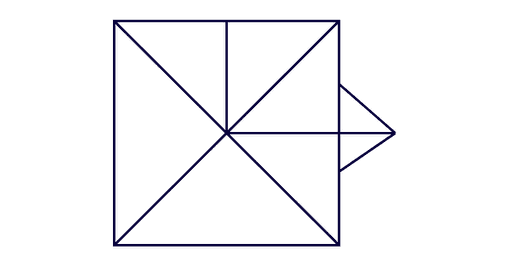
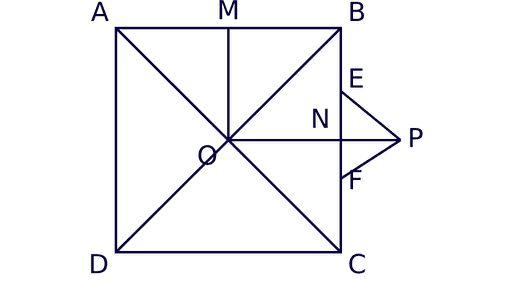 Smallest triangles inside the square: AOM, MOB, BON, NOC, COD and DOA — that is 6.
Two of the smallest ones join in pairs to give AOB (from AOM and MOB) and BOC (from BON and NOC) — 2 more.
Each diagonal cuts the square into two halves, and every half is a triangle: ABC, ABD, BCD and ACD — 4 more.
Outside the square the point P together with E, N and F gives PEN, PNF and PEF — 3 more.
Smallest triangles inside the square: AOM, MOB, BON, NOC, COD and DOA — that is 6.
Two of the smallest ones join in pairs to give AOB (from AOM and MOB) and BOC (from BON and NOC) — 2 more.
Each diagonal cuts the square into two halves, and every half is a triangle: ABC, ABD, BCD and ACD — 4 more.
Outside the square the point P together with E, N and F gives PEN, PNF and PEF — 3 more.
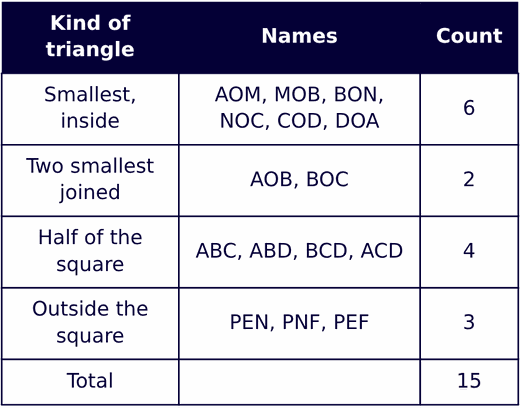 Total number of triangles = 6+2+4+3 = 15.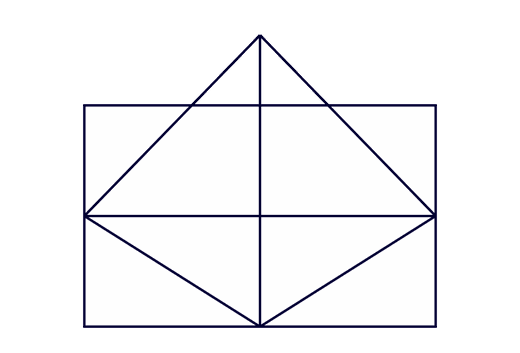
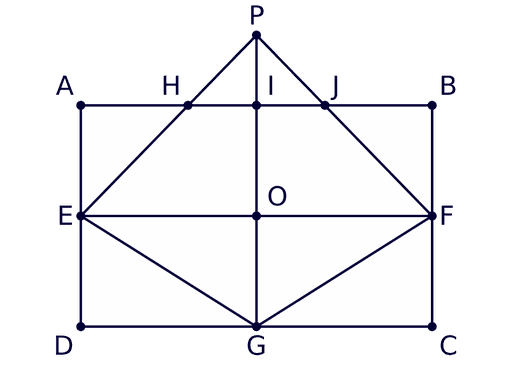 Above the rectangle the three lines from P give 3 triangles: PHI, PIJ and PHJ.
One triangle is cut off at each corner of the rectangle: AHE, BJF, DEG and CFG — 4 triangles.
The horizontal EF together with the apex gives PEO, POF and PEF — 3 triangles.
The same horizontal together with G gives EOG, OFG and EFG — 3 triangles.
Finally the two halves of the rhombus, PEG and PFG, add 2 more.
Total number of triangles =3+4+3+3+2=15.
Above the rectangle the three lines from P give 3 triangles: PHI, PIJ and PHJ.
One triangle is cut off at each corner of the rectangle: AHE, BJF, DEG and CFG — 4 triangles.
The horizontal EF together with the apex gives PEO, POF and PEF — 3 triangles.
The same horizontal together with G gives EOG, OFG and EFG — 3 triangles.
Finally the two halves of the rhombus, PEG and PFG, add 2 more.
Total number of triangles =3+4+3+3+2=15.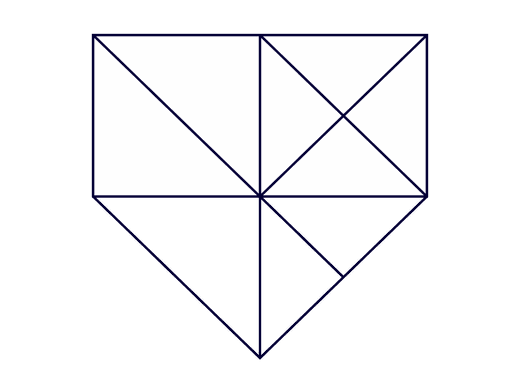
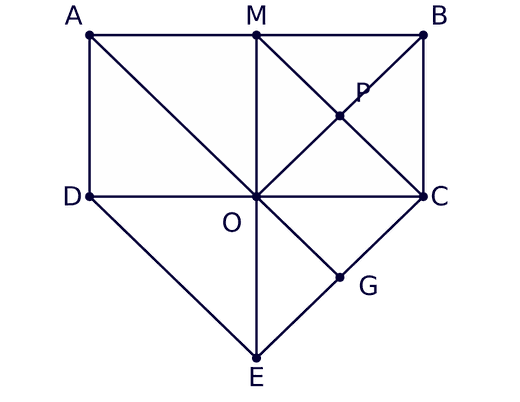 Left half of the rectangle: AMO and ADO — 2 triangles.
The right half is a square with both of its diagonals drawn, which always gives 8 triangles: MPB, BPC, CPO, OPM, MBC, BCO, COM and OMB.
The two halves of the rectangle join to give one more, ABO.
Below the horizontal: DOE on the left and COG, GOE, COE on the right — 4 triangles.
The big lower triangle DCE and the slanting triangle MCE complete the list — 2 more.
Total number of triangles =2+8+1+4+2=17.
Left half of the rectangle: AMO and ADO — 2 triangles.
The right half is a square with both of its diagonals drawn, which always gives 8 triangles: MPB, BPC, CPO, OPM, MBC, BCO, COM and OMB.
The two halves of the rectangle join to give one more, ABO.
Below the horizontal: DOE on the left and COG, GOE, COE on the right — 4 triangles.
The big lower triangle DCE and the slanting triangle MCE complete the list — 2 more.
Total number of triangles =2+8+1+4+2=17.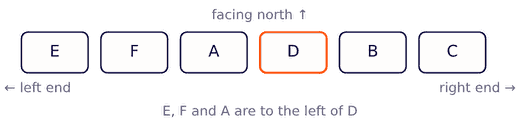 E, F and A sit to the left of D, so 3 persons are sitting towards the left of D.
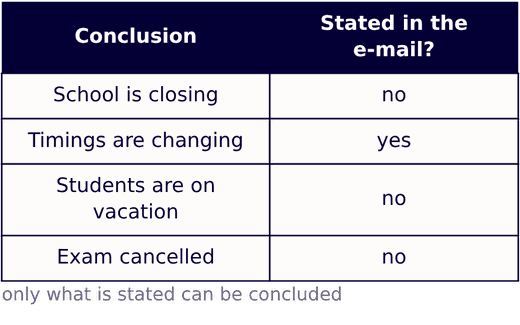 So the only thing that certainly follows is that the timings of the classes are changing, which is option (b).
A closure of the school, a vacation and a cancelled examination are fresh ideas that the e-mail never mentions, so none of them can be concluded.
So the only thing that certainly follows is that the timings of the classes are changing, which is option (b).
A closure of the school, a vacation and a cancelled examination are fresh ideas that the e-mail never mentions, so none of them can be concluded.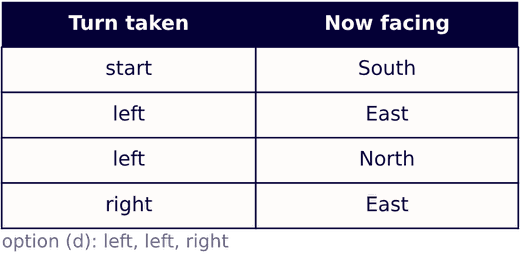 He finally faces east, so (d) is the required set of turns.
Option (a) ends facing west (south → west → north → west), option (b) also ends facing west (south → east → south → west) and option (c) ends facing south.
He finally faces east, so (d) is the required set of turns.
Option (a) ends facing west (south → west → north → west), option (b) also ends facing west (south → east → south → west) and option (c) ends facing south.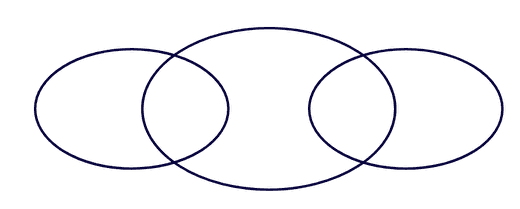
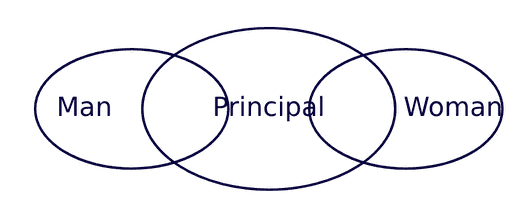 In option (a) water, salt and soda are three different substances, so no class shares a member with another; in option (b) a tool is neither a man nor a teacher; in option (d) a groom is always male, so 'Groom' can never overlap 'Girl'.
Hence the given Venn diagram best represents the classes of option (c).
In option (a) water, salt and soda are three different substances, so no class shares a member with another; in option (b) a tool is neither a man nor a teacher; in option (d) a groom is always male, so 'Groom' can never overlap 'Girl'.
Hence the given Venn diagram best represents the classes of option (c).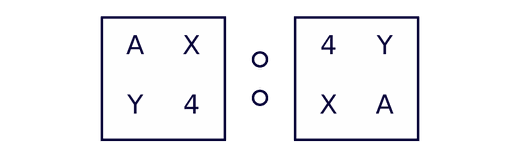
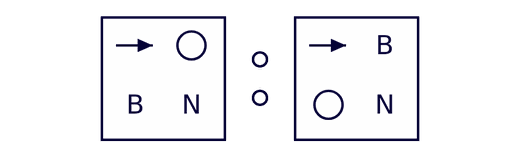
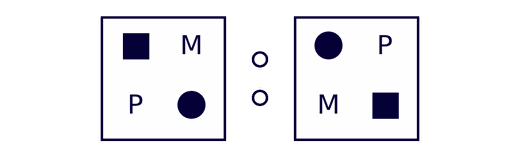
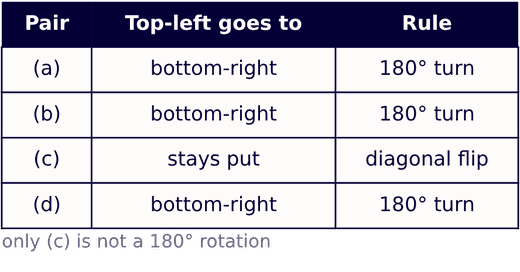 In (c) the arrow stays in the top-left corner and N stays in the bottom-right corner; only the circle and B exchange places, which is a reflection in the main diagonal, not a 180° turn.
Pair (c) therefore obeys a different rule and is the odd one out.
In (c) the arrow stays in the top-left corner and N stays in the bottom-right corner; only the circle and B exchange places, which is a reflection in the main diagonal, not a 180° turn.
Pair (c) therefore obeys a different rule and is the odd one out.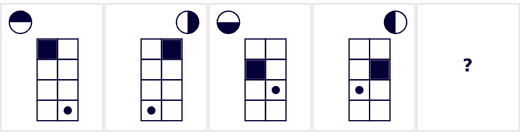
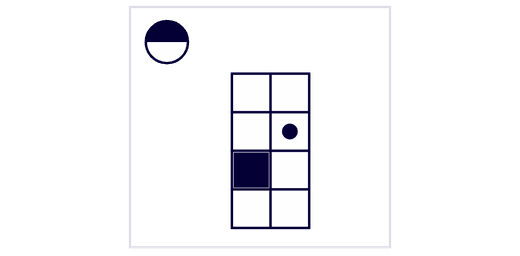
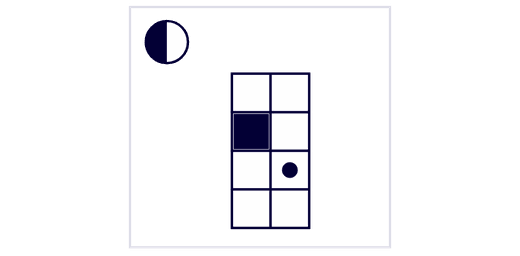
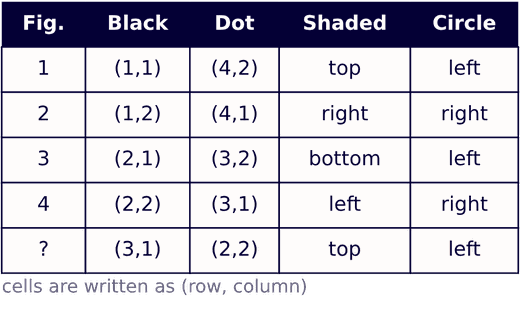 Only option (a) shows the circle on the left with its top half shaded, the black square at (3,1) and the dot at (2,2).
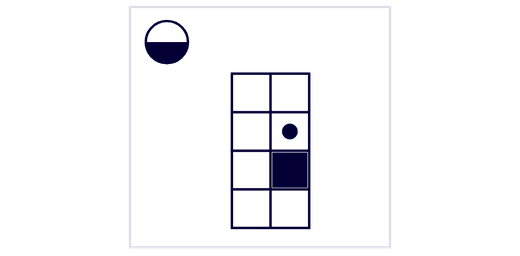
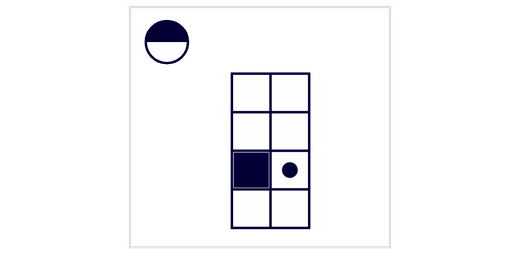
In (b) the lower half of the circle is shaded, in (c) the dot is at (3,2) and in (d) the left half of the circle is shaded, so all three are rejected.
Only option (a) shows the circle on the left with its top half shaded, the black square at (3,1) and the dot at (2,2).
In (b) the lower half of the circle is shaded, in (c) the dot is at (3,2) and in (d) the left half of the circle is shaded, so all three are rejected.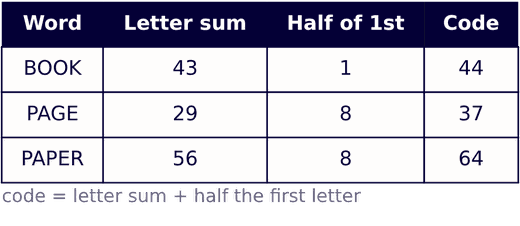 PAPER: 16+1+16+5+18=56 and half of P is 8.
Code for PAPER =56+8=64.
PAPER: 16+1+16+5+18=56 and half of P is 8.
Code for PAPER =56+8=64.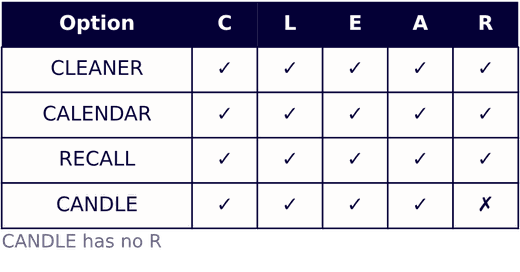 CLEANER has C, L, E, A, N, E, R — all five letters are available.
CALENDAR has C, A, L, E, N, D, A, R — all five letters are available.
RECALL has R, E, C, A, L, L — all five letters are available.
CANDLE has only C, A, N, D, L and E; there is no R in it, so CLEAR cannot be formed from CANDLE.
CLEANER has C, L, E, A, N, E, R — all five letters are available.
CALENDAR has C, A, L, E, N, D, A, R — all five letters are available.
RECALL has R, E, C, A, L, L — all five letters are available.
CANDLE has only C, A, N, D, L and E; there is no R in it, so CLEAR cannot be formed from CANDLE.