SSC CHSL 19 November 2025 · Shift 3 · General Awareness — questions with answers · ShikshaSphere
Chapter 78 of 200
19 November 2025 · Shift 3
General Awareness
25 questions ~25 min readFree
25 questions
A
76
In the policies of Emperor Akbar, the term sulh-i-kul denoted which of the following ideas?
A.A system of military expansion
B.Universal peace and tolerance
C.A programme of economic regulation
D.A codified set of laws
Solution
Akbar's religious policy
Sulh-i-kul is a Persian expression meaning 'peace with all', and as Akbar's state principle it stood for universal peace and religious tolerance.
Under it no subject was to be favoured or punished on grounds of faith; Akbar abolished the pilgrim tax in 1563 and the jizya on non-Muslims in 1564.
The idea grew out of the debates held in the Ibadat Khana at Fatehpur Sikri and was explained by Abul Fazl in the Akbarnama and the Ain-i-Akbari.
It was an ethical and political ideal, not a plan of conquest, an economic regulation or a written law code, so the other three options do not fit.
Hence option (b) is correct.
77
Which of the following commanders of Akbar led the campaign that attacked and defeated the Cheros in 1591?
A.Raja Man Singh
B.Raja Bhagwan Das
C.Abul Fazl
D.Tansen
Solution
Mughal campaigns under Akbar
Raja Man Singh of Amber, one of Akbar's Navratnas, commanded the Mughal campaign of 1591 that attacked and defeated the Cheros.
The Cheros held chiefdoms in Palamau and the neighbouring tracts of present-day Bihar and Jharkhand, which lay on the Mughal route to Bengal and Odisha.
Man Singh was Akbar's governor of Bihar and later of Bengal, which is why the eastern expeditions were entrusted to him.
Raja Bhagwan Das was his adoptive father and served mainly in the north-west; Abul Fazl was a courtier-historian and Tansen a court musician, so neither led armies.
Hence option (a) is correct.
78
The report titled "Takers Not Makers: The Unjust Poverty and
Unearned Wealth of Colonial Inheritance", released in January 2025, was published by which organization?
A.World Bank
B.United Nations Development Programme (UNDP)
C.Oxfam
D.International Labour Organization (ILO)
Solution
Reports on global inequality
'Takers Not Makers: The Unjust Poverty and Unearned Wealth of Colonial Inheritance' was released by Oxfam International in January 2025.
Oxfam publishes such an inequality report every January to coincide with the World Economic Forum meeting at Davos.
The 2025 report noted that billionaire wealth grew about three times faster in 2024 than in 2023, while the number of people living in poverty has barely changed since 1990.
Its central argument is that today's extreme inequality is rooted in the wealth extracted during the colonial era, hence the phrase 'colonial inheritance' in the title.
The World Bank, UNDP and ILO bring out their own flagship reports, but this title belongs to Oxfam, so option (c) is correct.
79
In January 2025, the largest-ever ceremony for distribution of property cards under the SVAMITVA Scheme was conducted by which ministry?
A.Ministry of Rural Development
B.Ministry of Panchayati Raj
C.Ministry of Housing and Urban Affairs
D.Ministry of Social Justice and Empowerment
Solution
SVAMITVA Scheme
SVAMITVA is a Central Sector Scheme of the Ministry of Panchayati Raj, launched on National Panchayati Raj Day, 24 April 2020.
On 18 January 2025 the Ministry held the largest-ever distribution of property cards under the scheme — over 65 lakh cards across 10 States and 2 Union Territories, taking the total past 2.25 crore.
The name stands for Survey of Villages and Mapping with Improvised Technology in Village Areas: drones survey the inhabited (abadi) land of a village and owners receive a legal 'Record of Rights'.
The property card lets a villager use the house as collateral for bank credit and helps settle boundary disputes, turning dead capital into a financial asset.
Rural roads and housing come under Rural Development and urban property under Housing and Urban Affairs, so option (b) is correct.
80
Which international index evaluates and ranks countries according to their conventional military strength in 2025?
A.Armed Forces Readiness Index
B.Strategic Power Ranking
C.World Defence Capability Index
D.Global Firepower Index
Solution
Global Firepower Index
The Global Firepower (GFP) Index ranks nations by their conventional military strength; the 2025 edition covered 145 countries.
It has been published every year since 2006 by the website globalfirepower.com, which builds an in-house 'PwrIndx' score from more than 60 individual factors.
Manpower (active, reserve and paramilitary), land, air and naval equipment, logistics, finances, natural resources and geography all feed into the score, and a PwrIndx closer to 0.0000 means a stronger military.
In the 2025 list the United States, Russia and China took the first three places, with India ranked 4th and Pakistan 12th.
The other three names are not real international indices, so option (d) is correct.
81
What position did India secure in the Global Hunger Index (GHI) 2024 ?
A.88th
B.102nd
C.105th
D.97th
Solution
Global Hunger Index 2024
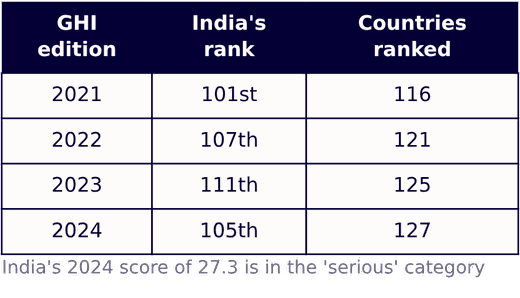
India was placed 105th among the 127 countries ranked in the Global Hunger Index (GHI) 2024.
Its score was 27.3 on the 100-point scale, which falls in the 'serious' band of hunger.
The index is brought out jointly by Concern Worldwide (Ireland) and Welthungerhilfe (Germany) and is built from four indicators — undernourishment, child stunting, child wasting and child mortality.
Hence the correct option is (c).
82
The Fiscal Health Index 2025 of India evaluates states using indicators classified into how many major categories ?
A.3
B.4
C.5
D.6
Solution
Fiscal Health Index 2025
The Fiscal Health Index (FHI) 2025 groups the indicators used to judge the states into five major categories.
The five sub-indices are Quality of Expenditure, Revenue Mobilisation, Fiscal Prudence, Debt Index and Debt Sustainability.
The report was released by NITI Aayog in January 2025 and covers 18 major states; Odisha stood first on the overall index.
Hence the correct option is (c).
83
In the game of basketball, rebounds are classified into how many main types ?
A.2
B.3
C.4
D.5
Solution
Basketball rebounds
A rebound is the act of gaining possession of the ball after a missed field goal or free throw, and it is of two main types.
In an offensive rebound the attacking team itself collects the miss, so possession does not change and it gets a fresh chance to score.
In a defensive rebound the defending team gathers the loose ball and possession passes to it.
Most rebounds are defensive, because the defenders stand nearer the basket and are better placed to collect a missed shot.
Hence the correct option is (a).
84
In which year was the Asian Games Federation formally inaugurated in New Delhi ?
A.1947
B.1945
C.1949
D.1955
Solution
Asian Games Federation
The Asian Games Federation (AGF) was formally inaugurated at New Delhi in 1949.
The idea of a common Asian sporting meet had been floated by Prof. G. D. Sondhi of India, and the constitution of the federation was adopted when the delegates of the participating nations met in the capital.
The federation then organised the first Asian Games at New Delhi in 1951; in 1982 the AGF was dissolved and its work was taken over by the Olympic Council of Asia (OCA).
Hence the correct option is (c).
85
The Amrabad Tiger Reserve is situated in which Indian state ?
A.Karnataka
B.Maharashtra
C.Telangana
D.Odisha
Solution
Tiger reserves of India
Amrabad Tiger Reserve lies in Telangana, spread over the Nallamala hills of Nagarkurnool district.
It was carved out of the Nagarjunsagar-Srisailam Tiger Reserve when Telangana was formed in 2014, and is one of the largest tiger reserves in the country.
The Chenchu, a particularly vulnerable tribal group, live inside this forest, and Telangana's other tiger reserve is Kawal.
Hence the correct option is (c).
86
Which institution functions as the nodal agency for the International Big Cat Alliance (IBCA) in India?
A.Wildlife Crime Control Bureau
B.Wildlife Institute of India
C.Central Zoo Authority
D.National Tiger Conservation Authority
Solution
International Big Cat Alliance
The National Tiger Conservation Authority (NTCA) is the nodal agency for the International Big Cat Alliance in India.
The IBCA was launched by India in April 2023 at Mysuru for the conservation of seven big cats — tiger, lion, leopard, snow leopard, cheetah, jaguar and puma — and its headquarters and secretariat are in India.
The NTCA is the statutory body set up under the Wild Life (Protection) Act, 1972 that runs Project Tiger, so the alliance's work in India is routed through it.
Hence the correct option is (d).
87
The first Indian meteorological rocket launched in 1963 had a diameter of how many millimetres?
A.30 mm
B.75 mm
C.100 mm
D.150 mm
Solution
Rohini sounding rockets
The rocket meant here is the Rohini RH-75, and the figure 75 in its name is its diameter in millimetres.
In the Rohini sounding-rocket family the number always states the calibre of the rocket, so RH-75 is a 75 mm rocket, RH-200 a 200 mm one, and so on.
It was the first sounding rocket built in India, flown from the Thumba Equatorial Rocket Launching Station near Thiruvananthapuram to carry instruments into the upper atmosphere for meteorological study.
Hence the correct option is (b).
88
In June 2025, India's first agentic Al system developed by the Krutrim startup was named .
A.Kruti
B.Saarthi
C.Vaani
D.Chitra
Solution
Agentic AI in India
The system is Kruti, unveiled in June 2025 by the Bengaluru-based startup Krutrim.
It is described as India's first agentic AI assistant: instead of only answering a query, it can plan a task, take decisions and carry out multi-step jobs such as booking a cab or ordering food for the user.
Kruti also works across several Indian languages, in keeping with Krutrim's India-first approach to artificial intelligence.
Hence the correct option is (a).
89
Which statement correctly explains the factors affecting the physical state of matter?
A.Only external force determines the state
B.Only heat energy controls state changes
C.Physical state remains fixed under all conditions
D.Both temperature and pressure affect the state of a substance
Solution
States of matter
The physical state of a substance depends on how closely its particles are held, and that is settled by both temperature and pressure.
Raising the temperature increases the kinetic energy of the particles, so a solid melts and a liquid vaporises; cooling reverses the change.
Raising the pressure pushes the particles closer together, so a gas can be turned into a liquid — LPG in a cylinder is a gas kept liquid purely by pressure.
So the state is neither fixed nor decided by heat alone; the two factors act together, and option (d) is correct.
90
Beginning from which decade did Maratha military campaigns in Rajasthan exert heavy pressure on regional principalities and halt their expansion?
A.1600s
B.1660s
C.1740s
D.1780s
Solution
Maratha campaigns in Rajasthan
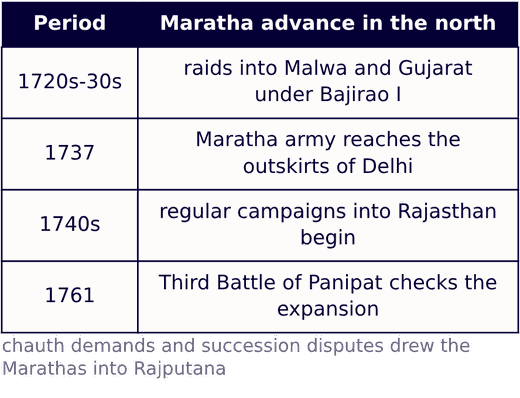
Regular Maratha campaigns into Rajasthan began in the 1740s.
Once the Marathas had secured Malwa and pushed north of the Chambal, their armies entered Rajputana again and again to collect chauth and to take sides in the succession quarrels of Jaipur, Marwar and Mewar.
The unending tribute and warfare drained the Rajput states of money and men, so their own expansion came to a halt after this decade.
Hence the correct option is (c).
91
Who became the ruler of the Maratha Empire immediately after the death of Chhatrapati Shivaji Maharaj ?
A.Balaji Vishwanath
B.Chhatrapati Sambhaji
C.Chhatrapati Shahu
D.Nana Saheb
Solution
Maratha succession after Shivaji
Chhatrapati Shivaji Maharaj died in 1680, and his elder son Chhatrapati Sambhaji succeeded him at once.
Sambhaji was formally crowned in 1681 and ruled till 1689, resisting Aurangzeb's Deccan campaign; he was seized at Sangameshwar and put to death in 1689.
Balaji Vishwanath and Nana Saheb were Peshwas and not Chhatrapatis, while Shahu — Sambhaji's own son — was released by the Mughals and came to the throne only in 1707.
Hence the correct option is (b).
92
In which year was the dual exchange rate system, known as the Liberalised Exchange Rate Management System (LERMS), introduced in India ?
A.February 1994
B.August 1991
C.March 1992
D.October 1993
Solution
LERMS dual exchange rate
The Liberalised Exchange Rate Management System (LERMS) was introduced in March 1992, along with the Union Budget for 1992-93.
Under it an exporter had to surrender of the foreign exchange earned to the RBI at the official rate, and could sell the remaining at the market-determined rate — hence the name dual exchange rate.
It was a bridge built after the balance-of-payments crisis of 1991, and in March 1993 the two rates were merged into a single market-determined rate under the Unified Exchange Rate System.
Hence the correct option is (c).
93
Which sector of the economy includes activities that extract raw materials directly from nature?
A.Quinary
B.Secondary
C.Tertiary
D.Primary
Solution
Sectors of the economy
Activities that take raw material straight out of nature belong to the primary sector.
Agriculture, animal husbandry, fishing, forestry and mining are primary activities, and they supply the raw material on which every other sector works.
The secondary sector then processes that material into goods, the tertiary sector provides services such as transport and banking, and the quaternary and quinary sectors handle knowledge work and top-level decision-making.
Hence the correct option is (d).
94
Which of the following is cultivated as a Kharif crop in India?
A.Wheat
B.Rice
C.Mustard
D.Barley
Solution
Kharif and rabi crops
Rice (paddy) is grown in India as a kharif crop.
Kharif crops are sown with the onset of the south-west monsoon in June-July and harvested in September-October; they need high temperature and a lot of water, which paddy fields exactly demand.
Wheat, mustard and barley are rabi crops, sown in the cool weather of October-December and harvested in March-April, so only rice fits the question.
Hence the correct option is (b).
95
The Socio-Economic and Caste Census (SECC) 2011 of India is primarily used for which of the following schemes?
I. Mahatma Gandhi National Rural Employment Guarantee Act (MGNREGA)
II. National Food Security Act (NFSA)
A.Only II
B.Only I
C.Both I and II
D.Neither I nor II
Solution
SECC 2011 and welfare schemes
SECC 2011 data is used for both MGNREGA and the National Food Security Act, so statements I and II are both correct.
The Socio-Economic and Caste Census, 2011 did not merely count people; it recorded the deprivation of each household, so the Ministry of Rural Development uses it to pick out the poor and eligible families for welfare schemes.
It was India's first paperless census, carried out on hand-held electronic devices, and the first caste-linked enumeration since 1931.
Hence the correct option is (c).
96
Why do prices tend to rise when the government increases spending or reduces taxes?
A.Wages rise dramatically
B.Aggregate demand decreases sharply
C.Firms export more goods abroad
D.Firms cannot produce enough to meet the higher demand at existing prices
Solution
Demand-pull inflation
More government spending, or a cut in taxes, leaves households and firms with more money in hand, so aggregate demand goes up.
In the short run factories are already working close to capacity and output cannot be raised at once, so the extra demand meets an almost fixed supply.
The excess demand is then settled by a rise in the price level — this is demand-pull inflation.
Option (b) states the opposite of what happens, and (a) and (c) are consequences that do not explain the price rise, so option (d) is correct.
97
Chandragupta Maurya laid the foundation of the Maurya Empire around which year?
A.246 BCE
B.321 BCE
C.456 BCE
D.521 BCE
Solution
Foundation of the Maurya Empire
Chandragupta Maurya laid the foundation of the Maurya Empire in about 321 BCE, after overthrowing Dhana Nanda, the last Nanda ruler of Magadha.
He was then only about 25 years old, and was guided throughout by his teacher Chanakya (Kautilya), the author of the Arthashastra.
Around 305 BCE he defeated Seleucus Nicator and gained the lands west of the Indus; the empire then passed to Bindusara and after him to Ashoka.
Hence the correct option is (b).
98
Who developed the philosophical system of Syādvāda?
A.Shankaracharya
B.Gautam Buddha
C.Lord Mahavira
D.Kanada
Solution
Jain doctrine of Syadvada
Syadvada was developed by Lord Mahavira, the 24th Tirthankara of Jainism.
'Syat' means 'in some respect', so every statement about a thing is true only from a particular standpoint; the doctrine is set out in seven-fold predication (saptabhangi) and rests on anekantavada, the many-sidedness of truth.
Shankaracharya gave Advaita Vedanta, the Buddha taught the Middle Path, and Kanada founded the Vaisheshika school with its atomic theory.
Hence the correct option is (c).
99
The Indus Valley Civilization site of Rakhigarhi is situated in which Indian state?
A.Bihar
B.Gujarat
C.Haryana
D.Uttar Pradesh
Solution
Harappan site Rakhigarhi
Rakhigarhi lies in the Hisar district of Haryana, on the bed of the dried-up Ghaggar-Drishadvati river system.
It is one of the largest Harappan sites in the subcontinent, with planned streets, drains, a granary area and bead and bangle workshops.
Ancient DNA taken from a skeleton found here has been widely studied for what it says about the ancestry of the Harappan people.
Hence the correct option is (c).
100
The Harappans mainly sourced 'carnelian', the stone used for making beads, from which region?
A.Assam
B.Gujarat
C.Kerala
D.Haryana
Solution
Harappan raw materials
The Harappans obtained carnelian, the deep red stone used for beads, mainly from Gujarat — the Bharuch and Khambhat (Cambay) belt of the Narmada valley.
The rough nodules were carried to bead workshops such as Lothal and Chanhudaro, where they were heated to bring out the red colour, then chipped, ground, polished and finally drilled.
Long barrel-shaped carnelian beads made in these workshops have been found as far away as the royal graves of Ur in Mesopotamia.
Hence the correct option is (b).
Finished reading? Now test yourself.
The same 25 questions, but with a timer and the answers hidden — 15 minutes.

 The index is brought out jointly by Concern Worldwide (Ireland) and Welthungerhilfe (Germany) and is built from four indicators — undernourishment, child stunting, child wasting and child mortality.
Hence the correct option is (c).
The index is brought out jointly by Concern Worldwide (Ireland) and Welthungerhilfe (Germany) and is built from four indicators — undernourishment, child stunting, child wasting and child mortality.
Hence the correct option is (c).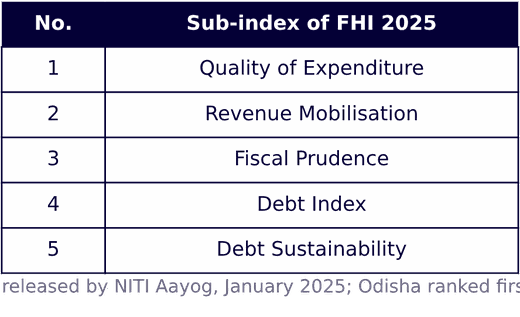 The report was released by NITI Aayog in January 2025 and covers 18 major states; Odisha stood first on the overall index.
Hence the correct option is (c).
The report was released by NITI Aayog in January 2025 and covers 18 major states; Odisha stood first on the overall index.
Hence the correct option is (c).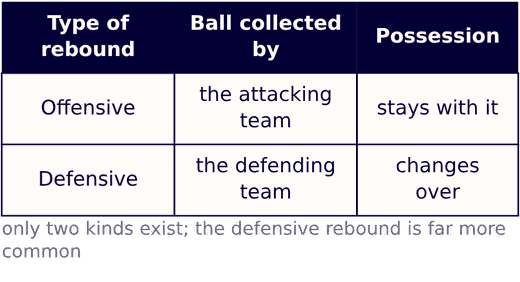 Most rebounds are defensive, because the defenders stand nearer the basket and are better placed to collect a missed shot.
Hence the correct option is (a).
Most rebounds are defensive, because the defenders stand nearer the basket and are better placed to collect a missed shot.
Hence the correct option is (a).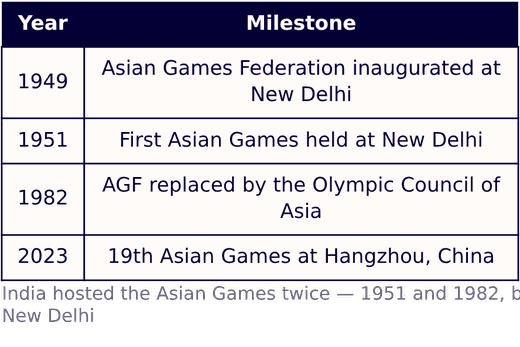 The federation then organised the first Asian Games at New Delhi in 1951; in 1982 the AGF was dissolved and its work was taken over by the Olympic Council of Asia (OCA).
Hence the correct option is (c).
The federation then organised the first Asian Games at New Delhi in 1951; in 1982 the AGF was dissolved and its work was taken over by the Olympic Council of Asia (OCA).
Hence the correct option is (c).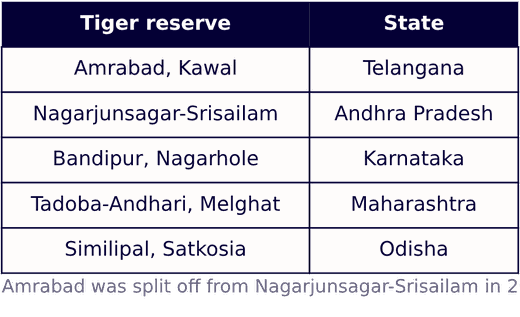 The Chenchu, a particularly vulnerable tribal group, live inside this forest, and Telangana's other tiger reserve is Kawal.
Hence the correct option is (c).
The Chenchu, a particularly vulnerable tribal group, live inside this forest, and Telangana's other tiger reserve is Kawal.
Hence the correct option is (c).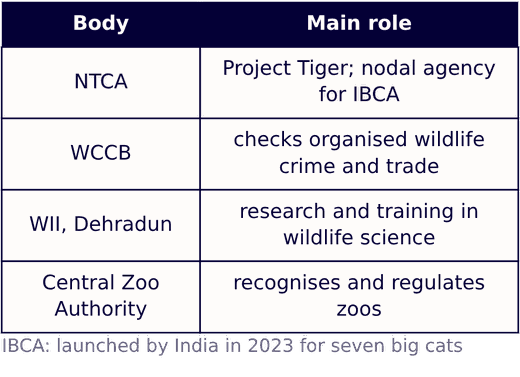 The NTCA is the statutory body set up under the Wild Life (Protection) Act, 1972 that runs Project Tiger, so the alliance's work in India is routed through it.
Hence the correct option is (d).
The NTCA is the statutory body set up under the Wild Life (Protection) Act, 1972 that runs Project Tiger, so the alliance's work in India is routed through it.
Hence the correct option is (d).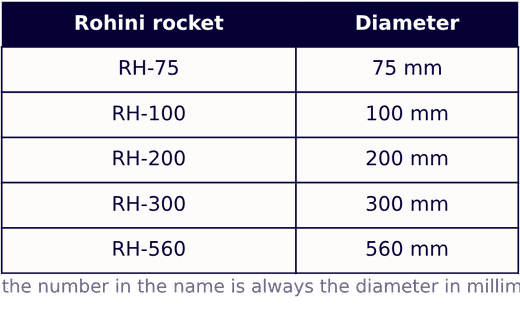 It was the first sounding rocket built in India, flown from the Thumba Equatorial Rocket Launching Station near Thiruvananthapuram to carry instruments into the upper atmosphere for meteorological study.
Hence the correct option is (b).
It was the first sounding rocket built in India, flown from the Thumba Equatorial Rocket Launching Station near Thiruvananthapuram to carry instruments into the upper atmosphere for meteorological study.
Hence the correct option is (b).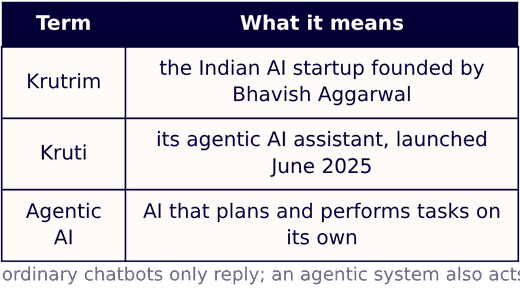 Kruti also works across several Indian languages, in keeping with Krutrim's India-first approach to artificial intelligence.
Hence the correct option is (a).
Kruti also works across several Indian languages, in keeping with Krutrim's India-first approach to artificial intelligence.
Hence the correct option is (a).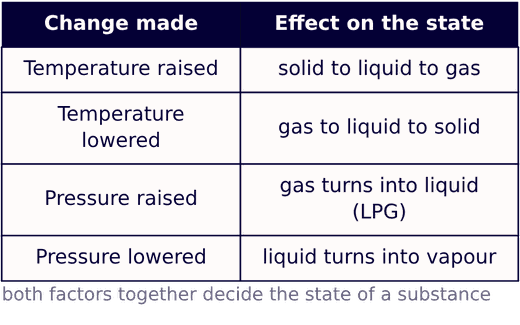 So the state is neither fixed nor decided by heat alone; the two factors act together, and option (d) is correct.
 The unending tribute and warfare drained the Rajput states of money and men, so their own expansion came to a halt after this decade.
Hence the correct option is (c).
The unending tribute and warfare drained the Rajput states of money and men, so their own expansion came to a halt after this decade.
Hence the correct option is (c).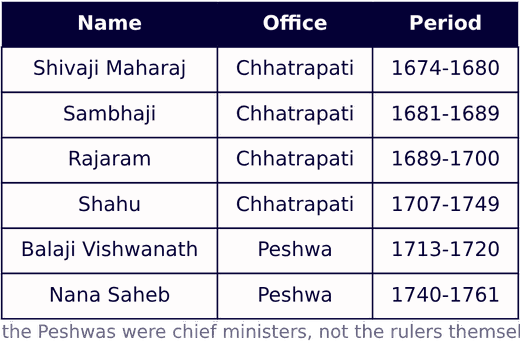 Balaji Vishwanath and Nana Saheb were Peshwas and not Chhatrapatis, while Shahu — Sambhaji's own son — was released by the Mughals and came to the throne only in 1707.
Hence the correct option is (b).
Balaji Vishwanath and Nana Saheb were Peshwas and not Chhatrapatis, while Shahu — Sambhaji's own son — was released by the Mughals and came to the throne only in 1707.
Hence the correct option is (b).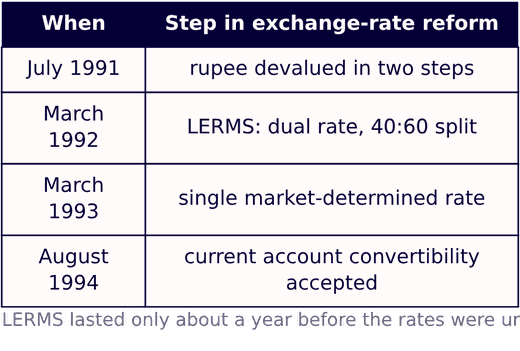 It was a bridge built after the balance-of-payments crisis of 1991, and in March 1993 the two rates were merged into a single market-determined rate under the Unified Exchange Rate System.
Hence the correct option is (c).
It was a bridge built after the balance-of-payments crisis of 1991, and in March 1993 the two rates were merged into a single market-determined rate under the Unified Exchange Rate System.
Hence the correct option is (c).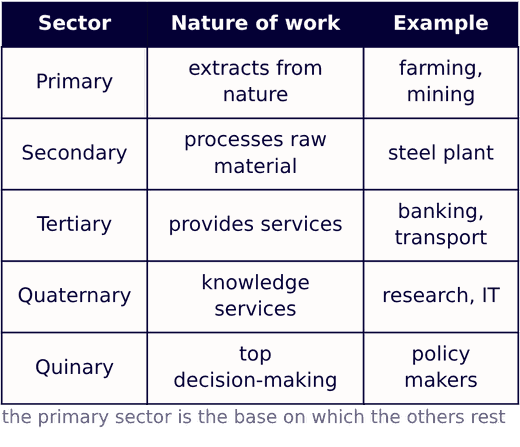 The secondary sector then processes that material into goods, the tertiary sector provides services such as transport and banking, and the quaternary and quinary sectors handle knowledge work and top-level decision-making.
Hence the correct option is (d).
The secondary sector then processes that material into goods, the tertiary sector provides services such as transport and banking, and the quaternary and quinary sectors handle knowledge work and top-level decision-making.
Hence the correct option is (d).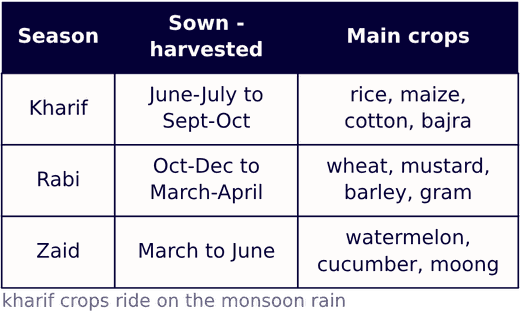 Wheat, mustard and barley are rabi crops, sown in the cool weather of October-December and harvested in March-April, so only rice fits the question.
Hence the correct option is (b).
Wheat, mustard and barley are rabi crops, sown in the cool weather of October-December and harvested in March-April, so only rice fits the question.
Hence the correct option is (b).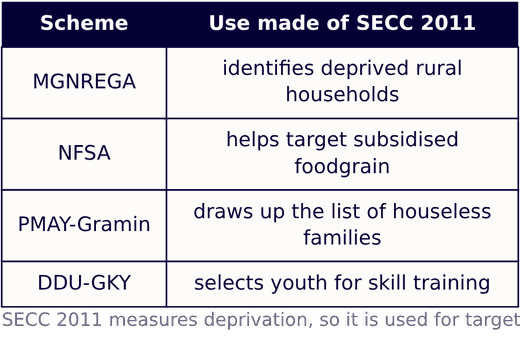 It was India's first paperless census, carried out on hand-held electronic devices, and the first caste-linked enumeration since 1931.
Hence the correct option is (c).
It was India's first paperless census, carried out on hand-held electronic devices, and the first caste-linked enumeration since 1931.
Hence the correct option is (c).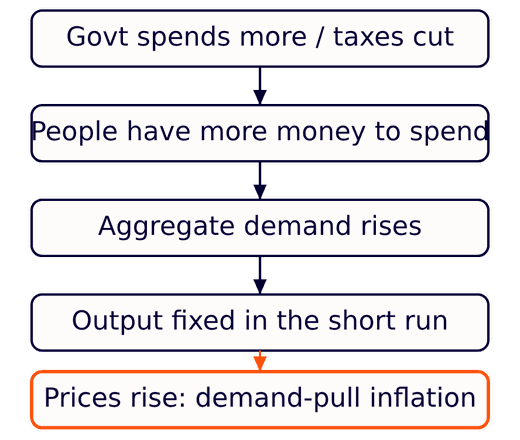 The excess demand is then settled by a rise in the price level — this is demand-pull inflation.
Option (b) states the opposite of what happens, and (a) and (c) are consequences that do not explain the price rise, so option (d) is correct.
The excess demand is then settled by a rise in the price level — this is demand-pull inflation.
Option (b) states the opposite of what happens, and (a) and (c) are consequences that do not explain the price rise, so option (d) is correct.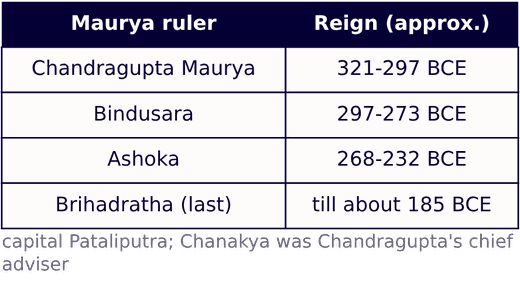 Around 305 BCE he defeated Seleucus Nicator and gained the lands west of the Indus; the empire then passed to Bindusara and after him to Ashoka.
Hence the correct option is (b).
Around 305 BCE he defeated Seleucus Nicator and gained the lands west of the Indus; the empire then passed to Bindusara and after him to Ashoka.
Hence the correct option is (b).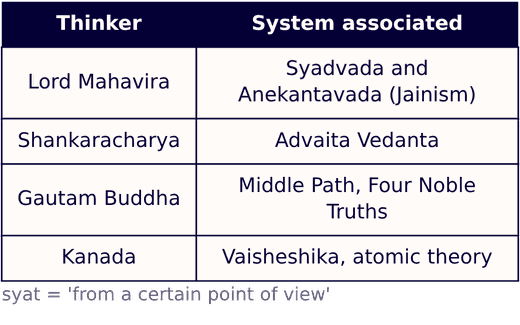 Shankaracharya gave Advaita Vedanta, the Buddha taught the Middle Path, and Kanada founded the Vaisheshika school with its atomic theory.
Hence the correct option is (c).
Shankaracharya gave Advaita Vedanta, the Buddha taught the Middle Path, and Kanada founded the Vaisheshika school with its atomic theory.
Hence the correct option is (c).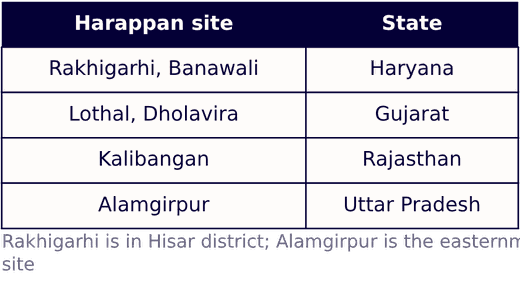 Ancient DNA taken from a skeleton found here has been widely studied for what it says about the ancestry of the Harappan people.
Hence the correct option is (c).
Ancient DNA taken from a skeleton found here has been widely studied for what it says about the ancestry of the Harappan people.
Hence the correct option is (c).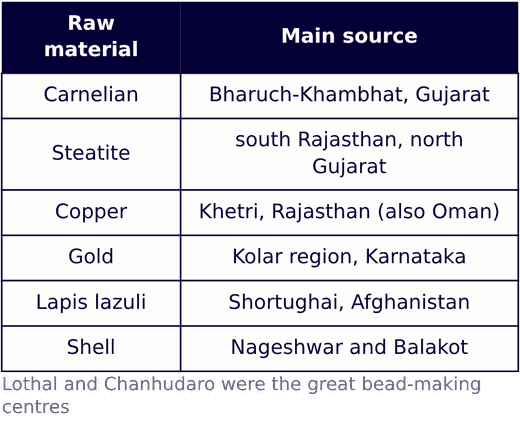 Long barrel-shaped carnelian beads made in these workshops have been found as far away as the royal graves of Ur in Mesopotamia.
Hence the correct option is (b).
Long barrel-shaped carnelian beads made in these workshops have been found as far away as the royal graves of Ur in Mesopotamia.
Hence the correct option is (b).