SSC CHSL 20 November 2025 · Shift 1 · English Language — questions with answers · ShikshaSphere
Chapter 84 of 200
20 November 2025 · Shift 1
English Language
25 questions ~25 min readFree
25 questions
A
1
Identify the part of the sentence that contains a grammatical error.
A. She worked B. hardly to master C. the skills required for D. the new role.
A.She worked
B.hardly to master
C.the skills required for
D.the new role.
Solution
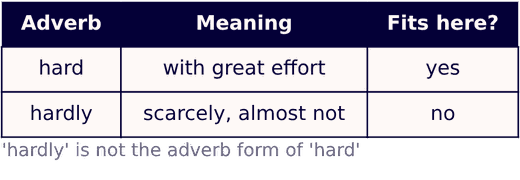
Adverb 'hard' vs 'hardly'
As an adverb 'hard' means 'with great effort', while 'hardly' is a negative adverb meaning 'scarcely, almost not'.
The sentence says that she put in effort so as to master the skills, so the positive adverb 'hard' is required after 'worked'.
With 'hardly' the clause would mean that she scarcely worked at all, which contradicts the purpose expressed by 'to master the skills'.
Part B must therefore read 'hard to master', so the error lies in part B.
2
Identify the part of the sentence that contains a grammatical error.
A. They has some of the most intricate
B. wood-carved figurines I have
C. ever seen, each one polished
D. to a deep mahogany sheen.
A.They has some of the most intricate
B.wood-carved figurines I have
C.ever seen, each one polished
D.to a deep mahogany sheen.
Solution
Subject-verb agreement
A plural subject always takes a plural verb.
The subject in part A is 'They', which is plural, so the verb must be 'have' and not the singular 'has'.
Part A should read 'They have some of the most intricate', so the error is in part A.
The remaining parts are sound: 'I have ever seen' is a present-perfect relative clause and 'each one polished to a deep mahogany sheen' is a correct participial phrase.
3
Identify the part of the sentence that contains a grammatical error.
A. She has been studying diligently
B. for her final exams for early
C. this morning to ensure she
D. achieves the highest marks in her class.
A.She has been studying diligently
B.for her final exams for early
C.this morning to ensure she
D.achieves the highest marks in her class.
Solution
'Since' vs 'for'
'For' is used before a length of time, while 'since' is used before the point of time at which the action began.
'Early this morning' names a point of time, not a stretch of time, so the preposition before it must be 'since'.
Part B should read 'for her final exams since early', so the error lies in part B.
The present perfect continuous 'has been studying' in part A is exactly the tense that goes with 'since', which confirms the choice.
4
Fill in the blank with the most appropriate preposition:
They finally arrived at a clear understanding considering every detail carefully.
A.before
B.after
C.during
D.without
Solution
Preposition of time
The blank links two events: the careful consideration of every detail, and the clear understanding that is reached.
The understanding is the result of that consideration, so it comes later in time, and the preposition that shows 'later than' is 'after'.
'Before' reverses the order, 'during' would make the two happen at the same moment, and 'without' would deny that any consideration took place at all.
Hence the sentence reads 'a clear understanding after considering every detail carefully', and option (b) is correct.
5
Select the most appropriate synonym of the word:
Genesis
A.Emergence
B.Termination
C.Premonition
D.Reproduction
Solution
Synonym
'Genesis' means the origin, birth or coming into being of something, as in the genesis of a movement.
'Emergence' is the process of coming into existence or becoming visible, which carries the same idea of a beginning.
'Termination' is an ending and so is the opposite, 'premonition' is a forewarning of something bad, and 'reproduction' is the making of copies or offspring, so none of them matches.
6
Fill in the blank with the most appropriate phrase:
The inheritance became among the siblings, leading to years of family feuding.
A.a leap in the dark
B.make a mountain out of a molehill
C.an apple of discord
D.a silver lining
Solution
Idiom in context
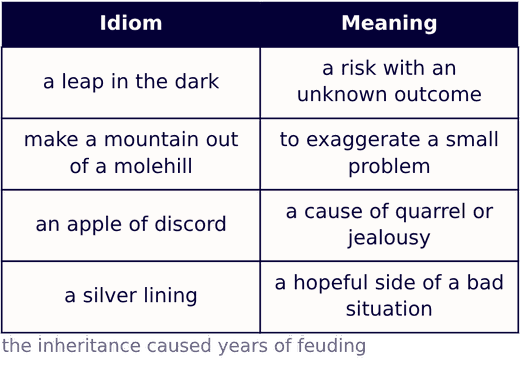
The second half of the sentence says that the inheritance led to years of family feuding, so the blank needs an idiom for something that sets people quarrelling.
'An apple of discord' means a subject or issue that causes a quarrel, dispute or jealousy among people, which fits exactly.
'A leap in the dark' is a risk taken without knowing the outcome and 'a silver lining' is the hopeful side of a bad situation, neither of which suggests a quarrel.
'Make a mountain out of a molehill' is a verb phrase meaning to exaggerate a trifle, and a verb phrase cannot follow 'became', so it is grammatically impossible here.
7
Choose the correctly spelt word:
A.Concession
B.Concission
C.Concesion
D.Consetion
Solution
Spelling
The noun formed from the verb 'concede' is 'concession', meaning a thing granted or an allowance made.
Verbs ending in -cede form their nouns in -cession: concede → concession, recede → recession, secede → secession.
So the correct spelling keeps 'conce-' and adds '-ssion', which rules out 'Concission', 'Concesion' and 'Consetion'.
8
Choose the correctly spelt word:
A.Proletarite
B.Proletaritat
C.Proletariat
D.Proletarirat
Solution
Spelling
'Proletariat' means the class of industrial wage-earners who own no means of production; it comes from the Latin proletarius.
The word ends in -ariat, the same ending seen in 'secretariat' and 'commissariat'.
The other three options distort that ending — 'Proletarite', 'Proletaritat' and 'Proletarirat' — so only (c) is correctly spelt.
9
Choose the correct meaning of the idiom: Two peas in a pod
A.To be in complete disagreement
B.To be very similar in appearance or character
C.To share a small space together
D.To have complementary skills
Solution
Idiom meaning
The image behind the idiom is that of two peas taken from the same pod, which look exactly alike.
'Two peas in a pod' therefore describes two people who are very similar in appearance or in character.
E.g. My sister and I are two peas in a pod — we like the same films and share the same odd sense of humour.
The idiom says nothing about disagreement, about sharing a cramped space, or about skills that complement each other, so (a), (c) and (d) are wrong.
10
Select the most appropriate antonym of the word: Ignominious
A.Offenders
B.Accused
C.Glorious
D.Fugitive
Solution
Antonym
'Ignominious' means bringing public shame or disgrace, as in 'an ignominious defeat'.
The opposite must express honour and praise, and 'glorious' means deserving honour, praise or fame.
'Offenders' and 'accused' merely name people connected with crime and 'fugitive' is one who flees punishment; these share the disgraceful tone of the given word instead of opposing it.
11
Choose the correct one-word substitute for:
Repeated and relentless urging to make someone do something.
A.Compel
B.Influence
C.Induce
D.Pester
Solution
One-word substitution
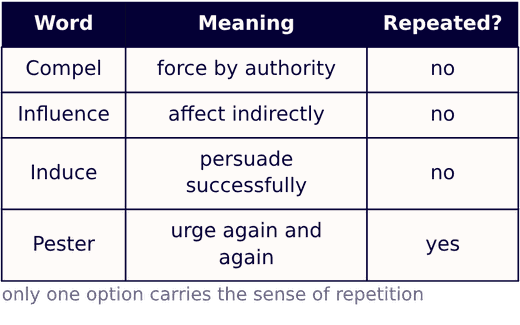
Two ideas must be captured together: the urging is repeated, and it is relentless.
'Pester' means to trouble somebody with insistent requests made again and again, which contains both ideas.
'Compel' works by force or authority and needs no repetition, 'influence' only affects a decision indirectly, and 'induce' means to succeed in persuading, which describes the result rather than the nagging.
Hence the required one-word substitute is 'pester'.
12
Select the most appropriate antonym of the word:
Magnificent
A.Ordinary
B.Majestic
C.Elevated
D.Grand
Solution
Antonym
'Magnificent' means strikingly beautiful, grand and impressive.
Its antonym must mean plain and in no way impressive, and that is 'ordinary'.
'Majestic' and 'grand' are straightforward synonyms of the given word, and 'elevated' means raised in rank or quality, which is also close to it in sense.
When three of the four options are synonyms of one another, the odd word out is the antonym asked for, which confirms option (a).
13
Change the following sentence into the Active form.
The complex equation will have been solved by the lead mathematician before the deadline.
A.The lead mathematician will solve the complex equation before the deadline.
B.The lead mathematician will have solved the complex equation before the deadline.
C.The complex equation will be solved by the lead mathematician before the deadline.
D.The lead mathematician has solved the complex equation before the deadline.
Solution
Passive to active voice
The given sentence is in the future perfect passive: 'will have been + solved'.
In the active form the agent becomes the subject and the future perfect is written as 'will have + past participle'.
So 'the lead mathematician' moves to the front and the verb becomes 'will have solved', giving 'The lead mathematician will have solved the complex equation before the deadline.'
Option (a) drops the perfect aspect, (c) is still in the passive voice, and (d) shifts the tense to the present perfect, so only (b) is a faithful change of voice.
14
Change the following sentence into the Active form.
The urgent repairs ought to be completed by tomorrow.
A.They ought to complete the urgent repairs by tomorrow.
B.The urgent repairs should complete by tomorrow.
C.Someone will complete the urgent repairs by tomorrow.
D.They must complete the urgent repairs by tomorrow.
Solution
Modal passive to active
With a modal the passive is 'modal + be + past participle' and the matching active is 'modal + base verb'.
Here the modal is 'ought to', so 'ought to be completed' becomes 'ought to complete' in the active voice.
The passive sentence names no agent, so an indefinite subject such as 'they' must be supplied, giving 'They ought to complete the urgent repairs by tomorrow.'
Option (b) keeps 'the urgent repairs' as the subject of an active verb, which absurdly makes the repairs do the completing.
Options (c) and (d) replace 'ought to' by 'will' and 'must', and a change of modal changes the degree of obligation, so the meaning is no longer the same.
15
One of these words is spelled incorrectly. Which one is it ?
A.Precise
B.Providence
C.Capricious
D.Cordiel
Solution
Spelling
The correct spelling is 'cordial', meaning warm and friendly; it comes from the Latin cor, meaning heart.
The ending is -ial, as in 'genial', 'partial' and 'martial', never -iel.
'Precise', 'Providence' and 'Capricious' are all spelt correctly, so the misspelt word is 'Cordiel' in option (d).
16
Choose the most suitable option to replace the highlighted part of the sentence:
The habit of carrying reusable bags is something that has doubtfully gained popularity in recent times.
A.undoubtedly
B.clear
C.doubtful
D.more clearly
Solution
Adverb choice
The sentence states as a fact that carrying reusable bags has become popular, so the adverb must confirm that fact, not cast doubt on it.
'Doubtfully' means in a hesitant or uncertain manner and therefore contradicts the sense of the sentence, while 'undoubtedly' means certainly, beyond doubt.
The word modifies the verb 'has gained', so an adverb is needed: 'clear' and 'doubtful' are adjectives and cannot fill that slot.
'More clearly' is an adverb, but a comparative needs something to compare with, and nothing here supplies it.
Hence the highlighted word must be replaced by 'undoubtedly'.
17
Choose the correct passive voice transformation of the sentence:
The researchers will have meticulously finalised the experimental data.
A.The experimental data will be meticulously finalised by the researchers.
B.The experimental data has been meticulously finalised by the researchers.
C.The experimental data will have been meticulously finalised by the researchers.
D.The experimental data would have been meticulously finalised by the researchers.
Solution
Future perfect passive
'Will have finalised' is the future perfect active, whose passive form is 'will have been + past participle'.
The object 'the experimental data' becomes the subject and the subject 'the researchers' becomes the agent introduced by 'by'.
The adverb 'meticulously' stays immediately before the main verb, giving 'The experimental data will have been meticulously finalised by the researchers.'
Option (a) drops the perfect aspect, (b) shifts to the present perfect and (d) changes 'will' to 'would', so only (c) keeps the original tense intact.
18
Choose the correct passive voice transformation of the sentence:
They are going to launch the new satellite next month.
A.The new satellite is going to be launched by them next month.
B.The new satellite will be launched by them next month.
C.The new satellite was going to be launched by them next month.
D.The new satellite is launched by them next month.
Solution
Passive of 'be going to'
'Are going to launch' is the 'be going to' future, and its passive is formed as 'is/are going to be + past participle'.
The object 'the new satellite' becomes the subject; it is singular, so the auxiliary becomes 'is', and 'they' becomes the agent 'by them'.
This gives 'The new satellite is going to be launched by them next month.'
Option (b) replaces 'be going to' with 'will', (c) shifts the sentence into the past and (d) uses a simple present passive, so none of them mirrors the original.
19
Directions (Qs. 19-23): Read the following passage carefully and answer the questions that follow.
In contemporary homes, cleaning products are stored in almost every room, from kitchens and bathrooms to storage cupboards. Detergents, disinfectants, floor cleaners, and insect repellents have become essential for maintaining hygiene. However, many of these substances contain chemicals that can be harmful if misused, especially by children. Their bright packaging and pleasant scents may attract young ones, who are often unable to distinguish between safe and dangerous substances.
Accidental ingestion or contact with cleaning agents can cause poisoning, burns, respiratory issues, or allergic reactions. Even products labelled as mild can be hazardous when combined or used improperly. Therefore, safeguarding children from such risks requires conscious effort. Storing chemicals in locked cabinets, using child-resistant
caps, and clearly labelling containers are fundamental safety practices. Avoiding the transfer of chemicals into food or drink containers is equally important. Beyond physical precautions, education remains a key component of safety. Teaching children to recognise warning symbols, explaining that certain items are not to be touched, and supervising them during cleaning activities can significantly reduce accidents. Awareness, coupled with responsible storage and handling, ensures that maintaining a clean home does not compromise the safety of its youngest occupants.
"Responsible storage and handling ensure children's safety." Rewrite the above sentence in passive voice.
A.Children's safety is ensured by responsible storage and handling.
B.Responsible storage and handling are ensuring children's safety.
C.Children's safety was ensured by responsible storage and handling.
D.Children's safety is ensuring responsible storage and handling.
Solution
Simple present passive
In the given sentence 'responsible storage and handling' is the subject, 'ensure' is the verb and 'children's safety' is the object.
In the passive the object becomes the subject; 'children's safety' is singular, so the auxiliary is 'is' and the verb becomes 'is ensured'.
The old subject follows as the agent, giving 'Children's safety is ensured by responsible storage and handling.'
Option (b) is still in the active voice, (c) shifts a present-tense statement into the past, and (d) makes safety the doer of the action, reversing the meaning.
20
Directions (Qs. 19-23): Read the following passage carefully and answer the questions that follow.
In contemporary homes, cleaning products are stored in almost every room, from kitchens and bathrooms to storage cupboards. Detergents, disinfectants, floor cleaners, and insect repellents have become essential for maintaining hygiene. However, many of these substances contain chemicals that can be harmful if misused, especially by children. Their bright packaging and pleasant scents may attract young ones, who are often unable to distinguish between safe and dangerous substances.
Accidental ingestion or contact with cleaning agents can cause poisoning, burns, respiratory issues, or allergic reactions. Even products labelled as mild can be hazardous when combined or used improperly. Therefore, safeguarding children from such risks requires conscious effort. Storing chemicals in locked cabinets, using child-resistant
caps, and clearly labelling containers are fundamental safety practices. Avoiding the transfer of chemicals into food or drink containers is equally important. Beyond physical precautions, education remains a key component of safety. Teaching children to recognise warning symbols, explaining that certain items are not to be touched, and supervising them during cleaning activities can significantly reduce accidents. Awareness, coupled with responsible storage and handling, ensures that maintaining a clean home does not compromise the safety of its youngest occupants.
"Education remains a key component of safety." Change the above sentence into an interrogative sentence without changing its meaning.
A.Has education remained a key component of safety?
B.Is education remaining a key component of safety?
C.Does education remain a key component of safety?
D.Education remains a key component of safety?
Solution
Assertive to interrogative
The sentence is in the simple present with the main verb 'remains' and has no auxiliary of its own.
To question such a sentence the do-support auxiliary is placed first and the main verb goes back to its base form, so 'does' is used and 'remains' becomes 'remain'.
This gives 'Does education remain a key component of safety?', which asks the same thing that the statement asserts.
Option (a) turns it into the present perfect and (b) into the present continuous, both of which change the tense, while (d) merely adds a question mark without inverting the word order.
21
Directions (Qs. 19-23): Read the following passage carefully and answer the questions that follow.
In contemporary homes, cleaning products are stored in almost every room, from kitchens and bathrooms to storage cupboards. Detergents, disinfectants, floor cleaners, and insect repellents have become essential for maintaining hygiene. However, many of these substances contain chemicals that can be harmful if misused, especially by children. Their bright packaging and pleasant scents may attract young ones, who are often unable to distinguish between safe and dangerous substances.
Accidental ingestion or contact with cleaning agents can cause poisoning, burns, respiratory issues, or allergic reactions. Even products labelled as mild can be hazardous when combined or used improperly. Therefore, safeguarding children from such risks requires conscious effort. Storing chemicals in locked cabinets, using child-resistant
caps, and clearly labelling containers are fundamental safety practices. Avoiding the transfer of chemicals into food or drink containers is equally important. Beyond physical precautions, education remains a key component of safety. Teaching children to recognise warning symbols, explaining that certain items are not to be touched, and supervising them during cleaning activities can significantly reduce accidents. Awareness, coupled with responsible storage and handling, ensures that maintaining a clean home does not compromise the safety of its youngest occupants.
Which of the following phrases from the passage best conveys the idea of preventing accidents before they occur ?
A.Conscious effort
B.Bright packaging
C.Accidental ingestion
D.Pleasant scents
Solution
Phrase meaning in passage
The question asks for the phrase that carries the idea of stopping an accident in advance, that is, the idea of prevention.
The passage says that 'safeguarding children from such risks requires conscious effort', and then lists locked cabinets, child-resistant caps and clear labelling — all steps taken before anything goes wrong.
So 'conscious effort' is the deliberate, planned action that keeps an accident from happening at all.
'Bright packaging' and 'pleasant scents' name the very things that draw children towards the chemicals, so they describe the danger, not its prevention.
'Accidental ingestion' names the accident itself, which is exactly what has to be prevented.
Hence option (a) is correct.
22
Directions (Qs. 19-23): Read the following passage carefully and answer the questions that follow.
In contemporary homes, cleaning products are stored in almost every room, from kitchens and bathrooms to storage cupboards. Detergents, disinfectants, floor cleaners, and insect repellents have become essential for maintaining hygiene. However, many of these substances contain chemicals that can be harmful if misused, especially by children. Their bright packaging and pleasant scents may attract young ones, who are often unable to distinguish between safe and dangerous substances.
Accidental ingestion or contact with cleaning agents can cause poisoning, burns, respiratory issues, or allergic reactions. Even products labelled as mild can be hazardous when combined or used improperly. Therefore, safeguarding children from such risks requires conscious effort. Storing chemicals in locked cabinets, using child-resistant
caps, and clearly labelling containers are fundamental safety practices. Avoiding the transfer of chemicals into food or drink containers is equally important. Beyond physical precautions, education remains a key component of safety. Teaching children to recognise warning symbols, explaining that certain items are not to be touched, and supervising them during cleaning activities can significantly reduce accidents. Awareness, coupled with responsible storage and handling, ensures that maintaining a clean home does not compromise the safety of its youngest occupants.
Which word from the passage means "harmful or dangerous" ?
A.Essential
B.Hazardous
C.Mild
D.Responsible
Solution
Word meaning from passage
'Hazardous' means full of risk, that is, harmful or dangerous, so it is the exact match asked for.
The passage uses it in 'Even products labelled as mild can be hazardous when combined or used improperly', where the sense of danger is plain.
'Essential' means absolutely necessary, and 'mild' means gentle — the very opposite of dangerous.
'Responsible' describes careful behaviour and never describes a quality of danger, so option (b) alone fits.
23
Directions (Qs. 19-23): Read the following passage carefully and answer the questions that follow.
In contemporary homes, cleaning products are stored in almost every room, from kitchens and bathrooms to storage cupboards. Detergents, disinfectants, floor cleaners, and insect repellents have become essential for maintaining hygiene. However, many of these substances contain chemicals that can be harmful if misused, especially by children. Their bright packaging and pleasant scents may attract young ones, who are often unable to distinguish between safe and dangerous substances.
Accidental ingestion or contact with cleaning agents can cause poisoning, burns, respiratory issues, or allergic reactions. Even products labelled as mild can be hazardous when combined or used improperly. Therefore, safeguarding children from such risks requires conscious effort. Storing chemicals in locked cabinets, using child-resistant
caps, and clearly labelling containers are fundamental safety practices. Avoiding the transfer of chemicals into food or drink containers is equally important. Beyond physical precautions, education remains a key component of safety. Teaching children to recognise warning symbols, explaining that certain items are not to be touched, and supervising them during cleaning activities can significantly reduce accidents. Awareness, coupled with responsible storage and handling, ensures that maintaining a clean home does not compromise the safety of its youngest occupants.
According to the passage, why are children particularly at risk from cleaning products?
A.They frequently help with household chores.
B.They are attracted to colourful packaging and scents.
C.They understand warning symbols poorly.
D.They spend most of their time in kitchens and bathrooms.
Solution
Detail from passage
The passage gives the reason in one sentence: 'Their bright packaging and pleasant scents may attract young ones, who are often unable to distinguish between safe and dangerous substances.'
So it is the look and the smell of the cleaning products that pull children towards them, which is exactly what option (b) states.
Option (c) is tempting, but the passage mentions warning symbols only while suggesting a remedy — teaching children to recognise them — and never gives poor understanding of symbols as the reason for the risk.
Options (a) and (d) speak of household chores and of time spent in kitchens and bathrooms, and the passage says nothing about either.
24
Which of the following pairs of homonyms can be used to fill in the blanks most suitably ?
The volunteers will households to collect opinions, and the panel will later
the issue in detail before announcing its findings.
A.canvass, canvas
B.canvas, canvass
C.canvas, canvas
D.canvass, canvass
Solution
Homonyms: canvass / canvas
'Canvass' (with two s) is a verb. It means to go from person to person asking for opinions or votes, and it also means to examine or discuss a matter thoroughly.
'Canvas' (with one s) is a noun — the coarse cloth used for tents, sails and paintings — so it cannot follow 'will' as a verb.
First blank: the volunteers 'will ___ households to collect opinions' needs the opinion-seeking sense, so 'canvass'.
Second blank: the panel 'will later ___ the issue in detail' needs the discuss-thoroughly sense, so again 'canvass'.
Both blanks demand a verb, so the pair is canvass, canvass — option (d).
25
Which of the following pairs of homonyms can be used to fill in the blanks most suitably?
The knights prepared for a fierce . while the car featured a exhaust system for enhanced performance.
A.dual, duel
B.duel, dual
C.dule, dual
D.dual, dule
Solution
Homonyms: duel / dual
'Duel' is a noun meaning a fight between two persons, usually fought with weapons; 'dual' is an adjective meaning made of two parts.
'Dule' is not an English word at all, so options (c) and (d) can be rejected straight away.
First blank: 'the knights prepared for a fierce ___' needs a noun naming a fight, so 'duel'.
Second blank: 'a ___ exhaust system' needs an adjective describing a two-part system, so 'dual'.
The correct pair is therefore duel, dual — option (b).
Finished reading? Now test yourself.
The same 25 questions, but with a timer and the answers hidden — 15 minutes.

 With 'hardly' the clause would mean that she scarcely worked at all, which contradicts the purpose expressed by 'to master the skills'.
Part B must therefore read 'hard to master', so the error lies in part B.
With 'hardly' the clause would mean that she scarcely worked at all, which contradicts the purpose expressed by 'to master the skills'.
Part B must therefore read 'hard to master', so the error lies in part B.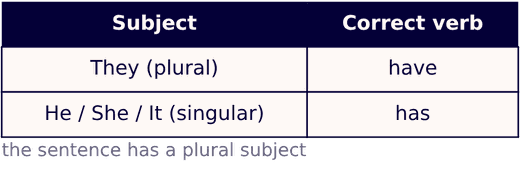 Part A should read 'They have some of the most intricate', so the error is in part A.
The remaining parts are sound: 'I have ever seen' is a present-perfect relative clause and 'each one polished to a deep mahogany sheen' is a correct participial phrase.
Part A should read 'They have some of the most intricate', so the error is in part A.
The remaining parts are sound: 'I have ever seen' is a present-perfect relative clause and 'each one polished to a deep mahogany sheen' is a correct participial phrase.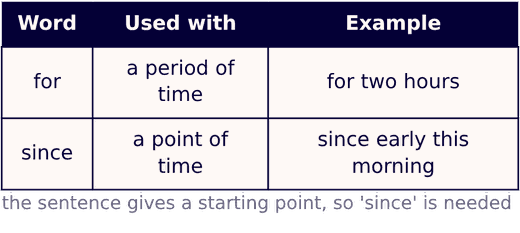 Part B should read 'for her final exams since early', so the error lies in part B.
The present perfect continuous 'has been studying' in part A is exactly the tense that goes with 'since', which confirms the choice.
Part B should read 'for her final exams since early', so the error lies in part B.
The present perfect continuous 'has been studying' in part A is exactly the tense that goes with 'since', which confirms the choice.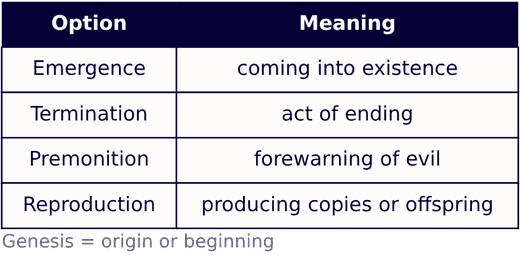 'Termination' is an ending and so is the opposite, 'premonition' is a forewarning of something bad, and 'reproduction' is the making of copies or offspring, so none of them matches.
 'A leap in the dark' is a risk taken without knowing the outcome and 'a silver lining' is the hopeful side of a bad situation, neither of which suggests a quarrel.
'Make a mountain out of a molehill' is a verb phrase meaning to exaggerate a trifle, and a verb phrase cannot follow 'became', so it is grammatically impossible here.
'A leap in the dark' is a risk taken without knowing the outcome and 'a silver lining' is the hopeful side of a bad situation, neither of which suggests a quarrel.
'Make a mountain out of a molehill' is a verb phrase meaning to exaggerate a trifle, and a verb phrase cannot follow 'became', so it is grammatically impossible here.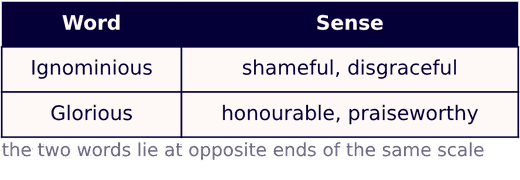 'Offenders' and 'accused' merely name people connected with crime and 'fugitive' is one who flees punishment; these share the disgraceful tone of the given word instead of opposing it.
 'Compel' works by force or authority and needs no repetition, 'influence' only affects a decision indirectly, and 'induce' means to succeed in persuading, which describes the result rather than the nagging.
Hence the required one-word substitute is 'pester'.
'Compel' works by force or authority and needs no repetition, 'influence' only affects a decision indirectly, and 'induce' means to succeed in persuading, which describes the result rather than the nagging.
Hence the required one-word substitute is 'pester'.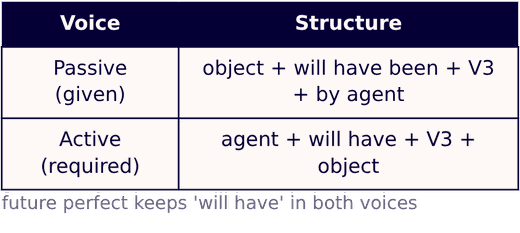 So 'the lead mathematician' moves to the front and the verb becomes 'will have solved', giving 'The lead mathematician will have solved the complex equation before the deadline.'
Option (a) drops the perfect aspect, (c) is still in the passive voice, and (d) shifts the tense to the present perfect, so only (b) is a faithful change of voice.
So 'the lead mathematician' moves to the front and the verb becomes 'will have solved', giving 'The lead mathematician will have solved the complex equation before the deadline.'
Option (a) drops the perfect aspect, (c) is still in the passive voice, and (d) shifts the tense to the present perfect, so only (b) is a faithful change of voice.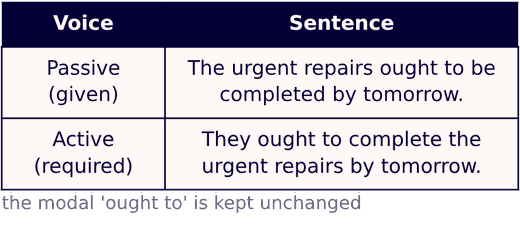 The passive sentence names no agent, so an indefinite subject such as 'they' must be supplied, giving 'They ought to complete the urgent repairs by tomorrow.'
Option (b) keeps 'the urgent repairs' as the subject of an active verb, which absurdly makes the repairs do the completing.
Options (c) and (d) replace 'ought to' by 'will' and 'must', and a change of modal changes the degree of obligation, so the meaning is no longer the same.
The passive sentence names no agent, so an indefinite subject such as 'they' must be supplied, giving 'They ought to complete the urgent repairs by tomorrow.'
Option (b) keeps 'the urgent repairs' as the subject of an active verb, which absurdly makes the repairs do the completing.
Options (c) and (d) replace 'ought to' by 'will' and 'must', and a change of modal changes the degree of obligation, so the meaning is no longer the same.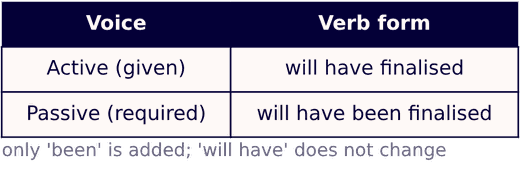 The adverb 'meticulously' stays immediately before the main verb, giving 'The experimental data will have been meticulously finalised by the researchers.'
Option (a) drops the perfect aspect, (b) shifts to the present perfect and (d) changes 'will' to 'would', so only (c) keeps the original tense intact.
The adverb 'meticulously' stays immediately before the main verb, giving 'The experimental data will have been meticulously finalised by the researchers.'
Option (a) drops the perfect aspect, (b) shifts to the present perfect and (d) changes 'will' to 'would', so only (c) keeps the original tense intact.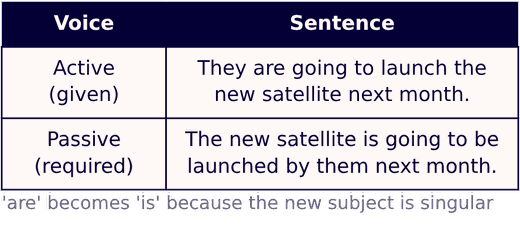 This gives 'The new satellite is going to be launched by them next month.'
Option (b) replaces 'be going to' with 'will', (c) shifts the sentence into the past and (d) uses a simple present passive, so none of them mirrors the original.
This gives 'The new satellite is going to be launched by them next month.'
Option (b) replaces 'be going to' with 'will', (c) shifts the sentence into the past and (d) uses a simple present passive, so none of them mirrors the original.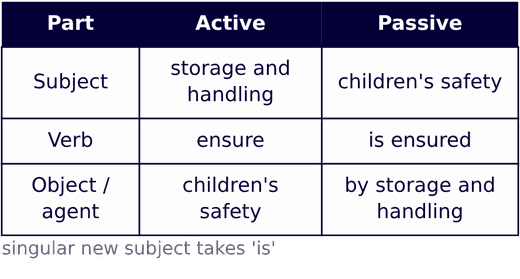 The old subject follows as the agent, giving 'Children's safety is ensured by responsible storage and handling.'
Option (b) is still in the active voice, (c) shifts a present-tense statement into the past, and (d) makes safety the doer of the action, reversing the meaning.
The old subject follows as the agent, giving 'Children's safety is ensured by responsible storage and handling.'
Option (b) is still in the active voice, (c) shifts a present-tense statement into the past, and (d) makes safety the doer of the action, reversing the meaning.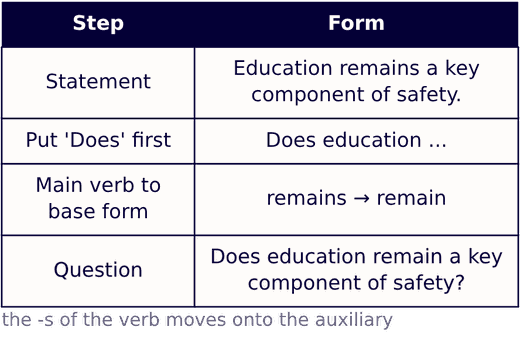 This gives 'Does education remain a key component of safety?', which asks the same thing that the statement asserts.
Option (a) turns it into the present perfect and (b) into the present continuous, both of which change the tense, while (d) merely adds a question mark without inverting the word order.
This gives 'Does education remain a key component of safety?', which asks the same thing that the statement asserts.
Option (a) turns it into the present perfect and (b) into the present continuous, both of which change the tense, while (d) merely adds a question mark without inverting the word order.