SSC CHSL 20 November 2025 · Shift 2 · General Intelligence — questions with answers · ShikshaSphere
Chapter 85 of 200
20 November 2025 · Shift 2
General Intelligence
25 questions ~25 min readFree
25 questions
A
26
Sunita's daughter's son's sister's mother's husband is Anil. How is Anil related to Sunita?
A.Husband
B.Brother
C.Father
D.Son-in-law
Solution
Blood relation chain
Open the chain one link at a time, starting from Sunita.
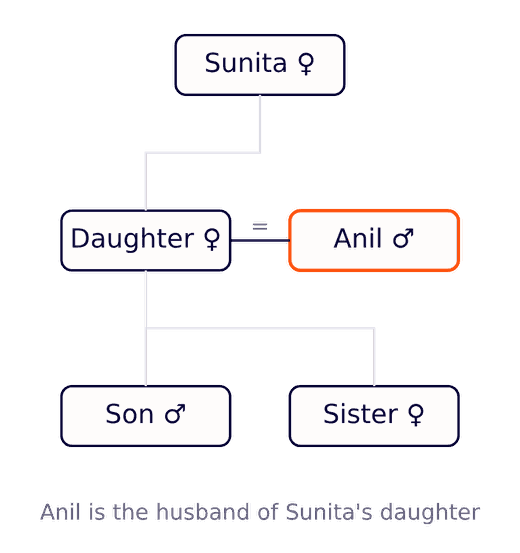
Sunita's daughter's son's sister is that boy's sister, so she is another child of Sunita's daughter.
That sister's mother is therefore Sunita's daughter herself.
Her husband is Anil, so Anil is the husband of Sunita's daughter.
The husband of one's daughter is one's son-in-law, so the answer is option (d).
27
In a family, K is the son of L. M is the brother of K. N is the mother of M. O is the father of N . How is L related to O ?
A.Daughter
B.Son-in-law
C.Son
D.Daughter-in-law
Solution
Blood relation
K is the son of L and M is the brother of K, so L is a parent of both K and M.
N is the mother of M, and therefore of K as well, so N is the mother in this family.
The other parent, L, must then be the father — a male member.
O is the father of N, which makes N the daughter of O, and L is the husband of that daughter.
The husband of one's daughter is one's son-in-law, so L is the son-in-law of O — option (b).
28
A company's profit in the first quarter was ₹1,50,000. In the second quarter, the profit decreased by 20%. What was the profit in the second quarter?
A.₹1,20,000
B.₹1,10,000
C.₹1,12,000
D.₹1,15,000
Solution
Percentage decrease
A decrease of 20% leaves of the first-quarter profit.
Second quarter profit
So the profit in the second quarter was ₹1,20,000 — option (a).
29
The ratio of men to boys in a room is . If there are 25 men, what is the total number of people in the room?
A.24
B.40
C.36
D.30
Solution
Ratio and proportion
Let the number of men be 5x and the number of boys be 3x.
Given that there are 25 men, 5x = 25, so x = 5.
Number of boys .
Total number of people = 25 + 15 = 40, which is option (b).
30
P can complete a work in 20 days, and Q can complete the same work in 30 days. If they work together, how many days will they take to complete the work?
A.6 days
B.8 days
C.12 days
D.5 days
Solution
Time and work
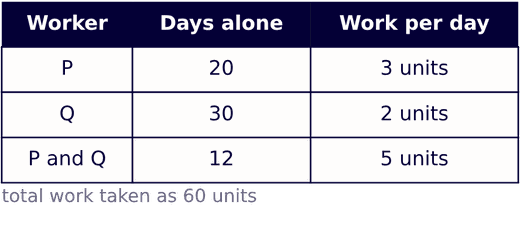
Take the total work as the LCM of 20 and 30, that is 60 units.
P's one day work units and Q's one day work units.
Working together, in one day they do 3 + 2 = 5 units.
Time taken together days, which is option (c).
31
Few of the letters are given followed by a question mark (?) these letters are following a specific pattern you have to give the correct option which can replace question mark.
What letter comes next: C, G, K, O, ?
A.S
B.T
C.Q
D.U
Solution
Letter series
Write the alphabetical position of each letter: C is 3, G is 7, K is 11 and O is 15.
The positions rise by 4 every time, so each letter is the fourth letter after the one before it.
The next position is 15 + 4 = 19, and the 19th letter of the alphabet is S — option (a).
32
In this type of questions, a question is provided with some issues/disputes/problem, followed by few methods to resolve the problem in statement choosing the appropriate problem solving method that can be implemented.
A school is facing frequent delays in morning assembly due to overcrowding at entry gates. What is the most immediate and practical step to resolve the problem?
A.Increase school fees to reduce admissions
B.Cancel the morning assembly permanently
C.Construct a new school building immediately
D.Stagger entry timings for different classes
Solution
Problem solving decision
The real problem is that everybody reaches the gate at the same moment, so the remedy must spread the arrivals out over time.
Staggering the entry timings of different classes does exactly that, needs no money and can begin the very next morning.
So option (d) is the most immediate and practical step.
Raising the fees (a) does not shorten the queue and punishes students instead, cancelling the assembly (b) removes the activity rather than solving the crowding, and a new building (c) takes months of time and heavy expense.
33
By interchanging which two signs the equation will be correct ?
A.- and
B.- and +
C.+ and
D.÷ and ×
Solution
Interchange of signs
The given equation is ; test each option by swapping the two signs everywhere and then applying BODMAS.
Interchanging - and turns the left side into .
Doing multiplication and division first: .
So the left side becomes 6+6-4=8, which is exactly the right-hand side.
Hence the signs to be interchanged are - and — option (a).
The other swaps fail: option (b) gives , option (c) gives and option (d) gives , none of which equals 8.
34
Pick the correct options from the given alternatives
3 : 9 : 27 :: 4 :16: 64 :: ?
A.
B.8 : 64 : 48
C.6 : 36 : 648
D.7 : 49 : 343
Solution
Number analogy
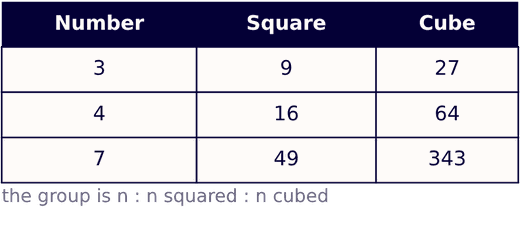
In 3:9:27 the second term is the square of the first and the third is its cube, since and .
The second group obeys the same rule: and .
Testing the options, and , so 7:49:343 fits the pattern exactly.
The others break it: not 48, not 648, and not 10.
Hence the answer is option (d).
35
Find out the missing number in the following sequence.
31, 37, 41, 43, 47, ?, 59
A.50
B.53
C.52
D.57
Solution
Prime number series
The differences +6, +4, +2, +4 follow no fixed rule, so look at the numbers themselves.
Every given term — 31, 37, 41, 43, 47 and 59 — is a prime number, and no prime has been skipped between them.
So the series is simply consecutive primes, and the prime just after 47 is 53.
It also fits the far end, since the prime right after 53 is 59, the last term given.
Hence the missing number is 53 — option (b); 50, 52 and 57 are all composite, as .
36
Select the related letter from the given alternatives
HLCF : INBH :: KOTX : ?
A.LQSZ
B.LSQZ
C.LOSZ
D.LZQS
Solution
Letter cluster analogy
Compare HLCF with INBH position by position: is +1, is +2, is -1 and is +2.
Apply the very same steps to KOTX: K+1=L, O+2=Q, T-1=S and X+2=Z.
This gives the cluster LQSZ, so the answer is option (a).
Option (b) swaps the middle two letters and option (c) leaves O unchanged, so neither follows the pattern.
37
Select the related letter from the given alternatives
GUJRATI : IGUJRAT :: ENGLISH: ?
A.EHNGLIS
B.ENGLHIS
C.HENGLIS
D.EHMGLIS
Solution
Word rearrangement analogy
In GUJRATI : IGUJRAT the last letter I has been lifted off the end and placed in front of the remaining letters GUJRAT.
No letter is changed and the order of the rest is untouched, so the rule is simply 'move the last letter to the front'.
In ENGLISH the last letter is H and the rest is ENGLIS, so H goes to the front.
This gives HENGLIS, which is option (c); option (a) puts H second, option (b) puts it fifth and option (d) also changes N into M.
38
In the question below there are three statements followed by two conclusions I and II. You have to take the three given statements to be true even if they seem to be at variance from commonly known facts and then decide which of the given conclusions logically follows from the three statements disregarding commonly known facts.Statements :
three given statements to be true even if they seem to be at variance from commonly known facts and then decide which of the given conclusions logically follows from the three statements disregarding commonly known facts.
Statements :
All dogs are cats.
No cat is a rat.
Conclusions :
I. Some rats are cats.
II. Some dogs are rats.
A.Neither conclusion I nor II follows
B.Only conclusion I follows.
C.Both conclusions I and II follow.
D.Only conclusion II follows.
Solution
Syllogism
'All dogs are cats' places the whole circle of dogs inside the circle of cats.
'No cat is a rat' keeps the circle of rats entirely separate from the circle of cats.
Conclusion I claims that some rats are cats, but the two circles never meet, so it does not follow.
For conclusion II, every dog lies inside cats and no cat is a rat, so no dog can be a rat either.
Since neither conclusion follows, the answer is option (a).
39
Carefully examine the Reference Statement. Then, identify the single option among the four alternatives (a, b, c, d) that is an EXACT AND COMPLETE REPLICATION of the Reference Statement. Pay exceptionally close attention to every character, number, symbol, space, and punctuation mark.
Reference: New Jersey, USA: November 20th, 2010.
A.New Jersei, USA: November 20th, 2010.
B.New Jersey, USA: November 30th, 2010.
C.New Jersey, USA: November 20th, 2020.
D.New Jersey, USA: November 20th, 2010.
Solution
Exact string matching
Read the reference in three blocks — the place, the date and the year — and check each option block by block.
Option (a) spells the place 'New Jersei', with an i in place of the final y.
Option (b) changes the date from 20th to 30th, and option (c) changes the year from 2010 to 2020.
Only option (d) reproduces every letter, digit, space and punctuation mark of the reference, so it is the answer.
40
Select the letter cluster from among the given options that can replace the question mark (?) in the following series.
YGP, DJU, IMZ, SSJ
A.OBV
B.NCV
C.NPE
D.NBV
Solution
Letter cluster series
Treat the three positions of the clusters as three separate letter series.
First letters are Y, D, I, ?, S; each moves +5 (counting on past Z), so the missing first letter is I+5=N.
Second letters are G, J, M, ?, S; each moves +3, so the missing second letter is M+3=P.
Third letters are P, U, Z, ?, J; each moves +5, so the missing third letter is Z+5=E.
Putting the three together gives NPE, which is option (c); the other options keep N but take the wrong second or third letter.
41
5 persons and T are sitting around a circular table facing towards the centre (not necessarily in the same order). Q is sitting second to the right of S. P is sitting second to the right of is not an immediate neighbour of . Who is sitting third to the right of ?
A.Q
B.P
C.S
D.T
Solution
Circular seating arrangement
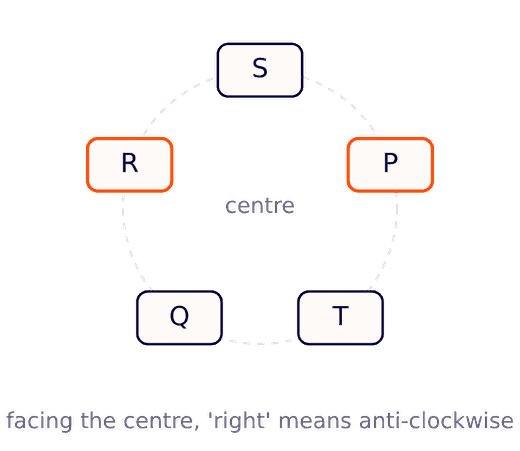
When everyone faces the centre, a person's right hand points anti-clockwise, so 'to the right' means moving anti-clockwise round the table.
Fix S anywhere and count two seats anti-clockwise to place Q; two more seats anti-clockwise from Q places P.
The remaining two seats go to R and T, and since R may not sit next to P, R takes the seat away from P and T takes the seat beside P.
Now count three seats to the right of R, i.e. three seats anti-clockwise: Q, then T, then P.
So P is sitting third to the right of R.
Hence option (b) is correct.
42
A man is facing towards the east. He then turns 45° anti-clockwise, again 180° anti-clockwise and then clockwise. In which direction is he facing now ?
A.West
B.North
C.South
D.East
Solution
Turning and direction
Count clockwise turns as positive and anti-clockwise turns as negative, then simply add them.
Net turn
A net turn of brings him back to the direction he started from.
He started facing east, so he is still facing east.
Hence option (d) is correct.
43
Arjun starts moving in the east direction. After running 50 meters, he turns left and walks 15 meters straight. Then, from there, he turns to his left and walks 30 meters straight. He again turns 15 meters to his left. How far is he from the starting point?
A.10 m
B.40 m
C.20 m
D.30 m
Solution
Direction sense distance
He starts facing east; a left turn from east gives north, the next left turn gives west and the last left turn gives south.
So the four legs are 50 m east, 15 m north, 30 m west and 15 m south.
The 15 m north and the 15 m south are equal and opposite, so they cancel and he finishes on the same east-west line as the start.
Net eastward distance =50-30=20 m
Hence option (c) is correct.
44
K walks 20 meters in east direction. He turns left and walks 12 meters. He turns right and walks 22 meters. He finally turns right and walks 12 meters. How far (in meters) and in which direction is he now from the starting point?
A.42, east
B.52, east
C.48 , west
D.32 , west
Solution
Direction sense distance
Facing east, a left turn gives north; from north a right turn gives east again; from east the last right turn gives south.
So the four legs are 20 m east, 12 m north, 22 m east and 12 m south.
The 12 m north and the 12 m south cancel exactly, so no north-south displacement is left.
Total eastward distance =20+22=42 m
He is therefore 42 m east of the starting point.
Hence option (a) is correct.
45
Select the option that is related to the second number in the same way as the third number is related to the fourth number and fifth number is related to sixth number.
(NOTE: Operations should be performed on the whole numbers, without breaking down the numbers into its constituent digits. E.g. 13 - Operations on 13 such as adding /subtracting /multiplying etc. to 13 can be performed. Breaking down 13 into 1 and 3 and then performing mathematical operations on 1 and 3 is not allowed)
? : 4325 :: 23 : 143 :: 35 : 215
A.720
B.727
C.722
D.712
Solution
Number analogy
Look for one rule that works on the whole number in both of the completed pairs.
and 138+5=143
and 210+5=215
So the rule is: second number = first number .
Let the missing number be x, so 6x+5=4325.
6x=4325-5=4320
Hence option (a) is correct.
46
If ' ' means '+', ' ' means '-', ' ' means ' ' and ' N ' means ' ', then which of the following equation is correct?
I. 35 K 3 L 28 M 7 N
II. 13 K 47 L 36 M 4 N 5 =15
A.Both I and II
B.Neither I nor II
C.Only I
D.Only II
Solution
Symbol substitution
Replace each letter by the sign it stands for and then solve by BODMAS, doing division and multiplication from left to right before addition and subtraction.
I becomes
, which is exactly the value given.
II becomes
, which is also the value given.
Both equations therefore hold.
Hence option (a) is correct.
47
In a certain code language, 'HAND' is coded as '81144', 'LEGS' is coded as '125719'. How will 'CHAIR' be coded in that code language?
A.381917
B.371918
C.381918
D.371818
Solution
Letter-place-value coding
Each letter is simply replaced by its position number in the alphabet and the numbers are written one after another without any gap.
HAND: H is 8, A is 1, N is 14, D is 4, and joining them gives 81144.
LEGS: L is 12, E is 5, G is 7, S is 19, and joining them gives 125719.
CHAIR: C is 3, H is 8, A is 1, I is 9, R is 18.
Joining these gives 381918.
Hence option (c) is correct.
48
In a certain coded language 'SHAPES' is coded as 'HSZKVH' and 'BATTER' is coded as 'YZGGVI'. How will 'MENTOR' be coded in the same code language?
A.NVMKLI
B.NKKGLI
C.NVMGLI
D.NMVGLI
Solution
Opposite-letter coding
Every letter is replaced by its opposite letter in the alphabet: A becomes Z, B becomes Y, C becomes X and so on.
The test is that the two positions always add up to 27, since 1+26=27.
Check SHAPES: S is 19 and 27-19=8, which is H; A is 1 and 27-1=26, which is Z, so HSZKVH fits.
Apply it to MENTOR: M(13) gives N(14), E(5) gives V(22), N(14) gives M(13), T(20) gives G(7), O(15) gives L(12) and R(18) gives I(9).
The code is therefore NVMGLI.
Hence option (c) is correct.
49
In a certain coded language 'ANIMAL' is coded as 'CKMHGE' and 'ENERGY' is coded as 'GKIMMR'. How will 'ASPIRE' be coded in the same code language?
A.CPTDXX
B.CPTDXY
C.CTPDYX
D.CPTXDY
Solution
Alternating letter shifts
Compare the letters position by position instead of looking at the word as a whole.
ANIMAL to CKMHGE: A to C is +2, N to K is -3, I to M is +4, M to H is -5, A to G is +6 and L to E is -7.
ENERGY to GKIMMR obeys the very same list +2,-3,+4,-5,+6,-7, so the pattern is confirmed.
ASPIRE: A+2=C, S-3=P, P+4=T, I-5=D, R+6=X.
For the last letter, E(5)-7 goes past the start of the alphabet, so it wraps round to 26-2=24, which is X.
The code is therefore CPTDXX.
Hence option (a) is correct.
50
From the given alternatives, select the word that CAN be formed by using the letters of the word given in the question.
HOSTILITY
A.HASTY
B.POINT
C.HOST
D.HOTEL
Solution
Word formation from letters
The letters available in HOSTILITY are H, O, S, T, I, L, I, T, Y.
Take each option and look for a letter that the pool does not contain.
HASTY needs an A, POINT needs a P and an N, and HOTEL needs an E, none of which is available.
HOST needs only H, O, S and T, and all four are present in HOSTILITY.
Hence option (c) is correct.
Finished reading? Now test yourself.
The same 25 questions, but with a timer and the answers hidden — 15 minutes.

 Her husband is Anil, so Anil is the husband of Sunita's daughter.
The husband of one's daughter is one's son-in-law, so the answer is option (d).
Her husband is Anil, so Anil is the husband of Sunita's daughter.
The husband of one's daughter is one's son-in-law, so the answer is option (d).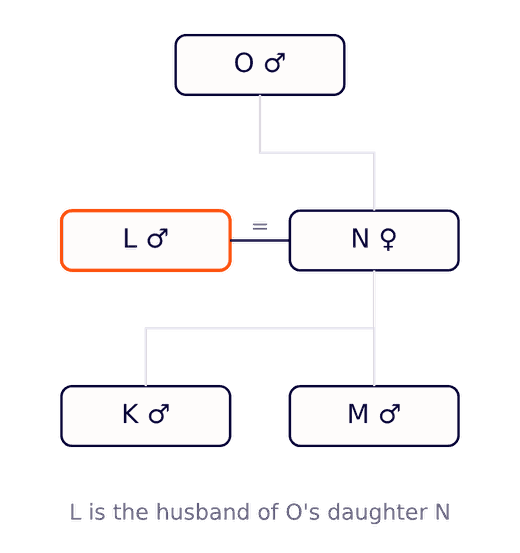 O is the father of N, which makes N the daughter of O, and L is the husband of that daughter.
The husband of one's daughter is one's son-in-law, so L is the son-in-law of O — option (b).
O is the father of N, which makes N the daughter of O, and L is the husband of that daughter.
The husband of one's daughter is one's son-in-law, so L is the son-in-law of O — option (b).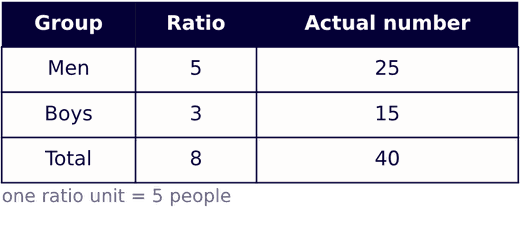 Total number of people = 25 + 15 = 40, which is option (b).
 Time taken together days, which is option (c).
 The next position is 15 + 4 = 19, and the 19th letter of the alphabet is S — option (a).
 Testing the options, and , so 7:49:343 fits the pattern exactly.
The others break it: not 48, not 648, and not 10.
Hence the answer is option (d).
Testing the options, and , so 7:49:343 fits the pattern exactly.
The others break it: not 48, not 648, and not 10.
Hence the answer is option (d).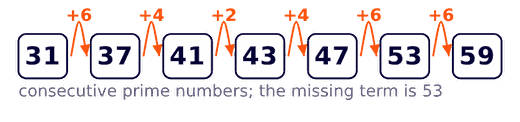 So the series is simply consecutive primes, and the prime just after 47 is 53.
It also fits the far end, since the prime right after 53 is 59, the last term given.
Hence the missing number is 53 — option (b); 50, 52 and 57 are all composite, as .
So the series is simply consecutive primes, and the prime just after 47 is 53.
It also fits the far end, since the prime right after 53 is 59, the last term given.
Hence the missing number is 53 — option (b); 50, 52 and 57 are all composite, as .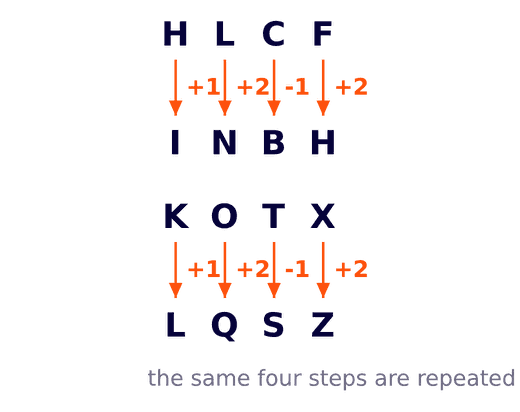 Apply the very same steps to KOTX: K+1=L, O+2=Q, T-1=S and X+2=Z.
This gives the cluster LQSZ, so the answer is option (a).
Option (b) swaps the middle two letters and option (c) leaves O unchanged, so neither follows the pattern.
Apply the very same steps to KOTX: K+1=L, O+2=Q, T-1=S and X+2=Z.
This gives the cluster LQSZ, so the answer is option (a).
Option (b) swaps the middle two letters and option (c) leaves O unchanged, so neither follows the pattern.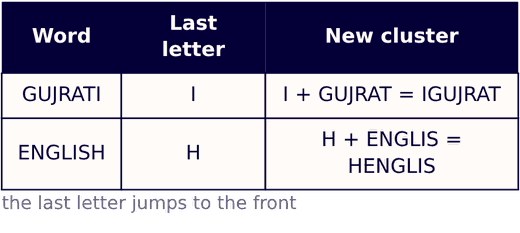 In ENGLISH the last letter is H and the rest is ENGLIS, so H goes to the front.
This gives HENGLIS, which is option (c); option (a) puts H second, option (b) puts it fifth and option (d) also changes N into M.
In ENGLISH the last letter is H and the rest is ENGLIS, so H goes to the front.
This gives HENGLIS, which is option (c); option (a) puts H second, option (b) puts it fifth and option (d) also changes N into M.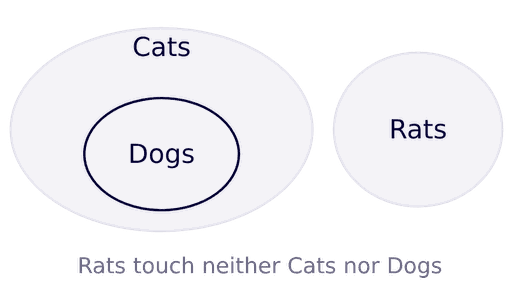 Conclusion I claims that some rats are cats, but the two circles never meet, so it does not follow.
For conclusion II, every dog lies inside cats and no cat is a rat, so no dog can be a rat either.
Since neither conclusion follows, the answer is option (a).
Conclusion I claims that some rats are cats, but the two circles never meet, so it does not follow.
For conclusion II, every dog lies inside cats and no cat is a rat, so no dog can be a rat either.
Since neither conclusion follows, the answer is option (a).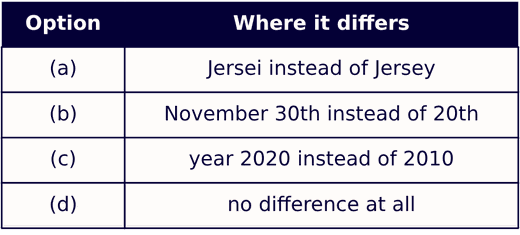 Option (a) spells the place 'New Jersei', with an i in place of the final y.
Option (b) changes the date from 20th to 30th, and option (c) changes the year from 2010 to 2020.
Only option (d) reproduces every letter, digit, space and punctuation mark of the reference, so it is the answer.
Option (a) spells the place 'New Jersei', with an i in place of the final y.
Option (b) changes the date from 20th to 30th, and option (c) changes the year from 2010 to 2020.
Only option (d) reproduces every letter, digit, space and punctuation mark of the reference, so it is the answer.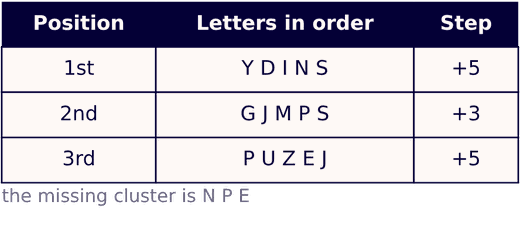 Putting the three together gives NPE, which is option (c); the other options keep N but take the wrong second or third letter.
 Now count three seats to the right of R, i.e. three seats anti-clockwise: Q, then T, then P.
So P is sitting third to the right of R.
Hence option (b) is correct.
Now count three seats to the right of R, i.e. three seats anti-clockwise: Q, then T, then P.
So P is sitting third to the right of R.
Hence option (b) is correct.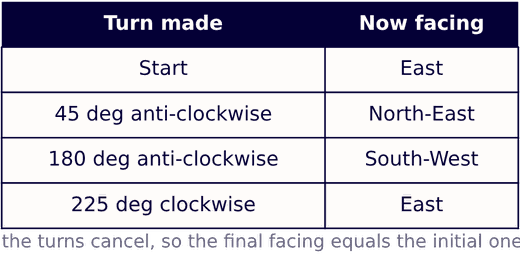 A net turn of brings him back to the direction he started from.
He started facing east, so he is still facing east.
Hence option (d) is correct.
A net turn of brings him back to the direction he started from.
He started facing east, so he is still facing east.
Hence option (d) is correct.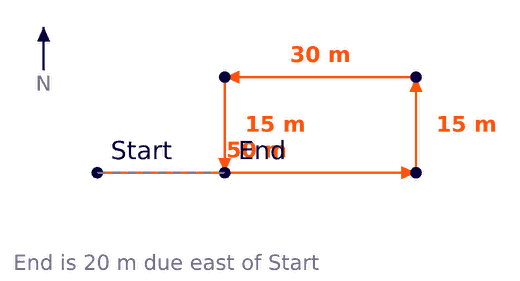 The 15 m north and the 15 m south are equal and opposite, so they cancel and he finishes on the same east-west line as the start.
Net eastward distance =50-30=20 m
Hence option (c) is correct.
The 15 m north and the 15 m south are equal and opposite, so they cancel and he finishes on the same east-west line as the start.
Net eastward distance =50-30=20 m
Hence option (c) is correct.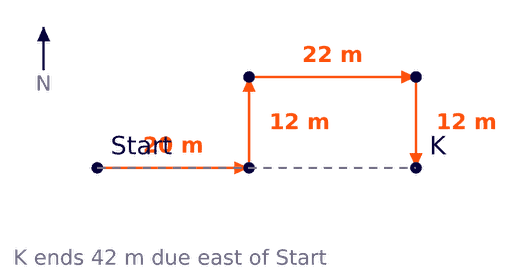 The 12 m north and the 12 m south cancel exactly, so no north-south displacement is left.
Total eastward distance =20+22=42 m
He is therefore 42 m east of the starting point.
Hence option (a) is correct.
The 12 m north and the 12 m south cancel exactly, so no north-south displacement is left.
Total eastward distance =20+22=42 m
He is therefore 42 m east of the starting point.
Hence option (a) is correct.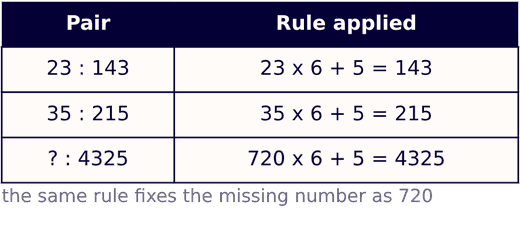 So the rule is: second number = first number .
Let the missing number be x, so 6x+5=4325.
6x=4325-5=4320
Hence option (a) is correct.
So the rule is: second number = first number .
Let the missing number be x, so 6x+5=4325.
6x=4325-5=4320
Hence option (a) is correct.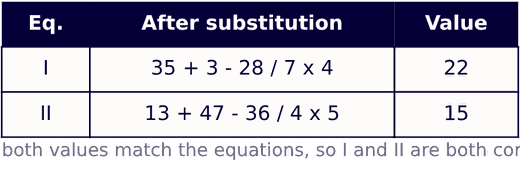 Both equations therefore hold.
Hence option (a) is correct.
Both equations therefore hold.
Hence option (a) is correct.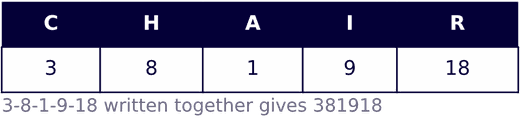 CHAIR: C is 3, H is 8, A is 1, I is 9, R is 18.
Joining these gives 381918.
Hence option (c) is correct.
CHAIR: C is 3, H is 8, A is 1, I is 9, R is 18.
Joining these gives 381918.
Hence option (c) is correct.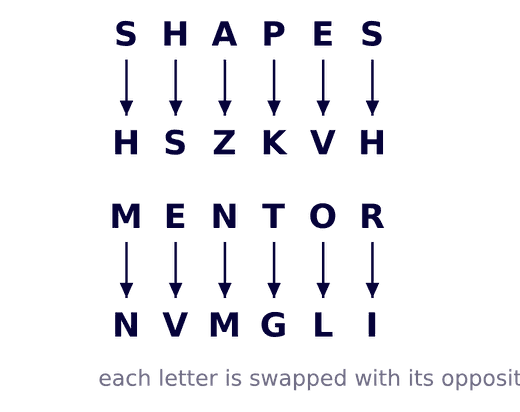 Apply it to MENTOR: M(13) gives N(14), E(5) gives V(22), N(14) gives M(13), T(20) gives G(7), O(15) gives L(12) and R(18) gives I(9).
The code is therefore NVMGLI.
Hence option (c) is correct.
Apply it to MENTOR: M(13) gives N(14), E(5) gives V(22), N(14) gives M(13), T(20) gives G(7), O(15) gives L(12) and R(18) gives I(9).
The code is therefore NVMGLI.
Hence option (c) is correct.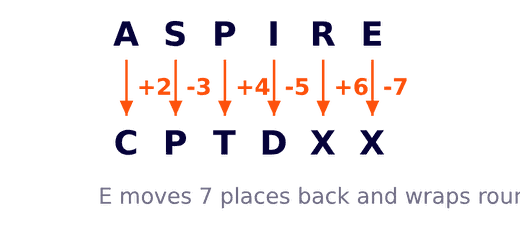 ASPIRE: A+2=C, S-3=P, P+4=T, I-5=D, R+6=X.
For the last letter, E(5)-7 goes past the start of the alphabet, so it wraps round to 26-2=24, which is X.
The code is therefore CPTDXX.
Hence option (a) is correct.
ASPIRE: A+2=C, S-3=P, P+4=T, I-5=D, R+6=X.
For the last letter, E(5)-7 goes past the start of the alphabet, so it wraps round to 26-2=24, which is X.
The code is therefore CPTDXX.
Hence option (a) is correct.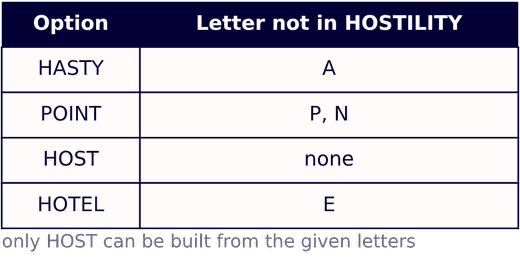 HASTY needs an A, POINT needs a P and an N, and HOTEL needs an E, none of which is available.
HOST needs only H, O, S and T, and all four are present in HOSTILITY.
Hence option (c) is correct.
HASTY needs an A, POINT needs a P and an N, and HOTEL needs an E, none of which is available.
HOST needs only H, O, S and T, and all four are present in HOSTILITY.
Hence option (c) is correct.