SSC CHSL 20 November 2025 · Shift 2 · English Language — questions with answers · ShikshaSphere
Chapter 88 of 200
20 November 2025 · Shift 2
English Language
25 questions ~25 min readFree
25 questions
A
1
Identify Spot the error in the given sentence.
"Because of he was exhausted, he could not finish the task on time."
A.Because of
B.he was exhausted
C.he could not finish
D.the task on time
Solution
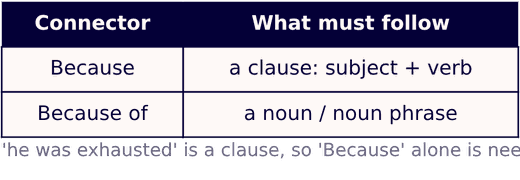
Because vs because of
'Because of' is a two-word preposition, so it must be followed by a noun or a noun phrase — 'because of his exhaustion', 'because of the rain'.
What follows here is 'he was exhausted', a full clause with its own subject and finite verb, and a clause needs the plain conjunction 'Because'.
Parts (b), (c) and (d) are all sound, so the error lies in the opening words 'Because of'.
Hence option (a) is correct.
2
Fill in the blank with the most appropriate preposition:
He has great confidence his ability to handle difficult situations.
A.in
B.on
C.at
D.with
Solution
Preposition with 'confidence'
Nouns of trust — confidence, faith, belief, trust — take the preposition 'in' before the thing that is trusted.
The trust here rests on his ability, so the fixed collocation is 'confidence in his ability'.
'Confidence on' and 'confidence at' are not standard English, and 'with confidence' means 'confidently', which cannot take 'his ability' as an object.
Hence option (a) is correct.
3
Fill in the blank with the most appropriate phrasal verb:
The negotiator worked hard to the rising tensions between the two groups.
A.smooth over
B.call off
C.set out
D.bring up
Solution
Phrasal verb 'smooth over'
'Smooth over' means to make a disagreement or difficulty seem less serious, that is, to calm it down.
The negotiator is working on 'the rising tensions', and tensions are exactly the kind of thing one smooths over.
'Call off' means to cancel, 'set out' means to begin a journey or to state formally, and 'bring up' means to raise a topic or to rear a child — none of them fits the easing of tension.
Hence option (a) is correct.
4
Select the most appropriate synonym of the word: DIVERGENT
A.Distinct
B.Alike
C.Parallel
D.Consistent
Solution
Synonym of 'divergent'
'Divergent' describes things that move apart from a common point and therefore differ from one another — divergent views, divergent paths.
'Distinct' means clearly different and separate, which carries the very same idea of difference.
'Alike', 'parallel' and 'consistent' all point to sameness or agreement, the opposite of divergent.
Hence option (a) is correct.
5
Select the most appropriate synonym of the word: Laconic
A.Verbose
B.Taciturn
C.Terse
D.Loquacious
Solution
Synonym of 'laconic'
'Laconic' describes speech or writing that uses very few words — a laconic reply, a laconic note.
'Terse' means brief and to the point, so it matches 'laconic' both in sense and in the nouns it goes with.
'Taciturn' is the tempting choice, but it describes a person's silent, reserved nature, not the brevity of the words actually spoken.
'Verbose' and 'loquacious' mean wordy and talkative, which is the very opposite of laconic.
Hence option (c) is correct.
6
Fill in the blank with the most appropriate idiomatic expression:
When asked about the mistake, she avoided giving a direct answer and continued to .
A.pay the piper
B.dance around the issue
C.get the taste of her own medicine
D.spill the beans
Solution
Idiom of evasion
'To dance around the issue' means to avoid dealing with a subject directly.
The sentence itself says that she 'avoided giving a direct answer', so the idiom in the blank must continue that idea of evasion.
'Pay the piper' is to bear the consequences, 'a taste of her own medicine' is to receive the same bad treatment one gave others, and 'spill the beans' is to reveal a secret — the last is in fact the opposite of avoiding an answer.
Hence option (b) is correct.
7
Select the most appropriate antonym of the word: Counterfeit
A.Straightforward
B.Genuine
C.Blunt
D.Forthright
Solution
Antonym of 'counterfeit'
'Counterfeit' means made in imitation of something real so as to deceive — counterfeit notes, counterfeit goods.
Its opposite must therefore be something real and authentic, and that word is 'genuine'.
'Straightforward', 'blunt' and 'forthright' are opposites of 'evasive' or 'devious'; they answer a different question, not the one about fake versus real.
Hence option (b) is correct.
8
Choose the most suitable option to replace the highlighted part of the sentence:
The player who took the most lowest number of wickets was harshly criticised by the spectators in the stadium.
A.the most lowest
B.the lowest number of
C.the most number
D.the lowest
Solution
Double superlative
'Lowest' is already the superlative form of 'low', so placing 'most' before it creates a double superlative, which English does not permit.
Wickets are counted, and the natural way to speak of the smallest count is 'the lowest number of wickets'.
Option (a) keeps the double superlative, (c) 'the most number' is unidiomatic, and (d) would give 'took the lowest wickets', which never says what was low.
Hence option (b) is correct.
9
Choose the correct one-word substitute for:
A person who has been rejected or ostracized by their society or social group.
A.Alien
B.Asylum seeker
C.Visitor
D.Outcast
Solution
One-word substitution
The clue words are 'rejected' and 'ostracized by their society' — the person has been pushed out of his own group.
'Outcast' means exactly that: one who has been rejected and driven out by his society or social group.
'Alien' is a foreigner, an 'asylum seeker' flees to another country for safety, and a 'visitor' merely calls on a place — none of them carries the sense of rejection by one's own people.
Hence option (d) is correct.
10
Choose the correct indirect narration of the following statement from the given alternatives:
The teacher said, "Students, finish your work and submit the files by evening."
A.The teacher asked the students to finish their work and submit the files by evening.
B.The teacher asked the students to finish your work and submit the files by evening.
C.The teacher asked the students that they finish their work and submit the files by evening.
D.The teacher asked the students to finished their work and submitted the files by evening.
Solution
Direct to indirect: imperative
The reported words are an order, so the reporting verb becomes 'asked/told' and the command is turned into a 'to + V1' infinitive.
The vocative 'Students' becomes the object of that verb, 'the students', and the pronoun 'your' shifts to 'their'.
That yields 'The teacher asked the students to finish their work and submit the files by evening.'
Option (b) keeps 'your', option (c) replaces the infinitive with a 'that'-clause, and option (d) puts past forms after 'to'.
Hence option (a) is correct.
11
Select the most appropriate antonym of the word:
ALACRITY
A.Lethargy
B.Eagerness
C.Promptness
D.Readiness
Solution
Antonym of 'alacrity'
'Alacrity' means brisk and cheerful willingness — 'she accepted the invitation with alacrity'.
Its opposite is a want of energy and willingness, and that is 'lethargy'.
'Eagerness', 'promptness' and 'readiness' are all synonyms of alacrity, so they cannot be its antonym.
Hence option (a) is correct.
12
Which sentence contains a misspelled word?
A.The garden looked beautiful after the morning rain.
B.She wore a beautiful dress that suited the occasion perfectly.
C.The sunset over the hills was truly beautiful to watch.
D.He described the idea in a simple yet beautifull manner.
Solution
Spelling: '-ful' suffix
The word being tested in all four sentences is 'beautiful', which ends in a single 'l' — beauty + ful.
Option (d) writes it as 'beautifull' with a double 'l', so that is the sentence carrying a misspelt word.
The suffix '-ful' always keeps one 'l' when it is added to a word: careful, useful, hopeful, powerful.
Hence option (d) is correct.
13
Fill in the blank with the correctly spelled word:
"The author was given a for his outstanding contribution to literature."
A.recognision
B.recoginition
C.recognittion
D.recognition
Solution
Spelling: 'recognition'
'Recognition' is built on 'recognise': the '-ise' ending is dropped and '-ition' is added.
The correct spelling therefore keeps the stem 'recogn-' intact — r-e-c-o-g-n-i-t-i-o-n.
'Recognision' spoils the ending, 'recoginition' inserts an extra 'i' after the 'g', and 'recognittion' doubles the 't'.
Hence option (d) is correct.
14
Change the following sentence into the Active form.
Has the ancient manuscript been translated by the scholar?
A.Has the scholar translated the ancient manuscript?
B.The scholar has translated the ancient manuscript?
C.Did the scholar translate the ancient manuscript?
D.The ancient manuscript has been translating by the scholar?
Solution
Passive to active voice
The given sentence is a present-perfect passive question: Has + object + been + V3 + by + doer.
In the active form the doer becomes the subject, 'been' disappears and the pattern is Has + doer + V3 + object.
So 'the scholar' moves to the front and the question reads 'Has the scholar translated the ancient manuscript?'
Option (b) is a statement given a question mark, option (c) shifts the tense to simple past, and option (d) is still passive.
Hence option (a) is correct.
15
Choose the correct passive voice transformation of the sentence:
She cannot solve the puzzle alone.
A.The puzzle was not solved by her alone.
B.The puzzle is not solved by her alone.
C.The puzzle cannot be solved by her alone.
D.The puzzle cannot have been solved by her alone.
Solution
Passive with a modal
When the active sentence has a modal verb, the passive is formed as modal + be + V3.
'Cannot solve' therefore becomes 'cannot be solved', while the object 'the puzzle' moves to the front and 'she' becomes 'by her'.
Options (a) and (b) drop the modal and put 'was not' / 'is not' in its place, and option (d) adds a perfect 'have been' that the active sentence does not contain.
Hence option (c) is correct.
16
Select the option that expresses the given sentence in direct voice.
The witness stated that the incident had occurred late at night.
A.The witness stated, "The incident is occurred late at night."
B.The witness stated, "The incident occurred late at night."
C.The witness stated, "The incident have occurred late at night."
D.The witness stated, "The incident is occuring late at night."
Solution
Indirect to direct speech
To turn indirect speech into direct speech, the conjunction 'that' is dropped and the speaker's own words are placed after a comma inside inverted commas.
The backshift of tense is then undone: the reported past perfect 'had occurred' goes back to the simple past 'occurred'.
Option (a) turns the verb into a faulty passive, option (c) uses plural 'have' with the singular 'incident', and option (d) makes it continuous and misspells 'occurring'.
Hence option (b) is correct.
17
Choose the correct passive voice transformation of the sentence:
The proposal is believed to have influenced public opinion significantly.
A.Public opinion is believed to have been influenced significantly by the proposal.
B.It is believed that public opinion has been influenced significantly by the proposal.
C.Public opinion will have been influenced significantly by the proposal.
D.The proposal is believed that public opinion has been influenced significantly.
Solution
Passive of a perfect infinitive
In the frame 'X is believed to have + V3 + object', the voice change is carried out inside the infinitive, and the object of that inner verb becomes the new subject.
The inner active idea here is 'the proposal influenced public opinion', so 'public opinion' takes the front position.
The perfect infinitive 'to have influenced' becomes the passive perfect infinitive 'to have been influenced', and the old subject returns as 'by the proposal'.
The sentence therefore becomes 'Public opinion is believed to have been influenced significantly by the proposal.'
Option (b) abandons the infinitive and builds a fresh 'It is believed that ...' clause instead of transforming the given structure, option (c) changes the tense to future perfect, and option (d) is ungrammatical.
Hence option (a) is correct.
18
Directions (Qs. 18-22): Read the following passage carefully and answer the questions that follow.
Forests are among the most valuable natural resources on Earth, supporting a wide variety of plant and animal life. They help regulate the climate by absorbing carbon dioxide, releasing oxygen, and influencing rainfall patterns. Many communities also depend on forests for food, shelter, and livelihoods.
Tropical rainforests, in particular, are known for their extraordinary biodiversity. A single hectare can contain hundreds of different tree species, along with countless insects, birds, and mammals. These forests also play a key role in maintaining soil fertility and preventing erosion.
Despite their importance, forests around the world are under severe threat due to deforestation, illegal logging, and expanding agriculture. Scientists and environmentalists warn that continued forest loss could lead to irreversible damage to ecosystems and worsen climate change. Protecting forests is therefore essential for environmental balance and human survival.
In the sentence: "Forests are among the most valuable natural resources on Earth," what is the tense of the verb "are" ?
A.Past simple
B.Present simple
C.Present perfect
D.Future simple
Solution
Tense identification
'Are' is the plural present form of the verb 'be' (am / is / are), so the verb itself is in the present.
A general, timeless fact is stated in the simple present, and 'Forests are among the most valuable natural resources on Earth' is exactly such a fact.
The past simple would need 'were', the present perfect 'have been', and the future simple 'will be' — none of these appears.
Hence option (b) is correct.
19
Directions (Qs. 18-22): Read the following passage carefully and answer the questions that follow.
Forests are among the most valuable natural resources on Earth, supporting a wide variety of plant and animal life. They help regulate the climate by absorbing carbon dioxide, releasing oxygen, and influencing rainfall patterns. Many communities also depend on forests for food, shelter, and livelihoods.
Tropical rainforests, in particular, are known for their extraordinary biodiversity. A single hectare can contain hundreds of different tree species, along with countless insects, birds, and mammals. These forests also play a key role in maintaining soil fertility and preventing erosion.
Despite their importance, forests around the world are under severe threat due to deforestation, illegal logging, and expanding agriculture. Scientists and environmentalists warn that continued forest loss could lead to irreversible damage to ecosystems and worsen climate change. Protecting forests is therefore essential for environmental balance and human survival.
In the sentence: "They help regulate the climate by absorbing carbon dioxide,"
The given sentence is in active voice or passive voice?
A.Active voice - the subject performs the action
B.Passive voice - the action is done to the subject
C.Passive voice - the doer is hidden
D.Active voice - without an object
Solution
Voice identification
In the active voice the subject performs the action; in the passive voice the subject receives it.
Here 'They' (the forests) is the subject and 'help regulate' is what they themselves do, so the subject is the doer.
A passive version would have to read 'The climate is regulated ... by them', which is not what the sentence says.
Option (d) also fails because the sentence does carry an object, 'the climate'.
Hence option (a) is correct.
20
Directions (Qs. 18-22): Read the following passage carefully and answer the questions that follow.
Forests are among the most valuable natural resources on Earth, supporting a wide variety of plant and animal life. They help regulate the climate by absorbing carbon dioxide, releasing oxygen, and influencing rainfall patterns. Many communities also depend on forests for food, shelter, and livelihoods.
Tropical rainforests, in particular, are known for their extraordinary biodiversity. A single hectare can contain hundreds of different tree species, along with countless insects, birds, and mammals. These forests also play a key role in maintaining soil fertility and preventing erosion.
Despite their importance, forests around the world are under severe threat due to deforestation, illegal logging, and expanding agriculture. Scientists and environmentalists warn that continued forest loss could lead to irreversible damage to ecosystems and worsen climate change. Protecting forests is therefore essential for environmental balance and human survival.
The word "biodiversity" refers to:
A.A type of forest soil
B.The variety of living organisms in an area
C.A farming technique
D.A weather condition
Solution
Vocabulary from the passage
'Bio-' means life and 'diversity' means variety, so 'biodiversity' is the variety of living organisms found in an area.
The passage confirms the sense: one hectare of rainforest may hold 'hundreds of different tree species, along with countless insects, birds, and mammals'.
Soil, a farming technique and a weather condition have nothing to do with the range of living things, so the other options are ruled out.
Hence option (b) is correct.
21
Directions (Qs. 18-22): Read the following passage carefully and answer the questions that follow.
Forests are among the most valuable natural resources on Earth, supporting a wide variety of plant and animal life. They help regulate the climate by absorbing carbon dioxide, releasing oxygen, and influencing rainfall patterns. Many communities also depend on forests for food, shelter, and livelihoods.
Tropical rainforests, in particular, are known for their extraordinary biodiversity. A single hectare can contain hundreds of different tree species, along with countless insects, birds, and mammals. These forests also play a key role in maintaining soil fertility and preventing erosion.
Despite their importance, forests around the world are under severe threat due to deforestation, illegal logging, and expanding agriculture. Scientists and environmentalists warn that continued forest loss could lead to irreversible damage to ecosystems and worsen climate change. Protecting forests is therefore essential for environmental balance and human survival.
The word "deforestation" means:
A.Planting new trees
B.Protection of wildlife
C.Large-scale removal of forests
D.Natural forest growth
Solution
Vocabulary from passage
The prefix 'de-' carries the sense of removal or undoing, so 'deforestation' is the undoing of forest cover.
The passage confirms this by listing it among the dangers: forests are 'under severe threat due to deforestation, illegal logging, and expanding agriculture'.
A word placed beside 'illegal logging' must name a form of forest loss, so it means the large-scale removal or clearing of forests — option (c).
Options (a) 'planting new trees' and (d) 'natural forest growth' describe forests increasing, which is the opposite, and (b) names a conservation activity, not forest loss.
22
Directions (Qs. 18-22): Read the following passage carefully and answer the questions that follow.
Forests are among the most valuable natural resources on Earth, supporting a wide variety of plant and animal life. They help regulate the climate by absorbing carbon dioxide, releasing oxygen, and influencing rainfall patterns. Many communities also depend on forests for food, shelter, and livelihoods.
Tropical rainforests, in particular, are known for their extraordinary biodiversity. A single hectare can contain hundreds of different tree species, along with countless insects, birds, and mammals. These forests also play a key role in maintaining soil fertility and preventing erosion.
Despite their importance, forests around the world are under severe threat due to deforestation, illegal logging, and expanding agriculture. Scientists and environmentalists warn that continued forest loss could lead to irreversible damage to ecosystems and worsen climate change. Protecting forests is therefore essential for environmental balance and human survival.
What does the passage mainly focus on?
A.Forests are useful only for timber
B.Tropical forests exist only in certain countries
C.Forests are vital but are being threatened and need protection
D.Agriculture has no effect on forests
Solution
Central idea of passage
The main focus must cover the whole passage, not a single detail from one paragraph.
Paragraph 1 sets out what forests give us, paragraph 2 adds the biodiversity of tropical rainforests, and paragraph 3 warns of deforestation and closes with 'Protecting forests is therefore essential'.
Put together, the passage says forests are vital, they are being threatened, and they must be protected — option (c).
Option (a) is wrong because the passage never limits forests to timber, (b) is never stated, and (d) is contradicted by 'expanding agriculture' being named as a threat.
23
Which of the following pairs of homophones can be used to fill in the blanks most suitably?
The designer received a sincere for her creativity, which served as the perfect
to the overall presentation.
A.complement, compliment
B.compliment, complement
C.complement, complement
D.compliment, compliment
Solution
Homophones: compliment/complement
'Compliment' with an 'i' is a spoken expression of praise; 'complement' with an 'e' is something that completes another thing or goes perfectly with it.
The first blank follows 'received a sincere ___ for her creativity', and what one receives for creativity is praise, so it takes 'compliment'.
The second blank says the thing 'served as the perfect ___ to the overall presentation', that is, it completed the presentation, so it takes 'complement'.
Hence the correct pair is 'compliment, complement' — option (b).
Option (a) simply reverses the two words, and options (c) and (d) repeat one spelling twice, so they are not even a pair of homophones.
24
Which of the following pairs of homophones can be used to fill in the blanks most suitably?
The legal offered valuable to the members during the emergency meeting.
A.counsel, council
B.council, counsel
C.counsel, counsel
D.council, council
Solution
Homophones: council/counsel
'Council' is a body of people who sit together to advise or to govern; 'counsel' means advice, especially advice given formally.
The first blank comes after 'The legal' and acts as the subject that 'offered' something at a meeting, so it names the body that met — 'council'.
The second blank is what was 'offered ... to the members', and what is offered to members at a meeting is advice, so it takes 'counsel'.
The question asks for a pair of homophones, so the two blanks must carry the two different spellings: 'council, counsel' — option (b).
Options (c) and (d) repeat a single word instead of pairing the homophones, and option (a) reverses the sense by putting the advice in front of 'legal' and the body after 'offered valuable'.
25
Which of the following words refers to a gentle feeling of fondness or liking?
A.Affection
B.Aversion
C.Admiration
D.Compassion
Solution
One word substitution
'Affection' means a gentle, warm feeling of fondness or liking for a person or thing, which is exactly the definition given.
'Aversion' is its opposite — a strong feeling of dislike or hostility.
'Admiration' is respect and warm approval for someone's qualities, which is stronger and more judgemental than simple fondness.
'Compassion' is the sympathy one feels for another person's suffering, not fondness at all.
So the word wanted is 'Affection' — option (a).
Finished reading? Now test yourself.
The same 25 questions, but with a timer and the answers hidden — 15 minutes.

 Parts (b), (c) and (d) are all sound, so the error lies in the opening words 'Because of'.
Hence option (a) is correct.
Parts (b), (c) and (d) are all sound, so the error lies in the opening words 'Because of'.
Hence option (a) is correct.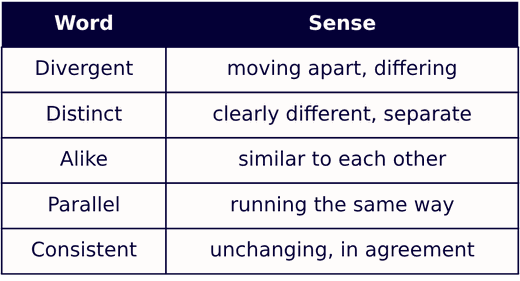 'Alike', 'parallel' and 'consistent' all point to sameness or agreement, the opposite of divergent.
Hence option (a) is correct.
'Alike', 'parallel' and 'consistent' all point to sameness or agreement, the opposite of divergent.
Hence option (a) is correct.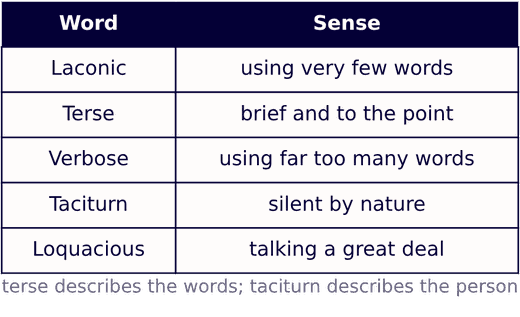 'Taciturn' is the tempting choice, but it describes a person's silent, reserved nature, not the brevity of the words actually spoken.
'Verbose' and 'loquacious' mean wordy and talkative, which is the very opposite of laconic.
Hence option (c) is correct.
'Taciturn' is the tempting choice, but it describes a person's silent, reserved nature, not the brevity of the words actually spoken.
'Verbose' and 'loquacious' mean wordy and talkative, which is the very opposite of laconic.
Hence option (c) is correct.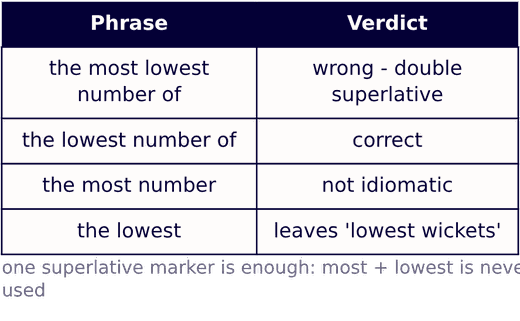 Option (a) keeps the double superlative, (c) 'the most number' is unidiomatic, and (d) would give 'took the lowest wickets', which never says what was low.
Hence option (b) is correct.
Option (a) keeps the double superlative, (c) 'the most number' is unidiomatic, and (d) would give 'took the lowest wickets', which never says what was low.
Hence option (b) is correct.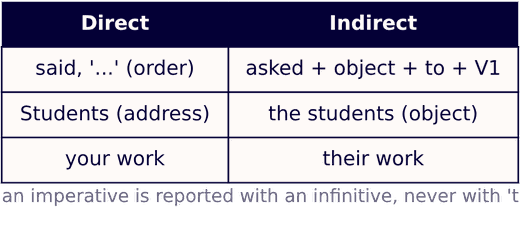 That yields 'The teacher asked the students to finish their work and submit the files by evening.'
Option (b) keeps 'your', option (c) replaces the infinitive with a 'that'-clause, and option (d) puts past forms after 'to'.
Hence option (a) is correct.
That yields 'The teacher asked the students to finish their work and submit the files by evening.'
Option (b) keeps 'your', option (c) replaces the infinitive with a 'that'-clause, and option (d) puts past forms after 'to'.
Hence option (a) is correct.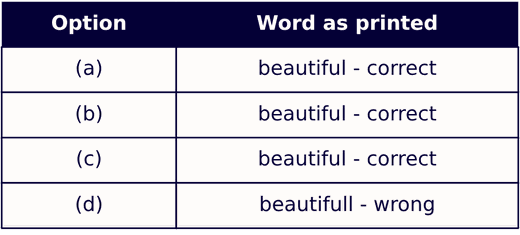 The suffix '-ful' always keeps one 'l' when it is added to a word: careful, useful, hopeful, powerful.
Hence option (d) is correct.
The suffix '-ful' always keeps one 'l' when it is added to a word: careful, useful, hopeful, powerful.
Hence option (d) is correct.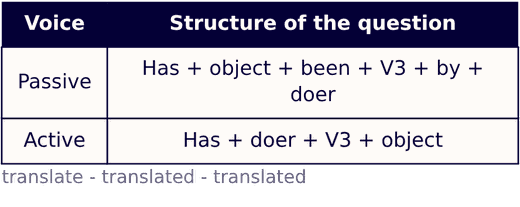 So 'the scholar' moves to the front and the question reads 'Has the scholar translated the ancient manuscript?'
Option (b) is a statement given a question mark, option (c) shifts the tense to simple past, and option (d) is still passive.
Hence option (a) is correct.
So 'the scholar' moves to the front and the question reads 'Has the scholar translated the ancient manuscript?'
Option (b) is a statement given a question mark, option (c) shifts the tense to simple past, and option (d) is still passive.
Hence option (a) is correct.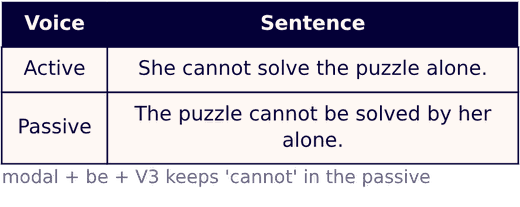 Options (a) and (b) drop the modal and put 'was not' / 'is not' in its place, and option (d) adds a perfect 'have been' that the active sentence does not contain.
Hence option (c) is correct.
Options (a) and (b) drop the modal and put 'was not' / 'is not' in its place, and option (d) adds a perfect 'have been' that the active sentence does not contain.
Hence option (c) is correct.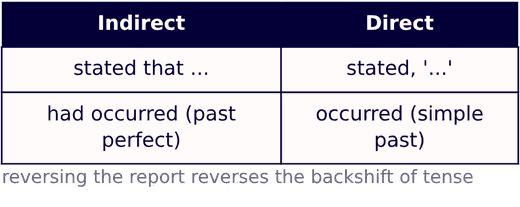 Option (a) turns the verb into a faulty passive, option (c) uses plural 'have' with the singular 'incident', and option (d) makes it continuous and misspells 'occurring'.
Hence option (b) is correct.
Option (a) turns the verb into a faulty passive, option (c) uses plural 'have' with the singular 'incident', and option (d) makes it continuous and misspells 'occurring'.
Hence option (b) is correct.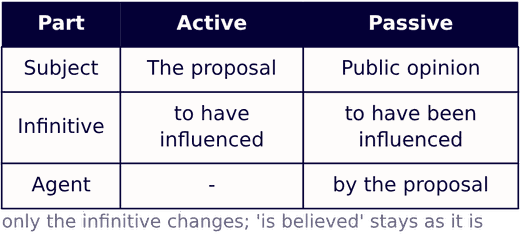 The sentence therefore becomes 'Public opinion is believed to have been influenced significantly by the proposal.'
Option (b) abandons the infinitive and builds a fresh 'It is believed that ...' clause instead of transforming the given structure, option (c) changes the tense to future perfect, and option (d) is ungrammatical.
Hence option (a) is correct.
The sentence therefore becomes 'Public opinion is believed to have been influenced significantly by the proposal.'
Option (b) abandons the infinitive and builds a fresh 'It is believed that ...' clause instead of transforming the given structure, option (c) changes the tense to future perfect, and option (d) is ungrammatical.
Hence option (a) is correct.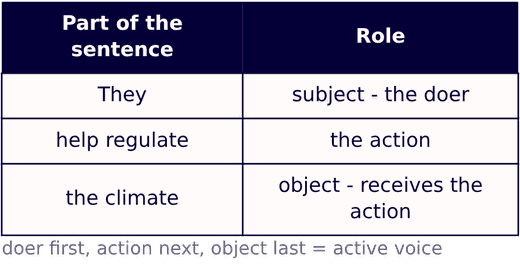 A passive version would have to read 'The climate is regulated ... by them', which is not what the sentence says.
Option (d) also fails because the sentence does carry an object, 'the climate'.
Hence option (a) is correct.
A passive version would have to read 'The climate is regulated ... by them', which is not what the sentence says.
Option (d) also fails because the sentence does carry an object, 'the climate'.
Hence option (a) is correct.