
1
Identify the incorrect sentence.
- A.Homeless are seeking shelter from the cold.
- B.The cat cleaned itself on the rug.
- C.Which house is yours
- D.This is the most difficult puzzle that I have solved.
Solution
Article before adjective
An adjective that names a whole class of people — the poor, the rich, the elderly, the homeless — must carry the definite article 'the' before it, and it then behaves as a plural noun.
Option (a) drops that article, so 'Homeless are seeking shelter from the cold' has no proper subject; it must read 'The homeless are seeking shelter from the cold.'
In (b) the reflexive pronoun 'itself' correctly points back to the subject 'The cat'.
In (c) the word order of the wh-question is right (only the question mark is missing, which is a punctuation slip and not a grammatical error), and in (d) 'the most difficult ... that I have solved' is the standard superlative pattern.
Hence, the incorrect sentence is option (a).
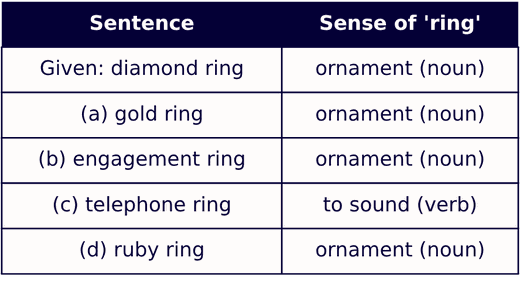 In option (c) 'ring' is a verb — the sound a telephone makes — so it is a true homonym of the given word.
In (a), (b) and (d) 'ring' is once again the ornament, that is, the very same meaning, so no homonym appears there.
Hence, option (c) is the most appropriate answer.
In option (c) 'ring' is a verb — the sound a telephone makes — so it is a true homonym of the given word.
In (a), (b) and (d) 'ring' is once again the ornament, that is, the very same meaning, so no homonym appears there.
Hence, option (c) is the most appropriate answer.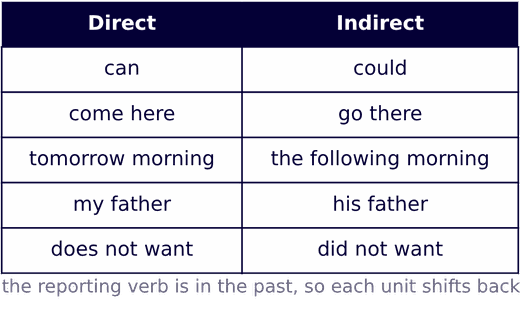 'can' becomes 'could', 'here' becomes 'there' (so 'come' turns into 'go'), 'tomorrow morning' becomes 'the following morning', 'my' becomes 'his', and 'does not want' becomes 'did not want'.
Applying all of these gives: He said that he could go there the following morning if his father did not want him to go for practice.
Option (a) keeps the present modal 'can' and the direct-speech word 'next', while (c) and (d) leave 'does not' unchanged.
Hence, option (b) is the most appropriate answer.
'can' becomes 'could', 'here' becomes 'there' (so 'come' turns into 'go'), 'tomorrow morning' becomes 'the following morning', 'my' becomes 'his', and 'does not want' becomes 'did not want'.
Applying all of these gives: He said that he could go there the following morning if his father did not want him to go for practice.
Option (a) keeps the present modal 'can' and the direct-speech word 'next', while (c) and (d) leave 'does not' unchanged.
Hence, option (b) is the most appropriate answer.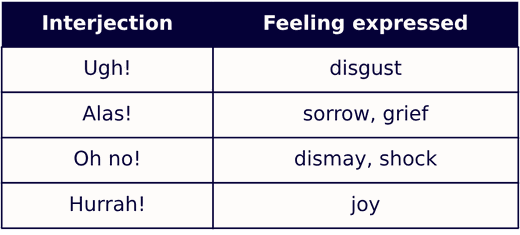 'Ugh!' is the interjection of disgust, whereas 'Alas!' expresses sorrow and 'Oh no!' expresses dismay or shock.
An exclamatory sentence is framed as 'How + adjective + subject + verb', which gives 'How terrible this food tastes!'
Option (d) is written as a question and carries no interjection at all.
Hence, option (b) is the most appropriate answer.
'Ugh!' is the interjection of disgust, whereas 'Alas!' expresses sorrow and 'Oh no!' expresses dismay or shock.
An exclamatory sentence is framed as 'How + adjective + subject + verb', which gives 'How terrible this food tastes!'
Option (d) is written as a question and carries no interjection at all.
Hence, option (b) is the most appropriate answer.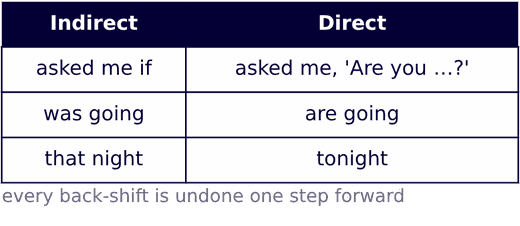 So 'asked me if' becomes the question 'Are you …?', 'was going' returns to 'are going', and 'that night' returns to 'tonight'; the listener 'me' must be kept and the spoken words go inside inverted commas.
This gives: My father asked me, "Are you going to the party tonight?"
Options (b) and (c) leave the verb in the past ('Were you going'), and (d) drops 'me' and keeps the reported time phrase 'that night'.
Hence, option (a) is the most appropriate answer.
So 'asked me if' becomes the question 'Are you …?', 'was going' returns to 'are going', and 'that night' returns to 'tonight'; the listener 'me' must be kept and the spoken words go inside inverted commas.
This gives: My father asked me, "Are you going to the party tonight?"
Options (b) and (c) leave the verb in the past ('Were you going'), and (d) drops 'me' and keeps the reported time phrase 'that night'.
Hence, option (a) is the most appropriate answer.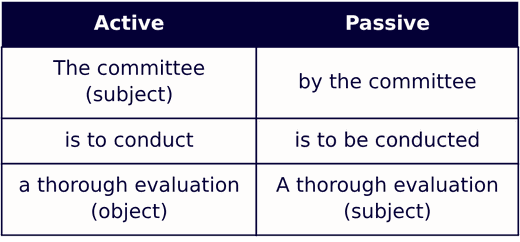 The object of 'conduct' is 'a thorough evaluation of the proposed environmental modifications', so that phrase becomes the subject and the doer moves behind 'by'.
This gives: A thorough evaluation is to be conducted of the proposed environmental modifications by the committee.
Option (b) makes 'the modifications' the subject, so what is conducted silently changes into what is evaluated; (c) replaces 'is to be' with the plain future 'will be'; and (d) is still active at its core, since 'to conduct' is left untouched.
Hence, option (a) is the most appropriate answer.
The object of 'conduct' is 'a thorough evaluation of the proposed environmental modifications', so that phrase becomes the subject and the doer moves behind 'by'.
This gives: A thorough evaluation is to be conducted of the proposed environmental modifications by the committee.
Option (b) makes 'the modifications' the subject, so what is conducted silently changes into what is evaluated; (c) replaces 'is to be' with the plain future 'will be'; and (d) is still active at its core, since 'to conduct' is left untouched.
Hence, option (a) is the most appropriate answer.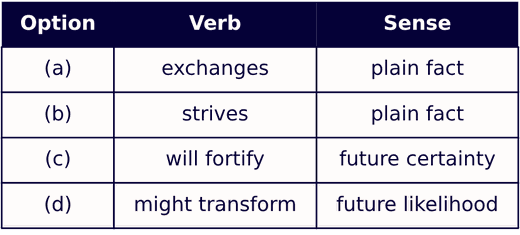 Option (d) contains 'might' in 'the NEP might transform India's learning future', which states a possible future outcome rather than a certain one.
In (c) 'will' expresses certainty, not likelihood, while (a) 'exchanges' and (b) 'strives' are ordinary present-tense main verbs with no helping verb of possibility at all.
Hence, option (d) is the most appropriate answer.
Option (d) contains 'might' in 'the NEP might transform India's learning future', which states a possible future outcome rather than a certain one.
In (c) 'will' expresses certainty, not likelihood, while (a) 'exchanges' and (b) 'strives' are ordinary present-tense main verbs with no helping verb of possibility at all.
Hence, option (d) is the most appropriate answer.