SSC CHSL 21 November 2025 · Shift 2 · English Language — questions with answers · ShikshaSphere
Chapter 100 of 200
21 November 2025 · Shift 2
English Language
25 questions ~25 min readFree
25 questions
A
1
Identify the part of the sentence that contains a grammatical error.
A. Having been a member of the organisation for three years,
B. the elevation to supervisor was
C. surprising but deeply valued
D. by her.
A.Having been a member of the organisation for six years,
B.the elevation to supervisor was
C.surprising but deeply valued
D.by her.
Solution
Dangling participle
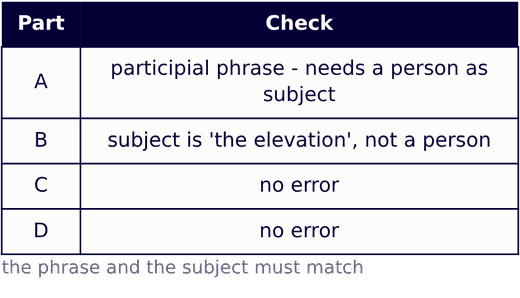
A participial phrase such as 'Having been a member of the organisation for three years' must describe the subject that comes immediately after it.
Here the subject that follows is 'the elevation', but an elevation cannot be a member of an organisation, so the phrase is left dangling.
The person meant is 'she', so part B has to be rewritten as 'she was elevated to supervisor, which was'.
Parts A, C and D contain no error, so the error lies in part B.
Correct sentence: Having been a member of the organisation for three years, she was elevated to supervisor, which was surprising but deeply valued by her.
2
Fill in the blank with the most appropriate preposition:
My teacher is adept in various musical instruments, including the piano and the violin.
A.of
B.in
C.to
D.over
Solution
Preposition with adjective
The blank needs the preposition that regularly follows 'adept' before the field in which somebody is skilled.
'Adept' takes 'in' (or 'at'), exactly like 'skilled in', 'proficient in' and 'experienced in'.
'Of', 'to' and 'over' never combine with 'adept', so they can be ruled out at once.
Correct sentence: My teacher is adept in various musical instruments, including the piano and the violin.
3
Fill in the blank with the most appropriate conjunction:
You will fail in the examination you revise the entire syllabus carefully.
A.or
B.unless
C.yet
D.otherwise
Solution
Conjunction of condition
The blank has to join a consequence — failing in the examination — with the condition that alone can prevent it, revising the syllabus.
'Unless' means 'if … not', so 'unless you revise' is the same as 'if you do not revise', which is exactly the sense required.
'Otherwise' would need the condition to be stated first, as in 'Revise the syllabus carefully, otherwise you will fail'.
'Or' offers an alternative and 'yet' shows contrast, so neither can introduce a condition.
Correct sentence: You will fail in the examination unless you revise the entire syllabus carefully.
4
Select the most appropriate synonym of the word: PARADISAL
A.Pragmatic
B.Utopian
C.Reasonable
D.Rational
Solution
Synonyms
'Paradisal' means resembling paradise — blissfully perfect, ideal, heavenly.
'Utopian' describes an imagined state of ideal perfection, so it carries the same idea of a flawless, dream-like world.
'Pragmatic', 'Reasonable' and 'Rational' all belong to the practical-and-sensible family, which is the opposite pole from dream-like perfection.
Hence, option (b) is the most appropriate answer.
5
Select the incorrectly spelt word from the underlined words in the given sentence.
The troups listened in silence as the colonel explained the strategy and gave final instructions before the military operation began.
A.troups
B.colonel
C.strategy
D.instructions
Solution
Spelling
Of the four underlined words only 'troups' is misspelt.
The correct spelling is 'troops', meaning a body of soldiers; the look-alike word 'troupe' (with -e) means a company of performers and is not intended here.
'Colonel', 'strategy' and 'instructions' are all spelt correctly.
Hence, option (a) is the incorrectly spelt word.
6
Select the most appropriate antonym of the word: Negligible
A.Petty
B.Slight
C.Principal
D.Ordinary
Solution
Antonyms
'Negligible' means so small or unimportant that it can safely be ignored.
Its opposite must therefore mean 'chief, first in importance', and that is 'Principal'.
'Petty', 'Slight' and 'Ordinary' all keep the sense of small or unremarkable, so they are near-synonyms of negligible, not antonyms.
Hence, option (c) is the most appropriate answer.
7
Define the term: Philologist.
A.a person who writes the words to a popular song or musical.
B.a person who composes the sequence of steps and moves for a performance of dance.
C.a person who studies the history of languages.
D.a person whose job is to document words and their definitions systematically.
Solution
One-word substitution
The root 'philo-' means love and 'logos' means word or language, so a philologist is literally a lover of words.
Philology is the study of languages and of the way they have developed over time, which is what option (c) describes.
The other three definitions belong to a lyricist, a choreographer and a lexicographer respectively.
Hence, option (c) is the most appropriate answer.
8
Choose the most suitable option to replace the highlighted part of the sentence:
Amit makes hardly only effort.
A.hardly any effort
B.any hardly effort
C.effort hardly any
D.effort not hardly
Solution
Negative adverb 'hardly'
'Hardly' is itself a negative adverb, meaning 'almost not', and the determiner used after a negative is 'any', never 'only'.
So 'hardly any effort' gives the required sense — Amit makes almost no effort.
The order must stay adverb + determiner + noun, which rules out 'any hardly effort', 'effort hardly any' and 'effort not hardly'.
Correct sentence: Amit makes hardly any effort.
9
Select the most appropriate antonym of the word: EXUBERANT
A.Lively
B.Gloomy
C.Energetic
D.Merry
Solution
Antonyms
'Exuberant' means overflowing with high spirits, energy and cheerfulness.
The exact reverse of that cheerfulness is 'Gloomy' — dark, dejected and low in spirits.
'Lively', 'Energetic' and 'Merry' merely repeat the sense of exuberant, so they are synonyms and cannot be the answer.
Hence, option (b) is the most appropriate answer.
10
Choose the option that is the most appropriate conversion of the following sentence into Direct Speech.
She said that while she had been reading a novel, her tablet unexpectedly turned off.
A.She said, "While I read the novel, my tablet unexpectedly turned off."
B.She said, "While I was reading the novel, my tablet unexpectedly turned off."
C.She said, "While I am reading the novel, my tablet unexpectedly turned off."
D.She said, "While I had been reading the novel, my tablet had turned off."
Solution
Direct speech
To go back from indirect to direct speech the backshift of tense is undone and the pronouns return to the speaker's own point of view.
The reported past perfect continuous 'she had been reading' comes from the past continuous 'I was reading', and 'her tablet' becomes 'my tablet'.
So the speaker's actual words were: While I was reading the novel, my tablet unexpectedly turned off.
Options (a) and (c) use the wrong tense, and (d) keeps the backshifted forms and drops 'unexpectedly'.
Hence, option (b) is the most appropriate answer.
11
Select the incorrectly spelt word.
A.increasing
B.accumalating
C.gathering
D.cumulative
Solution
Spelling
'Accumalating' is misspelt; the correct spelling is 'accumulating'.
The verb comes from Latin 'cumulus', a heap, so the vowel is u and not a — accumulate, accumulation, cumulative.
'Increasing', 'gathering' and 'cumulative' are all spelt correctly.
Hence, option (b) is the incorrectly spelt word.
12
Change the following sentence into the Active form.
Are the old electronics expected to be repaired immediately in all the homes?
A.Are they expecting to repair the old electronics immediately in all the homes?
B.Are the old electronics repairing immediately in all the homes?
C.Do they expect to repair the old electronics immediately in all the homes?
D.They expect to repair the old electronics immediately in all the homes?
Solution
Passive to active voice
In 'Are the old electronics expected to be repaired …?' the doer is not named, so in the active form the understood doer 'they' becomes the subject.
The simple present passive 'are … expected' turns into the simple present active 'do … expect', because the sentence is a question.
The passive infinitive 'to be repaired' likewise turns into the active infinitive 'to repair'.
So the active form is: Do they expect to repair the old electronics immediately in all the homes?
Hence, option (c) is the most appropriate answer.
13
Select the option that expresses the given sentence in indirect voice.
Her sister said, "I will support you in your journey."
A.Her sister said that she would support me in my journey.
B.Her sister said that she will support me in my journey.
C.Her sister said that she would have supported me in my journey.
D.Her sister said that she supported me in my journey.
Solution
Indirect speech
The reporting verb 'said' is in the past tense, so the reported clause must be backshifted by one tense.
'Will' becomes 'would', the speaker's 'I' becomes 'she' and the listener's 'you' becomes 'me', with 'your journey' becoming 'my journey'.
So the sentence reads: Her sister said that she would support me in my journey.
Option (b) leaves 'will' unchanged, (c) changes the meaning to an action that never happened, and (d) drops the modal altogether.
Hence, option (a) is the most appropriate answer.
14
Choose the most suitable option to replace the highlighted part of the sentence:
A sweet course, like cake, ice cream, or fruit, served at the end of a meal is called a dinner.
A.diner
B.dessert
C.daisy
D.desert
Solution
Confusing words
The sentence defines a sweet course served at the end of a meal, and the exact word for that is 'dessert'.
'Dinner' names the whole evening meal, not the sweet course, so the highlighted word has to be replaced.
Watch the spelling: 'dessert' with two s's is the sweet dish, while 'desert' with one s is a dry sandy region.
Correct sentence: A sweet course, like cake, ice cream, or fruit, served at the end of a meal is called a dessert.
15
Choose the correct passive voice transformation of the sentence:
Who published the novel?
A.By whom was the novel published?
B.Who was the novel published by?
C.The novel was published by whom?
D.By whom the novel was published?
Solution
Passive voice of questions
In 'Who published the novel?' the word 'who' is the subject, and a subject-'who' becomes 'by whom' in the passive.
The object 'the novel' becomes the new subject and the past-tense verb becomes 'was published'.
A question must still keep the helping verb before the subject, giving 'By whom was the novel published?'
Option (d) leaves 'was' after the subject, (b) uses 'who' where the preposition demands 'whom', and (c) keeps statement order.
Hence, option (a) is the most appropriate answer.
16
Directions (Qs. 16-20): Read the following passage carefully and answer the questions that follow.
In recent years, many urban professionals across different sectors have begun to experience rising levels of mental fatigue due to prolonged screen exposure, constant connectivity, and performance-driven environments. The expectation to remain productive at all hours has subtly reshaped work habits, often at the cost of adequate rest and recovery. While technological tools have improved efficiency, they have also increased psychological pressure by shortening response times and blurring personal boundaries.
Many individuals have started waking early each day, checking notifications repeatedly, skipping regular breaks deliberately, and struggling continuously to maintain mental focus.
The deleterious consequences of this lifestyle are becoming increasingly visible, particularly among younger professionals who struggle to balance ambition with well-being. Irregular sleep patterns, reduced physical activity, and persistent anxiety have emerged as common concerns. Despite awareness campaigns, conversations around mental health remain limited, preventing many from seeking timely support.
Experts argue that this situation should be treated as a clarion call for organisations and individuals alike to reassess priorities. Sustainable work practices, realistic expectations, and open dialogue around mental health are essential to prevent long-term damage to both productivity and quality of life.
Identify the voice of the verb phrase in the sentence:
"The expectation to remain productive at all hours has reshaped work habits."
A.Active voice
B.Passive voice
C.Causative voice
D.Imperative mood
Solution
Voice identification
The verb phrase in the sentence is 'has reshaped', a present perfect form made of 'has' + past participle only.
A passive would need a form of 'be' before the past participle, as in 'work habits have been reshaped by the expectation'.
Here the subject, 'The expectation to remain productive at all hours', is itself the doer and 'work habits' is the object acted upon.
Hence, the verb phrase is in the active voice, option (a).
17
Directions (Qs. 16-20): Read the following passage carefully and answer the questions that follow.
In recent years, many urban professionals across different sectors have begun to experience rising levels of mental fatigue due to prolonged screen exposure, constant connectivity, and performance-driven environments. The expectation to remain productive at all hours has subtly reshaped work habits, often at the cost of adequate rest and recovery. While technological tools have improved efficiency, they have also increased psychological pressure by shortening response times and blurring personal boundaries.
Many individuals have started waking early each day, checking notifications repeatedly, skipping regular breaks deliberately, and struggling continuously to maintain mental focus.
The deleterious consequences of this lifestyle are becoming increasingly visible, particularly among younger professionals who struggle to balance ambition with well-being. Irregular sleep patterns, reduced physical activity, and persistent anxiety have emerged as common concerns. Despite awareness campaigns, conversations around mental health remain limited, preventing many from seeking timely support.
Experts argue that this situation should be treated as a clarion call for organisations and individuals alike to reassess priorities. Sustainable work practices, realistic expectations, and open dialogue around mental health are essential to prevent long-term damage to both productivity and quality of life.
"Many individuals have started waking early each day, checking notifications repeatedly, skipping regular breaks deliberately, and struggling continuously to maintain mental focus." In the above sentence, identify the finite verb(s):
A.started
B.checking
C.skipping
D.struggling
Solution
Finite and non-finite verbs
A finite verb changes with the subject and carries the tense of the clause; a non-finite verb — infinitive, gerund or participle — does neither.
The only verb here tied to the subject 'Many individuals' and to the present perfect tense is 'have started', and among the options that is 'started'.
'Checking', 'skipping' and 'struggling' are -ing participles that simply continue the list begun by 'waking', so they are non-finite.
A quick test: change the subject to 'One individual' and only 'have started' changes, to 'has started'.
Hence, option (a) is the most appropriate answer.
18
Directions (Qs. 16-20): Read the following passage carefully and answer the questions that follow.
In recent years, many urban professionals across different sectors have begun to experience rising levels of mental fatigue due to prolonged screen exposure, constant connectivity, and performance-driven environments. The expectation to remain productive at all hours has subtly reshaped work habits, often at the cost of adequate rest and recovery. While technological tools have improved efficiency, they have also increased psychological pressure by shortening response times and blurring personal boundaries.
Many individuals have started waking early each day, checking notifications repeatedly, skipping regular breaks deliberately, and struggling continuously to maintain mental focus.
The deleterious consequences of this lifestyle are becoming increasingly visible, particularly among younger professionals who struggle to balance ambition with well-being. Irregular sleep patterns, reduced physical activity, and persistent anxiety have emerged as common concerns. Despite awareness campaigns, conversations around mental health remain limited, preventing many from seeking timely support.
Experts argue that this situation should be treated as a clarion call for organisations and individuals alike to reassess priorities. Sustainable work practices, realistic expectations, and open dialogue around mental health are essential to prevent long-term damage to both productivity and quality of life.
Select the most appropriate meaning of the word 'deleterious'.
A.Advantageous
B.Adverse
C.Temporary
D.Uncertain
Solution
Vocabulary in context
'Deleterious' means causing harm or damage, and the passage uses it for the harmful consequences of the always-connected lifestyle.
'Adverse' means unfavourable or harmful in effect, so it matches that sense exactly.
'Advantageous' is the opposite, while 'Temporary' and 'Uncertain' speak of duration and predictability, not of harm.
Hence, option (b) is the most appropriate answer.
19
Directions (Qs. 16-20): Read the following passage carefully and answer the questions that follow.
In recent years, many urban professionals across different sectors have begun to experience rising levels of mental fatigue due to prolonged screen exposure, constant connectivity, and performance-driven environments. The expectation to remain productive at all hours has subtly reshaped work habits, often at the cost of adequate rest and recovery. While technological tools have improved efficiency, they have also increased psychological pressure by shortening response times and blurring personal boundaries.
Many individuals have started waking early each day, checking notifications repeatedly, skipping regular breaks deliberately, and struggling continuously to maintain mental focus.
The deleterious consequences of this lifestyle are becoming increasingly visible, particularly among younger professionals who struggle to balance ambition with well-being. Irregular sleep patterns, reduced physical activity, and persistent anxiety have emerged as common concerns. Despite awareness campaigns, conversations around mental health remain limited, preventing many from seeking timely support.
Experts argue that this situation should be treated as a clarion call for organisations and individuals alike to reassess priorities. Sustainable work practices, realistic expectations, and open dialogue around mental health are essential to prevent long-term damage to both productivity and quality of life.
Which of the following options can replace the phrase "a clarion call" in the sentence:
Experts argue that this situation should be treated as a clarion call for organisations and individuals alike to reassess priorities.
A.A mild recommendation
B.A strong and urgent appeal
C.A confusing message
D.A delayed response
Solution
Idiomatic phrase
A 'clarion' was a shrill war-trumpet, so a 'clarion call' is a loud, ringing summons to act at once.
In the sentence the experts want organisations and individuals to reassess their priorities without delay, so the phrase means a strong and urgent appeal.
'A mild recommendation' is far too weak, and 'a confusing message' and 'a delayed response' contradict the clarity and urgency of a trumpet call.
Hence, option (b) is the most appropriate answer.
20
Directions (Qs. 16-20): Read the following passage carefully and answer the questions that follow.
In recent years, many urban professionals across different sectors have begun to experience rising levels of mental fatigue due to prolonged screen exposure, constant connectivity, and performance-driven environments. The expectation to remain productive at all hours has subtly reshaped work habits, often at the cost of adequate rest and recovery. While technological tools have improved efficiency, they have also increased psychological pressure by shortening response times and blurring personal boundaries.
Many individuals have started waking early each day, checking notifications repeatedly, skipping regular breaks deliberately, and struggling continuously to maintain mental focus.
The deleterious consequences of this lifestyle are becoming increasingly visible, particularly among younger professionals who struggle to balance ambition with well-being. Irregular sleep patterns, reduced physical activity, and persistent anxiety have emerged as common concerns. Despite awareness campaigns, conversations around mental health remain limited, preventing many from seeking timely support.
Experts argue that this situation should be treated as a clarion call for organisations and individuals alike to reassess priorities. Sustainable work practices, realistic expectations, and open dialogue around mental health are essential to prevent long-term damage to both productivity and quality of life.
According to the passage, which factor contributes to professional fatigue?
A.Shortened response expectations
B.Improved leisure facilities
C.Reduced use of technology
D.Fixed working hours
Solution
Reading comprehension
The first paragraph says that technological tools 'have also increased psychological pressure by shortening response times and blurring personal boundaries'.
Shorter response times mean the professional is expected to reply at once, and that unbroken pressure is what builds up into mental fatigue.
Improved leisure facilities and fixed working hours are nowhere mentioned, and the passage describes more use of technology, not less.
Hence, option (a) is the most appropriate answer.
21
Rearrange the following sentence parts to form a meaningful and grammatically correct paragraph:
P: The technician prepared a thin section of the specimen and placed it on a clean slide.
Q: A drop of dye was applied to highlight the structures clearly.
R: A transparent cover was gently lowered to secure the sample.
S: The prepared slide was then positioned under the lens for observation.
A.S, Q, P, R
B.P, Q, R, S
C.R, Q, P, S
D.Q, P, R, S
Solution
Para jumble
The paragraph describes the steps of preparing a microscope slide, so the parts must follow the order in which the work is actually done.
P is the opening step: the thin section is cut and placed on a clean slide, and it is the only part that introduces 'the specimen' and 'a clean slide'.
Q comes next, because the dye can be applied only after the section is already lying on the slide.
R follows, since the transparent cover is lowered on to the stained section to hold it in place.
S is the closing step, because 'The prepared slide' points back to everything done in P, Q and R.
Hence the correct sequence is P, Q, R, S.
22
Rearrange the following sentences to form a meaningful and grammatically correct paragraph:
P: The humanoid designed to solve a complex problem became the team's final project.
Q: Over several weeks, the necessary algorithms were carefully developed and tested.
R: Their skills in analysis, coding, and design merged to bring the project to life.
S: The successful outcome reflected their dedication and collaborative effort.
A.Q, R, P, S
B.R, Q, P, S
C.S, R, Q, P
D.P, R, Q, S
Solution
Sentence rearrangement
Only P can begin the paragraph, because it names the humanoid and the team's final project; R, Q and S all refer back to something already introduced.
R follows P: 'Their skills in analysis, coding, and design merged to bring the project to life' tells how the team took up the project just named.
Q then gives the detail of that work — over several weeks the necessary algorithms were developed and tested.
S closes the paragraph by judging the result: 'The successful outcome reflected their dedication'.
Hence the correct sequence is P, R, Q, S.
23
Which word is nearest in meaning to buyer?
A.Chief
B.Familiar
C.Opponent
D.Patron
Solution
Synonym
'Buyer' means a person who purchases goods or services, that is, a customer.
'Patron' means a customer of a shop or a restaurant, especially a regular one, so it is nearest in meaning to 'buyer'.
'Chief' means a leader, 'familiar' means well known, and 'opponent' means a rival — none of them has anything to do with purchasing.
Hence 'Patron' is the correct answer.
24
Fill in the blanks using the correct homonym of the words given in brackets. He decided to (right) a detailed report, even though the long process began to (boar) him after a while.
A.riot, bore
B.rite, boor
C.write, bore
D.rite, bore
Solution
Homonyms
Homonyms sound alike but differ in spelling and meaning, so each blank needs the word that sounds like the one in brackets and also fits the sense.
'Right' sounds like 'write', and a report is 'written', so the first blank takes 'write'.
'Boar' (a wild pig) sounds like 'bore', which means to make somebody lose interest, so the second blank takes 'bore'.
'Rite' means a religious ceremony and 'boor' means a rude person, so options (a), (b) and (d) do not fit.
Correct sentence: He decided to write a detailed report, even though the long process began to bore him after a while.
25
Select the correct definition of oligarchy
A.A system of government by one person with absolute power
B.A small group of people that control a government or society
C.A state of lawlessness or political disorder due to the absence or non-recognition of authority
D.A form of government where religious leaders rule in the name of God.
Solution
Word definition
'Oligarchy' comes from the Greek 'oligos' (few) and 'arkhein' (to rule), so it means rule by a few.
Hence the correct definition is 'a small group of people that control a government or society'.
Rule by one person with absolute power is autocracy, disorder caused by the absence of authority is anarchy, and rule by religious leaders in the name of God is theocracy.
Finished reading? Now test yourself.
The same 25 questions, but with a timer and the answers hidden — 15 minutes.

 Here the subject that follows is 'the elevation', but an elevation cannot be a member of an organisation, so the phrase is left dangling.
The person meant is 'she', so part B has to be rewritten as 'she was elevated to supervisor, which was'.
Parts A, C and D contain no error, so the error lies in part B.
Correct sentence: Having been a member of the organisation for three years, she was elevated to supervisor, which was surprising but deeply valued by her.
Here the subject that follows is 'the elevation', but an elevation cannot be a member of an organisation, so the phrase is left dangling.
The person meant is 'she', so part B has to be rewritten as 'she was elevated to supervisor, which was'.
Parts A, C and D contain no error, so the error lies in part B.
Correct sentence: Having been a member of the organisation for three years, she was elevated to supervisor, which was surprising but deeply valued by her.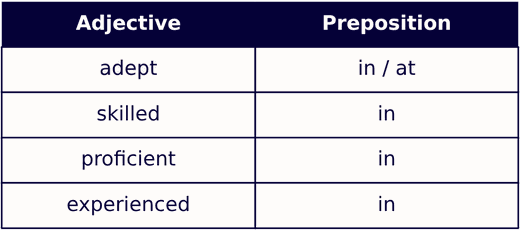 'Adept' takes 'in' (or 'at'), exactly like 'skilled in', 'proficient in' and 'experienced in'.
'Of', 'to' and 'over' never combine with 'adept', so they can be ruled out at once.
Correct sentence: My teacher is adept in various musical instruments, including the piano and the violin.
'Adept' takes 'in' (or 'at'), exactly like 'skilled in', 'proficient in' and 'experienced in'.
'Of', 'to' and 'over' never combine with 'adept', so they can be ruled out at once.
Correct sentence: My teacher is adept in various musical instruments, including the piano and the violin.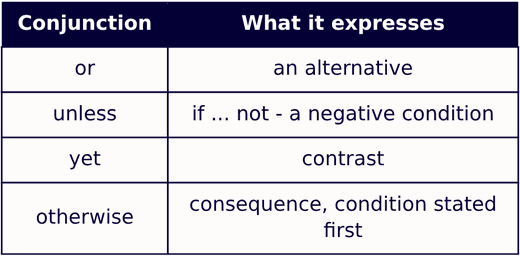 'Unless' means 'if … not', so 'unless you revise' is the same as 'if you do not revise', which is exactly the sense required.
'Otherwise' would need the condition to be stated first, as in 'Revise the syllabus carefully, otherwise you will fail'.
'Or' offers an alternative and 'yet' shows contrast, so neither can introduce a condition.
Correct sentence: You will fail in the examination unless you revise the entire syllabus carefully.
'Unless' means 'if … not', so 'unless you revise' is the same as 'if you do not revise', which is exactly the sense required.
'Otherwise' would need the condition to be stated first, as in 'Revise the syllabus carefully, otherwise you will fail'.
'Or' offers an alternative and 'yet' shows contrast, so neither can introduce a condition.
Correct sentence: You will fail in the examination unless you revise the entire syllabus carefully.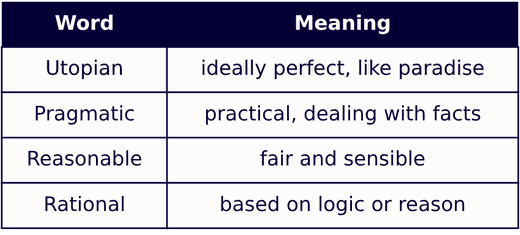 'Utopian' describes an imagined state of ideal perfection, so it carries the same idea of a flawless, dream-like world.
'Pragmatic', 'Reasonable' and 'Rational' all belong to the practical-and-sensible family, which is the opposite pole from dream-like perfection.
Hence, option (b) is the most appropriate answer.
'Utopian' describes an imagined state of ideal perfection, so it carries the same idea of a flawless, dream-like world.
'Pragmatic', 'Reasonable' and 'Rational' all belong to the practical-and-sensible family, which is the opposite pole from dream-like perfection.
Hence, option (b) is the most appropriate answer.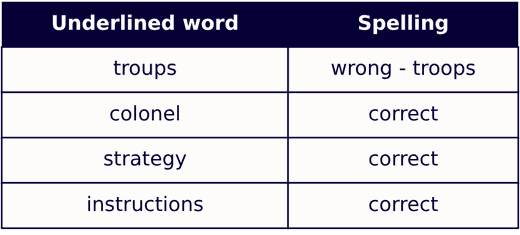 The correct spelling is 'troops', meaning a body of soldiers; the look-alike word 'troupe' (with -e) means a company of performers and is not intended here.
'Colonel', 'strategy' and 'instructions' are all spelt correctly.
Hence, option (a) is the incorrectly spelt word.
The correct spelling is 'troops', meaning a body of soldiers; the look-alike word 'troupe' (with -e) means a company of performers and is not intended here.
'Colonel', 'strategy' and 'instructions' are all spelt correctly.
Hence, option (a) is the incorrectly spelt word.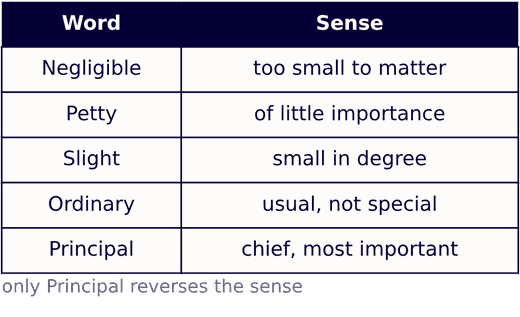 Its opposite must therefore mean 'chief, first in importance', and that is 'Principal'.
'Petty', 'Slight' and 'Ordinary' all keep the sense of small or unremarkable, so they are near-synonyms of negligible, not antonyms.
Hence, option (c) is the most appropriate answer.
Its opposite must therefore mean 'chief, first in importance', and that is 'Principal'.
'Petty', 'Slight' and 'Ordinary' all keep the sense of small or unremarkable, so they are near-synonyms of negligible, not antonyms.
Hence, option (c) is the most appropriate answer.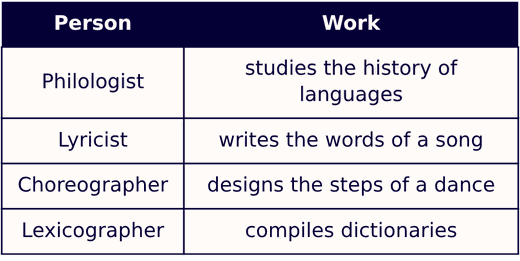 Philology is the study of languages and of the way they have developed over time, which is what option (c) describes.
The other three definitions belong to a lyricist, a choreographer and a lexicographer respectively.
Hence, option (c) is the most appropriate answer.
Philology is the study of languages and of the way they have developed over time, which is what option (c) describes.
The other three definitions belong to a lyricist, a choreographer and a lexicographer respectively.
Hence, option (c) is the most appropriate answer.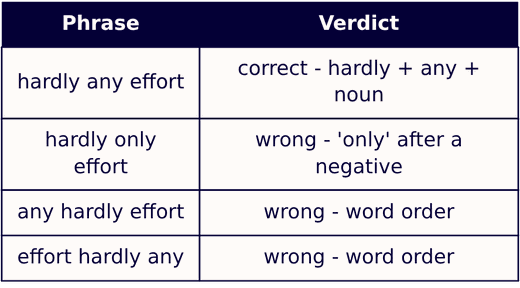 So 'hardly any effort' gives the required sense — Amit makes almost no effort.
The order must stay adverb + determiner + noun, which rules out 'any hardly effort', 'effort hardly any' and 'effort not hardly'.
Correct sentence: Amit makes hardly any effort.
So 'hardly any effort' gives the required sense — Amit makes almost no effort.
The order must stay adverb + determiner + noun, which rules out 'any hardly effort', 'effort hardly any' and 'effort not hardly'.
Correct sentence: Amit makes hardly any effort.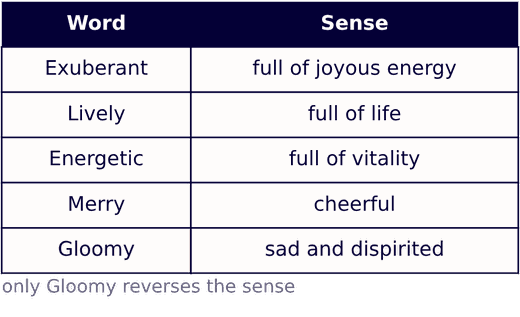 The exact reverse of that cheerfulness is 'Gloomy' — dark, dejected and low in spirits.
'Lively', 'Energetic' and 'Merry' merely repeat the sense of exuberant, so they are synonyms and cannot be the answer.
Hence, option (b) is the most appropriate answer.
The exact reverse of that cheerfulness is 'Gloomy' — dark, dejected and low in spirits.
'Lively', 'Energetic' and 'Merry' merely repeat the sense of exuberant, so they are synonyms and cannot be the answer.
Hence, option (b) is the most appropriate answer.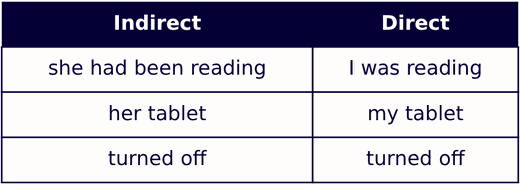 The reported past perfect continuous 'she had been reading' comes from the past continuous 'I was reading', and 'her tablet' becomes 'my tablet'.
So the speaker's actual words were: While I was reading the novel, my tablet unexpectedly turned off.
Options (a) and (c) use the wrong tense, and (d) keeps the backshifted forms and drops 'unexpectedly'.
Hence, option (b) is the most appropriate answer.
The reported past perfect continuous 'she had been reading' comes from the past continuous 'I was reading', and 'her tablet' becomes 'my tablet'.
So the speaker's actual words were: While I was reading the novel, my tablet unexpectedly turned off.
Options (a) and (c) use the wrong tense, and (d) keeps the backshifted forms and drops 'unexpectedly'.
Hence, option (b) is the most appropriate answer.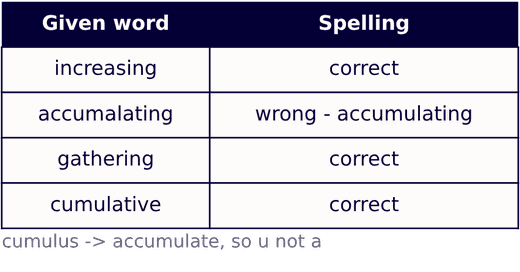 The verb comes from Latin 'cumulus', a heap, so the vowel is u and not a — accumulate, accumulation, cumulative.
'Increasing', 'gathering' and 'cumulative' are all spelt correctly.
Hence, option (b) is the incorrectly spelt word.
The verb comes from Latin 'cumulus', a heap, so the vowel is u and not a — accumulate, accumulation, cumulative.
'Increasing', 'gathering' and 'cumulative' are all spelt correctly.
Hence, option (b) is the incorrectly spelt word.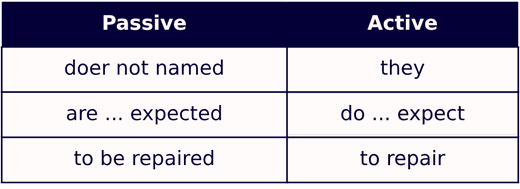 The simple present passive 'are … expected' turns into the simple present active 'do … expect', because the sentence is a question.
The passive infinitive 'to be repaired' likewise turns into the active infinitive 'to repair'.
So the active form is: Do they expect to repair the old electronics immediately in all the homes?
Hence, option (c) is the most appropriate answer.
The simple present passive 'are … expected' turns into the simple present active 'do … expect', because the sentence is a question.
The passive infinitive 'to be repaired' likewise turns into the active infinitive 'to repair'.
So the active form is: Do they expect to repair the old electronics immediately in all the homes?
Hence, option (c) is the most appropriate answer.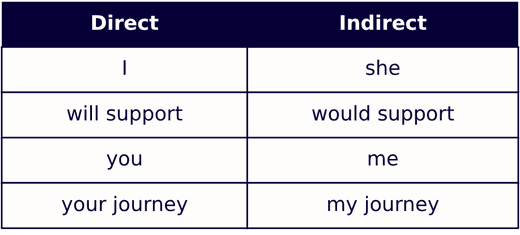 'Will' becomes 'would', the speaker's 'I' becomes 'she' and the listener's 'you' becomes 'me', with 'your journey' becoming 'my journey'.
So the sentence reads: Her sister said that she would support me in my journey.
Option (b) leaves 'will' unchanged, (c) changes the meaning to an action that never happened, and (d) drops the modal altogether.
Hence, option (a) is the most appropriate answer.
'Will' becomes 'would', the speaker's 'I' becomes 'she' and the listener's 'you' becomes 'me', with 'your journey' becoming 'my journey'.
So the sentence reads: Her sister said that she would support me in my journey.
Option (b) leaves 'will' unchanged, (c) changes the meaning to an action that never happened, and (d) drops the modal altogether.
Hence, option (a) is the most appropriate answer.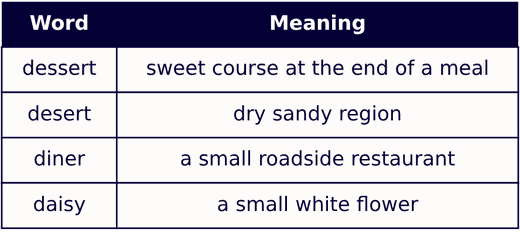 'Dinner' names the whole evening meal, not the sweet course, so the highlighted word has to be replaced.
Watch the spelling: 'dessert' with two s's is the sweet dish, while 'desert' with one s is a dry sandy region.
Correct sentence: A sweet course, like cake, ice cream, or fruit, served at the end of a meal is called a dessert.
'Dinner' names the whole evening meal, not the sweet course, so the highlighted word has to be replaced.
Watch the spelling: 'dessert' with two s's is the sweet dish, while 'desert' with one s is a dry sandy region.
Correct sentence: A sweet course, like cake, ice cream, or fruit, served at the end of a meal is called a dessert.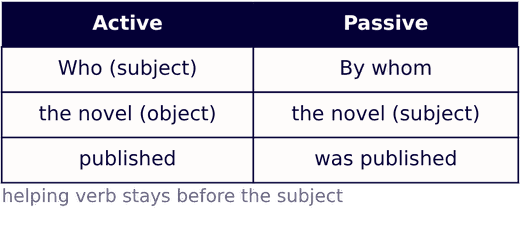 The object 'the novel' becomes the new subject and the past-tense verb becomes 'was published'.
A question must still keep the helping verb before the subject, giving 'By whom was the novel published?'
Option (d) leaves 'was' after the subject, (b) uses 'who' where the preposition demands 'whom', and (c) keeps statement order.
Hence, option (a) is the most appropriate answer.
The object 'the novel' becomes the new subject and the past-tense verb becomes 'was published'.
A question must still keep the helping verb before the subject, giving 'By whom was the novel published?'
Option (d) leaves 'was' after the subject, (b) uses 'who' where the preposition demands 'whom', and (c) keeps statement order.
Hence, option (a) is the most appropriate answer.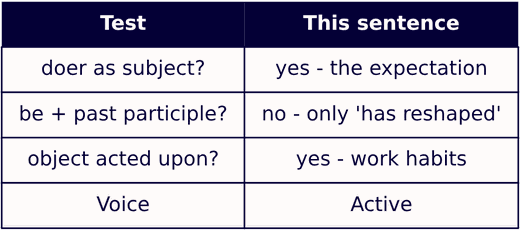 A passive would need a form of 'be' before the past participle, as in 'work habits have been reshaped by the expectation'.
Here the subject, 'The expectation to remain productive at all hours', is itself the doer and 'work habits' is the object acted upon.
Hence, the verb phrase is in the active voice, option (a).
A passive would need a form of 'be' before the past participle, as in 'work habits have been reshaped by the expectation'.
Here the subject, 'The expectation to remain productive at all hours', is itself the doer and 'work habits' is the object acted upon.
Hence, the verb phrase is in the active voice, option (a).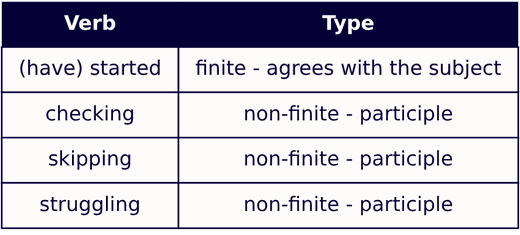 The only verb here tied to the subject 'Many individuals' and to the present perfect tense is 'have started', and among the options that is 'started'.
'Checking', 'skipping' and 'struggling' are -ing participles that simply continue the list begun by 'waking', so they are non-finite.
A quick test: change the subject to 'One individual' and only 'have started' changes, to 'has started'.
Hence, option (a) is the most appropriate answer.
The only verb here tied to the subject 'Many individuals' and to the present perfect tense is 'have started', and among the options that is 'started'.
'Checking', 'skipping' and 'struggling' are -ing participles that simply continue the list begun by 'waking', so they are non-finite.
A quick test: change the subject to 'One individual' and only 'have started' changes, to 'has started'.
Hence, option (a) is the most appropriate answer.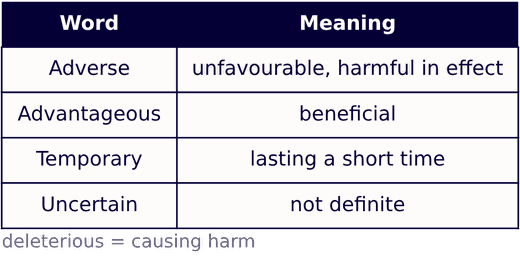 'Adverse' means unfavourable or harmful in effect, so it matches that sense exactly.
'Advantageous' is the opposite, while 'Temporary' and 'Uncertain' speak of duration and predictability, not of harm.
Hence, option (b) is the most appropriate answer.
'Adverse' means unfavourable or harmful in effect, so it matches that sense exactly.
'Advantageous' is the opposite, while 'Temporary' and 'Uncertain' speak of duration and predictability, not of harm.
Hence, option (b) is the most appropriate answer.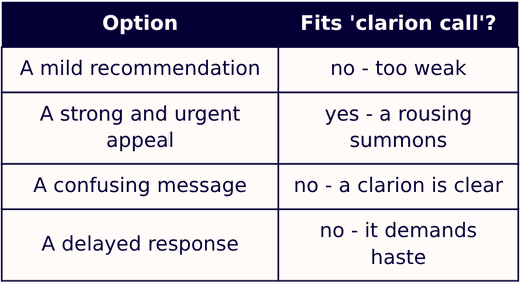 In the sentence the experts want organisations and individuals to reassess their priorities without delay, so the phrase means a strong and urgent appeal.
'A mild recommendation' is far too weak, and 'a confusing message' and 'a delayed response' contradict the clarity and urgency of a trumpet call.
Hence, option (b) is the most appropriate answer.
In the sentence the experts want organisations and individuals to reassess their priorities without delay, so the phrase means a strong and urgent appeal.
'A mild recommendation' is far too weak, and 'a confusing message' and 'a delayed response' contradict the clarity and urgency of a trumpet call.
Hence, option (b) is the most appropriate answer.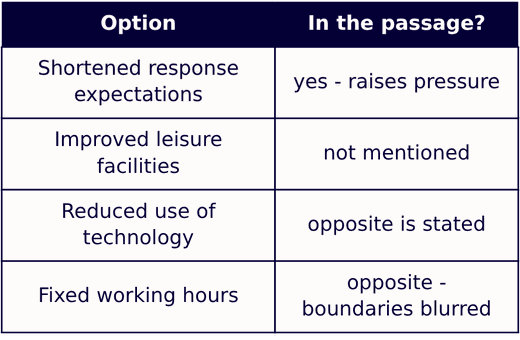 Shorter response times mean the professional is expected to reply at once, and that unbroken pressure is what builds up into mental fatigue.
Improved leisure facilities and fixed working hours are nowhere mentioned, and the passage describes more use of technology, not less.
Hence, option (a) is the most appropriate answer.
Shorter response times mean the professional is expected to reply at once, and that unbroken pressure is what builds up into mental fatigue.
Improved leisure facilities and fixed working hours are nowhere mentioned, and the passage describes more use of technology, not less.
Hence, option (a) is the most appropriate answer.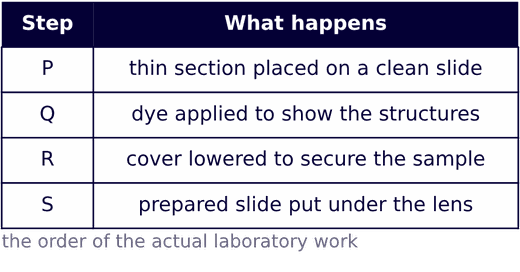 P is the opening step: the thin section is cut and placed on a clean slide, and it is the only part that introduces 'the specimen' and 'a clean slide'.
Q comes next, because the dye can be applied only after the section is already lying on the slide.
R follows, since the transparent cover is lowered on to the stained section to hold it in place.
S is the closing step, because 'The prepared slide' points back to everything done in P, Q and R.
Hence the correct sequence is P, Q, R, S.
P is the opening step: the thin section is cut and placed on a clean slide, and it is the only part that introduces 'the specimen' and 'a clean slide'.
Q comes next, because the dye can be applied only after the section is already lying on the slide.
R follows, since the transparent cover is lowered on to the stained section to hold it in place.
S is the closing step, because 'The prepared slide' points back to everything done in P, Q and R.
Hence the correct sequence is P, Q, R, S.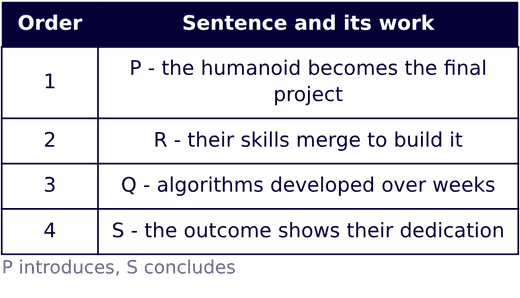 R follows P: 'Their skills in analysis, coding, and design merged to bring the project to life' tells how the team took up the project just named.
Q then gives the detail of that work — over several weeks the necessary algorithms were developed and tested.
S closes the paragraph by judging the result: 'The successful outcome reflected their dedication'.
Hence the correct sequence is P, R, Q, S.
R follows P: 'Their skills in analysis, coding, and design merged to bring the project to life' tells how the team took up the project just named.
Q then gives the detail of that work — over several weeks the necessary algorithms were developed and tested.
S closes the paragraph by judging the result: 'The successful outcome reflected their dedication'.
Hence the correct sequence is P, R, Q, S.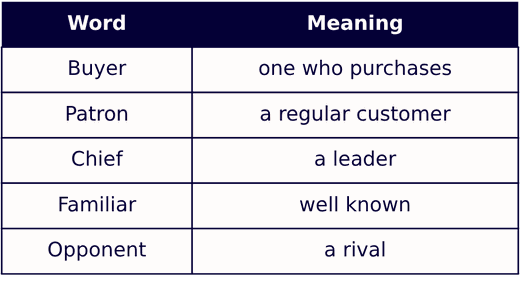 'Patron' means a customer of a shop or a restaurant, especially a regular one, so it is nearest in meaning to 'buyer'.
'Chief' means a leader, 'familiar' means well known, and 'opponent' means a rival — none of them has anything to do with purchasing.
Hence 'Patron' is the correct answer.
'Patron' means a customer of a shop or a restaurant, especially a regular one, so it is nearest in meaning to 'buyer'.
'Chief' means a leader, 'familiar' means well known, and 'opponent' means a rival — none of them has anything to do with purchasing.
Hence 'Patron' is the correct answer.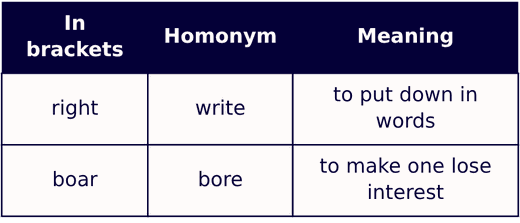 'Right' sounds like 'write', and a report is 'written', so the first blank takes 'write'.
'Boar' (a wild pig) sounds like 'bore', which means to make somebody lose interest, so the second blank takes 'bore'.
'Rite' means a religious ceremony and 'boor' means a rude person, so options (a), (b) and (d) do not fit.
Correct sentence: He decided to write a detailed report, even though the long process began to bore him after a while.
'Right' sounds like 'write', and a report is 'written', so the first blank takes 'write'.
'Boar' (a wild pig) sounds like 'bore', which means to make somebody lose interest, so the second blank takes 'bore'.
'Rite' means a religious ceremony and 'boor' means a rude person, so options (a), (b) and (d) do not fit.
Correct sentence: He decided to write a detailed report, even though the long process began to bore him after a while.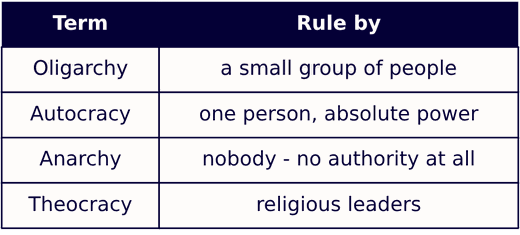 Hence the correct definition is 'a small group of people that control a government or society'.
Rule by one person with absolute power is autocracy, disorder caused by the absence of authority is anarchy, and rule by religious leaders in the name of God is theocracy.
Hence the correct definition is 'a small group of people that control a government or society'.
Rule by one person with absolute power is autocracy, disorder caused by the absence of authority is anarchy, and rule by religious leaders in the name of God is theocracy.