SSC CHSL 21 November 2025 · Shift 3 · General Intelligence — questions with answers · ShikshaSphere
Chapter 101 of 200
21 November 2025 · Shift 3
General Intelligence
25 questions ~25 min readFree
25 questions
A
26
In this type of question, the question is provided with substitutes for various mathematical symbols, followed by a question involving calculation of an expression. You have to put the real signs in the given equation and then solve the questions as required.
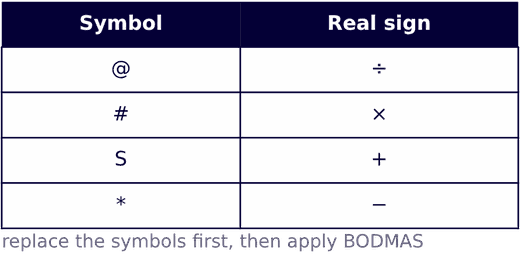
If '@' stands for '÷', '#' stands for '×', 'S' stands for '+', and '*' stands for '-', then find the value of:
32 @ 4 # 3 $ 10 * 6 = ?
A.30
B.28
C.32
D.24
Solution
Symbol substitution
Put the real mathematical sign in place of every symbol before doing any arithmetic.
The expression becomes .
By BODMAS, division and multiplication are settled first and from left to right: , then .
Addition and subtraction come last: 24 + 10 - 6 = 34 - 6 = 28.
Hence option (b) is correct.
27
In a row of 60 students, Karan is 20th from the left end and Arjun is 12th from the right end. How many students are standing between Karan and Arjun?
A.27
B.28
C.29
D.30
Solution
Ranking in a row
Both positions must first be counted from the same end of the row.
Position from the left = total - position from the right , so Arjun is 60 - 12 + 1 = 49th from the left.
Karan is 20th and Arjun is 49th from the left, so the students standing strictly between them fill the 21st to the 48th places.
Number of students between = 49 - 20 - 1 = 28.
Hence option (b) is correct.
28
There are 50 cars parked in a single row. Car A is 15th from the left end and Car B is 12th from the right end. How many cars are parked between Car A and Car B?
A.22
B.26
C.24
D.23
Solution
Ranking in a row
Convert Car B's rank so that both cars are counted from the same end.
Car B from the left = 50 - 12 + 1 = 39th.
Car A is 15th and Car B is 39th from the left, so the cars between them occupy the 16th to the 38th places.
Number of cars between = 39 - 15 - 1 = 23.
Hence option (d) is correct.
29
If 940 # 169 ~ 13 = 927 and 625 # , then what is the value of 755 # 252 ~ 18?
A.741
B.739
C.745
D.731
Solution
Symbol-coded equation
Read '#' as the minus sign and '~' as the division sign, and check the rule on the two given equations.
, which is the value given.
, which is again the value given.
Apply the same rule to the third expression: .
Hence option (a) is correct.
30
Few of the letters are given followed by a question mark (?). These letters are following a specific pattern. You have to give the correct option which can replace the question mark.
Identify the next term: B, F, J, N, ?
A.P
B.Q
C.R
D.S
Solution
Letter series
Write the alphabet position of each letter: B =2, F =6, J =10, N =14.
Each term is 4 more than the one before it, so the next position is 14 + 4 = 18.
The 18th letter of the English alphabet is R.
Hence option (c) is correct.
31
In three of the following pairs are same by same pattern except one pair. Which pair does not follow this pattern?
A.8 : 15
B.
C.48 : 63
D.
Solution
Odd number pair
Compare each number with the squares of the natural numbers.
and ; and ; and .
So in three of the pairs both numbers are one less than a perfect square, and the two squares are consecutive.
In 36 : 48 the second number does fit, since , but the first does not: 36 is itself a perfect square, and one less than a square would be .
This pair alone breaks the rule, so option (d) is correct.
32
In three of the following pairs are same by same pattern except one pair. Which pair does not follow this pattern?
A.
B.
C.15 : 15
D.19 : 18
Solution
Odd number pair
Look at how far apart the two numbers of each pair stand.
11 - 10 = 1, 25 - 24 = 1 and 19 - 18 = 1, so in these three pairs the numbers are consecutive integers, differing by exactly 1.
In 15 : 15 the two numbers are identical, so the gap is 0 and not 1.
That is the only pair which is not a pair of consecutive numbers, so option (c) is correct.
33
Select the related word from the given alternatives.
Vacant : Empty :: Sedate : ?
A.Nervous
B.Calm
C.Noisy
D.Fast
Solution
Synonym analogy
In the first pair the two words carry the same meaning: 'vacant' and 'empty' both describe a place with nothing and nobody in it.
The second pair must therefore also be a pair of synonyms.
'Sedate' means quiet, unhurried and composed in manner, which is precisely the sense of 'calm'.
'Nervous', 'noisy' and 'fast' all suggest agitation or hurry and are opposite in spirit to 'sedate', so option (b) is correct.
34
Pick the correct options from the given alternatives
132 : 354 :: 643 :?
A.854
B.865
C.765
D.864
Solution
Number analogy
Compare 132 and 354 digit by digit, keeping the places in the same order.
1 + 2 = 3, 3 + 2 = 5 and 2 + 2 = 4, so every digit has simply been increased by 2.
Apply the same rule to 643: 6 + 2 = 8, 4 + 2 = 6 and 3 + 2 = 5, which gives 865.
Hence option (b) is correct.
35
Choose the correct options from the alternative
72 : 125 :: 84 : ?
A.27
B.216
C.64
D.512
Solution
Number analogy
Take the two digits of the first number, subtract the smaller from the larger and cube the result.
For 72: 7 - 2 = 5 and , which is exactly the second number of the given pair.
For 84: 8 - 4 = 4 and .
Hence option (c) is correct.
36
Which of the following options will replace the question mark (?) in the given series?
C24, F20, I16, L12 ?
A.O8
B.P8
C.010
D.N8
Solution
Alphanumeric series
Treat the letter part and the number part of the series separately.
The letters are C, F, I, L, whose positions are 3, 6, 9, 12, so each letter moves 3 places forward and the next position is 12 + 3 = 15, the letter O.
The numbers are 24, 20, 16, 12, each 4 less than the one before, so the next number is 12 - 4 = 8.
Joining the two parts gives O8, so option (a) is correct.
37
What comes next in the series? DGI, JMO, PSU, ?
A.VXZ
B.VYA
C.WZB
D.UXZ
Solution
Letter-group series
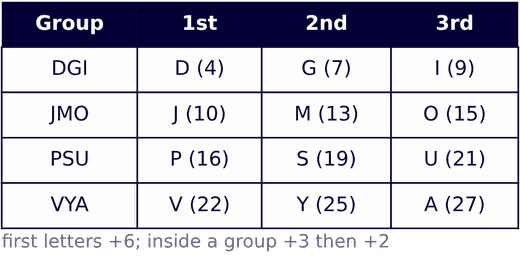
Inside every group the letters rise first by 3 and then by 2: D (4), G (7), I (9); J (10), M (13), O (15); P (16), S (19), U (21).
The first letters of the groups are D (4), J (10) and P (16), each 6 places after the previous one, so the next group must begin at 16 + 6 = 22, the letter V.
Adding 3 to V (22) gives 25, the letter Y, and adding 2 more gives 27, which continues past Z and comes back to A.
The missing group is therefore VYA, so option (b) is correct.
38
Carefully examine the Reference Statement. Then, identify the single option among the four alternatives (a, b, c, d) that is an EXACT AND COMPLETE REPLICATION of the Reference Statement. Pay exceptionally close attention to every character, number, symbol, space, and punctuation mark.
Reference: Zurich; January 12th, 14:20 CET.
A.Zurich, January 12th, 14:20 CET.
B.Zurich; January 12th, 14:20 CET.
C.Zurich; January 12th, 14:20 Cet.
D.Zurich; January 12.th, 14:20 CET.
Solution
Exact replication check
Compare each option with the reference 'Zurich; January 12th, 14:20 CET.' character by character.
In (a) the city name is followed by a comma, whereas the reference puts a semicolon after 'Zurich'.
In (c) the time zone is written 'Cet.' in place of the capitals 'CET.'.
In (d) a stray full stop has crept into the date — '12.th' instead of '12th'.
Only (b) repeats every letter, digit and punctuation mark of the reference, so option (b) is correct.
39
Carefully examine the Reference Statement. Then, identify the single option among the four alternatives (a, b, c, d) that is an EXACT AND COMPLETE REPLICATION of the Reference Statement. Pay exceptionally close attention to every character, number, symbol, space, and punctuation mark.
Reference: London_05 Nov_2024, 18:45 GMT.
Solution
Exact replication check
Compare each option with the reference 'London_05 Nov_2024, 18:45 GMT.' character by character.
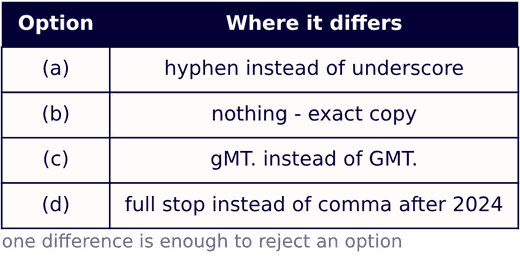
In (a) the city is joined to the date by a hyphen — 'London-05' — while the reference uses an underscore, 'London_05'.
In (c) the time zone reads 'gMT.' with a small g in place of the capital G of 'GMT.'.
In (d) the year is followed by a full stop — '2024.' — where the reference has a comma.
Option (b) reproduces the reference exactly, so option (b) is correct.
40
How many triangles are there in the given figure?
A.12
B.15
C.10
D.14
Solution
Counting triangles
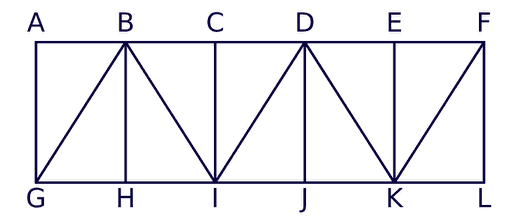
Name the corner points of the figure so that every triangle can be written down without repetition.
The rectangle is cut into 5 equal columns and one slanting line crosses each column, splitting it into two triangles.
These smallest triangles are ABG, GBH, BHI, BCI, CDI, IDJ, DJK, DEK, EFK and KFL, that is triangles.
Two neighbouring slanting lines meet at a common point and are closed by the top or the bottom edge, giving the larger triangles GBI, BID, IDK and DKF — 4 more.
No other combination closes, because slanting lines that are not neighbours are parallel to each other.
Total number of triangles = 10 + 4 = 14, so option (d) is correct.
41
How many triangles are there in the given figure?
A.13
B.15
C.17
D.14
Solution
Counting triangles
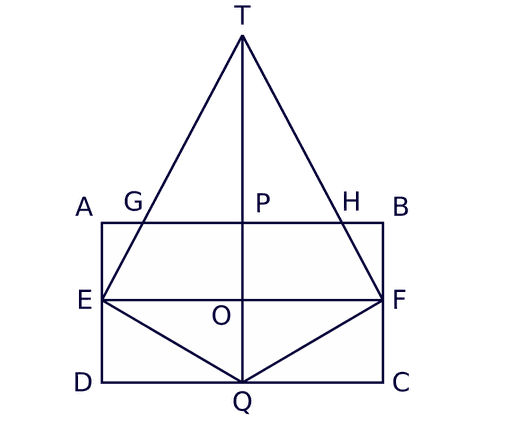
Name the figure first: ABCD is the rectangle, EF its horizontal mid-line, O the centre, T the top vertex, P and Q the mid-points of AB and DC, while TE and TF cut AB at G and H.
Triangles having T as a vertex: , , , , , , , - 8 in all.
Triangles lying between AB and EF: and - 2 more.
Triangles lying below EF: , , , , - 5 more.
Total number of triangles =8+2+5=15.
Hence the correct option is (b).
42
Heights of 5 students P, Q, R, S, and T are compared. No two students have the same height. Q is taller than S but shorter than P. T is taller than R. T is the second shortest. How many students are taller than Q?
A.1
B.2
C.3
D.0
Solution
Order and ranking
Q is taller than S but shorter than P, so P>Q>S.
T is the second shortest, so exactly one student stands below T; since T is taller than R, that student must be R.
So R is the shortest and T comes next, which leaves the top three places for P, Q and S in the order P>Q>S.
The complete order from tallest to shortest is P>Q>S>T>R.
Only P is taller than Q, so the required number of students is 1.
Hence the correct option is (a).
43
5 friends L, M, N, O, and K are sitting around a circular table facing the center. K is sitting to the immediate left of L. O is sitting third to the right of K. N is not an immediate neighbor of L. Who is sitting to the immediate right of L?
A.N
B.M
C.0
D.K
Solution
Circular seating
All five face the centre, so for each of them the clockwise side is the left side and the anticlockwise side is the right side.
K is immediately to the left of L, so going clockwise the order begins L, K.
O is third to the right of K, i.e. three seats anticlockwise from K; in a circle of five seats that is the same as two seats clockwise from K, so the clockwise order so far is L, K, _, O, _.
The seat left beside L would make its occupant a neighbour of L, and N cannot be one, so N takes the seat between K and O, and M sits beside L.
The clockwise order is L, K, N, O, M, so the friend sitting anticlockwise of L - that is, immediately to L’s right - is M.
Hence the correct option is (b).
44
8 friends A, B, C, D, E, F, G, and H are sitting in a row facing south (not necessarily in the same order). A is immediately to the right of E.A is at the fifth position to the right of F. D is at the fifth position to the left of E. H is at the third position to the right of . There are exactly two friends sitting between B and G. G is the immediate neighbour of A. Which friends are at the ends of the row?
A.A and G
B.G and D
C.B and E
D.D and H
Solution
Linear seating
Number the seats 1 to 8 from the left end of the row and let D sit at seat d.
D is fifth to the left of E, so E=d+5; A is immediately to the right of E, so A=d+6.
A is fifth to the right of F, so F=A-5=d+1; H is third to the right of D, so H=d+3.
gives ; if d=2 then A=8 and the only neighbour seat for G would be 7, which E already occupies, so d=1.
Therefore D is at 1, F at 2, H at 4, E at 6, A at 7, and G - the neighbour of A - takes seat 8.
Exactly two friends sit between B and G, so B is at seat 5, and C fills the only vacant seat, 3.
The two end seats, 1 and 8, are occupied by D and G.
Hence the correct option is (b).
45
A person starts walking from his home. He walks 30 km towards East. He then turns right and walks 40 km. After that, he turns left and walks 30 km. Finally, he turns right and walks 40 km . How far (in km) and in which direction is he now from his starting point?
A.60, South-East
B.80, South
C.100, South-East
D.60, East
Solution
Direction sense
He starts facing East; a right turn makes him face South, the next left turn brings him back to East, and the last right turn makes him face South again.
Total movement towards East =30+30=60 km.
Total movement towards South =40+40=80 km.
The two movements are perpendicular, so the straight distance is km.
He has finished east of and south of his home, so he is in the South-East direction from it.
Hence the correct option is (c).
46
M walks 10 km towards South and reaches point X . He turns left and walks 12 km to reach point Y . He finally turns left and walks 5 km to reach point Z . How far (in km ) is point X from point Z and in which direction is M facing now?
A.13 , North
B.17, North
C.13, South
D.17, West
Solution
Direction sense
He is first walking South, so a left turn makes him face East; after the eastward walk a second left turn makes him face North.
Take the start as the origin: X lies 10 km south of it, Y lies 12 km east of X, and Z lies 5 km north of Y.
So Z is 12 km east of X and 5 km north of X, and these two are perpendicular.
km.
His last move was towards the North, so M is now facing North.
Hence the correct option is (a).
47
Three out of the following four are alike in a particular pattern and hence form a group. Find the one which does not belong to that group.
Windows, MacOS, Android, HTML
A.Windows
B.MacOS
C.Android
D.HTML
Solution
Odd one out
Windows, MacOS and Android are all operating systems - the software that controls a device’s hardware and runs the applications on it.
HTML (HyperText Markup Language) is not an operating system at all; it is the markup language used to lay out the content of web pages.
So HTML is the one that does not belong to the group.
Hence the correct option is (d).
48
Which option figure will complete the pattern in the question figure? (Rotation is not allowed)
A.
B.
C.
D.
Solution
Completing the pattern
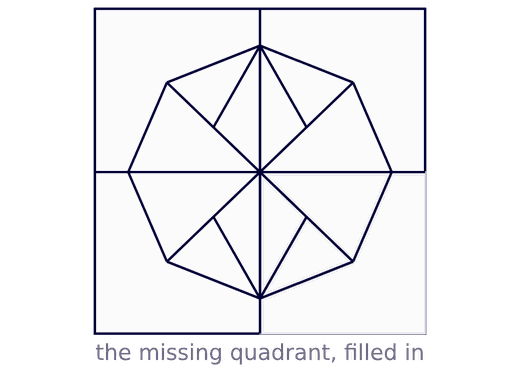
In the question figure a regular octagon is drawn about the centre of the square and a spoke joins the centre to every vertex of the octagon.
Besides these, the top vertex of the octagon is joined to the mid-point of each of the two upper slanting spokes, and the bottom vertex to the mid-point of each of the two lower slanting spokes.
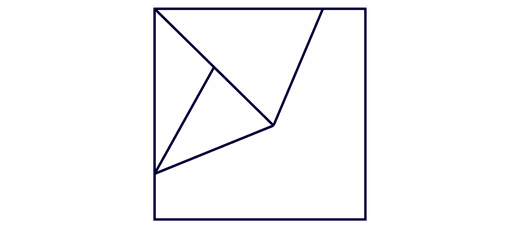
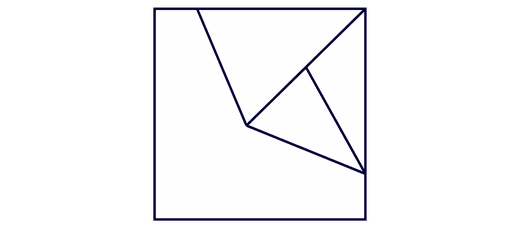
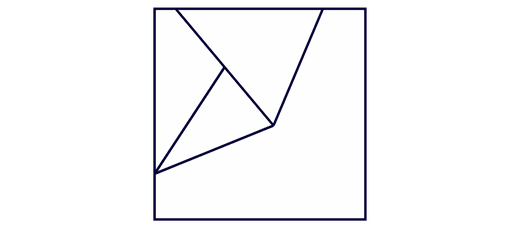
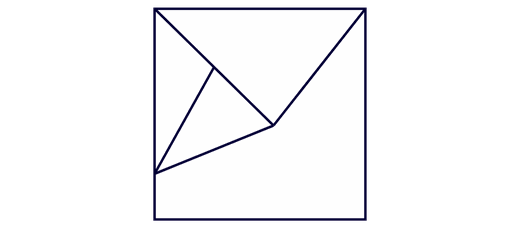
So the missing bottom-right quadrant must carry four things: the two octagon sides meeting at the lower-right vertex, the spoke from the centre to that vertex, and the line from the bottom vertex to the mid-point of that spoke.
Option (a) has exactly these four: its long line starts at the corner that is the centre of the pattern, one side ends on the horizontal mid-line and the other on the vertical line, and the short line meets the long one at its mid-point.
In (b) the piece is the mirror image of what is needed, in (c) the long line does not begin at the corner, and in (d) the octagon side runs into the corner of the square instead of stopping on the mid-line.
Hence the correct option is (a).
49
If ' ' denotes ' ', ' ' denotes ' ', ' ' denotes '+' and ' S ' denotes ' - , then what is the value of the following expression ?
12 R 8 P 3 S 10 Q 2
A.25
B.30
C.31
D.36
Solution
Symbol substitution
Replace every letter by the sign it stands for.
The expression becomes .
By BODMAS, division and multiplication are done first: and .
=12+24-5
=31
Hence the correct option is (c).
50
By interchanging the given two numbers (not digits) which of the following equation will be correct? 4 and 8
I.
II.
A.Only I
B.Only II
C.Both I and II
D.Neither I nor II
Solution
Interchanging numbers
Interchanging the numbers 4 and 8 means every 4 in the equation becomes 8 and every 8 becomes 4.
I. turns into .
By BODMAS, =12+8-5=15, which is exactly the right-hand side, so I becomes correct.
II. turns into .
By BODMAS, =4+20-6=18, which is exactly the right-hand side, so II becomes correct as well.
Both equations therefore hold after the interchange.
Hence the correct option is (c).
Finished reading? Now test yourself.
The same 25 questions, but with a timer and the answers hidden — 15 minutes.

 The expression becomes .
By BODMAS, division and multiplication are settled first and from left to right: , then .
Addition and subtraction come last: 24 + 10 - 6 = 34 - 6 = 28.
Hence option (b) is correct.
The expression becomes .
By BODMAS, division and multiplication are settled first and from left to right: , then .
Addition and subtraction come last: 24 + 10 - 6 = 34 - 6 = 28.
Hence option (b) is correct.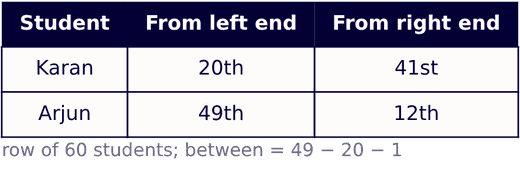 Karan is 20th and Arjun is 49th from the left, so the students standing strictly between them fill the 21st to the 48th places.
Number of students between = 49 - 20 - 1 = 28.
Hence option (b) is correct.
Karan is 20th and Arjun is 49th from the left, so the students standing strictly between them fill the 21st to the 48th places.
Number of students between = 49 - 20 - 1 = 28.
Hence option (b) is correct.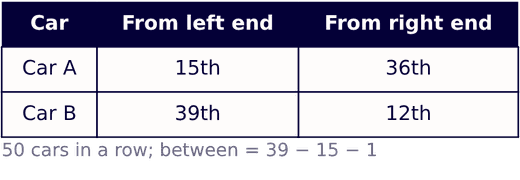 Car A is 15th and Car B is 39th from the left, so the cars between them occupy the 16th to the 38th places.
Number of cars between = 39 - 15 - 1 = 23.
Hence option (d) is correct.
Car A is 15th and Car B is 39th from the left, so the cars between them occupy the 16th to the 38th places.
Number of cars between = 39 - 15 - 1 = 23.
Hence option (d) is correct.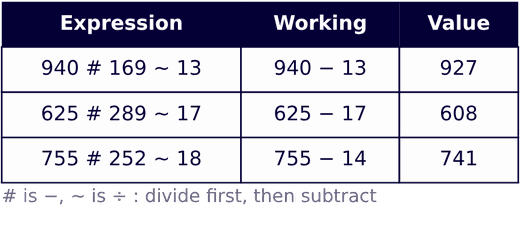 Apply the same rule to the third expression: .
Hence option (a) is correct.
Apply the same rule to the third expression: .
Hence option (a) is correct. The 18th letter of the English alphabet is R.
Hence option (c) is correct.
The 18th letter of the English alphabet is R.
Hence option (c) is correct.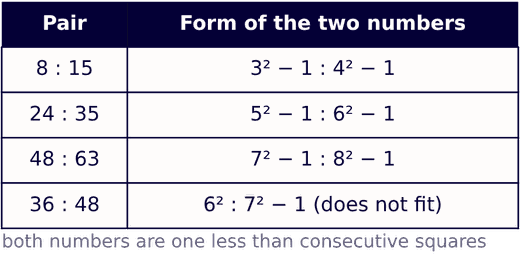 In 36 : 48 the second number does fit, since , but the first does not: 36 is itself a perfect square, and one less than a square would be .
This pair alone breaks the rule, so option (d) is correct.
In 36 : 48 the second number does fit, since , but the first does not: 36 is itself a perfect square, and one less than a square would be .
This pair alone breaks the rule, so option (d) is correct.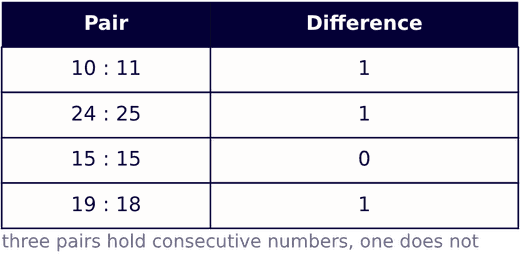 In 15 : 15 the two numbers are identical, so the gap is 0 and not 1.
That is the only pair which is not a pair of consecutive numbers, so option (c) is correct.
In 15 : 15 the two numbers are identical, so the gap is 0 and not 1.
That is the only pair which is not a pair of consecutive numbers, so option (c) is correct.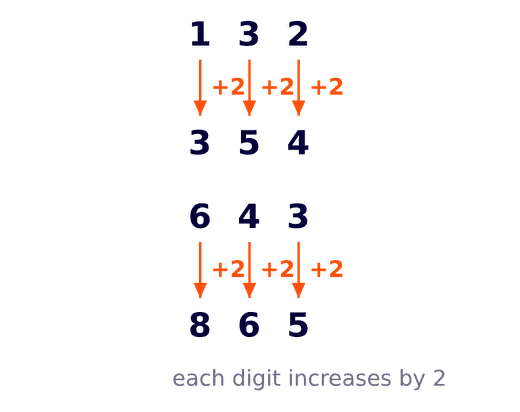 Apply the same rule to 643: 6 + 2 = 8, 4 + 2 = 6 and 3 + 2 = 5, which gives 865.
Hence option (b) is correct.
Apply the same rule to 643: 6 + 2 = 8, 4 + 2 = 6 and 3 + 2 = 5, which gives 865.
Hence option (b) is correct.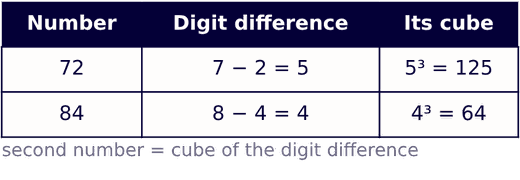 For 84: 8 - 4 = 4 and .
Hence option (c) is correct.
For 84: 8 - 4 = 4 and .
Hence option (c) is correct.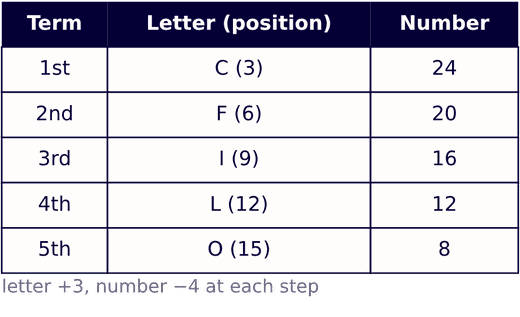 Joining the two parts gives O8, so option (a) is correct.
 Adding 3 to V (22) gives 25, the letter Y, and adding 2 more gives 27, which continues past Z and comes back to A.
The missing group is therefore VYA, so option (b) is correct.
Adding 3 to V (22) gives 25, the letter Y, and adding 2 more gives 27, which continues past Z and comes back to A.
The missing group is therefore VYA, so option (b) is correct.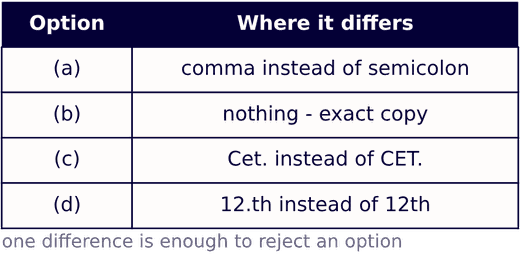 In (a) the city name is followed by a comma, whereas the reference puts a semicolon after 'Zurich'.
In (c) the time zone is written 'Cet.' in place of the capitals 'CET.'.
In (d) a stray full stop has crept into the date — '12.th' instead of '12th'.
Only (b) repeats every letter, digit and punctuation mark of the reference, so option (b) is correct.
In (a) the city name is followed by a comma, whereas the reference puts a semicolon after 'Zurich'.
In (c) the time zone is written 'Cet.' in place of the capitals 'CET.'.
In (d) a stray full stop has crept into the date — '12.th' instead of '12th'.
Only (b) repeats every letter, digit and punctuation mark of the reference, so option (b) is correct.
 In (a) the city is joined to the date by a hyphen — 'London-05' — while the reference uses an underscore, 'London_05'.
In (c) the time zone reads 'gMT.' with a small g in place of the capital G of 'GMT.'.
In (d) the year is followed by a full stop — '2024.' — where the reference has a comma.
Option (b) reproduces the reference exactly, so option (b) is correct.
In (a) the city is joined to the date by a hyphen — 'London-05' — while the reference uses an underscore, 'London_05'.
In (c) the time zone reads 'gMT.' with a small g in place of the capital G of 'GMT.'.
In (d) the year is followed by a full stop — '2024.' — where the reference has a comma.
Option (b) reproduces the reference exactly, so option (b) is correct.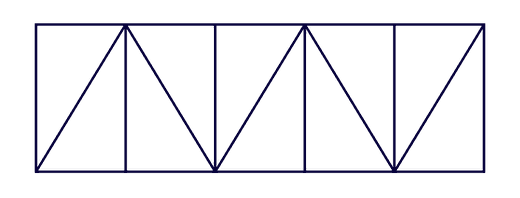
 The rectangle is cut into 5 equal columns and one slanting line crosses each column, splitting it into two triangles.
These smallest triangles are ABG, GBH, BHI, BCI, CDI, IDJ, DJK, DEK, EFK and KFL, that is triangles.
Two neighbouring slanting lines meet at a common point and are closed by the top or the bottom edge, giving the larger triangles GBI, BID, IDK and DKF — 4 more.
No other combination closes, because slanting lines that are not neighbours are parallel to each other.
Total number of triangles = 10 + 4 = 14, so option (d) is correct.
The rectangle is cut into 5 equal columns and one slanting line crosses each column, splitting it into two triangles.
These smallest triangles are ABG, GBH, BHI, BCI, CDI, IDJ, DJK, DEK, EFK and KFL, that is triangles.
Two neighbouring slanting lines meet at a common point and are closed by the top or the bottom edge, giving the larger triangles GBI, BID, IDK and DKF — 4 more.
No other combination closes, because slanting lines that are not neighbours are parallel to each other.
Total number of triangles = 10 + 4 = 14, so option (d) is correct.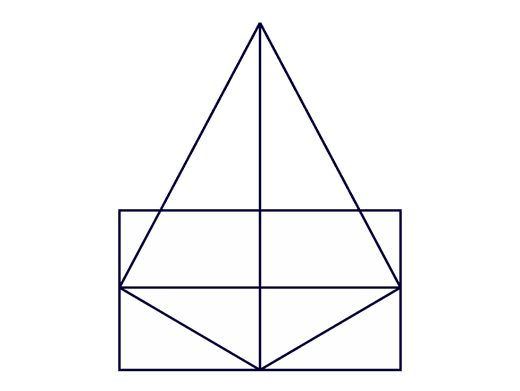
 Triangles having T as a vertex: , , , , , , , - 8 in all.
Triangles lying between AB and EF: and - 2 more.
Triangles lying below EF: , , , , - 5 more.
Total number of triangles =8+2+5=15.
Hence the correct option is (b).
Triangles having T as a vertex: , , , , , , , - 8 in all.
Triangles lying between AB and EF: and - 2 more.
Triangles lying below EF: , , , , - 5 more.
Total number of triangles =8+2+5=15.
Hence the correct option is (b).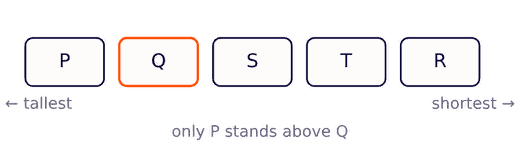 The complete order from tallest to shortest is P>Q>S>T>R.
Only P is taller than Q, so the required number of students is 1.
Hence the correct option is (a).
The complete order from tallest to shortest is P>Q>S>T>R.
Only P is taller than Q, so the required number of students is 1.
Hence the correct option is (a).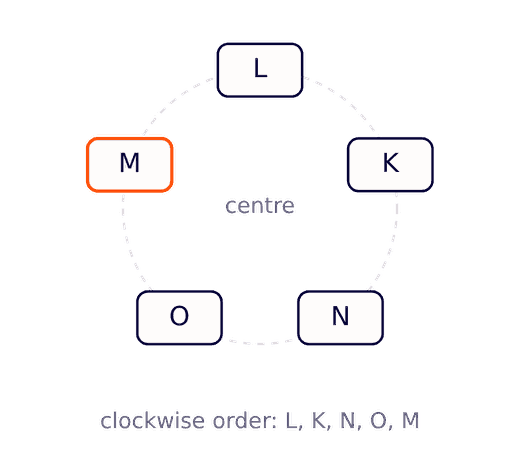 The clockwise order is L, K, N, O, M, so the friend sitting anticlockwise of L - that is, immediately to L’s right - is M.
Hence the correct option is (b).
The clockwise order is L, K, N, O, M, so the friend sitting anticlockwise of L - that is, immediately to L’s right - is M.
Hence the correct option is (b).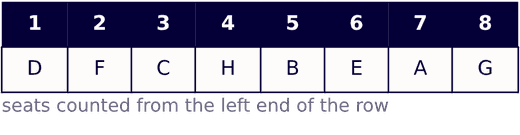 The two end seats, 1 and 8, are occupied by D and G.
Hence the correct option is (b).
The two end seats, 1 and 8, are occupied by D and G.
Hence the correct option is (b).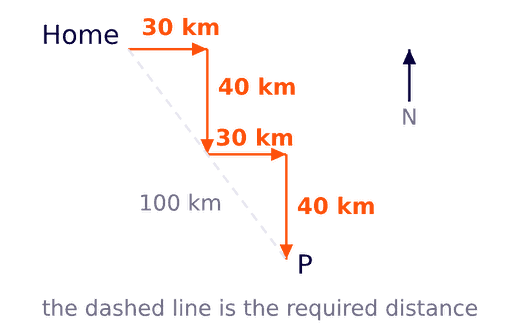 Total movement towards East =30+30=60 km.
Total movement towards South =40+40=80 km.
The two movements are perpendicular, so the straight distance is km.
He has finished east of and south of his home, so he is in the South-East direction from it.
Hence the correct option is (c).
Total movement towards East =30+30=60 km.
Total movement towards South =40+40=80 km.
The two movements are perpendicular, so the straight distance is km.
He has finished east of and south of his home, so he is in the South-East direction from it.
Hence the correct option is (c).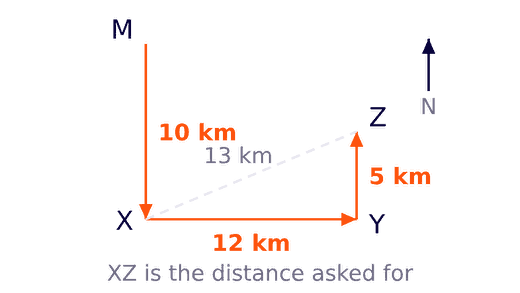 Take the start as the origin: X lies 10 km south of it, Y lies 12 km east of X, and Z lies 5 km north of Y.
So Z is 12 km east of X and 5 km north of X, and these two are perpendicular.
km.
His last move was towards the North, so M is now facing North.
Hence the correct option is (a).
Take the start as the origin: X lies 10 km south of it, Y lies 12 km east of X, and Z lies 5 km north of Y.
So Z is 12 km east of X and 5 km north of X, and these two are perpendicular.
km.
His last move was towards the North, so M is now facing North.
Hence the correct option is (a).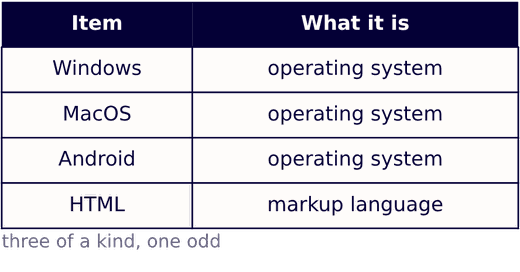 So HTML is the one that does not belong to the group.
Hence the correct option is (d).
So HTML is the one that does not belong to the group.
Hence the correct option is (d).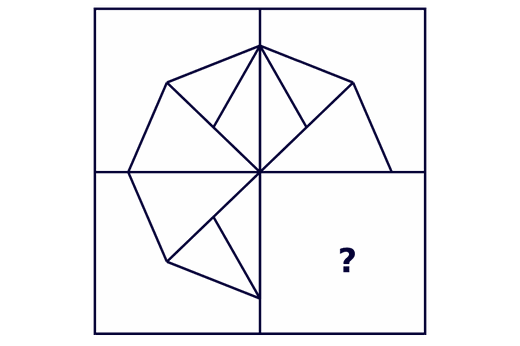
 Option (a) has exactly these four: its long line starts at the corner that is the centre of the pattern, one side ends on the horizontal mid-line and the other on the vertical line, and the short line meets the long one at its mid-point.
In (b) the piece is the mirror image of what is needed, in (c) the long line does not begin at the corner, and in (d) the octagon side runs into the corner of the square instead of stopping on the mid-line.
Hence the correct option is (a).
Option (a) has exactly these four: its long line starts at the corner that is the centre of the pattern, one side ends on the horizontal mid-line and the other on the vertical line, and the short line meets the long one at its mid-point.
In (b) the piece is the mirror image of what is needed, in (c) the long line does not begin at the corner, and in (d) the octagon side runs into the corner of the square instead of stopping on the mid-line.
Hence the correct option is (a).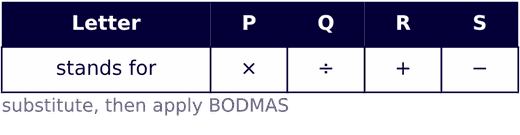 The expression becomes .
By BODMAS, division and multiplication are done first: and .
=12+24-5
=31
Hence the correct option is (c).
The expression becomes .
By BODMAS, division and multiplication are done first: and .
=12+24-5
=31
Hence the correct option is (c).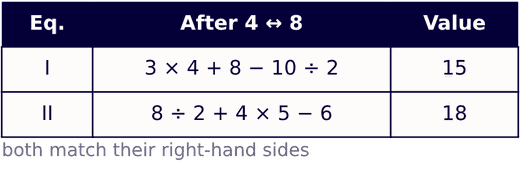 Both equations therefore hold after the interchange.
Hence the correct option is (c).
Both equations therefore hold after the interchange.
Hence the correct option is (c).