SSC CHSL 21 November 2025 · Shift 3 · General Awareness — questions with answers · ShikshaSphere
Chapter 102 of 200
21 November 2025 · Shift 3
General Awareness
25 questions ~25 min readFree
25 questions
A
76
The first volume of the Akbar Nama, written by Abul Fazl, primarily deals with:
A.Administrative reforms under Akbar
B.Major military campaigns of Akbar
C.Territorial expansion of the Mughal Empire
D.Akbar's ancestors
Solution
Akbar Nama
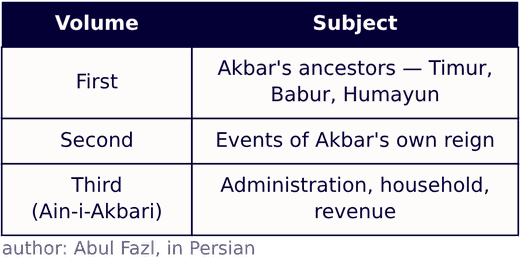
The Akbar Nama was written in Persian by Abul Fazl, one of the navratnas of Akbar's court, and it runs into three volumes.
The first volume is the history of Akbar's ancestors — the house of Timur — together with the reigns of Babur and Humayun, up to the birth of Akbar.
The second volume narrates the events of Akbar's own reign year by year, and the third, called the Ain-i-Akbari, records the administration, the imperial household and the revenue statistics of the empire.
So administration, campaigns and territorial growth belong to the later volumes, and option (d) is correct.
77
Which Mughal emperor led a successful campaign against Kashmir, and in which year did it take place ?
A.Babur, 1526
B.Humayun, 1545
C.Akbar, 1586
D.Jahangir, 1605
Solution
Mughal conquest of Kashmir
Kashmir was annexed to the Mughal empire in 1586, in the reign of Akbar.
Akbar sent an army under Raja Bhagwant Das and Qasim Khan, which defeated the Chak rulers Yusuf Shah Chak and his son Yaqub Shah Chak.
Kashmir was then administered as part of the Kabul subah, and its valley became the favourite summer retreat of the later Mughal emperors.
The years in the other options mark different events — 1526 is Babur's victory at the first battle of Panipat and 1605 is Jahangir's accession — and neither is a Kashmir campaign.
Hence option (c) is correct.
78
Which committee recommended the three-tier structure of Panchayati Raj in India ?
A.Sarkaria Committee
B.Balwant Rai Mehta Committee
C.Ashok Mehta Committee
D.Punchhi Committee
Solution
Panchayati Raj committees
The Balwant Rai Mehta Committee was appointed in 1957 to examine the working of the Community Development Programme, and it recommended 'democratic decentralisation'.
It proposed a three-tier structure: Gram Panchayat at the village level, Panchayat Samiti at the block level and Zila Parishad at the district level.
Rajasthan was the first state to put the scheme into practice, inaugurated at Nagaur on 2 October 1959.
The Ashok Mehta Committee (1977) recommended a two-tier system instead, while the Sarkaria and Punchhi Committees examined Centre–State relations, so those options do not fit.
Hence option (b) is correct.
79
The report of the Justice Hema Committee, which was constituted in 2017, was made public in 2024. The committee consisted of how many members?
A.9
B.7
C.5
D.3
Solution
Justice Hema Committee
The Justice Hema Committee was set up by the Government of Kerala in 2017 to study the problems faced by women in the Malayalam film industry.
It was a three-member committee.
It was constituted after the Women in Cinema Collective approached the state government, and it submitted its report in 2019.
The report was made public only in August 2024, when it brought out the widespread harassment, unsafe workplaces and unequal pay in the industry.
Hence option (d) is correct.
80
As of June 2025, the Smart Cities Mission of the Government of India has completed how many years since its launch?
A.10
B.9
C.6
D.11
Solution
Smart Cities Mission
The Smart Cities Mission was launched by the Ministry of Housing and Urban Affairs on 25 June 2015.
Counting from that date, the mission completed 2025-2015=10 years in June 2025.
One hundred cities were chosen through the Smart City Challenge to take up area-based development and technology-driven urban services such as integrated command and control centres.
The deadline for finishing the projects was extended more than once and finally set at 31 March 2025.
Hence option (a) is correct.
81
According to the Henley Passport Index 2025, what is India's rank in passport strength?
A.70th
B.68th
C.72nd
D.83rd
Solution
Henley Passport Index 2025
As per the Henley Passport Index 2025, India's passport stands at the 83rd position in terms of passport strength.
The index, published by Henley & Partners since 2006, ranks a passport by the number of destinations its holder can enter without a prior visa, using exclusive data of the International Air Transport Association (IATA).
It covers 199 passports against 227 travel destinations of the world.
Singapore tops the 2025 list with visa-free access to 193 destinations, with Japan and South Korea close behind.
Hence option (d) is correct.
82
How many countries were included in the World Press Freedom Index 2025?
A.180
B.160
C.190
D.145
Solution
World Press Freedom Index
The World Press Freedom Index 2025, brought out by Reporters Without Borders (RSF), assessed 180 countries and territories.
The score of each country is built on five indicators — political, legal, economic, sociocultural and safety.
Norway stayed at the top for the ninth year in a row, Eritrea was placed last, and India was ranked 151st.
Hence option (a) is correct.
83
Which of the following is NOT one of the pillars of India's Export Preparedness Index (EPI)?
I. Export policy II. Business environment
A.Only I
B.Only II
C.Both I and II
D.Neither I nor II
Solution
Export Preparedness Index
The Export Preparedness Index (EPI) is released by NITI Aayog and ranks all States and Union Territories on how ready they are to export.
It is a composite index resting on four pillars and ten sub-pillars.
Export policy is read under the Policy pillar and business environment under the Business Ecosystem pillar, so neither of the two statements names something that lies outside the pillar framework.
Hence option (d) is correct.
84
The Flamingo Festival 2025 was organised from January 18 to 20 at which location?
A.Visakhapatnam
B.Tirupati
C.Dehradun
D.Amritsar
Solution
Flamingo Festival 2025
The Flamingo Festival 2025 was held from January 18 to 20 in the Tirupati district of Andhra Pradesh.
Its venues were spread over Sullurpeta, the Nelapattu Bird Sanctuary and Pulicat Lake, the wetlands to which flamingos and other migratory birds fly in every winter.
The festival was revived after a gap of four years and is used to push eco-tourism and wetland conservation in the region.
Hence option (b) is correct.
85
The Government of India has set a target of achieving 140 GW of wind power capacity by which year?
A.2025
B.2028
C.2030
D.2047
Solution
Wind power capacity target
India has committed to 500 GW of non-fossil fuel electricity capacity by 2030, a pledge made at the COP26 summit in Glasgow.
Inside that 500 GW basket the target fixed for wind power is 140 GW, the rest coming largely from solar, hydro, biomass and nuclear.
The push is backed by steps such as the National Wind-Solar Hybrid Policy and the National Offshore Wind Energy Policy, and forms part of the road to net-zero emissions by 2070.
Hence option (c) is correct.
86
Geostationary orbit satellites travel at an approximate speed of km per second.
A.12
B.3
C.20
D.8
Solution
Geostationary satellite speed
A geostationary satellite moves in a circular orbit right above the equator at a height of about 35786 km, so its orbital radius is km.
To hang over the same point of the ground it must take exactly one day for one revolution, that is s.
Orbital speed km/s.
So the speed is nearly 3 km per second, which is far slower than the 8 km/s of a low-earth-orbit satellite.
Hence option (b) is correct.
87
Consider the effect of forces on the motion of an object:
I. Unbalanced forces can change the speed or direction of motion.
II. Balanced forces are responsible for producing acceleration.
Which of the above statements is/are correct?
A.Only I
B.Only II
C.Both I and II
D.Neither I nor II
Solution
Balanced and unbalanced forces
By Newton's second law the acceleration of a body depends on the net (resultant) force acting on it: .
Statement I: when the forces are unbalanced, , so the body accelerates and its speed or its direction of motion changes — correct.
Statement II: for balanced forces , hence a=0; the body stays at rest or keeps moving with the same velocity, so balanced forces cannot produce acceleration — incorrect.
Only statement I is right, so option (a) is correct.
88
The 'Pralay' missile, developed by DRDO, was successfully tested in July 2025 from which launch location?
A.Andaman Islands
B.Kalpeni Island
C.Car Nicobar Island
D.Dr. APJ Abdul Kalam Island
Solution
Pralay missile test
In July 2025 the DRDO carried out successful back-to-back flight tests of the 'Pralay' missile from Dr. APJ Abdul Kalam Island off the Odisha coast.
This island, earlier called Wheeler Island, is the integrated test range used for almost all Indian missile trials.
Pralay is a short-range, surface-to-surface, quasi-ballistic missile with a range of about 150-500 km, meant for tactical use on the battlefield.
Hence option (d) is correct.
89
The period between 1713 and 1719 in Mughal history is marked by political instability and dominance of court nobles. Who was the emperor during this phase?
A.Bahadur Shah I
B.Rafi-ud-Darajat
C.Farrukh Siyar
D.Alamgir II
Solution
Later Mughal emperors
Farrukh Siyar sat on the Mughal throne from 1713 to 1719, the years named in the question.
He owed the throne to the Sayyid brothers, Abdullah Khan and Hussain Ali Khan, who came to be called the 'king makers' and kept the emperor a puppet in their hands.
It was in his reign that the English East India Company obtained the farman of 1717 allowing duty-free trade in Bengal.
The Sayyid brothers deposed and killed him in 1719, which shows how far imperial authority had already sunk.
Hence option (c) is correct.
90
Which military strategy was most commonly used by Shivaji against his opponents?
A.Cavalry-based open warfare
B.Elephant corps warfare
C.Guerrilla warfare
D.Naval blockades
Solution
Shivaji's war strategy
Chhatrapati Shivaji Maharaj is best known for guerrilla warfare, called Ganimi Kava in Marathi.
His enemies, the Mughals and the Bijapur Sultanate, had far larger armies, so instead of pitched battles he used light, fast-moving cavalry for surprise raids and ambushes in the hilly Sahyadri country he knew well.
Cutting supply lines, striking at night and withdrawing into hill forts made his small force very hard to defeat.
He did build a navy and used elephants and cavalry too, but those were supporting arms, not his usual method.
Hence option (c) is correct.
91
The National Stock Exchange (NSE) introduced trading in Index Options based on the Nifty 50 on June 4 of which year?
A.1999
B.2001
C.2004
D.2006
Solution
NSE derivatives milestones
The NSE started trading in Index Options based on the Nifty 50 on June 4, 2001.
The derivatives segment had opened a year earlier with index futures in June 2000, and options on single stocks followed in July 2001.
These products gave Indian investors their first proper tools for hedging and risk management.
Hence option (b) is correct.
92
The Hill Area Development Programme (HADP) was initiated during which Five-Year Plan in India?
A.4th
B.5th
C.6th
D.7th
Solution
Hill Area Development Programme
The Hill Area Development Programme was taken up in the Fifth Five-Year Plan (1974-79).
It was one of a set of area-based programmes of that Plan meant to cut down regional imbalance; the Western Ghats Development Programme and the Tribal Sub-Plan also date from the same Plan.
HADP covered designated hill districts and worked on horticulture, animal husbandry, forestry and road links while guarding the fragile hill ecology.
Hence option (b) is correct.
93
The AGMARK certification mark in India is used for which category of products?
A.Industrial machinery
B.Pharmaceutical goods
C.Agricultural products
D.Banking instruments
Solution
AGMARK certification
AGMARK is the quality mark used in India for agricultural produce.
It rests on the Agricultural Produce (Grading and Marking) Act, 1937, and is granted by the Directorate of Marketing and Inspection (DMI) under the Ministry of Agriculture after laboratory testing.
It now covers more than 200 commodities such as pulses, cereals, spices, honey, ghee and vegetable oils.
Industrial goods carry the ISI mark of the BIS instead, so the other options do not fit.
Hence option (c) is correct.
94
The first complete census of an Indian city was conducted in which year?
A.1830
B.1815
C.1845
D.1825
Solution
First city census in India
The first complete census of an Indian city was taken in 1830 by Henry Walter at Dacca (present-day Dhaka).
Head counts had been attempted earlier at Allahabad in 1824 and at Banaras in 1827-28, but they were partial.
The Dacca exercise is called complete because it recorded the people by sex, by age group and by caste-occupation, and also noted the kind of houses they lived in.
Regular all-India decennial censuses began much later, in 1881, under Lord Ripon.
Hence option (a) is correct.
95
In India, the Socio-Economic and Caste Census (SECC) 2011 was conducted by which of the following authorities?
I. Ministry of Rural Development
II. Ministry of Housing and Urban Affairs
A.Only I
B.Only II
C.Both I and II
D.Neither I nor II
Solution
SECC 2011 conducting bodies
The SECC 2011 was not run by one ministry alone; the work was split by area.
The Ministry of Rural Development carried it out in rural areas, while urban areas were covered by the Ministry of Housing and Urban Poverty Alleviation, now merged into the Ministry of Housing and Urban Affairs.
The caste part was handled by the Ministry of Home Affairs through the Registrar General and Census Commissioner of India.
Both statements I and II are therefore correct, so option (c) is correct.
96
During British rule in India, caste data was regularly collected in decennial censuses starting from 1881 up to which year?
A.1921
B.1941
C.1931
D.1971
Solution
Caste data in colonial census
Caste was recorded in every decennial census from 1881 down to 1931, so 1931 is the last census whose full caste tables were published.
In 1941 the enumeration was cut short and the caste tables were not brought out, mainly because of the strain of the Second World War.
After independence the government decided to count only the Scheduled Castes and Scheduled Tribes, which is why 1931 figures were used for decades in debates on backward classes.
Hence option (c) is correct.
97
Which of the following tax reforms has amalgamated a large number of central and state taxes and cesses in India?
A.Goods and Services Tax
B.Customs duty
C.Minimum Alternate Tax
D.Corporate tax
Solution
Goods and Services Tax
The Goods and Services Tax, in force from July 1, 2017 under the 101st Constitutional Amendment, merged a large number of central and state indirect taxes and cesses into one levy.
By allowing input tax credit across the chain it removed the cascading 'tax on tax' and turned India into one common market.
Customs duty stayed outside GST, while minimum alternate tax and corporate tax are direct taxes on income and amalgamate nothing.
Hence option (a) is correct.
98
Which ancient Sanskrit grammarian is believed to have lived during the time of the Nanda dynasty?
A.Bhasa
B.Varahamihira
C.Panini
D.Bharavi
Solution
Panini and the Nandas
Panini, the author of the Ashtadhyayi, is the grammarian traditionally placed in the age of the Nanda dynasty of Magadha, around the 4th century BCE.
The Kathasaritsagara and later tradition link him with the Nanda court, where Vararuchi and the minister Sakatala are also placed.
The Ashtadhyayi sets out Sanskrit grammar in about 4,000 sutras and is the earliest surviving work of its kind anywhere.
Of the others, Bhasa and Bharavi were poets and dramatists and Varahamihira an astronomer of the Gupta age, so none of them fits.
Hence option (c) is correct.
99
According to early Indian tradition, the hymns of the Rigveda and other Vedas were composed and transmitted by:
A.Tribal chiefs
B.Court poets
C.Monastic teachers
D.Rishis and Rishikas
Solution
Composers of Vedic hymns
Tradition holds that the Vedic hymns were 'seen' by seers — the Rishis, and women seers called Rishikas such as Lopamudra, Ghosha, Apala and Vishvavara.
That is why the Vedas are classed as Shruti, 'that which is heard', and not as the composition of ordinary authors.
They were carried forward for centuries by an exact oral tradition of recitation before being written down.
Court poets and monastic teachers belong to much later periods, so those options do not fit.
Hence option (d) is correct.
100
Consider the following features of early Indian society and philosophy:
I. The varna system formed the basis of social organisation in the Vedic period.
II. The concept of four Ashramas was an integral part of early Hindu thought.
Which of the above statements is/are correct?
A.Only I
B.Only II
C.Both I and II
D.Neither I nor II
Solution
Varna and Ashrama system
Statement I: the varna order — Brahmana, Kshatriya, Vaishya and Shudra — is first named in the Purusha Sukta of the tenth mandala of the Rigveda and became the frame of Vedic society, so it is correct.
Statement II: the four ashramas — Brahmacharya, Grihastha, Vanaprastha and Sannyasa — divide a life into stages of study, household duty, retreat and renunciation, and are laid down in the Dharmasutras and Dharmashastras as part of early Hindu thought, so it is correct too.
Taken together the two schemes make up Varnashrama Dharma, the standard framework of duty in early India.
Both statements are right, so option (c) is correct.
Finished reading? Now test yourself.
The same 25 questions, but with a timer and the answers hidden — 15 minutes.

 The first volume is the history of Akbar's ancestors — the house of Timur — together with the reigns of Babur and Humayun, up to the birth of Akbar.
The second volume narrates the events of Akbar's own reign year by year, and the third, called the Ain-i-Akbari, records the administration, the imperial household and the revenue statistics of the empire.
So administration, campaigns and territorial growth belong to the later volumes, and option (d) is correct.
The first volume is the history of Akbar's ancestors — the house of Timur — together with the reigns of Babur and Humayun, up to the birth of Akbar.
The second volume narrates the events of Akbar's own reign year by year, and the third, called the Ain-i-Akbari, records the administration, the imperial household and the revenue statistics of the empire.
So administration, campaigns and territorial growth belong to the later volumes, and option (d) is correct.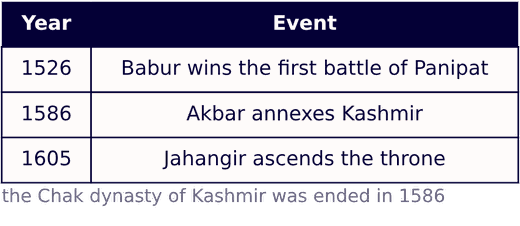 Kashmir was then administered as part of the Kabul subah, and its valley became the favourite summer retreat of the later Mughal emperors.
The years in the other options mark different events — 1526 is Babur's victory at the first battle of Panipat and 1605 is Jahangir's accession — and neither is a Kashmir campaign.
Hence option (c) is correct.
Kashmir was then administered as part of the Kabul subah, and its valley became the favourite summer retreat of the later Mughal emperors.
The years in the other options mark different events — 1526 is Babur's victory at the first battle of Panipat and 1605 is Jahangir's accession — and neither is a Kashmir campaign.
Hence option (c) is correct.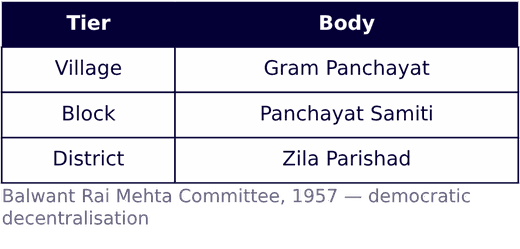 Rajasthan was the first state to put the scheme into practice, inaugurated at Nagaur on 2 October 1959.
The Ashok Mehta Committee (1977) recommended a two-tier system instead, while the Sarkaria and Punchhi Committees examined Centre–State relations, so those options do not fit.
Hence option (b) is correct.
Rajasthan was the first state to put the scheme into practice, inaugurated at Nagaur on 2 October 1959.
The Ashok Mehta Committee (1977) recommended a two-tier system instead, while the Sarkaria and Punchhi Committees examined Centre–State relations, so those options do not fit.
Hence option (b) is correct.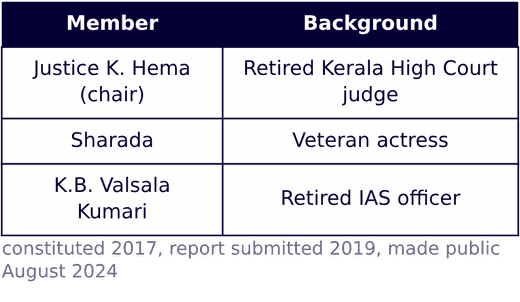 It was constituted after the Women in Cinema Collective approached the state government, and it submitted its report in 2019.
The report was made public only in August 2024, when it brought out the widespread harassment, unsafe workplaces and unequal pay in the industry.
Hence option (d) is correct.
It was constituted after the Women in Cinema Collective approached the state government, and it submitted its report in 2019.
The report was made public only in August 2024, when it brought out the widespread harassment, unsafe workplaces and unequal pay in the industry.
Hence option (d) is correct.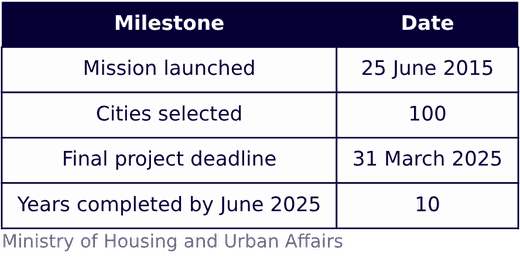 One hundred cities were chosen through the Smart City Challenge to take up area-based development and technology-driven urban services such as integrated command and control centres.
The deadline for finishing the projects was extended more than once and finally set at 31 March 2025.
Hence option (a) is correct.
One hundred cities were chosen through the Smart City Challenge to take up area-based development and technology-driven urban services such as integrated command and control centres.
The deadline for finishing the projects was extended more than once and finally set at 31 March 2025.
Hence option (a) is correct.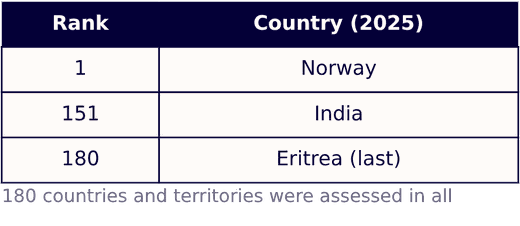 Norway stayed at the top for the ninth year in a row, Eritrea was placed last, and India was ranked 151st.
Hence option (a) is correct.
Norway stayed at the top for the ninth year in a row, Eritrea was placed last, and India was ranked 151st.
Hence option (a) is correct.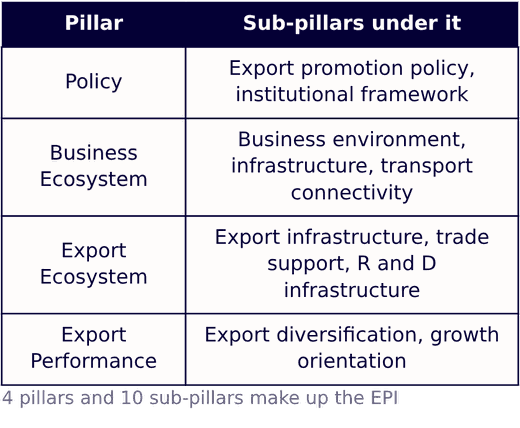 Export policy is read under the Policy pillar and business environment under the Business Ecosystem pillar, so neither of the two statements names something that lies outside the pillar framework.
Hence option (d) is correct.
Export policy is read under the Policy pillar and business environment under the Business Ecosystem pillar, so neither of the two statements names something that lies outside the pillar framework.
Hence option (d) is correct.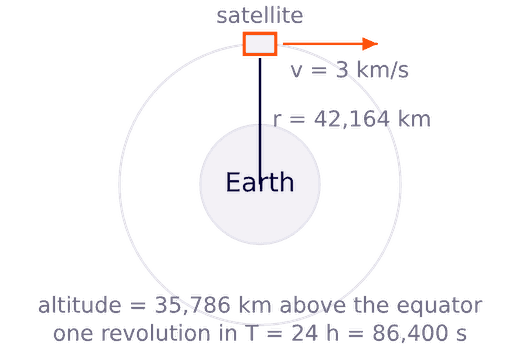 Orbital speed km/s.
So the speed is nearly 3 km per second, which is far slower than the 8 km/s of a low-earth-orbit satellite.
Hence option (b) is correct.
Orbital speed km/s.
So the speed is nearly 3 km per second, which is far slower than the 8 km/s of a low-earth-orbit satellite.
Hence option (b) is correct.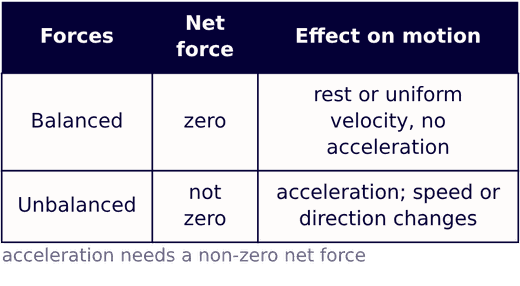 Statement I: when the forces are unbalanced, , so the body accelerates and its speed or its direction of motion changes — correct.
Statement II: for balanced forces , hence a=0; the body stays at rest or keeps moving with the same velocity, so balanced forces cannot produce acceleration — incorrect.
Only statement I is right, so option (a) is correct.
Statement I: when the forces are unbalanced, , so the body accelerates and its speed or its direction of motion changes — correct.
Statement II: for balanced forces , hence a=0; the body stays at rest or keeps moving with the same velocity, so balanced forces cannot produce acceleration — incorrect.
Only statement I is right, so option (a) is correct.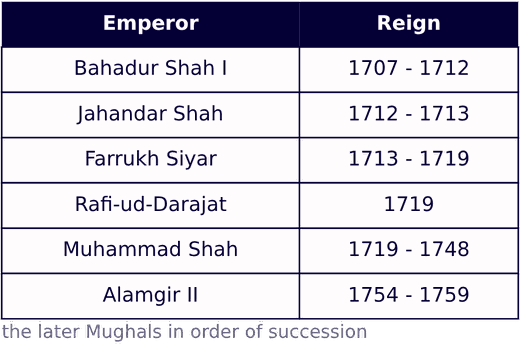 He owed the throne to the Sayyid brothers, Abdullah Khan and Hussain Ali Khan, who came to be called the 'king makers' and kept the emperor a puppet in their hands.
It was in his reign that the English East India Company obtained the farman of 1717 allowing duty-free trade in Bengal.
The Sayyid brothers deposed and killed him in 1719, which shows how far imperial authority had already sunk.
Hence option (c) is correct.
He owed the throne to the Sayyid brothers, Abdullah Khan and Hussain Ali Khan, who came to be called the 'king makers' and kept the emperor a puppet in their hands.
It was in his reign that the English East India Company obtained the farman of 1717 allowing duty-free trade in Bengal.
The Sayyid brothers deposed and killed him in 1719, which shows how far imperial authority had already sunk.
Hence option (c) is correct.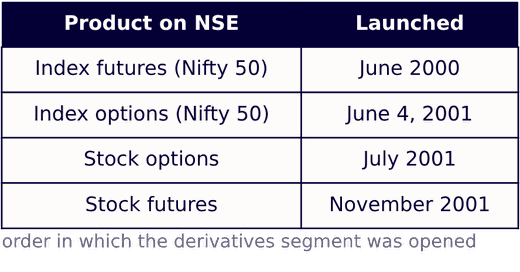 The derivatives segment had opened a year earlier with index futures in June 2000, and options on single stocks followed in July 2001.
These products gave Indian investors their first proper tools for hedging and risk management.
Hence option (b) is correct.
The derivatives segment had opened a year earlier with index futures in June 2000, and options on single stocks followed in July 2001.
These products gave Indian investors their first proper tools for hedging and risk management.
Hence option (b) is correct.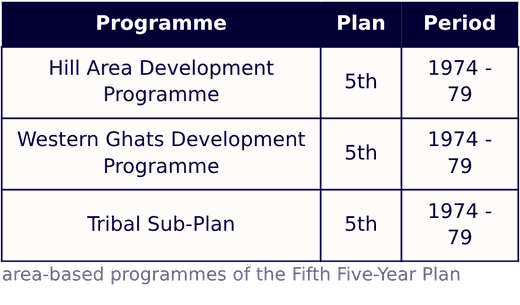 It was one of a set of area-based programmes of that Plan meant to cut down regional imbalance; the Western Ghats Development Programme and the Tribal Sub-Plan also date from the same Plan.
HADP covered designated hill districts and worked on horticulture, animal husbandry, forestry and road links while guarding the fragile hill ecology.
Hence option (b) is correct.
It was one of a set of area-based programmes of that Plan meant to cut down regional imbalance; the Western Ghats Development Programme and the Tribal Sub-Plan also date from the same Plan.
HADP covered designated hill districts and worked on horticulture, animal husbandry, forestry and road links while guarding the fragile hill ecology.
Hence option (b) is correct.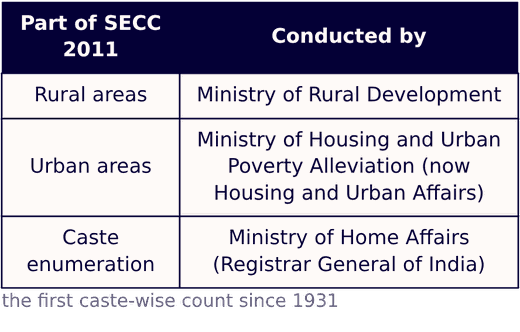 The Ministry of Rural Development carried it out in rural areas, while urban areas were covered by the Ministry of Housing and Urban Poverty Alleviation, now merged into the Ministry of Housing and Urban Affairs.
The caste part was handled by the Ministry of Home Affairs through the Registrar General and Census Commissioner of India.
Both statements I and II are therefore correct, so option (c) is correct.
The Ministry of Rural Development carried it out in rural areas, while urban areas were covered by the Ministry of Housing and Urban Poverty Alleviation, now merged into the Ministry of Housing and Urban Affairs.
The caste part was handled by the Ministry of Home Affairs through the Registrar General and Census Commissioner of India.
Both statements I and II are therefore correct, so option (c) is correct.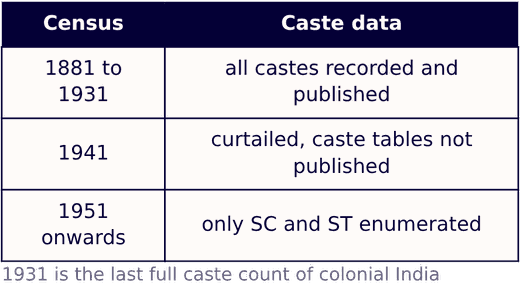 In 1941 the enumeration was cut short and the caste tables were not brought out, mainly because of the strain of the Second World War.
After independence the government decided to count only the Scheduled Castes and Scheduled Tribes, which is why 1931 figures were used for decades in debates on backward classes.
Hence option (c) is correct.
In 1941 the enumeration was cut short and the caste tables were not brought out, mainly because of the strain of the Second World War.
After independence the government decided to count only the Scheduled Castes and Scheduled Tribes, which is why 1931 figures were used for decades in debates on backward classes.
Hence option (c) is correct.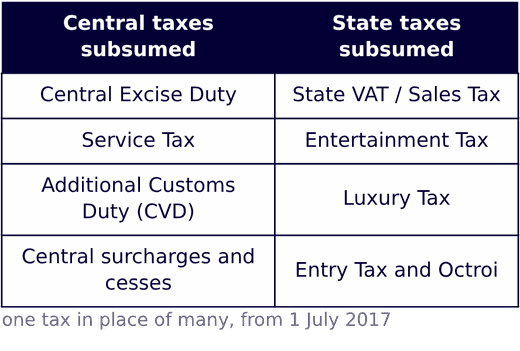 By allowing input tax credit across the chain it removed the cascading 'tax on tax' and turned India into one common market.
Customs duty stayed outside GST, while minimum alternate tax and corporate tax are direct taxes on income and amalgamate nothing.
Hence option (a) is correct.
By allowing input tax credit across the chain it removed the cascading 'tax on tax' and turned India into one common market.
Customs duty stayed outside GST, while minimum alternate tax and corporate tax are direct taxes on income and amalgamate nothing.
Hence option (a) is correct.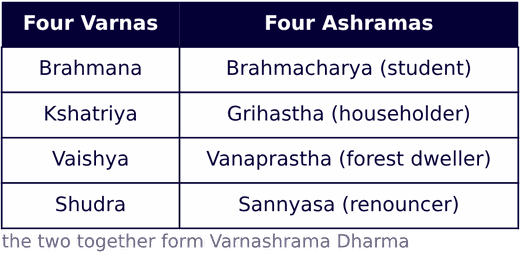 Taken together the two schemes make up Varnashrama Dharma, the standard framework of duty in early India.
Both statements are right, so option (c) is correct.
Taken together the two schemes make up Varnashrama Dharma, the standard framework of duty in early India.
Both statements are right, so option (c) is correct.