SSC CHSL 21 November 2025 · Shift 3 · English Language — questions with answers · ShikshaSphere
Chapter 104 of 200
21 November 2025 · Shift 3
English Language
25 questions ~25 min readFree
25 questions
A
1
Identify the incorrect sentence.
A.Beautiful funitures made this penthouse elegant.
B.How much sugar do you take?
C.Please hurry. It's getting late.
D.He is a very good friend of mine.
Solution
Uncountable noun
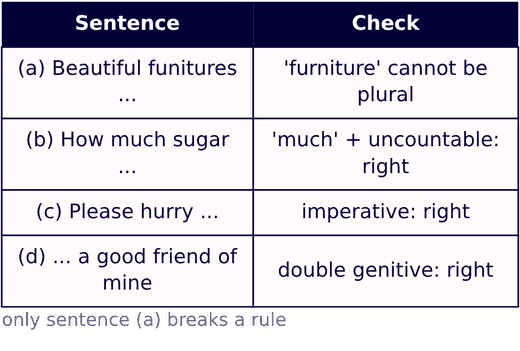
'Furniture' is an uncountable (mass) noun in English: it has no plural form and never takes -s, however many pieces are meant.
Option (a) writes 'funitures', so the sentence is ungrammatical; the correct form is 'Beautiful furniture made this penthouse elegant.'
The other three sentences are sound - 'much' is the right quantifier with the uncountable 'sugar', 'Please hurry' is a normal imperative, and 'a very good friend of mine' is the usual double genitive.
Hence the correct option is (a).
2
Identify the part of the sentence that contains a grammatical error.
A. The organization's data, B. which has been collected and analyzed C. for over a decade, D. support the conclusion that the new strategy is ineffective.
A.The company's data
B.which has been collected and analyzed
C.for over a decade
D.support the conclusion that the new strategy is ineffective.
Solution
Subject-verb agreement
Part B already fixes the number of the subject: 'which has been collected' is a singular verb, so 'data' is being used as a singular mass noun in this sentence.
The main verb in part D must agree with that same subject, therefore 'support' has to become 'supports the conclusion that the new strategy is ineffective.'
Parts A, B and C are faultless - the possessive 'organization's', the relative clause and the time phrase 'for over a decade' are all correctly built.
Hence the correct option is (d).
3
Fill in the blank with the most appropriate preposition:
The rules were implemented accordance with local laws.
A.in
B.by
C.to
D.under
Solution
Fixed preposition
'In accordance with' is a fixed prepositional phrase meaning 'in agreement with' or 'as laid down by'.
The rules were put into effect exactly as the local laws require, which is that sense, so the blank takes 'in'.
'By accordance', 'to accordance' and 'under accordance' are not English collocations; 'under' can go with 'the law' but never with 'accordance'.
Hence the correct option is (a).
4
Fill in the blank with the most appropriate conjunction:
He must complete the registration by Friday, he won't be allowed to participate.
A.or else
B.unless
C.and
D.since
Solution
Conjunction of consequence
The first clause states a condition and the second states what will happen if that condition is missed, so the linker must mean 'if this is not done, then ...'.
'Or else' carries exactly that warning - finish the registration by Friday, otherwise participation is barred.
'Unless' already contains a negative ('if not'), so it cannot be followed by another negative clause; 'and' shows mere addition and 'since' gives a cause, and neither fits a penalty.
Hence the correct option is (a).
5
Choose the correctly spelt word:
A.Abeeyance
B.Abyeence
C.Abyeance
D.Abeyance
Solution
Correct spelling
The correct spelling is 'Abeyance', meaning a state of temporary suspension, as in 'the matter was held in abeyance'.
It comes from Old French 'abeance' and keeps the simple pattern a-bey-ance: one 'e' after the 'b', then 'y', then '-ance'.
Hence the correct option is (d).
6
Select the most appropriate antonym of the word:
Exquisite
A.Elegant
B.Refined
C.Coarse
D.Delicate
Solution
Antonym of Exquisite
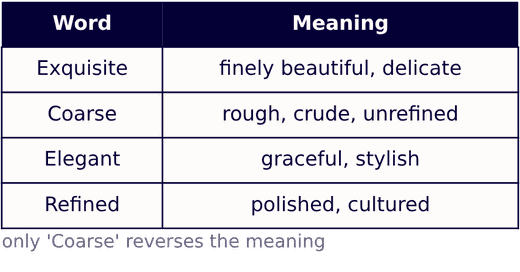
'Exquisite' means extremely beautiful, delicate and finely finished, so its opposite must mean rough or unrefined.
'Coarse' means rough in texture and crude in taste or manner - the exact opposite of a fine, delicate finish.
'Elegant', 'Refined' and 'Delicate' each repeat a part of the meaning of exquisite, so they are synonyms and not antonyms.
Hence the correct option is (c).
7
Choose the correct one-word substitute for:
A system of government of a country in which one person has complete power
A.Democracy
B.Oligarchy
C.Autocracy
D.Plutocracy
Solution
One-word substitution
'Autocracy' is government by a single person who holds absolute, unchecked power - the Greek roots are 'autos' (self) and 'kratos' (rule).
In a democracy power rests with the people, in an oligarchy with a small group and in a plutocracy with the wealthy; in none of these does one person rule alone.
Hence the correct option is (c).
8
Choose the most suitable option to replace the highlighted part of the sentence:
Stewie did not speak to no one in the room.
A.anyone
B.no one
C.somebody
D.nobody
Solution
Double negative
Standard English does not allow two negatives to express a single negation, and 'did not' has already made this sentence negative.
Adding the negative pronoun 'no one' creates a double negative, so it must be replaced by the non-assertive form 'anyone': 'Stewie did not speak to anyone in the room.'
'Nobody' repeats exactly the same fault, and 'somebody' is an assertive form that cannot follow a negative verb.
Hence the correct option is (a).
9
Select the most appropriate antonym of the word:
Euphemism
A.Vagueness
B.Bluntness
C.Substitute
D.Understatement
Solution
Antonym of Euphemism
A euphemism is a mild, polite expression used in place of a harsh or unpleasant one, as 'passed away' is used for 'died'.
Its opposite is plain, direct speech that spares nobody's feelings, and that is 'Bluntness'.
'Understatement' also plays a matter down and 'Vagueness' merely blurs it, so both stand on the same side as euphemism; 'Substitute' names what a euphemism is, not its opposite.
Hence the correct option is (b).
10
Choose the correct indirect narration of the following statement from the given alternatives:
The father said to the child, "Don't touch the hot iron."
A.The father warned the child not to touch the hot iron.
B.The father told the child not to touched the hot iron.
C.The father warned the child not to be touching the hot iron.
D.The father requested the child never to touching the hot iron.
Solution
Imperative in indirect speech
The reported words are a negative command, so in indirect speech the reporting verb becomes one of ordering, telling, forbidding or warning, and the command turns into 'not + to + V1'.
'Don't touch' therefore becomes 'not to touch', and since the caution concerns a danger - a hot iron - 'warned' is the fitting reporting verb.
(b) writes 'not to touched', (c) turns the base verb into a continuous 'to be touching', and (d) has 'never to touching'; all three break the to + base-verb rule.
Hence the correct option is (a).
11
Change the following sentence into the Active form.
The complex project will have been finished by a staff of workers.
A.A staff of workers will finish the complex project.
B.The complex project will finish a staff of workers.
C.A staff of workers will have finished the complex project.
D.The complex project has been finished by a staff of workers.
Solution
Passive to active voice
The given sentence is future perfect passive: 'will have been + V3' in 'will have been finished'.
To make it active, the agent after 'by' becomes the subject, the passive subject becomes the object, and the verb takes the future perfect active form 'will have + V3'.
That gives 'A staff of workers will have finished the complex project.'
(a) drops the perfect aspect, (b) reverses subject and object so that the project finishes the workers, and (d) is still passive and in a different tense.
Hence the correct option is (c).
12
Fill in the blank with the correctly spelled word that means "excessively talkative, especially about trivial matters." The guest kept the host tired with his boring talk.
A.garulous
B.garralous
C.garrulous
D.garrolous
Solution
Correct spelling
The word meant is 'garrulous' - excessively talkative, especially about trivial matters.
It is spelt with a double 'r' and a 'u' in the second syllable: gar-ru-lous, from the Latin 'garrire', to chatter.
Hence the correct option is (c).
13
Choose the most suitable option to replace the highlighted part of the sentence:
As soon as Reena opened the umbrella, a scorpion fell about of it.
A.fell up from
B.fell off from
C.fell out of
D.fallen down of
Solution
Phrasal verb with preposition
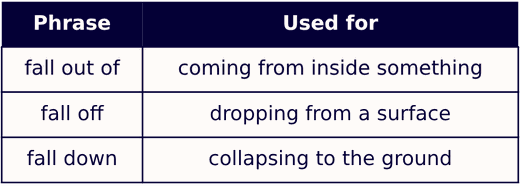
The scorpion was inside the umbrella and came down from inside it, and the phrasal verb for movement out of an enclosed space is 'fall out of'.
The sentence needs a simple past verb to match 'As soon as Reena opened', so the form is 'fell out of'.
'Fell up from' is self-contradictory, 'fell off from' doubles the preposition and suits a surface rather than an inside, and 'fallen down of' is a past participle with no auxiliary verb.
Hence the correct option is (c).
14
Select the option that expresses the given sentence in direct voice.
The novice artist confidently announced that he could paint a masterpiece if he were given enough time.
A.The novice artist announced, "I can paint a masterpiece if I am given enough time."
B.The novice artist said, "He could paint a masterpiece if he was given enough time."
C.The novice artist announced, 'I could paint a masterpiece if I were given enough time."
D.The novice artist said, "I can paint a masterpiece if I were given enough time."
Solution
Indirect to direct speech
The reporting verb 'announced' is in the past, so every verb inside the reported clause has already been shifted one step back; turning the sentence into direct speech simply undoes that shift.
'he could paint' comes forward to 'I can paint' and 'if he were given' to 'if I am given', while the third-person 'he' returns to the speaker's own 'I'.
The reporting verb 'announced' is kept, the conjunction 'that' is dropped, a comma is placed after the reporting verb and the words go inside double inverted commas.
(b) keeps 'He' inside the speaker's own words, (c) leaves the backshifted 'could' and 'were' untouched, and (d) mixes the present 'can' with the backshifted 'were given'.
Hence the correct option is (a).
15
Choose the correct passive voice transformation of the sentence:
The industrious worker performs his tasks with meticulous care every single day.
A.His tasks are performed with meticulous care by the industrious worker every single day.
B.His tasks were performed with meticulous care by the industrious worker every single day.
C.His tasks are being performed with meticulous care by the industrious worker every single day.
D.The industrious worker is performed with meticulous care by his tasks every single day.
Solution
Active to passive voice
The active sentence is in the simple present: subject 'The industrious worker', verb 'performs', object 'his tasks'.
The passive of a simple present verb is 'am/is/are + V3'; the object 'his tasks' is plural, so it becomes the subject and the verb is 'are performed', with 'by the industrious worker' as the agent.
(b) shifts the tense to the past 'were performed', (c) makes it present continuous 'are being performed', and (d) swaps subject and agent so that the worker is performed by his tasks.
Hence the correct option is (a).
16
Directions (Qs. 16-20): Read the following passage carefully and answer the questions that follow.
In an era where urban dwellers frequently lament their scarcity of time, cultivating plants that demand minimal supervision has become almost axiomatic for those seeking verdant comfort within their homes. Certain species, endowed with remarkable resilience, can subsist with negligible intervention, thereby mitigating the anxieties often associated with horticulture.
The snake plant (Sansevieria trifasciata), for instance, is virtually indomitable. It thrives in varied light conditions and can endure erratic watering schedules without forfeiting its structural elegance. Likewise, the pothos (Epipremnum aureum), with its lush, trailing foliage, adapts to both dimly lit corners and well-illuminated spaces, performing photosynthesis with an almost stoic persistence.
Another exemplar is the aloe vera, whose succulent leaves serve as reservoirs of moisture, rendering frequent irrigation superfluous. Beyond its ornamental utility, aloe vera confers medicinal benefits, as its gel is esteemed for dermal amelioration. Even the ZZ plant (Zamioculcas zamiifolia), seemingly sculpted from emerald wax, flourishes in neglect, tolerating prolonged droughts and low luminosity without capitulating to decay.
The allure of such flora lies not merely in their aesthetic contribution but in their implicit lesson: resilience is as captivating as fragility. In cultivating them, one engages in a quiet partnership where human oversight is ancillary, and nature's intrinsic mechanisms orchestrate survival with effortless
grace.
Which of the following correctly converts the statement below into an interrogative sentence? "Plants that demand minimal vigilance have become almost axiomatic for those seeking verdant comfort within their domiciles."
A.Plants that demand minimal vigilance have not become almost axiomatic for those seeking verdant comfort within their domiciles?
B.Is plants that demand minimal vigilance have become almost axiomatic for those seeking verdant comfort within their domiciles?
C.Why plants that demand minimal vigilance have become almost axiomatic for those seeking verdant comfort within their domiciles?
D.Have plants that demand minimal vigilance become almost axiomatic for those seeking verdant comfort within their domiciles?
Solution
Statement to interrogative
The statement carries the auxiliary 'have' in 'have become', and a yes-no question is formed by moving that auxiliary in front of the subject.
The subject here is the whole phrase 'plants that demand minimal vigilance', so 'Have' comes before it and the main verb stays as the past participle 'become'.
(a) keeps the word order of a statement and merely adds 'not', (b) puts the singular 'Is' before a plural subject while still keeping 'have become', and (c) begins with 'Why' without inverting the auxiliary.
Hence the correct option is (d).
17
Directions (Qs. 16-20): Read the following passage carefully and answer the questions that follow.
In an era where urban dwellers frequently lament their scarcity of time, cultivating plants that demand minimal supervision has become almost axiomatic for those seeking verdant comfort within their homes. Certain species, endowed with remarkable resilience, can subsist with negligible intervention, thereby mitigating the anxieties often associated with horticulture.
The snake plant (Sansevieria trifasciata), for instance, is virtually indomitable. It thrives in varied light conditions and can endure erratic watering schedules without forfeiting its structural elegance. Likewise, the pothos (Epipremnum aureum), with its lush, trailing foliage, adapts to both dimly lit corners and well-illuminated spaces, performing photosynthesis with an almost stoic persistence.
Another exemplar is the aloe vera, whose succulent leaves serve as reservoirs of moisture, rendering frequent irrigation superfluous. Beyond its ornamental utility, aloe vera confers medicinal benefits, as its gel is esteemed for dermal amelioration. Even the ZZ plant (Zamioculcas zamiifolia), seemingly sculpted from emerald wax, flourishes in neglect, tolerating prolonged droughts and low luminosity without capitulating to decay.
The allure of such flora lies not merely in their aesthetic contribution but in their implicit lesson: resilience is as captivating as fragility. In cultivating them, one engages in a quiet partnership where human oversight is ancillary, and nature's intrinsic mechanisms orchestrate survival with effortless
grace.
Rewrite the following sentence from the passage in passive voice without changing the tense: "The snake plant (Sansevieria trifasciata) can endure erratic watering schedules without forfeiting its structural elegance."
A.Erratic watering schedules can be endured by the snake plant without forfeiting its structural elegance.
B.Erratic watering schedules are endured by the snake plant without forfeiting its structural elegance.
C.Erratic watering schedules will be endured by the snake plant without forfeiting its structural elegance.
D.Erratic watering schedules were endured by the snake plant without forfeiting its structural elegance.
Solution
Passive with a modal
The sentence contains the modal 'can', and a modal passive is formed as 'modal + be + V3', the modal itself never changing.
The object 'erratic watering schedules' becomes the subject, so 'can endure' becomes 'can be endured', with 'by the snake plant' as the agent; the adverbial 'without forfeiting its structural elegance' stays as it is.
(b) 'are endured', (c) 'will be endured' and (d) 'were endured' all throw away the modal 'can', and with it the sense of ability that the sentence must keep.
Hence the correct option is (a).
18
Directions (Qs. 16-20): Read the following passage carefully and answer the questions that follow.
In an era where urban dwellers frequently lament their scarcity of time, cultivating plants that demand minimal supervision has become almost axiomatic for those seeking verdant comfort within their homes. Certain species, endowed with remarkable resilience, can subsist with negligible intervention, thereby mitigating the anxieties often associated with horticulture.
The snake plant (Sansevieria trifasciata), for instance, is virtually indomitable. It thrives in varied light conditions and can endure erratic watering schedules without forfeiting its structural elegance. Likewise, the pothos (Epipremnum aureum), with its lush, trailing foliage, adapts to both dimly lit corners and well-illuminated spaces, performing photosynthesis with an almost stoic persistence.
Another exemplar is the aloe vera, whose succulent leaves serve as reservoirs of moisture, rendering frequent irrigation superfluous. Beyond its ornamental utility, aloe vera confers medicinal benefits, as its gel is esteemed for dermal amelioration. Even the ZZ plant (Zamioculcas zamiifolia), seemingly sculpted from emerald wax, flourishes in neglect, tolerating prolonged droughts and low luminosity without capitulating to decay.
The allure of such flora lies not merely in their aesthetic contribution but in their implicit lesson: resilience is as captivating as fragility. In cultivating them, one engages in a quiet partnership where human oversight is ancillary, and nature's intrinsic mechanisms orchestrate survival with effortless
grace.
In the phrase *tolerating prolonged droughts... without capitulating to decay," the word "capitulating" is closest in meaning to:
A.Strengthening
B.Surrendering
C.Multiplying
D.Regenerating
Solution
Word meaning in context
'Capitulate' means to stop resisting and give in, to surrender to a stronger force.
The passage says the ZZ plant tolerates prolonged droughts and low light 'without capitulating to decay', that is, without yielding to decay, so 'Surrendering' is the closest meaning.
'Strengthening', 'Multiplying' and 'Regenerating' all describe growth or recovery, which is the very opposite of giving in.
Hence the correct option is (b).
19
Directions (Qs. 16-20): Read the following passage carefully and answer the questions that follow.
In an era where urban dwellers frequently lament their scarcity of time, cultivating plants that demand minimal supervision has become almost axiomatic for those seeking verdant comfort within their homes. Certain species, endowed with remarkable resilience, can subsist with negligible intervention, thereby mitigating the anxieties often associated with horticulture.
The snake plant (Sansevieria trifasciata), for instance, is virtually indomitable. It thrives in varied light conditions and can endure erratic watering schedules without forfeiting its structural elegance. Likewise, the pothos (Epipremnum aureum), with its lush, trailing foliage, adapts to both dimly lit corners and well-illuminated spaces, performing photosynthesis with an almost stoic persistence.
Another exemplar is the aloe vera, whose succulent leaves serve as reservoirs of moisture, rendering frequent irrigation superfluous. Beyond its ornamental utility, aloe vera confers medicinal benefits, as its gel is esteemed for dermal amelioration. Even the ZZ plant (Zamioculcas zamiifolia), seemingly sculpted from emerald wax, flourishes in neglect, tolerating prolonged droughts and low luminosity without capitulating to decay.
The allure of such flora lies not merely in their aesthetic contribution but in their implicit lesson: resilience is as captivating as fragility. In cultivating them, one engages in a quiet partnership where human oversight is ancillary, and nature's intrinsic mechanisms orchestrate survival with effortless
grace.
What does the expression "verdant comfort" imply in the context of the passage?
A.Emotional rest derived from green scenery
B.A luxurious sofa
C.Comfort provided by greenery
D.Artificial decoration
Solution
Meaning of an expression
'Verdant' means green with growing plants, and 'comfort' here is the ease and pleasantness of a living space.
The passage uses the phrase for city dwellers who want that greenery inside their homes without the labour of tending it, so the plain reading is 'Comfort provided by greenery'.
(a) narrows it to emotional rest from 'scenery', which suggests an outdoor view that the passage never discusses; (b) takes 'comfort' literally as furniture; (d) contradicts the passage, which is about living plants, not artificial decoration.
Hence the correct option is (c).
20
Directions (Qs. 16-20): Read the following passage carefully and answer the questions that follow.
In an era where urban dwellers frequently lament their scarcity of time, cultivating plants that demand minimal supervision has become almost axiomatic for those seeking verdant comfort within their homes. Certain species, endowed with remarkable resilience, can subsist with negligible intervention, thereby mitigating the anxieties often associated with horticulture.
The snake plant (Sansevieria trifasciata), for instance, is virtually indomitable. It thrives in varied light conditions and can endure erratic watering schedules without forfeiting its structural elegance. Likewise, the pothos (Epipremnum aureum), with its lush, trailing foliage, adapts to both dimly lit corners and well-illuminated spaces, performing photosynthesis with an almost stoic persistence.
Another exemplar is the aloe vera, whose succulent leaves serve as reservoirs of moisture, rendering frequent irrigation superfluous. Beyond its ornamental utility, aloe vera confers medicinal benefits, as its gel is esteemed for dermal amelioration. Even the ZZ plant (Zamioculcas zamiifolia), seemingly sculpted from emerald wax, flourishes in neglect, tolerating prolonged droughts and low luminosity without capitulating to decay.
The allure of such flora lies not merely in their aesthetic contribution but in their implicit lesson: resilience is as captivating as fragility. In cultivating them, one engages in a quiet partnership where human oversight is ancillary, and nature's intrinsic mechanisms orchestrate survival with effortless
grace.
According to the passage, which plant offers a functional medicinal benefit esteemed for skin care ('dermal amelioration") in addition to its ornamental value?
A.Pothos (Epipremnum aureum)
B.Aloe vera
C.Snake plant (Sansevieria trifasciata)
D.ZZ plant (Zamioculcas zamiifolia)
Solution
Detail from the passage
The third paragraph states that beyond its ornamental utility, aloe vera confers medicinal benefits, as its gel is esteemed for dermal amelioration.
'Dermal amelioration' means improvement of the skin, so aloe vera is the plant credited with a skin-care benefit as well as an ornamental one.
The snake plant, the pothos and the ZZ plant are praised only for hardiness and appearance; the passage claims no medicinal use for them.
Hence the correct option is (b).
21
Rearrange the following sentences to form a meaningful and grammatically correct paragraph:
P. He prepared his body for the intense training by following a specific diet and drinking lots of water.
Q. He tested his body to its limits by going on long runs on the weekends.
R. During the week, he built his endurance by running smaller distances.
S. He was weary but joyful when he reached the finish line on race day.
A.Q, R, P, S
B.P, R, Q, S
C.S, R, Q, P
D.R, S, Q, P
Solution
Sentence rearrangement
The paragraph traces a runner's preparation from the first step to race day, so it must open with what he did before the training itself began.
P is that opening line: the special diet and the water are how he got his body ready for the intense training.
R follows, because it describes the weekday routine — shorter distances that slowly built his endurance.
Q comes after R, since the modest weekday runs lead naturally to the long weekend runs that pushed his body to its limits.
S is the closing line, as the finish line on race day is the result of all that training.
The order is therefore P, R, Q, S, so option (b) is correct.
22
Put the following sentences in the correct order to form a logical and grammatically accurate paragraph:
P. The municipal public park was transformed into a vibrant community hub with lush gardens and leisure spots.
Q. This was a highly anticipated effort that brought people together and fostered a warm atmosphere.
R. The area quickly turned into a popular spot for parents, exercise lovers, and outdoor rans.
S. Residents and local shops teamed up to provide essential items like flowers, seats, and equipment.
A.P, S, Q, R
B.Q, S, R, P
C.S, P, R, Q
D.R, S, P, Q
Solution
Sentence rearrangement
The paragraph is about a park, so the sentence that names the park and states what happened to it has to come first.
P does exactly that: the municipal public park was transformed into a vibrant community hub.
S then tells us how the transformation was managed — residents and local shops pooled flowers, seats and equipment.
Q must follow S, because 'This ... effort' in Q points back to the joint work described in S and comments on it.
R rounds the paragraph off with the outcome: the area became a popular spot for parents and exercise lovers.
The correct order is P, S, Q, R, so option (a) is correct.
23
Which word is closest in meaning to parlour?
The weather was grey and damp, but in the quiet parlour the shades were closed and the lamp shone clearly.
A.Tunnel
B.Balcony
C.Room
D.Garden
Solution
Synonym in context
A parlour is a sitting room in a house, kept for relaxing or for receiving guests, so the plain word closest to it is 'room'.
The sentence itself proves the point: the shades were closed and the lamp shone clearly, which can happen only in an enclosed indoor space.
A balcony is an open platform projecting from an outside wall and a garden is an outdoor patch of ground, so neither could hold drawn shades and a steady lamp while the weather outside was grey and damp.
A tunnel is an underground passage and has nothing to do with a house at all, so option (c) is correct.
24
Which of the following pairs of homonyms can be used to fill in the blanks most suitably?
As Sneha's ring slipped from her finger and sank into the pond, a curious
paddled over and, mistaking it for food, swallowed it whole.
A.symbol, cymbal
B.signet, cygnet
C.cygnet, signet
D.cymbal, symbol
Solution
Homophones: signet / cygnet
'Signet' is a small seal, and a signet ring is the seal-ring worn on a finger — exactly what the first blank needs, since the ring slips off Sneha's finger.
'Cygnet' is a young swan; a swan paddles on a pond and may swallow a shiny object taking it for food, so the second blank needs 'cygnet'.
The order asked for is therefore ring first and bird second, which rules out option (c), where the same two words stand the wrong way round.
'Symbol' is a sign that stands for something and 'cymbal' is a brass percussion instrument, so neither can describe a ring or a bird in a pond.
The correct pair is signet, cygnet, so option (b) is correct.
25
Which term describes an individual who believes in and worships multiple gods?
A.Monotheist
B.Polytheist
C.Atheist
D.Agnostic
Solution
One-word substitution
'Poly-' means many and '-theist' comes from the Greek 'theos', meaning god, so a polytheist is a person who believes in and worships many gods.
The Greek and Roman religions of antiquity are the stock examples of polytheistic faiths.
'Mono-' means one, so a monotheist worships a single god, and the prefix 'a-' means without, so an atheist believes in no god at all.
An agnostic neither affirms nor denies god, holding that the question cannot be settled; hence option (b) is correct.
Finished reading? Now test yourself.
The same 25 questions, but with a timer and the answers hidden — 15 minutes.

 The other three sentences are sound - 'much' is the right quantifier with the uncountable 'sugar', 'Please hurry' is a normal imperative, and 'a very good friend of mine' is the usual double genitive.
Hence the correct option is (a).
The other three sentences are sound - 'much' is the right quantifier with the uncountable 'sugar', 'Please hurry' is a normal imperative, and 'a very good friend of mine' is the usual double genitive.
Hence the correct option is (a).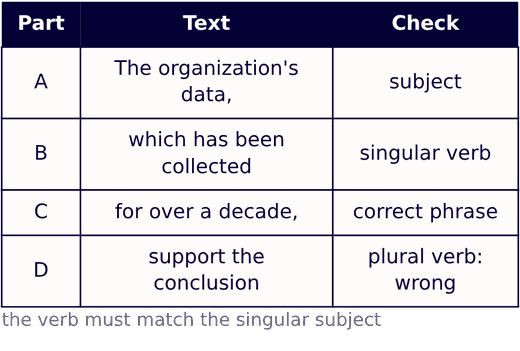 Parts A, B and C are faultless - the possessive 'organization's', the relative clause and the time phrase 'for over a decade' are all correctly built.
Hence the correct option is (d).
Parts A, B and C are faultless - the possessive 'organization's', the relative clause and the time phrase 'for over a decade' are all correctly built.
Hence the correct option is (d).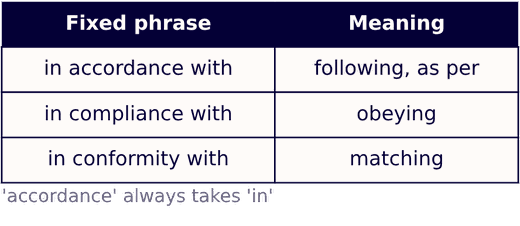 'By accordance', 'to accordance' and 'under accordance' are not English collocations; 'under' can go with 'the law' but never with 'accordance'.
Hence the correct option is (a).
'By accordance', 'to accordance' and 'under accordance' are not English collocations; 'under' can go with 'the law' but never with 'accordance'.
Hence the correct option is (a).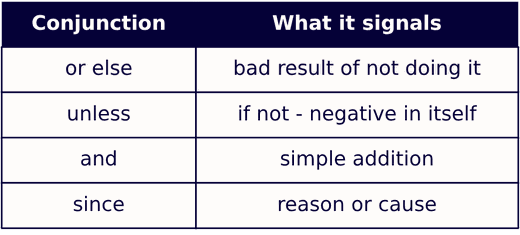 'Unless' already contains a negative ('if not'), so it cannot be followed by another negative clause; 'and' shows mere addition and 'since' gives a cause, and neither fits a penalty.
Hence the correct option is (a).
'Unless' already contains a negative ('if not'), so it cannot be followed by another negative clause; 'and' shows mere addition and 'since' gives a cause, and neither fits a penalty.
Hence the correct option is (a).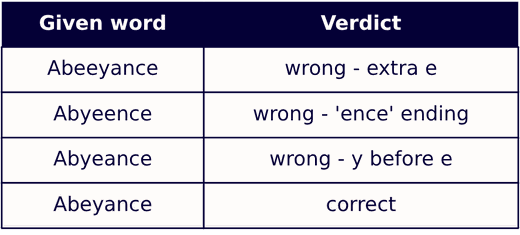 Hence the correct option is (d).
 'Elegant', 'Refined' and 'Delicate' each repeat a part of the meaning of exquisite, so they are synonyms and not antonyms.
Hence the correct option is (c).
'Elegant', 'Refined' and 'Delicate' each repeat a part of the meaning of exquisite, so they are synonyms and not antonyms.
Hence the correct option is (c).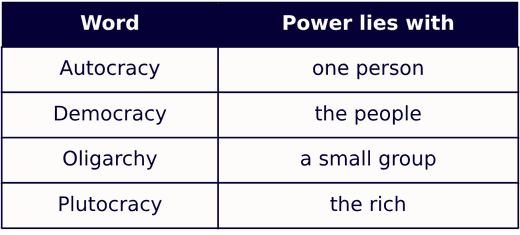 In a democracy power rests with the people, in an oligarchy with a small group and in a plutocracy with the wealthy; in none of these does one person rule alone.
Hence the correct option is (c).
In a democracy power rests with the people, in an oligarchy with a small group and in a plutocracy with the wealthy; in none of these does one person rule alone.
Hence the correct option is (c).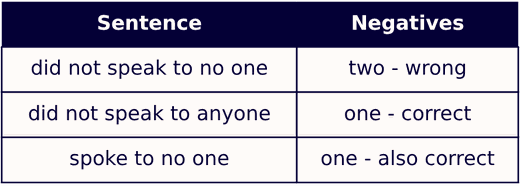 'Nobody' repeats exactly the same fault, and 'somebody' is an assertive form that cannot follow a negative verb.
Hence the correct option is (a).
'Nobody' repeats exactly the same fault, and 'somebody' is an assertive form that cannot follow a negative verb.
Hence the correct option is (a).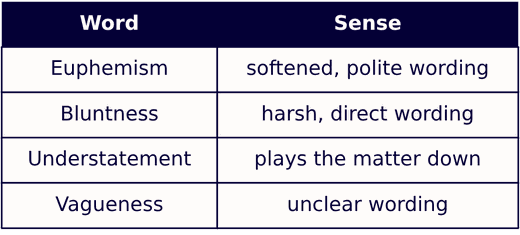 'Understatement' also plays a matter down and 'Vagueness' merely blurs it, so both stand on the same side as euphemism; 'Substitute' names what a euphemism is, not its opposite.
Hence the correct option is (b).
'Understatement' also plays a matter down and 'Vagueness' merely blurs it, so both stand on the same side as euphemism; 'Substitute' names what a euphemism is, not its opposite.
Hence the correct option is (b).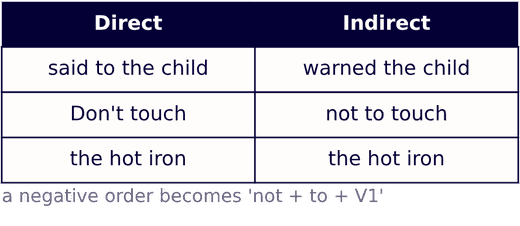 (b) writes 'not to touched', (c) turns the base verb into a continuous 'to be touching', and (d) has 'never to touching'; all three break the to + base-verb rule.
Hence the correct option is (a).
(b) writes 'not to touched', (c) turns the base verb into a continuous 'to be touching', and (d) has 'never to touching'; all three break the to + base-verb rule.
Hence the correct option is (a).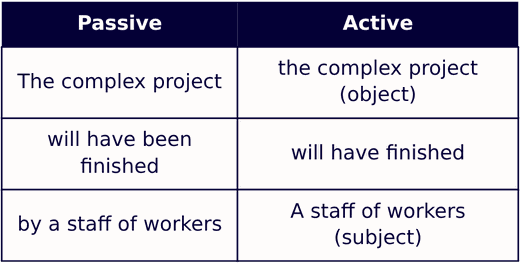 That gives 'A staff of workers will have finished the complex project.'
(a) drops the perfect aspect, (b) reverses subject and object so that the project finishes the workers, and (d) is still passive and in a different tense.
Hence the correct option is (c).
That gives 'A staff of workers will have finished the complex project.'
(a) drops the perfect aspect, (b) reverses subject and object so that the project finishes the workers, and (d) is still passive and in a different tense.
Hence the correct option is (c).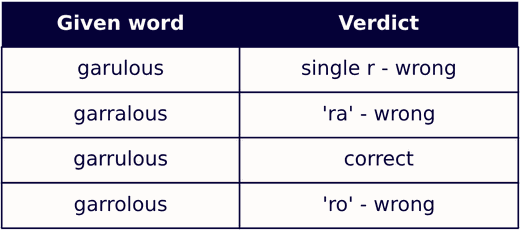 Hence the correct option is (c).
 'Fell up from' is self-contradictory, 'fell off from' doubles the preposition and suits a surface rather than an inside, and 'fallen down of' is a past participle with no auxiliary verb.
Hence the correct option is (c).
'Fell up from' is self-contradictory, 'fell off from' doubles the preposition and suits a surface rather than an inside, and 'fallen down of' is a past participle with no auxiliary verb.
Hence the correct option is (c).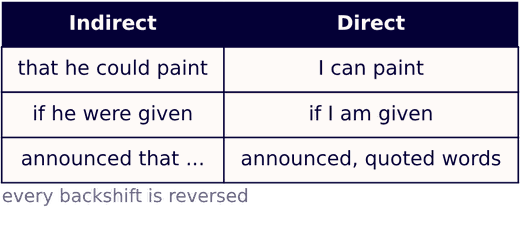 The reporting verb 'announced' is kept, the conjunction 'that' is dropped, a comma is placed after the reporting verb and the words go inside double inverted commas.
(b) keeps 'He' inside the speaker's own words, (c) leaves the backshifted 'could' and 'were' untouched, and (d) mixes the present 'can' with the backshifted 'were given'.
Hence the correct option is (a).
The reporting verb 'announced' is kept, the conjunction 'that' is dropped, a comma is placed after the reporting verb and the words go inside double inverted commas.
(b) keeps 'He' inside the speaker's own words, (c) leaves the backshifted 'could' and 'were' untouched, and (d) mixes the present 'can' with the backshifted 'were given'.
Hence the correct option is (a).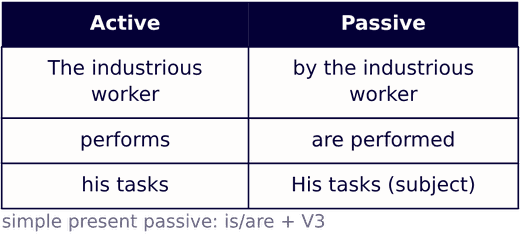 (b) shifts the tense to the past 'were performed', (c) makes it present continuous 'are being performed', and (d) swaps subject and agent so that the worker is performed by his tasks.
Hence the correct option is (a).
(b) shifts the tense to the past 'were performed', (c) makes it present continuous 'are being performed', and (d) swaps subject and agent so that the worker is performed by his tasks.
Hence the correct option is (a).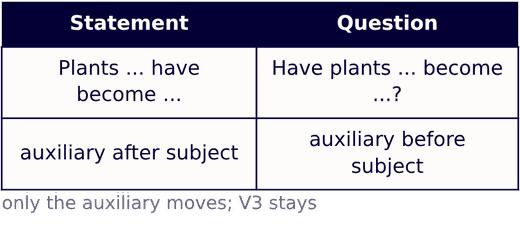 (a) keeps the word order of a statement and merely adds 'not', (b) puts the singular 'Is' before a plural subject while still keeping 'have become', and (c) begins with 'Why' without inverting the auxiliary.
Hence the correct option is (d).
(a) keeps the word order of a statement and merely adds 'not', (b) puts the singular 'Is' before a plural subject while still keeping 'have become', and (c) begins with 'Why' without inverting the auxiliary.
Hence the correct option is (d).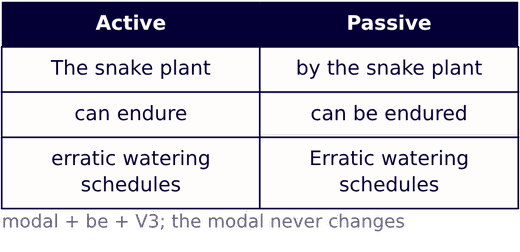 (b) 'are endured', (c) 'will be endured' and (d) 'were endured' all throw away the modal 'can', and with it the sense of ability that the sentence must keep.
Hence the correct option is (a).
(b) 'are endured', (c) 'will be endured' and (d) 'were endured' all throw away the modal 'can', and with it the sense of ability that the sentence must keep.
Hence the correct option is (a).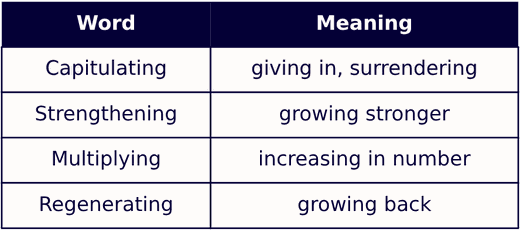 'Strengthening', 'Multiplying' and 'Regenerating' all describe growth or recovery, which is the very opposite of giving in.
Hence the correct option is (b).
'Strengthening', 'Multiplying' and 'Regenerating' all describe growth or recovery, which is the very opposite of giving in.
Hence the correct option is (b).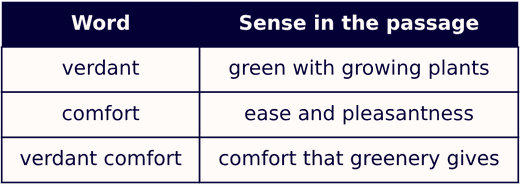 (a) narrows it to emotional rest from 'scenery', which suggests an outdoor view that the passage never discusses; (b) takes 'comfort' literally as furniture; (d) contradicts the passage, which is about living plants, not artificial decoration.
Hence the correct option is (c).
(a) narrows it to emotional rest from 'scenery', which suggests an outdoor view that the passage never discusses; (b) takes 'comfort' literally as furniture; (d) contradicts the passage, which is about living plants, not artificial decoration.
Hence the correct option is (c).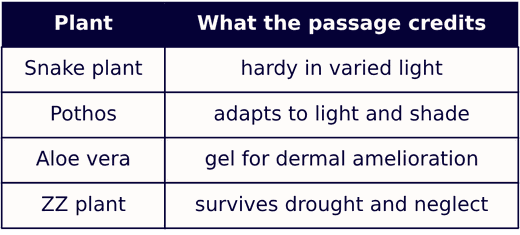 The snake plant, the pothos and the ZZ plant are praised only for hardiness and appearance; the passage claims no medicinal use for them.
Hence the correct option is (b).
The snake plant, the pothos and the ZZ plant are praised only for hardiness and appearance; the passage claims no medicinal use for them.
Hence the correct option is (b).