
26
A contractor hired workers to complete a job in 30 days. After 10 days, 10 workers quit, causing a 5 -day delay. How many workers were hired initially?
- A.30
- B.36
- C.40
- D.50
Solution
Time and work
Let the number of workers hired at the start be x.
Total work = 30x worker-days.
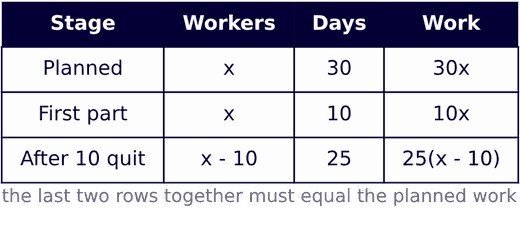 Work done in the first 10 days = 10x, so the work still left = 30x - 10x = 20x.
After the 10 workers leave, (x - 10) workers finish this remaining work, and they take 30 - 10 + 5 = 25 days.
So 25(x - 10) = 20x
25x - 250 = 20x, i.e. 5x = 250, so x = 50
Hence, option (d) is the correct answer.
Work done in the first 10 days = 10x, so the work still left = 30x - 10x = 20x.
After the 10 workers leave, (x - 10) workers finish this remaining work, and they take 30 - 10 + 5 = 25 days.
So 25(x - 10) = 20x
25x - 250 = 20x, i.e. 5x = 250, so x = 50
Hence, option (d) is the correct answer.
Work done in the first 10 days = 10x, so the work still left = 30x - 10x = 20x.
After the 10 workers leave, (x - 10) workers finish this remaining work, and they take 30 - 10 + 5 = 25 days.
So 25(x - 10) = 20x
25x - 250 = 20x, i.e. 5x = 250, so x = 50
Hence, option (d) is the correct answer.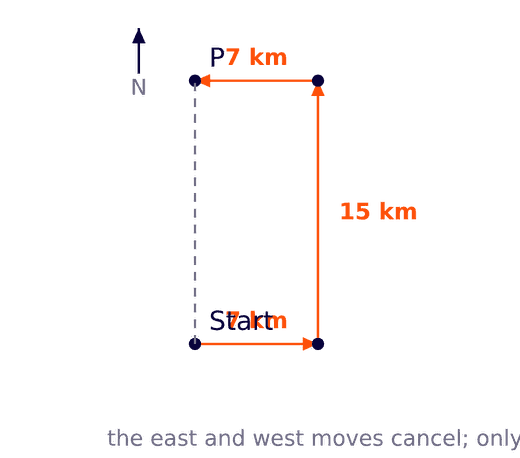 The 7 km walked east is exactly undone by the 7 km walked west, so he ends up on the same north-south line on which he started.
Only the 15 km walked north is left over, so the finishing point lies 15 km due north of the start.
Hence, option (c) is the correct answer.
The 7 km walked east is exactly undone by the 7 km walked west, so he ends up on the same north-south line on which he started.
Only the 15 km walked north is left over, so the finishing point lies 15 km due north of the start.
Hence, option (c) is the correct answer.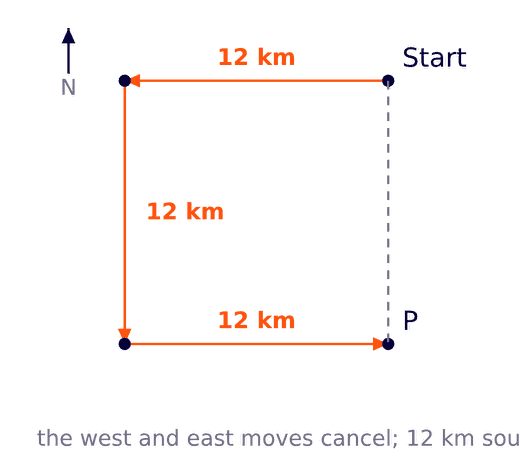 The 12 km walked west and the 12 km walked east are equal and opposite, so they cancel out completely.
Only the 12 km walked south survives, so the required distance = 12 km.
Hence, option (a) is the correct answer.
The 12 km walked west and the 12 km walked east are equal and opposite, so they cancel out completely.
Only the 12 km walked south survives, so the required distance = 12 km.
Hence, option (a) is the correct answer.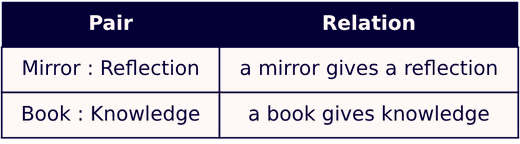 A mirror gives back a reflection; in exactly the same way a book gives the reader knowledge.
'Words' and 'page' are only parts of a book, and the 'author' is the one who makes the book, not what the book gives.
Hence, option (c) is the correct answer.
A mirror gives back a reflection; in exactly the same way a book gives the reader knowledge.
'Words' and 'page' are only parts of a book, and the 'author' is the one who makes the book, not what the book gives.
Hence, option (c) is the correct answer.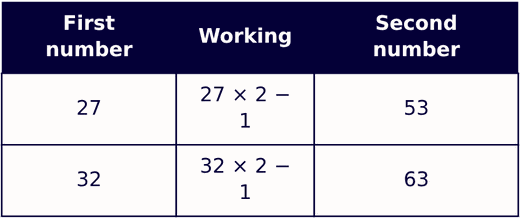 So the rule is: second number = (first number .
Applying it to 32:
Hence, option (c) is the correct answer.
So the rule is: second number = (first number .
Applying it to 32:
Hence, option (c) is the correct answer.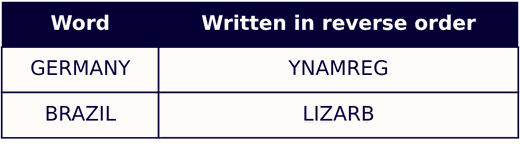 So the code simply writes the word backwards.
BRAZIL reversed letter by letter gives L-I-Z-A-R-B, that is LIZARB.
Hence, option (a) is the correct answer.
So the code simply writes the word backwards.
BRAZIL reversed letter by letter gives L-I-Z-A-R-B, that is LIZARB.
Hence, option (a) is the correct answer.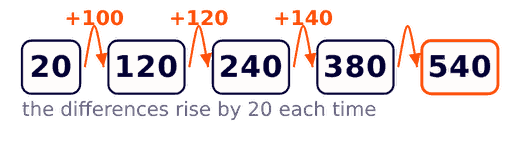 The differences themselves grow by 20 each time, so the next difference must be 140 + 20 = 160.
Required term = 380 + 160 = 540
Hence, option (a) is the correct answer.
The differences themselves grow by 20 each time, so the next difference must be 140 + 20 = 160.
Required term = 380 + 160 = 540
Hence, option (a) is the correct answer.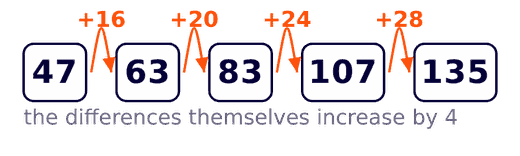 Between them lie two more differences, and 16, 20, 24, 28 rise by 4 each time.
So the missing term = 63 + 20 = 83.
Check: 83 + 24 = 107 and 107 + 28 = 135, which agrees with the series.
Hence, option (d) is the correct answer.
Between them lie two more differences, and 16, 20, 24, 28 rise by 4 each time.
So the missing term = 63 + 20 = 83.
Check: 83 + 24 = 107 and 107 + 28 = 135, which agrees with the series.
Hence, option (d) is the correct answer.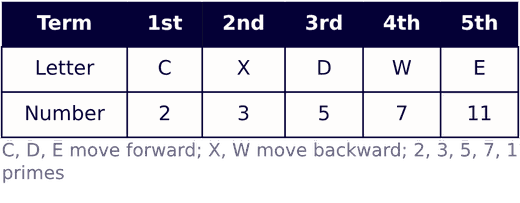 The 1st, 3rd and 5th letters run forward from the beginning of the alphabet - C, D, E; the 2nd and 4th run backward from the end - X, W.
The fifth term is an odd-numbered term, so its letter is E.
The numbers 2, 3, 5, 7 are consecutive prime numbers, so the next number is 11.
The missing term is therefore E11. Hence, option (a) is the correct answer.
The 1st, 3rd and 5th letters run forward from the beginning of the alphabet - C, D, E; the 2nd and 4th run backward from the end - X, W.
The fifth term is an odd-numbered term, so its letter is E.
The numbers 2, 3, 5, 7 are consecutive prime numbers, so the next number is 11.
The missing term is therefore E11. Hence, option (a) is the correct answer.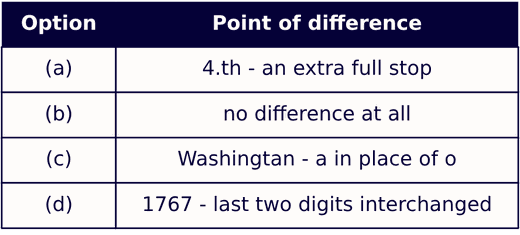 Option (a) inserts an extra full stop and writes '4.th'; option (c) spells the name as 'Washingtan'; option (d) writes the year as 1767 instead of 1776.
Option (b) repeats every letter, digit, space and punctuation mark of the reference without a single change.
Hence, option (b) is the correct answer.
Option (a) inserts an extra full stop and writes '4.th'; option (c) spells the name as 'Washingtan'; option (d) writes the year as 1767 instead of 1776.
Option (b) repeats every letter, digit, space and punctuation mark of the reference without a single change.
Hence, option (b) is the correct answer.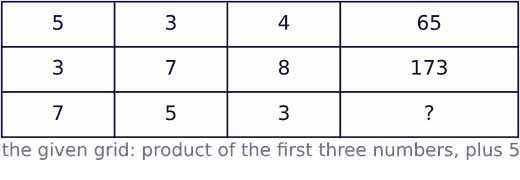 In each row, multiply the first three numbers and then add 5 to that product.
Row 1: and 60 + 5 = 65
Row 2: and 168 + 5 = 173
Row 3: , so ? = 105 + 5 = 110
Hence, option (b) is the correct answer.
In each row, multiply the first three numbers and then add 5 to that product.
Row 1: and 60 + 5 = 65
Row 2: and 168 + 5 = 173
Row 3: , so ? = 105 + 5 = 110
Hence, option (b) is the correct answer.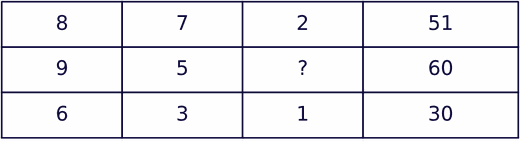
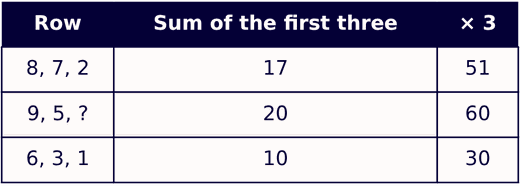 Row 1:
Row 3:
Row 2: , so 9 + 5 + ? = 20, which gives ? = 6
Hence, option (c) is the correct answer.
Row 1:
Row 3:
Row 2: , so 9 + 5 + ? = 20, which gives ? = 6
Hence, option (c) is the correct answer.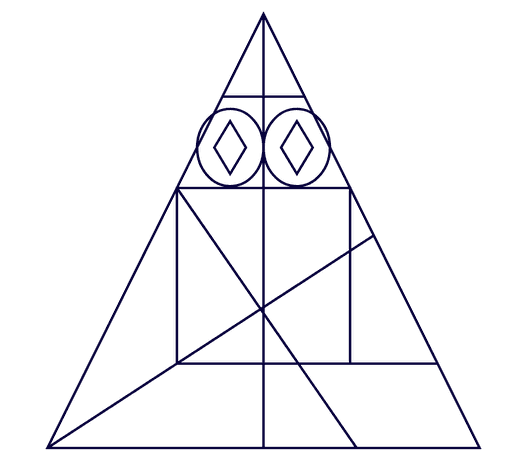
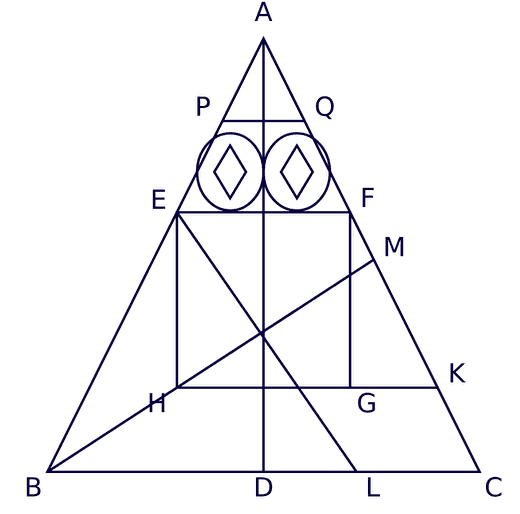 Take the triangles group by group so that none is counted twice.
With the apex A as a vertex: ABC, ABD, ACD, AEF, APQ, ABM and the eight smaller ones that the median AD cuts out with PQ, EF, HK, EL and BM - 14 in all.
With B as a vertex but not A: BEL, BCM and the three pieces that AD and EL cut from them - 5 in all.
Lying wholly inside the square EFGH and in the strip below it: FGK, HKM, EHW, GHY, DLT and six more formed where EL, BM, HK and AD cross - 11 in all.
Total number of triangles = 14 + 5 + 11 = 30
Hence, option (c) is the correct answer.
Take the triangles group by group so that none is counted twice.
With the apex A as a vertex: ABC, ABD, ACD, AEF, APQ, ABM and the eight smaller ones that the median AD cuts out with PQ, EF, HK, EL and BM - 14 in all.
With B as a vertex but not A: BEL, BCM and the three pieces that AD and EL cut from them - 5 in all.
Lying wholly inside the square EFGH and in the strip below it: FGK, HKM, EHW, GHY, DLT and six more formed where EL, BM, HK and AD cross - 11 in all.
Total number of triangles = 14 + 5 + 11 = 30
Hence, option (c) is the correct answer.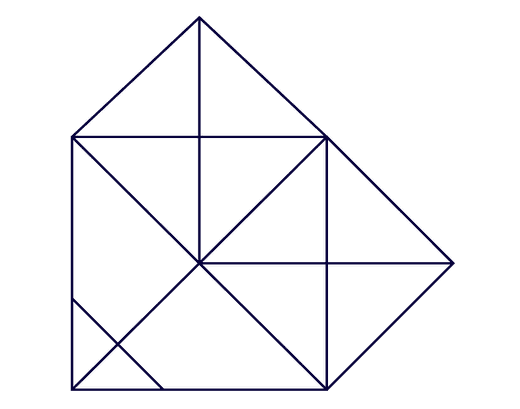
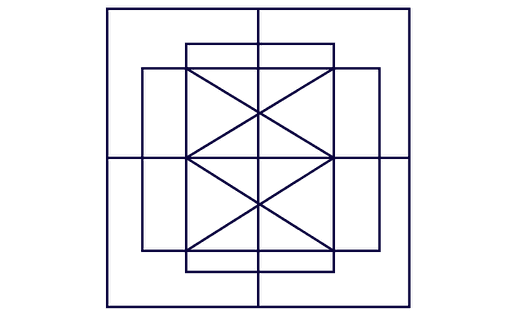
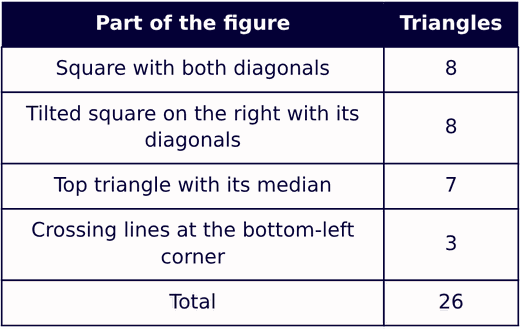 A square with both of its diagonals drawn always holds 8 triangles - 4 quarters and 4 halves - so the big square gives 8.
The tilted square on the right also has both of its diagonals drawn (the right side of the big square and the horizontal line to the far corner), so it gives 8 more.
The triangle standing on top has its median drawn down to the centre; with the two diagonals of the square it accounts for 7 more.
The two crossing lines in the bottom-left corner add 3 more.
Total = 8 + 8 + 7 + 3 = 26
Hence, option (c) is the correct answer.
A square with both of its diagonals drawn always holds 8 triangles - 4 quarters and 4 halves - so the big square gives 8.
The tilted square on the right also has both of its diagonals drawn (the right side of the big square and the horizontal line to the far corner), so it gives 8 more.
The triangle standing on top has its median drawn down to the centre; with the two diagonals of the square it accounts for 7 more.
The two crossing lines in the bottom-left corner add 3 more.
Total = 8 + 8 + 7 + 3 = 26
Hence, option (c) is the correct answer.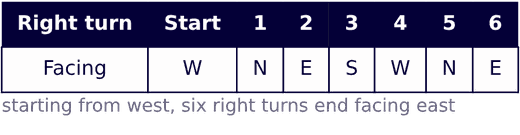 A half turn simply reverses the direction, so the final direction is exactly opposite to the starting one.
He finally faces east, and the opposite of east is west, so he started walking towards the west.
Hence, option (d) is the correct answer.
A half turn simply reverses the direction, so the final direction is exactly opposite to the starting one.
He finally faces east, and the opposite of east is west, so he started walking towards the west.
Hence, option (d) is the correct answer.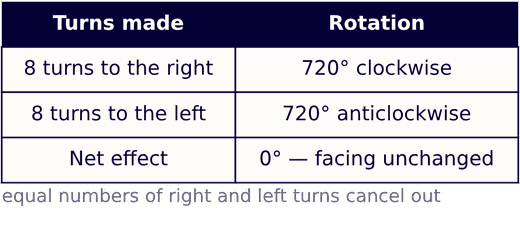 Net turning , and since rotations simply add up, the order of the turns does not matter.
So the final facing is the same as the starting facing, which was south.
Hence, option (c) is the most appropriate answer.
Net turning , and since rotations simply add up, the order of the turns does not matter.
So the final facing is the same as the starting facing, which was south.
Hence, option (c) is the most appropriate answer.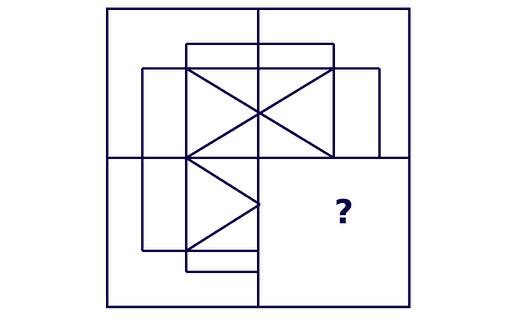
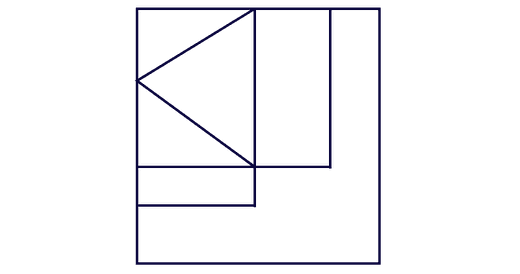
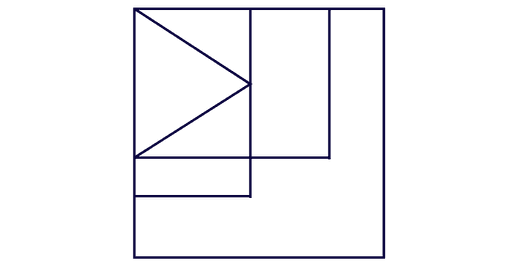
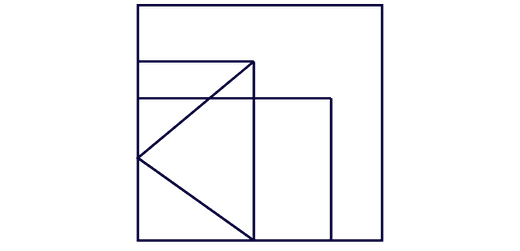
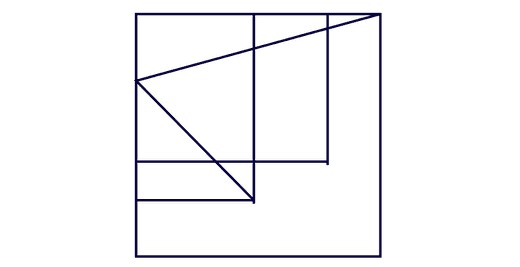
 Only figure (a) has both nested corners together with the wedge opening towards the right; (b) turns the wedge the other way round, (c) pushes the two corners up towards the top edge and (d) stretches one arm of the wedge to the far corner.
Hence, option (a) is the most appropriate answer.
Only figure (a) has both nested corners together with the wedge opening towards the right; (b) turns the wedge the other way round, (c) pushes the two corners up towards the top edge and (d) stretches one arm of the wedge to the far corner.
Hence, option (a) is the most appropriate answer.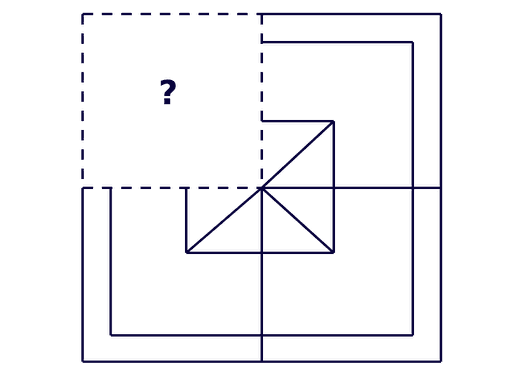
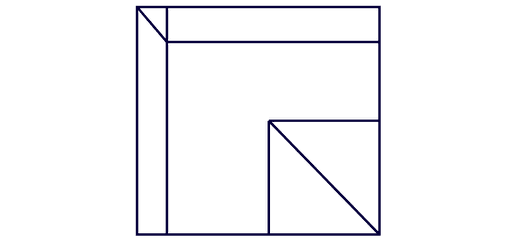
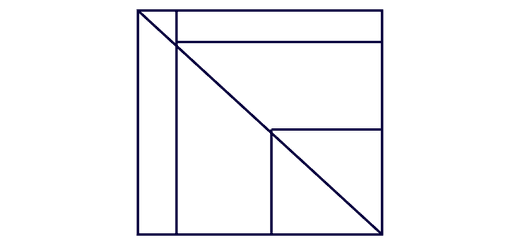
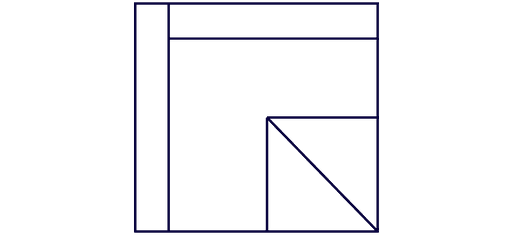
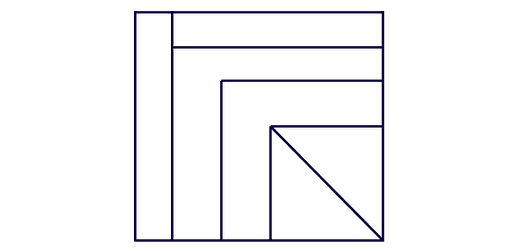
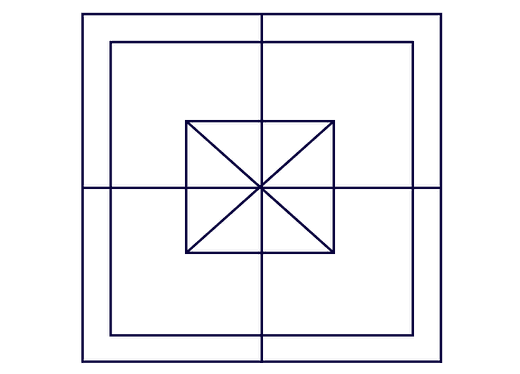 Figure (c) shows exactly two nested corners plus that single short diagonal; (a) adds a stray diagonal at the outer corner, (b) draws the diagonal right across the tile from corner to corner and (d) has three nested corners instead of two.
Hence, option (c) is the most appropriate answer.
Figure (c) shows exactly two nested corners plus that single short diagonal; (a) adds a stray diagonal at the outer corner, (b) draws the diagonal right across the tile from corner to corner and (d) has three nested corners instead of two.
Hence, option (c) is the most appropriate answer.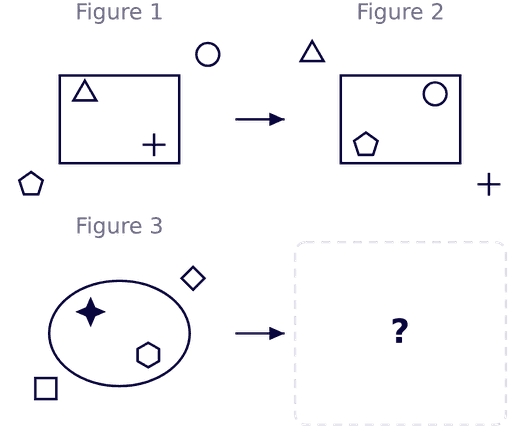




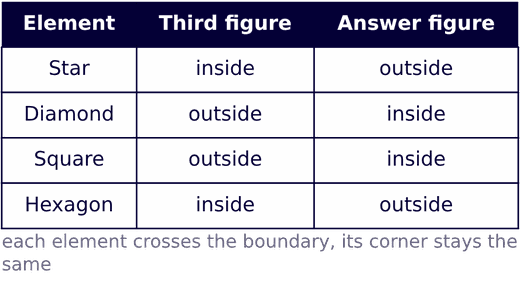 The answer figure must therefore show the star outside at the top-left, the diamond inside at the top-right, the square inside at the bottom-left and the hexagon outside at the bottom-right.
Option (b) leaves the diamond and the square outside, option (a) leaves the diamond sitting on the ellipse instead of fully inside it, and option (d) keeps the star inside.
Hence, option (c) is the correct answer.
The answer figure must therefore show the star outside at the top-left, the diamond inside at the top-right, the square inside at the bottom-left and the hexagon outside at the bottom-right.
Option (b) leaves the diamond and the square outside, option (a) leaves the diamond sitting on the ellipse instead of fully inside it, and option (d) keeps the star inside.
Hence, option (c) is the correct answer.
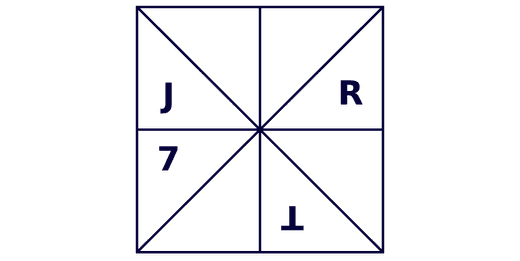
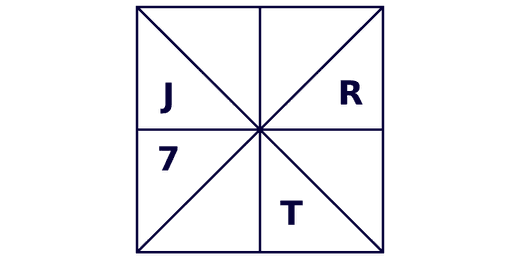
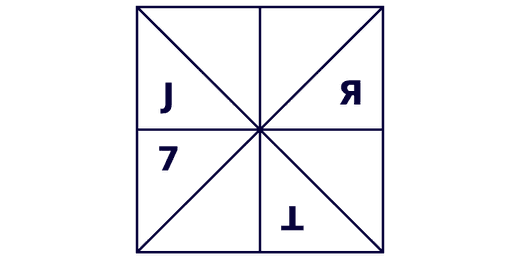
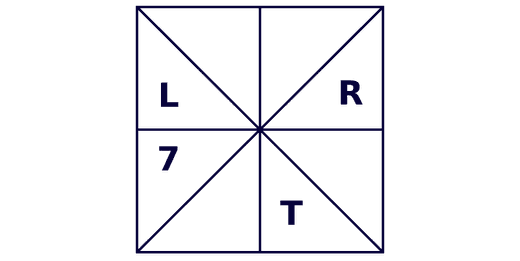
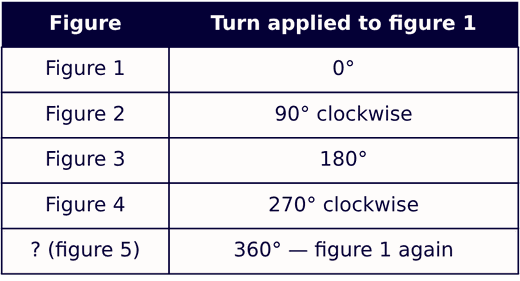 So figure 2 is figure 1 turned through , figure 3 through and figure 4 through .
One more quarter turn completes , so the fifth figure must be figure 1 itself: J in the upper left triangle, R in the upper right, 7 in the lower left and T at the bottom, every symbol standing the right way up.
Option (b) is that figure. (a) and (c) turn the T upside down, (c) also reverses the R, and (d) replaces the J by an L.
Hence, option (b) is the most appropriate answer.
So figure 2 is figure 1 turned through , figure 3 through and figure 4 through .
One more quarter turn completes , so the fifth figure must be figure 1 itself: J in the upper left triangle, R in the upper right, 7 in the lower left and T at the bottom, every symbol standing the right way up.
Option (b) is that figure. (a) and (c) turn the T upside down, (c) also reverses the R, and (d) replaces the J by an L.
Hence, option (b) is the most appropriate answer.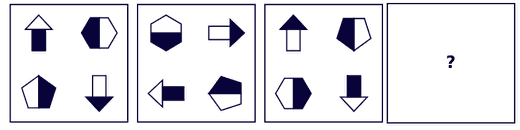
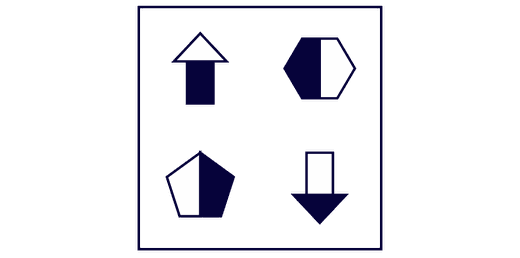
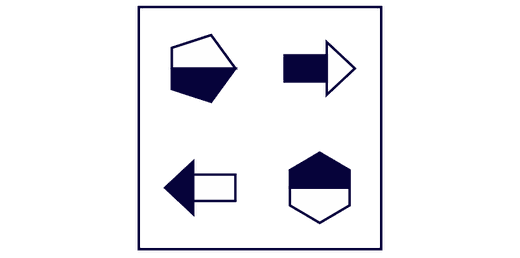
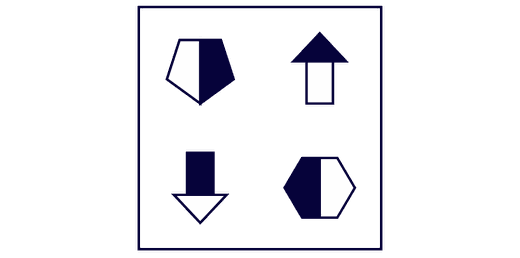
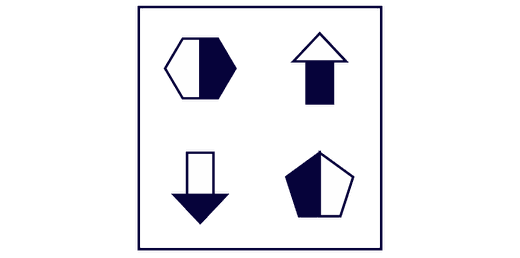
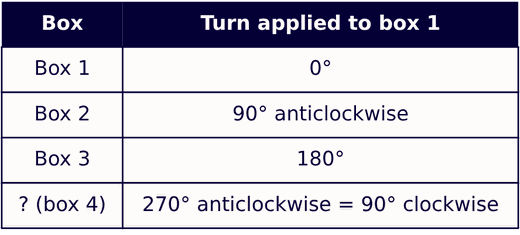 Box 3 is therefore box 1 turned through , and the missing box is box 1 turned through anticlockwise, which is the same as turning box 1 through clockwise.
That places the pentagon at the top left pointing right with its shaded half below, the white-headed arrow at the top right pointing right, the arrow with the white tail at the bottom left pointing left and the hexagon at the bottom right with its shaded half on top.
Hence, option (b) is the most appropriate answer.
Box 3 is therefore box 1 turned through , and the missing box is box 1 turned through anticlockwise, which is the same as turning box 1 through clockwise.
That places the pentagon at the top left pointing right with its shaded half below, the white-headed arrow at the top right pointing right, the arrow with the white tail at the bottom left pointing left and the hexagon at the bottom right with its shaded half on top.
Hence, option (b) is the most appropriate answer.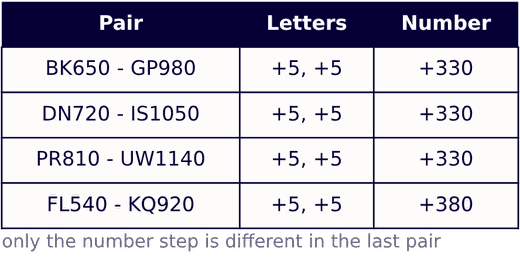 The letter rule holds everywhere, so it cannot decide the question; the number rule +330 is broken only in (d).
Hence, option (d) is the most appropriate answer.
The letter rule holds everywhere, so it cannot decide the question; the number rule +330 is broken only in (d).
Hence, option (d) is the most appropriate answer.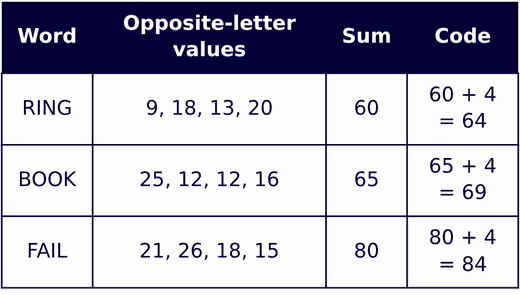 FAIL: , , , .
Sum = 21+26+18+15 = 80, so the code is 80+4 = 84.
Hence, option (b) is the most appropriate answer.
FAIL: , , , .
Sum = 21+26+18+15 = 80, so the code is 80+4 = 84.
Hence, option (b) is the most appropriate answer.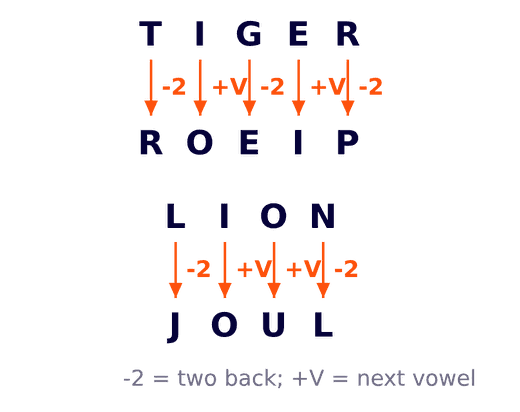 Now apply the same rules to LION: , , , .
So LION is written as JOUL.
Hence, option (a) is the most appropriate answer.
Now apply the same rules to LION: , , , .
So LION is written as JOUL.
Hence, option (a) is the most appropriate answer.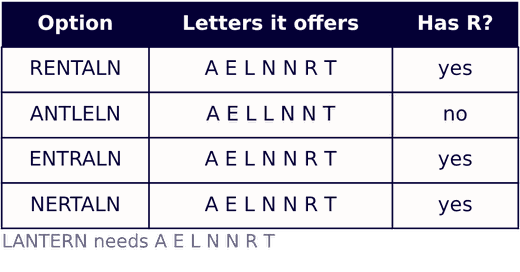 RENTALN, ENTRALN and NERTALN are all made of exactly those seven letters in a different order, so LANTERN can be formed from each of them.
ANTLELN, however, is made of A, E, L, L, N, N, T — it carries a second L but no R at all, and LANTERN cannot be written without an R.
Hence, option (b) is the most appropriate answer.
RENTALN, ENTRALN and NERTALN are all made of exactly those seven letters in a different order, so LANTERN can be formed from each of them.
ANTLELN, however, is made of A, E, L, L, N, N, T — it carries a second L but no R at all, and LANTERN cannot be written without an R.
Hence, option (b) is the most appropriate answer.