SSC CHSL 22 November 2025 · Shift 1 · General Awareness — questions with answers · ShikshaSphere
Chapter 106 of 200
22 November 2025 · Shift 1
General Awareness
25 questions ~25 min readFree
25 questions
A
76
Which tribal group held significant influence in the Punjab region during the 13th and 14th centuries?
A.The Khokhar
B.The Munda
C.The Oraon
D.The Baiga
Solution
Medieval tribes of India
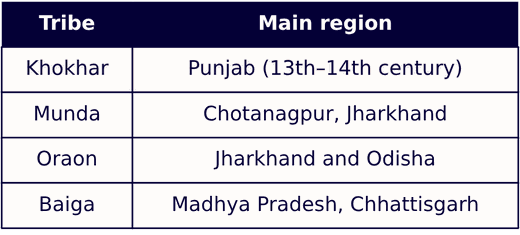
The Khokhars were a powerful tribal clan of the Punjab plains in the 13th and 14th centuries.
They repeatedly defied the authority of the Delhi Sultanate; their chief Jasrat Khokhar even seized parts of Punjab and challenged the Sayyid rulers of Delhi.
The Munda and the Oraon belong to the Chotanagpur plateau and the Baiga to central India, so none of them fits the Punjab region.
Hence, option (a) is the correct answer.
77
Consider the following statements about Emperor Akbar's military campaigns:
I. The conquest of Ranthambore took place in the year 1569 .
II. Akbar's Gujarat campaign was carried out in 1572.
Which of the statements given above is/are correct?
A.Statement I alone
B.Statement II alone
C.Both I and II
D.Neither statement is correct
Solution
Akbar's conquests
Statement I is correct: Akbar laid siege to the fort of Ranthambore and Rai Surjan Hada surrendered it in 1569, the year after the fall of Chittor.
Statement II is correct: Akbar marched on Gujarat in 1572 and occupied Ahmedabad the same year; the campaign was completed with the capture of Surat in 1573.
Both statements are therefore correct.
Hence, option (c) is the correct answer.
78
Which Indian actress became the first from India to receive an international award at the 1963 Moscow International Film Festival ?
A.Meena Kumari
B.Suchitra Sen
C.Sharmila Tagore
D.Waheeda Rehman
Solution
Indian cinema awards
Suchitra Sen won the Silver Prize for Best Actress at the 3rd Moscow International Film Festival in 1963.
The award was for her performance in the Bengali film Saat Paake Bandha, and it made her the first Indian actress to win an international acting honour.
Celebrated as the 'Mahanayika' of Bengali cinema, she also received the Padma Shri and withdrew from public life after 1978.
Hence, option (b) is the correct answer.
79
Who was the first Indian to receive the Nobel Prize ?
A.Hargobind Khorana
B.Rabindranath Tagore
C.C. V. Raman
D.Venkatraman Ramakrishnan
Solution
Indian Nobel laureates
Rabindranath Tagore received the Nobel Prize in Literature in 1913 for Gitanjali, becoming the first Indian - and the first Asian - to win a Nobel Prize.
C. V. Raman (Physics, 1930) was the first Indian scientist to be honoured, Hargobind Khorana won the prize in Medicine in 1968 and Venkatraman Ramakrishnan in Chemistry in 2009.
Since Tagore's award of 1913 is the earliest of these, he is the first Indian Nobel laureate.
Hence, option (b) is the correct answer.
80
Swavalambini, launched in March 2025, is an initiative focused on which area ?
A.Skill Development for Youth
B.Women Entrepreneurship Programme
C.Rural Health Awareness
D.Digital Literacy Drive
Solution
Government scheme 2025
Swavalambini, launched in March 2025, is a Women Entrepreneurship Programme.
It was rolled out by the Ministry of Skill Development and Entrepreneurship through the Indian Institute of Entrepreneurship (IIE), Guwahati, starting with higher-education institutions of the North-Eastern states.
Women students get awareness sessions, entrepreneurship training and mentorship so that they leave college as job creators rather than job seekers.
Hence, option (b) is the correct answer.
81
In 2025, the PM SVANidhi scheme was upgraded to include UPI-linked credit cards for street vendors. Which Ministry is responsible for this scheme ?
A.Ministry of Finance
B.Ministry of Housing & Urban Affairs
C.Ministry of Labour & Employment
D.Ministry of Commerce & Industry
Solution
Government schemes
PM Street Vendor's AtmaNirbhar Nidhi (PM SVANidhi) is administered by the Ministry of Housing & Urban Affairs, because street vending is an urban-livelihood subject that ministry already handles through DAY-NULM.
The scheme was launched on 1 June 2020 to give urban street vendors collateral-free working capital loans in rising tranches, so that they could restart the businesses that the COVID-19 lockdown had shut down.
Repayment on time earns an interest subsidy and a bigger next loan, and digital transactions earn cashback — which is exactly why the 2025 upgrade issued vendors UPI-linked credit cards.
Banks and the RBI only act as lending and regulatory partners, so the Finance Ministry is not the nodal ministry; Labour & Employment deals with organised-sector labour law, not urban vending.
Hence option (b) is correct.
82
According to the World Press Freedom Index 2025, which country ranked as the lowest performer in terms of press freedom?
A.Yemen
B.North Korea
C.Eritrea
D.Myanmar
Solution
Global indices
The World Press Freedom Index is brought out every year by Reporters Without Borders (RSF), a Paris-based non-profit, and it ranks 180 countries and territories.
In the 2025 Index, Eritrea was placed 180th, i.e. the lowest performer in the world, since the country has no privately owned news media at all and every outlet works directly under the state.
Norway held the first position once again, with Estonia and the Netherlands next.
India was ranked 151st in 2025, an improvement from 159th in 2024; Yemen, North Korea and Myanmar also lie near the bottom but all of them finished above Eritrea.
Hence option (c) is correct.
83
As of July 2025, what is the approximate cumulative installed solar power capacity of India (in GW) ?
A.85
B.119.02
C.140
D.200
Solution
Renewable energy capacity
As per the Ministry of New and Renewable Energy, India's cumulative installed solar capacity stood at about 119.02 GW at the end of July 2025.
Ground-mounted utility-scale plants supply the bulk of it, with grid-connected rooftop solar a distant second, and hybrid and off-grid systems making up the rest.
Solar alone is therefore more than half of India's total renewable capacity of roughly 227 GW reached in July 2025, and it is the fastest-growing segment of the 500 GW non-fossil target for 2030.
The figure of 85 GW belongs to an earlier year and 140 GW and 200 GW were reached only later, so they cannot describe July 2025.
Hence option (b) is correct.
84
Speedpost, a book consisting of personal letters written to her children, was authored by whom?
A.Anita Desai
B.Shobha De
C.Chitra Banerjee Divakaruni
D.Namita Gokhale
Solution
Books and authors
'Speedpost' (1999) is by Shobhaa De; it is a set of frank, affectionate letters addressed to her six children on growing up, careers, love and family life, and it is her best-known work of non-fiction.
Shobhaa De began as a journalist and founded the magazine 'Stardust'; her novels include 'Socialite Evenings', 'Starry Nights' and 'Strange Obsession'.
The other three writers are all novelists and none of them has a book of letters to her children by this title.
Hence option (b) is correct.
85
The period regarded as the "Golden Age" of Indian temple architecture is:
A.Gupta Period
B.Satavahana Period
C.Pala Period
D.Rajput Period
Solution
Temple architecture
The Gupta period (roughly 320-550 CE) is called the Golden Age of Indian temple architecture because the first free-standing structural temples in stone and brick were raised then.
It fixed the vocabulary that every later Hindu temple used: a square garbhagriha (sanctum) for the image, a pillared mandapa in front, a raised plinth, and the beginnings of the shikhara above the sanctum.
Deogarh's Dashavatara temple, the brick temple at Bhitargaon and Temple No. 17 at Sanchi are the classic surviving examples, and the Nagara style grew directly out of them.
The Satavahanas are remembered for rock-cut chaityas such as Karle, the Palas for Buddhist monastic universities and bronzes, and the Rajputs for forts and much later temples — none of these begins the temple tradition.
Hence option (a) is correct.
86
Which dance form is traditionally associated with the state of Himachal Pradesh?
A.Bihu
B.Garba
C.Kathakali
D.Shand and Shabu
Solution
Folk dances of India
Shand and Shabu are the traditional dances of the Lahaul valley of Himachal Pradesh, performed by the Buddhist communities of the region in the courtyards of gompas (monasteries) to honour the Buddha.
Shand is danced on ceremonial and religious occasions, while Shabu is performed during the summer months after the flocks return, both to the beat of local drums and horns.
The other three options belong to other states altogether, so they cannot be the answer.
Hence option (d) is correct.
87
About how many years after the Big Bang did the universe cool to nearly 4500 K , allowing atoms to form and making the universe transparent?
A.300,000
B.30,000
C.3,000
D.300
Solution
Big Bang theory
Within about 300,000 years of the Big Bang the expanding universe had cooled to roughly 4500 K, cool enough for free electrons to be captured by nuclei and form neutral atoms.
Before this the universe was a hot plasma of nuclei and free electrons, and the electrons scattered light continuously, so the universe was opaque.
Once the electrons were locked into atoms, light could travel freely — the universe became transparent, and that released radiation survives today as the cosmic microwave background.
At 300, 3,000 or 30,000 years the temperature was still far too high for atoms to survive, so those options are ruled out.
Hence option (a) is correct.
88
In January 2025, which nation unveiled the world's most powerful hydrogen-powered train engine?
A.India
B.China
C.South Korea
D.Italy
Solution
Current affairs - Railways
In January 2025 Indian Railways announced an indigenously developed hydrogen-powered train engine of 1,200 horsepower — the most powerful hydrogen rail engine in the world.
It was built at the Integral Coach Factory, Chennai, and its first trial run was planned on the 89 km Jind-Sonipat section in Haryana under the 'Hydrogen for Heritage' programme.
Hydrogen trains run on fuel cells in which hydrogen combines with oxygen to give electricity, and the only emission is water vapour, so they are zero-carbon at the point of use.
Germany, France, Sweden and China already run hydrogen trains, but those engines are rated at about 500-600 HP, roughly half of the Indian engine's output.
Hence option (a) is correct.
89
When an object travels different distances in the same amount of time, its motion is described as:
A.Uniform motion
B.Linear motion
C.Non-uniform motion
D.Circular motion
Solution
Types of motion
A body is in uniform motion when it covers equal distances in equal intervals of time, however small the intervals are; its speed is constant and its acceleration is a = 0.
If the distances covered in equal intervals are unequal, the speed keeps changing, so the acceleration is and the motion is called non-uniform motion.
A car in city traffic is the standard example — it covers different distances each second because of stops and turns.
Linear and circular motion only describe the shape of the path (straight line or circle) and say nothing about whether the distance per unit time is equal, so they do not answer the question.
Hence option (c) is correct.
90
Which historic battle took place in the year 1761 in Indian history?
A.Third Battle of Panipat
B.Battle of Plassey
C.Battle of Buxar
D.First Battle of Tarain
Solution
Battles in Indian history
The Third Battle of Panipat was fought on 14 January 1761 between the Marathas, led by Sadashivrao Bhau, and the Afghan ruler Ahmad Shah Abdali (Durrani), who was supported by Najib-ud-Daulah and Shuja-ud-Daula.
The Marathas were decisively defeated; Vishwasrao and Sadashivrao Bhau were killed, and Maratha power in North India was crippled for the next decade.
That collapse of the only Indian power able to check the English is why 1761 is treated as a turning point in the rise of British supremacy.
Hence option (a) is correct.
91
In government budgeting, expenses such as salaries, pensions, and defence services are classified under:
A.Revenue expenditure
B.Capital expenditure
C.Capital receipts
D.Non-tax revenue
Solution
Government budget
The test for revenue expenditure is simple: the spending must neither create an asset for the government nor reduce any of its liabilities, and it must recur year after year.
Salaries, pensions, defence services, interest payments and subsidies all pass that test — the money is consumed in running the government, leaving nothing behind that the government owns.
Capital expenditure is the opposite: buying land, building roads, or repaying the principal of a loan either creates an asset or reduces a liability.
Capital receipts and non-tax revenue are on the receipts side of the budget, not the expenditure side, so they cannot classify a payment at all.
Hence option (a) is correct.
92
The committee headed by Deepak Parekh, constituted to examine different aspects of affordable housing, was formed in which year?
A.2008
B.2010
C.2003
D.2012
Solution
Committees on housing
The High Level Task Force on Affordable Housing for All, chaired by Deepak Parekh of HDFC, was constituted by the Government of India in 2008 and submitted its report in December of the same year.
It was asked to define affordable housing and to suggest how the shortage of urban dwelling units, then estimated at about 25 million, could be met.
Its main recommendations were to link affordability to household income and to the size of the dwelling, to release land at cheaper rates, and to give infrastructure status to affordable-housing projects so that they could borrow cheaply.
The same Deepak Parekh also headed the earlier committee on infrastructure financing, which is a common point of confusion.
Hence option (a) is correct.
93
The Hirakud multipurpose dam, developed for flood control, irrigation, and hydroelectric power, is constructed across which river?
A.Mahanadi
B.Godavari
C.Tapi
D.Narmada
Solution
Dams and rivers
The Hirakud Dam is built across the Mahanadi in Sambalpur district of Odisha and was inaugurated in 1957 as one of the first major multipurpose river valley projects of independent India.
It is among the longest earthen dams in the world, and its chief purpose was to tame the Mahanadi floods that used to devastate the Odisha delta, besides supplying irrigation and hydroelectric power.
The reservoir behind it is Hirakud Reservoir, a Ramsar-recognised wetland rich in migratory birds.
Hence option (a) is correct.
94
Which Indian state is known for abundant deposits of sandstone, granite, and marble?
A.Rajasthan
B.Jharkhand
C.Gujarat
D.Karnataka
Solution
Mineral resources
Rajasthan is India's leading producer of dimensional and building stones and holds large reserves of sandstone, granite and marble together.
Its Makrana marble in Nagaur district was used in the Taj Mahal, while Dholpur and Jodhpur sandstone went into Rashtrapati Bhavan and the Parliament House.
Granite reserves are concentrated in Jalore, Barmer, Sirohi and Ajmer, which is why Jalore is nicknamed the 'granite city'.
Jharkhand is known for coal and iron ore, Gujarat for petroleum and lignite, and Karnataka for iron ore and gold, so none of them fits all three stones.
Hence option (a) is correct.
95
According to the 1951 Census, what was the literacy rate of India?
A.10.33%
B.12.5%
C.17.33%
D.18.33%
Solution
Census and literacy
The 1951 Census, the first census after Independence, put India's literacy rate at 18.33 per cent, counting everyone aged 5 years and above as the base.
From 1991 onwards the base was changed to persons aged 7 years and above, which is the definition still used, so figures before and after 1991 are not strictly comparable.
By Census 2011 literacy had risen to 74.04 per cent, with 82.14 per cent for males and 65.46 per cent for females — Kerala the highest and Bihar the lowest among the states.
Hence option (d) is correct.
96
Identify the sub-fields of social geography from the following:
I. Gender Geography
II. Cultural Geography
A.Only I
B.Only II
C.Both I and II
D.Neither I nor II
Solution
Branches of geography
Human geography is divided into social, economic, political, population and settlement geography; social geography studies how social groups and their relations are distributed over space.
Its recognised sub-fields are behavioural geography, geography of social well-being, geography of leisure, cultural geography, gender geography, historical geography and medical geography.
Gender geography examines the spatial dimension of gender roles, access and inequality, so statement I is a sub-field of social geography.
Cultural geography studies the spatial spread of language, religion, custom and way of life, so statement II is a sub-field as well.
Both statements are therefore correct.
Hence option (c) is correct.
97
The Fiscal Responsibility and Budget Management (FRBM) Act of 2003 requires the central government to limit the fiscal deficit to what maximum percentage of GDP ?
A.1%
B.2%
C.3%
D.5%
Solution
FRBM Act
The Fiscal Responsibility and Budget Management Act, 2003 set the ceiling for the Centre's fiscal deficit at 3 per cent of GDP, to be reached by a phased annual reduction.
The Act also required the revenue deficit to be brought down to nil, so that the government borrows only for creating assets and not for meeting day-to-day expenses.
Its purpose is inter-generational equity: borrowing today is repaid by tomorrow's taxpayers, so the debt burden has to be capped by law rather than left to each year's politics.
The N. K. Singh Committee (2017) retained the 3 per cent fiscal-deficit target and added a debt-to-GDP anchor of 40 per cent for the Centre.
Hence option (c) is correct.
98
In plant cells, what is the primary function of vacuoles related to waste handling?
A.They regulate gas exchange
B.They store waste products
C.They generate cellular energy
D.They control cell division
Solution
Plant cell organelles
A mature plant cell has one large central vacuole, bounded by the tonoplast and filled with cell sap, which may take up 50-90 per cent of the cell's volume.
Plants have no excretory system to throw wastes out, so metabolic wastes and toxic by-products such as tannins, resins, alkaloids and crystals of calcium oxalate are simply dumped into the vacuole and kept there, isolated from the cytoplasm.
The vacuole also stores water, sugars, amino acids and pigments, and the turgor pressure of its sap keeps herbaceous parts of the plant firm and erect.
Gas exchange is done by stomata, energy is generated in mitochondria and chloroplasts, and cell division is controlled by the nucleus, so those options belong to other structures.
Hence option (b) is correct.
99
As part of his diplomatic marriage policy, King Bimbisara married the sister of which ruler of the Kosala kingdom ?
A.Udayin
B.Prasenjit
C.Bimbara
D.Shuddhodana
Solution
Magadha - Bimbisara
Bimbisara (c. 544-492 BCE) of the Haryanka dynasty enlarged Magadha as much by marriage as by war, and his first alliance was with Kosala.
He married Kosala Devi, the sister of King Prasenajit of Kosala, and received the revenues of the village of Kashi as her dowry — which ended the long rivalry over Kashi and secured Magadha's western frontier.
Udayin was Bimbisara's own grandson and founded Pataliputra, while Shuddhodana was the Shakya chief of Kapilavastu and the father of the Buddha — neither ruled Kosala.
Hence option (b) is correct.
100
Gautamiputra Satakarni, a prominent ruler of the 1st century AD, is considered the greatest king of which dynasty ?
A.Kushana dynasty
B.Satavahana dynasty
C.Pallava dynasty
D.Vakataka dynasty
Solution
Satavahana dynasty
Gautamiputra Satakarni is regarded as the greatest ruler of the Satavahana dynasty, which ruled the Deccan from Pratishthana (Paithan) and later Amaravati after being founded by Simuka.
His achievements are recorded in the Nashik Prashasti, an inscription issued by his mother Gautami Balashri, which calls him the destroyer of the Shakas, Yavanas and Pahlavas and the restorer of the glory of the Satavahanas.
He defeated the Western Kshatrapa ruler Nahapana and restruck Nahapana's silver coins with his own name — hoards of these overstruck coins are direct proof of the victory.
The Satavahanas took their metronymics from their mothers' names, which is why he is 'Gautami-putra', the son of Gautami.
Kanishka belongs to the Kushanas, Mahendravarman I to the Pallavas and Pravarasena to the Vakatakas, so those dynasties are ruled out.
Hence option (b) is correct.
Finished reading? Now test yourself.
The same 25 questions, but with a timer and the answers hidden — 15 minutes.

 They repeatedly defied the authority of the Delhi Sultanate; their chief Jasrat Khokhar even seized parts of Punjab and challenged the Sayyid rulers of Delhi.
The Munda and the Oraon belong to the Chotanagpur plateau and the Baiga to central India, so none of them fits the Punjab region.
Hence, option (a) is the correct answer.
They repeatedly defied the authority of the Delhi Sultanate; their chief Jasrat Khokhar even seized parts of Punjab and challenged the Sayyid rulers of Delhi.
The Munda and the Oraon belong to the Chotanagpur plateau and the Baiga to central India, so none of them fits the Punjab region.
Hence, option (a) is the correct answer.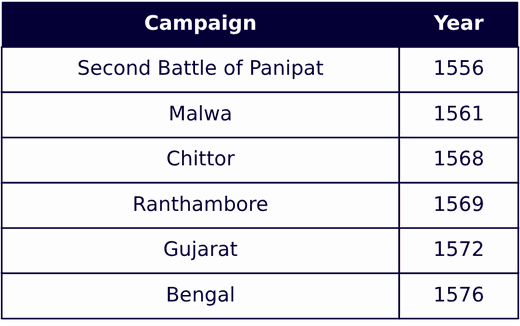 Both statements are therefore correct.
Hence, option (c) is the correct answer.
Both statements are therefore correct.
Hence, option (c) is the correct answer.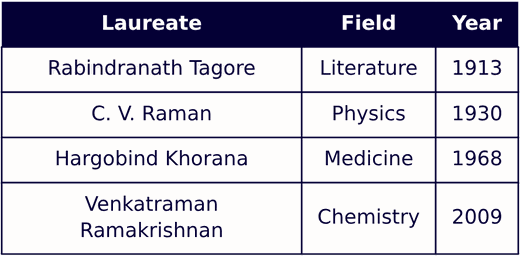 C. V. Raman (Physics, 1930) was the first Indian scientist to be honoured, Hargobind Khorana won the prize in Medicine in 1968 and Venkatraman Ramakrishnan in Chemistry in 2009.
Since Tagore's award of 1913 is the earliest of these, he is the first Indian Nobel laureate.
Hence, option (b) is the correct answer.
C. V. Raman (Physics, 1930) was the first Indian scientist to be honoured, Hargobind Khorana won the prize in Medicine in 1968 and Venkatraman Ramakrishnan in Chemistry in 2009.
Since Tagore's award of 1913 is the earliest of these, he is the first Indian Nobel laureate.
Hence, option (b) is the correct answer.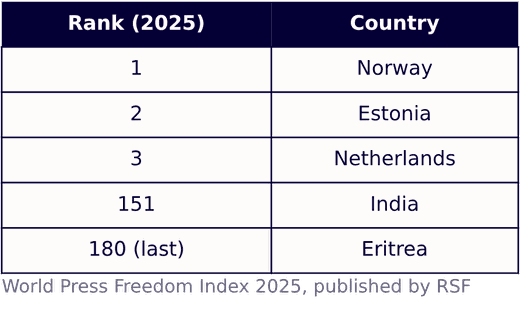 India was ranked 151st in 2025, an improvement from 159th in 2024; Yemen, North Korea and Myanmar also lie near the bottom but all of them finished above Eritrea.
Hence option (c) is correct.
India was ranked 151st in 2025, an improvement from 159th in 2024; Yemen, North Korea and Myanmar also lie near the bottom but all of them finished above Eritrea.
Hence option (c) is correct.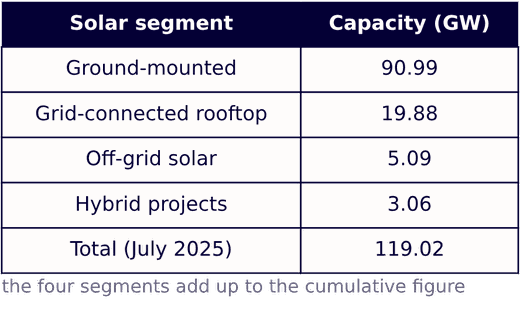 Ground-mounted utility-scale plants supply the bulk of it, with grid-connected rooftop solar a distant second, and hybrid and off-grid systems making up the rest.
Solar alone is therefore more than half of India's total renewable capacity of roughly 227 GW reached in July 2025, and it is the fastest-growing segment of the 500 GW non-fossil target for 2030.
The figure of 85 GW belongs to an earlier year and 140 GW and 200 GW were reached only later, so they cannot describe July 2025.
Hence option (b) is correct.
Ground-mounted utility-scale plants supply the bulk of it, with grid-connected rooftop solar a distant second, and hybrid and off-grid systems making up the rest.
Solar alone is therefore more than half of India's total renewable capacity of roughly 227 GW reached in July 2025, and it is the fastest-growing segment of the 500 GW non-fossil target for 2030.
The figure of 85 GW belongs to an earlier year and 140 GW and 200 GW were reached only later, so they cannot describe July 2025.
Hence option (b) is correct.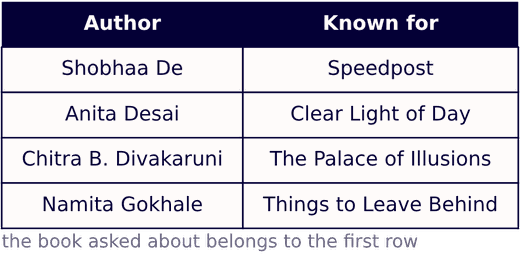 Shobhaa De began as a journalist and founded the magazine 'Stardust'; her novels include 'Socialite Evenings', 'Starry Nights' and 'Strange Obsession'.
The other three writers are all novelists and none of them has a book of letters to her children by this title.
Hence option (b) is correct.
Shobhaa De began as a journalist and founded the magazine 'Stardust'; her novels include 'Socialite Evenings', 'Starry Nights' and 'Strange Obsession'.
The other three writers are all novelists and none of them has a book of letters to her children by this title.
Hence option (b) is correct.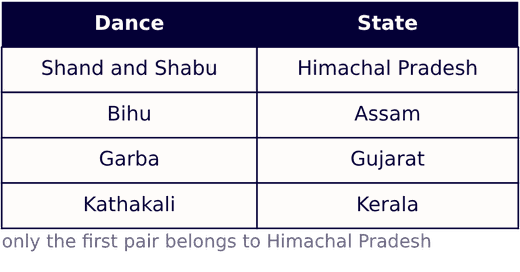 The other three options belong to other states altogether, so they cannot be the answer.
Hence option (d) is correct.
The other three options belong to other states altogether, so they cannot be the answer.
Hence option (d) is correct.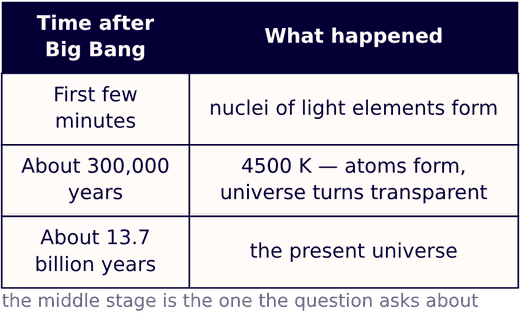 At 300, 3,000 or 30,000 years the temperature was still far too high for atoms to survive, so those options are ruled out.
Hence option (a) is correct.
At 300, 3,000 or 30,000 years the temperature was still far too high for atoms to survive, so those options are ruled out.
Hence option (a) is correct.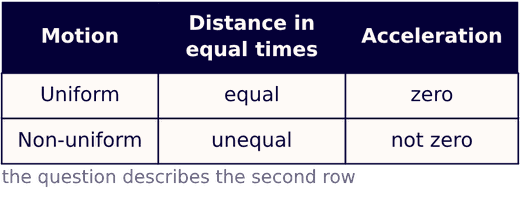 A car in city traffic is the standard example — it covers different distances each second because of stops and turns.
Linear and circular motion only describe the shape of the path (straight line or circle) and say nothing about whether the distance per unit time is equal, so they do not answer the question.
Hence option (c) is correct.
A car in city traffic is the standard example — it covers different distances each second because of stops and turns.
Linear and circular motion only describe the shape of the path (straight line or circle) and say nothing about whether the distance per unit time is equal, so they do not answer the question.
Hence option (c) is correct.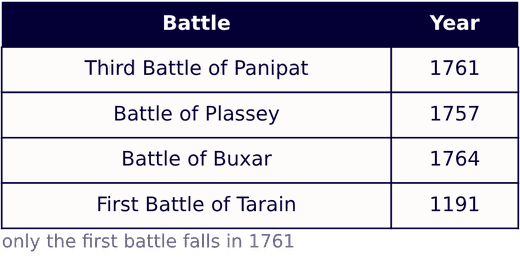 That collapse of the only Indian power able to check the English is why 1761 is treated as a turning point in the rise of British supremacy.
Hence option (a) is correct.
That collapse of the only Indian power able to check the English is why 1761 is treated as a turning point in the rise of British supremacy.
Hence option (a) is correct.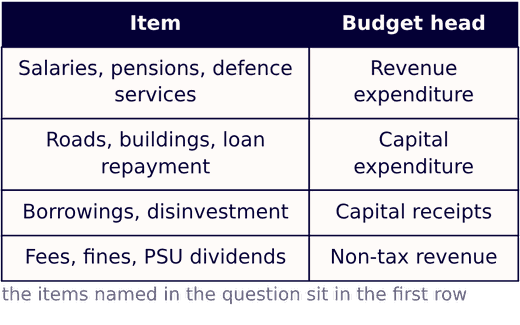 Capital expenditure is the opposite: buying land, building roads, or repaying the principal of a loan either creates an asset or reduces a liability.
Capital receipts and non-tax revenue are on the receipts side of the budget, not the expenditure side, so they cannot classify a payment at all.
Hence option (a) is correct.
Capital expenditure is the opposite: buying land, building roads, or repaying the principal of a loan either creates an asset or reduces a liability.
Capital receipts and non-tax revenue are on the receipts side of the budget, not the expenditure side, so they cannot classify a payment at all.
Hence option (a) is correct.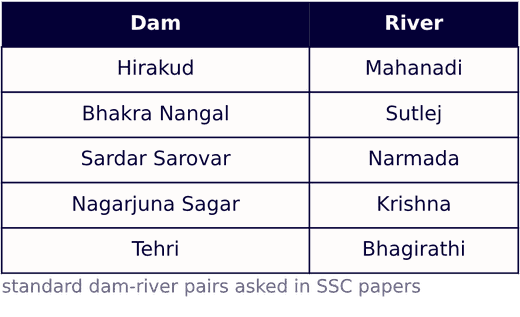 The reservoir behind it is Hirakud Reservoir, a Ramsar-recognised wetland rich in migratory birds.
Hence option (a) is correct.
The reservoir behind it is Hirakud Reservoir, a Ramsar-recognised wetland rich in migratory birds.
Hence option (a) is correct.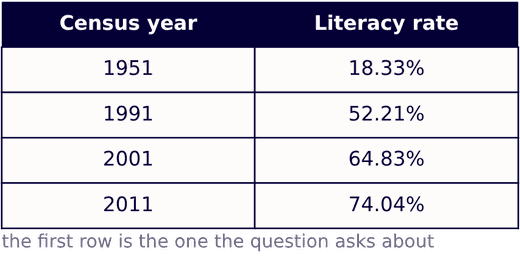 From 1991 onwards the base was changed to persons aged 7 years and above, which is the definition still used, so figures before and after 1991 are not strictly comparable.
By Census 2011 literacy had risen to 74.04 per cent, with 82.14 per cent for males and 65.46 per cent for females — Kerala the highest and Bihar the lowest among the states.
Hence option (d) is correct.
From 1991 onwards the base was changed to persons aged 7 years and above, which is the definition still used, so figures before and after 1991 are not strictly comparable.
By Census 2011 literacy had risen to 74.04 per cent, with 82.14 per cent for males and 65.46 per cent for females — Kerala the highest and Bihar the lowest among the states.
Hence option (d) is correct.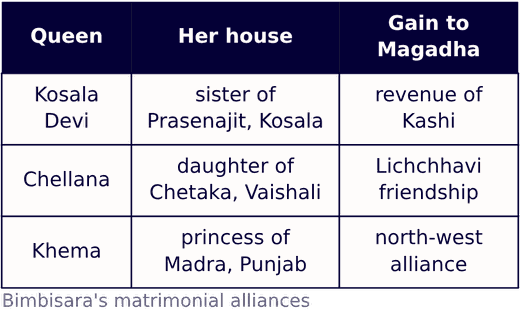 Udayin was Bimbisara's own grandson and founded Pataliputra, while Shuddhodana was the Shakya chief of Kapilavastu and the father of the Buddha — neither ruled Kosala.
Hence option (b) is correct.
Udayin was Bimbisara's own grandson and founded Pataliputra, while Shuddhodana was the Shakya chief of Kapilavastu and the father of the Buddha — neither ruled Kosala.
Hence option (b) is correct.