
1
Identify the incorrect sentence.
- A.Half of the rooms are empty.
- B.Eleven people were rescued from the fire.
- C.All of the cities in New York is being affected by the rain yesterday.
- D.Some of the Online shows are very interesting.
Solution
Subject-verb agreement
'All of the cities' is a plural subject, so it needs a plural verb; the singular 'is' cannot be used with it.
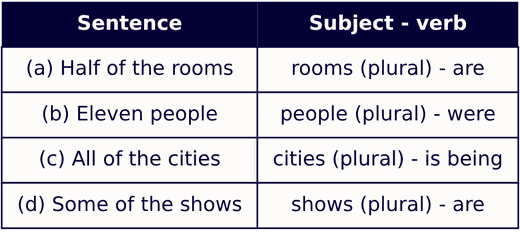 The adverb 'yesterday' fixes the action in past time, so the sentence must be in the simple past and not in the present continuous 'is being affected'.
The correct form is 'All of the cities in New York were affected by the rain yesterday'.
In (a), (b) and (d) the verb agrees with its subject correctly - 'rooms are', 'people were', 'shows are'.
Hence, option (c) is the incorrect sentence.
The adverb 'yesterday' fixes the action in past time, so the sentence must be in the simple past and not in the present continuous 'is being affected'.
The correct form is 'All of the cities in New York were affected by the rain yesterday'.
In (a), (b) and (d) the verb agrees with its subject correctly - 'rooms are', 'people were', 'shows are'.
Hence, option (c) is the incorrect sentence.
The adverb 'yesterday' fixes the action in past time, so the sentence must be in the simple past and not in the present continuous 'is being affected'.
The correct form is 'All of the cities in New York were affected by the rain yesterday'.
In (a), (b) and (d) the verb agrees with its subject correctly - 'rooms are', 'people were', 'shows are'.
Hence, option (c) is the incorrect sentence.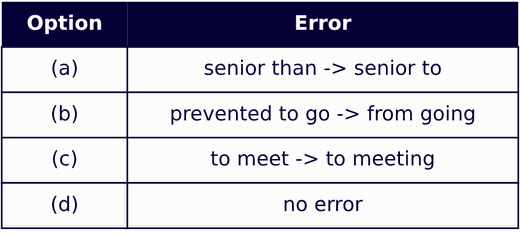 The verb 'prevent' takes the pattern 'prevent somebody from + verb-ing', so (b) needs 'prevented from going out'.
In 'look forward to', the word 'to' is a preposition and not part of an infinitive, so a gerund must follow: 'look forward to meeting you'.
In (d) the phrase 'as well as his students' is parenthetical, so the verb agrees with the real subject 'The teacher' and the singular 'was' is correct.
Hence, option (d) is free from grammatical error.
The verb 'prevent' takes the pattern 'prevent somebody from + verb-ing', so (b) needs 'prevented from going out'.
In 'look forward to', the word 'to' is a preposition and not part of an infinitive, so a gerund must follow: 'look forward to meeting you'.
In (d) the phrase 'as well as his students' is parenthetical, so the verb agrees with the real subject 'The teacher' and the singular 'was' is correct.
Hence, option (d) is free from grammatical error.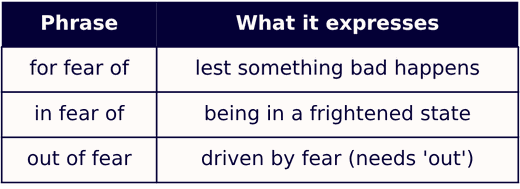 That phrase is 'for fear of', so the sentence reads 'The informer was reluctant to testify for fear of retaliation'.
'In fear of' only describes a frightened state; it does not give the reason for refusing to testify, and 'of fear' and 'from fear' are not idiomatic in this position.
Hence, option (d) is the most appropriate answer.
That phrase is 'for fear of', so the sentence reads 'The informer was reluctant to testify for fear of retaliation'.
'In fear of' only describes a frightened state; it does not give the reason for refusing to testify, and 'of fear' and 'from fear' are not idiomatic in this position.
Hence, option (d) is the most appropriate answer.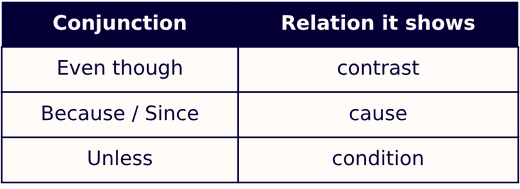 A clash like this needs a conjunction of contrast, and 'Even though' is exactly that.
'Because' and 'Since' would show cause, which would absurdly mean the snow warning made the function happen, while 'Unless' would set a condition.
Hence, option (a) is the most appropriate answer.
A clash like this needs a conjunction of contrast, and 'Even though' is exactly that.
'Because' and 'Since' would show cause, which would absurdly mean the snow warning made the function happen, while 'Unless' would set a condition.
Hence, option (a) is the most appropriate answer.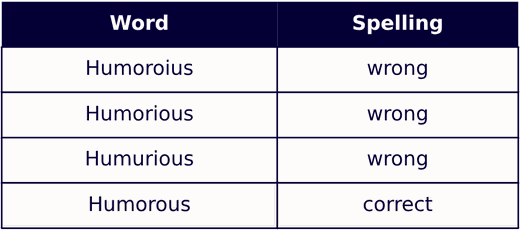 So the correct spelling carries a plain 'o' in the middle and ends in '-ous', not in '-ious': H-U-M-O-R-O-U-S.
'Humoroius', 'Humorious' and 'Humurious' each insert an extra 'i' or replace the 'o' with a 'u'.
Hence, option (d) is correctly spelt.
So the correct spelling carries a plain 'o' in the middle and ends in '-ous', not in '-ious': H-U-M-O-R-O-U-S.
'Humoroius', 'Humorious' and 'Humurious' each insert an extra 'i' or replace the 'o' with a 'u'.
Hence, option (d) is correctly spelt.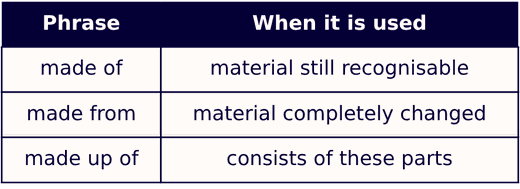 'Made from' is used when the material has been changed so completely that it can no longer be recognised - wood pulped into paper sheets is exactly such a change.
'Made up of' means 'consists of these parts', which fits 'the team is made up of five players', not a raw material.
Hence, option (c) is the most appropriate answer.
'Made from' is used when the material has been changed so completely that it can no longer be recognised - wood pulped into paper sheets is exactly such a change.
'Made up of' means 'consists of these parts', which fits 'the team is made up of five players', not a raw material.
Hence, option (c) is the most appropriate answer.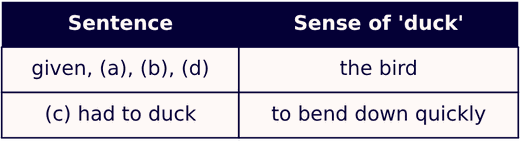 A homonym is a word with the same spelling and pronunciation but a completely different meaning, so the answer must use 'duck' in some other sense.
In (c) 'duck' is a verb meaning to bend down quickly in order to avoid something - the same word carrying a different meaning.
In (a), (b) and (d) 'duck' is still the bird, so they only repeat the given meaning instead of changing it.
Hence, option (c) is the most appropriate answer.
A homonym is a word with the same spelling and pronunciation but a completely different meaning, so the answer must use 'duck' in some other sense.
In (c) 'duck' is a verb meaning to bend down quickly in order to avoid something - the same word carrying a different meaning.
In (a), (b) and (d) 'duck' is still the bird, so they only repeat the given meaning instead of changing it.
Hence, option (c) is the most appropriate answer.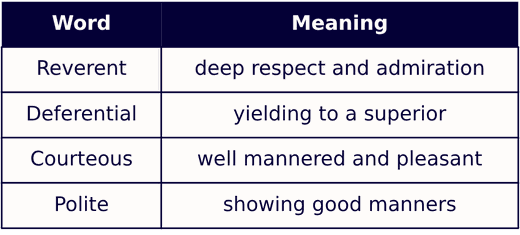 'Reverent' means feeling or showing deep respect and admiration, often mixed with awe, which matches the given definition word for word.
'Deferential' is the tempting choice, but it means yielding politely to someone of higher rank; admiration is no part of its meaning.
'Courteous' and 'polite' describe good manners in behaviour only, and say nothing about admiration.
Hence, option (c) is the most appropriate answer.
'Reverent' means feeling or showing deep respect and admiration, often mixed with awe, which matches the given definition word for word.
'Deferential' is the tempting choice, but it means yielding politely to someone of higher rank; admiration is no part of its meaning.
'Courteous' and 'polite' describe good manners in behaviour only, and say nothing about admiration.
Hence, option (c) is the most appropriate answer.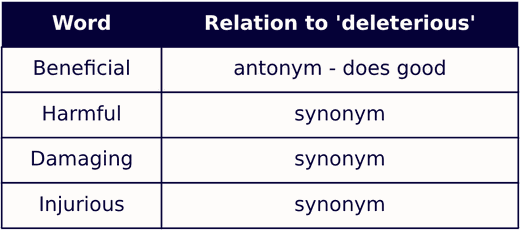 Its antonym must therefore mean 'doing good', and that word is 'beneficial'.
'Harmful', 'damaging' and 'injurious' all carry the same idea of harm, so they are synonyms of the given word, not antonyms.
Hence, option (a) is the most appropriate answer.
Its antonym must therefore mean 'doing good', and that word is 'beneficial'.
'Harmful', 'damaging' and 'injurious' all carry the same idea of harm, so they are synonyms of the given word, not antonyms.
Hence, option (a) is the most appropriate answer.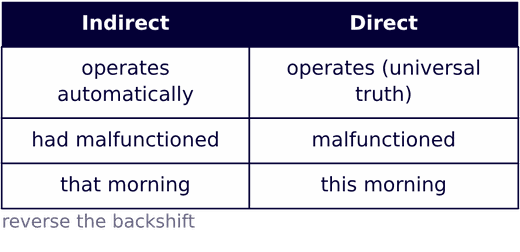 'The machine operates automatically' states a general truth, so it was never backshifted and stays in the simple present in the direct form too.
'Had malfunctioned' is the backshifted form of the simple past, so it goes back to 'malfunctioned', and 'that morning' returns to 'this morning'.
(a) and (b) keep the reported forms 'operated' and 'had malfunctioned', while (d) needlessly changes the tense to 'is operating'.
Hence, option (c) is the most appropriate answer.
'The machine operates automatically' states a general truth, so it was never backshifted and stays in the simple present in the direct form too.
'Had malfunctioned' is the backshifted form of the simple past, so it goes back to 'malfunctioned', and 'that morning' returns to 'this morning'.
(a) and (b) keep the reported forms 'operated' and 'had malfunctioned', while (d) needlessly changes the tense to 'is operating'.
Hence, option (c) is the most appropriate answer.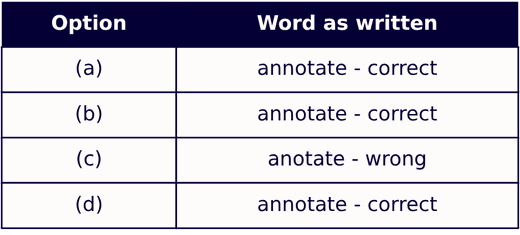 Option (c) writes 'anotate' with a single 'n', so that is the sentence containing a misspelt word.
The same word is spelt correctly in (a), (b) and (d).
Hence, option (c) is the most appropriate answer.
Option (c) writes 'anotate' with a single 'n', so that is the sentence containing a misspelt word.
The same word is spelt correctly in (a), (b) and (d).
Hence, option (c) is the most appropriate answer.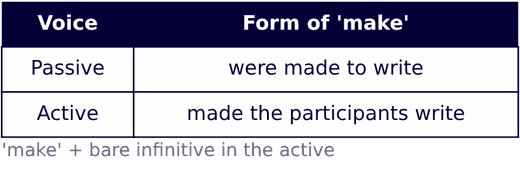 The causative verb 'make' takes a bare infinitive in the active voice and a to-infinitive only in the passive, so 'were made to write' becomes 'made ... write'.
The active form is therefore 'They made the participants write a detailed summary of the complex text'.
(c) keeps the 'to' that belongs only to the passive, (b) drops the causative idea altogether, and (d) is still passive.
Hence, option (a) is the most appropriate answer.
The causative verb 'make' takes a bare infinitive in the active voice and a to-infinitive only in the passive, so 'were made to write' becomes 'made ... write'.
The active form is therefore 'They made the participants write a detailed summary of the complex text'.
(c) keeps the 'to' that belongs only to the passive, (b) drops the causative idea altogether, and (d) is still passive.
Hence, option (a) is the most appropriate answer.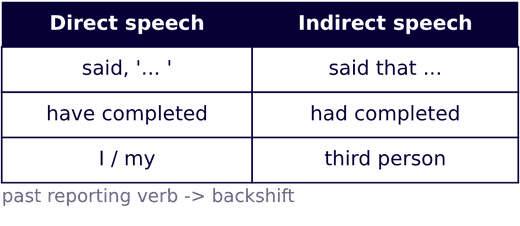 The present perfect 'have completed' therefore becomes the past perfect 'had completed'.
The first-person words 'I' and 'my' belong to the speaker, so in the reported clause they change to the third person and the possessive must change with them.
(a) leaves the verb un-backshifted as 'has', (c) keeps 'I' and 'my' unchanged, and (d) mixes an un-backshifted 'have' with a third-person 'her'.
Hence, option (b) is the most appropriate answer.
The present perfect 'have completed' therefore becomes the past perfect 'had completed'.
The first-person words 'I' and 'my' belong to the speaker, so in the reported clause they change to the third person and the possessive must change with them.
(a) leaves the verb un-backshifted as 'has', (c) keeps 'I' and 'my' unchanged, and (d) mixes an un-backshifted 'have' with a third-person 'her'.
Hence, option (b) is the most appropriate answer.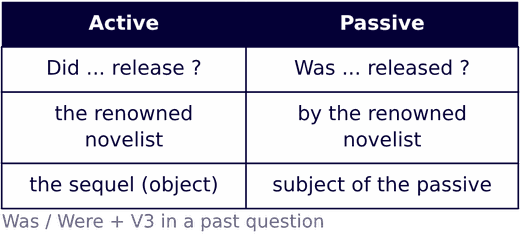 The object 'the highly anticipated sequel to his award-winning novel' becomes the subject, 'release' becomes the past participle 'released', and the tense marker 'Did' turns into 'Was'.
The doer moves to the end with 'by', giving 'Was the highly anticipated sequel to his award-winning novel finally released by the renowned novelist?'
(b) shifts the tense to the present perfect, (c) adds a needless 'been' after 'Was', and (d) keeps 'Did' along with 'be released'.
Hence, option (a) is the most appropriate answer.
The object 'the highly anticipated sequel to his award-winning novel' becomes the subject, 'release' becomes the past participle 'released', and the tense marker 'Did' turns into 'Was'.
The doer moves to the end with 'by', giving 'Was the highly anticipated sequel to his award-winning novel finally released by the renowned novelist?'
(b) shifts the tense to the present perfect, (c) adds a needless 'been' after 'Was', and (d) keeps 'Did' along with 'be released'.
Hence, option (a) is the most appropriate answer.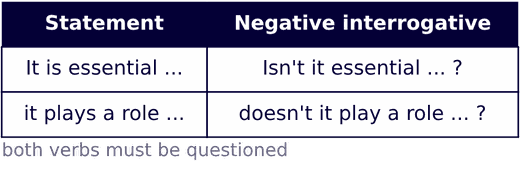 The given sentence has two verbs, 'is essential' and 'plays', so both halves have to be turned into questions: 'Isn't it essential ...' and 'doesn't it play ...'.
After 'doesn't' the main verb loses its '-s' and appears in the bare form 'play', and the whole sentence must end in a question mark.
(a) and (d) remain statements, and (c) questions only the first half while wrongly bringing in the modal 'should'.
Hence, option (b) is the most appropriate answer.
The given sentence has two verbs, 'is essential' and 'plays', so both halves have to be turned into questions: 'Isn't it essential ...' and 'doesn't it play ...'.
After 'doesn't' the main verb loses its '-s' and appears in the bare form 'play', and the whole sentence must end in a question mark.
(a) and (d) remain statements, and (c) questions only the first half while wrongly bringing in the modal 'should'.
Hence, option (b) is the most appropriate answer.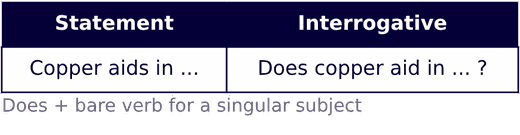 Once 'Does' carries the tense and the '-s', the main verb returns to its bare form: 'Does copper aid in the formation of red blood cells?'
(a) puts the plural 'Do' with a singular subject, while (b) and (d) change the tense to the present continuous and the present perfect.
Hence, option (c) is the most appropriate answer.
Once 'Does' carries the tense and the '-s', the main verb returns to its bare form: 'Does copper aid in the formation of red blood cells?'
(a) puts the plural 'Do' with a singular subject, while (b) and (d) change the tense to the present continuous and the present perfect.
Hence, option (c) is the most appropriate answer.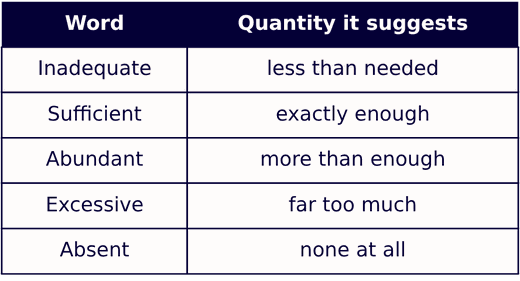 The opposite of 'enough' is 'not enough', and the word for that is 'inadequate'.
'Abundant' and 'excessive' both mean more than enough, so they lie on the same side of 'sufficient' rather than opposite it, and 'absent' means missing altogether, which is far stronger than a shortfall.
Hence, option (a) is the most appropriate answer.
The opposite of 'enough' is 'not enough', and the word for that is 'inadequate'.
'Abundant' and 'excessive' both mean more than enough, so they lie on the same side of 'sufficient' rather than opposite it, and 'absent' means missing altogether, which is far stronger than a shortfall.
Hence, option (a) is the most appropriate answer.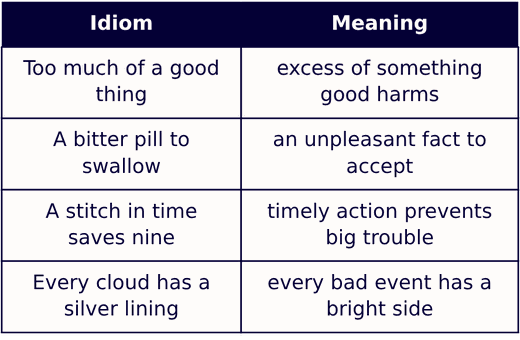 'Too much of a good thing' names exactly that idea - something helpful becomes harmful once there is too much of it.
'A bitter pill to swallow' is an unpleasant fact one must accept, 'a stitch in time saves nine' urges timely action, and 'every cloud has a silver lining' finds hope in a bad situation - none of them is about excess.
Hence, option (d) is the most appropriate answer.
'Too much of a good thing' names exactly that idea - something helpful becomes harmful once there is too much of it.
'A bitter pill to swallow' is an unpleasant fact one must accept, 'a stitch in time saves nine' urges timely action, and 'every cloud has a silver lining' finds hope in a bad situation - none of them is about excess.
Hence, option (d) is the most appropriate answer.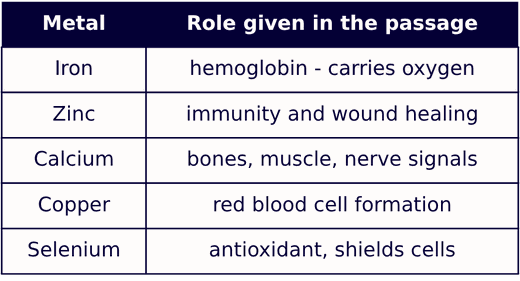 So iron's role is to help form hemoglobin, which then carries oxygen to every part of the body; that is why its deficiency causes anaemia and exhaustion.
Muscle contraction and strong bones and teeth are credited to calcium and magnesium, and shielding cells from damage is the work of selenium.
Hence, option (a) is the most appropriate answer.
So iron's role is to help form hemoglobin, which then carries oxygen to every part of the body; that is why its deficiency causes anaemia and exhaustion.
Muscle contraction and strong bones and teeth are credited to calcium and magnesium, and shielding cells from damage is the work of selenium.
Hence, option (a) is the most appropriate answer.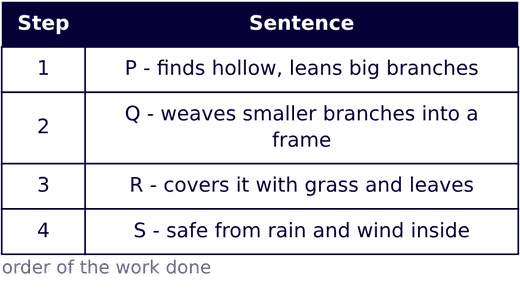 P has to open, because it alone introduces the site - she finds a natural hollow and leans big branches on a solid support.
Q follows P, since the 'major supports' between which she weaves the smaller branches are those big branches of P.
R then covers that finished frame with grass and leaves for insulation, and S closes with the result - inside the completed shelter she is safe from rain and wind.
Hence, the correct sequence is P, Q, R, S and option (c) is the most appropriate answer.
P has to open, because it alone introduces the site - she finds a natural hollow and leans big branches on a solid support.
Q follows P, since the 'major supports' between which she weaves the smaller branches are those big branches of P.
R then covers that finished frame with grass and leaves for insulation, and S closes with the result - inside the completed shelter she is safe from rain and wind.
Hence, the correct sequence is P, Q, R, S and option (c) is the most appropriate answer.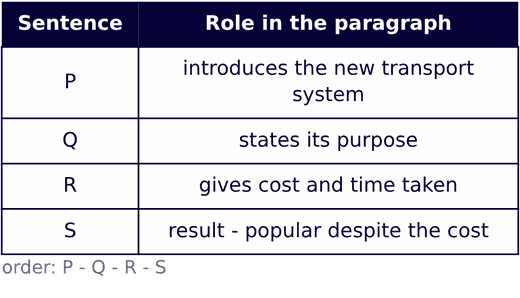 Q begins with the pronoun 'It', which can point back only to the system named in P, so Q comes straight after P.
R then supplies the cost and the ten years the project took, and S opens with 'Despite its high cost', which needs R's mention of cost to come first.
The coherent order is therefore P, Q, R, S - introduction, purpose, cost, result.
Hence, option (b) is the correct answer.
Q begins with the pronoun 'It', which can point back only to the system named in P, so Q comes straight after P.
R then supplies the cost and the ten years the project took, and S opens with 'Despite its high cost', which needs R's mention of cost to come first.
The coherent order is therefore P, Q, R, S - introduction, purpose, cost, result.
Hence, option (b) is the correct answer.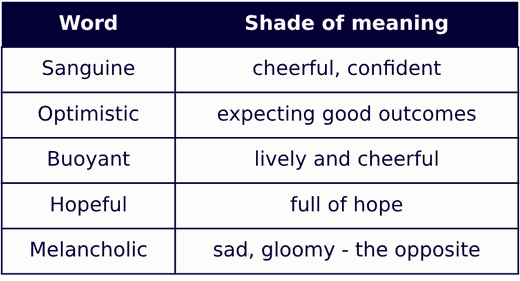 Its antonym must therefore express gloom, and 'melancholic' means sad, low-spirited and dejected.
'Optimistic', 'buoyant' and 'hopeful' all carry the same bright, positive shade as 'sanguine', so they are its synonyms and not its opposites.
Hence, option (d) is the correct answer.
Its antonym must therefore express gloom, and 'melancholic' means sad, low-spirited and dejected.
'Optimistic', 'buoyant' and 'hopeful' all carry the same bright, positive shade as 'sanguine', so they are its synonyms and not its opposites.
Hence, option (d) is the correct answer.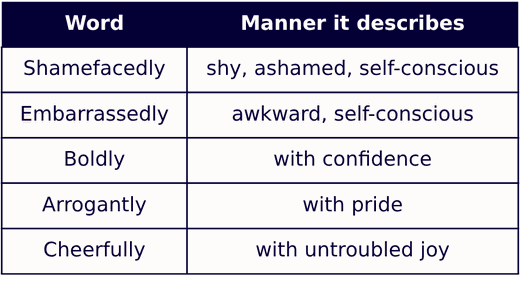 'Embarrassedly' carries exactly that sense of awkward self-consciousness, so it is nearest in meaning.
'Boldly' and 'arrogantly' suggest confidence or pride, and 'cheerfully' suggests untroubled happiness - all the opposite of feeling ashamed.
Hence, option (b) is the correct answer.
'Embarrassedly' carries exactly that sense of awkward self-consciousness, so it is nearest in meaning.
'Boldly' and 'arrogantly' suggest confidence or pride, and 'cheerfully' suggests untroubled happiness - all the opposite of feeling ashamed.
Hence, option (b) is the correct answer.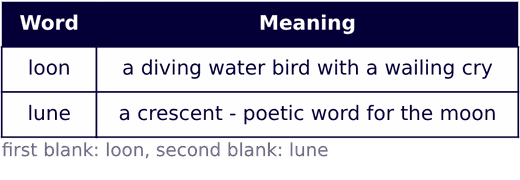 The second blank names the pale object that 'rose gradually' and cast silver ripples on the water - that is the moon, and 'lune' is the poetic word for it.
So the pair must be 'loon, lune'; taken the other way round a crescent would be wailing and a bird would be rising over the lake, which makes no sense.
Hence, option (d) is the correct answer.
The second blank names the pale object that 'rose gradually' and cast silver ripples on the water - that is the moon, and 'lune' is the poetic word for it.
So the pair must be 'loon, lune'; taken the other way round a crescent would be wailing and a bird would be rising over the lake, which makes no sense.
Hence, option (d) is the correct answer.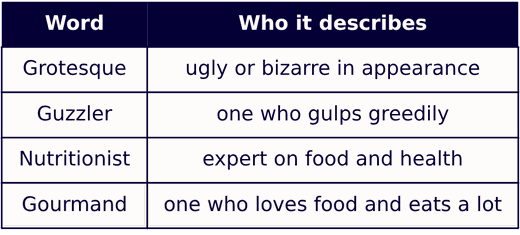 'Gourmand' is exactly that word - a hearty eater fond of good food, unlike a 'gourmet', who is a refined judge of food.
'Grotesque' describes something ugly or bizarre, 'guzzler' stresses greedy drinking or gulping rather than enjoyment, and a 'nutritionist' is an expert on diet and health.
Hence, option (d) is the correct answer.
'Gourmand' is exactly that word - a hearty eater fond of good food, unlike a 'gourmet', who is a refined judge of food.
'Grotesque' describes something ugly or bizarre, 'guzzler' stresses greedy drinking or gulping rather than enjoyment, and a 'nutritionist' is an expert on diet and health.
Hence, option (d) is the correct answer.