SSC CHSL 22 November 2025 · Shift 3 · English Language — questions with answers · ShikshaSphere
Chapter 116 of 200
22 November 2025 · Shift 3
English Language
25 questions ~25 min readFree
25 questions
A
1
Choose the one-word substitute for the following sentence:
Because of his cynical view of the world, Silas spent his later years in bitter seclusion, expressing a deep-seated hatred and distrust for all of humanity.
A.Philanthropist
B.Altruist
C.Misanthrope
D.Polyglot
Solution
One word substitution
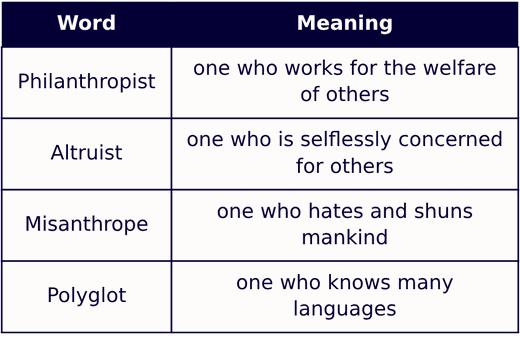
The sentence describes a man who cut himself off from society and carried hatred and distrust for the whole of mankind.
'Misanthrope' is exactly a person who dislikes human beings and avoids their company, which matches 'a deep-seated hatred and distrust for all of humanity'.
'Philanthropist' and 'Altruist' say the opposite - both work for the good of others - and a 'Polyglot' merely knows several languages.
Hence, option (c) is the most appropriate answer.
2
Identify the incorrect sentence.
A.Working too hard his energy was exhausted.
B.Many students prefer studying in a quiet environment where they can concentrate.
C.For centuries people believed that the sun revolved around the Earth and that the stars moved.
D.You have to be wealthy to dine at that restaurant. The food is very costly there.
Solution
Dangling participle
An opening participial phrase must describe the subject of the main clause that follows it.
In (a) the phrase is 'Working too hard', but the subject of the main clause is 'his energy' - and energy cannot work hard, so the participle is left dangling.
The sentence has to supply the real doer: 'Working too hard, he exhausted his energy.' or 'He worked so hard that his energy was exhausted.'
(b) has a correct relative clause, (c) keeps a proper past-tense sequence after 'believed', and (d) is two sound independent sentences.
Hence, option (a) is the most appropriate answer.
3
Identify the grammatical error in the sentence below.
The student must submit the assignment will done with writing.
A.The student
B.done with writing
C.must submit
D.the assignment will
Solution
Error spotting
Test each labelled part against the rest of the sentence.
The words 'will done' cannot stand together: a modal like 'will' is always followed by the bare form of the verb, never by the past participle 'done'.
So the faulty part is 'the assignment will'. What the sentence needs there is a time clause, so 'will' must be replaced with 'when'.
'When done with writing' then works as a shortened clause meaning 'when it is finished being written'.
Correct sentence: The student must submit the assignment when done with writing.
'The student', 'must submit' and 'done with writing' are all free from error, so the answer is (d).
4
Fill in the blank with the most appropriate preposition:
The initiative was aimed to provide better healthcare facilities and raise awareness
preventive measures in remote rural areas.
A.about
B.into
C.out
D.in
Solution
Appropriate preposition
The blank has to link the noun 'awareness' with the subject that people are to be made aware of.
The fixed collocation for that is 'awareness about' (or 'awareness of'), which introduces the topic - here 'preventive measures in remote rural areas'.
'Into' shows movement to the inside of something and 'out' shows movement away, so neither can follow 'awareness'.
'In' after 'awareness' would point to a place or a field rather than to the topic people are informed about.
The sentence reads: ... raise awareness about preventive measures in remote rural areas.
Hence, option (a) is the most appropriate answer.
5
Fill in the blank with the most appropriate phrasal verb:
When the project failed, the manager attempted to and hold his team accountable.
A.look into
B.pass the buck
C.set aside
D.bring about
Solution
Idioms and phrases
The project the manager was in charge of has failed, yet the second half of the sentence shows him making his team answer for it.
'Pass the buck' means to shift the blame or responsibility for something on to somebody else, which is precisely what 'hold his team accountable' describes.
'Look into' means to investigate, 'set aside' means to keep apart or to cancel a decision, and 'bring about' means to cause something to happen - none of them carries the idea of shifting blame.
Hence, option (b) is the most appropriate answer.
6
Select the most appropriate synonym of the word: Pragmatic.
A.Fabulous
B.Factual
C.Mythopoeic
D.Practical
Solution
Synonyms
'Pragmatic' describes a person or an approach that deals with matters sensibly and realistically, judging by results rather than by theory.
'Practical' carries the same idea of working with what actually succeeds, so it is the closest synonym.
'Factual' is the tempting choice, but it only means 'based on facts' and says nothing about acting for results; 'Fabulous' means wonderful or fable-like and 'Mythopoeic' means myth-making - both point away from the real world.
Hence, option (d) is the most appropriate answer.
7
Choose the best option to replace the underlined part to improve the given sentence. If no substitution is required, select 'No substitution.'
Her brother is very good with solving puzzles.
A.good for solving puzzles
B.good with puzzles
C.good at solving puzzles
D.No substitution
Solution
Sentence improvement
The sentence states a skill, and the preposition that introduces a skill after 'good' is 'at'.
The pattern is 'good at + noun / verb-ing', meaning able to do something well: 'good at solving puzzles'.
'Good with' is used for handling people, animals or tools ('good with children'), and 'good for' means beneficial, so neither suits an ability.
Option (b) 'good with puzzles' also drops the act of solving, which changes what the sentence says.
Hence, option (c) is the most appropriate answer.
8
Select the option which correctly uses the homonym of the highlighted word in the given sentence.
The nation imported advanced arms to modernise its military forces.
A.Strict laws were introduced to control the illegal trade of arms.
B.She carried the heavy books in her arms as she walked to the library.
C.The rebels surrendered their arms after the peace agreement was signed.
D.The museum displayed ancient arms used in historical battles.
Solution
Homonyms
First fix the sense of the highlighted word in the given sentence: the nation imported them to modernise its military, so 'arms' there means weapons.
A homonym is a word spelt and pronounced alike but used with a different meaning, so the right option must use 'arms' in some other sense.
In (b) 'she carried the heavy books in her arms' uses 'arms' for the limbs of the body - a completely different meaning, so this is the homonym.
The illegal trade in (a), the surrender in (c) and the battle pieces in (d) all keep the sense 'weapons', so they merely repeat the given meaning.
Hence, option (b) is the most appropriate answer.
9
From the alternatives given below, select the correct passive voice of the following sentence.
Why has Raghav forced Shyam out of Vikram's room?
A.Why has Raghav been forced out of Vikram's room by Shyam?
B.Why has Vikram been forced out of Raghav's room by Shyam?
C.Why has Raghav been forced out by Shyam of Vikram's room?
D.Why has Shyam been forced out of Vikram's room by Raghav?
Solution
Active to passive voice
In the active sentence Raghav is the doer and Shyam is the one acted upon, so Shyam becomes the subject of the passive and Raghav moves to the end with 'by'.
The tense is present perfect, so the passive verb group is 'has been + forced', and in a question the auxiliary 'has' comes before the new subject.
The question word 'Why' stays at the very front, and the adverbial 'out of Vikram's room' keeps its place right after the verb.
Passive: Why has Shyam been forced out of Vikram's room by Raghav?
(a) and (c) make Raghav the person forced out, (b) swaps Vikram and Raghav, and (c) further separates 'out' from 'of Vikram's room'.
Hence, option (d) is the most appropriate answer.
10
Choose the correct indirect narration of the following statement from the given alternatives:
The employer said to his assistant, "What wrong have I done to you that you are working with me so carelessly?"
A.The employer asked his assistant that what wrong he did to him that he was working with him so carelessly.
B.The employer asked his assistant what wrong he had done to him that he worked with him so carelessly.
C.The employer asked his assistant what wrong he had been doing to him that he was working with him so carelessly.
D.The employer asked his assistant what wrong he had done to him that he was working with him so carelessly.
Solution
Direct to indirect speech
The reported sentence is a question, so 'said to' changes to 'asked', and the question word 'What' itself joins the two clauses - no 'that' is used.
The reporting verb is in the past, so both tenses shift back: 'have I done' (present perfect) becomes 'he had done', and 'you are working' (present continuous) becomes 'he was working'.
Pronouns follow the persons: 'I' becomes 'he' (the employer), 'you' becomes 'he' (the assistant) and 'me' becomes 'him'.
Indirect: The employer asked his assistant what wrong he had done to him that he was working with him so carelessly.
(a) wrongly adds 'that' after 'asked', (b) flattens the continuous into 'he worked', and (c) uses 'had been doing' where a completed action is meant.
Hence, option (d) is the most appropriate answer.
11
Select the most appropriate antonym of the word:
Dominance
A.Subjection
B.Command
C.Parity
D.Control
Solution
Antonyms
'Dominance' is the state of holding more power or influence than everyone else.
'Parity' means being equal in status or power, so it takes away the very superiority on which dominance rests - the two are direct opposites.
'Command' and 'Control' both name authority over others, which makes them synonyms of dominance rather than antonyms.
'Subjection' is the act of bringing others under one's authority, so it moves in the same direction as dominance and cannot be its opposite.
Hence, option (c) is the most appropriate answer.
12
Change the following sentence into the Active form.
The committee's resolution was made known to the members through a formal notice.
A.A formal notice made the committee's resolution known to the members.
B.The members were made known to the committee's resolution.
C.The committee made its resolution known to the members through a formal notice.
D.A formal notice was used to make the committee's resolution known.
Solution
Passive to active voice
The passive sentence hides the doer, so first ask who made the resolution known: the resolution belongs to the committee, so the committee is the doer.
The committee therefore becomes the subject, and the passive 'was made known to the members' becomes the active 'made its resolution known to the members'.
'Through a formal notice' names the means, not the doer, so it must stay as an adverbial phrase and cannot be promoted to subject.
Active: The committee made its resolution known to the members through a formal notice.
(a) and (d) make the notice the doer, and (b) is still passive and also changes the meaning, since it is the resolution, not the members, that was made known.
Hence, option (c) is the most appropriate answer.
13
Choose the most suitable option to replace the highlighted part of the sentence:These factor will be examined while addressing the evolving situation in our eastern region.
A.This factors will be examining while addressing
B.This factors will be examiner while addressing
C.These factor would be examined while addressing
D.These factors will be examined while addressing
Solution
Subject-determiner agreement
The demonstrative 'These' is plural, so the noun it points to must be plural as well: 'These factors', not 'These factor'.
The factors are the things that get examined, so the passive 'will be examined' is right, and 'will' suits a definite future action.
(a) uses the singular 'This' with a plural noun and turns the verb into the active 'will be examining'; (b) replaces the verb with the noun 'examiner'; (c) leaves the singular 'factor' uncorrected.
Correct sentence: These factors will be examined while addressing the evolving situation in our eastern region.
Hence, option (d) is the most appropriate answer.
14
Select the option that expresses the given sentence in direct voice.
She said that she had delayed her wedding.
A.She said, "I have delayed her wedding."
B.She said, "She has delayed my wedding.'
C.She said, 'I have delayed my wedding.'
D.She said, "She had delayed her wedding."
Solution
Indirect to direct speech
Reverse the backshift: the past perfect 'had delayed' in the reported clause comes from a present perfect 'have delayed' in the speaker's own words.
Both 'she' and 'her' refer to the speaker herself, so in her own words they become 'I' and 'my'.
No listener is mentioned, so the reporting verb stays 'said'; the conjunction 'that' is dropped, a comma is put after 'said', and the exact words go inside inverted commas with a capital letter.
Direct: She said, 'I have delayed my wedding.'
(a) keeps 'her wedding', which would mean somebody else's wedding, (b) keeps 'She' as the doer instead of 'I', and (d) leaves the verb in the past perfect.
Hence, option (c) is the most appropriate answer.
15
Directions (Qs. 15-19): Read the following passage carefully and answer the questions that follow.
The jewelry and fashion industry in India has reshaped itself over the past few decades, influenced by changing lifestyles, global trends, and advances in technology. Historically, women wore gold, silver, and gemstone jewelry that reflected regional craftsmanship, social status, and cultural traditions. Certain ornaments indicated marital status, community, or participation in religious ceremonies.
In recent years, improved infrastructure in urban areas, including modern retail outlets and online marketplaces, has made high-quality jewelry accessible to a wider audience. Many women now combine traditional pieces with contemporary designs, such as minimalist earrings, statement necklaces, and fusion bracelets, creating a versatile style suitable for daily wear as well as festive occasions.
Today, designers are reimagining jewelry and clothing together, blending heritage motifs with modern materials and cuts. Fashion and jewelry have become a form of self-expression, reflecting individuality,
creativity, and cultural pride in modern India.
Identify the correct use of a compound adjective from the passage. Which of the following phrases from the passage is a compound adjective used to modify a noun?
A.Statement necklaces
B.Fusion bracelets
C.Modern retail outlets
D.Gold jewelry
Solution
Compound adjective
A compound adjective is formed when two or more words work together as one adjective in front of a noun.
In 'modern retail outlets' the words 'modern' and 'retail' together tell us what kind of outlets are meant, so 'modern retail' modifies the noun 'outlets'.
In 'statement necklaces', 'fusion bracelets' and 'gold jewelry' only a single word - a noun used attributively - describes the following noun, so no compound adjective is formed there.
Hence, option (c) is the most appropriate answer.
16
Directions (Qs. 15-19): Read the following passage carefully and answer the questions that follow.
The jewelry and fashion industry in India has reshaped itself over the past few decades, influenced by changing lifestyles, global trends, and advances in technology. Historically, women wore gold, silver, and gemstone jewelry that reflected regional craftsmanship, social status, and cultural traditions. Certain ornaments indicated marital status, community, or participation in religious ceremonies.
In recent years, improved infrastructure in urban areas, including modern retail outlets and online marketplaces, has made high-quality jewelry accessible to a wider audience. Many women now combine traditional pieces with contemporary designs, such as minimalist earrings, statement necklaces, and fusion bracelets, creating a versatile style suitable for daily wear as well as festive occasions.
Today, designers are reimagining jewelry and clothing together, blending heritage motifs with modern materials and cuts. Fashion and jewelry have become a form of self-expression, reflecting individuality,
creativity, and cultural pride in modern India.
Which sentence from the passage contains a relative clause?
A.Today, designers are reimagining jewelry and clothing together, blending heritage motifs with modern materials and cuts.
B.Historically, women wore gold, silver, and gemstone jewelry that reflected regional craftsmanship, social status, and cultural traditions.
C.Many women now combine traditional pieces with contemporary designs, creating a versatile style suitable for daily wear as well as festive occasions.
D.In recent years, improved infrastructure in urban areas has made high-quality jewelry accessible to a wider audience.
Solution
Relative clause
A relative clause begins with a relative pronoun - who, whom, whose, which or that - and adds information about the noun just before it.
In (b) the clause 'that reflected regional craftsmanship, social status, and cultural traditions' opens with the relative pronoun 'that' and describes the noun 'jewelry'.
(a) and (c) use participial phrases beginning with 'blending' and 'creating', which are not clauses because they have no subject and no finite verb.
(d) is a simple sentence with a single finite verb and no subordinate clause at all.
Hence, option (b) is the most appropriate answer.
17
Directions (Qs. 15-19): Read the following passage carefully and answer the questions that follow.
The jewelry and fashion industry in India has reshaped itself over the past few decades, influenced by changing lifestyles, global trends, and advances in technology. Historically, women wore gold, silver, and gemstone jewelry that reflected regional craftsmanship, social status, and cultural traditions. Certain ornaments indicated marital status, community, or participation in religious ceremonies.
In recent years, improved infrastructure in urban areas, including modern retail outlets and online marketplaces, has made high-quality jewelry accessible to a wider audience. Many women now combine traditional pieces with contemporary designs, such as minimalist earrings, statement necklaces, and fusion bracelets, creating a versatile style suitable for daily wear as well as festive occasions.
Today, designers are reimagining jewelry and clothing together, blending heritage motifs with modern materials and cuts. Fashion and jewelry have become a form of self-expression, reflecting individuality,
creativity, and cultural pride in modern India.
Which word from the passage means 'adapted for many different uses'?
A.blending
B.versatile
C.combine
D.reshaped
Solution
Vocabulary from passage
The passage says that women combine traditional pieces with contemporary designs, 'creating a versatile style suitable for daily wear as well as festive occasions'.
A style that serves both everyday wear and festivals is one that can be adapted for many different uses, which is exactly what 'versatile' means.
'Blending' is the act of mixing, 'combine' means to join two or more things, and 'reshaped' means changed in form - none of them speaks of many uses.
Hence, option (b) is the most appropriate answer.
18
Directions (Qs. 15-19): Read the following passage carefully and answer the questions that follow.
The jewelry and fashion industry in India has reshaped itself over the past few decades, influenced by changing lifestyles, global trends, and advances in technology. Historically, women wore gold, silver, and gemstone jewelry that reflected regional craftsmanship, social status, and cultural traditions. Certain ornaments indicated marital status, community, or participation in religious ceremonies.
In recent years, improved infrastructure in urban areas, including modern retail outlets and online marketplaces, has made high-quality jewelry accessible to a wider audience. Many women now combine traditional pieces with contemporary designs, such as minimalist earrings, statement necklaces, and fusion bracelets, creating a versatile style suitable for daily wear as well as festive occasions.
Today, designers are reimagining jewelry and clothing together, blending heritage motifs with modern materials and cuts. Fashion and jewelry have become a form of self-expression, reflecting individuality,
creativity, and cultural pride in modern India.
What does the term "infrastructure" refer to in the passage?
A.Regional traditions and customs
B.Facilities, retail outlets, and online platforms
C.Jewelry and clothing designs
D.Cultural pride and self-expression
Solution
Reading comprehension
Go back to the sentence in which the word appears: 'improved infrastructure in urban areas, including modern retail outlets and online marketplaces'.
The word 'including' introduces examples of that infrastructure, so in this passage it stands for the facilities, retail outlets and online platforms through which jewelry now reaches buyers.
(a) traditions, (c) designs and (d) cultural pride are all mentioned elsewhere in the passage, but the writer never links any of them to 'infrastructure'.
Hence, option (b) is the most appropriate answer.
19
Directions (Qs. 15-19): Read the following passage carefully and answer the questions that follow.
The jewelry and fashion industry in India has reshaped itself over the past few decades, influenced by changing lifestyles, global trends, and advances in technology. Historically, women wore gold, silver, and gemstone jewelry that reflected regional craftsmanship, social status, and cultural traditions. Certain ornaments indicated marital status, community, or participation in religious ceremonies.
In recent years, improved infrastructure in urban areas, including modern retail outlets and online marketplaces, has made high-quality jewelry accessible to a wider audience. Many women now combine traditional pieces with contemporary designs, such as minimalist earrings, statement necklaces, and fusion bracelets, creating a versatile style suitable for daily wear as well as festive occasions.
Today, designers are reimagining jewelry and clothing together, blending heritage motifs with modern materials and cuts. Fashion and jewelry have become a form of self-expression, reflecting individuality,
creativity, and cultural pride in modern India.
What does the passage suggest about modern fashion and jewelry in India?
A.It is purely traditional and unchanged.
B.It combines heritage with modernity, allowing personal expression.
C.It focuses only on wealth and status.
D.It discourages creativity and individuality.
Solution
Reading comprehension
The last paragraph says that designers are 'blending heritage motifs with modern materials and cuts' and that fashion and jewelry 'have become a form of self-expression'.
Those two ideas together give option (b): heritage joined with modernity, leaving room for personal expression.
(a) is ruled out because the passage describes constant change, (c) because status is mentioned only for the earlier period, and (d) because the passage closes by praising individuality and creativity.
Hence, option (b) is the most appropriate answer.
20
What is the antonym of "Headstrong"?
A.Compliant
B.Obstinate
C.Intractable
D.Defiant
Solution
Antonyms
'Headstrong' describes a self-willed person who insists on having his own way and will not listen to advice.
'Compliant' means ready to agree with others and to obey rules, which is the exact reverse of that stubbornness.
'Obstinate', 'Intractable' and 'Defiant' all describe someone hard to control or openly disobedient, so they are synonyms of 'headstrong', not antonyms.
Hence, option (a) is the most appropriate answer.
21
What is the synonym of praise ? The artist received widespread praise from critics for his original and thoughtful work.
A.Cheat
B.Commend
C.Beguile
D.Support
Solution
Synonym
'Praise' means to express approval or admiration for someone or something.
'Commend' means to praise formally or publicly, so it carries the very same sense.
In the sentence the critics express admiration for the artist's original work — that is exactly commendation.
'Cheat' is to act dishonestly, 'beguile' is to charm someone in a deceptive way, and 'support' is to help or back someone, which is assistance rather than approval put into words.
Hence the correct option is (b).
22
Select the incorrectly spelt word.
A.prolonged
B.agrement
C.committee
D.intransigence
Solution
Spelling error
The word 'agrement' is spelt wrongly; the correct spelling is 'agreement'.
It is formed from the verb 'agree' plus the noun suffix '-ment', and nothing is dropped when the suffix is added: agree + ment = agreement.
'Prolonged', 'committee' and 'intransigence' are all spelt correctly.
Hence the incorrectly spelt word is option (b).
23
Select the incorrectly spelt word.
A.challenged
B.conventional
C.culinary
D.ordanary
Solution
Spelling error
The word 'ordanary' is spelt wrongly; the correct spelling is 'ordinary'.
It comes from the Latin 'ordinarius' meaning 'in the usual order', so the middle syllable is written with an 'i' — or-di-nar-y — never with an 'a'.
'Challenged', 'conventional' and 'culinary' are all spelt correctly.
Hence the incorrectly spelt word is option (d).
24
Choose the word that best completes the sentence:
As humanity masters local space travel, the next major milestone will be voyages to neighboring solar systems within our own galaxy.
A.Intergalactic
B.Intragalactic
C.Extragalactic
D.Transgalactic
Solution
Prefix and word choice
The blank must describe voyages made 'to neighboring solar systems within our own galaxy'.
The prefix decides the answer: 'intra-' means within, 'inter-' means between, 'extra-' means outside and 'trans-' means across or beyond.
Because the travel stays inside one single galaxy — our own — the word needed is 'intragalactic'.
'Intergalactic', 'extragalactic' and 'transgalactic' all describe travel between or beyond galaxies, which contradicts the phrase 'within our own galaxy'.
Hence the correct option is (b).
25
Select the correct one word substitution for: A graduate or former student of a particular school, college, or university.
A.Alumni
B.Post-graduate
C.Freelancer
D.Alma mater
Solution
One word substitution
The definition names a person — someone who has passed out of a school, college or university.
'Alumni' is the word used for such former students (singular alumnus for a man, alumna for a woman).
'Alma mater' is the tempting option, but it names the institution itself, not the student who left it.
'Post-graduate' is a student studying for a further degree, and a 'freelancer' works without any permanent employer; neither matches the definition.
Hence the correct option is (a).
Finished reading? Now test yourself.
The same 25 questions, but with a timer and the answers hidden — 15 minutes.

 'Misanthrope' is exactly a person who dislikes human beings and avoids their company, which matches 'a deep-seated hatred and distrust for all of humanity'.
'Philanthropist' and 'Altruist' say the opposite - both work for the good of others - and a 'Polyglot' merely knows several languages.
Hence, option (c) is the most appropriate answer.
'Misanthrope' is exactly a person who dislikes human beings and avoids their company, which matches 'a deep-seated hatred and distrust for all of humanity'.
'Philanthropist' and 'Altruist' say the opposite - both work for the good of others - and a 'Polyglot' merely knows several languages.
Hence, option (c) is the most appropriate answer.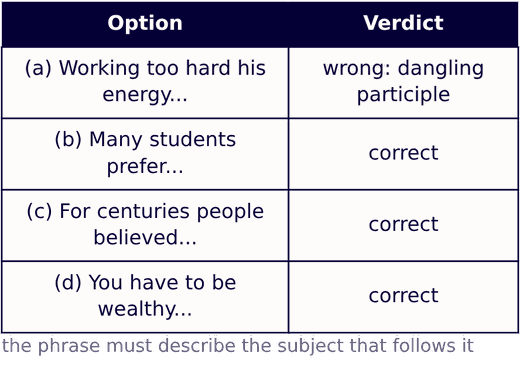 In (a) the phrase is 'Working too hard', but the subject of the main clause is 'his energy' - and energy cannot work hard, so the participle is left dangling.
The sentence has to supply the real doer: 'Working too hard, he exhausted his energy.' or 'He worked so hard that his energy was exhausted.'
(b) has a correct relative clause, (c) keeps a proper past-tense sequence after 'believed', and (d) is two sound independent sentences.
Hence, option (a) is the most appropriate answer.
In (a) the phrase is 'Working too hard', but the subject of the main clause is 'his energy' - and energy cannot work hard, so the participle is left dangling.
The sentence has to supply the real doer: 'Working too hard, he exhausted his energy.' or 'He worked so hard that his energy was exhausted.'
(b) has a correct relative clause, (c) keeps a proper past-tense sequence after 'believed', and (d) is two sound independent sentences.
Hence, option (a) is the most appropriate answer.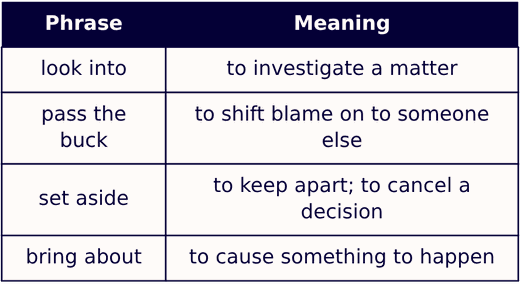 'Pass the buck' means to shift the blame or responsibility for something on to somebody else, which is precisely what 'hold his team accountable' describes.
'Look into' means to investigate, 'set aside' means to keep apart or to cancel a decision, and 'bring about' means to cause something to happen - none of them carries the idea of shifting blame.
Hence, option (b) is the most appropriate answer.
'Pass the buck' means to shift the blame or responsibility for something on to somebody else, which is precisely what 'hold his team accountable' describes.
'Look into' means to investigate, 'set aside' means to keep apart or to cancel a decision, and 'bring about' means to cause something to happen - none of them carries the idea of shifting blame.
Hence, option (b) is the most appropriate answer.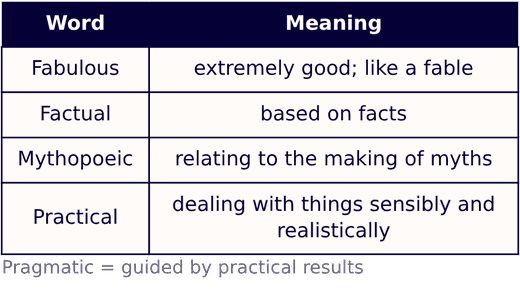 'Practical' carries the same idea of working with what actually succeeds, so it is the closest synonym.
'Factual' is the tempting choice, but it only means 'based on facts' and says nothing about acting for results; 'Fabulous' means wonderful or fable-like and 'Mythopoeic' means myth-making - both point away from the real world.
Hence, option (d) is the most appropriate answer.
'Practical' carries the same idea of working with what actually succeeds, so it is the closest synonym.
'Factual' is the tempting choice, but it only means 'based on facts' and says nothing about acting for results; 'Fabulous' means wonderful or fable-like and 'Mythopoeic' means myth-making - both point away from the real world.
Hence, option (d) is the most appropriate answer.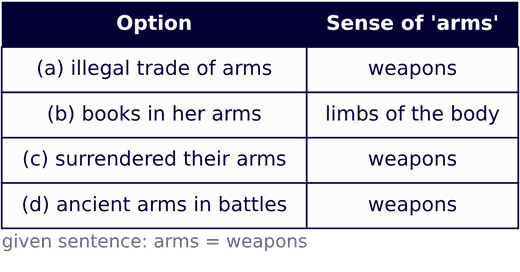 In (b) 'she carried the heavy books in her arms' uses 'arms' for the limbs of the body - a completely different meaning, so this is the homonym.
The illegal trade in (a), the surrender in (c) and the battle pieces in (d) all keep the sense 'weapons', so they merely repeat the given meaning.
Hence, option (b) is the most appropriate answer.
In (b) 'she carried the heavy books in her arms' uses 'arms' for the limbs of the body - a completely different meaning, so this is the homonym.
The illegal trade in (a), the surrender in (c) and the battle pieces in (d) all keep the sense 'weapons', so they merely repeat the given meaning.
Hence, option (b) is the most appropriate answer.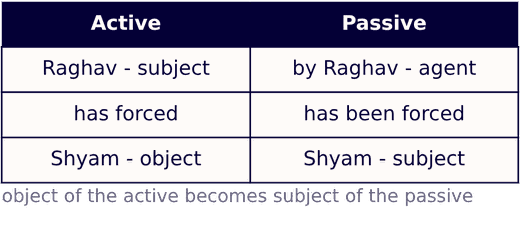 The tense is present perfect, so the passive verb group is 'has been + forced', and in a question the auxiliary 'has' comes before the new subject.
The question word 'Why' stays at the very front, and the adverbial 'out of Vikram's room' keeps its place right after the verb.
Passive: Why has Shyam been forced out of Vikram's room by Raghav?
(a) and (c) make Raghav the person forced out, (b) swaps Vikram and Raghav, and (c) further separates 'out' from 'of Vikram's room'.
Hence, option (d) is the most appropriate answer.
The tense is present perfect, so the passive verb group is 'has been + forced', and in a question the auxiliary 'has' comes before the new subject.
The question word 'Why' stays at the very front, and the adverbial 'out of Vikram's room' keeps its place right after the verb.
Passive: Why has Shyam been forced out of Vikram's room by Raghav?
(a) and (c) make Raghav the person forced out, (b) swaps Vikram and Raghav, and (c) further separates 'out' from 'of Vikram's room'.
Hence, option (d) is the most appropriate answer.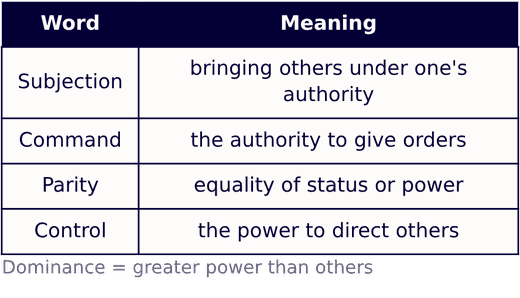 'Parity' means being equal in status or power, so it takes away the very superiority on which dominance rests - the two are direct opposites.
'Command' and 'Control' both name authority over others, which makes them synonyms of dominance rather than antonyms.
'Subjection' is the act of bringing others under one's authority, so it moves in the same direction as dominance and cannot be its opposite.
Hence, option (c) is the most appropriate answer.
'Parity' means being equal in status or power, so it takes away the very superiority on which dominance rests - the two are direct opposites.
'Command' and 'Control' both name authority over others, which makes them synonyms of dominance rather than antonyms.
'Subjection' is the act of bringing others under one's authority, so it moves in the same direction as dominance and cannot be its opposite.
Hence, option (c) is the most appropriate answer.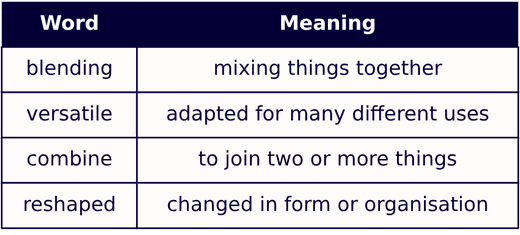 A style that serves both everyday wear and festivals is one that can be adapted for many different uses, which is exactly what 'versatile' means.
'Blending' is the act of mixing, 'combine' means to join two or more things, and 'reshaped' means changed in form - none of them speaks of many uses.
Hence, option (b) is the most appropriate answer.
A style that serves both everyday wear and festivals is one that can be adapted for many different uses, which is exactly what 'versatile' means.
'Blending' is the act of mixing, 'combine' means to join two or more things, and 'reshaped' means changed in form - none of them speaks of many uses.
Hence, option (b) is the most appropriate answer.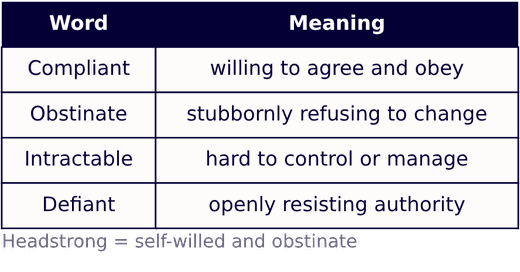 'Compliant' means ready to agree with others and to obey rules, which is the exact reverse of that stubbornness.
'Obstinate', 'Intractable' and 'Defiant' all describe someone hard to control or openly disobedient, so they are synonyms of 'headstrong', not antonyms.
Hence, option (a) is the most appropriate answer.
'Compliant' means ready to agree with others and to obey rules, which is the exact reverse of that stubbornness.
'Obstinate', 'Intractable' and 'Defiant' all describe someone hard to control or openly disobedient, so they are synonyms of 'headstrong', not antonyms.
Hence, option (a) is the most appropriate answer.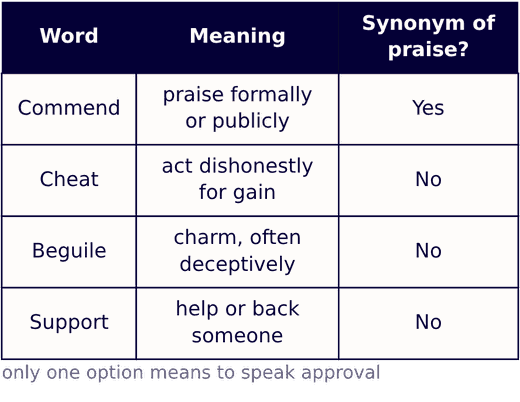 In the sentence the critics express admiration for the artist's original work — that is exactly commendation.
'Cheat' is to act dishonestly, 'beguile' is to charm someone in a deceptive way, and 'support' is to help or back someone, which is assistance rather than approval put into words.
Hence the correct option is (b).
In the sentence the critics express admiration for the artist's original work — that is exactly commendation.
'Cheat' is to act dishonestly, 'beguile' is to charm someone in a deceptive way, and 'support' is to help or back someone, which is assistance rather than approval put into words.
Hence the correct option is (b).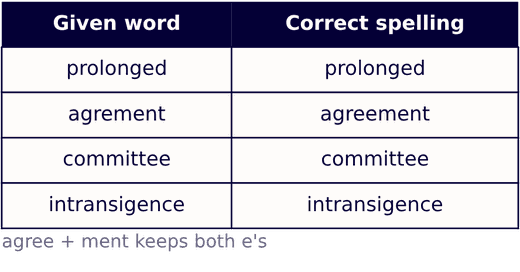 'Prolonged', 'committee' and 'intransigence' are all spelt correctly.
Hence the incorrectly spelt word is option (b).
'Prolonged', 'committee' and 'intransigence' are all spelt correctly.
Hence the incorrectly spelt word is option (b).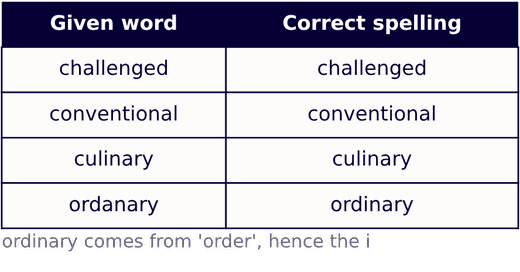 'Challenged', 'conventional' and 'culinary' are all spelt correctly.
Hence the incorrectly spelt word is option (d).
'Challenged', 'conventional' and 'culinary' are all spelt correctly.
Hence the incorrectly spelt word is option (d).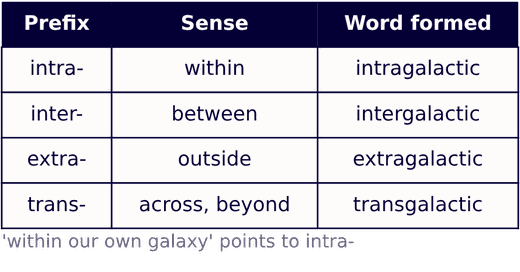 Because the travel stays inside one single galaxy — our own — the word needed is 'intragalactic'.
'Intergalactic', 'extragalactic' and 'transgalactic' all describe travel between or beyond galaxies, which contradicts the phrase 'within our own galaxy'.
Hence the correct option is (b).
Because the travel stays inside one single galaxy — our own — the word needed is 'intragalactic'.
'Intergalactic', 'extragalactic' and 'transgalactic' all describe travel between or beyond galaxies, which contradicts the phrase 'within our own galaxy'.
Hence the correct option is (b).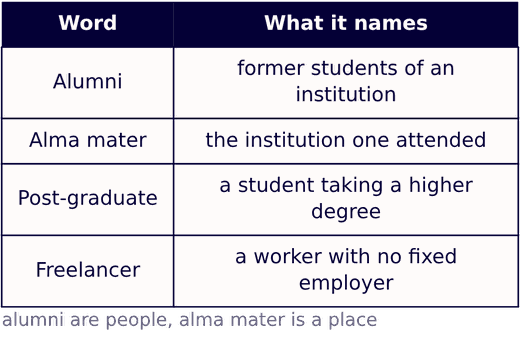 'Alma mater' is the tempting option, but it names the institution itself, not the student who left it.
'Post-graduate' is a student studying for a further degree, and a 'freelancer' works without any permanent employer; neither matches the definition.
Hence the correct option is (a).
'Alma mater' is the tempting option, but it names the institution itself, not the student who left it.
'Post-graduate' is a student studying for a further degree, and a 'freelancer' works without any permanent employer; neither matches the definition.
Hence the correct option is (a).