SSC CHSL 24 November 2025 · Shift 1 · General Intelligence — questions with answers · ShikshaSphere
Chapter 117 of 200
24 November 2025 · Shift 1
General Intelligence
25 questions ~25 min readFree
25 questions
A
26
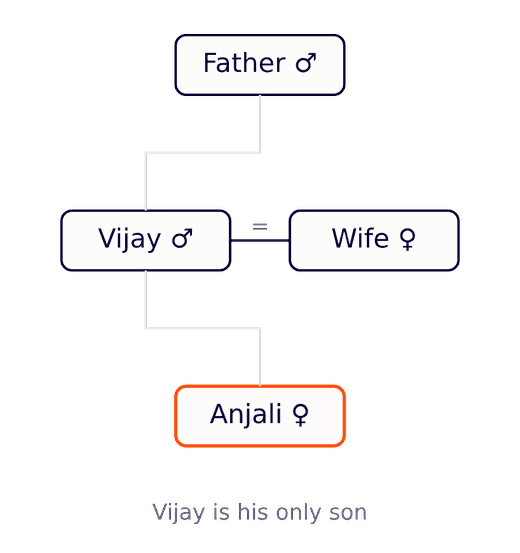
Anjali's father is the only son of Vijay's father. How is Vijay's wife related to Anjali?
A.Aunt
B.Mother
C.Sister
D.Grandmother
Solution
Blood relations
'Anjali's father is the only son of Vijay's father' tells us that Vijay's father has exactly one son.
Vijay is himself a son of Vijay's father, and there is only one such son, so Vijay must be that son — that is, Vijay is Anjali's father.
The wife of Anjali's father is Anjali's mother, so Vijay's wife is Anjali's mother, option (b).
27
In this type of questions, questions are provided with substitutes for various mathematical symbols, followed by a question involving calculation of an expression or choosing the correct/incorrect equation. You have to put the real signs in the given equation and then solve the questions as required. If 'A' stands for '+', 'B' stands for '-', 'C' stands for ' ', and ' D ' stands for ' x ', then find the value of:
9 C 12 D 10 B ?
A.
B.
C.
D.
Solution
Symbol substitution
Put the real sign in place of every code letter.
The expression therefore becomes .
By BODMAS, division and multiplication are done first and from left to right: and .
Now the subtraction: .
Hence the required value is , option (b).
28
Read the following statement carefully and identify the conclusion that follows.Statements:
Some Cups are Glasses.
Some Glasses are Bottles.
Conclusions:
I. Some Cups are Bottles.
II. No Cup is a Bottle.
A.Only conclusion I follows.
B.Only conclusion II follows.
C.Either conclusion I or II follows.
D.Neither conclusion I nor II follows.
Solution
Syllogism
Both statements are particular ('some'), and two particular statements can never give a definite conclusion, so nothing certain links Cups with Bottles.
One diagram can be drawn in which no cup is a bottle and another in which a few cups are also bottles, so neither conclusion is true by itself.
But conclusions I and II form a complementary pair — 'Some Cups are Bottles' and 'No Cup is a Bottle' cannot both be false, so at least one of them must be true.
Hence either conclusion I or conclusion II follows, option (c).
29
Read the following statements carefully and identify the conclusion that follows.Statements:
All novels are books.
All books are paper.
Conclusions:
I. All novels are paper.
II. Some paper are novels.
A.Only conclusion I follows.
B.Only conclusion II follows.
C.Both conclusions I and II follow.
D.Neither conclusion I nor II follows.
Solution
Syllogism
Both statements are universal affirmative, so draw them as one circle inside another: novels inside books, books inside paper.
The whole of the novels circle therefore lies inside the paper circle, so 'All novels are paper' is certainly true — conclusion I follows.
A definite 'All A are B' always yields the particular converse 'Some B are A', because the novels themselves are papers that are novels; so 'Some paper are novels' is also true — conclusion II follows.
Hence both conclusions follow, option (c).
30
In a row of 42 students, Rohan is 15th from the left end and Sohan is 14th from the right end. How many students are sitting between Rohan and Sohan?
A.11
B.12
C.13
D.14
Solution
Ranking in a row
Bring both positions to the same end first: rank from the left = total - rank from the right +1.
Sohan's rank from the left =42-14+1=29.
Rohan is 15th and Sohan is 29th from the left, so the students strictly between them =29-15-1=13.
Hence 13 students sit between Rohan and Sohan, option (c).
31
A mirror is placed on the line AB. Out of the option figures, which figure will be the right image of the question figure?
A.
B.
C.
D.
Solution
Mirror image of a row
A mirror standing along the vertical line AB interchanges left and right only; nothing is turned upside down.
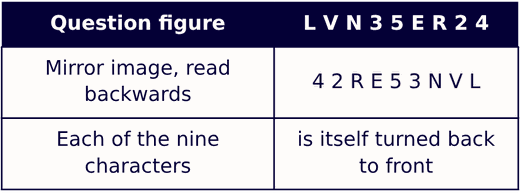
So the row L V N 3 5 E R 2 4 is read backwards as 4 2 R E 5 3 N V L.
That reversal of order is only half the work — in a lateral inversion every single character is itself printed back to front as well.
In three of the option figures at least one character (the 4, the R or the 5) is still printed the right way round, so they cannot be the image.
Only one figure shows all nine characters reversed in order and each one laterally inverted, so the mirror image is option (c).
32
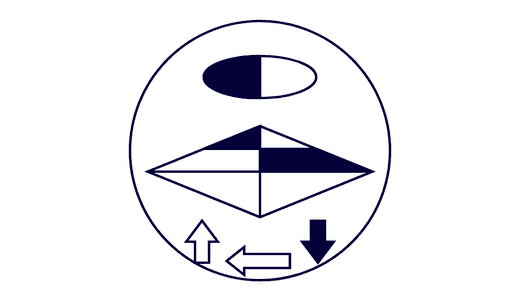
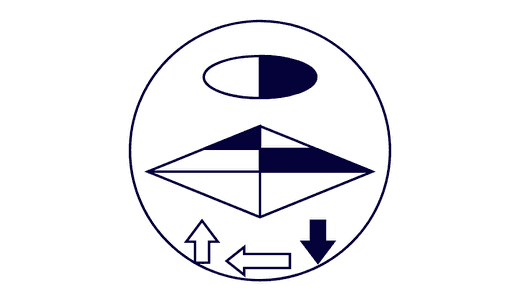
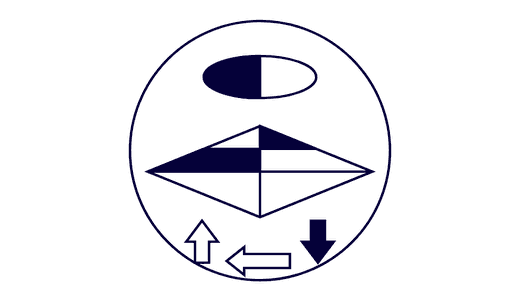
A mirror is placed on the line AB. Out of the option figures, which figure will be the right image of the question figure?
A.
B.
C.
D.
Solution
Mirror image of a figure
The mirror stands along the vertical line AB, so left and right are exchanged while up and down stay exactly as they are.
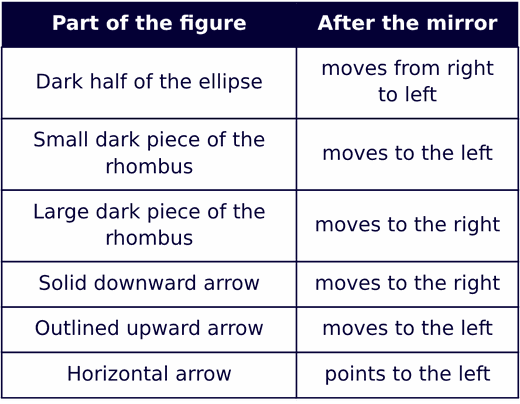
Check the four parts of the figure one by one.
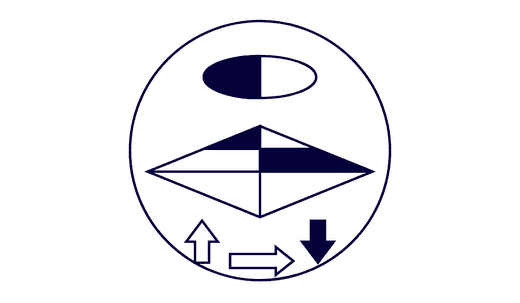
The dark half of the ellipse must therefore sit on the left, and inside the rhombus the small dark triangle must move to the left of the vertical diagonal while the large dark piece moves to the right.
Among the arrows, the solid downward arrow must appear on the right, the outlined upward arrow on the left, and the horizontal arrow must point to the left.
Option (a) keeps the horizontal arrow pointing right, option (c) keeps the dark half of the ellipse on the right and option (d) leaves the rhombus unchanged.
Only one figure carries all the changes together, so the mirror image is option (b).
33
A piece of paper is folded and punched as shown below in the question figures. From the given option figures, indicate how it will appear when opened.
A.
B.
C.
D.
Solution
Paper folding and punching
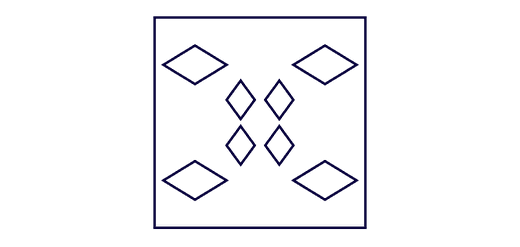
The sheet is first folded bottom half upwards and then the right half onto the left, so the two punches lie in the top-left quarter of the open sheet.
Undo the folds in the reverse order and mirror the holes at each crease.
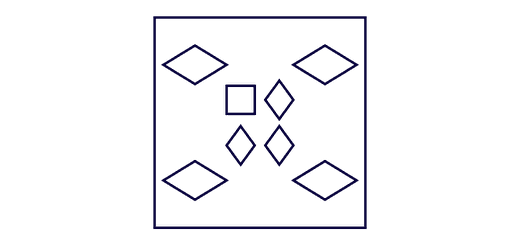
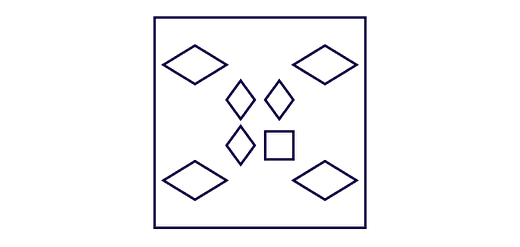
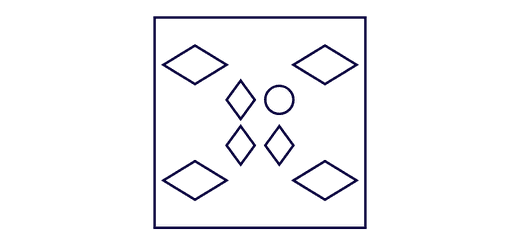
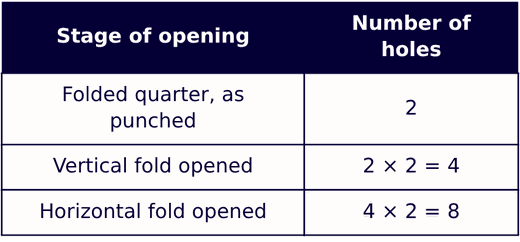
Opening the vertical crease reflects the two holes into the top-right quarter, giving four holes in the top half; opening the horizontal crease reflects those four into the bottom half, giving eight holes in all.
A punch cuts right through the folded paper, so every one of the eight holes must have the same diamond shape as the original punches — four large diamonds near the corners and four small ones around the centre.
Options (a) and (b) replace one hole by a square and option (c) replaces one by a circle, so they are impossible.
The figure with eight diamond-shaped holes is option (d).
34
Select the related letter-cluster from the given alternatives.
BEAT : DGCV :: SOUL : ?
A.UQWN
B.UQWM
C.VPXM
D.TQWK
Solution
Letter-cluster analogy
Compare BEAT with DGCV letter by letter: B→D, E→G, A→C, T→V — each letter moves 2 places forward in the alphabet.
Apply the same rule to SOUL: S→U, O→Q, U→W, L→N.
Hence SOUL : UQWN, option (a).
35
Select the correct option from the given alternatives.
13, 10, 26, 23, 39, 36, 52, ?
A.49
B.50
C.45
D.55
Solution
Number series
Take the differences of consecutive terms of 13, 10, 26, 23, 39, 36, 52.
They are -3,+16,-3,+16,-3,+16, so a fall of 3 and a rise of 16 alternate.
The last step shown is a rise of 16, so the next step must be a fall of 3: 52-3=49.
Hence the required number is 49, option (a).
36
What comes next in the series? BDFH, DFHJ, FHJL, ?
A.HJKL
B.HJLJ
C.HJLN
D.HILK
Solution
Letter series
Break each group into its letters: B D F H, then D F H J, then F H J L.
Within a group every letter is 2 places after the one before it, and each new group begins 2 letters after the previous group, so the fourth group must begin with H.
Counting on in twos from H gives H, J, L, N.
Hence the missing term is HJLN, option (c).
37
You are given a Master Address (MA) from official records. Your task is to identify the correct candidate address that matches exactly with the master address in terms of formatting, punctuation, spelling, and structure.
Master Address (MA): 56, Hill Top View, Lane No. 3, Shimla - 171001
Candidate Addresses:
A.56, Hill Top View, Lane No 3, Shimla - 171001
B.56, Hill Top View, Lane No. 3, Shimla - 171001
C.56, Hilltop View, Lane No. 3, Shimla - 171001
D.56, Hill Top View, Lane No. 3, Simla - 171001
Solution
Address matching
Compare the candidates with the master address one field at a time — house number, building, lane, city, PIN.
Option (a) drops the full stop in 'No.', option (c) joins 'Hill Top' into 'Hilltop', and option (d) spells the city 'Simla' instead of 'Shimla'.
Only option (b) reproduces the master address exactly, so it is correct.
38
You are given a Master Address (MA) from official records. Your task is to identify the correct candidate address that matches exactly with the master address in terms of formatting, punctuation, spelling, and structure.
Master Address (MA): Shop No. 12, 3rd Floor, Phoenix Mall, Viman-Nagar, Pune - 411014
Candidate Addresses:
A.Shop No. 12, Third Floor, Phoenix Mall, Viman-Nagar, Pune - 411014
B.Shop No 12, 3rd Floor, Phoenix Mall, Viman-Nagar, Pune - 411014
Address matching
Check the four candidates field by field against the master address.
Option (a) writes 'Third Floor' for '3rd Floor', option (b) loses the full stop after 'No', and option (c) drops the hyphen in 'Viman-Nagar'.
Option (d) matches the master address character for character, so option (d) is correct.
39
If + means -, - means ×, × means ÷, and ÷ means + , evaluate: ?
A.12
B.15
C.18
D.25
Solution
Interchange of signs
Replace each sign of the expression by the sign it really stands for.
So becomes .
By BODMAS the division comes first: , and then .
The expression is now 20 + 10 - 15 = 30 - 15 = 15.
Hence the required value is 15, option (b).
40
In the following question, select the number which can be placed at the sign of question mark (?) from the given alternatives.
A.104
B.115
C.110
D.106
Solution
Number matrix
In a matrix of this kind the same rule binds the entries of every row, so the rule has to be discovered from the rows that are complete.
Take the first row and combine its numbers by the usual operations — multiply the first two, then add or subtract the third — until the last entry of that row is reproduced.
Test the very same rule on the second row; only a rule that works for both rows may be carried over to the third.
Applying that rule to the numbers of the third row gives 106, so the number in place of the question mark is 106, option (d).
41
In the following question, select the number which can be placed at the sign of question mark (?) from the given alternatives.
A.50
B.60
C.48
D.44
Solution
Number pattern
All the complete groups of the arrangement are built on one and the same rule, so that rule has to be read off from them first.
The same rule is then applied to the group that carries the question mark, and each of the four alternatives is tested in its place.
Only 50 keeps the rule intact; the other three break it.
Hence the number that replaces the question mark is 50.
42
Identify the diagram that best represents the relationship among the given classes.
Fishes, Sharks, dolphins
A.
B.
C.
D.
Solution
Class relationship diagram
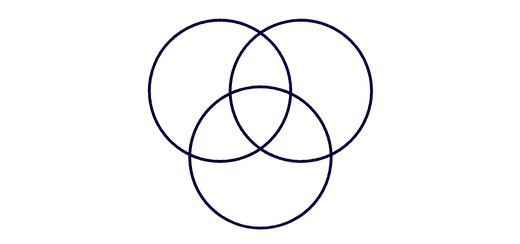
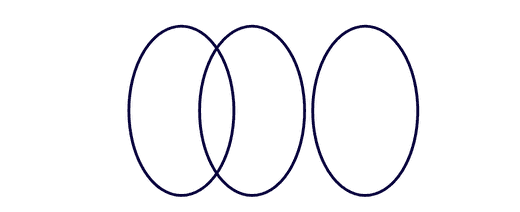
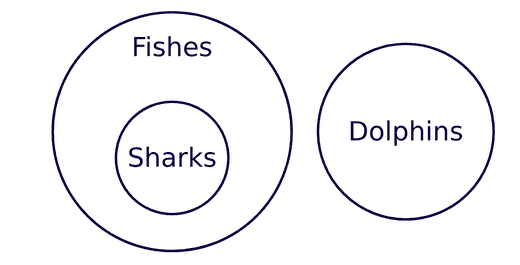
A shark is a kind of fish, so the class of Sharks lies wholly inside the class of Fishes.
Dolphins are mammals and not fish at all, so their class stands completely apart from both Fishes and Sharks.
The picture therefore needs a small circle inside a big one, and a third circle clear of both.
Only option (d) shows this; (a) puts both smaller classes inside Fishes, (b) makes all three overlap and (c) shows two overlapping classes, none of which is true here.
43
In the figure given below, the circle represents 'Singers', the triangle represents 'Dancers', and the rectangle represents 'Actors'. The number in each area represents the number of artists in that area.
Which of the following statement is correct?
I. Total number of Actors are 20.
II. Total number of Singers are 18.
A.Only I
B.Only II
C.Both I and II
D.Neither I nor II
Solution
Venn diagram counting
Every number that lies inside the rectangle belongs to the Actors, wherever else it may also lie.
The rectangle covers four regions: 9 (rectangle alone), 4 (shared with the circle), 6 (shared with the triangle) and 2 (common to all three).
Total number of actors =9+4+6+2=21, so statement I, which claims 20, is wrong.
The circle stands for the Singers, and it covers the regions 12, 4 and 2.
Total number of singers =12+4+2=18, so statement II is correct.
Hence only statement II is correct.
44
Anjali is walking towards the West. After taking 13 right turns and 12 left turns, in which direction is she moving now?
A.East
B.West
C.North
D.South
Solution
Direction sense
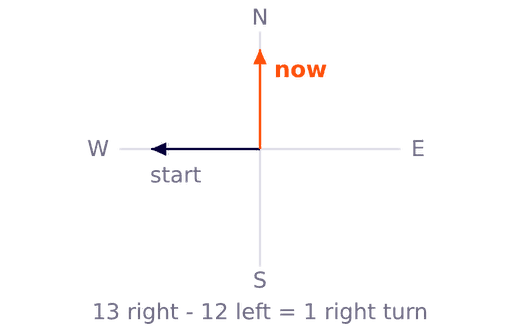
A right turn and a left turn undo each other, so only the extra turns decide the final direction.
13 right turns and 12 left turns leave 13-12=1 right turn.
Anjali sets out facing West, and turning right from West brings her face to the North.
Hence she is now moving towards the North.
45
Which option figure will complete the pattern in the question figure? (Rotation is not allowed)
A.
B.
C.
D.
Solution
Completing a pattern
The two centre lines cut the big square into four quarters, and each finished quarter carries the same three things: a wide horizontal bar, a tall vertical bar crossing it, and a straight line drawn from the centre of the square to the outer corner of that crossing.
The empty quarter is the bottom-right one, so it must be the mirror image of the bottom-left quarter taken in the vertical centre line.
In that mirror image the vertical bar stands just right of the middle of the piece, the horizontal bar starts at the centre line and stops a little short of the outer edge, and the slanting line runs from the corner of the piece that touches the centre down to the near corner of the crossing.
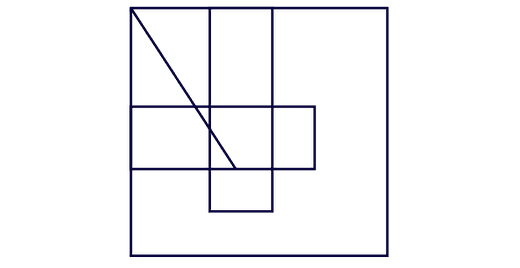
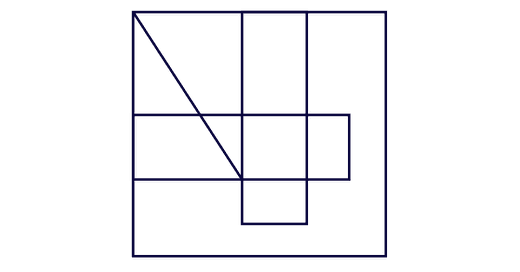
Option (b) shows exactly this arrangement, and rotation is not allowed, so no other figure can be turned to fit.
In (a) the vertical bar sits left of the middle and the slanting line stops inside that bar instead of at its edge; in (c) the slanting line runs on past the crossing to the foot of the vertical bar; in (d) the slanting line rises towards the top-right corner.
46
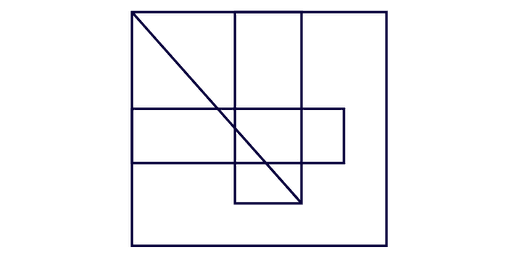
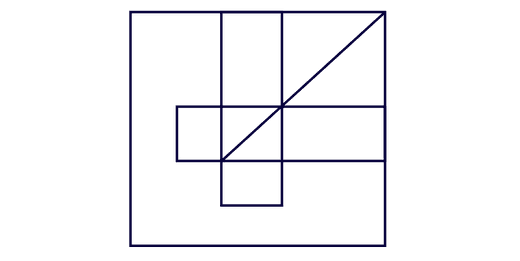
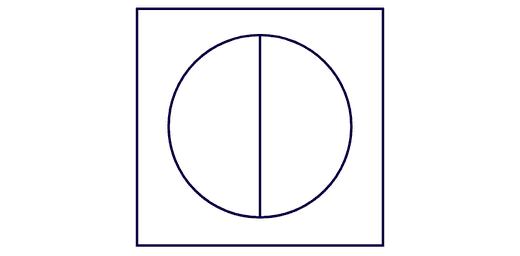
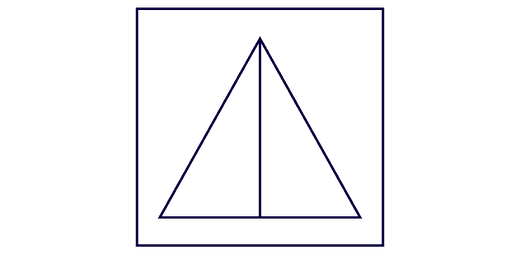
Three of the given four figures are similar in a certain manner while one is different. Pick the odd one out.
A
B
C
D
A.A
B.B
C.C
D.D
Solution
Odd figure out
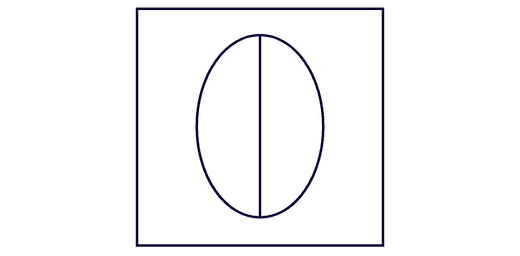
In figures A, B and C the line drawn inside the closed shape is an axis of symmetry.
It halves the circle along a diameter, the isosceles triangle along the line from the apex to the mid-point of the base, and the ellipse along its axis, so in each case the two pieces are identical.
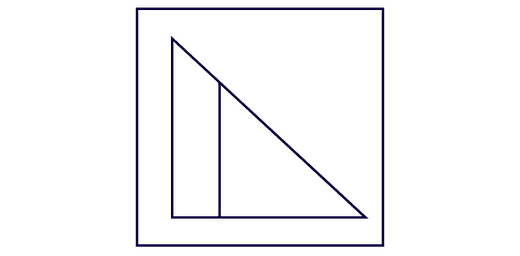
In figure D the line drops from the hypotenuse to the base of a right triangle well away from the middle, so the two pieces are a four-sided figure and a triangle, quite unequal.
Hence figure D is the odd one out.
47
In the following figure series, select the figure which can be placed at the sign of question mark (?) from the given alternatives.
A.
B.
C.
D.
Solution
Figure series
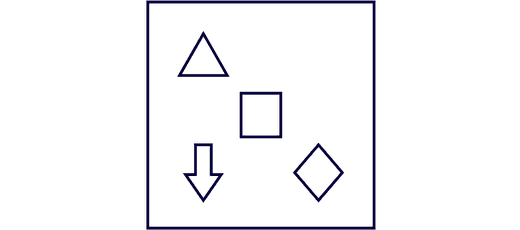
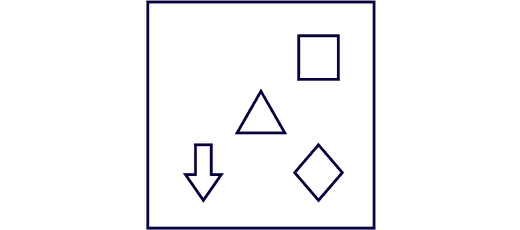
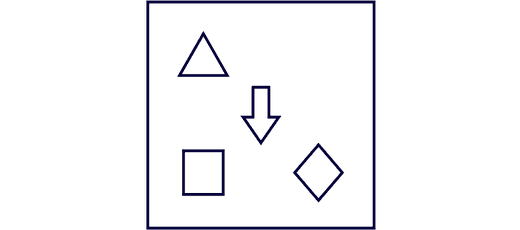
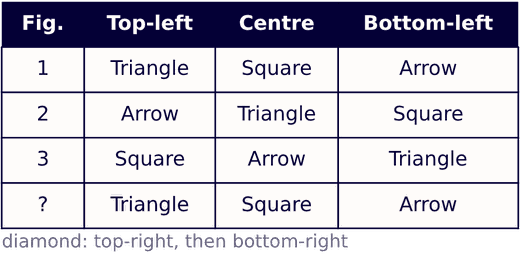
The triangle, the square and the arrow always keep to the same three places — top-left, centre and bottom-left — and only exchange them.
They move in a fixed cycle: the shape at the top-left goes to the centre, the shape at the centre goes to the bottom-left, and the shape at the bottom-left climbs to the top-left.
The third figure has square, arrow, triangle in those three places, so the fourth has triangle, square, arrow — the same as the first figure.
The diamond keeps to the right side and only changes corner: top-right, bottom-right, top-right, so now it comes to the bottom-right.
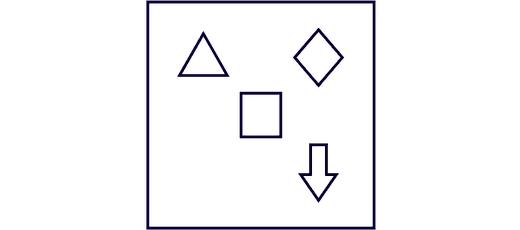
Option (b) is the only figure with the triangle at the top-left, the square in the centre, the arrow at the bottom-left and the diamond at the bottom-right.
48
In the following figure series, select the figure which can be placed at the sign of question mark (?) from the given alternatives.
A.
B.
C.
D.
Solution
Figure series
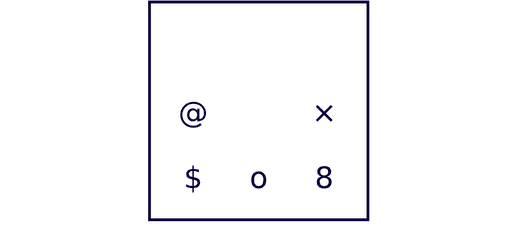
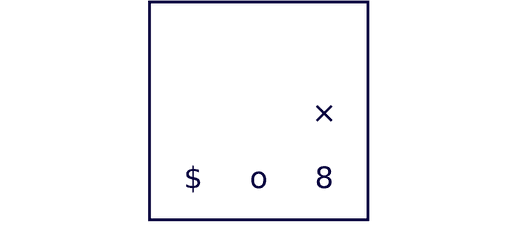
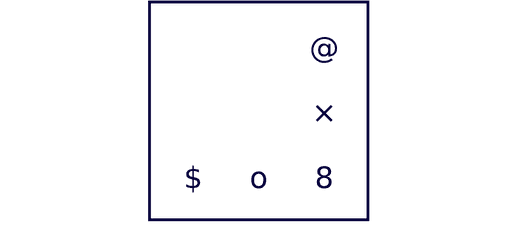
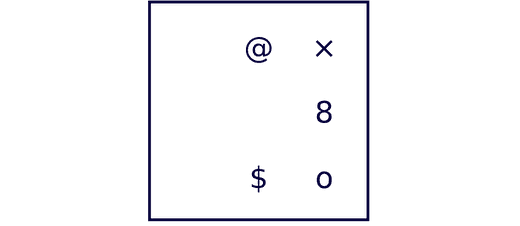
The four signs ×, 8, o and the dollar sign always stand in that order on neighbouring cells of the border of the box, and the whole block creeps clockwise round that border.
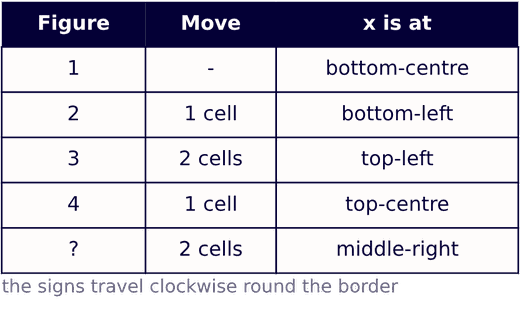
In the first figure × is at the bottom-centre, in the second at the bottom-left, in the third at the top-left and in the fourth at the top-centre.
So the block moves one cell, then two cells, then one cell, and the next move must again be of two cells.
Two cells clockwise from the top-centre brings × to the middle-right, and 8, o and the dollar sign follow it into the bottom-right, bottom-centre and bottom-left cells.
The third and the fourth figures already carry the same four signs, so no fresh sign joins the block in the fifth figure either.
Option (b) alone shows these four signs in exactly these four cells.
49
If 'A' means '÷', 'B' means '+', 'C' means ' - ', and ' D ' means ' ', then evaluate the following expression:
24 A 6 D4B9C8 = ?
A.25
B.17
C.19
D.21
Solution
Symbol substitution
Put back the sign that each letter stands for: A is , B is +, C is - and D is .
The expression becomes .
By BODMAS, and are done first, from left to right: and then .
What is left is 16 + 9 - 8 = 17.
Hence the value of the expression is 17.
50
If 'A' means 'x', 'B' means '+', 'C' means ' ' and ' D ' means ' - , then evaluate the following expression:
15 A 4 D 18 C 3 B ?
A.58
B.64
C.62
D.60
Solution
Symbol substitution
Here A stands for , B for +, C for and D for -.
The expression becomes .
By BODMAS the and the go first: and .
Now 60 - 6 + 6 = 60.
Hence the required value is 60.
Finished reading? Now test yourself.
The same 25 questions, but with a timer and the answers hidden — 15 minutes.

 The wife of Anjali's father is Anjali's mother, so Vijay's wife is Anjali's mother, option (b).
 The expression therefore becomes .
By BODMAS, division and multiplication are done first and from left to right: and .
Now the subtraction: .
Hence the required value is , option (b).
The expression therefore becomes .
By BODMAS, division and multiplication are done first and from left to right: and .
Now the subtraction: .
Hence the required value is , option (b).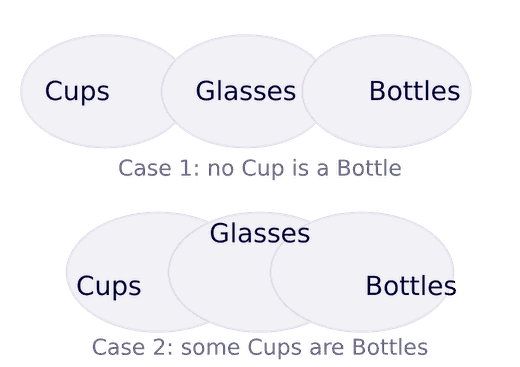 One diagram can be drawn in which no cup is a bottle and another in which a few cups are also bottles, so neither conclusion is true by itself.
But conclusions I and II form a complementary pair — 'Some Cups are Bottles' and 'No Cup is a Bottle' cannot both be false, so at least one of them must be true.
Hence either conclusion I or conclusion II follows, option (c).
One diagram can be drawn in which no cup is a bottle and another in which a few cups are also bottles, so neither conclusion is true by itself.
But conclusions I and II form a complementary pair — 'Some Cups are Bottles' and 'No Cup is a Bottle' cannot both be false, so at least one of them must be true.
Hence either conclusion I or conclusion II follows, option (c).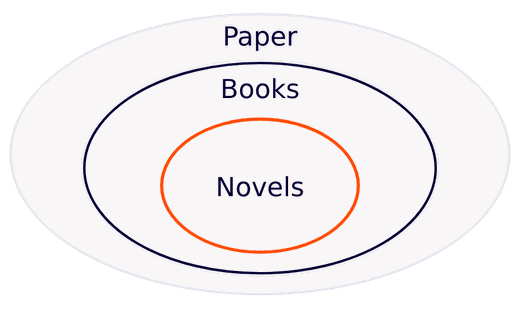 The whole of the novels circle therefore lies inside the paper circle, so 'All novels are paper' is certainly true — conclusion I follows.
A definite 'All A are B' always yields the particular converse 'Some B are A', because the novels themselves are papers that are novels; so 'Some paper are novels' is also true — conclusion II follows.
Hence both conclusions follow, option (c).
The whole of the novels circle therefore lies inside the paper circle, so 'All novels are paper' is certainly true — conclusion I follows.
A definite 'All A are B' always yields the particular converse 'Some B are A', because the novels themselves are papers that are novels; so 'Some paper are novels' is also true — conclusion II follows.
Hence both conclusions follow, option (c).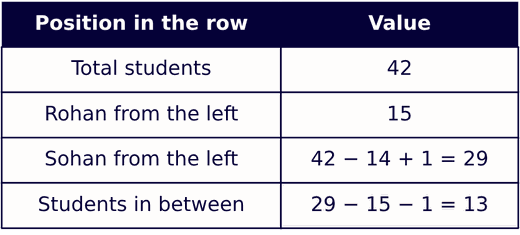 Rohan is 15th and Sohan is 29th from the left, so the students strictly between them =29-15-1=13.
Hence 13 students sit between Rohan and Sohan, option (c).
Rohan is 15th and Sohan is 29th from the left, so the students strictly between them =29-15-1=13.
Hence 13 students sit between Rohan and Sohan, option (c).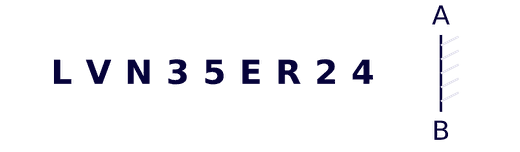




 That reversal of order is only half the work — in a lateral inversion every single character is itself printed back to front as well.
In three of the option figures at least one character (the 4, the R or the 5) is still printed the right way round, so they cannot be the image.
Only one figure shows all nine characters reversed in order and each one laterally inverted, so the mirror image is option (c).
That reversal of order is only half the work — in a lateral inversion every single character is itself printed back to front as well.
In three of the option figures at least one character (the 4, the R or the 5) is still printed the right way round, so they cannot be the image.
Only one figure shows all nine characters reversed in order and each one laterally inverted, so the mirror image is option (c).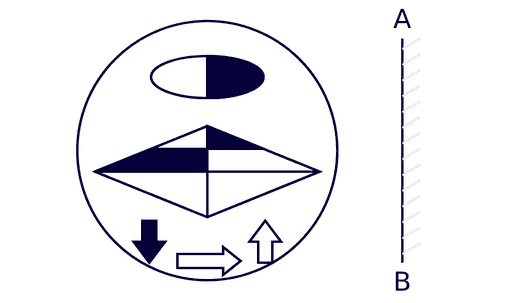
 The dark half of the ellipse must therefore sit on the left, and inside the rhombus the small dark triangle must move to the left of the vertical diagonal while the large dark piece moves to the right.
Among the arrows, the solid downward arrow must appear on the right, the outlined upward arrow on the left, and the horizontal arrow must point to the left.
Option (a) keeps the horizontal arrow pointing right, option (c) keeps the dark half of the ellipse on the right and option (d) leaves the rhombus unchanged.
Only one figure carries all the changes together, so the mirror image is option (b).
The dark half of the ellipse must therefore sit on the left, and inside the rhombus the small dark triangle must move to the left of the vertical diagonal while the large dark piece moves to the right.
Among the arrows, the solid downward arrow must appear on the right, the outlined upward arrow on the left, and the horizontal arrow must point to the left.
Option (a) keeps the horizontal arrow pointing right, option (c) keeps the dark half of the ellipse on the right and option (d) leaves the rhombus unchanged.
Only one figure carries all the changes together, so the mirror image is option (b).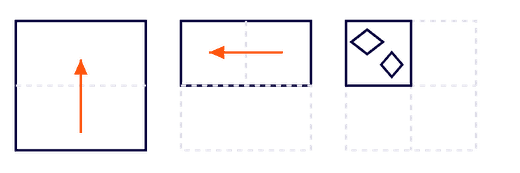
 Opening the vertical crease reflects the two holes into the top-right quarter, giving four holes in the top half; opening the horizontal crease reflects those four into the bottom half, giving eight holes in all.
A punch cuts right through the folded paper, so every one of the eight holes must have the same diamond shape as the original punches — four large diamonds near the corners and four small ones around the centre.
Options (a) and (b) replace one hole by a square and option (c) replaces one by a circle, so they are impossible.
The figure with eight diamond-shaped holes is option (d).
Opening the vertical crease reflects the two holes into the top-right quarter, giving four holes in the top half; opening the horizontal crease reflects those four into the bottom half, giving eight holes in all.
A punch cuts right through the folded paper, so every one of the eight holes must have the same diamond shape as the original punches — four large diamonds near the corners and four small ones around the centre.
Options (a) and (b) replace one hole by a square and option (c) replaces one by a circle, so they are impossible.
The figure with eight diamond-shaped holes is option (d).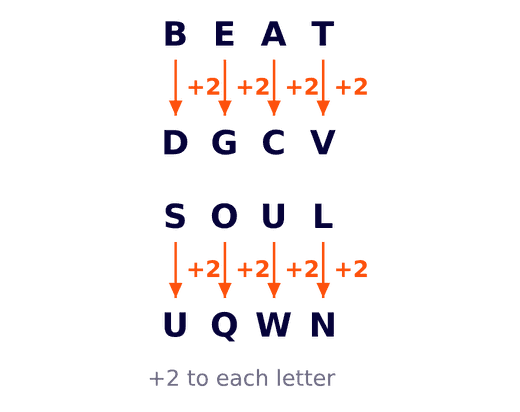 Apply the same rule to SOUL: S→U, O→Q, U→W, L→N.
Hence SOUL : UQWN, option (a).
Apply the same rule to SOUL: S→U, O→Q, U→W, L→N.
Hence SOUL : UQWN, option (a).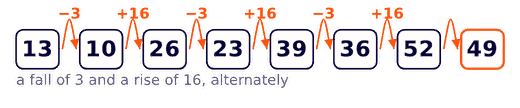 The last step shown is a rise of 16, so the next step must be a fall of 3: 52-3=49.
Hence the required number is 49, option (a).
The last step shown is a rise of 16, so the next step must be a fall of 3: 52-3=49.
Hence the required number is 49, option (a).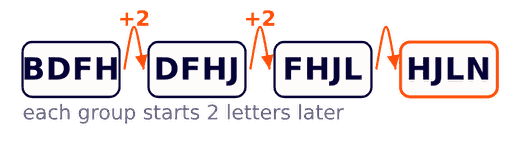 Counting on in twos from H gives H, J, L, N.
Hence the missing term is HJLN, option (c).
Counting on in twos from H gives H, J, L, N.
Hence the missing term is HJLN, option (c).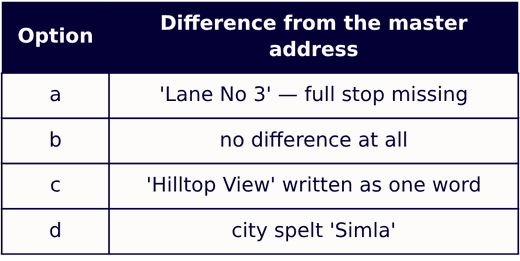 Option (a) drops the full stop in 'No.', option (c) joins 'Hill Top' into 'Hilltop', and option (d) spells the city 'Simla' instead of 'Shimla'.
Only option (b) reproduces the master address exactly, so it is correct.
Option (a) drops the full stop in 'No.', option (c) joins 'Hill Top' into 'Hilltop', and option (d) spells the city 'Simla' instead of 'Shimla'.
Only option (b) reproduces the master address exactly, so it is correct.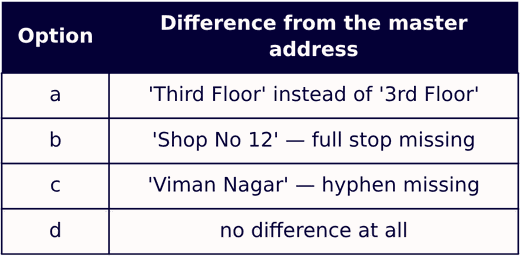 Option (a) writes 'Third Floor' for '3rd Floor', option (b) loses the full stop after 'No', and option (c) drops the hyphen in 'Viman-Nagar'.
Option (d) matches the master address character for character, so option (d) is correct.
Option (a) writes 'Third Floor' for '3rd Floor', option (b) loses the full stop after 'No', and option (c) drops the hyphen in 'Viman-Nagar'.
Option (d) matches the master address character for character, so option (d) is correct. So becomes .
By BODMAS the division comes first: , and then .
The expression is now 20 + 10 - 15 = 30 - 15 = 15.
Hence the required value is 15, option (b).
So becomes .
By BODMAS the division comes first: , and then .
The expression is now 20 + 10 - 15 = 30 - 15 = 15.
Hence the required value is 15, option (b).

 The picture therefore needs a small circle inside a big one, and a third circle clear of both.
Only option (d) shows this; (a) puts both smaller classes inside Fishes, (b) makes all three overlap and (c) shows two overlapping classes, none of which is true here.
The picture therefore needs a small circle inside a big one, and a third circle clear of both.
Only option (d) shows this; (a) puts both smaller classes inside Fishes, (b) makes all three overlap and (c) shows two overlapping classes, none of which is true here.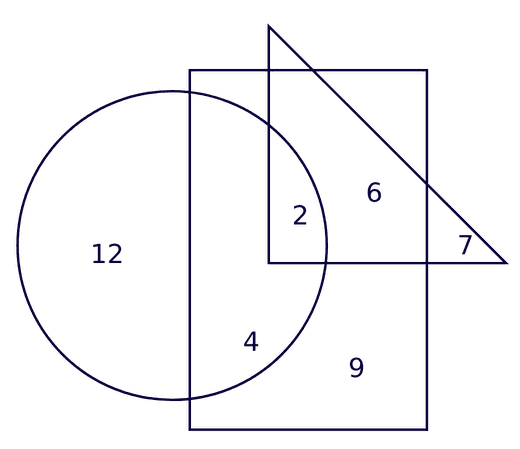 Which of the following statement is correct?
I. Total number of Actors are 20.
II. Total number of Singers are 18.
Which of the following statement is correct?
I. Total number of Actors are 20.
II. Total number of Singers are 18.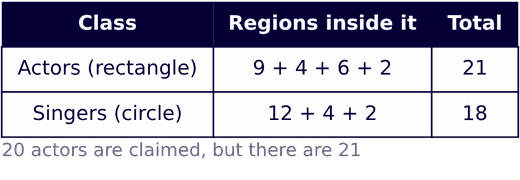 Hence only statement II is correct.
 Hence she is now moving towards the North.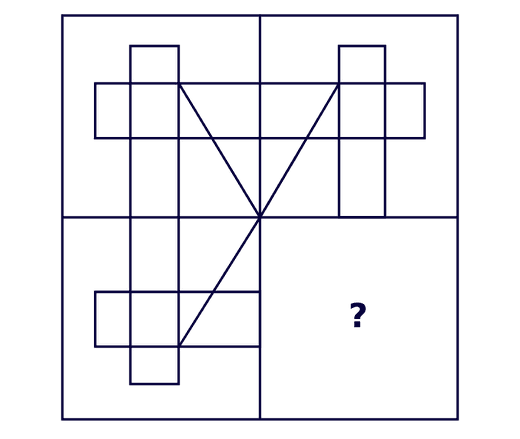
 A
A
 B
B
 C
C
 D
D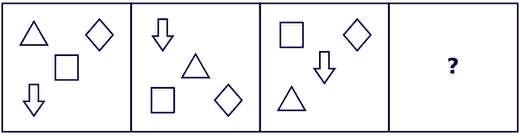
 The third figure has square, arrow, triangle in those three places, so the fourth has triangle, square, arrow — the same as the first figure.
The diamond keeps to the right side and only changes corner: top-right, bottom-right, top-right, so now it comes to the bottom-right.
Option (b) is the only figure with the triangle at the top-left, the square in the centre, the arrow at the bottom-left and the diamond at the bottom-right.
The third figure has square, arrow, triangle in those three places, so the fourth has triangle, square, arrow — the same as the first figure.
The diamond keeps to the right side and only changes corner: top-right, bottom-right, top-right, so now it comes to the bottom-right.
Option (b) is the only figure with the triangle at the top-left, the square in the centre, the arrow at the bottom-left and the diamond at the bottom-right.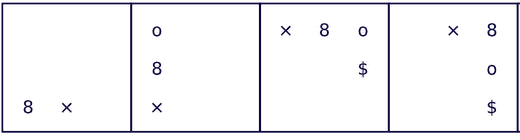
 Two cells clockwise from the top-centre brings × to the middle-right, and 8, o and the dollar sign follow it into the bottom-right, bottom-centre and bottom-left cells.
The third and the fourth figures already carry the same four signs, so no fresh sign joins the block in the fifth figure either.
Option (b) alone shows these four signs in exactly these four cells.
Two cells clockwise from the top-centre brings × to the middle-right, and 8, o and the dollar sign follow it into the bottom-right, bottom-centre and bottom-left cells.
The third and the fourth figures already carry the same four signs, so no fresh sign joins the block in the fifth figure either.
Option (b) alone shows these four signs in exactly these four cells.