SSC CHSL 22 November 2025 · Shift 3 · General Awareness — questions with answers · ShikshaSphere
Chapter 114 of 200
22 November 2025 · Shift 3
General Awareness
25 questions ~25 min readFree
25 questions
A
76
In which year did Babur defeat Ibrahim Lodi, leading to the foundation of the Mughal Empire in India?
A.1615
B.1526
C.1530
D.1556
Solution
First Battle of Panipat
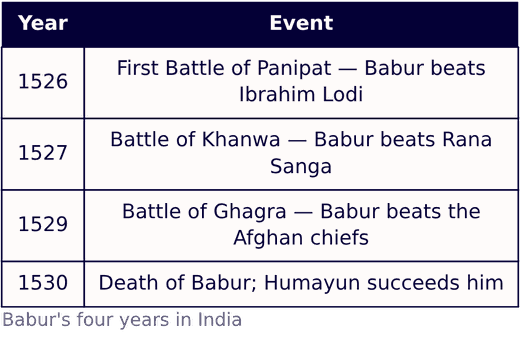
Babur defeated Ibrahim Lodi on 21 April 1526 in the First Battle of Panipat, and that victory founded the Mughal Empire in India.
Ibrahim Lodi was the last Sultan of the Lodi dynasty, so the same battle also ended the Delhi Sultanate.
Babur, though heavily outnumbered, won with field artillery and the Tulughma (flanking) formation, both new to northern India.
1530 is the year of Babur's death, 1556 is the Second Battle of Panipat (Akbar's forces against Hemu), and 1615 falls in Jahangir's reign.
Hence the correct option is (b).
77
Who was the first female Jawan inducted into the Indian Army?
A.Punita Arora
B.Shanti Tigga
C.Anju Bala
D.Navneet Kaur
Solution
First woman jawan
Shanti Tigga became the first woman jawan of the Indian Army in 2011.
She was enrolled as a sapper in the 969 Railway Engineer Regiment of the Territorial Army, a unit raised from Railway employees.
A mother of two from Jalpaiguri in West Bengal, she outdid her male batchmates in the physical tests and was adjudged 'Best Trainee'.
Punita Arora is remembered as the first woman Lieutenant General of the Indian Army — an officer, not a jawan, so she does not fit this question.
Hence the correct option is (b).
78
Pankaj Advani, who received the Rajiv Gandhi Khel Ratna Award in 2006, is associated with which sport?
A.Badminton
B.Billiards and Snooker
C.Squash
D.Lawn Tennis
Solution
Sportspersons and awards
Pankaj Advani is a cue-sports player — billiards and snooker — and he received the Rajiv Gandhi Khel Ratna, India's highest sporting honour, in 2006.
He is the country's most decorated cue-sportsman, with more than 25 world titles across the two games.
He is the only player to have won both the 'points' and the 'time' formats of the IBSF World Billiards Championship in the same season.
Hence the correct option is (b).
79
In 2025, Shri Jayant Chaudhary launched which Women Entrepreneurship Programme?
A.Mahila Udyam Yojana
B.Udyogini Initiative
C.Stree Nidhi Programme
D.Swavalambini
Solution
Women entrepreneurship scheme
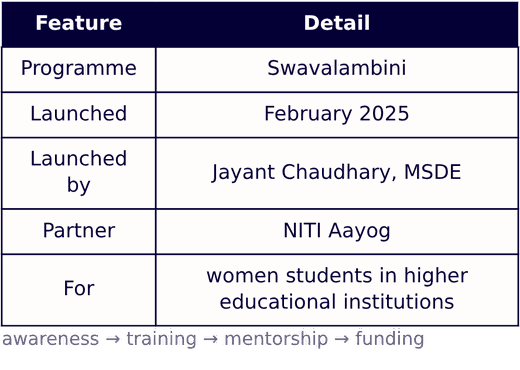
Swavalambini is the Women Entrepreneurship Programme launched in February 2025 by Shri Jayant Chaudhary, Minister of State (Independent Charge) for Skill Development and Entrepreneurship.
It is run by the MSDE together with NITI Aayog and is meant for women students of higher educational institutions, starting with the North-East and Uttar Pradesh.
The programme carries a student from idea to enterprise in stages — entrepreneurship awareness, structured training, mentorship and help in raising funds.
Hence the correct option is (d).
80
The National Mission on Natural Farming, launched in November 2024, aims to promote chemical-free farming among how many crore farmers?
A.1
B.5
C.3
D.6
Solution
National Mission on Natural Farming
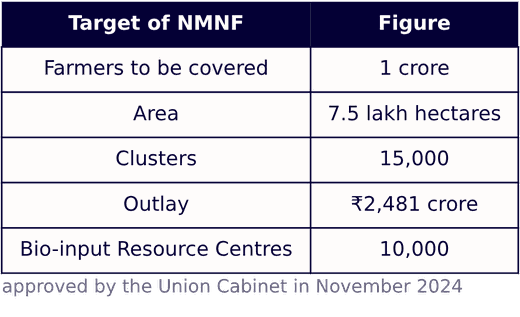
The Union Cabinet approved the National Mission on Natural Farming (NMNF) in November 2024, and it aims to take chemical-free farming to 1 crore farmers.
It is a standalone centrally sponsored scheme of the Ministry of Agriculture and Farmers' Welfare with an outlay of ₹2,481 crore up to 2025-26.
The mission plans to cover 7.5 lakh hectares through 15,000 clusters, supported by 10,000 Bio-input Resource Centres and about 30,000 Krishi Sakhis trained for field work.
Hence the correct option is (a).
81
According to the Energy Transition Index 2025, India is ranked at which position globally?
A.42nd
B.55th
C.71st
D.88th
Solution
Energy Transition Index 2025
India stands 71st in the Energy Transition Index (ETI) 2025, brought out by the World Economic Forum in June 2025.
The index scores 118 countries on the present performance of their energy system — security, equity and environmental sustainability — and on how ready that system is for the transition.
India had been 63rd in 2024, and it remains among the very few large economies that improved on every one of the three pillars, its gains coming from energy efficiency and clean-energy investment.
Sweden topped the index, followed by Finland and Denmark.
Hence the correct option is (c).
82
The India Meteorological Department (IMD) officially adopted the Bharat Forecast System on 26 May 2025. It was developed by which institution?
A.IIT Madras
B.IIT Delhi
C.National Centre for Medium Range Weather Forecasting
D.Indian Institute of Tropical Meteorology (IITM), Pune
Solution
Bharat Forecast System
The Bharat Forecast System (BFS) was built by the Indian Institute of Tropical Meteorology (IITM), Pune, an institute of the Ministry of Earth Sciences, and was put into operational use by the IMD on 26 May 2025.
Its distinguishing feature is resolution: it forecasts on a grid of about 6 km against the 12 km grid of the earlier model, which lets warnings be issued almost at panchayat level.
It runs on the supercomputers Arka and Arunika and sharply improves the tracking of short, violent events such as cloudbursts and heavy-rain spells.
The NCMRWF (option c) does run its own forecast models, but the BFS is an IITM Pune product.
Hence the correct option is (d).
83
Which Indian state topped the Management Effectiveness Evaluation (MEE) of Protected Areas for the period 2020-2025 ?
A.Arunachal Pradesh
B.Meghalaya
C.Tamil Nadu
D.Kerala
Solution
Management Effectiveness Evaluation
Kerala topped the Management Effectiveness Evaluation (MEE) of Protected Areas for 2020-2025, scoring 76.22% — the only State placed in the 'Very Good' band.
The exercise was released by the Ministry of Environment, Forest and Climate Change and covered 438 protected areas, judging them on the IUCN-WCPA framework of planning, inputs, process, outputs and outcomes.
Chandigarh scored highest among the Union Territories (85.16%), while Eravikulam National Park (Kerala) and Dachigam National Park (Jammu & Kashmir) shared the best individual score of 92.97%.
Hence the correct option is (d).
84
Who is the author of the autobiography 'Childhood Days: A Memoir'?
A.Bankim Chandra Chattopadhyay
B.Satyajit Ray
C.Nirad C. Chaudhuri
D.Sunil Gangopadhyay
Solution
Author of an autobiography
'Childhood Days: A Memoir' was written by Satyajit Ray.
It is the English version of his Bengali memoir Jakhan Chhoto Chhilam (1982), in which he recalls his boyhood in Kolkata and the household of his grandfather Upendrakishore Ray.
Ray, the film-maker of Pather Panchali and the Apu trilogy, received the honorary Academy Award and the Bharat Ratna in the same year, 1992.
Nirad C. Chaudhuri is the tempting distractor — his memoir is 'The Autobiography of an Unknown Indian'.
Hence the correct option is (b).
85
What type of street layout was found in the cities of the Harappan civilization, where the streets intersected each other at right angles?
A.Circular
B.Rectangular
C.Hexagonal
D.Triangular
Solution
Harappan town planning
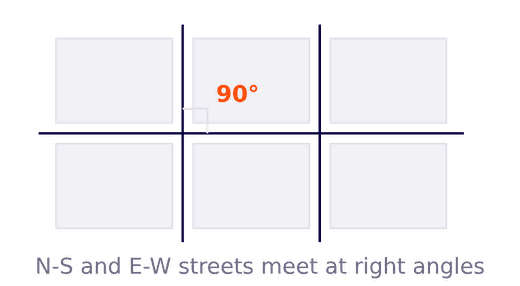
Harappan towns were laid out on a grid: the main streets ran north-south and east-west and cut one another at right angles, so the town was divided into rectangular blocks.
Because of this the plan is often called the 'chessboard' or grid pattern; it is best preserved at Mohenjodaro, Harappa and Kalibangan.
The same discipline shows in the burnt bricks of fixed ratio 4 : 2 : 1, the covered drains running under the streets, and the division of each city into a raised Citadel and a Lower Town.
Hence the correct option is (b).
86
In which Indian state/Union Territory dance form known as 'Luddi' is popular ?
A.Assam
B.Meghalaya
C.Punjab
D.Andaman and Nicobar
Solution
Folk dance of Punjab
Luddi is a folk dance of Punjab.
It is danced in a circle to mark a victory, a wedding or any moment of triumph: the dancers place one hand behind the back and the other before the face, snap their fingers and clap, and move with short jumps and half-turns while the body sways like a snake.
Punjab's other well-known folk forms are Bhangra and Jhumar (men) and Giddha and Kikli (women).
Hence the correct option is (c).
87
Which of the following statements is/are correct regarding Medium Earth Orbit (MEO)?
I. Satellites in MEO do not need to follow specific paths around Earth.
II. MEO is very commonly used by navigation satellites.
A.Only I
B.Only II
C.Both I and II
D.Neither I nor II
Solution
Medium Earth Orbit
Medium Earth Orbit is the broad band of orbits lying between about 2,000 km and 35,786 km above the Earth's surface.
Statement I is correct: a geostationary satellite must sit over the equator at one fixed height, but a MEO satellite is tied to no such track — it may be given any inclination and any altitude inside the band, so its path is chosen to suit the mission.
Statement II is correct: MEO is the standard home of navigation constellations — GPS (USA), Galileo (Europe) and GLONASS (Russia) all fly here, because this height gives each satellite a wide footprint while the signal is still strong and the orbital period convenient.
Both statements being correct, the correct option is (c).
88
In 2025, IIT Madras and ISRO jointly developed an indigenous semiconductor chip.
What is the name of this chip?
A.PRITHVI
B.IRIS
C.SARYU
D.VIKRAM
Solution
Indigenous IRIS chip
The chip is IRIS — Indigenous RISC-V Controller for Space Applications.
IIT Madras and the ISRO Inertial Systems Unit, Thiruvananthapuram, developed it jointly and booted it successfully in February 2025; it belongs to the SHAKTI family of RISC-V processors designed at IIT Madras.
IRIS is a 64-bit aerospace-grade controller fabricated at the Semi-Conductor Laboratory, Chandigarh, on 180 nm technology and packaged in India, and is meant for command-and-control electronics in space missions and for IoT devices.
It is counted as a milestone of the Atmanirbhar Bharat effort in chip design.
Hence the correct option is (b).
89
During the free fall of an object, how do its potential energy and kinetic energy change as it falls?
A.Both potential energy and kinetic energy decrease
B.Both potential energy and kinetic energy increase
C.Potential energy decreases while kinetic energy increases
D.Potential energy increases while kinetic energy decreases
Solution
Energy change in free fall
As the body falls, its height above the ground keeps falling, so the gravitational potential energy PE = mgh decreases.
Gravity accelerates it all the while, so its speed grows and the kinetic energy increases.
By the conservation of mechanical energy (air resistance neglected), the fall in PE is exactly equal to the rise in KE, so PE + KE stays constant at every point of the fall.
Just before impact the height is least and the speed greatest — minimum PE, maximum KE.
Hence the correct option is (c).
90
As of July 2025, which public sector enterprise has been accorded Maharatna status by the Government of India?
A.Bharat Heavy Electricals Limited
B.Engineers India Limited
C.Power Finance Corporation
D.Rail Vikas Nigam Limited
Solution
Maharatna CPSE status
Power Finance Corporation (PFC) was accorded Maharatna status by the Government of India in October 2021.
PFC, under the Ministry of Power, is the country's largest infrastructure finance company for the power sector and the holding company of REC.
To be made a Maharatna a CPSE must already be a Navratna, be listed with the prescribed public shareholding, and show over three years an average annual turnover above ₹25,000 crore, average net worth above ₹15,000 crore and average net profit above ₹5,000 crore, along with a significant international presence.
The reward is autonomy: a Maharatna board may invest up to ₹5,000 crore, or 15% of net worth, in a single project without government approval.
Engineers India Limited and Rail Vikas Nigam Limited are Navratna CPSEs, not Maharatna.
Hence the correct option is (c).
91
The disinvestment of a public sector unit (PSU) leads to which of the following outcomes?
A.Reduction in the government's financial assets
B.Increase in the government's financial assets
C.Creation of a government liability
D.Increase in the government's tax revenue
Solution
Disinvestment and capital receipts
Disinvestment means that the government sells part or all of the equity it holds in a public sector undertaking.
Those shares were a financial asset of the government; selling them turns the asset into cash, so the stock of financial assets held by the government is reduced.
That is exactly why disinvestment proceeds are classed as capital receipts that are non-debt creating — nothing is borrowed, so no new liability arises and option (c) is wrong.
Nor is the money a tax, so option (d) is wrong; the receipt is used mainly to bridge the fiscal deficit, and DIPAM manages the process.
Hence the correct option is (a).
92
On the bank of which river was the first English factory in India established?
A.Yamuna
B.Godavari
C.Brahmaputra
D.Hugli
Solution
First English factory
The factory referred to here was set up on the bank of the river Hugli, in 1651.
A 'factory' in this period was not a mill but a warehouse-cum-office where the East India Company's agents, called factors, stored goods and settled contracts.
The Hugli settlement became the base of the Company's Bengal trade and grew, after 1690, into Fort William and the city of Calcutta.
The Company's earlier factory at Surat (1613) stood on the Tapti, a river that does not appear among the options.
Hence the correct option is (d).
93
In which year was the Nawab of Awadh forced to surrender nearly half of his territory to the East India Company?
A.1798
B.1801
C.1812
D.1817
Solution
Awadh and Subsidiary Alliance
In 1801 the Nawab of Awadh, Saadat Ali Khan II, was forced to surrender nearly half his territory to the East India Company.
Under Lord Wellesley's Subsidiary Alliance the Nawab had to pay for a British force stationed in his state; when the payment fell into arrears, land was demanded in its place.
The ceded tracts — Rohilkhand, the lower Doab and Gorakhpur — were formed into the 'Ceded Provinces', and what was left of Awadh lay ringed by Company territory.
Awadh survived in that reduced form until Dalhousie annexed it in 1856 on the plea of misgovernment.
Hence the correct option is (b).
94
The Banking Codes and Standards Board of India (BCSBI) released the "Code of Bank's Commitment to Customers" in July of which year?
A.2004
B.2006
C.2008
D.2002
Solution
BCSBI customer code
The Banking Codes and Standards Board of India released the first Code of Bank's Commitment to Customers in July 2006.
BCSBI had itself been registered in February 2006 as an autonomous watchdog, set up by the RBI on the recommendation of the S. S. Tarapore Committee on procedures and performance audit of public services in banks.
The Code fixed the minimum standards a member bank promised its customers — plain-language disclosure of charges, fair dealing and time-bound grievance redressal — and was revised in 2009 and 2014.
The RBI wound up BCSBI in 2021, its work now being carried by the Reserve Bank - Integrated Ombudsman Scheme.
Hence the correct option is (b).
95
Owing to extensive canal and tube-well irrigation facilities, which state has over 90% of its net sown area irrigated?
A.Kerala
B.Punjab
C.Uttar Pradesh
D.Bihar
Solution
Irrigation intensity in India
Punjab is the state in which more than 90% of the net sown area is irrigated — the figure is close to 98%, the highest in the country.
The cover comes from two sources together: the canal systems fed by the Bhakra-Nangal and Sirhind works, and more than a dozen lakh tube-wells drawing on ground water.
Haryana follows at about 90%, while for India as a whole only about half of the net sown area is irrigated.
This assured water supply is why the Green Revolution took root first in Punjab, making it the country's wheat bowl — though it has also drawn the water table down sharply.
Hence the correct option is (b).
96
India possesses an extensive network of navigable rivers, canals, backwaters, and creeks. The total navigable length of inland waterways in India is approximately:
A.7,500 km
B.
C.
D.
Solution
Inland waterways of India
India's inland waterways — navigable rivers, canals, backwaters and creeks together — have a total navigable length of about 14,500 km.
Of this, roughly 5,200 km of rivers and 4,000 km of canals can actually take mechanised craft; the rest carries only country boats.
The network is developed and regulated by the Inland Waterways Authority of India (IWAI), set up in 1986, and National Waterway 1 is the Ganga-Bhagirathi-Hugli stretch from Prayagraj to Haldia.
Inland water transport is the cheapest and most fuel-efficient mode for bulk cargo, but it carries only a very small share of India's freight.
Hence the correct option is (d).
97
As per India's Socio-Economic and Caste Census (SECC) 2011, what was the total number of households (Rural + Urban) in the country?
A.24.49 crore
B.25.97 crore
C.10.97 crore
D.30.28 crore
Solution
SECC 2011 households
The Socio-Economic and Caste Census (SECC) 2011 counted 24.49 crore households in the country.
Of these about 17.97 crore were rural and 6.52 crore urban, covering every state and union territory.
Unlike the decennial Census, the SECC recorded each household by name and ranked it by deprivation, so its data could be used to pick beneficiaries.
That is why the SECC list is still the base for schemes such as PM Awas Yojana - Gramin and Ayushman Bharat.
Hence the correct option is (a).
98
The SECC 2011 survey was conducted across all administrative districts of India as per the 2011 Census. The total number of districts covered was:
A.640
B.680
C.730
D.750
Solution
Coverage of SECC 2011
The SECC 2011 covered all 640 districts of India — exactly the number of districts recorded in the Census of 2011.
It was the first paperless enumeration of its kind in the country: the enumerators worked on about 6.4 lakh hand-held electronic devices instead of schedules on paper.
The survey was run jointly by the Ministry of Rural Development, the Ministry of Housing and Urban Poverty Alleviation and the Registrar General of India, and was launched on 29 June 2011 from Sankhola village in West Tripura.
It was also the first exercise since 1931 to collect caste data along with socio-economic details.
Hence the correct option is (a).
99
In plants showing phototropism, auxin brings about bending towards light by:
A.Promoting equal growth on both sides
B.Increasing elongation on the illuminated side
C.Stopping growth on the darker side
D.Enhancing cell elongation on the shaded side
Solution
Phototropism and auxin
Phototropism is the bending of a shoot towards light, and the hormone that brings it about is auxin (indole-3-acetic acid).
When light falls from one side, auxin made at the shoot tip is pushed laterally away from the light, so it collects on the shaded side.
Auxin loosens the cell walls and lets the cells take in more water, so the cells on the shaded side elongate more than those on the lit side.
The shaded side thus becoming longer, the shoot curves over towards the light — note that growth on the dark side is speeded up, not stopped, so option (c) is wrong, and it is the shaded, not the illuminated, side that elongates, which rules out (b).
Hence the correct option is (d).
100
In Vedic society, which varna was primarily responsible for trade and business activities?
A.Vaishya
B.Brahmin
C.Shudra
D.Kshatriya
Solution
Vedic varna system
In the Vedic varna order trade and business were the work of the Vaishyas.
The four varnas are named in the Purusha-sukta of the tenth mandala of the Rig Veda: the Brahmana was the priest, the Kshatriya the ruler and warrior, the Vaishya the farmer, cattle-rearer and trader, and the Shudra the one who served the other three.
The Vaishya alone among the producing classes was dvija, twice-born, so he took the sacred thread and could study the Vedas.
Being the taxpayer of the tribe, the Vaishya was the economic base of the state, and in later times the varna came to mean the merchant and money-lending community.
Hence the correct option is (a).
Finished reading? Now test yourself.
The same 25 questions, but with a timer and the answers hidden — 15 minutes.

 1530 is the year of Babur's death, 1556 is the Second Battle of Panipat (Akbar's forces against Hemu), and 1615 falls in Jahangir's reign.
Hence the correct option is (b).
1530 is the year of Babur's death, 1556 is the Second Battle of Panipat (Akbar's forces against Hemu), and 1615 falls in Jahangir's reign.
Hence the correct option is (b).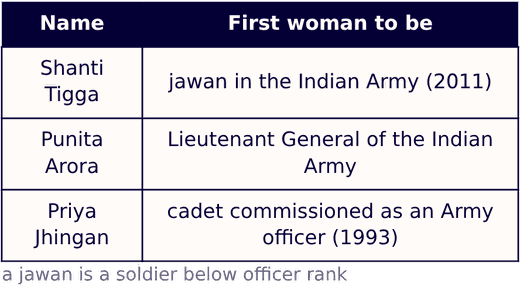 Punita Arora is remembered as the first woman Lieutenant General of the Indian Army — an officer, not a jawan, so she does not fit this question.
Hence the correct option is (b).
Punita Arora is remembered as the first woman Lieutenant General of the Indian Army — an officer, not a jawan, so she does not fit this question.
Hence the correct option is (b).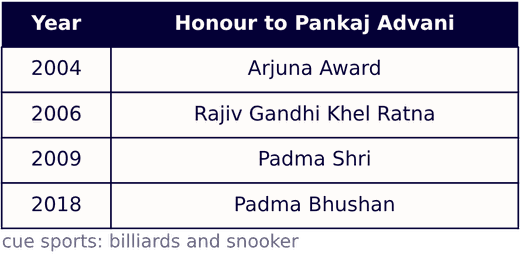 Hence the correct option is (b).
 Hence the correct option is (d).
 Hence the correct option is (a).
 Because of this the plan is often called the 'chessboard' or grid pattern; it is best preserved at Mohenjodaro, Harappa and Kalibangan.
The same discipline shows in the burnt bricks of fixed ratio 4 : 2 : 1, the covered drains running under the streets, and the division of each city into a raised Citadel and a Lower Town.
Hence the correct option is (b).
Because of this the plan is often called the 'chessboard' or grid pattern; it is best preserved at Mohenjodaro, Harappa and Kalibangan.
The same discipline shows in the burnt bricks of fixed ratio 4 : 2 : 1, the covered drains running under the streets, and the division of each city into a raised Citadel and a Lower Town.
Hence the correct option is (b).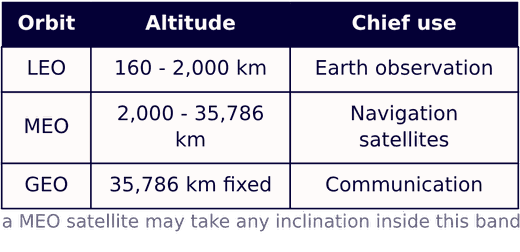 Statement I is correct: a geostationary satellite must sit over the equator at one fixed height, but a MEO satellite is tied to no such track — it may be given any inclination and any altitude inside the band, so its path is chosen to suit the mission.
Statement II is correct: MEO is the standard home of navigation constellations — GPS (USA), Galileo (Europe) and GLONASS (Russia) all fly here, because this height gives each satellite a wide footprint while the signal is still strong and the orbital period convenient.
Both statements being correct, the correct option is (c).
Statement I is correct: a geostationary satellite must sit over the equator at one fixed height, but a MEO satellite is tied to no such track — it may be given any inclination and any altitude inside the band, so its path is chosen to suit the mission.
Statement II is correct: MEO is the standard home of navigation constellations — GPS (USA), Galileo (Europe) and GLONASS (Russia) all fly here, because this height gives each satellite a wide footprint while the signal is still strong and the orbital period convenient.
Both statements being correct, the correct option is (c).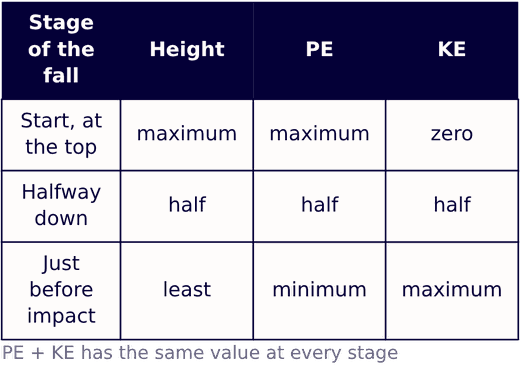 By the conservation of mechanical energy (air resistance neglected), the fall in PE is exactly equal to the rise in KE, so PE + KE stays constant at every point of the fall.
Just before impact the height is least and the speed greatest — minimum PE, maximum KE.
Hence the correct option is (c).
By the conservation of mechanical energy (air resistance neglected), the fall in PE is exactly equal to the rise in KE, so PE + KE stays constant at every point of the fall.
Just before impact the height is least and the speed greatest — minimum PE, maximum KE.
Hence the correct option is (c).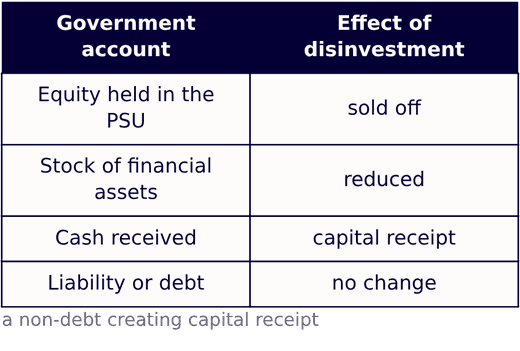 Those shares were a financial asset of the government; selling them turns the asset into cash, so the stock of financial assets held by the government is reduced.
That is exactly why disinvestment proceeds are classed as capital receipts that are non-debt creating — nothing is borrowed, so no new liability arises and option (c) is wrong.
Nor is the money a tax, so option (d) is wrong; the receipt is used mainly to bridge the fiscal deficit, and DIPAM manages the process.
Hence the correct option is (a).
Those shares were a financial asset of the government; selling them turns the asset into cash, so the stock of financial assets held by the government is reduced.
That is exactly why disinvestment proceeds are classed as capital receipts that are non-debt creating — nothing is borrowed, so no new liability arises and option (c) is wrong.
Nor is the money a tax, so option (d) is wrong; the receipt is used mainly to bridge the fiscal deficit, and DIPAM manages the process.
Hence the correct option is (a).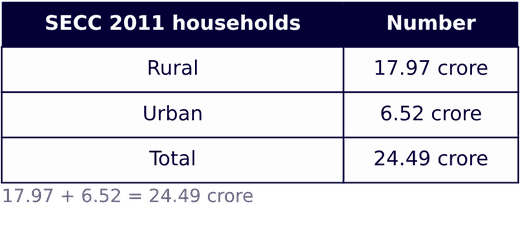 Of these about 17.97 crore were rural and 6.52 crore urban, covering every state and union territory.
Unlike the decennial Census, the SECC recorded each household by name and ranked it by deprivation, so its data could be used to pick beneficiaries.
That is why the SECC list is still the base for schemes such as PM Awas Yojana - Gramin and Ayushman Bharat.
Hence the correct option is (a).
Of these about 17.97 crore were rural and 6.52 crore urban, covering every state and union territory.
Unlike the decennial Census, the SECC recorded each household by name and ranked it by deprivation, so its data could be used to pick beneficiaries.
That is why the SECC list is still the base for schemes such as PM Awas Yojana - Gramin and Ayushman Bharat.
Hence the correct option is (a).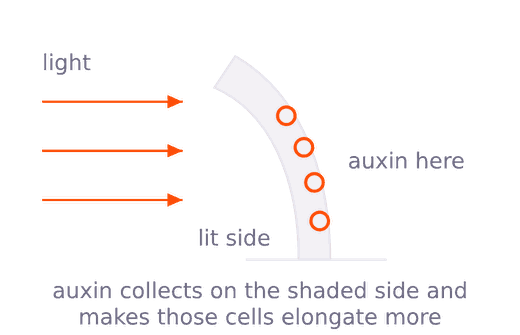 Auxin loosens the cell walls and lets the cells take in more water, so the cells on the shaded side elongate more than those on the lit side.
The shaded side thus becoming longer, the shoot curves over towards the light — note that growth on the dark side is speeded up, not stopped, so option (c) is wrong, and it is the shaded, not the illuminated, side that elongates, which rules out (b).
Hence the correct option is (d).
Auxin loosens the cell walls and lets the cells take in more water, so the cells on the shaded side elongate more than those on the lit side.
The shaded side thus becoming longer, the shoot curves over towards the light — note that growth on the dark side is speeded up, not stopped, so option (c) is wrong, and it is the shaded, not the illuminated, side that elongates, which rules out (b).
Hence the correct option is (d).