SSC CHSL 25 November 2025 · Shift 1 · English Language — questions with answers · ShikshaSphere
Chapter 132 of 200
25 November 2025 · Shift 1
English Language
25 questions ~25 min readFree
25 questions
A
1
Choose the one word substitute for the below sentence.
Lana asked her mother, a person who loves collecting coins called?
A.Hoarder
B.Collector
C.Philatelist
D.Numismatist
Solution
One-word substitution
A person who loves collecting and studying coins is called a numismatist (from Latin 'numisma' = coin).
Philatelist is the trap here — a philatelist collects postage stamps, not coins.
A hoarder piles up things compulsively, and 'collector' is too general to be a precise one-word substitute.
Hence option (d) is correct.
2
Choose the one word substitute for the below sentence.
Ivanka asked her teacher, a person who studies human societies called?
A.Psychologist
B.Anthropologist
C.Sociologist
D.Historian
Solution
One-word substitution
The study of human society — its structure, institutions and group behaviour — is sociology, so the person is a sociologist.
Anthropologist is the close distractor: an anthropologist studies human origins, evolution and culture rather than the working of society itself.
A psychologist studies the individual mind and behaviour; a historian studies past events.
Hence option (c) is correct.
3
Identify the incorrect sentence.
A.Every candidate has to take the preliminary test.
B.Most of coffee sold in Europe comes from India.
C.Priyanka is my brother's best friend.
D.The principles of science are difficult to understand.
Solution
Determiner error
Option (b) is the faulty sentence: 'most of' must always be followed by a determiner — the, this, my, his — before the noun.
Here 'coffee sold in Europe' is a particular, defined quantity, so the sentence needs 'Most of the coffee sold in Europe comes from India.'
Without a determiner the noun would have to lose 'of' as well: 'Most coffee sold in Europe comes from India.'
The other three are sound: 'every + singular noun + singular verb' in (a), a correct possessive in (c), and a plural subject with a plural verb in (d).
Hence option (b) is correct.
4
Fill in the blank with the most appropriate preposition:
The student was punished breaking the school rules.
A.with
B.for
C.to
D.from
Solution
Preposition with 'punish'
The verb 'punish' takes the fixed preposition 'for' before the offence or reason: punished for cheating, punished for coming late.
The reason here is 'breaking the school rules', so 'for' is the required preposition.
'Punished with' would introduce the instrument of the punishment (punished with a fine), which is not what the blank needs; 'to' and 'from' never follow 'punish'.
Hence option (b) is correct.
5
Choose the best option to replace the underlined part to improve the given sentence. If no substitution is required, select 'No substitution.'
Your brother has moved after the age at which a caretaker is required.
A.over the age
B.past the age
C.on the age
D.No substitution
Solution
Sentence improvement
The idiom for having crossed an age limit is 'past the age (at which / of)…', where 'past' means beyond.
'After the age' only fixes a point in time (after the age of sixty he retired); it cannot express 'beyond the stage of needing something'.
Corrected sentence: 'Your brother has moved past the age at which a caretaker is required.'
'Over the age' is used with a limit expressed as a number (over the age of 18), and 'on the age' is not English at all.
Hence option (b) is correct.
6
Select the sentence containing the homonym of the highlighted word:
She ran a 1600 -meter dash to the finish line.
A.The player made a sudden dash for the ball.
B.Shivangi made a quick dash to the super market for some milk.
C.The recipe calls for a dash of salt and pepper.
D.The marathon runner put on a final dash of speed.
Solution
Homonyms
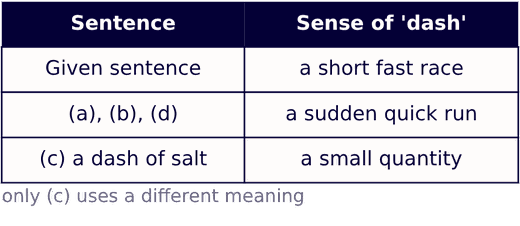
In the given sentence 'dash' is a noun of athletics — a short, fast race (a 1600-metre dash).
A homonym is a word spelt and pronounced alike but carrying a completely different meaning.
In option (c), 'a dash of salt and pepper' means a small quantity, an unrelated sense of the same word, so it is the homonym.
Options (a), (b) and (d) all use 'dash' for a sudden quick run — the same family of meaning as the given sentence.
Hence option (c) is correct.
7
From the alternatives given below, select the correct passive voice of the following sentence.
Ensure that the students have submitted their assignments before leaving the classroom.
A.Let it be made sure that their assignments have been submitted by the students before leaving the classroom.
B.Made sure that their assignments have been submitted by the students before leaving the classroom.
C.Let it be sure that their assignments have been submitted by the students before leaving the classroom.
D.Let it be made sure that the students have submitted their assignments after leaving the classroom.
Solution
Passive of imperative
The sentence is an imperative ('Ensure that…'), and an imperative is made passive with the pattern 'Let it be + past participle'.
So 'Ensure that…' becomes 'Let it be made sure that…'.
Inside the that-clause the present perfect active 'the students have submitted their assignments' becomes 'their assignments have been submitted by the students'.
(b) drops the 'Let it be' opener, (c) omits 'made', and (d) replaces 'before' with 'after', changing the meaning.
Hence option (a) is correct.
8
From the alternatives given below, select the correct passive voice of the following sentence.
Shraddha has written a beautiful story on how to make your nation proud.
A.A beautiful story on how to to be made your nation proud has been written by Shraddha.
B.A beautiful story on how your nation to be made proud had been written by Shraddha.
C.A beautiful story on how to make your nation proud has been written by Shraddha.
D.A beautiful story on how to make your nation proud of been written by Shraddha.
Solution
Present perfect passive
Active pattern: Shraddha (subject) + has written (present perfect) + a beautiful story… (object).
In the passive, 'has written' becomes 'has been written' and the object moves into the subject position, the doer following 'by'.
The modifier 'on how to make your nation proud' describes the story and must be carried across untouched.
So the passive reads: 'A beautiful story on how to make your nation proud has been written by Shraddha.'
(a) inserts an extra 'to' and mangles the infinitive, (b) reorders the phrase wrongly and uses 'had', and (d) drops 'has'.
Hence option (c) is correct.
9
Choose the correct indirect narration of the following statement from the given alternatives:
Sneha said, "I am going to carry all the luggage alone as I did not call my brother to help me."
A.Sneha said that she was going to carry all the luggage alone as she had not called her brother to help her.
B.Sneha said that she was going to carry all the luggage alone as she did not call her brother to help her.
C.Sneha said that she is going to carry all the luggage alone as she had not called her brother to help her.
D.Sneha said that she is going to carry all the luggage alone as she did not call her brother to help her.
Solution
Direct to indirect speech
The reporting verb 'said' is in the past, so every verb of the reported clause backshifts one step.
'I am going' becomes 'she was going', and the simple past 'I did not call' becomes the past perfect 'she had not called'.
Pronouns shift to the third person: I → she, my brother → her brother, me → her.
(b) leaves 'did not call' un-backshifted, while (c) and (d) keep the present 'is going'.
Hence option (a) is correct.
10
Choose the correct indirect narration of the following statement from the given alternatives:
Shreya said, "I am not going to forgive Rahul as he took my purse without my permission."
A.Shreya said that she was not going to forgive Rahul as he had taken her purse without her permission.
B.Shreya said that she is not going to forgive Rahul as he had taken her purse without her permission.
C.Shreya said that she has not been going to forgive Rahul as he had taken her purse without her permission.
D.Shreya said that she is not to going to forgive Rahul as he took her purse without her permission.
Solution
Direct to indirect speech
'Shreya said' is a past reporting verb, so the reported verbs move one tense back.
'I am not going' becomes 'she was not going'; the simple past 'he took' becomes the past perfect 'he had taken'.
The possessives follow the new speaker: 'my purse' → 'her purse', 'my permission' → 'her permission'.
(b) and (c) keep a present-tense verb after a past reporting verb, and (d) leaves 'took' un-backshifted while adding a stray 'to'.
Hence option (a) is correct.
11
Choose the correct indirect narration of the following statement from the given alternatives:
The officer said, 'What do you have to say in your defence?"
A.The officer asked what he was to say in his defence.
B.The officer asked what he will have to say in his defence.
C.The officer asked what he is to say in his defence.
D.The officer asked what he had to say in his defence.
Solution
Reported wh-question
It is a wh-question, so 'said' becomes 'asked' and the quoted question takes statement order — no auxiliary 'do' and no question mark.
'do you have to say' therefore loses the 'do' support and 'have' backshifts to 'had', giving 'what he had to say'.
'Your defence' becomes 'his defence', as the listener is now spoken of in the third person.
(a) and (c) replace the obligation 'have to' with 'was to' / 'is to', and (b) shifts to a future form, so none preserves the original sense.
Hence option (d) is correct.
12
Change the following sentence into the Active form.
The speech was delivered at the conference.
A.Someone delivered the speech at the conference.
B.The speech is delivered at the conference.
C.Someone delivers the speech at the conference.
D.The conference delivered the speech.
Solution
Passive to active voice
The given sentence is simple past passive: 'The speech (subject) + was delivered (was + V3) + at the conference'.
No agent is named, so the active version must supply an indefinite doer such as 'someone'.
'Was delivered' becomes the simple past active 'delivered', and 'the speech' moves into the object slot.
So the active form is: 'Someone delivered the speech at the conference.'
(b) is still passive, (c) shifts to the present tense, and (d) wrongly makes 'the conference' the doer.
Hence option (a) is correct.
13
Change the following sentence into the Active form.
The results will have been announced by the time the meeting ends.
A.The results will announce by the time the meeting ends.
B.They will announce the results by the time the meeting ends.
C.They will have announced the results by the time the meeting ends.
D.The results have been announced by the time the meeting ends.
Solution
Future perfect: voice change
'Will have been announced' is the future perfect passive; its active counterpart is 'will have announced'.
No agent is given, so an indefinite subject 'they' is supplied and 'the results' becomes the object.
The time clause 'by the time the meeting ends' stays exactly as it is.
So: 'They will have announced the results by the time the meeting ends.'
(b) uses the simple future and loses 'have', while (a) and (d) are not active constructions at all.
Hence option (c) is correct.
14
Choose the option that is the most appropriate conversion of the following sentence into Direct Speech.
Akshay asked me if I needed to use his computer to prepare my project.
A.Akshay said to me, "Do you need to use my computer to prepare your project?"
B.Akshay asked me, "Did you need my computer to prepared your project?"
C.Akshay said, *Do you need to used his computer to prepare my project?"
D.Akshay asked, "If I need to use his computer to prepare my project?"
Solution
Indirect to direct speech
'Asked me if' signals a yes/no question, so in direct speech it must reappear as a question beginning with 'Do…?' and ending in a question mark.
The backshift is undone: 'needed' returns to 'need'.
Pronouns swing back to the speaker's viewpoint: 'his computer' → 'my computer' and 'my project' → 'your project'.
So: Akshay said to me, "Do you need to use my computer to prepare your project?"
(b) has the ungrammatical 'to prepared', (c) has 'to used' with the wrong pronouns, and (d) keeps the reported 'if' inside the quotation marks.
Hence option (a) is correct.
15
Directions (Qs. 15-19): Read the following passage carefully and answer the questions that follow.
Adolescence is often defined as a time of discovery, growth, and sometimes, sudden emotional instability. Many young people navigate a shifting set of moods, extending from ambition and joy
to hesitation and fear. While some gain confidence from strong friendships and personal achievements, others struggle with feelings of insecurity and confusion, particularly when their academic path wavers or their goals blur.
Counselors argue that mental resilience in youth largely rests on consistent validation and a sense of identity. Pursuing passions, keeping connections, and feeling accepted by adult figures can remarkably enhance a teenager's spirit and view of the world. Regrettably, in various settings, growing minds are not offered the empathy and space they need, which can amplify their sense of stress. Mentors should guide young students.
It is, accordingly, crucial for parents and schools to validate the internal struggles of the young and build an ecosystem where they feel safe, encouraged, and understood. A culture that supports its rising generation eventually ensures its own future.
Identify the tense of the verb "is defined" in the first sentence.
A.Present Continuous
B.Present Perfect
C.Simple Present
D.Simple Present Passive
Solution
Identifying tense
The first sentence reads: 'Adolescence is often defined as a time of discovery, growth, and sometimes, sudden emotional instability.'
The verb phrase is 'is' (simple present of 'be') + 'defined' (past participle) — the standard simple present passive pattern, is/am/are + V3.
Adolescence receives the action instead of performing it, which confirms that the voice is passive.
Present continuous would need 'is being defined' and present perfect would need 'has been defined'; plain simple present would need the active 'defines'.
Hence option (d) is correct.
16
Directions (Qs. 15-19): Read the following passage carefully and answer the questions that follow.
Adolescence is often defined as a time of discovery, growth, and sometimes, sudden emotional instability. Many young people navigate a shifting set of moods, extending from ambition and joy
to hesitation and fear. While some gain confidence from strong friendships and personal achievements, others struggle with feelings of insecurity and confusion, particularly when their academic path wavers or their goals blur.
Counselors argue that mental resilience in youth largely rests on consistent validation and a sense of identity. Pursuing passions, keeping connections, and feeling accepted by adult figures can remarkably enhance a teenager's spirit and view of the world. Regrettably, in various settings, growing minds are not offered the empathy and space they need, which can amplify their sense of stress. Mentors should guide young students.
It is, accordingly, crucial for parents and schools to validate the internal struggles of the young and build an ecosystem where they feel safe, encouraged, and understood. A culture that supports its rising generation eventually ensures its own future.
Choose the option that correctly converts this sentence into passive voice:
"Mentors should guide young students."
A.Young students are guided by mentors.
B.Young students should be guided by mentors.
C.Young students have been guided by mentors.
D.Young students must guided by mentors.
Solution
Passive with a modal
When the active verb carries a modal, the passive is formed as 'modal + be + past participle'.
So 'should guide' becomes 'should be guided', and the object 'young students' moves into the subject position.
The doer 'mentors' follows 'by': 'Young students should be guided by mentors.'
(a) and (c) drop the modal 'should' and change the tense, altering the sense of obligation; (d) omits the essential 'be' after 'must'.
Hence option (b) is correct.
17
Directions (Qs. 15-19): Read the following passage carefully and answer the questions that follow.
Adolescence is often defined as a time of discovery, growth, and sometimes, sudden emotional instability. Many young people navigate a shifting set of moods, extending from ambition and joy
to hesitation and fear. While some gain confidence from strong friendships and personal achievements, others struggle with feelings of insecurity and confusion, particularly when their academic path wavers or their goals blur.
Counselors argue that mental resilience in youth largely rests on consistent validation and a sense of identity. Pursuing passions, keeping connections, and feeling accepted by adult figures can remarkably enhance a teenager's spirit and view of the world. Regrettably, in various settings, growing minds are not offered the empathy and space they need, which can amplify their sense of stress. Mentors should guide young students.
It is, accordingly, crucial for parents and schools to validate the internal struggles of the young and build an ecosystem where they feel safe, encouraged, and understood. A culture that supports its rising generation eventually ensures its own future.
What does the word "insecurity" most nearly mean as used in the passage?
A.Confidence
B.Safety
C.Uncertainty
D.Protection
Solution
Vocabulary in context
The passage places 'insecurity' beside 'confusion' and links both to an academic path that 'wavers' and goals that 'blur'.
That context makes insecurity a feeling of doubt about oneself and one's future — in a word, uncertainty.
Confidence, safety and protection all point the opposite way and would contradict the sentence about students who 'struggle'.
Hence option (c) is correct.
18
Directions (Qs. 15-19): Read the following passage carefully and answer the questions that follow.
Adolescence is often defined as a time of discovery, growth, and sometimes, sudden emotional instability. Many young people navigate a shifting set of moods, extending from ambition and joy
to hesitation and fear. While some gain confidence from strong friendships and personal achievements, others struggle with feelings of insecurity and confusion, particularly when their academic path wavers or their goals blur.
Counselors argue that mental resilience in youth largely rests on consistent validation and a sense of identity. Pursuing passions, keeping connections, and feeling accepted by adult figures can remarkably enhance a teenager's spirit and view of the world. Regrettably, in various settings, growing minds are not offered the empathy and space they need, which can amplify their sense of stress. Mentors should guide young students.
It is, accordingly, crucial for parents and schools to validate the internal struggles of the young and build an ecosystem where they feel safe, encouraged, and understood. A culture that supports its rising generation eventually ensures its own future.
Which word is the closest synonym for "enhance" as used in the passage?
A.Worsen
B.Improve
C.Reduce
D.Ignore
Solution
Synonym in context
'Enhance' means to raise the quality, value or degree of something.
In the passage, pursuing passions, keeping connections and feeling accepted 'enhance a teenager's spirit' — that is, they make it better.
'Improve' carries exactly that sense, so it is the closest synonym.
Worsen and reduce move in the opposite direction, and ignore has nothing to do with quality at all.
Hence option (b) is correct.
19
Directions (Qs. 15-19): Read the following passage carefully and answer the questions that follow.
Adolescence is often defined as a time of discovery, growth, and sometimes, sudden emotional instability. Many young people navigate a shifting set of moods, extending from ambition and joy
to hesitation and fear. While some gain confidence from strong friendships and personal achievements, others struggle with feelings of insecurity and confusion, particularly when their academic path wavers or their goals blur.
Counselors argue that mental resilience in youth largely rests on consistent validation and a sense of identity. Pursuing passions, keeping connections, and feeling accepted by adult figures can remarkably enhance a teenager's spirit and view of the world. Regrettably, in various settings, growing minds are not offered the empathy and space they need, which can amplify their sense of stress. Mentors should guide young students.
It is, accordingly, crucial for parents and schools to validate the internal struggles of the young and build an ecosystem where they feel safe, encouraged, and understood. A culture that supports its rising generation eventually ensures its own future.
According to the passage, what is one way to support the mental resilience of young people?
A.Increasing their academic pressure significantly
B.Ignoring their internal struggles
C.Ensuring consistent validation and a sense of identity
D.Focusing only on their physical growth
Solution
Reading comprehension
The third paragraph states it directly: 'Counselors argue that mental resilience in youth largely rests on consistent validation and a sense of identity.'
Option (c) simply restates that line, so it is what the passage actually says.
The passage warns against ignoring internal struggles rather than recommending it, so (b) is the opposite of its message.
Nowhere does it advise more academic pressure or a focus only on physical growth, ruling out (a) and (d).
Hence option (c) is correct.
20
Which word can best replace spell? After the announcement, there was a spell of quiet reflection in the hall.
A.Moment
B.Noise
C.Argument
D.Celebration
Solution
Word replacement
Here 'spell' is a noun meaning a short, continuous stretch of time — 'a spell of quiet reflection', like 'a spell of cold weather'.
'Moment' carries the same idea of a brief period, so it slips into the slot without changing the sense.
Noise, argument and celebration name events rather than periods of time, and each of them contradicts 'quiet reflection'.
Hence option (a) is correct.
21
Which word is closest in meaning to resignation?
The team faced the outcome with quiet resignation after the final decision.
A.Acceptance
B.Protest
C.Resistance
D.Denial
Solution
Synonym
In the sentence the team did not fight the decision — they took it quietly, so 'resignation' here means calmly accepting something unpleasant that cannot be changed.
'Acceptance' carries exactly that sense of coming to terms with an outcome.
Protest, resistance and denial all mean refusing the outcome, which is the opposite of what 'quiet resignation' describes.
Hence option (a) is correct.
22
Which of the following options is NOT one of the meanings of the homonym "record"?
A.A written account of facts or events
B.To officially store information for future reference
C.To capture sound or images for later use
D.A style of singing using only the human voice
Solution
Homonym
'Record' works both as a noun and as a verb: as a noun it is a written account of facts or events, and as a verb it means to store information officially or to capture sound and images.
So options (a), (b) and (c) are all genuine meanings of 'record'.
A style of singing that uses only the human voice is called 'a cappella', which has nothing to do with 'record'.
Hence option (d) is correct.
23
Fill in the blank with the correctly spelt word.
The constant worry caused him anxiety throughout the night.
A.gnawing
B.knawing
C.gnawaing
D.gnowing
Solution
Correct spelling
The correct spelling is 'gnawing' — the word begins with a silent 'g' followed by 'n', exactly as in gnat, gnome and gnash.
'Gnawing anxiety' is a fixed collocation meaning a worry that keeps biting away at the mind, which fits 'constant worry ... throughout the night'.
'knawing' replaces the silent 'g' with 'k', 'gnawaing' adds an extra 'a' and 'gnowing' changes the vowel.
Hence option (a) is correct.
24
Fill in the blank with the correctly spelt word.
The politician was often criticized for his excessive during public addresses.
A.grandilquence
B.grandeluquence
C.grandiloquance
D.grandiloquence
Solution
Correct spelling
The correct spelling is 'grandiloquence' — grand + i + loqu (from Latin 'loqui', to speak) + ence.
It means a pompous, inflated style of speaking, which is exactly what a politician would be criticised for during public addresses.
The other options drop the 'i' ('grandilquence'), change it to 'e' ('grandeluquence'), or end in '-ance' instead of '-ence'.
Hence option (d) is correct.
25
Which part of the following sentence contains a spelling error?
The study of cognitive psychology (1) explores human behavior (2) and mental baises (3) in decision-making processes (4).
A.(1)
B.(2)
C.(3)
D.(4)
Solution
Spelling error
Part (3) reads 'and mental baises'; the correct spelling is 'biases', the plural of 'bias'.
'Bias' keeps the 'i' before the 'a', so the plural is bias → biases, never 'baises'.
Parts (1), (2) and (4) — cognitive psychology, human behavior and decision-making processes — are all spelt correctly.
Hence option (c) is correct.
Finished reading? Now test yourself.
The same 25 questions, but with a timer and the answers hidden — 15 minutes.

 In option (c), 'a dash of salt and pepper' means a small quantity, an unrelated sense of the same word, so it is the homonym.
Options (a), (b) and (d) all use 'dash' for a sudden quick run — the same family of meaning as the given sentence.
Hence option (c) is correct.
In option (c), 'a dash of salt and pepper' means a small quantity, an unrelated sense of the same word, so it is the homonym.
Options (a), (b) and (d) all use 'dash' for a sudden quick run — the same family of meaning as the given sentence.
Hence option (c) is correct.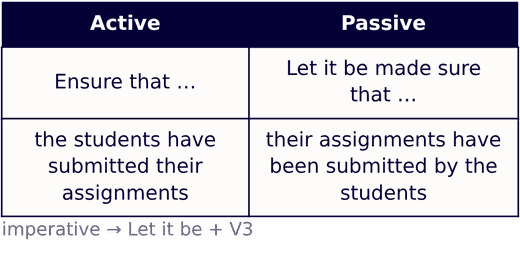 Inside the that-clause the present perfect active 'the students have submitted their assignments' becomes 'their assignments have been submitted by the students'.
(b) drops the 'Let it be' opener, (c) omits 'made', and (d) replaces 'before' with 'after', changing the meaning.
Hence option (a) is correct.
Inside the that-clause the present perfect active 'the students have submitted their assignments' becomes 'their assignments have been submitted by the students'.
(b) drops the 'Let it be' opener, (c) omits 'made', and (d) replaces 'before' with 'after', changing the meaning.
Hence option (a) is correct.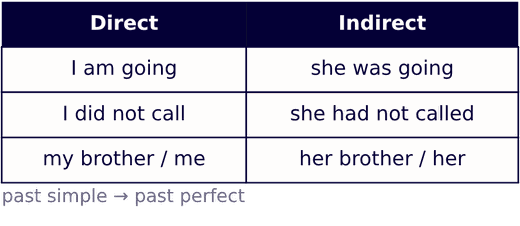 'I am going' becomes 'she was going', and the simple past 'I did not call' becomes the past perfect 'she had not called'.
Pronouns shift to the third person: I → she, my brother → her brother, me → her.
(b) leaves 'did not call' un-backshifted, while (c) and (d) keep the present 'is going'.
Hence option (a) is correct.
'I am going' becomes 'she was going', and the simple past 'I did not call' becomes the past perfect 'she had not called'.
Pronouns shift to the third person: I → she, my brother → her brother, me → her.
(b) leaves 'did not call' un-backshifted, while (c) and (d) keep the present 'is going'.
Hence option (a) is correct.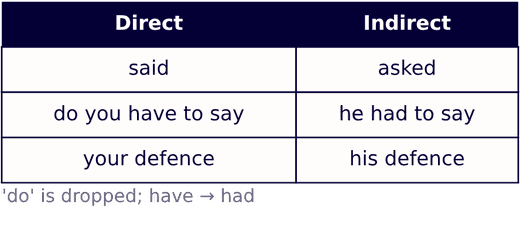 'do you have to say' therefore loses the 'do' support and 'have' backshifts to 'had', giving 'what he had to say'.
'Your defence' becomes 'his defence', as the listener is now spoken of in the third person.
(a) and (c) replace the obligation 'have to' with 'was to' / 'is to', and (b) shifts to a future form, so none preserves the original sense.
Hence option (d) is correct.
'do you have to say' therefore loses the 'do' support and 'have' backshifts to 'had', giving 'what he had to say'.
'Your defence' becomes 'his defence', as the listener is now spoken of in the third person.
(a) and (c) replace the obligation 'have to' with 'was to' / 'is to', and (b) shifts to a future form, so none preserves the original sense.
Hence option (d) is correct.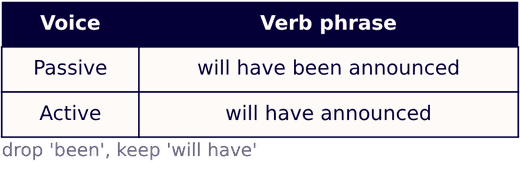 No agent is given, so an indefinite subject 'they' is supplied and 'the results' becomes the object.
The time clause 'by the time the meeting ends' stays exactly as it is.
So: 'They will have announced the results by the time the meeting ends.'
(b) uses the simple future and loses 'have', while (a) and (d) are not active constructions at all.
Hence option (c) is correct.
No agent is given, so an indefinite subject 'they' is supplied and 'the results' becomes the object.
The time clause 'by the time the meeting ends' stays exactly as it is.
So: 'They will have announced the results by the time the meeting ends.'
(b) uses the simple future and loses 'have', while (a) and (d) are not active constructions at all.
Hence option (c) is correct.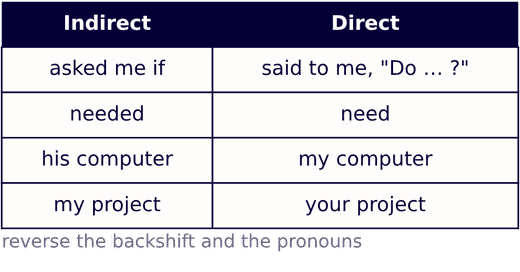 The backshift is undone: 'needed' returns to 'need'.
Pronouns swing back to the speaker's viewpoint: 'his computer' → 'my computer' and 'my project' → 'your project'.
So: Akshay said to me, "Do you need to use my computer to prepare your project?"
(b) has the ungrammatical 'to prepared', (c) has 'to used' with the wrong pronouns, and (d) keeps the reported 'if' inside the quotation marks.
Hence option (a) is correct.
The backshift is undone: 'needed' returns to 'need'.
Pronouns swing back to the speaker's viewpoint: 'his computer' → 'my computer' and 'my project' → 'your project'.
So: Akshay said to me, "Do you need to use my computer to prepare your project?"
(b) has the ungrammatical 'to prepared', (c) has 'to used' with the wrong pronouns, and (d) keeps the reported 'if' inside the quotation marks.
Hence option (a) is correct.