SSC CHSL 25 November 2025 · Shift 2 · English Language — questions with answers · ShikshaSphere
Chapter 136 of 200
25 November 2025 · Shift 2
English Language
25 questions ~25 min readFree
25 questions
A
1
Select the idiom that means: to accept the unpleasant consequences of one's actions.
A.face the music
B.bell the cat
C.bite the bullet
D.take the bull by the horns
Solution
Idiom meaning
'Face the music' means to stand before, and accept, the unpleasant results of what one has done.
The clue in the question is 'consequences of one's actions', so the idiom must express bearing the outcome — that is exactly 'face the music'.
'Bell the cat' = to take on a risky task for the good of a group; 'bite the bullet' = to force oneself at last to do something unpleasant one had been putting off.
'Take the bull by the horns' = to tackle a difficulty boldly and directly. None of these three carries the idea of accepting the punishment that follows, so option (a) is correct.
2
Identify the grammatical mistake in the given sentence:
The constant interruptions / by the workers / was deeply annoyed the manager / No error
A.The constant interruptions
B.by the workers
C.was deeply annoyed the manager
D.No error
Solution
Subject-verb error
Join the parts and look at the frame: subject 'The constant interruptions' (plural) + verb + object 'the manager'.
Part (c) reads 'was deeply annoyed the manager'. 'Was annoyed' is a passive form, and a passive verb can never be followed by a direct object.
Here the interruptions are the doer — they annoyed somebody — so the active past form is needed: 'deeply annoyed the manager'.
'Was' is also wrong in number, as the plural subject 'interruptions' would need 'were'. Parts (a) and (b) are faultless, so the error lies in part (c).
3
Select the most appropriate synonym of the word given in brackets to complete the following sentence.
The physicist's latest paper was filled with (recondite) terminology that even fellow researchers struggled to follow.
A.plain
B.esoteric
C.jargon
D.confidential
Solution
Synonym in context
'Recondite' describes matter so deep or obscure that only a handful of specialists can follow it.
'Esoteric' carries exactly that sense — intended for, or understood by, a small circle possessing special knowledge — and the sentence adds that even fellow researchers struggled, which confirms it.
'Plain' means simple and easy, the very opposite of recondite.
'Jargon' is a noun naming the special words themselves, so it cannot describe 'terminology'; 'confidential' means kept secret by rule, not hard to understand. Hence option (b).
4
Select the most appropriate synonym of the word:
Ceaseless
A.Transient
B.Ephemeral
C.Perpetual
D.Short
Solution
Synonym
'Ceaseless' means going on without any stop or break.
'Perpetual' means never ending, continuing for ever — the same idea, so it is the synonym.
'Transient' and 'ephemeral' both mean lasting only a very short time, and 'short' says the same in plain words.
All three are therefore antonyms of 'ceaseless'. Hence option (c).
5
Select the part which contains a spelling error.
A. The surgeon examined the B. patient's high palete to C. determine if it was D. affecting his speech.
A.A
B.B
C.C
D.D
Solution
Spelling error
Part B contains 'palete'; the correct spelling is 'palate', meaning the roof of the mouth.
The context — a surgeon checking whether it affects speech — confirms that the body part is meant.
Keep the trio apart: palate = roof of the mouth, palette = a painter's board of colours, pallet = a wooden platform or a straw bed.
'Surgeon', 'determine' and 'affecting' in parts A, C and D are all spelt correctly, so the error is in part B.
6
Select the part of the sentence that contains a spelling error.
A. The researchers asked the participants B. to complete a detailed questionaire C. regarding their dietary habits D. and exercise routines.
A.A
B.B
C.C
D.D
Solution
Spelling error
Part B contains 'questionaire'; the correct spelling is 'questionnaire', with a double 'n'.
The word reaches English from French 'questionner', and that double 'n' of the verb is kept before the ending '-aire'.
'Participants', 'dietary' and 'routines' in the other parts are all spelt correctly.
Hence the error is in part B, option (b).
7
Choose the best option to replace the underlined part to improve the given sentence. If no substitution is required, select 'No substitution.'
The freshwater spring is further into the mountain, hidden behind a jagged ridge.
A.further up the mountain
B.further ahead the mountain
C.further on the mountain
D.No substitution
Solution
Preposition improvement
The underlined phrase has to say where the spring lies on the mountain, and a spring hidden behind a ridge lies higher up the slope.
With mountains, hills and slopes English uses 'up' for a higher position, so 'further up the mountain' is the natural expression.
'Further into the mountain' would mean deeper inside the rock, which is not what a spring behind a ridge suggests.
'Ahead the mountain' is ungrammatical — 'ahead' needs 'of' — and 'on the mountain' merely places it somewhere on the surface, losing the sense of height. Hence option (a).
8
Choose the best option to replace the underlined part to improve the given sentence. If no substitution is required, select 'No substitution.'
The audience was requested to stay seated among the performance.
A.between the performance
B.throughout the performance
C.around the performance
D.No substitution
Solution
Preposition of duration
The audience had to remain seated from the beginning of the performance to its end, so the phrase must express duration.
'Throughout' is the preposition used for the whole length of an event: 'throughout the performance'.
'Among' is used for a group of three or more things and 'between' for two — neither can express a stretch of time here.
'Around the performance' would only suggest a time near it, not during it. Hence option (b).
9
Choose the correct passive voice of the following sentence:
Always remember that discipline shapes a successful career.
A.Let it always be remembered that a successful career is shaped by discipline.
B.Let always be remembered that a successful career is shaped by discipline.
C.Let it always be remembered that discipline is shaped by a successful career.
D.Let it always remembered that a successful career is shaped by discipline.
Solution
Passive of imperative
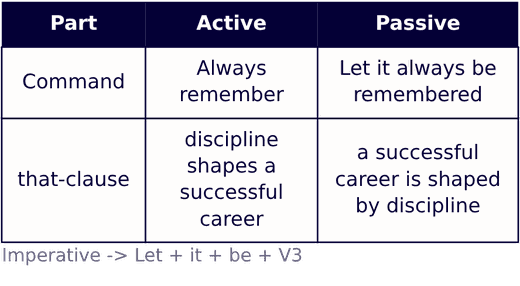
The sentence is an imperative ('Always remember that …'), and the passive of an imperative is built as 'Let + object + be + V3'.
Here the object of 'remember' is the whole that-clause, so the dummy subject 'it' fills the object slot: 'Let it always be remembered that …'.
Inside the that-clause the active 'discipline shapes a successful career' becomes 'a successful career is shaped by discipline'.
Option (b) drops 'it', option (d) drops 'be', and option (c) reverses doer and receiver, making discipline the thing shaped. Hence option (a).
10
Choose the correct indirect narration of the following statement from the given alternatives:
Rohan said to Kavita, 'Why didn't you tell your brother about the mistake you were making in the project?"
A.Rohan asked Kavita why she didn't tell her brother about the mistake she was making in the project.
B.Rohan told Kavita why she had not told her brother about the mistake she had been making in the project.
C.Rohan asked Kavita why she had not told her brother about the mistake she had been making in the project.
D.Rohan asked Kavita why had she not told her brother about the mistake she had been making in the project.
Solution
Indirect narration
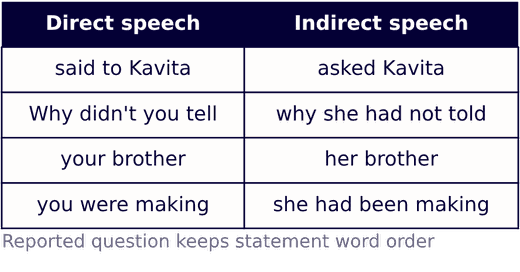
The quoted sentence is a wh-question, so the reporting verb 'said to' must change to 'asked'.
A reported question drops the interrogative order and takes the statement order — subject before verb: 'why she had not told', never 'why had she not told'.
The tenses move one step back: 'didn't tell' becomes 'had not told' and 'were making' becomes 'had been making'; the pronouns 'you / your' become 'she / her'.
Option (a) leaves the original tenses untouched, (b) uses 'told' where a question needs 'asked', and (d) keeps the interrogative word order. Hence option (c).
11
Select the most appropriate antonym of the word given in brackets to complete the sentence.
Feeling completely (joint) from society, the elderly woman lived alone in a remote cabin, finding comfort only in books and nature's quiet sounds.
A.Linked
B.Isolated
C.Attached
D.Concomitant
Solution
Antonym in context
The blank needs the opposite of 'joint', which means connected or joined to others.
The rest of the sentence — she 'lived alone in a remote cabin' with only books for company — shows that she felt completely cut off.
'Isolated' means separated from others and without social contact, so it fits both the antonym test and the context.
'Linked' and 'attached' are synonyms of 'joint', and 'concomitant' means naturally accompanying something — again an idea of togetherness. Hence option (b).
12
Change the following sentence into the Active form:
The award was presented by the principal.
A.The principal presents the award.
B.The principal presented the award.
C.The award presents the principal.
D.The principal has presented the award.
Solution
Passive to active
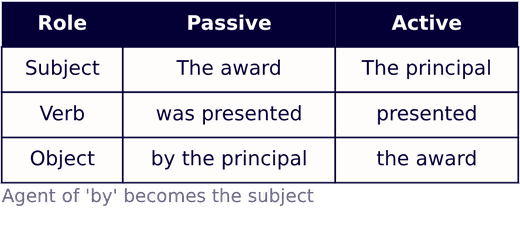
To turn a passive sentence into the active, the agent after 'by' becomes the subject and the passive subject becomes the object.
So 'by the principal' gives the subject 'The principal', and 'The award' moves to the object position.
'Was presented' is simple past passive, whose active counterpart is the simple past 'presented' — not the present 'presents' of option (a) or the present perfect 'has presented' of option (d).
Option (c) merely swaps the two nouns and changes the meaning altogether. Hence option (b).
13
Choose the option that is the most appropriate conversion of the following sentence into Direct Speech.
The teacher said that by the end of the week, he would have been teaching that chapter for three days.
A.The teacher said, "By the end of the week, I will be teaching this chapter for three days.'
B.The teacher said, 'By the end of the week, I will have been teaching this chapter for three days."
C.The teacher said, "By the end of the week, I have been teaching this chapter for three days."
D.The teacher said, "By the end of the week, he will have been teaching this chapter for three days."
Solution
Direct narration
Moving from indirect to direct speech, 'said that' becomes 'said,' and the speaker's exact words follow inside quotation marks.
The reported 'would have been teaching' shifts one step forward to its original 'will have been teaching', keeping the future perfect continuous demanded by 'by the end of the week … for three days'.
The far demonstrative 'that chapter' returns to the near 'this chapter', and the pronoun 'he' returns to the speaker's own 'I', since the teacher is talking about himself.
Option (a) writes 'will be teaching', losing the perfect-continuous sense; option (c) uses the present perfect continuous; option (d) keeps 'he'. Hence option (b).
14
Directions (Qs. 14-18): Read the following passage carefully and answer the questions that follow.
In our current era of hyper-connectivity, the sheer volume of data available at our fingertips has created a new challenge: information overload. Unlike the past, where news was gathered from a few reliable sources, we are now bombarded by a non-stop stream of articles, videos, and opinions. This results in a fragmented understanding of complex issues, as people often consume only headlines or "bite-sized" snippets of information rather than reading in depth. When our intake of data is fragmented, it becomes difficult to distinguish between factual evidence and mere speculation. This constant influx of data can lead to "analytical paralysis," where the brain becomes so overwhelmed by choices and conflicting reports that it struggles to make simple decisions. Instead of becoming more informed, many individuals find that hyper-connectivity actually makes them feel more confused and mentally exhausted.
To combat this, experts recommend "information filtering." By choosing a few high-quality sources and limiting the time spent on news feeds, individuals can move away from a fragmented perspective. Learning to curate our digital environment is essential for turning a chaotic stream of data into meaningful knowledge.
Which of the following sentences is written in the active voice?
A.News was gathered from a few reliable sources in the past.
B.People often consume only headlines or snippets of information.
C.Analytical paralysis is caused by a constant influx of data.
D.Meaningful knowledge is being replaced by chaotic data.
Solution
Active voice identification
In the active voice the subject performs the action; in the passive the subject receives it and the verb takes the form 'be + past participle'.
Option (b), 'People often consume only headlines or snippets of information', has 'People' doing the consuming: subject + verb + object, so it is active.
Options (a), (c) and (d) all show 'be + V3' — 'was gathered', 'is caused', 'is being replaced' — and in each the subject is acted upon.
Hence option (b).
15
Directions (Qs. 14-18): Read the following passage carefully and answer the questions that follow.
In our current era of hyper-connectivity, the sheer volume of data available at our fingertips has created a new challenge: information overload. Unlike the past, where news was gathered from a few reliable sources, we are now bombarded by a non-stop stream of articles, videos, and opinions. This results in a fragmented understanding of complex issues, as people often consume only headlines or "bite-sized" snippets of information rather than reading in depth. When our intake of data is fragmented, it becomes difficult to distinguish between factual evidence and mere speculation. This constant influx of data can lead to "analytical paralysis," where the brain becomes so overwhelmed by choices and conflicting reports that it struggles to make simple decisions. Instead of becoming more informed, many individuals find that hyper-connectivity actually makes them feel more confused and mentally exhausted.
To combat this, experts recommend "information filtering." By choosing a few high-quality sources and limiting the time spent on news feeds, individuals can move away from a fragmented perspective. Learning to curate our digital environment is essential for turning a chaotic stream of data into meaningful knowledge.
Convert this sentence to active voice: "A fragmented understanding of issues is created by bite-sized information."
A.Bite-sized information creates a fragmented understanding of issues.
C.Bite-sized information is creating fragmented understandings.
D.Understanding has been fragmented by bite-sized information.
Solution
Passive to active
The given sentence is 'A fragmented understanding of issues is created by bite-sized information'.
The agent after 'by', namely 'bite-sized information', becomes the subject, and the passive subject 'a fragmented understanding of issues' becomes the object.
'Is created' is simple present passive, so the active verb must be the simple present 'creates' — the tense may not be altered.
This yields 'Bite-sized information creates a fragmented understanding of issues'; option (c) changes the tense and (d) is still passive. Hence option (a).
16
Directions (Qs. 14-18): Read the following passage carefully and answer the questions that follow.
In our current era of hyper-connectivity, the sheer volume of data available at our fingertips has created a new challenge: information overload. Unlike the past, where news was gathered from a few reliable sources, we are now bombarded by a non-stop stream of articles, videos, and opinions. This results in a fragmented understanding of complex issues, as people often consume only headlines or "bite-sized" snippets of information rather than reading in depth. When our intake of data is fragmented, it becomes difficult to distinguish between factual evidence and mere speculation. This constant influx of data can lead to "analytical paralysis," where the brain becomes so overwhelmed by choices and conflicting reports that it struggles to make simple decisions. Instead of becoming more informed, many individuals find that hyper-connectivity actually makes them feel more confused and mentally exhausted.
To combat this, experts recommend "information filtering." By choosing a few high-quality sources and limiting the time spent on news feeds, individuals can move away from a fragmented perspective. Learning to curate our digital environment is essential for turning a chaotic stream of data into meaningful knowledge.
In this passage, what does "fragmented" imply about a person's knowledge?
A.It is broad, deep, and very detailed.
B.It is incomplete and consists of disconnected pieces.
C.It is perfectly organized and easy to remember.
D.It is entirely false and made up of lies.
Solution
Vocabulary in passage
A 'fragment' is a small piece broken off from a whole, so 'fragmented' means broken into unconnected pieces.
The passage links the word to people who 'consume only headlines or bite-sized snippets of information rather than reading in depth'.
Such knowledge is therefore incomplete and made of disconnected bits — option (b).
Option (a) states the opposite, (c) claims neat order where the passage describes confusion, and (d) speaks of falsehood, which the passage never says.
17
Directions (Qs. 14-18): Read the following passage carefully and answer the questions that follow.
In our current era of hyper-connectivity, the sheer volume of data available at our fingertips has created a new challenge: information overload. Unlike the past, where news was gathered from a few reliable sources, we are now bombarded by a non-stop stream of articles, videos, and opinions. This results in a fragmented understanding of complex issues, as people often consume only headlines or "bite-sized" snippets of information rather than reading in depth. When our intake of data is fragmented, it becomes difficult to distinguish between factual evidence and mere speculation. This constant influx of data can lead to "analytical paralysis," where the brain becomes so overwhelmed by choices and conflicting reports that it struggles to make simple decisions. Instead of becoming more informed, many individuals find that hyper-connectivity actually makes them feel more confused and mentally exhausted.
To combat this, experts recommend "information filtering." By choosing a few high-quality sources and limiting the time spent on news feeds, individuals can move away from a fragmented perspective. Learning to curate our digital environment is essential for turning a chaotic stream of data into meaningful knowledge.
What does "hyper-connectivity" refer to in the context of information?
A.Having no access to the internet or news.
B.The ability to speak many different languages.
C.The state of being constantly linked to a non-stop stream of data.
D.Building faster computers for office work.
Solution
Vocabulary in passage
The passage opens with 'our current era of hyper-connectivity' and at once describes a 'non-stop stream of articles, videos, and opinions'.
The prefix 'hyper-' means excessive, so hyper-connectivity is the state of being constantly, even excessively, linked to that endless flow of data.
That is precisely option (c).
Option (a) describes the opposite condition, while (b) and (d) bring in language skill and computer speed, neither of which the passage discusses.
18
Directions (Qs. 14-18): Read the following passage carefully and answer the questions that follow.
In our current era of hyper-connectivity, the sheer volume of data available at our fingertips has created a new challenge: information overload. Unlike the past, where news was gathered from a few reliable sources, we are now bombarded by a non-stop stream of articles, videos, and opinions. This results in a fragmented understanding of complex issues, as people often consume only headlines or "bite-sized" snippets of information rather than reading in depth. When our intake of data is fragmented, it becomes difficult to distinguish between factual evidence and mere speculation. This constant influx of data can lead to "analytical paralysis," where the brain becomes so overwhelmed by choices and conflicting reports that it struggles to make simple decisions. Instead of becoming more informed, many individuals find that hyper-connectivity actually makes them feel more confused and mentally exhausted.
To combat this, experts recommend "information filtering." By choosing a few high-quality sources and limiting the time spent on news feeds, individuals can move away from a fragmented perspective. Learning to curate our digital environment is essential for turning a chaotic stream of data into meaningful knowledge.
According to the experts mentioned in the passage, what is the best way to handle a "chaotic stream of data"?
A.Increase the number of news sources you follow to get every possible opinion.
B.Speed up your reading process so you can finish more articles in less time.
C.Practice "information filtering" by selecting a few high-quality, reliable sources.
D.Ignore all digital information and rely only on traditional printed books.
Solution
Detail from passage
The second paragraph gives the experts' advice directly: they recommend 'information filtering'.
It is then explained as choosing a few high-quality sources and limiting the time spent on news feeds.
So the remedy is to be selective, not to read more (option a) or faster (option b) — both of which would only add to the overload.
Option (d) suggests abandoning digital information altogether, which the passage nowhere advises. Hence option (c).
19
Which word is closest in meaning to "poised"?
The young athlete was poised and calm as she stepped onto the stage for the final round.
A.Anxious
B.Equanimous
C.Coarse
D.Quiet
Solution
Synonym in context
In the sentence 'poised' stands beside 'calm' and describes an athlete about to face a final round, so it means composed and self-possessed under pressure.
'Equanimous' means having an even, untroubled mind, especially in a testing situation — the closest match.
'Anxious' is the opposite feeling, and 'coarse' means rough or lacking refinement, which has nothing to do with composure.
'Quiet' refers only to making little noise, not to inner steadiness. Hence option (b).
20
Which of the following options does not mean the same as the phrase 'Special benefits'
A.Discriminate
B.Privilege
C.Advance
D.Favour
Solution
Odd one out (meaning)
The question asks which word does not carry the sense of 'special benefits'.
'Privilege' is a special right granted to a person or group, 'favour' is a special kindness or preference shown to someone, and 'advance' can mean a benefit or payment given ahead of time.
'Discriminate', on the other hand, means to treat one person or group less favourably than others — it withholds benefit instead of granting it.
Hence the odd word out is 'discriminate', option (a).
21
In which of the following sentences is the word 'resolution' used INCORRECTLY?
A.The screen's high resolution makes the video games look very realistic.
B.After the long court case, both parties were happy to reach a final resolution.
C.Following the scandal, the minister handed in his resolution to the President.
D.My brother made a resolution to stop eating junk food starting Monday.
Solution
Word usage in context
'Resolution' has three common senses: a firm decision, the settling of a dispute, and the level of detail a screen or image can show.
In (a) it is the picture detail of a screen, in (b) the settlement of a court case and in (d) a firm personal decision — all three are correct uses.
In (c) the minister is giving up his post, so the word needed there is 'resignation', not 'resolution'.
Hence the word is used incorrectly in option (c).
22
Select the part of the sentence containing an incorrectly spelt word.
A.Engineers rely on stiochiometry
B.to calculate optimal fuel-to-air
C.mixtures for engines,
D.ensuring complete combustion. (a) A (b) B (c) C (d) D
Solution
Spelling error
Read each labelled part separately and test the spelling of every content word in it.
Part A reads 'Engineers rely on stiochiometry' — the correct spelling is 'stoichiometry' (Greek stoicheion 'element' + metron 'measure').
The other parts — 'to calculate optimal fuel-to-air', 'mixtures for engines,' and 'ensuring complete combustion' — are all spelt correctly.
Hence the incorrectly spelt word lies in part A.
23
Select the part of the sentence that contains an incorrectly spelt word.
A.The professor's lecture on complex
B.philosophy was surprisingly jejoon, filled with (C) simplistic ideas that offered no real substance (D) or intellectual nourishment for the students.
C.A
D.B (c) C (d) D
Solution
Spelling error
Check the spelling of the unusual words in each labelled part.
Part B contains 'jejoon'; the correct spelling is 'jejune', meaning naive, simplistic or lacking real substance.
The sentence itself confirms the meaning — 'simplistic ideas that offered no real substance' is exactly what jejune describes.
Parts A, C and D contain no misspelling, so the error is in part B.
24
What is the term for a fictitious name that a person assumes for a particular purpose?
A.Initials
B.Pseudonym
C.Acronym
D.Autograph
Solution
One word substitution
A pseudonym is a fictitious name that a person assumes for a particular purpose, such as the pen name an author writes under.
Initials are only the first letters of a person's names, e.g. 'R. K.' for Rasipuram Krishnaswami.
An acronym is a short form built from the initial letters of a phrase, e.g. NASA.
An autograph is a signature, especially a celebrity's, kept as a memento.
Hence the correct option is (b).
25
Which of the following describes a newspaper or magazine that deals with a particular subject or professional activity?
A.Chronicle
B.Journal
C.Anthology
D.Autobiography
Solution
One word substitution
A journal is a newspaper or magazine devoted to one particular subject or professional activity, e.g. a medical journal.
A chronicle is a factual written account of events set down in the order in which they happened.
An anthology is a published collection of poems or other pieces of writing.
An autobiography is the account of a person's life written by that person himself.
Hence the correct option is (b).
Finished reading? Now test yourself.
The same 25 questions, but with a timer and the answers hidden — 15 minutes.

 Option (b) drops 'it', option (d) drops 'be', and option (c) reverses doer and receiver, making discipline the thing shaped. Hence option (a).
 Option (a) leaves the original tenses untouched, (b) uses 'told' where a question needs 'asked', and (d) keeps the interrogative word order. Hence option (c).
 'Was presented' is simple past passive, whose active counterpart is the simple past 'presented' — not the present 'presents' of option (a) or the present perfect 'has presented' of option (d).
Option (c) merely swaps the two nouns and changes the meaning altogether. Hence option (b).
'Was presented' is simple past passive, whose active counterpart is the simple past 'presented' — not the present 'presents' of option (a) or the present perfect 'has presented' of option (d).
Option (c) merely swaps the two nouns and changes the meaning altogether. Hence option (b).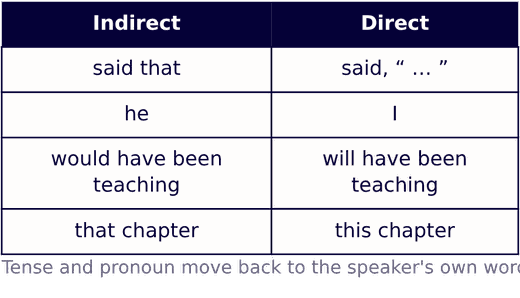 Option (a) writes 'will be teaching', losing the perfect-continuous sense; option (c) uses the present perfect continuous; option (d) keeps 'he'. Hence option (b).