SSC CHSL 25 November 2025 · Shift 3 · General Intelligence — questions with answers · ShikshaSphere
Chapter 137 of 200
25 November 2025 · Shift 3
General Intelligence
25 questions ~25 min readFree
25 questions
A
26
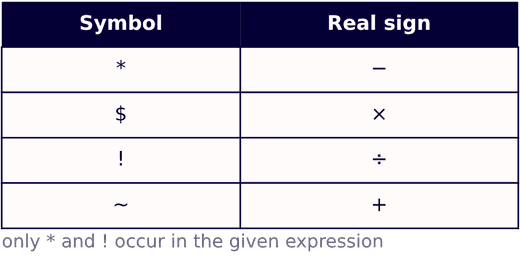
In this type of questions, question is provided with substitutes for various mathematical symbols, followed by a question involving calculation of an expression or choosing the correct/incorrect equation. You have to put the real signs in the given equation and then solve the questions as required. If '*' stands for ' ', ' ' stands for ' ', '!' stands for '÷', '~' stands for '+', then find the value of: ?
A.
B.
C.
D.
Solution
Symbol substitution
First put the real sign in place of every symbol used in the expression.
So 24 ! 9 * 4 * 6 becomes .
By BODMAS the division is done first: .
Now the two subtractions: .
.
Hence option (a) is correct.
27
A person walks 5 km south, then 7 km west, and finally 5 km north. In which direction is he from his starting point?
A.North
B.South
C.East
D.West
Solution
Direction sense
Draw the three moves one after the other, starting from the starting point.
The 5 km walked south and the 5 km walked north are equal and opposite, so they cancel and no north–south shift is left.
Only the 7 km walked towards the west survives.
So the finishing point lies 7 km due west of the starting point.
Hence option (d) is correct.
28
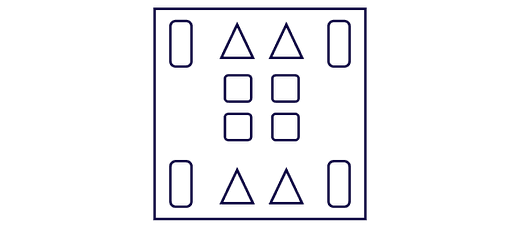
A piece of paper is folded and punched as shown below in the question figures. From the given option figures, indicate how it will appear when opened.
A.
B.
C.
D.
Solution
Paper folding and punching
The first fold brings the right half onto the left half and the second fold brings the bottom half up, so the punched sheet is exactly one quarter of the square.
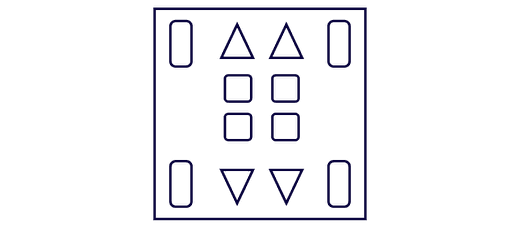
Every punch therefore reappears four times when the paper is opened: once as it is, once mirrored across the vertical fold and once across the horizontal fold, and once across both.
The quarter carries a bar near its outer edge, a triangle and a square, so the open sheet must show 4 bars, 4 triangles and 4 squares.
The four bars land in the four corners and the four squares form the block of squares in the middle.
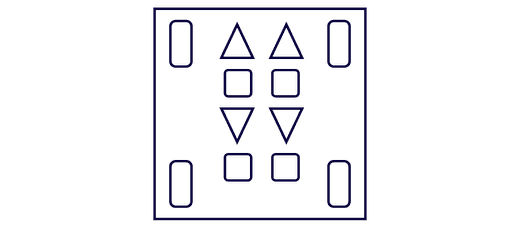
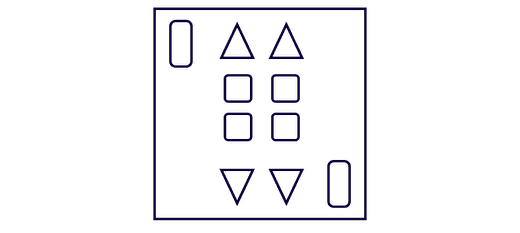
Mirroring across the horizontal fold turns a triangle upside down, so the two upper triangles point up and the two lower ones must point down.
Option (b) keeps the lower triangles pointing up, (c) interchanges the squares and the triangles in the lower half, and (d) shows only two bars instead of four.
Hence option (a) is correct.
29
Pick the correct options from below.
12,27,48,75,?
A.100
B.108
C.96
D.112
Solution
Number series
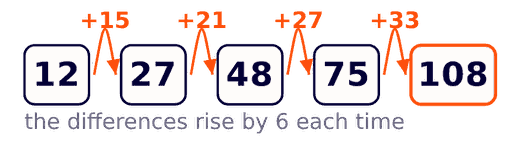
Write down the gap between each pair of consecutive terms.
The gaps are 15, 21, 27 and they themselves grow by 6 each time, so the next gap is 27 + 6 = 33.
Required term = 75 + 33 = 108.
The same series can be read as : , , , and .
Hence option (b) is correct.
30
Five friends Rahul, Ritu, Ramesh, Rohan, and Reena were born in different consecutive years starting from 2002.Reena was neither born in 2003 nor in 2006.Rahul is the oldest among all. Ritu is younger than Rohan. Ramesh was born in a leap year. Who was born in 2003?
A.Rohan
B.Ritu
C.Reena
D.Ramesh
Solution
Ordering by birth year
The five consecutive years starting from 2002 are 2002, 2003, 2004, 2005 and 2006.
Rahul is the oldest, so the earliest year belongs to him: Rahul was born in 2002.
Among these five years only 2004 is divisible by 4, so 2004 is the only leap year and Ramesh was born in 2004.
Reena is barred from 2003 and 2006, and 2002 and 2004 are already taken, so Reena was born in 2005.
Rohan and Ritu must take 2003 and 2006; Ritu is younger, so Ritu got 2006 and Rohan got 2003.
Hence option (a) is correct.
31
You are given a Master Address (MA) from official records. Your task is to identify the correct candidate address that matches exactly with the master address in terms of formatting, punctuation, spelling, and structure.
Master Address (MA):
H.No-21, Sector B-4, Green Valley, MG Road, Jaipur - 302015
Candidate Addresses:
A.H.No-21, Sector B-4, Green Valley, M.G. Road, Jaipur - 302015
B.H.No.21, Sector B-4, Green Valley, MG Road, Jaipur - 302015
C.H.No-21, Sector B 4, Green Valley, MG Road, Jaipur - 302015
D.H.No-21, Sector B-4, Green Valley, MG Road, Jaipur - 302015
Solution
Address matching
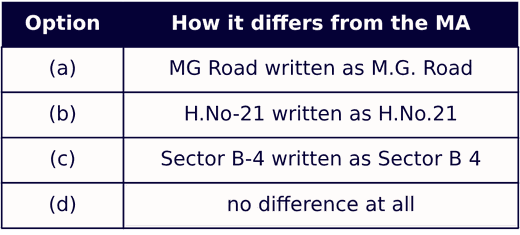
Compare each candidate address with the master address field by field, watching the full stops, hyphens and spaces.
In (a) the road is written 'M.G. Road' with two full stops, while the master has the plain 'MG Road'.
In (b) the house number is written 'H.No.21' with a full stop, while the master uses a hyphen in 'H.No-21'.
In (c) the sector is written 'Sector B 4' with a space, while the master uses a hyphen in 'Sector B-4'.
Only (d) keeps every letter, full stop, hyphen and space exactly as in the master address.
Hence option (d) is correct.
32
Identify the next number in the sequence.
6, 18, 36, 60, 90, ?
A.126
B.132
C.138
D.144
Solution
Number series
The differences between consecutive terms are 12, 18, 24, 30, and each difference is 6 more than the one before it.
So the next difference is 30 + 6 = 36.
Required term = 90 + 36 = 126.
The same series is 6 times the triangular numbers: , and next .
Hence option (a) is correct.
33
In the following question, select the number which can be placed at the sign of question mark (?) from the given alternatives.
A.13
B.14
C.5
D.9
Solution
Number grid
Read the grid row by row: the last entry of a row is the product of the first three entries of that row.
Row 1: , which matches the given entry.
Row 2: , which matches as well.
Row 3: , so .
.
Hence option (c) is correct.
34
In the following question, select the number which can be placed at the sign of question mark (?) from the given alternatives.
A.7
B.4
C.8
D.9
Solution
Number box pattern
In each box the bottom-left number is the odd one out, so try to build it from the other three.
Rule: bottom-left = (top-left top-right) + bottom-right.
Box 1: , which is the given entry.
Box 2: , which matches as well.
Box 3: , so 18 + ? = 25 and ? = 7.
Hence option (a) is correct.
35
How many triangles are there in the given figure ?
A.8
B.10
C.9
D.11
Solution
Counting triangles
Number the smallest closed triangular regions of the figure.
Simple triangles: 1, 2 and 3 inside the left square, 4 and 5 on the right, and 6 hanging below the rectangle — that is 6 triangles.
Two regions join to make a bigger triangle wherever their common edge lies on a longer straight line.
In the left square 1 + 2 and 1 + 3 each give a half-square triangle, and on the right 4 + 5 gives one more — 3 triangles.
One large triangle is still left: the top edge of the rectangle, the long slanting line and the vertical line enclose it.
Total = 6 + 3 + 1 = 10.
Hence option (b) is correct.
36
How many triangles are there in the given figure ?
A.22
B.23
C.24
D.20
Solution
Counting triangles
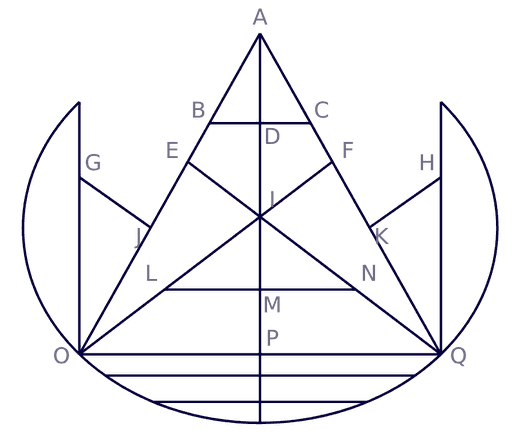
Name the points as shown and then count in groups so that nothing is repeated.
With the short line BC: ABC, ADB and ADC — 3 triangles.
The whole figure and its two halves cut by the axis AP: AOQ, APO and APQ — 3 triangles.
The two long lines OF and QE cross the axis at I and give AIE, AIF, AIO, AIQ, EOI, FIQ, AEQ, AFO, OEQ and OFQ — 10 triangles.
Below I, the line LN and the base OQ give ILM, IMN, ILN, IPO, IPQ and IOQ — 6 triangles.
The two side flaps add GJO and HKQ — 2 triangles.
Total = 3 + 3 + 10 + 6 + 2 = 24.
Hence option (c) is correct.
37
5 persons and T are sitting around a circular table facing towards the centre (not necessarily in the same order). Q is sitting second to the right of is sitting second to the right of is not an immediate neighbour of P. Who is to the immediate right of P ?
A.T
B.Q
C.R
D.S
Solution
Circular seating
Everybody faces the centre, so a person's right hand points anticlockwise; 'second to the right' therefore means two seats anticlockwise.
Fix S first. Q sits two seats anticlockwise from S, and P sits two seats anticlockwise from Q.
Reading anticlockwise the five seats are S, _, Q, _, P.
R and T must fill the two empty seats, but R cannot be next to P, and the seat between Q and P touches P.
So R takes the seat between S and Q, and T takes the seat between Q and P.
One seat anticlockwise from P brings us back to S, so S is immediately to the right of P.
Hence option (d) is correct.
38
5 persons and T are sitting around a circular table facing towards the centre (not necessarily in the same order). Q is sitting second to the right of S. P is sitting second to the right of is not an immediate neighbour of P . Who is sitting third to the right of R ?
A.Q
B.P
C.S
D.T
Solution
Circular seating
Since all five face the centre, counting to the right means counting anticlockwise.
Place S, then Q two seats anticlockwise of S and P two seats anticlockwise of Q, which gives S, _, Q, _, P anticlockwise.
R may not be an immediate neighbour of P, so R cannot take the seat between Q and P; R sits between S and Q and T sits between Q and P.
The complete anticlockwise order is therefore S, R, Q, T, P.
Counting to the right from R: first Q, second T, third P.
Hence option (b) is correct.
39
A man is facing towards North. By taking which of the following combination of turns, he will be finally facing towards West?
A.Left, Right, Left, Right, Right
B.Right, Left, Right, Left, Left
C.Right, Right, Right, Left, Left
D.Left, Right, Left, Right, Left
Solution
Direction after turns
Each turn is a quarter turn, so start from North and apply the turns of option (b) one at a time.
North, turn right → East; turn left → North; turn right → East; turn left → North; turn left → West.
So this combination leaves him facing West.
Options (a) and (c) contain three right turns against only two left turns, which brings him to East instead.
Hence option (b) is correct.
40
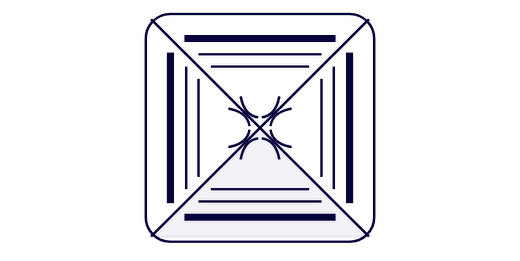
Which option figure will complete the pattern in the question figure? (Rotation is not allowed)
A.
B.
C.
D.
Solution
Completing the pattern
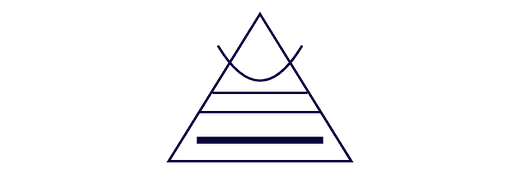
The two diagonals cut the rounded square into four equal triangles, and each triangle carries the same design read from its own base towards the centre.
That design is: one thick bar close to the base, then two thin lines parallel to it, and finally a pair of small arcs at the tip that meets the centre.
The missing piece is the bottom triangle, so its base is the bottom edge and its tip points up to the centre.
Rotation is not allowed, so the required figure must show the arcs at the top tip and the thick bar at the bottom, exactly as in option (c).
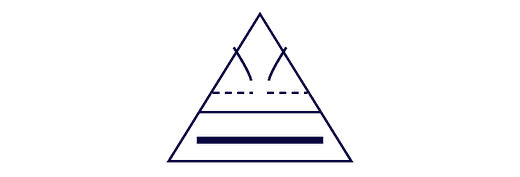
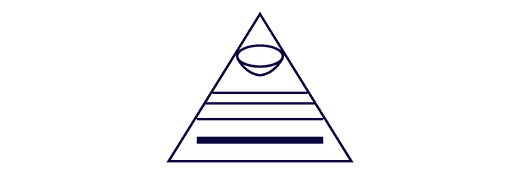
In (a) the upper thin line is broken into two dashes, in (b) the tip carries a closed oval and an extra line, and in (d) the tip carries one large arc instead of the pair of small ones.
Hence option (c) is correct.
41
In the following figure series, select the figure which can be placed at the sign of question mark (?) from the given alternatives.
A.
B.
C.
D.
Solution
Figure series: rotation
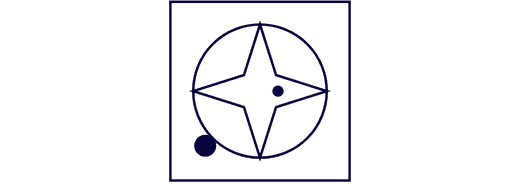
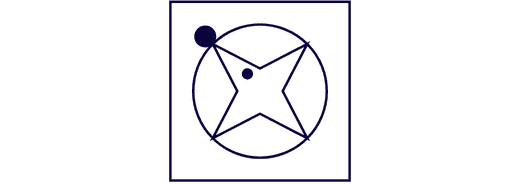
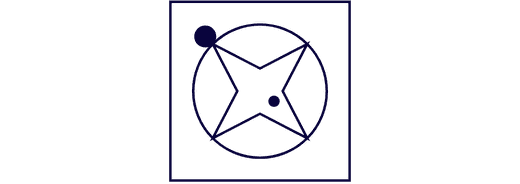
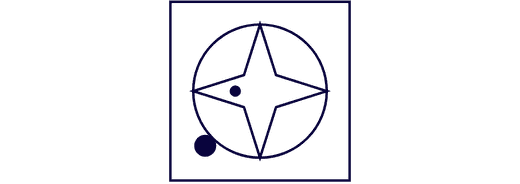
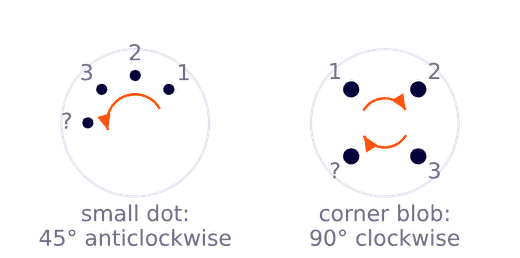
Three things change from figure to figure: the four-pointed star, the big dark blob at a corner and the small dot inside the circle.
The star turns through each step, so it is slanted, like the letter X, in figures 1 and 3 and upright, like a plus sign, in figure 2; the missing figure must therefore show the upright star.
The big blob moves clockwise round the circle: top-left, then top-right, then bottom-right, so next it reaches the bottom-left corner.
The small dot turns anticlockwise about the centre: it lies on the upper-right arm, then on the top arm, then on the upper-left arm, so in the fourth figure it must lie on the left arm — directly left of the centre.
Only one figure has the upright star, the blob at the bottom-left and the dot to the left of the centre, so option (d) is correct.
42
In the following figure series, select the figure which can be placed at the sign of question mark (?) from the given alternatives.
A.
B.
C.
D.
Solution
Water image series
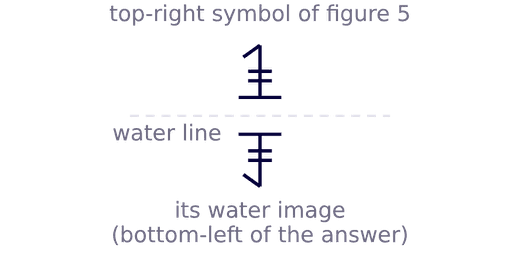
In every figure the symbol at the bottom-left is the water image (an up-down mirror) of the symbol that stood at the top-right of the figure just before it, and a brand-new symbol is drawn at the top-right.
Test it on the first pair: the Y at the top-right of figure 1 comes back upside down at the bottom-left of figure 2, and the same happens at every later step.
So the answer figure must carry, at its bottom-left, the water image of the symbol at the top-right of figure 5.
That symbol has a short flag at the top-left, a stem with two small cross-bars, and a long bar at its foot.
Turning it upside down puts the long bar on top and leaves the short flag at the bottom-left, because a water image never exchanges left and right.
Option (b) is the symbol mirrored left to right, option (c) is the symbol unchanged and option (d) is the symbol turned through , so option (a) is correct.
43
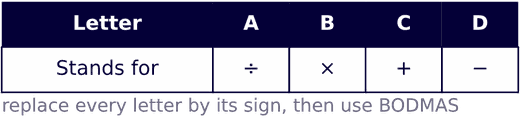
If 'A' means '÷', 'B' means 'x', 'C' means '+' and 'D' means '-', then find the value of :-
36A4B2C8D5=?
A.15
B.21
C.25
D.19
Solution
Symbol substitution
Replace each letter by the sign it stands for.
The expression becomes .
By BODMAS, division and multiplication come first, working from left to right: and .
Now 18 + 8 - 5 = 21.
So the value is 21 and option (b) is correct.
44
By interchanging the given two numbers (not digits) which of the following equation will NOT be correct ? 5 and 9
I.
II.
A.Only I
B.Only II
C.Both I and II
D.Neither I nor II
Solution
Interchanging numbers
Interchanging the numbers 5 and 9 means every 5 becomes 9 and every 9 becomes 5; all the other numbers stay where they are.
Equation I becomes , which is not 20.
Equation II becomes , which is not 34.
Both equations fail after the interchange, so option (c) is correct.
45
In the following question, four number pairs are given. In each pair the number on left side of (-) is related to the number of the right side of (-) with some Logic/Rule/Relation. Three pairs are similar on the basis of same Logic / Rule /Relation. Select the odd one out from the given alternatives.
(NOTE: Operations should be performed on the whole numbers, without breaking down the number into its constituent digits. E.g. 13 - Operations on 13 such as adding /subtracting /multiplying etc. to 13 can be performed. Breaking down 13 into 1 and 3 and then performing mathematical operations on 1 and 3 is not allowed)
A.17-289
B.16-256
C.15-225
D.14-197
Solution
Number pair: perfect square
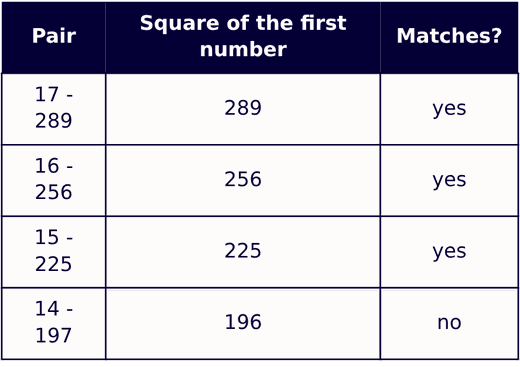
In each pair check whether the number on the right is the square of the number on the left.
, and — these three pairs follow the rule exactly.
, but the pair offers 197, which is one more than the square.
Hence 14 - 197 is the odd pair out, so option (d) is correct.
46
In a certain coded language 'GOLD' is coded as 'BIGX' and 'FISH' is coded as 'ACNB'. How will 'TASK' be coded in the same code language?
A.OTND
B.OUNE
C.PVNF
D.PTMD
Solution
Letter coding
Compare the code with the word letter by letter, using the positions A = 1 … Z = 26.
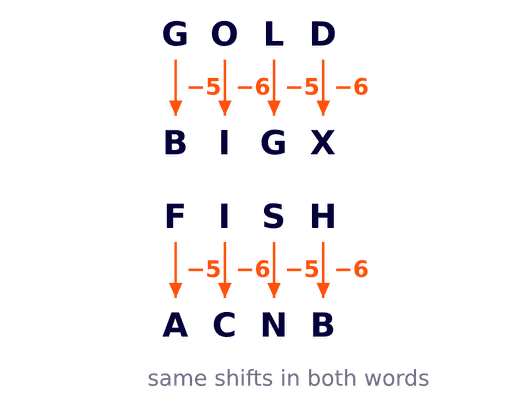
G(7) → B(2) is -5, O(15) → I(9) is -6, L(12) → G(7) is -5 and D(4) → X(24) is -6, counting back past A into Z.
FISH → ACNB follows the very same -5, -6, -5, -6 pattern, which confirms the rule.
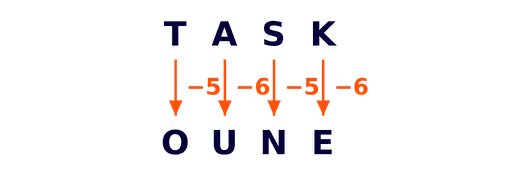
Apply it to TASK: T(20) -5 = O, A(1) -6 = U, S(19) -5 = N, K(11) -6 = E.
So TASK is coded as OUNE and option (b) is correct.
47
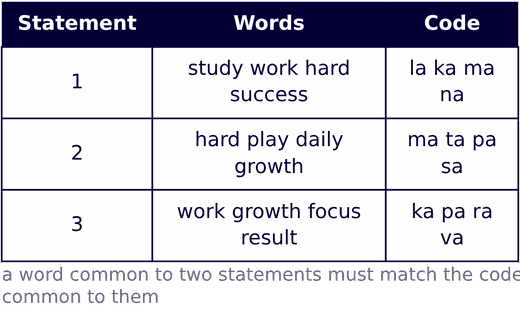
In a certain code language, 'study work hard success' is coded as 'la ka ma na', 'hard play daily growth' is coded as 'ma ta pa sa', and 'work growth focus result' is coded as 'ka pa ra va'. How will 'work growth' be coded in that code language ?
A.la ma
B.ka pa
C.na sa
D.ta ra
Solution
Word code language
Take the statements two at a time and pick out the word they share and the code they share.
Statements 1 and 2 have only 'hard' in common and only 'ma' in common, so hard → ma.
Statements 1 and 3 have only 'work' in common and only 'ka' in common, so work → ka.
Statements 2 and 3 have only 'growth' in common and only 'pa' in common, so growth → pa.
Hence 'work growth' is coded as 'ka pa' and option (b) is correct.
48
From the given alternatives, select the word that CANNOT be formed by using the letters of the given word. DEMOCRATIC
A.COMRADE
B.CREDIT
C.ACTION
D.METRIC
Solution
Word formation
The given word DEMOCRATIC supplies the letters A, C, C, D, E, I, M, O, R, T.
COMRADE, CREDIT and METRIC use only these letters, and the repeated C is available because DEMOCRATIC contains C twice.
ACTION needs the letter N, and there is no N anywhere in DEMOCRATIC.
So ACTION cannot be formed and option (c) is correct.
49
From the given alternatives, select the word that CANNOT be formed by using the letters of the given word. COMMUNICATION
A.ACTION
B.UNION
C.MUSIC
D.MOTION
Solution
Word formation
COMMUNICATION supplies the letters A, C, C, I, I, M, M, N, N, O, O, T, U.
ACTION, UNION and MOTION can all be built from these — UNION needs two N's and MOTION needs two O's, and both are available.
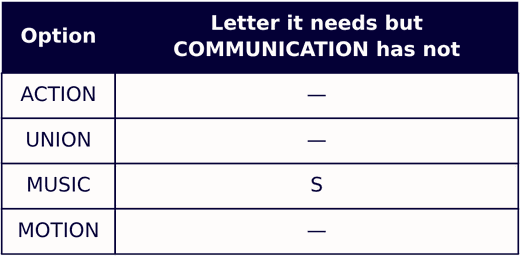
MUSIC needs the letter S, which does not occur in COMMUNICATION at all.
So MUSIC cannot be formed and option (c) is correct.
50
A series is given with one term missing. Select the correct alternative from the given ones that will complete the series.
MZ200 , KV245 , IR290 , GN335 , ?
A.EI385
B.DJ370
C.EJ380
D.FK380
Solution
Alphanumeric series
Split every term into its three parts and follow each part on its own.
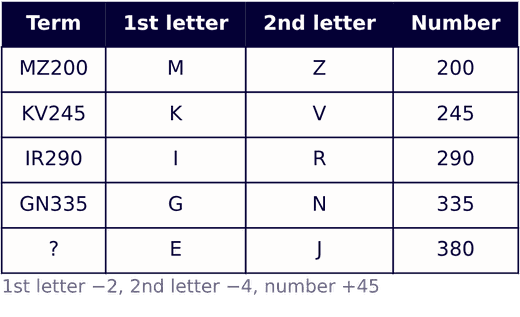
The first letters are M, K, I, G — each two steps back in the alphabet, so the next one is E.
The second letters are Z, V, R, N — each four steps back, so the next one is J.
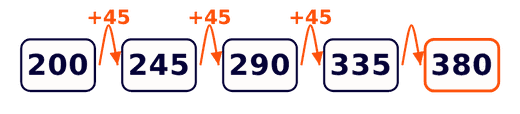
The numbers grow by 45 every time.
So the number is 335 + 45 = 380, the term is EJ380 and option (c) is correct.
Finished reading? Now test yourself.
The same 25 questions, but with a timer and the answers hidden — 15 minutes.

 So 24 ! 9 * 4 * 6 becomes .
By BODMAS the division is done first: .
Now the two subtractions: .
.
Hence option (a) is correct.
So 24 ! 9 * 4 * 6 becomes .
By BODMAS the division is done first: .
Now the two subtractions: .
.
Hence option (a) is correct.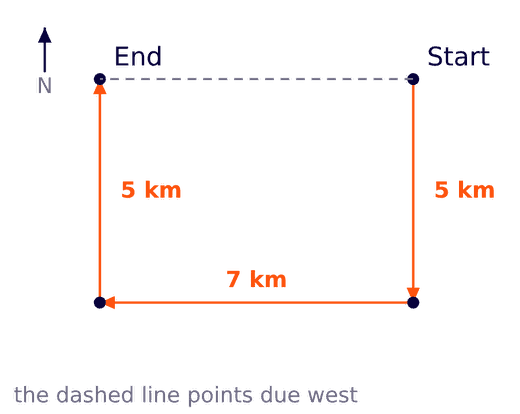 The 5 km walked south and the 5 km walked north are equal and opposite, so they cancel and no north–south shift is left.
Only the 7 km walked towards the west survives.
So the finishing point lies 7 km due west of the starting point.
Hence option (d) is correct.
The 5 km walked south and the 5 km walked north are equal and opposite, so they cancel and no north–south shift is left.
Only the 7 km walked towards the west survives.
So the finishing point lies 7 km due west of the starting point.
Hence option (d) is correct.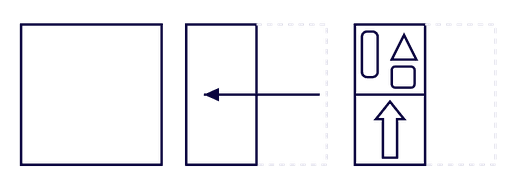
 The gaps are 15, 21, 27 and they themselves grow by 6 each time, so the next gap is 27 + 6 = 33.
Required term = 75 + 33 = 108.
The same series can be read as : , , , and .
Hence option (b) is correct.
The gaps are 15, 21, 27 and they themselves grow by 6 each time, so the next gap is 27 + 6 = 33.
Required term = 75 + 33 = 108.
The same series can be read as : , , , and .
Hence option (b) is correct.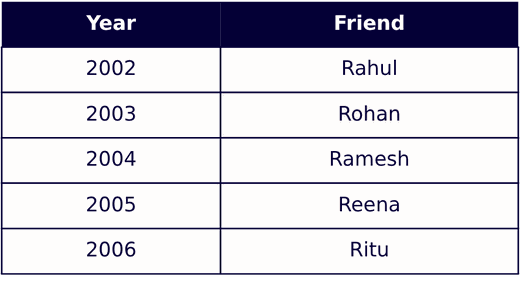 Hence option (a) is correct.
 In (a) the road is written 'M.G. Road' with two full stops, while the master has the plain 'MG Road'.
In (b) the house number is written 'H.No.21' with a full stop, while the master uses a hyphen in 'H.No-21'.
In (c) the sector is written 'Sector B 4' with a space, while the master uses a hyphen in 'Sector B-4'.
Only (d) keeps every letter, full stop, hyphen and space exactly as in the master address.
Hence option (d) is correct.
In (a) the road is written 'M.G. Road' with two full stops, while the master has the plain 'MG Road'.
In (b) the house number is written 'H.No.21' with a full stop, while the master uses a hyphen in 'H.No-21'.
In (c) the sector is written 'Sector B 4' with a space, while the master uses a hyphen in 'Sector B-4'.
Only (d) keeps every letter, full stop, hyphen and space exactly as in the master address.
Hence option (d) is correct.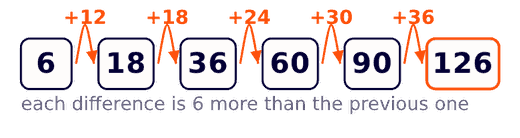 The differences between consecutive terms are 12, 18, 24, 30, and each difference is 6 more than the one before it.
So the next difference is 30 + 6 = 36.
Required term = 90 + 36 = 126.
The same series is 6 times the triangular numbers: , and next .
Hence option (a) is correct.
The differences between consecutive terms are 12, 18, 24, 30, and each difference is 6 more than the one before it.
So the next difference is 30 + 6 = 36.
Required term = 90 + 36 = 126.
The same series is 6 times the triangular numbers: , and next .
Hence option (a) is correct.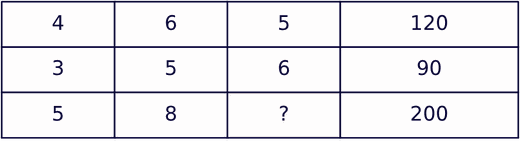 Read the grid row by row: the last entry of a row is the product of the first three entries of that row.
Row 1: , which matches the given entry.
Row 2: , which matches as well.
Row 3: , so .
.
Hence option (c) is correct.
Read the grid row by row: the last entry of a row is the product of the first three entries of that row.
Row 1: , which matches the given entry.
Row 2: , which matches as well.
Row 3: , so .
.
Hence option (c) is correct.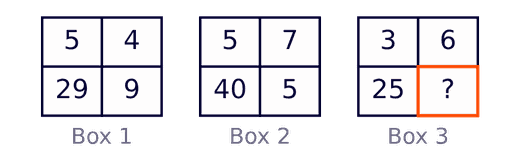 In each box the bottom-left number is the odd one out, so try to build it from the other three.
Rule: bottom-left = (top-left top-right) + bottom-right.
Box 1: , which is the given entry.
Box 2: , which matches as well.
Box 3: , so 18 + ? = 25 and ? = 7.
Hence option (a) is correct.
In each box the bottom-left number is the odd one out, so try to build it from the other three.
Rule: bottom-left = (top-left top-right) + bottom-right.
Box 1: , which is the given entry.
Box 2: , which matches as well.
Box 3: , so 18 + ? = 25 and ? = 7.
Hence option (a) is correct.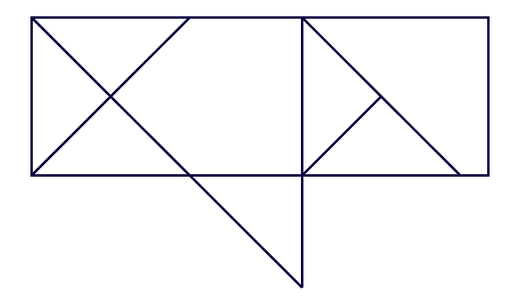
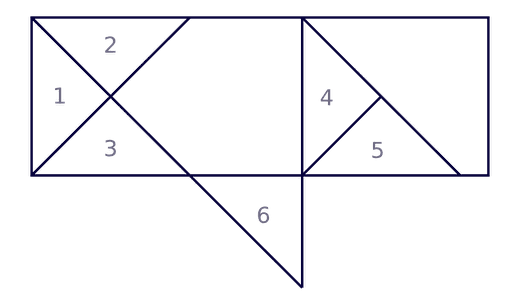 Simple triangles: 1, 2 and 3 inside the left square, 4 and 5 on the right, and 6 hanging below the rectangle — that is 6 triangles.
Two regions join to make a bigger triangle wherever their common edge lies on a longer straight line.
In the left square 1 + 2 and 1 + 3 each give a half-square triangle, and on the right 4 + 5 gives one more — 3 triangles.
One large triangle is still left: the top edge of the rectangle, the long slanting line and the vertical line enclose it.
Total = 6 + 3 + 1 = 10.
Hence option (b) is correct.
Simple triangles: 1, 2 and 3 inside the left square, 4 and 5 on the right, and 6 hanging below the rectangle — that is 6 triangles.
Two regions join to make a bigger triangle wherever their common edge lies on a longer straight line.
In the left square 1 + 2 and 1 + 3 each give a half-square triangle, and on the right 4 + 5 gives one more — 3 triangles.
One large triangle is still left: the top edge of the rectangle, the long slanting line and the vertical line enclose it.
Total = 6 + 3 + 1 = 10.
Hence option (b) is correct.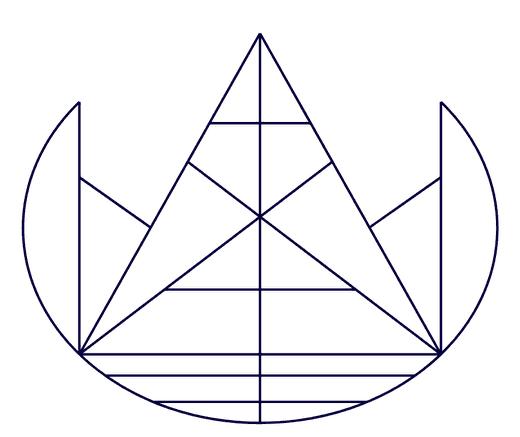
 With the short line BC: ABC, ADB and ADC — 3 triangles.
The whole figure and its two halves cut by the axis AP: AOQ, APO and APQ — 3 triangles.
The two long lines OF and QE cross the axis at I and give AIE, AIF, AIO, AIQ, EOI, FIQ, AEQ, AFO, OEQ and OFQ — 10 triangles.
Below I, the line LN and the base OQ give ILM, IMN, ILN, IPO, IPQ and IOQ — 6 triangles.
The two side flaps add GJO and HKQ — 2 triangles.
Total = 3 + 3 + 10 + 6 + 2 = 24.
Hence option (c) is correct.
With the short line BC: ABC, ADB and ADC — 3 triangles.
The whole figure and its two halves cut by the axis AP: AOQ, APO and APQ — 3 triangles.
The two long lines OF and QE cross the axis at I and give AIE, AIF, AIO, AIQ, EOI, FIQ, AEQ, AFO, OEQ and OFQ — 10 triangles.
Below I, the line LN and the base OQ give ILM, IMN, ILN, IPO, IPQ and IOQ — 6 triangles.
The two side flaps add GJO and HKQ — 2 triangles.
Total = 3 + 3 + 10 + 6 + 2 = 24.
Hence option (c) is correct.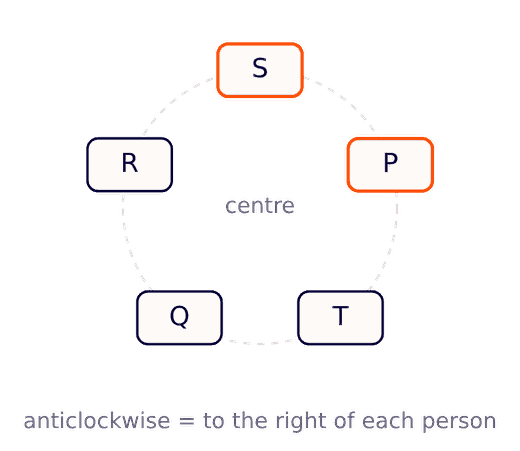 One seat anticlockwise from P brings us back to S, so S is immediately to the right of P.
Hence option (d) is correct.
One seat anticlockwise from P brings us back to S, so S is immediately to the right of P.
Hence option (d) is correct.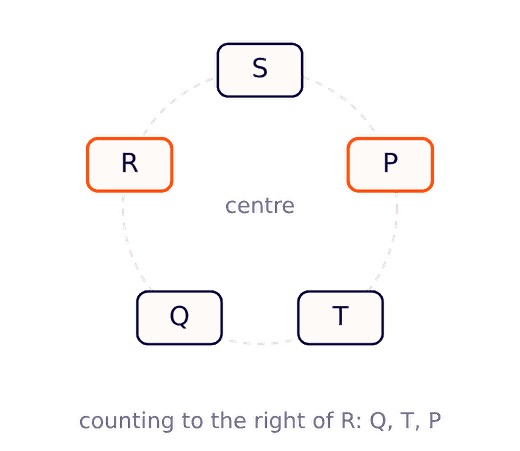 The complete anticlockwise order is therefore S, R, Q, T, P.
Counting to the right from R: first Q, second T, third P.
Hence option (b) is correct.
The complete anticlockwise order is therefore S, R, Q, T, P.
Counting to the right from R: first Q, second T, third P.
Hence option (b) is correct.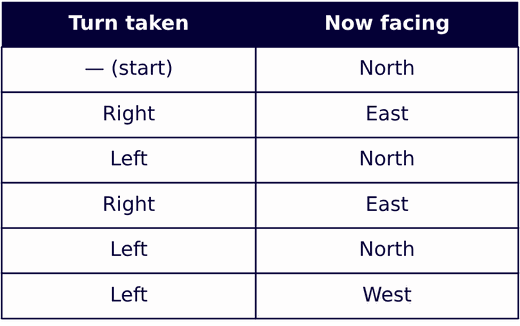 North, turn right → East; turn left → North; turn right → East; turn left → North; turn left → West.
So this combination leaves him facing West.
Options (a) and (c) contain three right turns against only two left turns, which brings him to East instead.
Hence option (b) is correct.
North, turn right → East; turn left → North; turn right → East; turn left → North; turn left → West.
So this combination leaves him facing West.
Options (a) and (c) contain three right turns against only two left turns, which brings him to East instead.
Hence option (b) is correct.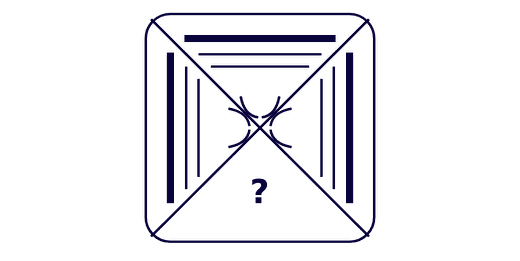
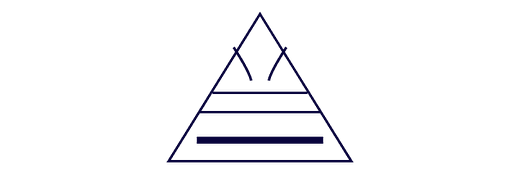
 Rotation is not allowed, so the required figure must show the arcs at the top tip and the thick bar at the bottom, exactly as in option (c).
In (a) the upper thin line is broken into two dashes, in (b) the tip carries a closed oval and an extra line, and in (d) the tip carries one large arc instead of the pair of small ones.
Hence option (c) is correct.
Rotation is not allowed, so the required figure must show the arcs at the top tip and the thick bar at the bottom, exactly as in option (c).
In (a) the upper thin line is broken into two dashes, in (b) the tip carries a closed oval and an extra line, and in (d) the tip carries one large arc instead of the pair of small ones.
Hence option (c) is correct.
 Only one figure has the upright star, the blob at the bottom-left and the dot to the left of the centre, so option (d) is correct.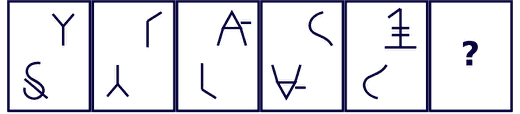
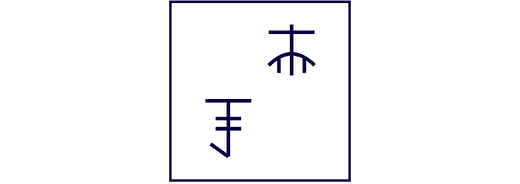
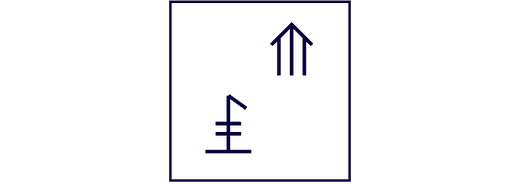
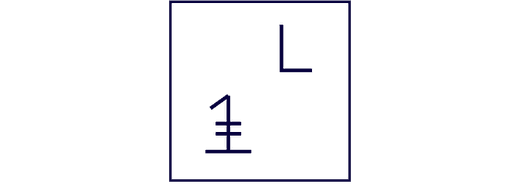
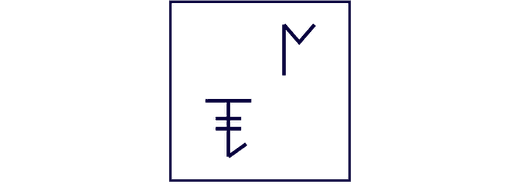
 Option (b) is the symbol mirrored left to right, option (c) is the symbol unchanged and option (d) is the symbol turned through , so option (a) is correct.
 The expression becomes .
By BODMAS, division and multiplication come first, working from left to right: and .
Now 18 + 8 - 5 = 21.
So the value is 21 and option (b) is correct.
The expression becomes .
By BODMAS, division and multiplication come first, working from left to right: and .
Now 18 + 8 - 5 = 21.
So the value is 21 and option (b) is correct.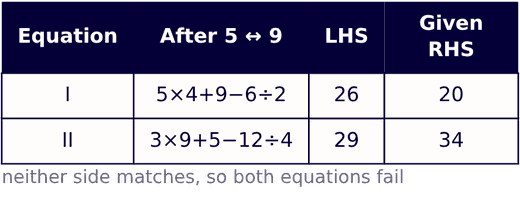 Both equations fail after the interchange, so option (c) is correct.
 Hence 14 - 197 is the odd pair out, so option (d) is correct.
 G(7) → B(2) is -5, O(15) → I(9) is -6, L(12) → G(7) is -5 and D(4) → X(24) is -6, counting back past A into Z.
FISH → ACNB follows the very same -5, -6, -5, -6 pattern, which confirms the rule.
Apply it to TASK: T(20) -5 = O, A(1) -6 = U, S(19) -5 = N, K(11) -6 = E.
G(7) → B(2) is -5, O(15) → I(9) is -6, L(12) → G(7) is -5 and D(4) → X(24) is -6, counting back past A into Z.
FISH → ACNB follows the very same -5, -6, -5, -6 pattern, which confirms the rule.
Apply it to TASK: T(20) -5 = O, A(1) -6 = U, S(19) -5 = N, K(11) -6 = E.
 So TASK is coded as OUNE and option (b) is correct.
 Statements 1 and 2 have only 'hard' in common and only 'ma' in common, so hard → ma.
Statements 1 and 3 have only 'work' in common and only 'ka' in common, so work → ka.
Statements 2 and 3 have only 'growth' in common and only 'pa' in common, so growth → pa.
Hence 'work growth' is coded as 'ka pa' and option (b) is correct.
Statements 1 and 2 have only 'hard' in common and only 'ma' in common, so hard → ma.
Statements 1 and 3 have only 'work' in common and only 'ka' in common, so work → ka.
Statements 2 and 3 have only 'growth' in common and only 'pa' in common, so growth → pa.
Hence 'work growth' is coded as 'ka pa' and option (b) is correct.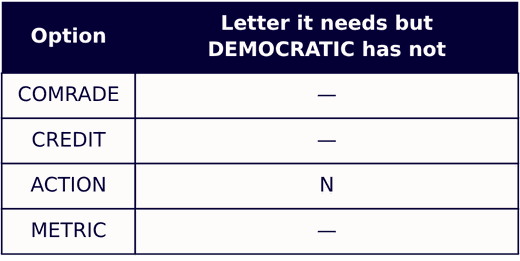 So ACTION cannot be formed and option (c) is correct.
 So MUSIC cannot be formed and option (c) is correct.
 The first letters are M, K, I, G — each two steps back in the alphabet, so the next one is E.
The second letters are Z, V, R, N — each four steps back, so the next one is J.
The numbers grow by 45 every time.
The first letters are M, K, I, G — each two steps back in the alphabet, so the next one is E.
The second letters are Z, V, R, N — each four steps back, so the next one is J.
The numbers grow by 45 every time.
 So the number is 335 + 45 = 380, the term is EJ380 and option (c) is correct.