SSC CHSL 26 November 2025 · Shift 1 · English Language — questions with answers · ShikshaSphere
Chapter 144 of 200
26 November 2025 · Shift 1
English Language
25 questions ~25 min readFree
25 questions
A
1
Choose the most appropriate idiom to fill in the blank in the sentence below: After months of stagnation, the research team finally achieved a major breakthrough, and now their project is .
A.back to the drawing board
B.firing on all cylinders
C.barking up the wrong tree
D.skating on thin ice
Solution
Idiom in context
The blank must describe a project that has suddenly begun to perform at its very best after a long standstill.
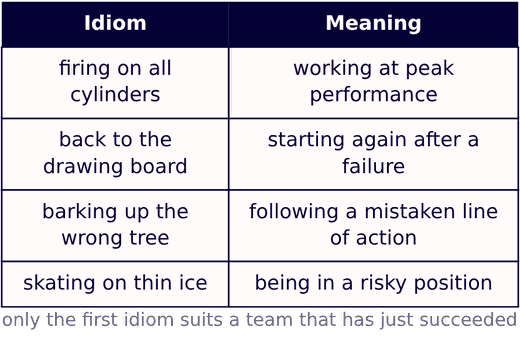
'Firing on all cylinders' means working at full power, with every part of the effort contributing — exactly what happens after a major breakthrough.
'Back to the drawing board' means starting all over again after a failure, which contradicts 'breakthrough'; the other two idioms describe a mistaken approach and a risky position.
Hence option (b) is correct.
2
Identify the part of the sentence that contains a grammatical error.
A. The latest laptop is B. much more faster C. and costlier than D. the old one.
A.The latest laptop is
B.much more faster
C.and sleeker than
D.the old one
Solution
Double comparative
A short adjective forms its comparative degree by adding -er, so 'fast' becomes 'faster' and never takes 'more' as well.
Part B reads 'much more faster', which uses 'more' and '-er' together — a double comparative.
The correct wording is 'much faster', so the error lies in part B.
'much' before a comparative is perfectly acceptable, and parts A, C and D contain no error.
3
Fill in the blank with the most appropriate conjunction:You will be rewarded you act selflessly for the benefit of mankind.
A.if only
B.yet
C.provided that
D.while
Solution
Conjunction of condition
The blank joins a reward to the single condition on which it depends, so a conditional conjunction is needed.
'Provided that' means 'only on the condition that', which makes selfless action the condition for the reward.
'Yet' and 'while' express contrast, and 'if only' expresses a wish or a regret ('If only I had known'), so none of them states a condition.
Hence option (c) is correct.
4
Select the most appropriate synonym of the word:
Kindness
A.bitterness
B.III-will
C.Compassion
D.Rancor
Solution
Synonym
Kindness is the quality of being warm, generous and considerate towards other people.
Compassion is a sympathetic concern for the suffering of others, which carries the same feeling of care and goodwill.
Bitterness, ill-will and rancour all describe resentment or hostility, so they are antonyms of kindness rather than synonyms.
5
Select the most appropriate synonym of the word:
Admit
A.Shun
B.Welcome
C.Eschew
D.Chase
Solution
Synonym
Admit means to let a person or a thing come in, or to accept something as true.
Welcome means to receive gladly, so it shares the central idea of allowing in and accepting.
Shun and eschew both mean to keep away from something deliberately, and chase means to run after — all of these move in the opposite direction.
6
Select the part of the sentence that contains a spelling error.
A. Her main supporters B. in the parliment have C . stood aside for her, D . but at what price?
A.A
B.B
C.C
D.D
Solution
Spelling error
Part B reads 'in the parliment have', and the word 'parliment' is misspelt.
The correct spelling is 'parliament' — the letter 'a' comes after 'parli', just as it does in 'parliamentary'.
'supporters' in part A, 'stood aside' in part C and 'price' in part D are all spelt correctly, so the error is in part B.
7
Choose the correct one-word substitute for:
A widely held but false belief or idea.
A.Myth
B.Veracity
C.Axiom
D.Postulate
Solution
One-word substitution
The definition points to something that a great many people believe although it is not true.
A myth is exactly that — a widely held but false belief or idea.
Veracity means truthfulness, while an axiom and a postulate are statements accepted as true for the sake of reasoning, so all three stand for truth rather than falsehood.
8
Select the most appropriate antonym of the word:
Sagacious
A.Foolish
B.Prodigy
C.Prudent
D.Learned
Solution
Antonym
Sagacious means having keen discernment and sound practical judgement.
Its opposite must therefore mean lacking sense or judgement, and that is 'foolish'.
Prudent and learned are close in meaning to sagacious, and a prodigy is an exceptionally gifted person, so none of them can be the antonym.
9
Choose the correct indirect narration of the following statement from the given alternatives:
The police said, "Driver! Please tell us who is inside the car."
A.The police requested the driver to tell them who was inside the car.
B.The police requested the driver to please tell them who was inside the car.
C.The police requested the driver to tell the police who is inside the car.
D.The police told the driver to tell them who has been inside the car.
Solution
Indirect narration
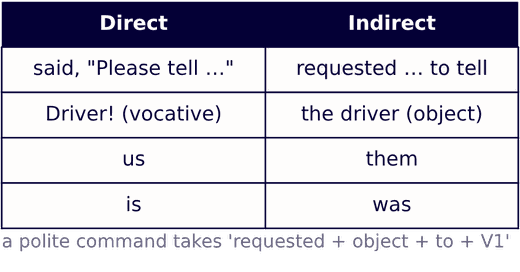
'Please tell us …' is a polite command, so in indirect speech the reporting verb becomes 'requested' and the command changes into a to-infinitive.
The vocative 'Driver!' becomes the object of the reporting verb, giving 'requested the driver'.
'Please' is already carried by 'requested' and is therefore dropped, the pronoun 'us' becomes 'them', and the present 'is' back-shifts to 'was' after a past reporting verb.
This gives: The police requested the driver to tell them who was inside the car.
Option (b) retains 'please', option (c) keeps the present tense 'is', and option (d) uses 'told' with a wrong tense, so option (a) is correct.
10
Select the most appropriate antonym of the word:
Paucity
A.Meagreness
B.Deficiency
C.Scarcity
D.Plenitude
Solution
Antonym
Paucity means smallness of number or quantity — a shortage of something.
Plenitude means abundance or a full supply, so it is the direct opposite.
Meagreness, deficiency and scarcity all repeat the idea of shortage, which makes them synonyms of paucity, not antonyms.
11
Select the part of the sentence that contains a spelling error.
A. The wealthy man was
B. very surprised to find
C. a rare silver coin in
D. his daily possesion.
A.A
B.B
C.C
D.D
Solution
Spelling error
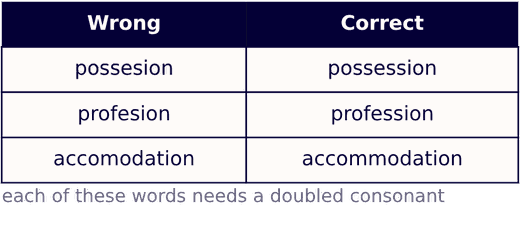
Part D reads 'his daily possesion', and 'possesion' is misspelt.
The correct spelling is 'possession', which carries a double 's' twice — pos-ses-sion.
'wealthy' in part A, 'surprised' in part B and 'silver' in part C are all correct, so the error lies in part D.
12
Change the following sentence into the Active form.
Let the software's instructions be carefully reviewed by the user before installation.
A.The user carefully reviews the software's instructions before installation.
B.The user should carefully review the software's instructions before installation.
C.Carefully review the software's instructions before installation.
D.Let the user carefully review the software's instructions before installation.
Solution
Active voice of imperative
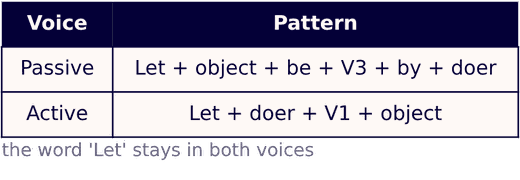
'Let + object + be + past participle' is the passive form of an imperative sentence built on 'Let'.
Its active form is 'Let + doer + bare infinitive + object', so the agent 'the user' moves in front of the verb and 'by' is dropped.
The object 'the software's instructions' then follows the verb: Let the user carefully review the software's instructions before installation.
Options (a) and (b) turn the imperative into an ordinary assertive sentence, and option (c) drops both 'Let' and the doer, so only option (d) keeps the sentence type intact.
13
Choose the most suitable option to replace the highlighted part of the sentence:Ten thousand dollars are the price of the high-end digital workstation.
A.Ten thousand dollars were the price
B.Ten thousand dollars is the price
C.Ten thousand dollar is the prices
D.Ten thousand dollars are being the price
Solution
Subject-verb agreement
A plural noun of money, time, distance or weight takes a singular verb when it is thought of as one single amount.
'Ten thousand dollars' here is one price — a single sum — so the verb must be 'is', not 'are'.
The corrected sentence reads: Ten thousand dollars is the price of the high-end digital workstation.
Option (a) shifts the tense to the past without reason, (c) wrongly makes 'dollar' singular and 'prices' plural, and (d) uses an impossible continuous form, so option (b) is correct.
14
Choose the correct passive voice transformation of the sentence:
The tech company has launched a mobile application.
A.A mobile application was launched by the tech company.
B.A mobile application is being launched by the tech company.
C.A mobile application has been launched by the tech company.
D.A mobile application had been launched by the tech company.
Solution
Present perfect passive
The active sentence is in the present perfect tense: 'has launched'.
The passive of the present perfect is formed as 'has/have been + past participle'.
The object 'a mobile application' becomes the subject and the doer takes 'by': A mobile application has been launched by the tech company.
Options (a), (b) and (d) shift the sentence to the simple past, the present continuous and the past perfect, so the tense no longer matches the original.
15
Select the option that expresses the given sentence in direct voice. His father told him that he would not sell the house
A.His father said to him, "He would not sell the house."
B.His father said to him, "I will not sell the house."
C.His father said to him, 'I would not sell the house."
D.His father said to him, "I should not sell the house."
Solution
Direct narration
To move back to direct speech the exact words of the speaker are restored: 'that' is removed and inverted commas are used.
The reported pronoun 'he' stands for the speaker himself — the father — so in his own words it becomes 'I'.
'Would' in indirect speech is the back-shifted form of 'will', so it returns to 'will', and the reporting verb 'told him' becomes 'said to him'.
This gives: His father said to him, "I will not sell the house."
Option (a) keeps the third-person 'He', while options (c) and (d) keep 'would' and use 'should', so option (b) is correct.
16
Directions (Qs. 16-20): Read the following passage carefully and answer the questions that follow.
In the modern era, a state's economic vitality depends less on its hoard of gold and more on its fiscal deficit management. When a government's developmental ambitions exceed its immediate liquidity, it must subsume various departmental budgets into a centralized master plan to ensure that limited resources are not wasted on redundant administrative costs. By consolidating these fragmented outlays, the state can direct massive capital toward "nation-building" projects like semiconductor hubs or green energy grids.
To fund these gargantuan ventures, the government often issues sovereign bonds, ostensibly to invite public participation in national growth. While these instruments are presented as a way for citizens to earn safe returns, their primary function is to bridge the gap between revenue and expenditure without triggering hyperinflation. However, this reliance on credit creates a delicate tension; if the state borrows too aggressively, it risks "crowding out" private players by absorbing the lion's share of available market capital.
Ultimately, the goal is to shift the balance from "Revenue Expenditure"-the recurring costs of running a bureaucracy-toward *Capital Expenditure." This transition ensures that the debt incurred today creates the infrastructure of tomorrow. Success in this arena requires more than just efficient collection; it demands a visionary framework where every borrowed rupee is transformed into a productive asset.
The clause "where every borrowed rupee is transformed into a productive asset" is:
A.Adverbial clause of time
B.Adjective clause
C.Noun clause
D.Adverbial clause of condition
Solution
Type of clause
In the passage the clause follows a noun: 'a visionary framework where every borrowed rupee is transformed into a productive asset'.
A clause that comes after a noun and tells us which kind of noun is meant does the work of an adjective, so it is an adjective (relative) clause.
Here 'where' is a relative adverb standing for 'in which framework', which confirms that the clause describes 'framework'.
It is not adverbial, because it does not tell us when the action happens or on what condition, and it is not a noun clause, because it cannot itself work as the subject or object of the sentence.
17
Directions (Qs. 16-20): Read the following passage carefully and answer the questions that follow.
In the modern era, a state's economic vitality depends less on its hoard of gold and more on its fiscal deficit management. When a government's developmental ambitions exceed its immediate liquidity, it must subsume various departmental budgets into a centralized master plan to ensure that limited resources are not wasted on redundant administrative costs. By consolidating these fragmented outlays, the state can direct massive capital toward "nation-building" projects like semiconductor hubs or green energy grids.
To fund these gargantuan ventures, the government often issues sovereign bonds, ostensibly to invite public participation in national growth. While these instruments are presented as a way for citizens to earn safe returns, their primary function is to bridge the gap between revenue and expenditure without triggering hyperinflation. However, this reliance on credit creates a delicate tension; if the state borrows too aggressively, it risks "crowding out" private players by absorbing the lion's share of available market capital.
Ultimately, the goal is to shift the balance from "Revenue Expenditure"-the recurring costs of running a bureaucracy-toward *Capital Expenditure." This transition ensures that the debt incurred today creates the infrastructure of tomorrow. Success in this arena requires more than just efficient collection; it demands a visionary framework where every borrowed rupee is transformed into a productive asset.
Rewrite the following sentence by converting it to an Interrogative Negative sentence:
"The state can direct massive capital toward nation-building projects.'
A.Can the state direct massive capital toward nation-building projects?
B.The state cannot direct massive capital toward nation-building projects, can it?
C.Can't the state direct massive capital toward nation-building projects?
D.Does the state direct massive capital toward nation-building projects?
Solution
Interrogative negative
An interrogative negative sentence asks a question and carries a negative word at the same time.
Its pattern is: helping verb or modal + not (usually contracted) + subject + main verb + object?
Here the modal 'can' joins 'not' to form "Can't" and moves in front of the subject 'the state', giving: Can't the state direct massive capital toward nation-building projects?
Option (a) is a plain question with no negative, option (b) is a question tag, and option (d) replaces the modal with 'does', so option (c) is correct.
18
Directions (Qs. 16-20): Read the following passage carefully and answer the questions that follow.
In the modern era, a state's economic vitality depends less on its hoard of gold and more on its fiscal deficit management. When a government's developmental ambitions exceed its immediate liquidity, it must subsume various departmental budgets into a centralized master plan to ensure that limited resources are not wasted on redundant administrative costs. By consolidating these fragmented outlays, the state can direct massive capital toward "nation-building" projects like semiconductor hubs or green energy grids.
To fund these gargantuan ventures, the government often issues sovereign bonds, ostensibly to invite public participation in national growth. While these instruments are presented as a way for citizens to earn safe returns, their primary function is to bridge the gap between revenue and expenditure without triggering hyperinflation. However, this reliance on credit creates a delicate tension; if the state borrows too aggressively, it risks "crowding out" private players by absorbing the lion's share of available market capital.
Ultimately, the goal is to shift the balance from "Revenue Expenditure"-the recurring costs of running a bureaucracy-toward *Capital Expenditure." This transition ensures that the debt incurred today creates the infrastructure of tomorrow. Success in this arena requires more than just efficient collection; it demands a visionary framework where every borrowed rupee is transformed into a productive asset.
Which word from the passage means appearing to be one thing but it is something else ?
A.Fraudulently
B.Ostensibly
C.Explicitly
D.Legally
Solution
Vocabulary from passage
The clue is 'appearing to be one thing but actually being something else' — a surface appearance that hides the real purpose.
The passage says the government issues bonds 'ostensibly to invite public participation in national growth', and then reveals that their primary function is to bridge the revenue gap.
'Ostensibly' therefore means apparently or seemingly, though the truth is different.
'Fraudulently' implies deliberate cheating, 'explicitly' means clearly and openly stated, and 'legally' refers to the law, so none of them carries this sense of appearance against reality.
19
Directions (Qs. 16-20): Read the following passage carefully and answer the questions that follow.
In the modern era, a state's economic vitality depends less on its hoard of gold and more on its fiscal deficit management. When a government's developmental ambitions exceed its immediate liquidity, it must subsume various departmental budgets into a centralized master plan to ensure that limited resources are not wasted on redundant administrative costs. By consolidating these fragmented outlays, the state can direct massive capital toward "nation-building" projects like semiconductor hubs or green energy grids.
To fund these gargantuan ventures, the government often issues sovereign bonds, ostensibly to invite public participation in national growth. While these instruments are presented as a way for citizens to earn safe returns, their primary function is to bridge the gap between revenue and expenditure without triggering hyperinflation. However, this reliance on credit creates a delicate tension; if the state borrows too aggressively, it risks "crowding out" private players by absorbing the lion's share of available market capital.
Ultimately, the goal is to shift the balance from "Revenue Expenditure"-the recurring costs of running a bureaucracy-toward *Capital Expenditure." This transition ensures that the debt incurred today creates the infrastructure of tomorrow. Success in this arena requires more than just efficient collection; it demands a visionary framework where every borrowed rupee is transformed into a productive asset.
What is the meaning of the word "subsume" as used in the passage?
A.To divide into smaller units
B.To exhaust a supply
C.To include or absorb into something larger
D.To calculate a total
Solution
Word meaning in context
The passage says a government 'must subsume various departmental budgets into a centralized master plan'.
Many smaller budgets are being taken up into one larger plan, so 'subsume' means to include or absorb something into a bigger whole.
The very next sentence confirms this by calling the same act 'consolidating these fragmented outlays'.
Dividing into smaller units is the reverse process, exhausting a supply is about using something up, and calculating a total is mere arithmetic, so options (a), (b) and (d) are ruled out.
20
Directions (Qs. 16-20): Read the following passage carefully and answer the questions that follow.
In the modern era, a state's economic vitality depends less on its hoard of gold and more on its fiscal deficit management. When a government's developmental ambitions exceed its immediate liquidity, it must subsume various departmental budgets into a centralized master plan to ensure that limited resources are not wasted on redundant administrative costs. By consolidating these fragmented outlays, the state can direct massive capital toward "nation-building" projects like semiconductor hubs or green energy grids.
To fund these gargantuan ventures, the government often issues sovereign bonds, ostensibly to invite public participation in national growth. While these instruments are presented as a way for citizens to earn safe returns, their primary function is to bridge the gap between revenue and expenditure without triggering hyperinflation. However, this reliance on credit creates a delicate tension; if the state borrows too aggressively, it risks "crowding out" private players by absorbing the lion's share of available market capital.
Ultimately, the goal is to shift the balance from "Revenue Expenditure"-the recurring costs of running a bureaucracy-toward *Capital Expenditure." This transition ensures that the debt incurred today creates the infrastructure of tomorrow. Success in this arena requires more than just efficient collection; it demands a visionary framework where every borrowed rupee is transformed into a productive asset.
According to the passage, what is the primary risk of aggressive government borrowing ?
A.It causes a decrease in the national population.
B.It leads to "crowding out" by reducing available capital for private investors.
C.It results in a surplus of revenue expenditure.
D.It forces the government to eliminate all sovereign bonds.
Solution
Reading comprehension
The second paragraph warns that if the state borrows too aggressively, it risks 'crowding out' private players by absorbing the lion's share of available market capital.
Heavy government borrowing soaks up the money available in the market, so private investors are left with far less capital — this is exactly the 'crowding out' effect.
The passage says nothing about the population, it treats revenue expenditure as something to be reduced rather than as a surplus, and it never suggests doing away with sovereign bonds.
21
Rearrange the following sentence parts to form a meaningful and grammatically correct paragraph:
P. It is a mind that sees the world as a finished product, something that has happened and is over.
Q. There are two types of mind in this world, and they differ profoundly in their outlook.
R. It is the legal and conservative type of mind, which looks back toward the past for its guidance and its authority.
S. The first type of mind I will call the retrospective or submissive mind.
A.QSRP
B.QSPR
C.SQRP
D.QSPR
Solution
Para-jumble: sentence order
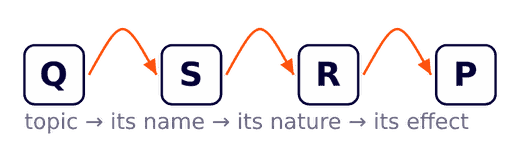
Q is the opening part: it introduces the subject of the whole paragraph — that there are two types of mind and that they differ profoundly.
S must come next, because it names the first of those two types: 'the retrospective or submissive mind'.
R and P both begin with 'It is …', so both describe that first type; R comes before P because 'looks back toward the past' explains the word 'retrospective' that S has just introduced.
P then adds what follows from that backward look — such a mind treats the world as a finished product.
The correct order is QSRP, so option (a) is correct.
22
Rearrange the following sentence parts to form a meaningful and grammatically correct paragraph:
P. She organized her ideas into a clear draft, typing steadily on her laptop.
Q. She carefully entered the complete contact address of the recipient in the address bar.
R. A brief subject line clearly conveyed the purpose of the message.
S. She felt relieved after clicking the submit button and watching the message get delivered.
A.Q, R, P, S
B.P, Q, S, R
C.S, Q, P, R
D.Q, S, R, P
Solution
Para-jumble: sentence order
The paragraph describes, step by step, how a message is composed and sent.
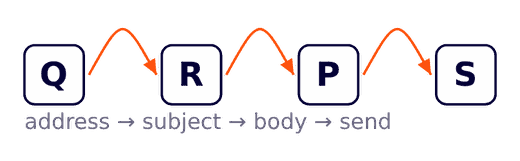
Q is first: the recipient's complete address is entered in the address bar — nothing can be sent before that.
R follows: after the address comes the subject line, which states the purpose of the message.
P then covers the body — she organises her ideas into a clear draft on her laptop.
S is the natural close: she clicks the submit button and feels relieved as the message is delivered.
The order is Q, R, P, S, so option (a) is correct.
23
Rearrange the following sentences to form a meaningful and grammatically correct paragraph:
P. He completed the move smoothly, holding his balance firmly at the end.
Q. He leapt into the air, rotating swiftly before preparing for the landing.
R. He sprinted down the track to build momentum for the jump.
S. After an impressive display, he acknowledged the officials and spectators with a confident nod,
A.R, Q, P, S
B.Q, R, P, S
C.R, P, Q, S
D.S, Q, P, R
Solution
Para-jumble: sentence order
The paragraph narrates a single athletic jump in the order in which it actually happens.
R begins the action: he sprints down the track to build the momentum needed for the jump.
Q follows: carrying that momentum he leaps into the air and rotates before the landing.
P comes next: the move is completed and the balance held firmly at the end.
S closes the account: after the display is over he acknowledges the officials and the spectators.
The order is R, Q, P, S, so option (a) is correct.
24
Which of the following pairs of homophones can be used to fill in the blanks most suitably?
'The explorer realized that his long journey would be for if he did find the hidden valley before the winter snows arrived."
A.council, counsel
B.discrete, discreet
C.naught, not
D.weather, whether
Solution
Homophones: naught / not
The two blanks must be filled by a pair of homophones — words that sound alike but differ in spelling and meaning.
The first blank follows 'would be for', a phrase completed by 'naught', which means 'nothing'; 'to be for naught' = to be in vain.
The second blank sits inside 'if he did ____ find', where the negative particle 'not' is required.
'Naught' and 'not' are pronounced alike, and together they give a sensible sentence: '… his long journey would be for naught if he did not find the hidden valley.'
'Council/counsel', 'discrete/discreet' and 'weather/whether' are genuine homophone pairs as well, but none of them yields any meaning in these particular blanks.
Hence, option (c) is correct.
25
Which of the following words refers to the act of inventing false information in order to deceive someone.
A.Fabrication
B.Vilification
C.Desecration
D.Blasphemy
Solution
One-word substitution
The definition asked for has two parts — making up something false, and doing it in order to deceive.
'Fabrication' is exactly that: the act of inventing false information or evidence so as to mislead someone.
'Vilification' is speaking ill of someone to damage their reputation — the statements may even be true, so invention is not essential to it.
'Desecration' is the violation of something sacred, and 'Blasphemy' is speaking irreverently of God or holy things; neither involves inventing false information.
Hence, option (a) is correct.
Finished reading? Now test yourself.
The same 25 questions, but with a timer and the answers hidden — 15 minutes.

 'Back to the drawing board' means starting all over again after a failure, which contradicts 'breakthrough'; the other two idioms describe a mistaken approach and a risky position.
Hence option (b) is correct.
'Back to the drawing board' means starting all over again after a failure, which contradicts 'breakthrough'; the other two idioms describe a mistaken approach and a risky position.
Hence option (b) is correct.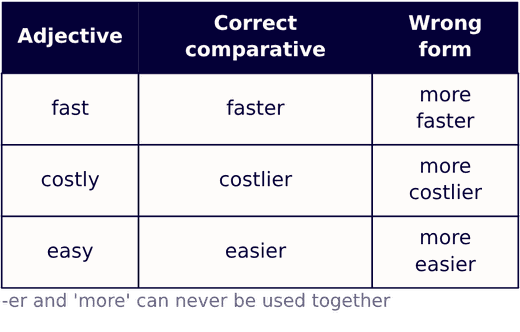 The correct wording is 'much faster', so the error lies in part B.
'much' before a comparative is perfectly acceptable, and parts A, C and D contain no error.
The correct wording is 'much faster', so the error lies in part B.
'much' before a comparative is perfectly acceptable, and parts A, C and D contain no error.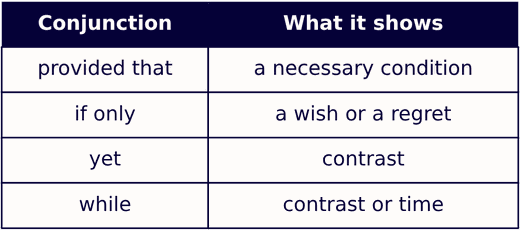 'Yet' and 'while' express contrast, and 'if only' expresses a wish or a regret ('If only I had known'), so none of them states a condition.
Hence option (c) is correct.
'Yet' and 'while' express contrast, and 'if only' expresses a wish or a regret ('If only I had known'), so none of them states a condition.
Hence option (c) is correct.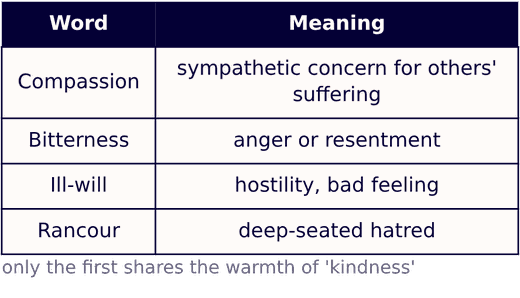 Bitterness, ill-will and rancour all describe resentment or hostility, so they are antonyms of kindness rather than synonyms.
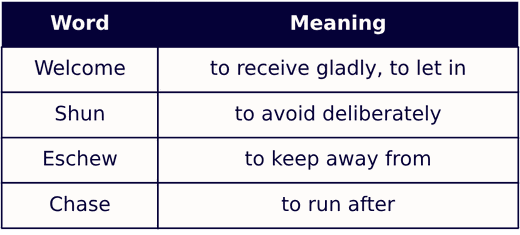 Shun and eschew both mean to keep away from something deliberately, and chase means to run after — all of these move in the opposite direction.
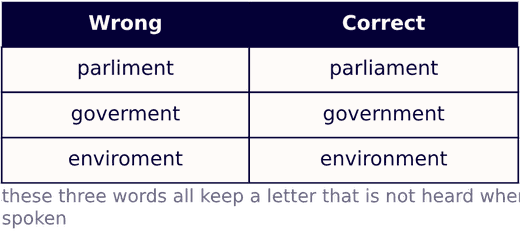 'supporters' in part A, 'stood aside' in part C and 'price' in part D are all spelt correctly, so the error is in part B.
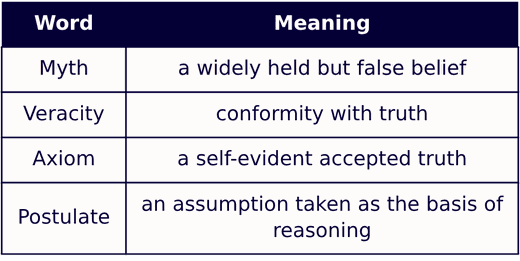 Veracity means truthfulness, while an axiom and a postulate are statements accepted as true for the sake of reasoning, so all three stand for truth rather than falsehood.
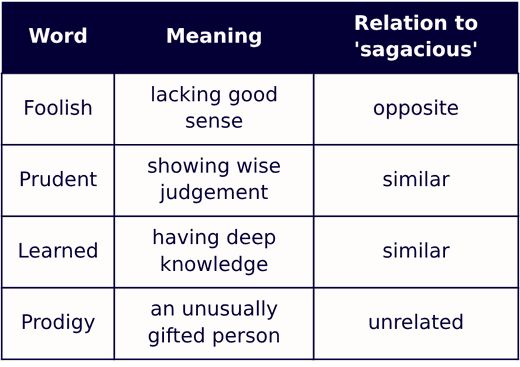 Prudent and learned are close in meaning to sagacious, and a prodigy is an exceptionally gifted person, so none of them can be the antonym.
 This gives: The police requested the driver to tell them who was inside the car.
Option (b) retains 'please', option (c) keeps the present tense 'is', and option (d) uses 'told' with a wrong tense, so option (a) is correct.
This gives: The police requested the driver to tell them who was inside the car.
Option (b) retains 'please', option (c) keeps the present tense 'is', and option (d) uses 'told' with a wrong tense, so option (a) is correct.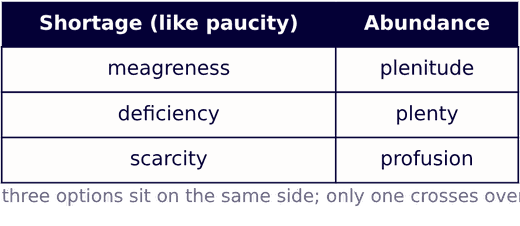 Meagreness, deficiency and scarcity all repeat the idea of shortage, which makes them synonyms of paucity, not antonyms.
 'wealthy' in part A, 'surprised' in part B and 'silver' in part C are all correct, so the error lies in part D.
 The object 'the software's instructions' then follows the verb: Let the user carefully review the software's instructions before installation.
Options (a) and (b) turn the imperative into an ordinary assertive sentence, and option (c) drops both 'Let' and the doer, so only option (d) keeps the sentence type intact.
The object 'the software's instructions' then follows the verb: Let the user carefully review the software's instructions before installation.
Options (a) and (b) turn the imperative into an ordinary assertive sentence, and option (c) drops both 'Let' and the doer, so only option (d) keeps the sentence type intact.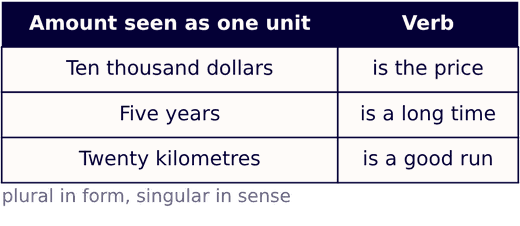 The corrected sentence reads: Ten thousand dollars is the price of the high-end digital workstation.
Option (a) shifts the tense to the past without reason, (c) wrongly makes 'dollar' singular and 'prices' plural, and (d) uses an impossible continuous form, so option (b) is correct.
The corrected sentence reads: Ten thousand dollars is the price of the high-end digital workstation.
Option (a) shifts the tense to the past without reason, (c) wrongly makes 'dollar' singular and 'prices' plural, and (d) uses an impossible continuous form, so option (b) is correct.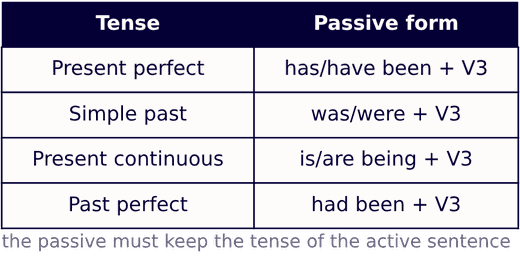 The object 'a mobile application' becomes the subject and the doer takes 'by': A mobile application has been launched by the tech company.
Options (a), (b) and (d) shift the sentence to the simple past, the present continuous and the past perfect, so the tense no longer matches the original.
The object 'a mobile application' becomes the subject and the doer takes 'by': A mobile application has been launched by the tech company.
Options (a), (b) and (d) shift the sentence to the simple past, the present continuous and the past perfect, so the tense no longer matches the original.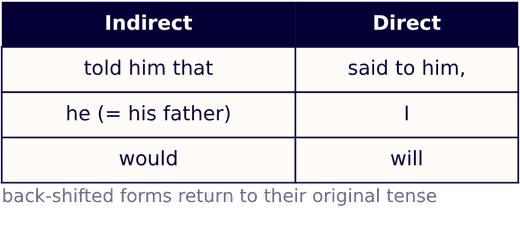 This gives: His father said to him, "I will not sell the house."
Option (a) keeps the third-person 'He', while options (c) and (d) keep 'would' and use 'should', so option (b) is correct.
This gives: His father said to him, "I will not sell the house."
Option (a) keeps the third-person 'He', while options (c) and (d) keep 'would' and use 'should', so option (b) is correct.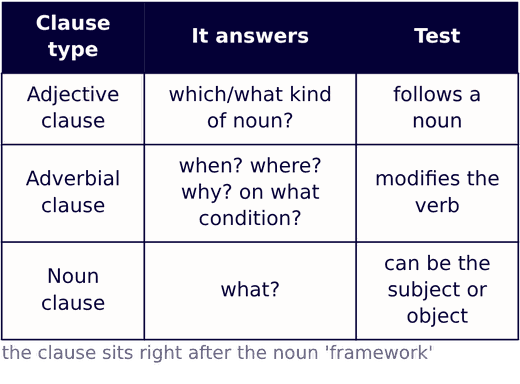 Here 'where' is a relative adverb standing for 'in which framework', which confirms that the clause describes 'framework'.
It is not adverbial, because it does not tell us when the action happens or on what condition, and it is not a noun clause, because it cannot itself work as the subject or object of the sentence.
Here 'where' is a relative adverb standing for 'in which framework', which confirms that the clause describes 'framework'.
It is not adverbial, because it does not tell us when the action happens or on what condition, and it is not a noun clause, because it cannot itself work as the subject or object of the sentence.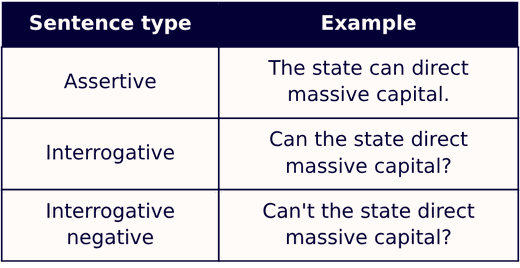 Here the modal 'can' joins 'not' to form "Can't" and moves in front of the subject 'the state', giving: Can't the state direct massive capital toward nation-building projects?
Option (a) is a plain question with no negative, option (b) is a question tag, and option (d) replaces the modal with 'does', so option (c) is correct.
Here the modal 'can' joins 'not' to form "Can't" and moves in front of the subject 'the state', giving: Can't the state direct massive capital toward nation-building projects?
Option (a) is a plain question with no negative, option (b) is a question tag, and option (d) replaces the modal with 'does', so option (c) is correct.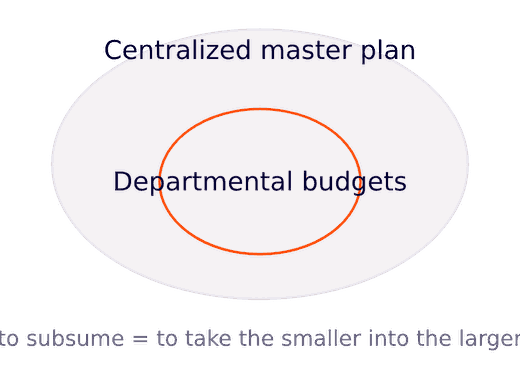 The very next sentence confirms this by calling the same act 'consolidating these fragmented outlays'.
Dividing into smaller units is the reverse process, exhausting a supply is about using something up, and calculating a total is mere arithmetic, so options (a), (b) and (d) are ruled out.
The very next sentence confirms this by calling the same act 'consolidating these fragmented outlays'.
Dividing into smaller units is the reverse process, exhausting a supply is about using something up, and calculating a total is mere arithmetic, so options (a), (b) and (d) are ruled out.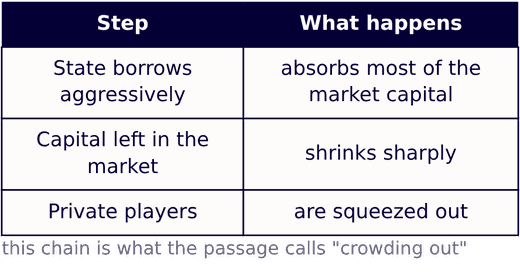 The passage says nothing about the population, it treats revenue expenditure as something to be reduced rather than as a surplus, and it never suggests doing away with sovereign bonds.
 The correct order is QSRP, so option (a) is correct.
 The order is Q, R, P, S, so option (a) is correct.
 The order is R, Q, P, S, so option (a) is correct.