SSC CHSL 26 November 2025 · Shift 2 · General Intelligence — questions with answers · ShikshaSphere
Chapter 145 of 200
26 November 2025 · Shift 2
General Intelligence
25 questions ~25 min readFree
25 questions
A
26
In a row, if is 15th from the left and 18th from the right, how many people are there in the row?
A.31
B.32
C.33
D.34
Solution
Position in a row
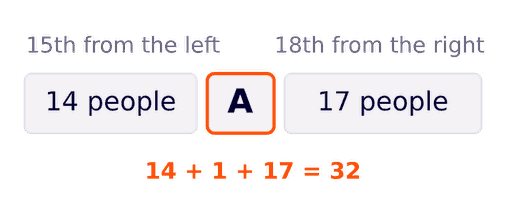
When a person's place is counted from both ends, that person gets counted twice, so 1 must be subtracted.
Formula: total = position from left + position from right -1.
Total =15+18-1=32.
So there are 32 people in the row, and option (b) is correct.
27
Introducing a man, a woman said, "His wife is the only daughter of my father." How is the man related to the woman?
A.Brother
B.Husband
C.Father
D.Uncle
Solution
Blood relation
'The only daughter of my father' is the woman herself, since she is her father's one and only daughter.
So the sentence really says: his wife is this very woman.
If the woman is the man's wife, the man is her husband, so option (b) is correct.
28
Read the following statements carefully and identify the conclusion that follows.Statements:
Some books are notebooks.
All notebooks are files.
Conclusions:
I. Some books are files.
II. No book is a file.
A.Only conclusion I follows.
B.Only conclusion II follows.
C.Both conclusions I and II follow.
D.Neither conclusion I nor II follows.
Solution
Syllogism
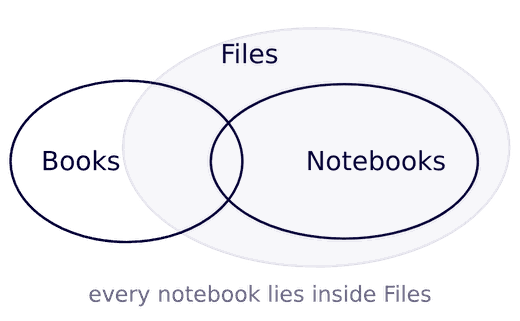
Statement 1 is a particular affirmative: at least one book is a notebook.
Statement 2 is a universal affirmative: every notebook lies inside the class of files.
Those books that are notebooks must therefore be files as well, so 'Some books are files' is certain - conclusion I follows.
Conclusion II claims that no book is a file, which directly contradicts what has just been proved, so it does not follow.
Only conclusion I follows, and option (a) is correct.
29
In a line of 35 bicycles, Bicycle P is 12th from the left and Bicycle Q is 15th from the right. How many bicycles are there between P and Q ?
A.6
B.7
C.8
D.9
Solution
Position in a row
First bring both positions to the same end. Position of Q from the left =35-15+1=21.
P is 12th from the left and Q is 21st from the left, so the bicycles strictly between them number 21-12-1=8.
Hence option (c) is correct.
30
There are 70 books arranged in a row on a shelf. Book A is 24th from the left and Book B is 21st from the right.How many books are there between A and B ?
A.23
B.24
C.25
D.26
Solution
Position in a row
Convert B's position to the left end: position of B from the left =70-21+1=50.
A is 24th from the left and B is 50th from the left.
Books lying between them =50-24-1=25.
Hence option (c) is correct.
31
A series is given with one term missing. Select the correct alternative from the given ones that will complete the series.
8, ?, 36, 75, 154, 313
A.15
B.16
C.17
D.18
Solution
Number series
Work with the terms that are given: , and .
So the rule is: double the term and add a number that grows by 1 at every step.
Running the rule backwards from 36, the missing term .
Check the first step: , which fits perfectly.
Hence the missing term is 17 and option (c) is correct.
32
A series is given with one term missing. Select the correct alternative from the given ones that will complete the series.
A.-132
B.-130
C.-128
D.-135
Solution
Number series
Take the differences between consecutive terms: -54-(-50)=-4, -64-(-54)=-10, -80-(-64)=-16 and -102-(-80)=-22.
The differences -4,-10,-16,-22 each fall by 6.
So the next difference is -22-6=-28, which gives the missing term =-102-28=-130.
Check onwards: -130-34=-164 and -164-40=-204, exactly the terms that follow.
Hence option (b) is correct.
33
A series is given with one term missing. Select the correct alternative from the given ones that will complete the series.
12, 29, 64, 135, 275, 556, ?
A.1112
B.1119
C.1120
D.1124
Solution
Number series
Test the rule 'double and add': and 29-24=5.
and 64-58=6; and 135-128=7.
and 275-270=5; and 556-550=6.
So the number added repeats in the cycle 5, 6, 7.
The next addition is therefore 7, giving the missing term .
Hence option (b) is correct.
34
If and , then what is the value of 20 # 9 ?
A.850
B.900
C.800
D.950
Solution
Symbol operation
Find what the symbol # does to the two numbers standing on either side of it.
and , so the product has been multiplied by 5.
Check with the second pair: , exactly the value given.
So , which gives .
Hence option (b) is correct.
35
If and , then what is the value of 745 $ 336; 14 ?
A.711
B.721
C.731
D.715
Solution
Symbol operation
Look for a rule that links the three numbers to the value on the right.
In the first case and 500-20=480, which is the value given.
In the second case and 920-18=902, so the same rule holds.
The rule is therefore: first number - (second number third number).
So the required value , and option (b) is correct.
36
In this type of questions, question is provided with substitutes for various mathematical symbols, followed by a question involving calculation of an expression or choosing the correct/incorrect equation. You have to put the real signs in the given equation and then solve the questions as required. If '%' stands for '÷', '! stands for '+', '?' stands for ' - ', '#' stands for ' ', then find the value of:
16 # 4 % 2 ! 7 = ?
A.36
B.38
C.37
D.39
Solution
Symbol substitution
Put the real sign in place of each symbol: # becomes , % becomes and ! becomes +.
The expression becomes .
By BODMAS, and are done from left to right: , then .
Finally add: 32+7=39.
Hence option (d) is correct.
37
In the question below there are three statements followed by two conclusions I and II. You have to take the three given statements to be true even if they seem to be at variance from commonly known facts and then decide which of the given conclusions logically follows from the three statements disregarding commonly known facts.Statements:
All Flowers are Beautiful.
Some Flowers are Red.
No Red is Artificial.
Conclusions:
I. Some Beautiful are Red.
II. Some Flowers are not Artificial.
A.Only conclusion I follows
B.Only conclusion II follows
C.Both conclusions I and II follow
D.Neither conclusion I nor conclusion II follows
Solution
Syllogism
'Some Flowers are Red' guarantees at least one thing that is a Flower and Red at the same time.
'All Flowers are Beautiful' places that thing inside Beautiful as well, so it is Beautiful and Red together - conclusion I follows.
'No Red is Artificial' keeps every Red thing outside Artificial, so those Red flowers cannot be Artificial.
That means at least some Flowers are not Artificial - conclusion II follows too.
Both conclusions follow, so option (c) is correct.
38
Six boxes A, B, C, D, E, and F are stacked one above the other (the bottom box is 1 and the top box is 6 ). Three boxes are placed between A and B. B is placed immediately below C , and C is not the top box. is placed immediately above E, and F is placed below E. How many boxes are placed between A and C?
A.1
B.2
C.3
D.0
Solution
Stack arrangement
Number the places 1 (bottom) to 6 (top). Three boxes between A and B means their places differ by 4, so the pair of places is (1, 5) or (2, 6).
B is immediately below C, that is C=B+1, and C is not at place 6.
If B were at 5, C would be at 6, which is not allowed; if B were at 1, then A is at 5 and C at 2, leaving 3, 4, 6 for D, E, F - and D=E+1 forces E at 3, D at 4 and F at 6, which contradicts 'F is below E'.
So B is at 2, C at 3 and A at 6. Places 1, 4, 5 are left; D=E+1 puts E at 4 and D at 5, and F takes place 1, correctly below E.
A stands at place 6 and C at place 3, so the boxes at places 4 and 5 lie between them - that is 2 boxes.
Hence option (b) is correct.
39
Select the letter cluster from among the given options that can replace the question mark (?) in the following series.
GZM, JXR, ?, PTB, SRG
A.MVW
B.MUW
C.NVW
D.MVX
Solution
Letter cluster series
Split each cluster into its three letter positions and track the positions separately.
First letters G, J, ?, P, S move +3 each time, so the missing first letter is J+3=M.
Second letters Z, X, ?, T, R move -2 each time, so the missing second letter is X-2=V.
Third letters M, R, ?, B, G move +5 each time (after Z the count starts again at A), so the missing third letter is R+5=W.
The cluster is therefore MVW, so option (a) is correct.
40
The weights of 5 boxes A, B, C, D, and E are compared. No two boxes have the same weight. C is heavier than only 3 boxes. A and B are lighter than D. E is heavier than D. If C weighs 50 kg, what is the possible weight of ?
A.60 kg
B.55 kg
C.42 kg
D.65 kg
Solution
Ranking by weight
'C is heavier than only 3 boxes' means exactly 3 boxes are lighter than C, so C is the 2nd heaviest of the five.
A and B are lighter than D and E is heavier than D, so E>D>A,B.
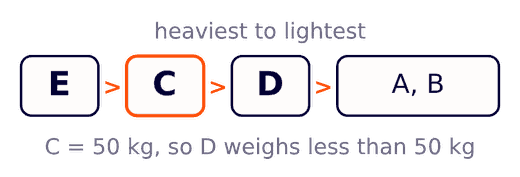
The only box that can stand above C is E, which gives the full order E>C>D>A,B.
So D is lighter than C, that is, D weighs less than 50 kg.
Among the options only 42 kg is below 50 kg, so option (c) is correct.
41
6 persons P, Q, R, S, T and U are sitting in a row facing north. S is to the immediate right of T. R is the immediate neighbour of Q and is not at any of the ends. U is at the extreme right end. Who is at the extreme left end?
A.T
B.Q
C.P
D.S
Solution
Linear seating arrangement
U is at the extreme right end, so seat 6 is fixed for U.
R is an immediate neighbour of both Q and S, so R sits between them: the block is either Q – R – S or S – R – Q.
S is immediately to the right of T, so T must sit just left of S; in Q – R – S the seat left of S is taken by R, so only S – R – Q works, giving the block T – S – R – Q.
P is not at either end, so P cannot take seat 1; the four-seat block must therefore fill seats 1 to 4 and P takes seat 5.
The row is T, S, R, Q, P, U, so T is at the extreme left end and option (a) is correct.
42
8 boys P, Q, R, S, T, U, V and W are sitting in a row facing south. W and P are at the extreme ends of the row. R and S are immediate neighbors of . is to the immediate right of W. V is third to the right of is not the immediate neighbor of R. How many boys are sitting between S and V ?
A.2
B.4
C.3
D.1
Solution
Linear seating arrangement
Number the eight seats 1 to 8 in the direction of the boys' own right, so 'immediate right' always means the next higher seat number.
S is to the immediate right of W, so W cannot be in seat 8; W takes seat 1 and S seat 2, and P, who is at the other end, takes seat 8.
R and S are both immediate neighbours of Q, so Q sits between them; S is in seat 2, hence Q is in seat 3 and R in seat 4.
V is third to the right of Q, so V is in seat 3+3=6.
Only seats 5 and 7 are left, for T and U; T is not an immediate neighbour of R (seat 4), so T cannot take seat 5 and must take seat 7, leaving seat 5 for U.
Between S (seat 2) and V (seat 6) sit Q, R and U, so 3 boys are sitting between them and option (c) is correct.
43
Some conditional data is provided to you in form of statement you have to check which of the following statement are logically inference from given statement.Statement: No athlete who fails the physical fitness test is allowed to participate in the National Games. Rohit participated in the National Games. What can we logically infer about Rohit's physical fitness test?
A.Rohit topped the physical fitness test.
B.Rohit did not fail the physical fitness test.
C.Rohit practiced for many months for the test.
D.Rohit was given a special exemption for the test.
Solution
Logical inference
The statement is a universal negative: failing the physical fitness test rules an athlete out of the National Games.
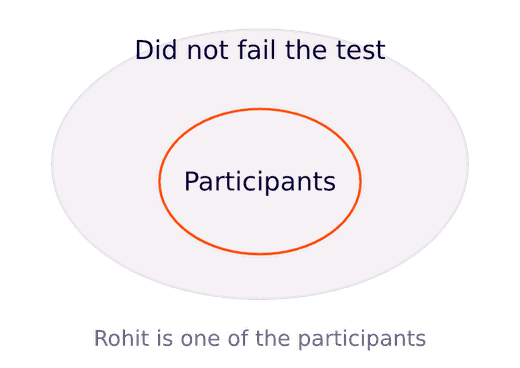
Turn it round (contrapositive): if a person did take part in the National Games, that person cannot have failed the test.
Rohit did participate, so the only thing that follows with certainty is that he did not fail the physical fitness test.
Topping the test, practising for months and receiving a special exemption are extra details that the statement never supplies, so none of them can be inferred; hence option (b) is correct.
44
After interchanging the given two numbers (not digits), what will be the value of the given equation ?
3 and 8
?
A.29
B.33
C.37
D.41
Solution
Interchange of numbers
The given equation is .
Only the two whole numbers 3 and 8 are swapped, so every 3 becomes 8 and every 8 becomes 3: .
Now apply BODMAS — division first, , then multiplication, .
The value is 40+3-6=37.
Hence option (c) is correct.
45
By interchanging the given two numbers (not digits) which of the following equation will NOT be correct ? 4 and 5 l. li.
A.Only I
B.Only II
C.Both I and II
D.Neither I nor II
Solution
Interchange of numbers
Swap the whole numbers 4 and 5 everywhere in each equation and then test it with BODMAS.
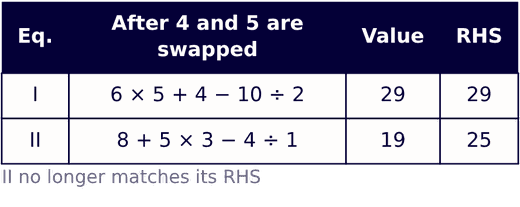
I. becomes .
Its value is 30+4-5=29, which is exactly the right-hand side, so equation I stays correct.
II. becomes .
Its value is 8+15-4=19, which is not 25, so equation II is not correct.
Only equation II fails after the interchange, so option (b) is correct.
46
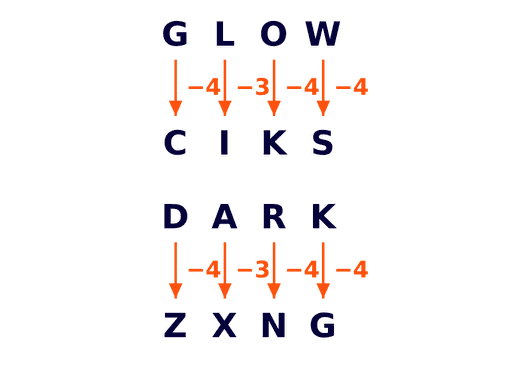
In a certain coded language 'GLOW' is coded as 'CIKS' and 'FISH' is coded as 'BFOD'. How will 'DARK' be coded in the same code language?
A.ZXNG
B.AXNG
C.ZXMF
D.AYNF
Solution
Letter coding-decoding
Write the alphabetical positions of GLOW and its code CIKS: G = 7, L = 12, O = 15, W = 23 and C = 3, I = 9, K = 11, S = 19.
The shifts are 7-3=4, 12-9=3, 15-11=4 and 23-19=4, i.e. the pattern −4, −3, −4, −4.
FISH → BFOD confirms the pattern: 6-4=2 (B), 9-3=6 (F), 19-4=15 (O), 8-4=4 (D).
Apply the same shifts to DARK: 4-4=0, which wraps round to 26, i.e. Z, and 1-3=-2, which wraps round to 24, i.e. X.
Then 18-4=14 gives N and 11-4=7 gives G, so DARK is coded as ZXNG and option (a) is correct.
47
In a certain coded language 'HEAD' is coded as 'CYVX' and 'MILK' is coded as 'HCGE'. How will 'PENT' be coded in the same code language?
A.KYIM
B.LZJN
C.KYIN
D.LXHM
Solution
Letter coding-decoding
Positions of HEAD and its code CYVX: H = 8, E = 5, A = 1, D = 4 and C = 3, Y = 25, V = 22, X = 24.
H → C is 8-5=3; E → Y is 5-6=-1, which wraps round to 25; A → V is 1-5=-4, which wraps round to 22; D → X is 4-6=-2, which wraps round to 24.
So the shifts run −5, −6, −5, −6, and MILK → HCGE confirms it: 13-5=8 (H), 9-6=3 (C), 12-5=7 (G), 11-6=5 (E).
For PENT, 16-5=11 gives K and 5-6=-1 wraps round to 25, i.e. Y.
Then 14-5=9 gives I and 20-6=14 gives N, so PENT is coded as KYIN and option (c) is correct.
48
A series is given with one term missing. Select the correct alternative from the given ones that will complete the series.
JS400, GP440, DM480, AJ520, ?
A.XG560
B.YG560
C.XH580
D.WH560
Solution
Alphanumeric series
Each term is two letters followed by a three-digit number, so treat the three parts separately.
The first letters are J, G, D, A — every step is three places back, so the next is 1-3=-2, which wraps round to 24, i.e. X.
The second letters are S, P, M, J — again three places back, so the next is 10-3=7, i.e. G.
The numbers 400, 440, 480, 520 rise by 40 each time, so the next is 520+40=560.
The missing term is therefore XG560, and option (a) is correct.
49
A series is given with one term missing. Select the correct alternative from the given ones that will complete the series.
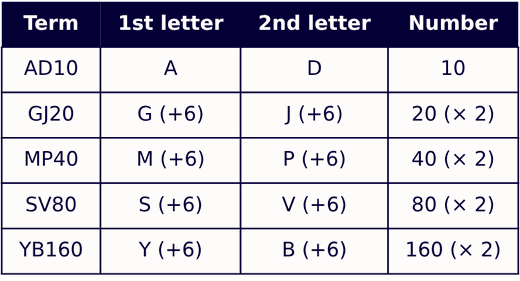
AD10, GJ20, MP40, SV80, ?
A.YB160
B.YC160
C.ZB140
D.YA120
Solution
Alphanumeric series
Split every term into its two letters and its number.
The first letters A, G, M, S each move six places forward, so the next is 19+6=25, i.e. Y.
The second letters D, J, P, V also move six places forward, so the next is 22+6=28, which wraps round to 28-26=2, i.e. B.
The numbers 10, 20, 40, 80 double each time, so the next is .
The missing term is YB160, so option (a) is correct.
50
A series is given with one term missing. Select the correct alternative from the given ones that will complete the series.
BE15, DG47, FI143, ?, JM1295
A.HK430
B.HL431
C.HM431
D.HK431
Solution
Alphanumeric series
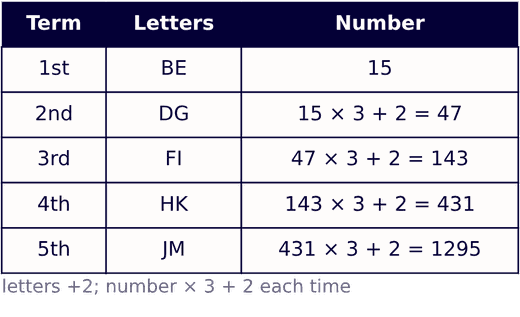
The first letters run B, D, F, ?, J and the second letters run E, G, I, ?, M — both move two places forward each time.
So the missing term begins with 6+2=8, i.e. H, followed by 9+2=11, i.e. K.
For the numbers, and , so each number is 3 times the previous one plus 2.
Hence the missing number is , and the check matches the last term.
The missing term is HK431, so option (d) is correct.
Finished reading? Now test yourself.
The same 25 questions, but with a timer and the answers hidden — 15 minutes.

 Total =15+18-1=32.
So there are 32 people in the row, and option (b) is correct.
Total =15+18-1=32.
So there are 32 people in the row, and option (b) is correct.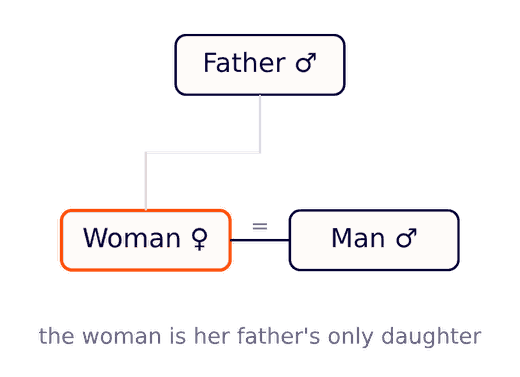 If the woman is the man's wife, the man is her husband, so option (b) is correct.
 Those books that are notebooks must therefore be files as well, so 'Some books are files' is certain - conclusion I follows.
Conclusion II claims that no book is a file, which directly contradicts what has just been proved, so it does not follow.
Only conclusion I follows, and option (a) is correct.
Those books that are notebooks must therefore be files as well, so 'Some books are files' is certain - conclusion I follows.
Conclusion II claims that no book is a file, which directly contradicts what has just been proved, so it does not follow.
Only conclusion I follows, and option (a) is correct.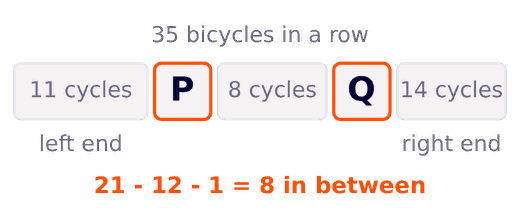 P is 12th from the left and Q is 21st from the left, so the bicycles strictly between them number 21-12-1=8.
Hence option (c) is correct.
P is 12th from the left and Q is 21st from the left, so the bicycles strictly between them number 21-12-1=8.
Hence option (c) is correct.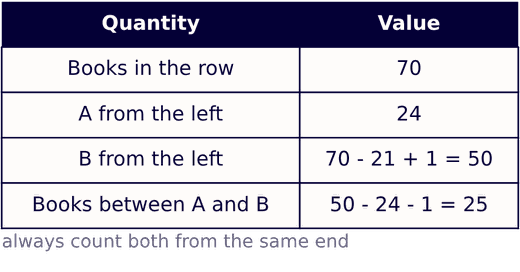 A is 24th from the left and B is 50th from the left.
Books lying between them =50-24-1=25.
Hence option (c) is correct.
A is 24th from the left and B is 50th from the left.
Books lying between them =50-24-1=25.
Hence option (c) is correct.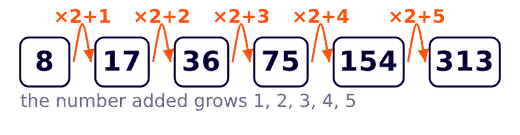 Check the first step: , which fits perfectly.
Hence the missing term is 17 and option (c) is correct.
Check the first step: , which fits perfectly.
Hence the missing term is 17 and option (c) is correct.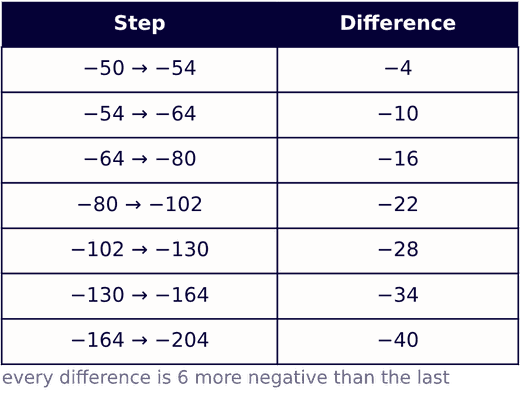 So the next difference is -22-6=-28, which gives the missing term =-102-28=-130.
Check onwards: -130-34=-164 and -164-40=-204, exactly the terms that follow.
Hence option (b) is correct.
So the next difference is -22-6=-28, which gives the missing term =-102-28=-130.
Check onwards: -130-34=-164 and -164-40=-204, exactly the terms that follow.
Hence option (b) is correct.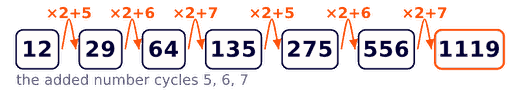 The next addition is therefore 7, giving the missing term .
Hence option (b) is correct.
The next addition is therefore 7, giving the missing term .
Hence option (b) is correct.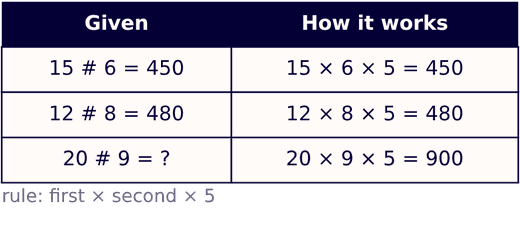 So , which gives .
Hence option (b) is correct.
So , which gives .
Hence option (b) is correct.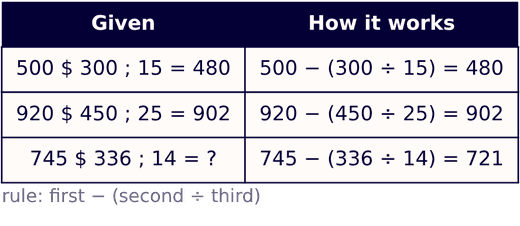 The rule is therefore: first number - (second number third number).
So the required value , and option (b) is correct.
The rule is therefore: first number - (second number third number).
So the required value , and option (b) is correct.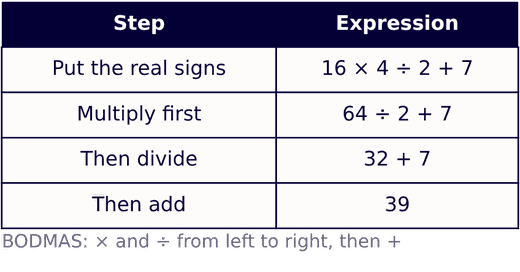 By BODMAS, and are done from left to right: , then .
Finally add: 32+7=39.
Hence option (d) is correct.
By BODMAS, and are done from left to right: , then .
Finally add: 32+7=39.
Hence option (d) is correct.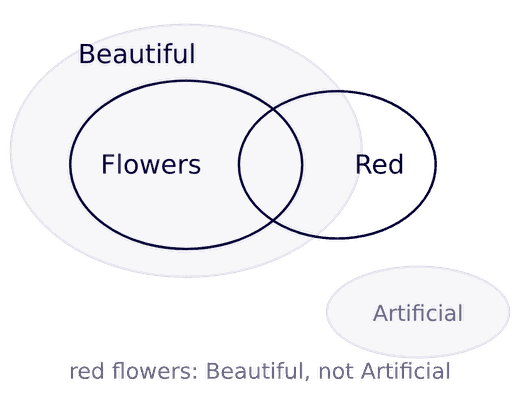 'No Red is Artificial' keeps every Red thing outside Artificial, so those Red flowers cannot be Artificial.
That means at least some Flowers are not Artificial - conclusion II follows too.
Both conclusions follow, so option (c) is correct.
'No Red is Artificial' keeps every Red thing outside Artificial, so those Red flowers cannot be Artificial.
That means at least some Flowers are not Artificial - conclusion II follows too.
Both conclusions follow, so option (c) is correct.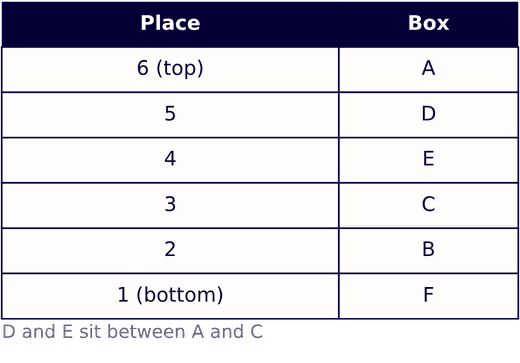 A stands at place 6 and C at place 3, so the boxes at places 4 and 5 lie between them - that is 2 boxes.
Hence option (b) is correct.
A stands at place 6 and C at place 3, so the boxes at places 4 and 5 lie between them - that is 2 boxes.
Hence option (b) is correct.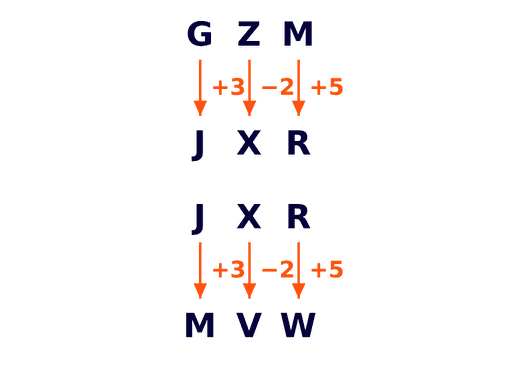 The cluster is therefore MVW, so option (a) is correct.
 So D is lighter than C, that is, D weighs less than 50 kg.
Among the options only 42 kg is below 50 kg, so option (c) is correct.
So D is lighter than C, that is, D weighs less than 50 kg.
Among the options only 42 kg is below 50 kg, so option (c) is correct.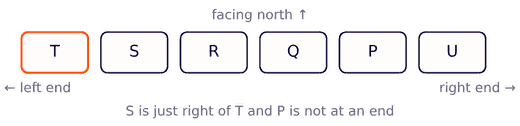 The row is T, S, R, Q, P, U, so T is at the extreme left end and option (a) is correct.
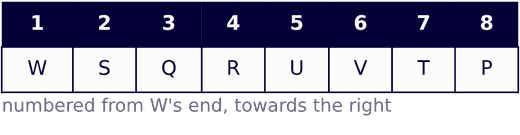 Between S (seat 2) and V (seat 6) sit Q, R and U, so 3 boys are sitting between them and option (c) is correct.
 Rohit did participate, so the only thing that follows with certainty is that he did not fail the physical fitness test.
Topping the test, practising for months and receiving a special exemption are extra details that the statement never supplies, so none of them can be inferred; hence option (b) is correct.
Rohit did participate, so the only thing that follows with certainty is that he did not fail the physical fitness test.
Topping the test, practising for months and receiving a special exemption are extra details that the statement never supplies, so none of them can be inferred; hence option (b) is correct.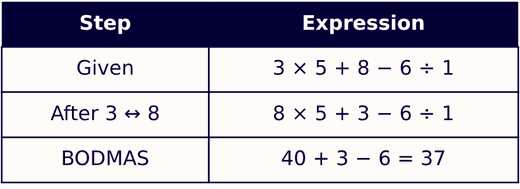 Hence option (c) is correct.
 Only equation II fails after the interchange, so option (b) is correct.
 Apply the same shifts to DARK: 4-4=0, which wraps round to 26, i.e. Z, and 1-3=-2, which wraps round to 24, i.e. X.
Then 18-4=14 gives N and 11-4=7 gives G, so DARK is coded as ZXNG and option (a) is correct.
Apply the same shifts to DARK: 4-4=0, which wraps round to 26, i.e. Z, and 1-3=-2, which wraps round to 24, i.e. X.
Then 18-4=14 gives N and 11-4=7 gives G, so DARK is coded as ZXNG and option (a) is correct.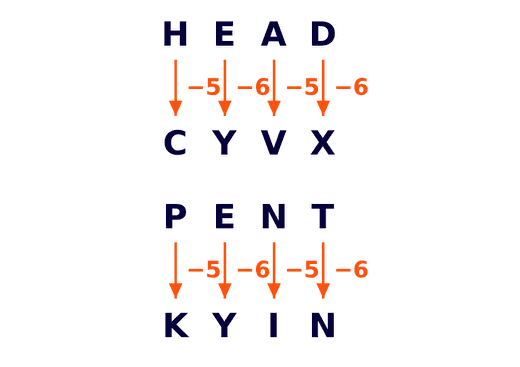 For PENT, 16-5=11 gives K and 5-6=-1 wraps round to 25, i.e. Y.
Then 14-5=9 gives I and 20-6=14 gives N, so PENT is coded as KYIN and option (c) is correct.
For PENT, 16-5=11 gives K and 5-6=-1 wraps round to 25, i.e. Y.
Then 14-5=9 gives I and 20-6=14 gives N, so PENT is coded as KYIN and option (c) is correct.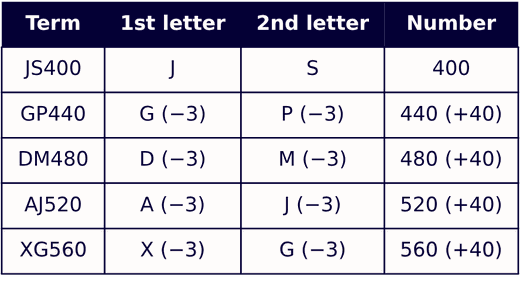 The missing term is therefore XG560, and option (a) is correct.
 The missing term is YB160, so option (a) is correct.
 The missing term is HK431, so option (d) is correct.