SSC CHSL 26 November 2025 · Shift 2 · English Language — questions with answers · ShikshaSphere
Chapter 148 of 200
26 November 2025 · Shift 2
English Language
25 questions ~25 min readFree
25 questions
A
1
Choose the option which is similar in meaning to the underlined word.
Chaucer, the great English poet, was a remarkable figure in English literature.
A.Typical
B.Ordinary
C.Trivial
D.Astounding
Solution
Synonym
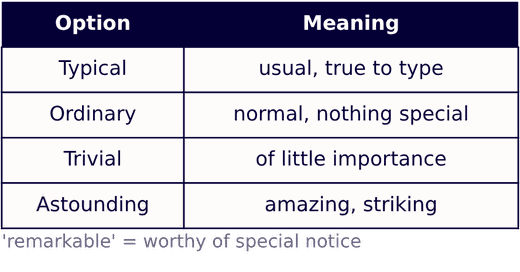
Remarkable means so extraordinary or striking that it deserves special notice.
Astounding means amazingly surprising or impressive, which carries the same idea of standing out from the ordinary.
Typical and Ordinary both mean commonplace and Trivial means unimportant, so all three are opposites of the required sense.
2
Choose the option that has an error in the sentence.
Students who does not read newspapers will never be able to receive knowledge in any way.
A.Students who does not read newspapers
B.will never be able to receive
C.knowledge in any way.
D.No correction required
Solution
Subject-verb agreement
A relative pronoun ('who') takes its number from the noun it stands for, and the verb after it must agree with that noun.
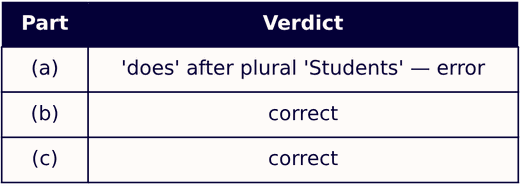
Here 'who' stands for 'Students', which is plural, so the verb must be the plural 'do', not the singular 'does'.
The error is therefore in part (a); the correct wording is 'Students who do not read newspapers'.
Parts (b) and (c) are already correct, so 'No correction required' cannot be chosen.
3
Identify the incorrect sentence.
A.Every document submitted here is well-organized and specifically formatted to maintain its clarity.
B.Legends are a type of narratives that are handed down from one century to another.
C.The Alps are the most picturesque mountains in the south and is very popular.
D.There are not many students of this ancient philosopher these days.
Solution
Subject-verb agreement
Check each sentence for agreement between its subject and its verb.
'The Alps' is a plural noun, so both verbs joined by 'and' must be plural: 'The Alps are ... and are very popular'.
Sentence (c) uses the singular 'is' for the second verb, which breaks the agreement, so it is the incorrect sentence.
In (a) the singular 'Every document' takes 'is', in (b) 'Legends are' is plural and in (d) 'There are not many students' is plural, so all three are sound.
4
Fill in the blank with the most appropriate preposition:
The manager elaborated the new company policies during the meeting.
A.over
B.on
C.with
D.for
Solution
Verb with preposition
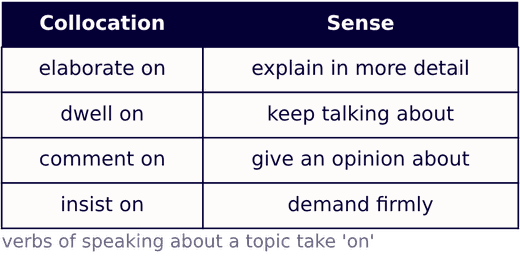
'Elaborate' takes the fixed preposition 'on' when it means to explain something at greater length.
The manager explained the new policies in detail, so the sentence reads 'elaborated on the new company policies'.
'Elaborate over', 'elaborate with' and 'elaborate for' are not accepted collocations in standard English.
5
Match the pair to its meaning:
A.1-A, 2-B
B.1-B, 2-A
C.1-A, 2-A
D.1-B, 2-B
Solution
Matching pairs
Take each item of the first list and test it against both meanings offered in the second list.
Item 1 agrees with meaning A, and the remaining item 2 then matches meaning B, because a correct matching uses every meaning exactly once.
Only option (a) gives that one-to-one pairing 1-A, 2-B; options (c) and (d) repeat a single meaning for both items, which a matching exercise never allows, and (b) simply reverses the correct pairing.
6
Choose the correctly spelt word:
A.Diarrhia
B.Diarehea
C.Diarrhea
D.Dirarhea
Solution
Correct spelling
The correct spelling is 'Diarrhea' — it keeps the double 'r' and ends in '-rrhea'.
The word comes from Greek 'dia-' (through) + 'rhein' (to flow), which is why the 'rrh' cluster is never broken up; British English writes the same word as 'diarrhoea'.
Each of the other options either drops an 'r', pushes a stray 'e' into the 'rrh' cluster, or reverses the letters, so all three are misspelt.
7
Choose the best option to replace the underlined part to improve the given sentence. If no substitution is required, select "No substitution."
Riya always finishes her assignment before bed.
A.at bed
B.at bed
C.by bed
D.No substitution
Solution
Prepositional phrase of time
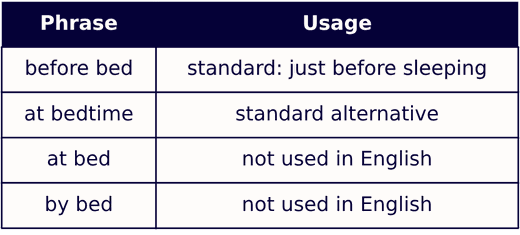
'Before bed' is a fixed adverbial phrase meaning 'in the time just before going to sleep'.
The sentence already uses it correctly with the habitual present 'finishes', so nothing has to be replaced.
'At bed' and 'by bed' are not idiomatic; English says 'at bedtime' or 'in bed', never 'at bed'.
8
Choose the best option to replace the underlined part to improve the given sentence. If no substitution is required, select "No substitution."
They should prevent him to making such an error in the future.
A.Prevent him for making
B.Prevent him from making
C.Prevent him in making
D.No substitution
Solution
Verb pattern with gerund
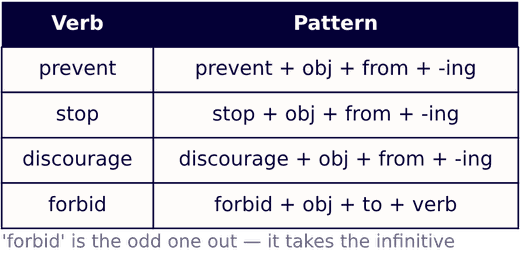
'Prevent' follows the fixed pattern prevent + object + from + verb-ing.
So the underlined part must become 'prevent him from making such an error in the future'.
'Prevent him to making', 'for making' and 'in making' all break that pattern, so only option (b) is correct.
9
Choose the correct indirect narration of the following statement from the given alternatives:
The nurse said, "Your brother is going to recover within the next five days."
A.The nurse said that his brother was going to recover within the following five days.
B.The nurse said that his brother is going to recover within the following five days.
C.The nurse said that his brother is going to recover within the next five days.
D.The nurse said that his brother was going to recover within the previous five days.
Solution
Direct to indirect speech
The reporting verb 'said' is in the past, so the reported verb moves one step back: 'is going to' becomes 'was going to'.
Time words shift as well: 'the next five days' becomes 'the following five days'.
The pronoun 'Your' changes to 'his', since the speech is now reported about that person.
Only option (a) makes all three changes; (b) and (c) keep the present 'is', and (d) turns future time into past with 'previous'.
10
Change the following sentence into the Active form.
The report has been submitted.
A.The report was submitted.
B.They had submitted the report.
C.Someone has submitted the report.
D.Someone submits the report.
Solution
Passive to active voice
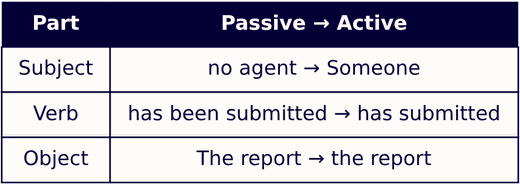
The passive 'has been submitted' is present perfect, so the active must stay present perfect: has/have + V3.
The passive names no agent, so an indefinite subject such as 'Someone' has to supply the doer.
This gives 'Someone has submitted the report.', which is option (c).
(a) is still passive and in the past, (b) uses the past perfect and (d) the simple present, so none of them keeps the original tense.
11
Choose the option that is the most appropriate conversion of the following sentence into Direct Speech.
Rohit told her that the files had already been signed before she had called.
A.Rohit said, "The files were already signed before you called."
B.Rohit said to her, "The files have already been signed before you had called."
C.Rohit said to her, "The files had already been signed before you called."
D.Rohit told her, "The files have already been signed before you have called."
Solution
Indirect to direct speech
In direct speech the reporting verb 'told her' becomes 'said to her', because the listener is still named before the quotation.
The reported clause is put back inside inverted commas and the pronoun 'she' becomes 'you', the person being addressed.
The signing was finished before she called, so the earlier action keeps the past perfect 'had already been signed' and the later action takes the simple past 'called'.
Option (c) alone keeps this earlier-action / later-action order; (a) drops the listener and the perfect form, while (b) and (d) shift the completed action into the present perfect.
12
Choose the most suitable preposition from the given options to fill in the blank in the following sentence:
This region is prone accidents during winter.
A.with
B.for
C.to
D.of
Solution
Adjective with preposition
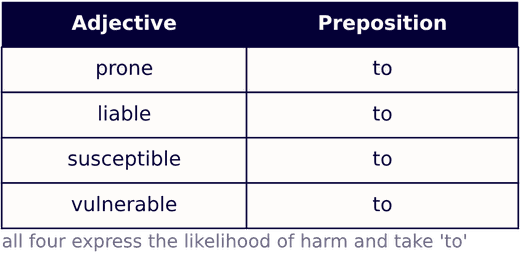
'Prone' is always followed by 'to' when it means liable or likely to suffer something unwanted.
The sentence therefore reads 'This region is prone to accidents during winter.'
'Prone with', 'prone for' and 'prone of' are not used in English, so the other options are ruled out.
13
Choose the correct passive voice transformation of the sentence:
Aman's family will have accepted his decision by next year.
A.Aman's decision will be accepted by his family by next year.
B.Aman's decision will be being accepted by his family by next year.
C.Aman's decision will have been accepted by his family by next year.
D.Aman's decision will have being accepted by his family by next year.
Solution
Future perfect passive
The active sentence is in the future perfect: will have + V3.
Formula: object + will have been + V3 + by + agent.
The object 'his decision' becomes the subject, so the passive is 'Aman's decision will have been accepted by his family by next year.'
(a) drops 'have' and slips into the simple future, while (b) and (d) put 'being' after 'will be' / 'will have', a form no passive allows.
14
Choose the correct passive voice transformation of the sentence:
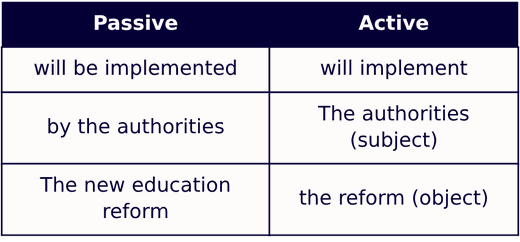
The new education reform will be implemented by the authorities with immediate effect.
A.The authorities will implement the new education reform with immediate effect.
B.The authorities will have implemented the new education reform with immediate effect.
C.The authorities have implemented the new education reform with immediate effect.
D.The authorities are implementing the new education reform with immediate effect.
Solution
Passive to active voice
'Will be implemented' is the simple future passive, so the matching active form is 'will + V1'.
The agent 'the authorities' becomes the subject and 'the new education reform' becomes the object.
That yields option (a); (b) shifts to the future perfect, (c) to the present perfect and (d) to the present continuous, so all three change the tense.
15
Directions (Qs. 15-19): Read the following passage carefully and answer the questions that follow.
In an epoch characterized by rapid urbanization and climactic volatility, the significance of sustainable infrastructure has never been more palpable. Conventional urban planning, with its reliance on impervious surfaces and rigid zoning, often fails to address the ecological friction generated by modern metropolises. This divergence between civic expansion and environmental stewardship has yielded cities dense in population but fragile in resilience.
Green infrastructure, distinctively, emphasizes ecological integration, promoting efficacy in stormwater management, air purification, and thermal regulation. Bioswales, living roofs, and permeable pavements immerse citizens in functional landscapes where nature is not merely preserved but functionalized. Such regenerative design nurtures not only environmental stability but also psychological well-being crucial in high-density settings.
Furthermore, nature-centric strategies foster a culture of adaptability, vital in a time where extreme weather can render static defenses obsolete within years. They decentralize resilience by empowering communities from various demographics to benefit from cleaner air and reduced heat islands rather than just aesthetic luxury.
Ultimately, weaving ecological frameworks into civic engineering is not
an ornamental addition but a strategic necessity. It resolves the enduring conflict between habitation and habitat, ensuring that cities are not stifling cages of concrete but thriving ecosystems for human flourishing.
The phrase "where nature is not merely preserved but functionalized* functions as:
A.Adverbial clause of place
B.Noun clause
C.Adjective clause
D.Absolute phrase
Solution
Type of clause
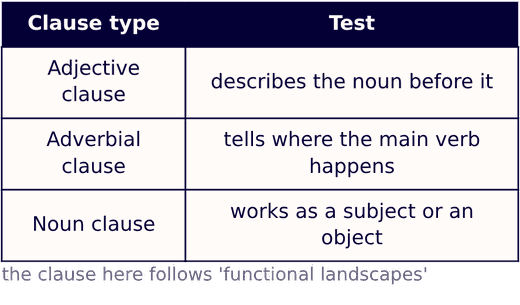
A clause beginning with 'where' can be adverbial, telling where the action happens, or adjectival, describing the noun just before it.
Here the clause follows the noun phrase 'functional landscapes' and tells us what kind of landscapes they are, so it modifies a noun.
A clause that modifies a noun is an adjective (relative) clause, so option (c) is correct.
It is not a noun clause, since it is neither the subject nor the object of any verb, and not an absolute phrase, since it carries its own finite verb 'is'.
16
Directions (Qs. 15-19): Read the following passage carefully and answer the questions that follow.
In an epoch characterized by rapid urbanization and climactic volatility, the significance of sustainable infrastructure has never been more palpable. Conventional urban planning, with its reliance on impervious surfaces and rigid zoning, often fails to address the ecological friction generated by modern metropolises. This divergence between civic expansion and environmental stewardship has yielded cities dense in population but fragile in resilience.
Green infrastructure, distinctively, emphasizes ecological integration, promoting efficacy in stormwater management, air purification, and thermal regulation. Bioswales, living roofs, and permeable pavements immerse citizens in functional landscapes where nature is not merely preserved but functionalized. Such regenerative design nurtures not only environmental stability but also psychological well-being crucial in high-density settings.
Furthermore, nature-centric strategies foster a culture of adaptability, vital in a time where extreme weather can render static defenses obsolete within years. They decentralize resilience by empowering communities from various demographics to benefit from cleaner air and reduced heat islands rather than just aesthetic luxury.
Ultimately, weaving ecological frameworks into civic engineering is not
an ornamental addition but a strategic necessity. It resolves the enduring conflict between habitation and habitat, ensuring that cities are not stifling cages of concrete but thriving ecosystems for human flourishing.
Identify the voice in "has yielded cities dense in population but fragile in resilience".
A.Middle voice
B.Passive voice
C.Causative voice
D.Active voice
Solution
Identifying voice
In the active voice the subject performs the action; in the passive the subject receives it and the verb takes the form be + V3.
The subject 'This divergence' does the yielding, and 'has yielded' is present perfect active — the passive would read 'has been yielded'.
Hence the clause is in the active voice, and 'middle' and 'causative' are not voices recognised in this pair of options.
17
Directions (Qs. 15-19): Read the following passage carefully and answer the questions that follow.
In an epoch characterized by rapid urbanization and climactic volatility, the significance of sustainable infrastructure has never been more palpable. Conventional urban planning, with its reliance on impervious surfaces and rigid zoning, often fails to address the ecological friction generated by modern metropolises. This divergence between civic expansion and environmental stewardship has yielded cities dense in population but fragile in resilience.
Green infrastructure, distinctively, emphasizes ecological integration, promoting efficacy in stormwater management, air purification, and thermal regulation. Bioswales, living roofs, and permeable pavements immerse citizens in functional landscapes where nature is not merely preserved but functionalized. Such regenerative design nurtures not only environmental stability but also psychological well-being crucial in high-density settings.
Furthermore, nature-centric strategies foster a culture of adaptability, vital in a time where extreme weather can render static defenses obsolete within years. They decentralize resilience by empowering communities from various demographics to benefit from cleaner air and reduced heat islands rather than just aesthetic luxury.
Ultimately, weaving ecological frameworks into civic engineering is not
an ornamental addition but a strategic necessity. It resolves the enduring conflict between habitation and habitat, ensuring that cities are not stifling cages of concrete but thriving ecosystems for human flourishing.
The word "palpable" means:
A.Obscure
B.Tangible
C.Theoretical
D.Insignificant
Solution
Word meaning in context
'Palpable' means so clear and obvious that it can almost be touched or felt.
The passage says the significance of sustainable infrastructure 'has never been more palpable', that is, never more plainly felt.
'Tangible' carries exactly that sense of being real and perceptible, so option (b) is correct.
Obscure, Theoretical and Insignificant all deny clear, felt reality, so they are opposites here.
18
Directions (Qs. 15-19): Read the following passage carefully and answer the questions that follow.
In an epoch characterized by rapid urbanization and climactic volatility, the significance of sustainable infrastructure has never been more palpable. Conventional urban planning, with its reliance on impervious surfaces and rigid zoning, often fails to address the ecological friction generated by modern metropolises. This divergence between civic expansion and environmental stewardship has yielded cities dense in population but fragile in resilience.
Green infrastructure, distinctively, emphasizes ecological integration, promoting efficacy in stormwater management, air purification, and thermal regulation. Bioswales, living roofs, and permeable pavements immerse citizens in functional landscapes where nature is not merely preserved but functionalized. Such regenerative design nurtures not only environmental stability but also psychological well-being crucial in high-density settings.
Furthermore, nature-centric strategies foster a culture of adaptability, vital in a time where extreme weather can render static defenses obsolete within years. They decentralize resilience by empowering communities from various demographics to benefit from cleaner air and reduced heat islands rather than just aesthetic luxury.
Ultimately, weaving ecological frameworks into civic engineering is not
an ornamental addition but a strategic necessity. It resolves the enduring conflict between habitation and habitat, ensuring that cities are not stifling cages of concrete but thriving ecosystems for human flourishing.
In the context of the passage, which idiom best conveys the meaning of "resolves the enduring conflict between habitation and habitat" as used in the final paragraph?
A.Strike a balance
B.Beat around the bush
C.Spill the beans
D.Bite the bullet
Solution
Idiom in context
The final paragraph says that weaving ecology into engineering settles the long conflict between where people live (habitation) and the natural environment (habitat).
Settling such a conflict by giving fair weight to both sides is exactly what 'strike a balance' means.
'Beat around the bush' is to avoid the point, 'spill the beans' is to reveal a secret and 'bite the bullet' is to face something unpleasant — none of them is about reconciling two competing demands.
19
Directions (Qs. 15-19): Read the following passage carefully and answer the questions that follow.
In an epoch characterized by rapid urbanization and climactic volatility, the significance of sustainable infrastructure has never been more palpable. Conventional urban planning, with its reliance on impervious surfaces and rigid zoning, often fails to address the ecological friction generated by modern metropolises. This divergence between civic expansion and environmental stewardship has yielded cities dense in population but fragile in resilience.
Green infrastructure, distinctively, emphasizes ecological integration, promoting efficacy in stormwater management, air purification, and thermal regulation. Bioswales, living roofs, and permeable pavements immerse citizens in functional landscapes where nature is not merely preserved but functionalized. Such regenerative design nurtures not only environmental stability but also psychological well-being crucial in high-density settings.
Furthermore, nature-centric strategies foster a culture of adaptability, vital in a time where extreme weather can render static defenses obsolete within years. They decentralize resilience by empowering communities from various demographics to benefit from cleaner air and reduced heat islands rather than just aesthetic luxury.
Ultimately, weaving ecological frameworks into civic engineering is not
an ornamental addition but a strategic necessity. It resolves the enduring conflict between habitation and habitat, ensuring that cities are not stifling cages of concrete but thriving ecosystems for human flourishing.
According to the passage, what is the primary advantage of green infrastructure over conventional urban planning?
A.It increases the density of the population
B.It prioritizes aesthetic luxury over function
C.It integrates ecological health with urban functionality
D.It relies solely on rigid zoning laws
Solution
Reading comprehension
The second paragraph says green infrastructure 'emphasizes ecological integration', promoting stormwater management, air purification and thermal regulation.
Its advantage, then, is that ecological health is built into the working of the city itself — exactly what option (c) states.
(a) is wrong because density is a problem the passage describes, (b) is contradicted by 'rather than just aesthetic luxury', and (d) describes conventional planning, not green infrastructure.
20
Rearrange the following sentence parts to form a meaningful and grammatically correct paragraph:
P. He presented the findings to his team, revealing new patterns in the business.
Q. He created a series of functions to clean and transform the data, making it usable.
R. He developed a dashboard to visualise the insights and trends hidden in the data.
S. He wrote a script to extract raw data from multiple sources.
A.R, Q, P, S
B.S, Q, R, P
C.P, Q, R, S
D.R, Q, S, P
Solution
Sentence rearrangement
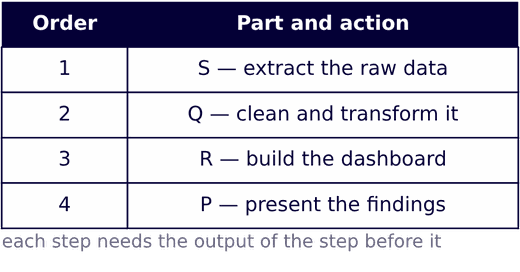
The paragraph describes one data project, so the parts must follow the order in which the work is actually done.
S opens it: raw data is first extracted from several sources.
Q follows, because that raw data is then cleaned and transformed until it is usable.
R comes next, since the usable data is turned into a dashboard of insights.
P closes the paragraph, as the findings are finally presented to the team.
The correct sequence is therefore S, Q, R, P — option (b).
21
Rearrange the following sentences to form a meaningful and grammatically correct paragraph:
P. The group of astronomers was searching for a celestial body outside of our solar system.
Q. They observed the distant star using a powerful telescope in search of a telltale dimming of its brightness.
R. They discovered a new world, establishing its existence through a series of follow-up observations.
S. This slight dimming would indicate a celestial body passing in front of the star.
A.
B.Q, R, S, P
C.P, Q, S, R
D.R, Q, S, P
Solution
Para jumble
The paragraph must open with the sentence that introduces the subject: P names the group of astronomers and the search they were making.
Q follows, because 'They' now refers to those astronomers and it tells how they searched - by watching the distant star through a telescope for a dimming of its brightness.
S explains the very dimming just mentioned in Q ('This slight dimming'), so it must come straight after Q.
R closes the paragraph with the outcome of the search - the discovery of a new world.
The order is therefore P, Q, S, R, so option (c) is correct.
22
Which of the following words is the antonym of "Generous"?
A.Benevolent
B.Parsimonious
C.Liberal
D.Kind
Solution
Antonym
'Generous' means willing to give freely and open-handedly.
'Parsimonious' means extremely unwilling to spend money or share resources, that is, stingy - the exact opposite.
Benevolent (kind-hearted), Liberal (free in giving) and Kind (considerate) are all close in meaning to 'generous', not opposite to it.
Hence option (b) is correct.
23
Which of the following words is the antonym of "Awake"?
A.Somnolent
B.Alert
C.Active
D.Conscious
Solution
Antonym
'Awake' means not sleeping - fully conscious and roused.
'Somnolent' comes from Latin somnus (sleep) and means sleepy or drowsy, so it is the opposite.
Alert, Active and Conscious all describe a person who is already awake, so they are synonyms rather than antonyms.
Hence option (a) is correct.
24
Fill in the blank with the correctly spelt word.
The narrator's writing was infused with
imagery.
A.chiaroscuoro
B.chiaroscuro
C.chairoscouro
D.chairoscuro
Solution
Correct spelling
The word required is the art term for a strong contrast of light and shade, used here for vivid light-and-dark imagery.
It is borrowed from Italian: chiaro (light, clear) + oscuro (dark), joined as chiaro + scuro.
So the correct spelling is 'chiaroscuro'.
Option (a) adds an extra 'o' in the second half, while (c) and (d) turn 'chiaro' into 'chairo', so option (b) is correct.
25
Which word best describes an intense feeling of dislike towards a person or thing?
A.Hatred
B.Respect
C.Affection
D.Admiration
Solution
One-word substitution
The question itself gives the definition: an intense feeling of dislike towards a person or thing.
'Hatred' is exactly that - deep, intense dislike or hostility.
Respect, Affection and Admiration all express positive feelings, so they carry the opposite sense.
Hence option (a) is correct.
Finished reading? Now test yourself.
The same 25 questions, but with a timer and the answers hidden — 15 minutes.

 Typical and Ordinary both mean commonplace and Trivial means unimportant, so all three are opposites of the required sense.
 The error is therefore in part (a); the correct wording is 'Students who do not read newspapers'.
Parts (b) and (c) are already correct, so 'No correction required' cannot be chosen.
The error is therefore in part (a); the correct wording is 'Students who do not read newspapers'.
Parts (b) and (c) are already correct, so 'No correction required' cannot be chosen.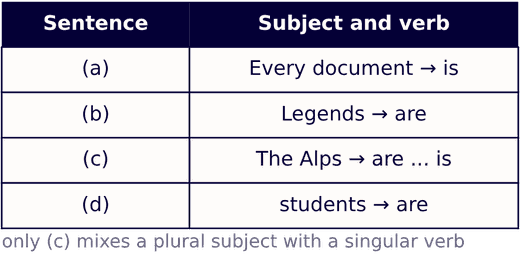 In (a) the singular 'Every document' takes 'is', in (b) 'Legends are' is plural and in (d) 'There are not many students' is plural, so all three are sound.
 The manager explained the new policies in detail, so the sentence reads 'elaborated on the new company policies'.
'Elaborate over', 'elaborate with' and 'elaborate for' are not accepted collocations in standard English.
The manager explained the new policies in detail, so the sentence reads 'elaborated on the new company policies'.
'Elaborate over', 'elaborate with' and 'elaborate for' are not accepted collocations in standard English.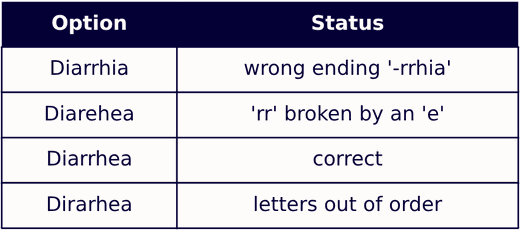 Each of the other options either drops an 'r', pushes a stray 'e' into the 'rrh' cluster, or reverses the letters, so all three are misspelt.
 'At bed' and 'by bed' are not idiomatic; English says 'at bedtime' or 'in bed', never 'at bed'.
 So the underlined part must become 'prevent him from making such an error in the future'.
'Prevent him to making', 'for making' and 'in making' all break that pattern, so only option (b) is correct.
So the underlined part must become 'prevent him from making such an error in the future'.
'Prevent him to making', 'for making' and 'in making' all break that pattern, so only option (b) is correct.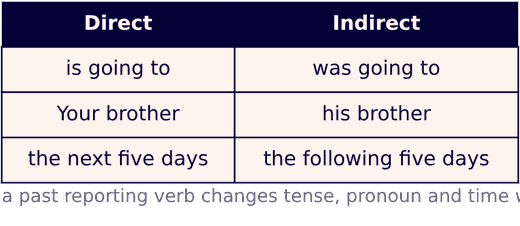 Only option (a) makes all three changes; (b) and (c) keep the present 'is', and (d) turns future time into past with 'previous'.
 This gives 'Someone has submitted the report.', which is option (c).
(a) is still passive and in the past, (b) uses the past perfect and (d) the simple present, so none of them keeps the original tense.
This gives 'Someone has submitted the report.', which is option (c).
(a) is still passive and in the past, (b) uses the past perfect and (d) the simple present, so none of them keeps the original tense.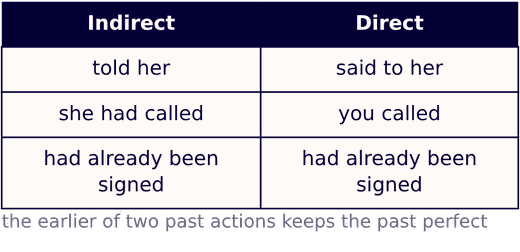 Option (c) alone keeps this earlier-action / later-action order; (a) drops the listener and the perfect form, while (b) and (d) shift the completed action into the present perfect.
 The sentence therefore reads 'This region is prone to accidents during winter.'
'Prone with', 'prone for' and 'prone of' are not used in English, so the other options are ruled out.
The sentence therefore reads 'This region is prone to accidents during winter.'
'Prone with', 'prone for' and 'prone of' are not used in English, so the other options are ruled out.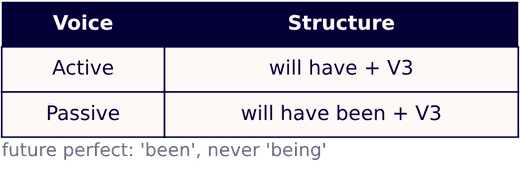 (a) drops 'have' and slips into the simple future, while (b) and (d) put 'being' after 'will be' / 'will have', a form no passive allows.
 That yields option (a); (b) shifts to the future perfect, (c) to the present perfect and (d) to the present continuous, so all three change the tense.
 A clause that modifies a noun is an adjective (relative) clause, so option (c) is correct.
It is not a noun clause, since it is neither the subject nor the object of any verb, and not an absolute phrase, since it carries its own finite verb 'is'.
A clause that modifies a noun is an adjective (relative) clause, so option (c) is correct.
It is not a noun clause, since it is neither the subject nor the object of any verb, and not an absolute phrase, since it carries its own finite verb 'is'.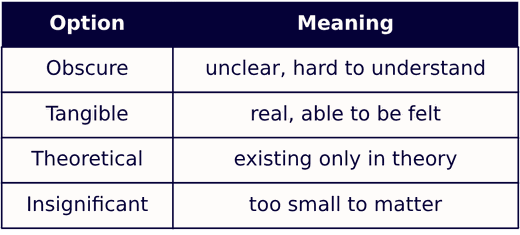 'Tangible' carries exactly that sense of being real and perceptible, so option (b) is correct.
Obscure, Theoretical and Insignificant all deny clear, felt reality, so they are opposites here.
'Tangible' carries exactly that sense of being real and perceptible, so option (b) is correct.
Obscure, Theoretical and Insignificant all deny clear, felt reality, so they are opposites here.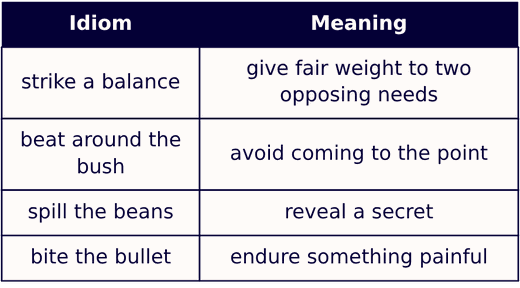 'Beat around the bush' is to avoid the point, 'spill the beans' is to reveal a secret and 'bite the bullet' is to face something unpleasant — none of them is about reconciling two competing demands.
 The correct sequence is therefore S, Q, R, P — option (b).