SSC CHSL 26 November 2025 · Shift 3 · General Awareness — questions with answers · ShikshaSphere
Chapter 150 of 200
26 November 2025 · Shift 3
General Awareness
25 questions ~25 min readFree
25 questions
A
76
From their maternal lineage, the Mughal rulers traced their ancestry to which historical figure?
A.Babur
B.Genghis Khan
C.Mahmud of Ghazni
D.Alauddin Khalji
Solution
Mughal ancestry
The Mughals claimed a double descent: from the father's side they came from Timur, and from the mother's side from Genghis Khan, the founder of the Mongol empire.
Babur records this Turco-Mongol ancestry in his memoir, the Baburnama; the very name 'Mughal' is derived from 'Mongol'.
Babur founded the dynasty, so he is not its ancestor, while Mahmud of Ghazni and Alauddin Khalji belonged to entirely different and earlier ruling houses.
Hence option (b) is correct.
77
The Veerashaiva (Lingayat) movement emerged during the mid-twelfth century in which region of India?
A.Assam
B.Karnataka
C.Bengal
D.Maharashtra
Solution
Veerashaiva movement
The Veerashaiva or Lingayat movement began in Karnataka around the middle of the twelfth century, led by Basavanna along with Allama Prabhu and Akka Mahadevi.
Its followers worshipped Shiva in the form of the linga they wore, rejected idol worship, elaborate ritual and caste hierarchy, and expressed their ideas in Kannada verses called vachanas.
Assam is associated with Sankaradeva, Bengal with Chaitanya and Maharashtra with the Varkari saints such as Jnaneshwar and Namdev, all of them later or different movements.
Hence option (b) is correct.
78
Which of the following obligations is listed among the Fundamental Duties of Indian citizens?
A.Showing obedience to elders and teachers
B.Participating in local self-government
C.Honouring the national animal
D.Protecting public property
Solution
Fundamental Duties
Article 51A(i) of the Constitution lays down the duty of every citizen 'to safeguard public property and to abjure violence'.
The Fundamental Duties were inserted in Part IVA by the 42nd Amendment Act, 1976 on the recommendation of the Swaran Singh Committee; ten were added then and an eleventh, on the education of children, by the 86th Amendment Act, 2002.
Obedience to elders, taking part in local self-government and honouring the national animal are desirable habits but find no place in the list of Fundamental Duties.
Hence option (d) is correct.
79
Which of the following statements correctly describe the nature of the Directive Principles of State Policy in the Indian Constitution?
I. They cannot be enforced through courts of law.
II. The State is expected to implement them while framing policies and laws.
A.Only II
B.Only I
C.Neither I nor II
D.Both I and II
Solution
Directive Principles
The Directive Principles of State Policy are contained in Part IV (Articles 36 to 51) of the Constitution and are borrowed from the Irish Constitution.
Article 37 states that these principles shall not be enforceable by any court, so statement I is correct.
The same Article adds that they are nevertheless fundamental in the governance of the country and that it shall be the duty of the State to apply them in making laws, so statement II is also correct.
Hence option (d) is correct.
80
As on 31 July 2025, which of the following countries are members of the South Asian Association for Regional Cooperation (SAARC)?
I. Pakistan
II. Nepal
A.Only II
B.Only I
C.Neither I nor II
D.Both I and II
Solution
SAARC membership
SAARC was founded on 8 December 1985 at Dhaka by seven countries: Bangladesh, Bhutan, India, Maldives, Nepal, Pakistan and Sri Lanka.
Afghanistan joined in 2007, taking the membership to eight, and this has remained unchanged; the Secretariat works from Kathmandu, Nepal.
Pakistan and Nepal are therefore both founding members and both continue as members, so statements I and II are correct.
Hence option (d) is correct.
81
Which Indian woman created history by becoming the first to win an Olympic medal for India?
A.Anju Bobby George
B.Dipa Karmakar
C.Sakshi Malik
D.Karnam Malleswari
Solution
India's Olympic firsts
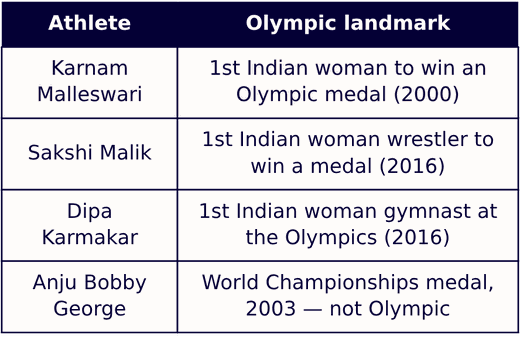
Karnam Malleswari won the bronze medal in weightlifting at the 2000 Sydney Olympics and thereby became the first Indian woman ever to win an Olympic medal.
She competed in the 69 kg category and lifted a total of 240 kg — 110 kg in the snatch and 130 kg in the clean and jerk; Sydney 2000 was also the first Games at which women's weightlifting was contested.
Sakshi Malik became the first Indian woman wrestler to win an Olympic medal (Rio 2016), Anju Bobby George's famous medal came at the 2003 World Athletics Championships and not at the Olympics, and Dipa Karmakar finished fourth in gymnastics at Rio 2016.
Hence option (d) is correct.
82
In July 2025, which country honoured Narendra Modi with its highest civilian award titled "Officer of the Order of the Star*?
A.Kenya
B.Ghana
C.Nigeria
D.Ethiopia
Solution
Foreign honours to PM Modi
During his state visit to Accra on 3 July 2025, Prime Minister Narendra Modi was conferred Ghana's national honour, the Officer of the Order of the Star of Ghana.
It was the first visit by an Indian Prime Minister to Ghana in three decades; the honour was given for his statesmanship and for deepening India–Ghana ties, and Mr Modi dedicated it to the people of India.
Ghana was the first stop of a five-nation tour in July 2025 on which the Prime Minister received the highest honour of four different countries, so the country named in the award itself is the answer.
Hence option (b) is correct.
83
In December 2024, who assumed office as the constitutional head (Governor) of the state of Odisha?
A.Ramesh Bais
B.Rajendra Vishwanath Arlekar
C.Hari Babu Kambhampati
D.La. Ganesan
Solution
Governor of Odisha
Dr Hari Babu Kambhampati was appointed Governor of Odisha in December 2024 and was sworn in as the state's constitutional head on 31 December 2024.
The office had fallen vacant when Raghubar Das resigned; the President accepted the resignation on 24 December 2024 and transferred Kambhampati, till then Governor of Mizoram, to Odisha.
The Governor is the constitutional head of a state under Article 153 and is appointed by the President under Article 155, holding office during the President's pleasure.
Ramesh Bais had earlier been Governor of Jharkhand and Maharashtra, Rajendra Vishwanath Arlekar was Governor of Bihar at that time and moved to Kerala in January 2025, and La. Ganesan was Governor of Nagaland.
Hence option (c) is correct.
84
The Wagf (Amendment) Bill, 2025 was cleared by the Indian Parliament after approval by the Rajya Sabha in which month of 2025?
A.February
B.April
C.June
D.September
Solution
Waqf (Amendment) Act, 2025
The Waqf (Amendment) Bill, 2025 completed its passage through Parliament in April 2025.
The Lok Sabha passed it in the early hours of 3 April 2025 after a debate of about twelve hours, by 288 votes to 232.
The Rajya Sabha then cleared it in the early hours of 4 April 2025 by 128 votes to 95, and with that the approval of Parliament was complete.
The President gave her assent on 5 April 2025 and the Act was brought into force from 8 April 2025; it provides for mandatory registration and audit of waqf properties and for wider representation on waqf boards.
Hence option (b) is correct.
85
In the Union Budget for FY 2025-26, the Government announced a comprehensive multi-sectoral programme to tackle under-employment in agriculture through skilling, technology, and investment. What is the name of this programme?
A.Cluster Facilitation Programme
B.Rural Prosperity and Resilience Programme
C.Rural Upliftment and Skill Mission
D.Cluster Skill Centres Initiative
Solution
Union Budget 2025-26 schemes
In the Union Budget for 2025-26 the Finance Minister announced the Rural Prosperity and Resilience Programme, a comprehensive multi-sectoral scheme aimed directly at under-employment in agriculture.
It is to be delivered through skilling, investment, technology and support to rural enterprise, in partnership with the states.
Its target groups are rural women, young farmers, young landless labourers and marginal farmers, and its stated aim is to create enough opportunity in the villages themselves so that migration becomes an option rather than a compulsion.
The other three names do not correspond to any programme announced in that Budget.
Hence option (b) is correct.
86
The Fiscal Health Index (FHI) 2025 was released by which of the following institutions?
A.NITI Aayog
B.Reserve Bank of India
C.Ministry of Finance
D.Comptroller and Auditor General of India
Solution
Fiscal Health Index 2025
The first Fiscal Health Index was released by NITI Aayog on 24 January 2025.
It ranks 18 major states on five sub-indices — quality of expenditure, revenue mobilisation, fiscal prudence, debt index and debt sustainability.
Odisha topped the index, followed by Chhattisgarh and Goa, while Punjab, Andhra Pradesh, West Bengal and Kerala were placed at the bottom.
The CAG only supplies the audited state accounts on which the index is built and does not publish the index itself; neither the Reserve Bank nor the Ministry of Finance brings it out.
Hence option (a) is correct.
87
Which team secured the Raja Bhalindra Singh Trophy in the year 2025?
A.Tamil Nadu
B.Rajasthan
C.Services Sports Control Board
D.Uttar Pradesh
Solution
38th National Games, 2025
The Raja Bhalindra Singh Trophy is given to the best overall team of the National Games, and at the 38th National Games held in Uttarakhand in January–February 2025 it was retained by the Services Sports Control Board.
Services finished on top of the table with 68 gold, 26 silver and 27 bronze — 121 medals in all.
The trophy is decided on the gold-medal count, which is why Services took it although Maharashtra won more medals overall.
The trophy is named after Raja Bhalindra Singh, the long-serving president of the Indian Olympic Association and a member of the International Olympic Committee.
Hence option (c) is correct.
88
Which of the following practices are associated with Yoga ?
I. Agnisara
II. Kapalbhati
A.Only II
B.Only I
C.Both I and II
D.Neither I nor II
Solution
Yogic cleansing practices
Both the practices named belong to yoga, so statement I and statement II are correct.
Kapalbhati is one of the six Shatkarmas of Hatha Yoga — short forceful exhalations with passive inhalation; kapala means skull and bhati means shining, and the practice clears the nasal passages and sharpens alertness.
Agnisara Kriya is the rhythmic drawing in and releasing of the abdomen after a full exhalation; agni means fire, and it is done to kindle the digestive fire and tone the abdominal organs.
Hence option (c) is correct.
89
Table tennis was introduced for the first time as an Olympic sport in which edition of the Olympic Games?
A.Seoul Olympics
B.Berlin Olympics
C.Tokyo Olympics
D.Beijing Olympics
Solution
Olympic debut of sports
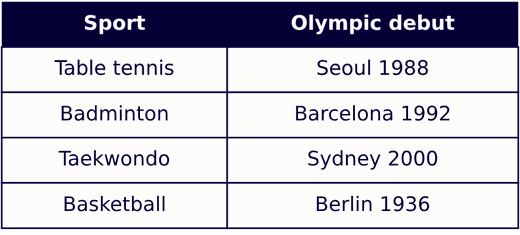
Table tennis entered the Olympic programme as a full medal sport at the 1988 Summer Olympics in Seoul, South Korea.
Four events were held at that debut — men's singles, women's singles, men's doubles and women's doubles.
The game had been played internationally since the 1920s, the International Table Tennis Federation having been founded in 1926, but it took until Seoul to reach the Olympics; the doubles events were replaced by team events from Beijing 2008.
Hence option (a) is correct.
90
The below given image is of which of the following animal?
A.Nilgiri tahr
B.Barasingha
C.Sambar deer
D.Chital
Solution
Indian deer species
The animal in the picture has a golden-rufous coat carrying rows of white spots, a white underside and slender antlers with three tines — that combination identifies the chital, or spotted deer.
Chital stand about 90 cm at the shoulder, move in large herds in the open forests of the Indian subcontinent, and are the chief prey of the tiger, the leopard and the dhole.
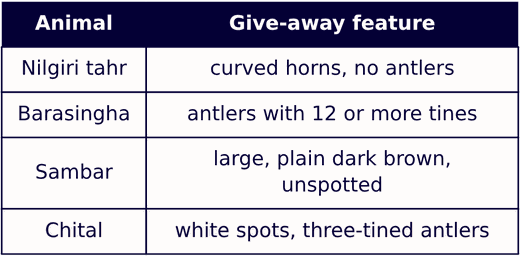
The Nilgiri tahr is a goat-antelope of the Western Ghats and carries curved horns rather than antlers, the barasingha's antlers branch into twelve or more tines, and the sambar is far larger with a plain dark-brown coat and no spots.
Hence option (d) is correct.
91
Who authored the Hindi novel Kitne Pakistan, which received the Sahitya Akademi Award?
A.Kamleshwar
B.Krishna Sobti
C.Amrita Pritam
D.Bhisham Sahni
Solution
Sahitya Akademi Award novel
Kitne Pakistan was written by Kamleshwar and won him the Sahitya Akademi Award for Hindi in 2003.
The novel is built as a courtroom in which an adalat summons figures from history and myth to answer for the borders they drew and the killings that followed, so Partition is treated not as one event of 1947 but as a recurring human failing.
Kamleshwar was a leading writer of the Nayi Kahani movement and also a well-known editor and screenwriter.
Hence option (a) is correct.
92
The traditional Raas Leela performances, especially famous in Mathura, are most closely associated with which Indian festival?
A.Diwali
B.Holi
C.Janmashtami
D.Raksha Bandhan
Solution
Raas Leela and Janmashtami
Raas Leela is the dance-drama of the Braj region that re-enacts the life of Krishna and his raas with Radha and the gopis, and it is staged above all at Janmashtami, the festival of Krishna's birth.
Through Janmashtami night the temples of Mathura and Vrindavan hold Raas Leela performances by young swaroops who play Krishna and the gopis, the cycle ending with the midnight birth.
Diwali marks Rama's return to Ayodhya, Holi is the spring festival of colours and Raksha Bandhan celebrates the bond of brother and sister — none of them is the occasion for Raas Leela.
Hence option (c) is correct.
93
The famous rock-cut ratha temples located at Mahabalipuram were constructed under the patronage of which dynasty?
A.Rashtrakutas
B.Pallavas
C.Hoysalas
D.Pandyas
Solution
Mahabalipuram rathas
The rock-cut rathas at Mahabalipuram, on the Coromandel coast south of Chennai, were carved under the patronage of the Pallava kings in the seventh century.
The group known as the Pancha Rathas — Draupadi, Arjuna, Bhima, Dharmaraja and Nakula-Sahadeva — belongs mainly to the reign of Narasimhavarman I Mamalla, after whom Mamallapuram is named.
Each ratha is cut downward out of a single granite boulder, so they are monoliths rather than built temples, and each copies a different roof form of its day, which makes the group a museum of early Dravidian architecture.
Mahabalipuram is a UNESCO World Heritage Site; the Rashtrakutas carved the Kailasa temple at Ellora, the Hoysalas built at Belur and Halebidu and the Pandyas ruled from Madurai.
Hence option (b) is correct.
94
In March 2025, which organisation successfully developed the high-speed microprocessors "Vikram 3201" and "Kalpana 3201" for use in space missions?
A.Hindustan Aeronautics Limited
B.Defence Research and Development Organisation
C.Indian Space Research Organisation
D.Bharat Electronics Limited
Solution
ISRO space-grade processors
Vikram 3201 and Kalpana 3201 were developed by the Indian Space Research Organisation and were announced in March 2025.
They were designed at the Vikram Sarabhai Space Centre, Thiruvananthapuram, and fabricated at the Semi-Conductor Laboratory, Chandigarh, so both the design and the silicon are indigenous.
Vikram 3201 is India's first fully indigenous 32-bit microprocessor qualified for launch-vehicle avionics, and Kalpana 3201 is a 32-bit RISC processor built for the same space-grade duty.
These chips run the onboard navigation, guidance and control computers, and they end ISRO's dependence on imported radiation-tolerant processors.
Hence option (c) is correct.
95
The launch of South Asia's biggest BESS in May 2025 took place in which Indian city?
A.Bengaluru
B.Hyderabad
C.Delhi
D.Chennai
Solution
Battery Energy Storage System
South Asia's largest Battery Energy Storage System, rated 20 MW with a storage capacity of 40 MWh, was inaugurated in May 2025 at the Kilokari substation in South Delhi.
It is India's first utility-scale standalone BESS, set up by BSES Rajdhani Power Limited with IndiGrid as the storage developer and support from the Global Energy Alliance for People and Planet.
Built with lithium iron phosphate cells, it charges on cheap off-peak power and discharges during peak hours, firming up supply for about a lakh consumers and cutting the need for costly peaking power.
Hence option (c) is correct.
96
The First Anglo-Maratha War came to an end with the signing of which treaty?
A.Treaty of Lahore
B.Treaty of Seringapatam
C.Treaty of Salbai
D.Treaty of Delhi
Solution
First Anglo-Maratha War
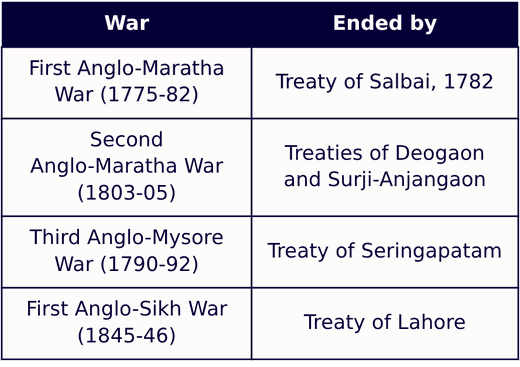
The First Anglo-Maratha War of 1775-82 was brought to an end by the Treaty of Salbai, signed on 17 May 1782.
Mahadji Scindia mediated between the East India Company and the Peshwa's court; by the treaty the British accepted Sawai Madhavrao II as Peshwa and abandoned the claims of their protege Raghunathrao.
Most of the captured territory was returned, the Company keeping Salsette and Elephanta, and the settlement gave the two powers about twenty years of peace.
The Treaty of Seringapatam (1792) ended the Third Anglo-Mysore War and the Treaty of Lahore (1846) the First Anglo-Sikh War, so neither can close an Anglo-Maratha war.
Hence option (c) is correct.
97
Which Article of the Indian Constitution deals with the Special Address by the Governor?
A.Article 179
B.Article 176
C.Article 167
D.Article 178
Solution
Article 176 of the Constitution
Article 176 is headed 'Special address by the Governor' and requires the Governor to address the Legislative Assembly — or both Houses together where a Council exists — at the first session after each general election and at the first session of every year.
In that address the Governor informs the House of the causes of its summons and sets out the government's policy for the year; the House then debates it on the Motion of Thanks.
Article 176 is the state counterpart of Article 87, which provides for the President's special address to Parliament.
Hence option (b) is correct.
98
The Karve Committee was constituted in which year?
A.1968
B.1958
C.1955
D.1952
Solution
Karve Committee, 1955
The Karve Committee was constituted in 1955 by the Planning Commission and is formally called the Village and Small-Scale Industries Committee.
It was chaired by the economist D. G. Karve and was asked how village, cottage and small-scale industry could be used to raise rural employment and income.
Its report shaped the Second Five-Year Plan (1956-61): small industries were to be protected and developed so that output and jobs spread beyond the few large industrial centres and income was distributed more evenly.
Hence option (c) is correct.
99
Which of the following organisms does NOT use a parasitic mode of nutrition?
A.Ticks
B.Lice
C.Tapeworm
D.Yeast
Solution
Modes of nutrition
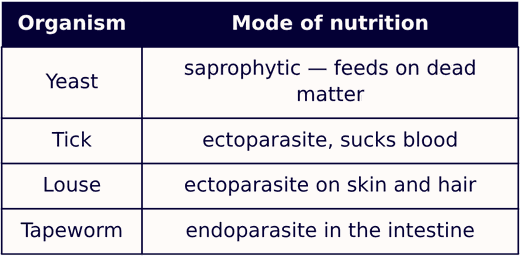
Yeast is a fungus and feeds saprophytically: it secretes enzymes on to dead and decaying organic matter and then absorbs the simple substances released.
A parasite, by contrast, lives on or inside a living host, takes its food from that host and harms it in the process.
Ticks and lice are ectoparasites that cling to the skin and suck blood, while the tapeworm is an endoparasite that lies in the intestine and absorbs the host's already digested food through its body wall.
So the only organism in the list that is not a parasite is yeast.
Hence option (d) is correct.
100
The systematic study of human cultures, social structures, and evolution across time is undertaken by:
A.Archaeobotanists
B.Sociologists
C.Anthropologists
D.Zoologists
Solution
Branches of study
Anthropology is the systematic study of human beings — their cultures, their social structures and their biological evolution across time — so the work described is that of anthropologists.
The subject has four branches: physical or biological anthropology, cultural or social anthropology, linguistic anthropology and archaeological anthropology.
A sociologist studies the institutions of present-day society, an archaeobotanist studies plant remains recovered from excavated sites, and a zoologist studies animals — none of the three covers the whole span of human culture and evolution.
Hence option (c) is correct.
Finished reading? Now test yourself.
The same 25 questions, but with a timer and the answers hidden — 15 minutes.

 Sakshi Malik became the first Indian woman wrestler to win an Olympic medal (Rio 2016), Anju Bobby George's famous medal came at the 2003 World Athletics Championships and not at the Olympics, and Dipa Karmakar finished fourth in gymnastics at Rio 2016.
Hence option (d) is correct.
Sakshi Malik became the first Indian woman wrestler to win an Olympic medal (Rio 2016), Anju Bobby George's famous medal came at the 2003 World Athletics Championships and not at the Olympics, and Dipa Karmakar finished fourth in gymnastics at Rio 2016.
Hence option (d) is correct.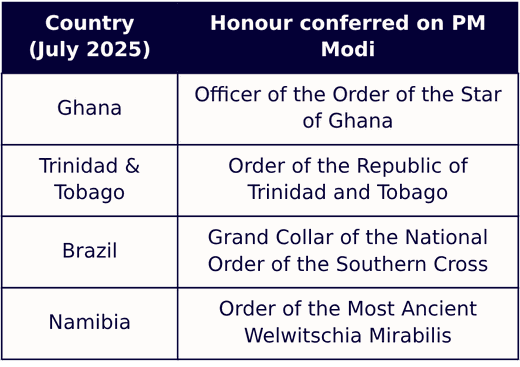 Ghana was the first stop of a five-nation tour in July 2025 on which the Prime Minister received the highest honour of four different countries, so the country named in the award itself is the answer.
Hence option (b) is correct.
Ghana was the first stop of a five-nation tour in July 2025 on which the Prime Minister received the highest honour of four different countries, so the country named in the award itself is the answer.
Hence option (b) is correct.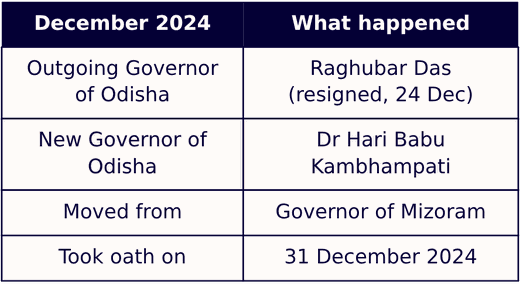 The Governor is the constitutional head of a state under Article 153 and is appointed by the President under Article 155, holding office during the President's pleasure.
Ramesh Bais had earlier been Governor of Jharkhand and Maharashtra, Rajendra Vishwanath Arlekar was Governor of Bihar at that time and moved to Kerala in January 2025, and La. Ganesan was Governor of Nagaland.
Hence option (c) is correct.
The Governor is the constitutional head of a state under Article 153 and is appointed by the President under Article 155, holding office during the President's pleasure.
Ramesh Bais had earlier been Governor of Jharkhand and Maharashtra, Rajendra Vishwanath Arlekar was Governor of Bihar at that time and moved to Kerala in January 2025, and La. Ganesan was Governor of Nagaland.
Hence option (c) is correct.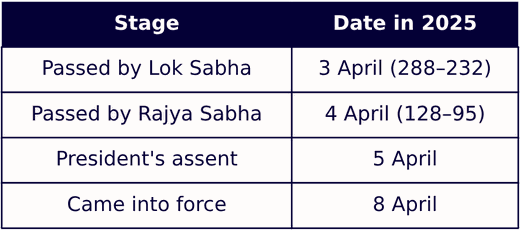 The President gave her assent on 5 April 2025 and the Act was brought into force from 8 April 2025; it provides for mandatory registration and audit of waqf properties and for wider representation on waqf boards.
Hence option (b) is correct.
The President gave her assent on 5 April 2025 and the Act was brought into force from 8 April 2025; it provides for mandatory registration and audit of waqf properties and for wider representation on waqf boards.
Hence option (b) is correct.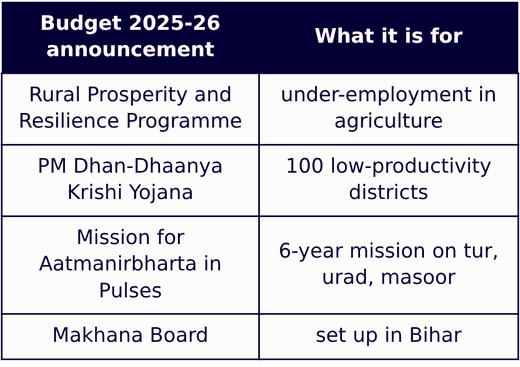 The other three names do not correspond to any programme announced in that Budget.
Hence option (b) is correct.
The other three names do not correspond to any programme announced in that Budget.
Hence option (b) is correct.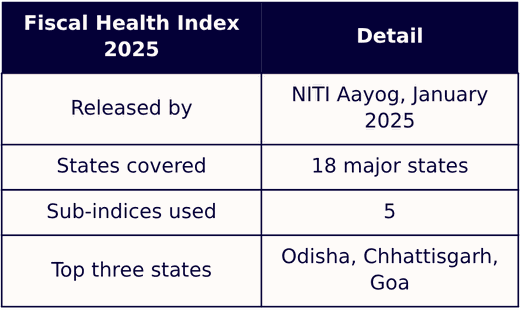 The CAG only supplies the audited state accounts on which the index is built and does not publish the index itself; neither the Reserve Bank nor the Ministry of Finance brings it out.
Hence option (a) is correct.
The CAG only supplies the audited state accounts on which the index is built and does not publish the index itself; neither the Reserve Bank nor the Ministry of Finance brings it out.
Hence option (a) is correct.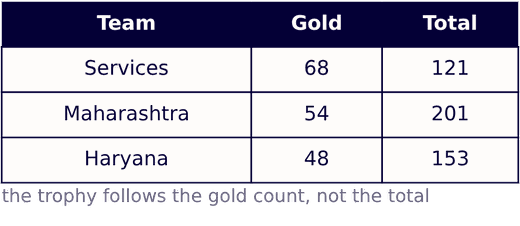 The trophy is named after Raja Bhalindra Singh, the long-serving president of the Indian Olympic Association and a member of the International Olympic Committee.
Hence option (c) is correct.
The trophy is named after Raja Bhalindra Singh, the long-serving president of the Indian Olympic Association and a member of the International Olympic Committee.
Hence option (c) is correct.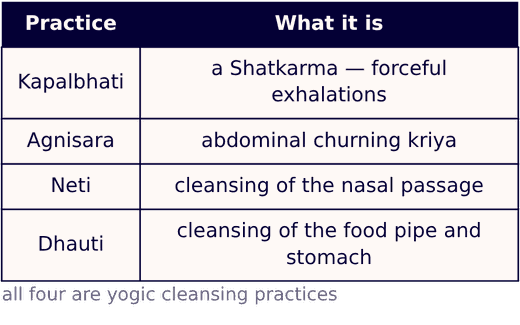 Hence option (c) is correct.
 The game had been played internationally since the 1920s, the International Table Tennis Federation having been founded in 1926, but it took until Seoul to reach the Olympics; the doubles events were replaced by team events from Beijing 2008.
Hence option (a) is correct.
The game had been played internationally since the 1920s, the International Table Tennis Federation having been founded in 1926, but it took until Seoul to reach the Olympics; the doubles events were replaced by team events from Beijing 2008.
Hence option (a) is correct.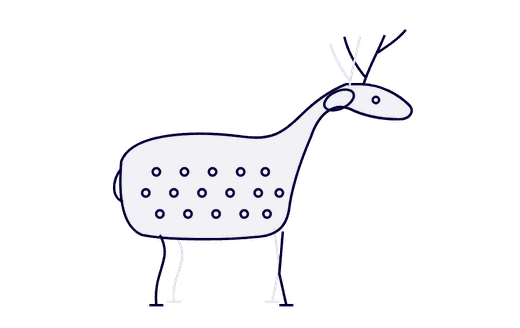
 The Nilgiri tahr is a goat-antelope of the Western Ghats and carries curved horns rather than antlers, the barasingha's antlers branch into twelve or more tines, and the sambar is far larger with a plain dark-brown coat and no spots.
Hence option (d) is correct.
The Nilgiri tahr is a goat-antelope of the Western Ghats and carries curved horns rather than antlers, the barasingha's antlers branch into twelve or more tines, and the sambar is far larger with a plain dark-brown coat and no spots.
Hence option (d) is correct.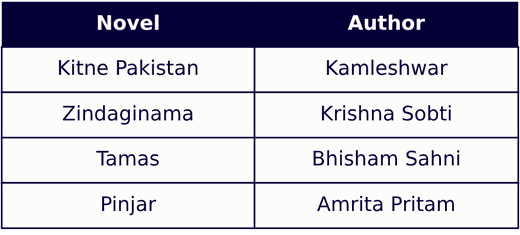 Kamleshwar was a leading writer of the Nayi Kahani movement and also a well-known editor and screenwriter.
Hence option (a) is correct.
Kamleshwar was a leading writer of the Nayi Kahani movement and also a well-known editor and screenwriter.
Hence option (a) is correct.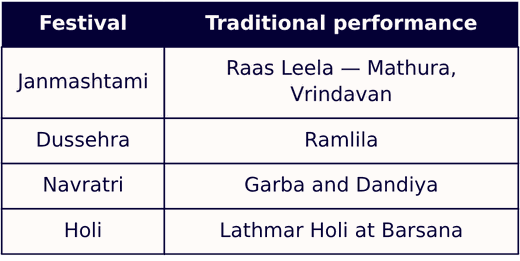 Diwali marks Rama's return to Ayodhya, Holi is the spring festival of colours and Raksha Bandhan celebrates the bond of brother and sister — none of them is the occasion for Raas Leela.
Hence option (c) is correct.
Diwali marks Rama's return to Ayodhya, Holi is the spring festival of colours and Raksha Bandhan celebrates the bond of brother and sister — none of them is the occasion for Raas Leela.
Hence option (c) is correct.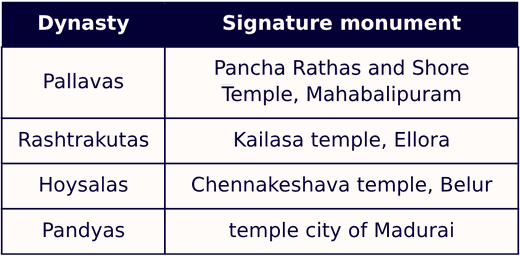 Mahabalipuram is a UNESCO World Heritage Site; the Rashtrakutas carved the Kailasa temple at Ellora, the Hoysalas built at Belur and Halebidu and the Pandyas ruled from Madurai.
Hence option (b) is correct.
Mahabalipuram is a UNESCO World Heritage Site; the Rashtrakutas carved the Kailasa temple at Ellora, the Hoysalas built at Belur and Halebidu and the Pandyas ruled from Madurai.
Hence option (b) is correct.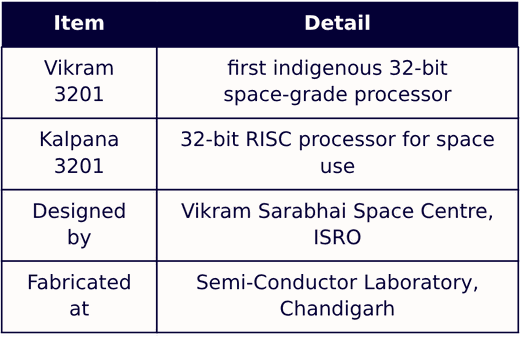 These chips run the onboard navigation, guidance and control computers, and they end ISRO's dependence on imported radiation-tolerant processors.
Hence option (c) is correct.
These chips run the onboard navigation, guidance and control computers, and they end ISRO's dependence on imported radiation-tolerant processors.
Hence option (c) is correct.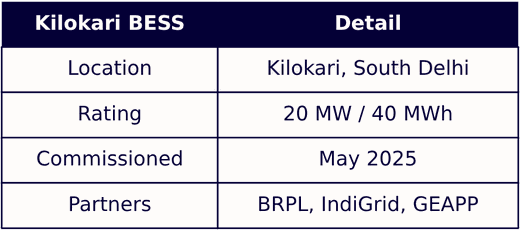 Hence option (c) is correct.
 The Treaty of Seringapatam (1792) ended the Third Anglo-Mysore War and the Treaty of Lahore (1846) the First Anglo-Sikh War, so neither can close an Anglo-Maratha war.
Hence option (c) is correct.
The Treaty of Seringapatam (1792) ended the Third Anglo-Mysore War and the Treaty of Lahore (1846) the First Anglo-Sikh War, so neither can close an Anglo-Maratha war.
Hence option (c) is correct.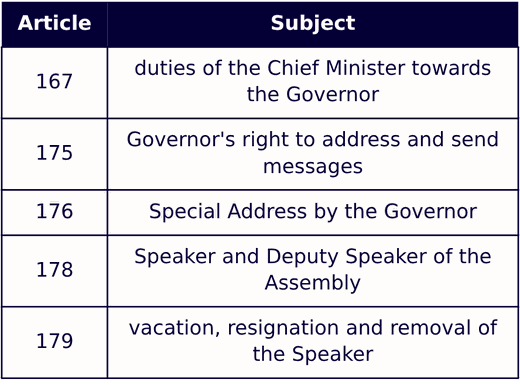 Article 176 is the state counterpart of Article 87, which provides for the President's special address to Parliament.
Hence option (b) is correct.
Article 176 is the state counterpart of Article 87, which provides for the President's special address to Parliament.
Hence option (b) is correct.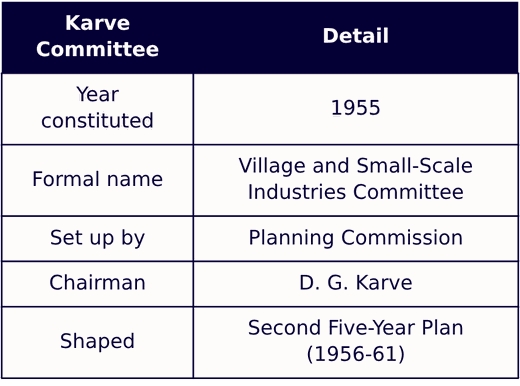 Hence option (c) is correct.
 So the only organism in the list that is not a parasite is yeast.
Hence option (d) is correct.
So the only organism in the list that is not a parasite is yeast.
Hence option (d) is correct.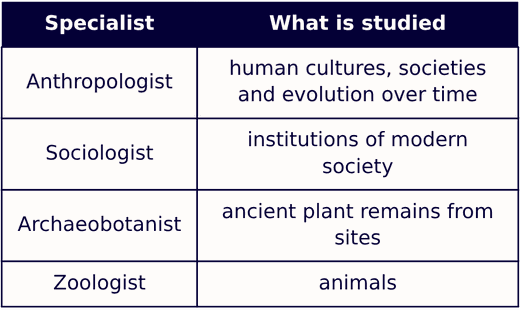 A sociologist studies the institutions of present-day society, an archaeobotanist studies plant remains recovered from excavated sites, and a zoologist studies animals — none of the three covers the whole span of human culture and evolution.
Hence option (c) is correct.
A sociologist studies the institutions of present-day society, an archaeobotanist studies plant remains recovered from excavated sites, and a zoologist studies animals — none of the three covers the whole span of human culture and evolution.
Hence option (c) is correct.