SSC CHSL 27 November 2025 · Shift 1 · English Language — questions with answers · ShikshaSphere
Chapter 156 of 200
27 November 2025 · Shift 1
English Language
25 questions ~25 min readFree
25 questions
A
1
Choose a word that is similar in meaning to the word in bold.
Students often rely on reference books that are not easily obtainable in small libraries.
A.Reachable
B.Interminable
C.Probable
D.Accessible
Solution
Synonym
The word in bold is 'obtainable', which means 'able to be got, acquired or procured'.
'Accessible' means 'able to be obtained, used or entered easily', so it conveys exactly the same idea in the sentence: books that cannot easily be got in small libraries.
'Reachable' refers to physical distance or being contactable, 'interminable' means endless and tiresome, and 'probable' means likely to happen — none of them expresses availability.
Hence option (d) is the correct answer.
2
Choose the option that has an error in the sentence.
It is necessary for employees to become more responsibility at the workplace.
A.It is necessary
B.for employees to become
C.more responsibility
D.at the workplace
Solution
Error spotting
'Become' is a linking verb, and a linking verb is completed by an adjective (a subject complement), not by a noun of quality.
The comparative word 'more' also signals that an adjective must follow, so the phrase should read 'more responsible'.
'Responsibility' is a noun; 'to become more responsibility' therefore breaks the linking-verb rule, and part (c) carries the error.
The corrected sentence is: It is necessary for employees to become more responsible at the workplace.
Hence option (c) is the correct answer.
3
Choose the correct sentence.
A.Sahil suggested me to take rest.
B.Sahil suggested that I take rest.
C.Sahil suggested me that I take rest.
D.Sahil suggested for me to take rest.
Solution
Verb pattern: suggest
The verb 'suggest' never takes a personal object immediately after it, and it is never followed by 'to + verb'.
Its correct pattern is 'suggest + that-clause', in which the verb of the clause stays in the base (subjunctive) form: suggested that I take rest.
Option (b) follows this pattern exactly.
Options (a) and (d) wrongly attach an object ('me', 'for me') with a to-infinitive, and option (c) inserts an unnecessary object 'me' before the that-clause.
Hence option (b) is the correct answer.
4
Fill in the blank with the most appropriate preposition:
Revant was accused embezzling public money.
A.for
B.about
C.with
D.of
Solution
Preposition with 'accuse'
'Accuse' takes the fixed preposition 'of' before the offence: accuse somebody of something / of doing something.
So the sentence reads: Revant was accused of embezzling public money.
'Charge' takes 'with' and 'blame' takes 'for', which is why 'with' and 'for' are tempting but wrong here.
Hence option (d) is the correct answer.
5
Fill in the blank with the most appropriate option:
During the negotiations, her approach was aiming to ease tensions and promote agreement.
A.abrasive
B.unpredictable
C.conciliatory
D.gloomy
Solution
Vocabulary: word choice
The second half of the sentence — 'aiming to ease tensions and promote agreement' — describes the purpose of her approach, so the blank needs a word meaning 'peace-making'.
'Conciliatory' means intended to pacify, to win goodwill and to settle a dispute, which matches that purpose perfectly.
'Abrasive' means harsh and irritating and 'gloomy' means depressing — both contradict the idea of easing tension; 'unpredictable' says nothing about making peace.
Hence option (c) is the correct answer.
6
Choose the correctly spelt word:
A.Abbreivation
B.Abbreviation
C.Abbravietion
D.Abbriviation
Solution
Spelling
The correctly spelt word is 'Abbreviation', meaning a shortened form of a word or phrase.
Break it as Ab-bre-vi-a-tion: double 'b' after 'A', then 'brev' (from Latin brevis = short), and the ending '-iation'.
The other options misplace these parts — 'Abbreivation' swaps 'vi' to 'iv', 'Abbravietion' and 'Abbriviation' change the vowel of 'brev'.
Hence option (b) is the correct answer.
7
Choose the correctly spelt word:
A.Milleniuum
B.Millennium
C.Millannium
D.Millennuim
Solution
Spelling
The correctly spelt word is 'Millennium', a period of one thousand years.
It comes from Latin 'mille' (thousand) + 'annus' (year), so it keeps double 'l' from mille and double 'n' from annus, and ends in '-ium'.
'Milleniuum' and 'Millannium' drop one 'n' or change the vowel, and 'Millennuim' reverses the final '-ium' to '-uim'.
Hence option (b) is the correct answer.
8
Choose the best option to replace the underlined part to improve the given sentence. If no substitution is required, select "No substitution."
They reunited at the park at a long time.
A.till a long time
B.after a long time
C.before a long time
D.No substitution
Solution
Prepositional phrase
The sentence means that the two people met again once a long gap had passed, and the fixed expression for that is 'after a long time'.
'At' is used with a point of time (at 5 o'clock, at noon), not with a stretch of time, so 'at a long time' is unidiomatic.
'Till a long time' and 'before a long time' are also not standard English collocations.
The improved sentence is: They reunited at the park after a long time.
Hence option (b) is the correct answer.
9
Choose the best option to replace the underlined part to improve the given sentence. If no substitution is required, select "No substitution."
She is married with a man who works in the Air Force.
A.Married for
B.Married to
C.Married by
D.No substitution
Solution
Preposition with 'married'
When we name the person one has wed, the fixed preposition after 'married' is 'to', not 'with'.
So the sentence becomes: She is married to a man who works in the Air Force.
'Married with' is used only in a different sense — 'married with two children' — where 'with' introduces what the couple has, not the spouse.
'Married for' shows duration (married for ten years) and 'married by' names the person who performs the ceremony, so neither fits here.
Hence option (b) is the correct answer.
10
Choose the correct indirect narration of the following statement from the given alternatives:
The teacher said, "There is a library near our school which is filled with different kinds of books."
A.The teacher said that there was a library near their school which had been filled with different kinds of books.
B.The teacher said that there had been a library near their school which was filled with different kinds of books.
C.The teacher said that there was a library near their school which was filled with different kinds of books.
D.The teacher said that there was a library near your school which was filled with different kinds of books.
Solution
Direct to indirect speech
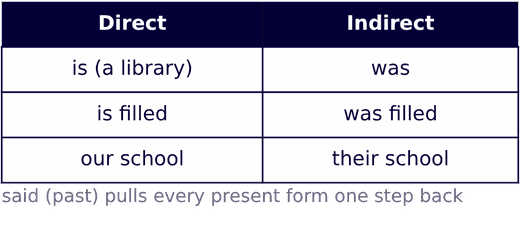
The reporting verb 'said' is in the past tense, so every present-tense verb inside the quotation moves one step back into the past.
'There is a library' becomes 'there was a library', and 'which is filled' becomes 'which was filled'.
The possessive 'our' belongs to the speaker's side and, since the reporter is a third person, it changes to 'their'.
Option (a) needlessly makes the second verb past perfect and option (b) does the same to the first verb; option (d) keeps 'your', which is the wrong person.
Hence option (c) is the correct answer.
11
Change the following sentence into the Active form.
It was being believed that the decision would be beneficial.
A.The decision would be beneficial.
B.The committee believed the decision would be beneficial.
C.People were believing that the decision would be beneficial.
D.Someone has believed that the decision would be beneficial.
Solution
Passive to active voice
'It was being believed' is the past continuous passive; its active counterpart must also be past continuous, that is 'was/were + verb-ing'.
The agent is not named in the passive sentence, so in the active form we supply the general doer 'people'.
This gives: People were believing that the decision would be beneficial, with the that-clause left untouched.
Option (a) drops the reporting clause altogether, option (b) invents a specific agent 'the committee' and changes the tense to simple past, and option (d) shifts to the present perfect 'has believed'.
Hence option (c) is the correct answer.
12
Choose the option that is the most appropriate conversion of the following sentence into Direct Speech.
The boy said that he was afraid of the darkness and requested the woman to stay with him.
A.The boy said, "I am afraid of the darkness. Please stay with me."
B.The boy said, "I was afraid of the darkness. Kindly stay with me."
C.The boy said, ''l am afraid of the darkness. Will you stay with me?"
D.The boy said, "I was afraid of the darkness. Stay with me."
Solution
Indirect to direct speech
Turning indirect speech into direct speech reverses the backshift, so the reported 'he was afraid' returns to the speaker's own words 'I am afraid'.
The second part, 'requested the woman to stay with him', is a request; in direct speech a request is written as an imperative softened by 'please': 'Please stay with me.'
The pronoun 'him' becomes 'me' because the boy is now speaking for himself.
Options (b) and (d) keep 'was afraid', which is the indirect form, and (d) also turns the polite request into a bare command; option (c) converts the request into a question, which changes the sense.
Hence option (a) is the correct answer.
13
Which of the following sentences contains a misspelled word?
A.The engineer recommended using concrete in the foundation to ensure strength and durability.
B.The committee demanded a concrete plan before giving approval.
C.Sheela required more concrete examples to support her argument.
D.In the absence of concreet proof, the theory remains purely speculative.
Solution
Misspelt word
All four sentences use the same word, so only its spelling has to be compared.
The correct spelling is 'concrete' — con-crete, ending in '-crete' with a single 'e' before the final 'te'.
Option (d) writes it as 'concreet', with a double 'e' and no final 'e', which is wrong; sentences (a), (b) and (c) spell it correctly.
Hence option (d) is the correct answer.
14
Choose the correct passive voice transformation of the sentence:
The dedicated group of scientists, who had been examining the data for a long time, finally published their findings.
A.Their findings were finally published by the dedicated group of scientists, who had been examining the data for a long time.
B.Their findings had been finally published by the dedicated group of scientists, who had been examining the data for a long time.
C.Their findings have been finally published by the dedicated group of scientists, who had been examining the data for a long time.
D.The dedicated group of scientists was finally published by their findings.
Solution
Active to passive voice
Strip the sentence to its main clause: 'The dedicated group of scientists ... finally published their findings.' The relative clause 'who had been examining the data for a long time' merely describes the subject and is carried over unchanged.
The main verb 'published' is simple past, so the passive of simple past is 'was/were + past participle'; the object 'their findings' is plural, hence 'were published'.
This gives: Their findings were finally published by the dedicated group of scientists, who had been examining the data for a long time.
Options (b) and (c) wrongly use 'had been published' and 'have been published', which belong to the past perfect and present perfect; option (d) exchanges the subject and object and makes nonsense of the meaning.
Hence option (a) is the correct answer.
15
Directions (Qs. 15-19): Read the following passage carefully and answer the questions that follow.
National Farmers' Day, observed every year on 23rd December, commemorates the birth anniversary of Chaudhary Charan Singh. It highlights the importance of India's agriculture sector, which represents not just food security but also rural stability and economic growth.
India is home to millions of small farmers, many of them working in diverse climatic zones. Each state contributes a unique crop variety: such as Basmati rice, Alphonso mangoes, and Darjeeling tea, reflecting the soil, seasons, and labor of its growers.
Despite its vital role, the farming sector faces significant hurdles. With rising costs of chemical fertilizers, traditional cultivators are struggling to maintain their profits. Government schemes, like soil health cards, aim to improve yields and reduce the dependency on harmful inputs. However, access to fair prices and cold storage remains limited for many producers.
National Farmers' Day is more than ceremonial. It reminds us that prioritizing agriculture supports food sovereignty, rural development, and environmental health. As consumer awareness grows around organic produce, farm-fresh goods offer a healthy alternative to processed foods.
By buying local produce, we are not only sustaining a vital industry but also boosting incomes and encouraging chemically-free farming.
Identify the type of the following sentence from the passage:
"Each state contributes a unique crop variety: such as Basmati rice, Alphonso mangoes, and Darjeeling tea, reflecting the soil, seasons, and labor of its growers.*
A.Simple sentence
B.Compound sentence
C.Complex sentence
D.Compound-complex sentence
Solution
Sentence type
Count the finite verbs: the sentence has only one, 'contributes', in 'Each state contributes a unique crop variety'.
Everything that follows is a phrase, not a clause — 'such as Basmati rice, Alphonso mangoes, and Darjeeling tea' is an example phrase and 'reflecting the soil, seasons, and labor of its growers' is a participial phrase with no subject or finite verb of its own.
A sentence with exactly one independent clause and no subordinate clause is a simple sentence.
A compound sentence would need two independent clauses joined by a coordinator, and a complex sentence would need a subordinate clause; neither is present here.
Hence option (a) is the correct answer.
16
Directions (Qs. 15-19): Read the following passage carefully and answer the questions that follow.
National Farmers' Day, observed every year on 23rd December, commemorates the birth anniversary of Chaudhary Charan Singh. It highlights the importance of India's agriculture sector, which represents not just food security but also rural stability and economic growth.
India is home to millions of small farmers, many of them working in diverse climatic zones. Each state contributes a unique crop variety: such as Basmati rice, Alphonso mangoes, and Darjeeling tea, reflecting the soil, seasons, and labor of its growers.
Despite its vital role, the farming sector faces significant hurdles. With rising costs of chemical fertilizers, traditional cultivators are struggling to maintain their profits. Government schemes, like soil health cards, aim to improve yields and reduce the dependency on harmful inputs. However, access to fair prices and cold storage remains limited for many producers.
National Farmers' Day is more than ceremonial. It reminds us that prioritizing agriculture supports food sovereignty, rural development, and environmental health. As consumer awareness grows around organic produce, farm-fresh goods offer a healthy alternative to processed foods.
By buying local produce, we are not only sustaining a vital industry but also boosting incomes and encouraging chemically-free farming.
What is the tense used in the sentence below, and why is it appropriate?
"National Farmers' Day, observed every year on 23rd December."
A.Past Continuous - because the event is ongoing
B.Present Perfect - because it has just happened
C.Present Simple - because it states a general fact
D.Future Simple - because it refers to a yearly event
Solution
Tense identification
The phrase 'observed every year on 23rd December' describes something that happens again and again on a fixed date.
Repeated actions, routines and general facts are expressed by the present simple tense, and the adverbial 'every year' is a typical present-simple marker.
The full sentence in the passage runs 'National Farmers' Day ... commemorates the birth anniversary', where 'commemorates' is plainly present simple.
It is not past continuous (no 'was + -ing'), not present perfect (no 'has/have + V3'), and not future simple, because a yearly observance is a standing fact, not a coming event.
Hence option (c) is the correct answer.
17
Directions (Qs. 15-19): Read the following passage carefully and answer the questions that follow.
National Farmers' Day, observed every year on 23rd December, commemorates the birth anniversary of Chaudhary Charan Singh. It highlights the importance of India's agriculture sector, which represents not just food security but also rural stability and economic growth.
India is home to millions of small farmers, many of them working in diverse climatic zones. Each state contributes a unique crop variety: such as Basmati rice, Alphonso mangoes, and Darjeeling tea, reflecting the soil, seasons, and labor of its growers.
Despite its vital role, the farming sector faces significant hurdles. With rising costs of chemical fertilizers, traditional cultivators are struggling to maintain their profits. Government schemes, like soil health cards, aim to improve yields and reduce the dependency on harmful inputs. However, access to fair prices and cold storage remains limited for many producers.
National Farmers' Day is more than ceremonial. It reminds us that prioritizing agriculture supports food sovereignty, rural development, and environmental health. As consumer awareness grows around organic produce, farm-fresh goods offer a healthy alternative to processed foods.
By buying local produce, we are not only sustaining a vital industry but also boosting incomes and encouraging chemically-free farming.
What does "environmental health" most likely refer to in this sentence?
"It reminds us that prioritizing agriculture supports food sovereignty, rural development, and environmental health."
A.Equal distribution of crops
B.Balance between rich and poor
C.Well-being and sustainability of nature
D.Government pricing laws
Solution
Contextual meaning
'Environmental health' is listed beside 'food sovereignty' and 'rural development' as one of the good outcomes that giving priority to agriculture brings.
In the passage the environment is discussed through soil health cards, reducing harmful chemical inputs and chemically-free farming, so the phrase refers to keeping nature — soil, water, air and ecosystems — sound and sustainable.
That is exactly what option (c), 'Well-being and sustainability of nature', states.
Options (a) and (b) concern distribution and social equity, and option (d) concerns pricing policy; the passage links none of these to the word 'environmental'.
Hence option (c) is the correct answer.
18
Directions (Qs. 15-19): Read the following passage carefully and answer the questions that follow.
National Farmers' Day, observed every year on 23rd December, commemorates the birth anniversary of Chaudhary Charan Singh. It highlights the importance of India's agriculture sector, which represents not just food security but also rural stability and economic growth.
India is home to millions of small farmers, many of them working in diverse climatic zones. Each state contributes a unique crop variety: such as Basmati rice, Alphonso mangoes, and Darjeeling tea, reflecting the soil, seasons, and labor of its growers.
Despite its vital role, the farming sector faces significant hurdles. With rising costs of chemical fertilizers, traditional cultivators are struggling to maintain their profits. Government schemes, like soil health cards, aim to improve yields and reduce the dependency on harmful inputs. However, access to fair prices and cold storage remains limited for many producers.
National Farmers' Day is more than ceremonial. It reminds us that prioritizing agriculture supports food sovereignty, rural development, and environmental health. As consumer awareness grows around organic produce, farm-fresh goods offer a healthy alternative to processed foods.
By buying local produce, we are not only sustaining a vital industry but also boosting incomes and encouraging chemically-free farming.
Which idiom best matches the message conveyed by the sentence below?
"By buying local produce, we are not only sustaining a vital industry but also boosting incomes and encouraging chemically-free farming."
Which idiom expresses the idea of achieving multiple positive results with a single action?
A.Burn the midnight oil
B.Kill two birds with one stone
C.Add fuel to the fire
D.Let the cat out of the bag
Solution
Idiom
The sentence names one single action — buying local produce — and then lists three gains from it: a vital industry is sustained, incomes rise and chemically-free farming is encouraged.
The idiom for gaining more than one benefit from a single effort is 'Kill two birds with one stone'.
'Burn the midnight oil' means to work late into the night, 'add fuel to the fire' means to worsen a quarrel, and 'let the cat out of the bag' means to reveal a secret — none describes a double benefit.
Hence option (b) is the correct answer.
19
Directions (Qs. 15-19): Read the following passage carefully and answer the questions that follow.
National Farmers' Day, observed every year on 23rd December, commemorates the birth anniversary of Chaudhary Charan Singh. It highlights the importance of India's agriculture sector, which represents not just food security but also rural stability and economic growth.
India is home to millions of small farmers, many of them working in diverse climatic zones. Each state contributes a unique crop variety: such as Basmati rice, Alphonso mangoes, and Darjeeling tea, reflecting the soil, seasons, and labor of its growers.
Despite its vital role, the farming sector faces significant hurdles. With rising costs of chemical fertilizers, traditional cultivators are struggling to maintain their profits. Government schemes, like soil health cards, aim to improve yields and reduce the dependency on harmful inputs. However, access to fair prices and cold storage remains limited for many producers.
National Farmers' Day is more than ceremonial. It reminds us that prioritizing agriculture supports food sovereignty, rural development, and environmental health. As consumer awareness grows around organic produce, farm-fresh goods offer a healthy alternative to processed foods.
By buying local produce, we are not only sustaining a vital industry but also boosting incomes and encouraging chemically-free farming.
What is the main purpose of observing National Farmers' Day, according to the passage?
A.To promote the import of processed foods
B.To encourage people to leave rural areas
C.To highlight the value of agriculture and support farmers
D.To replace farming with industrial robotics
Solution
Reading comprehension
The first paragraph states the purpose directly: the day 'highlights the importance of India's agriculture sector, which represents not just food security but also rural stability and economic growth'.
The last paragraph adds that the day reminds us to prioritise agriculture and to buy local produce, that is, to support farmers.
Option (c), 'To highlight the value of agriculture and support farmers', sums up both ideas.
The passage in fact calls processed foods the less healthy choice, says nothing about people leaving rural areas and never mentions robotics, so (a), (b) and (d) are contradicted or unsupported.
Hence option (c) is the correct answer.
20
Rearrange the following sentence parts to form a meaningful and grammatically correct paragraph:
P. She removed all old coating and surface defects from the entire car body by thorough sanding.
Q. She observed the fresh coating dry to a smooth finish after applying several thin, even layers.
R. She protected the windows and trims from spray by carefully masking them.
S. The car achieved a flawless colour, looked brand new, and was ready to be driven.
A.Q, R, P, S
B.P, R, Q, S
C.S, R, Q, P
D.R, P, Q, S
Solution
Para jumbles
The paragraph describes repainting a car, so arrange the parts in the natural order of the job.
P is the opening step: the old coating and surface defects are sanded off before anything else can be done.
R must follow P, because the windows and trims are masked only after sanding and just before the spray begins.
Q comes next — the thin, even layers of fresh coating are applied and left to dry — and S is the closing line, giving the finished result.
The sequence is therefore P, R, Q, S, so hence option (b) is the correct answer.
21
What is the antonym of "Wordy"?
A.Redundant
B.Laconic
C.Verbose
D.Inflated
Solution
Antonym
'Wordy' describes writing or speech that uses far more words than the idea actually needs.
Its opposite must therefore mean 'expressed in very few words', and that is exactly the meaning of 'laconic'.
'Verbose' and 'redundant' both point to excess wording, so they are synonyms of 'wordy' rather than antonyms, and 'inflated' means exaggerated or overblown.
Hence option (b) is the correct answer.
22
Which word is closest in meaning to ghastly?
The detective described the crime scene in such a ghastly manner that everyone felt uneasy.
A.Cheerful
B.Ordinary
C.Gruesome
D.Mild
Solution
Synonym in context
'Ghastly' means extremely unpleasant, shocking or horrifying.
In the sentence the description of a crime scene leaves everyone uneasy, so the word must carry a sense of horror and disgust.
'Gruesome' means causing horror or revulsion, especially through something violent, so it fits the sentence exactly.
'Cheerful' reverses the sense, while 'ordinary' and 'mild' weaken it to the point of contradiction.
Hence option (c) is the correct answer.
23
Which of the following does NOT represent a meaning of the homonym "condition"?
A.To make something stronger or more flexible
B.The physical or mental state of a person or thing
C.To teach or accustom someone to behave in a particular way
D.A rule or requirement that must be satisfied for an event to occur
Solution
Homonym: condition
As a noun, 'condition' means the state a person or thing is in, which is option (b), and also a requirement that must be met before something can happen, which is option (d).
As a verb, 'condition' means to train or accustom somebody to behave in a particular way, which is option (c).
Making something stronger or more flexible is the work of words such as 'strengthen', 'reinforce' or 'limber' — it is not one of the recognised senses of 'condition'.
Hence option (a) is the correct answer.
24
Which word is used for a solemn funeral procession?
A.Claque
B.Assembly
C.Cortege
D.Carousal
Solution
One-word substitution
A 'cortege' is the solemn procession of mourners and vehicles that accompanies a coffin at a funeral.
'Claque' is a group hired to applaud a performer, 'assembly' is any gathering of people for a purpose, and 'carousal' is a noisy drinking party.
Only 'cortege' carries both required ideas together — a procession, and the solemn funeral setting.
Hence option (c) is the correct answer.
25
Choose the correct one-word substitution for the italicized part.
Meera has always been a person who strongly resists authority, control, and traditional norms, frequently questioning every rule imposed on her.
A.Optimist
B.Traditionalist
C.Conformist
D.Anarchist
Solution
One-word substitution
The italicised part describes somebody who rejects authority, control and established rules altogether.
An 'anarchist' is exactly that — a person who opposes every form of imposed authority and government.
A 'conformist' and a 'traditionalist' do the opposite, since both accept rules and long-established customs.
An 'optimist' only expects favourable outcomes and says nothing about authority at all.
Hence option (d) is the correct answer.
Finished reading? Now test yourself.
The same 25 questions, but with a timer and the answers hidden — 15 minutes.

 Option (a) needlessly makes the second verb past perfect and option (b) does the same to the first verb; option (d) keeps 'your', which is the wrong person.
Hence option (c) is the correct answer.
Option (a) needlessly makes the second verb past perfect and option (b) does the same to the first verb; option (d) keeps 'your', which is the wrong person.
Hence option (c) is the correct answer.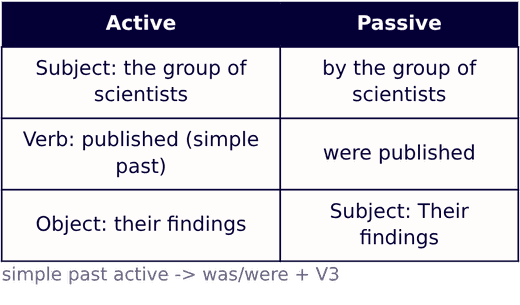 This gives: Their findings were finally published by the dedicated group of scientists, who had been examining the data for a long time.
Options (b) and (c) wrongly use 'had been published' and 'have been published', which belong to the past perfect and present perfect; option (d) exchanges the subject and object and makes nonsense of the meaning.
Hence option (a) is the correct answer.
This gives: Their findings were finally published by the dedicated group of scientists, who had been examining the data for a long time.
Options (b) and (c) wrongly use 'had been published' and 'have been published', which belong to the past perfect and present perfect; option (d) exchanges the subject and object and makes nonsense of the meaning.
Hence option (a) is the correct answer.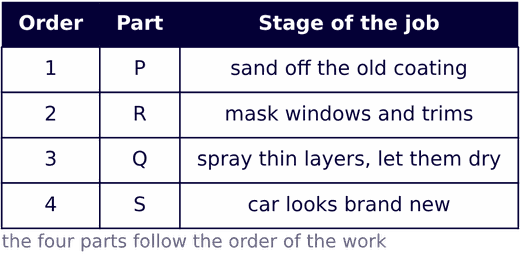 The sequence is therefore P, R, Q, S, so hence option (b) is the correct answer.