SSC CHSL 27 November 2025 · Shift 2 · General Intelligence — questions with answers · ShikshaSphere
Chapter 157 of 200
27 November 2025 · Shift 2
General Intelligence
25 questions ~25 min readFree
25 questions
A
26
In a class, among the passed students, A is 14th from the top and 19nd from the bottom. If 9 students failed, what is the total number of students in the class?
A.41
B.42
C.43
D.44
Solution
Ranking and position
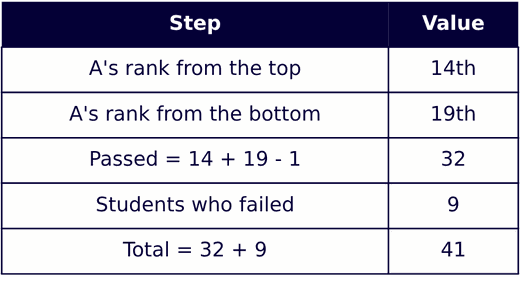
When one person's rank is counted from both ends, total = (rank from the top) + (rank from the bottom) -1, because that person gets counted twice.
Number of passed students =14+19-1=32
Total students = passed students + failed students
=32+9=41
Hence the correct option is (a).
27
In a row of children, is 12 th from the left and is 18 th from the right. If is 8th to the right of A and is exactly in the middle of and , what is the total number of children in the row?
A.46
B.43
C.44
D.45
Solution
Ranking and position
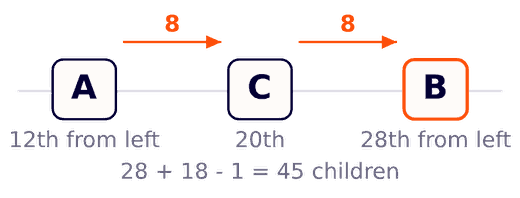
A is 12th from the left and C is 8 places to the right of A, so C's position from the left =12+8=20th.
C is exactly in the middle of A and B, so C is as far from B as it is from A, i.e. B is 8 places to the right of C.
B's position from the left =20+8=28th.
B is 28th from the left and 18th from the right, so total children =28+18-1=45.
Hence the correct option is (d).
28
In a row of students, Mohan is 15th from the left and Sohan is 16th from the right. If they interchange their positions, Mohan becomes 24th from the left. How many students are there in the row?
A.41
B.40
C.39
D.38
Solution
Ranking and position
When two people interchange seats, each takes the other's original place.
So Mohan's new position, 24th from the left, was Sohan's original position from the left.
Sohan is therefore 24th from the left and 16th from the right.
Total students =24+16-1=39
Mohan's own starting rank of 15th is extra information and is not needed.
Hence the correct option is (c).
29
A family consists of seven persons A, B, C, D, E, F, G.
1. is the daughter of .
2. F is the son of C.
3. is the brother of .
4. is the mother of .
5. G is the sister-in-law of F .
6. is the father of .
How is A related to F?
A.Father
B.Grandfather
C.Uncle
D.Son
Solution
Blood relation
A is the father of D, and B is the daughter of A, so B and D are children of A.
C is the brother of D, so C is also a child of A — that is, A is C's father.
F is the son of C, so F belongs to the generation below C.
A is thus two generations above F, and A is a male, so A is the grandfather of F.
Hence the correct option is (b).
30
Read the following statement carefully and identify the conclusion that follows.Statement:
No flower is a tree.
All trees are tall.
Conclusions:
I. No flower is tall.
II. Some tall things are not flowers.
A.Only conclusion I follows.
B.Only conclusion II follows.
C.Both conclusions I and II follow.
D.Neither conclusion I nor II follows.
Solution
Syllogism
'All trees are tall' puts the whole class of trees inside the class of tall things.
'No flower is a tree' only keeps flowers outside the class of trees; it says nothing about flowers and tallness.
Conclusion I: a flower is barred from being a tree, but the tall region outside 'trees' is still open to flowers, so 'No flower is tall' is only a possibility, not a certainty — it does not follow.
Conclusion II: trees are tall, and no tree can be a flower, so those trees are tall things that are not flowers — this is definitely true, so it follows.
Hence only conclusion II follows, and the correct option is (b).
31
A series is given with one term missing. Select the correct alternative from the given ones that will complete the series.
7, 25, 104, 316, ?, 3808, 15236, 45712
A.1264
B.1268
C.1260
D.1256
Solution
Number series
The multiplier alternates between 3 and 4, and 4 is added every time.
So the missing term
The pattern continues: , , .
Hence the correct option is (b).
32
A series is given with one term wrong. Select the wrong term from the given alternatives.
-319, -330, -342, -355, -368, -384, -400, -417
A.-368
B.-330
C.-319
D.-400
Solution
Wrong term in series
Ignore the minus signs and look at how fast the numbers grow; the gap should increase by 1 each step: +11,+12,+13,+14,+15,+16,+17.
319+11=330, 330+12=342, 342+13=355
The next gap must be +14, so the fifth term should be 355+14=369, i.e. -369.
The remaining terms confirm the rule: 369+15=384, 384+16=400, 400+17=417.
So the term printed as -368 is the wrong one, and the correct option is (a).
33
A series is given with one term missing. Select the correct alternative from the given ones that will complete the series.
4, 17, ?, 224, 901, 2708, 10837, 32516
A.168
B.73
C.275
D.182
Solution
Number series
Here the multiplier alternates between 3 and 4, and 5 is added every time.
So the missing term
Verify with the later terms: , , .
Hence the correct option is (b).
34
Few of the letters are given followed by a question mark (?) these letters are following a specific pattern you have to give the correct option which can replace question mark.
Complete the series: E, I, L, N, ?
A.O
B.P
C.Q
D.R
Solution
Letter series
Replace each letter by its position in the alphabet: E=5, I=9, L=12, N=14.
The gaps are +4, +3, +2 — each gap is one less than the one before it.
So the next gap is +1, giving 14+1=15, and the 15th letter is O.
Hence the correct option is (a).
35
If 15 # 20 = 1200 and 5 # , then what is the value of 25 # 30?
A.3000
B.3200
C.2800
D.3400
Solution
Mathematical operations
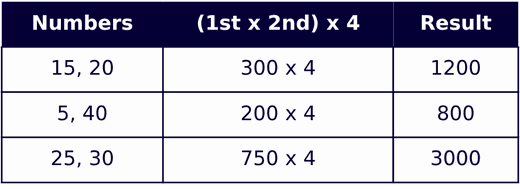
Find what the symbol # does: multiply the two numbers and then multiply the product by 4.
Both given results agree, so apply the same rule to 25 # 30.
Hence the correct option is (a).
36
If 650 & and 820 & 35 , then what is the value of 945 & 6 $ 8?
A.890
B.897
C.900
D.905
Solution
Mathematical operations
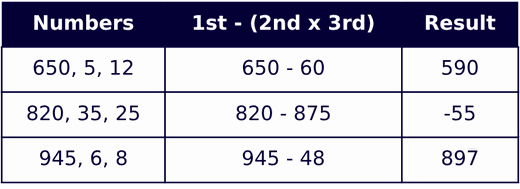
The rule joining the three numbers is: first number - (second number third number).
Both given values match, so apply the same rule to the last expression with 945, 6 and 8.
Hence the correct option is (b).
37
In the questions given below, there are three statements followed by two conclusions I and II. You have to take the three given statements to be true even if they seem to be at variance from commonly known facts. Read all the conclusions and then decide which of the given conclusions logically follows from the three statements disregarding commonly known facts.Statements:
Only some engineers are scientists
Some scientists are artists
All artists are intelligent.
Conclusion:
I. Some engineers are not intelligent.
II. Some intelligent are scientists.
A.Both conclusions I and II follow
B.Only conclusion I follows
C.Only conclusion II follows
D.Neither conclusion I nor II follows
Solution
Syllogism
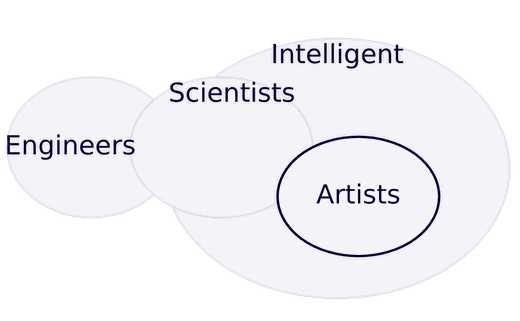
'Only some engineers are scientists' means two things: some engineers are scientists, and some engineers are definitely not scientists.
Conclusion I: those engineers who are not scientists may still be intelligent — nothing in the statements shuts them out of the 'intelligent' circle — so 'Some engineers are not intelligent' is only a possibility and does not follow.
Conclusion II: some scientists are artists, and all artists are intelligent, so those scientists are certainly intelligent.
Converting 'some scientists are intelligent' gives 'some intelligent are scientists', which therefore follows.
Hence only conclusion II follows, and the correct option is (c).
38
Six persons M, N, O, P, Q and R lived in a building with 6 floors. Only one person lived on each floor. N lived just above P. 2 persons lived between P and R. P lived on one of the floors above R. M lived just above 0 who did not live on a floor second from the bottom. How many persons lived below Q ?
A.None
B.One
C.Two
D.Three
Solution
Floor arrangement
Number the floors 1 (bottom) to 6 (top). Two persons live between P and R and P is above R, so P's floor = R's floor +3.
N lives just above P, so P cannot be on floor 6; this leaves R on 1 with P on 4, or R on 2 with P on 5.
Take R on 1 and P on 4: then N is on 5 and floors 2, 3, 6 are left for M, O and Q. M is just above O, so the only pair available is O on 2 and M on 3 — but O may not live on the second floor from the bottom, so this case fails.
So R is on 2, P on 5 and N on 6. Floors 1, 3 and 4 remain; M just above O gives O on 3 and M on 4, and Q takes floor 1.
Q sits on the lowest floor, so nobody lives below Q.
Hence the correct option is (a).
39
Price of 5 cups A, B, C, D and E is compared. Price of no two cups is same. Price of D is more than E but less than B and C . Price of A is highest. If the price of is less than , then the price of how many cups is more than ?
A.2
B.3
C.1
D.0
Solution
Comparison ordering
From 'D is more than E but less than B and C' we get B > D, C > D and D > E.
A has the highest price, so A stands at the top of the chain.
The extra condition B < C fixes the order of B and C, giving A > C > B > D > E.
Only A and C stand above B, so the price of 2 cups is more than that of B.
Hence the correct option is (a).
40
Six players P, Q, R, S, T, and U are compared on the basis of their heights. No two players have the same height. P's height is the second tallest. U's height is greater than that of and but less than that of S and T. T's height is not the maximum. Which player has the maximum height?
A.P
B.S
C.Q
D.T
Solution
Comparison ordering
U is taller than R and Q but shorter than S and T, so S > U, T > U, U > R and U > Q.
P is the second tallest, so the tallest player is neither P nor anyone below U; it must be S or T.
T is not the tallest, so S is the tallest.
The full order is S > P > T > U > R and Q (in some order).
Hence the correct option is (b).
41
8 boys S, T, U, V, W, X, Y and Z are sitting around a circular table facing towards the centre (not necessarily in the same order). Z is to the immediate right of S. Z is not the immediate neighbour of W or V. X is to the immediate left of T. Y is the immediate neighbour of is the immediate neighbour of W and Y. Who is sitting second to the right of Z ?
A.U
B.W
C.V
D.T
Solution
Circular seating arrangement
All eight boys face the centre, so for every boy the neighbour on his right is the one placed anticlockwise to him and the neighbour on his left is the one placed clockwise to him.
Y and U are the immediate neighbours of W, so the block Y - W - U is fixed, and X is to the immediate left of T gives the block T - X.
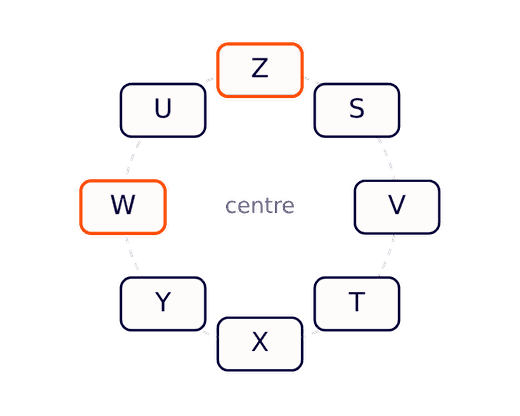
Z sits to the immediate right of S, and Z may sit beside neither W nor V, so the boy on Z's right has to be U; V then takes the only seat left, between S and T.
Counting towards the right (anticlockwise) from Z: U is first and W is second.
Hence, option (b) W is the most appropriate answer.
42
Some conditional data is provided to you in form of statement you have to check which of the following statement are logically inference from given statement.Statement : Employees who complete their projects before the deadline are given a bonus. Rahul completed his project this month before the deadline. What can we infer?
A.Rahul received a bonus this month
B.Rahul always completes work before the deadline
C.Rahul needed extra leave
D.Rahul is a hardworking employee
Solution
Logical inference
The statement lays down a rule: finishing a project before the deadline is the condition, and the bonus is its result.
Rahul is said to satisfy that condition this month, so the rule applies to him directly and its result must follow.
Options (b), (c) and (d) talk about his habit, his leave and his nature - none of these is contained in the statement, so none of them can be inferred.
Hence, option (a) is the most appropriate answer.
43
In this type of questions, question is provided with substitutes for various mathematical symbols, followed by a question involving calculation of an expression or choosing the correct/incorrect equation. You have to put the real signs in the given equation and then solve the questions as required. If '#' stands for '÷', '%' stands for '-', '$' stands for ' + ', ' stands for ' ', then find the value of: ?
A.424
B.423
C.421
D.422
Solution
Symbol substitution
Replace every substitute by the real sign it stands for; in this expression only two of them occur.
The wave symbol stands for and the dollar symbol stands for +, so the expression becomes .
By BODMAS the multiplication is done first: .
Then 420+3=423.
Hence, option (b) is the most appropriate answer.
44
After interchanging the given two signs, what will be the value of the given equation ?
× and -
?
A.22
B.-20
C.-18
D.-14
Solution
Sign interchange
Every in the expression becomes - and every - becomes .
So becomes .
By BODMAS, division and multiplication come first: .
Now 18-48+12=-30+12=-18.
Hence, option (c) is the most appropriate answer.
45
By interchanging the given two numbers (not digits) which of the following equation will NOT be correct?
4 and 6
l.
II.
A.Only I
B.Only II
C.Both I and II
D.Neither I nor II
Solution
Number interchange
Wherever the number 4 stands alone it becomes 6 and wherever 6 stands alone it becomes 4; the digits inside 10, 12 and so on are not touched.
Equation I becomes .
=12+6-5=13, which is the same as the right-hand side, so equation I stays correct.
Equation II becomes .
=32+6-4=34, but the right-hand side is 18, so equation II is not correct.
Hence, option (b) Only II is the most appropriate answer.
46
In a certain coded language 'CPET' is coded as 'IWKA' and 'TLJQ' is coded as 'ZSPX'. How will 'CPXM' be coded in the same code language?
A.GXDU
B.IWDT
C.HWCS
D.HYCT
Solution
Letter coding
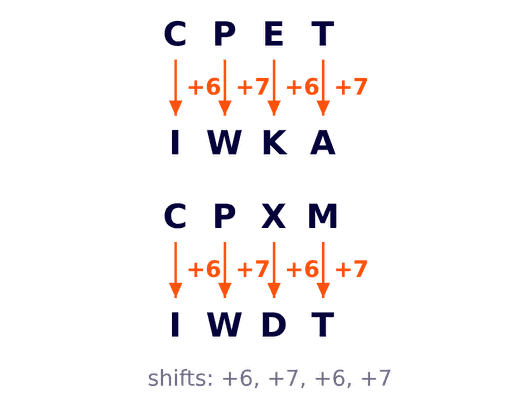
Write the alphabetical position of each letter of the word and of its code and compare them place by place.
is +6, is +7, is +6 and is +7 (after Z the counting starts again at A).
TLJQ obeys the very same pattern, which confirms the rule +6,+7,+6,+7.
For CPXM: C+6=I, P+7=W, X(24)+6=30-26=4=D and M(13)+7=20=T.
Hence, option (b) IWDT is the most appropriate answer.
47
In a certain coded language 'RSNV' is coded as 'NNJQ' and 'GDHQ' is coded as 'CYDL'. How will 'ONRG' be coded in the same code language?
A.MHOC
B.KINB
C.LJOZ
D.IKPA
Solution
Letter coding
Compare the positions of the letters of the word with those of its code, place by place.
is -4, is -5, is -4 and is -5.
GDHQ follows the same rule - G-4=C, D-5=Y (before A the counting continues from Z), H-4=D, Q-5=L.
For ONRG: O(15)-4=11=K, N(14)-5=9=I, R(18)-4=14=N and G(7)-5=2=B.
Hence, option (b) KINB is the most appropriate answer.
48
Which following group of letters, when sequentially placed from left to right will complete the given series?
t_pp_kpptkp_tk_p
A.k k t p
B.ktpp
C.kttt
D.kttp
Solution
Missing letters series
The string has 16 letters, so break it into four blocks of four: t _ p p / _ k p p / t k p _ / t k _ p.
Every block is the same group tkpp, and each blank is simply the letter missing from that block.
Reading the blanks from left to right gives k, t, p, p.
Hence, option (b) ktpp is the most appropriate answer.
49
A series is given with one term missing. Select the correct alternative from the given ones that will complete the series.
OK34, JF136, EA544, ZV2176, ?
A.UR8934
B.TQ8604
C.UQ8704
D.TR8814
Solution
Letter-number series
Treat the two letters and the number of each term separately.
Letters: each letter goes 5 steps back - , , , , and before A the counting continues from Z.
So after Z(26) and V(22) come 26-5=21=U and 22-5=17=Q.
Numbers: , , , so the next number is .
The missing term is therefore UQ8704.
Hence, option (c) is the most appropriate answer.
50
A series is given with one term missing. Select the correct alternative from the given ones that will complete the series.
NX32, QT97, TP292, WL877, ?
A.YH2882
B.ZH2632
C.ZG2462
D.YG2742
Solution
Letter-number series
Study the first letter, the second letter and the number of each term separately.
First letters: , a jump of +3 each time, so the next one is 23+3=26=Z.
Second letters: , a jump of -4 each time, so the next one is 12-4=8=H.
Numbers: , , , so the next number is .
The missing term is therefore ZH2632.
Hence, option (b) is the most appropriate answer.
Finished reading? Now test yourself.
The same 25 questions, but with a timer and the answers hidden — 15 minutes.

 Hence the correct option is (a).
 B is 28th from the left and 18th from the right, so total children =28+18-1=45.
Hence the correct option is (d).
B is 28th from the left and 18th from the right, so total children =28+18-1=45.
Hence the correct option is (d).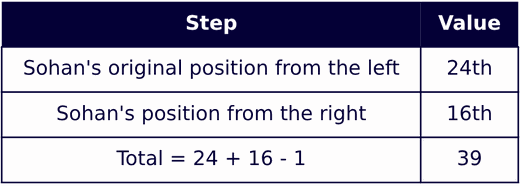 Mohan's own starting rank of 15th is extra information and is not needed.
Hence the correct option is (c).
Mohan's own starting rank of 15th is extra information and is not needed.
Hence the correct option is (c).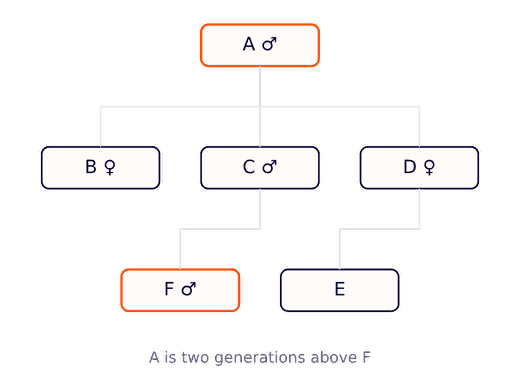 A is thus two generations above F, and A is a male, so A is the grandfather of F.
Hence the correct option is (b).
A is thus two generations above F, and A is a male, so A is the grandfather of F.
Hence the correct option is (b).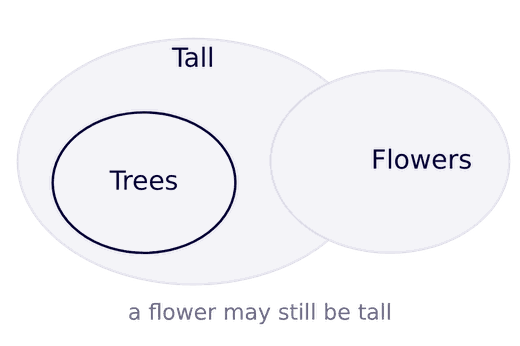 Conclusion I: a flower is barred from being a tree, but the tall region outside 'trees' is still open to flowers, so 'No flower is tall' is only a possibility, not a certainty — it does not follow.
Conclusion II: trees are tall, and no tree can be a flower, so those trees are tall things that are not flowers — this is definitely true, so it follows.
Hence only conclusion II follows, and the correct option is (b).
Conclusion I: a flower is barred from being a tree, but the tall region outside 'trees' is still open to flowers, so 'No flower is tall' is only a possibility, not a certainty — it does not follow.
Conclusion II: trees are tall, and no tree can be a flower, so those trees are tall things that are not flowers — this is definitely true, so it follows.
Hence only conclusion II follows, and the correct option is (b).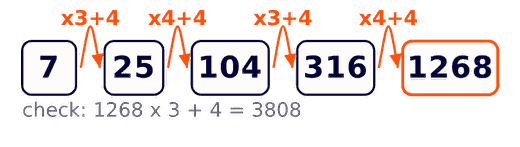 The pattern continues: , , .
Hence the correct option is (b).
The pattern continues: , , .
Hence the correct option is (b).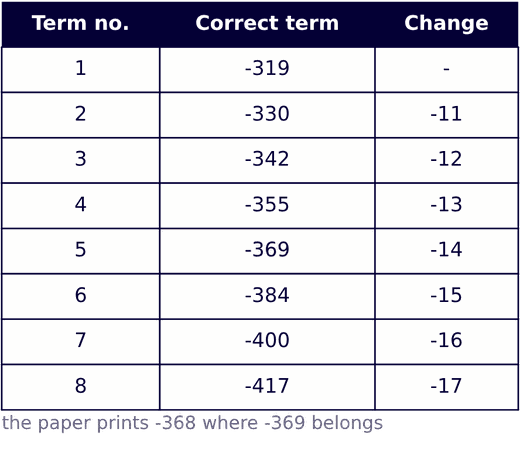 The remaining terms confirm the rule: 369+15=384, 384+16=400, 400+17=417.
So the term printed as -368 is the wrong one, and the correct option is (a).
The remaining terms confirm the rule: 369+15=384, 384+16=400, 400+17=417.
So the term printed as -368 is the wrong one, and the correct option is (a).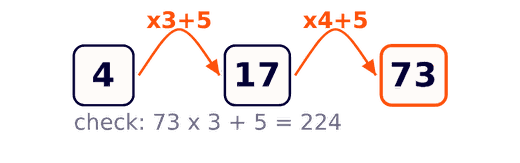 Verify with the later terms: , , .
Hence the correct option is (b).
Verify with the later terms: , , .
Hence the correct option is (b). Hence the correct option is (a).
 Hence the correct option is (a).
 Hence the correct option is (b).
 Conclusion I: those engineers who are not scientists may still be intelligent — nothing in the statements shuts them out of the 'intelligent' circle — so 'Some engineers are not intelligent' is only a possibility and does not follow.
Conclusion II: some scientists are artists, and all artists are intelligent, so those scientists are certainly intelligent.
Converting 'some scientists are intelligent' gives 'some intelligent are scientists', which therefore follows.
Hence only conclusion II follows, and the correct option is (c).
Conclusion I: those engineers who are not scientists may still be intelligent — nothing in the statements shuts them out of the 'intelligent' circle — so 'Some engineers are not intelligent' is only a possibility and does not follow.
Conclusion II: some scientists are artists, and all artists are intelligent, so those scientists are certainly intelligent.
Converting 'some scientists are intelligent' gives 'some intelligent are scientists', which therefore follows.
Hence only conclusion II follows, and the correct option is (c).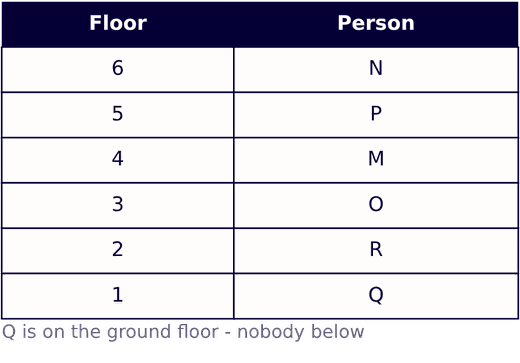 Q sits on the lowest floor, so nobody lives below Q.
Hence the correct option is (a).
Q sits on the lowest floor, so nobody lives below Q.
Hence the correct option is (a).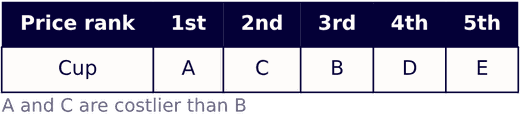 Only A and C stand above B, so the price of 2 cups is more than that of B.
Hence the correct option is (a).
Only A and C stand above B, so the price of 2 cups is more than that of B.
Hence the correct option is (a).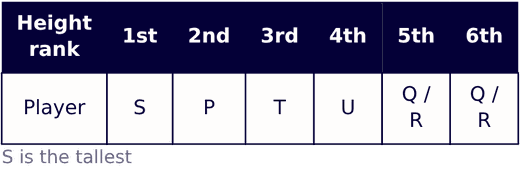 Hence the correct option is (b).
 Counting towards the right (anticlockwise) from Z: U is first and W is second.
Hence, option (b) W is the most appropriate answer.
Counting towards the right (anticlockwise) from Z: U is first and W is second.
Hence, option (b) W is the most appropriate answer.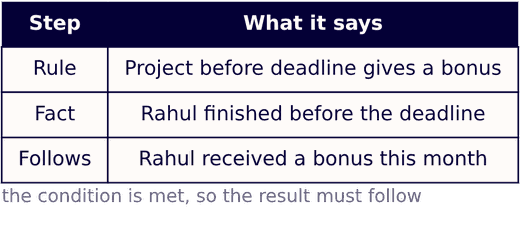 Options (b), (c) and (d) talk about his habit, his leave and his nature - none of these is contained in the statement, so none of them can be inferred.
Hence, option (a) is the most appropriate answer.
Options (b), (c) and (d) talk about his habit, his leave and his nature - none of these is contained in the statement, so none of them can be inferred.
Hence, option (a) is the most appropriate answer.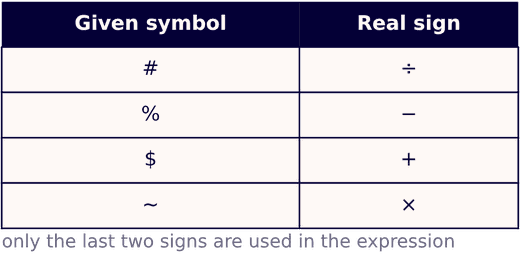 The wave symbol stands for and the dollar symbol stands for +, so the expression becomes .
By BODMAS the multiplication is done first: .
Then 420+3=423.
Hence, option (b) is the most appropriate answer.
The wave symbol stands for and the dollar symbol stands for +, so the expression becomes .
By BODMAS the multiplication is done first: .
Then 420+3=423.
Hence, option (b) is the most appropriate answer.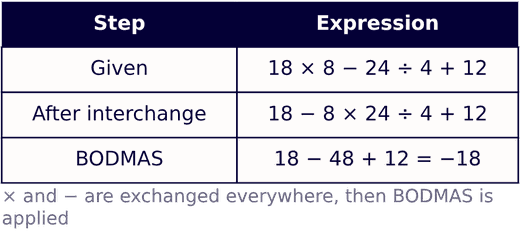 So becomes .
By BODMAS, division and multiplication come first: .
Now 18-48+12=-30+12=-18.
Hence, option (c) is the most appropriate answer.
So becomes .
By BODMAS, division and multiplication come first: .
Now 18-48+12=-30+12=-18.
Hence, option (c) is the most appropriate answer.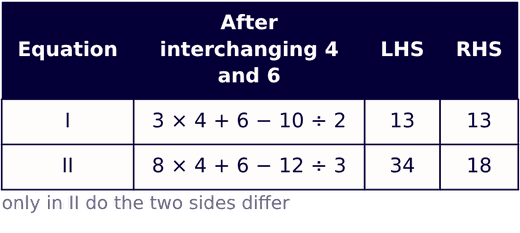 Hence, option (b) Only II is the most appropriate answer.
 For CPXM: C+6=I, P+7=W, X(24)+6=30-26=4=D and M(13)+7=20=T.
Hence, option (b) IWDT is the most appropriate answer.
For CPXM: C+6=I, P+7=W, X(24)+6=30-26=4=D and M(13)+7=20=T.
Hence, option (b) IWDT is the most appropriate answer.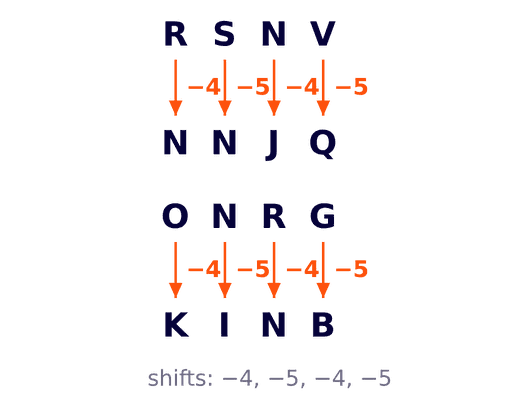 For ONRG: O(15)-4=11=K, N(14)-5=9=I, R(18)-4=14=N and G(7)-5=2=B.
Hence, option (b) KINB is the most appropriate answer.
For ONRG: O(15)-4=11=K, N(14)-5=9=I, R(18)-4=14=N and G(7)-5=2=B.
Hence, option (b) KINB is the most appropriate answer.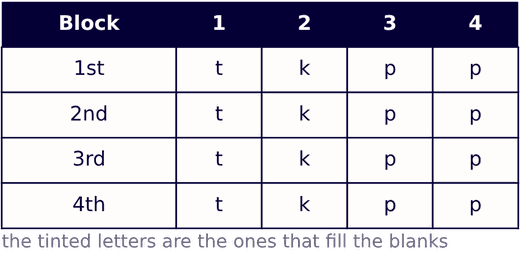 Reading the blanks from left to right gives k, t, p, p.
Hence, option (b) ktpp is the most appropriate answer.
Reading the blanks from left to right gives k, t, p, p.
Hence, option (b) ktpp is the most appropriate answer.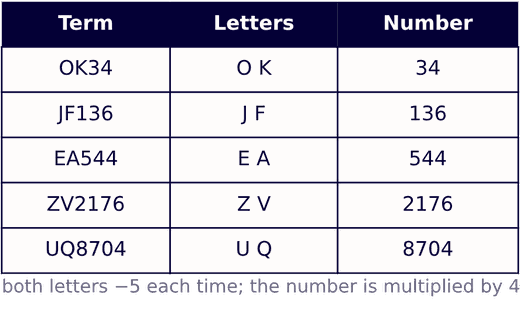 The missing term is therefore UQ8704.
Hence, option (c) is the most appropriate answer.
The missing term is therefore UQ8704.
Hence, option (c) is the most appropriate answer.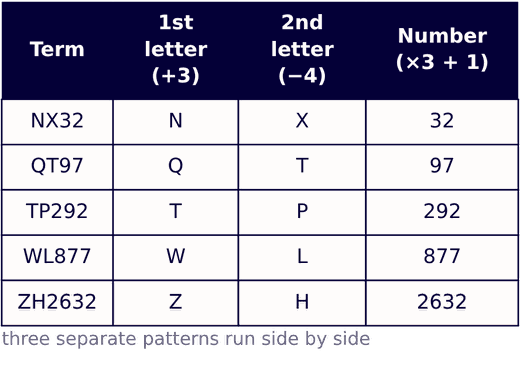 The missing term is therefore ZH2632.
Hence, option (b) is the most appropriate answer.
The missing term is therefore ZH2632.
Hence, option (b) is the most appropriate answer.