SSC CHSL 27 November 2025 · Shift 1 · General Intelligence — questions with answers · ShikshaSphere
Chapter 153 of 200
27 November 2025 · Shift 1
General Intelligence
25 questions ~25 min readFree
25 questions
A
26
In this type of questions, question is provided with substitutes for various mathematical symbols, followed by a question involving calculation of an expression or choosing the correct/incorrect equation. You have to put the real signs in the given equation and then solve the questions as required. If '&' stands for '+', '"' stands for '-, ' stands for ' ', '' stands for ' ', then find the value of: ?
A.
B.
C.
D.
Solution
Symbol substitution
Replace every symbol of the expression by the sign it stands for and then apply the BODMAS order.
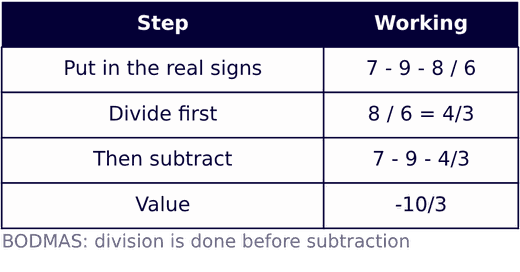
With the given code the expression becomes .
Division comes first: .
So the value is .
Hence option (b) is the correct answer.
27
There are 60 soldiers standing in a parade line. Soldier A is 18th from the front and Soldier B is 22nd from the back. Find the number of soldiers between A and B.
A.18
B.19
C.20
D.21
Solution
Ranking in a row
First bring both positions to the same end of the line.
Position of B from the front = total - position from the back .
So A stands at the 18th place from the front and B at the 39th place from the front.
Soldiers strictly between them =39-18-1=20.
Hence option (c) is the correct answer.
28
In a row, 15 candles are arranged. A red candle is 6th from the left.How many candles are to its right?
A.7
B.8
C.9
D.10
Solution
Ranking in a row
The red candle is 6th from the left, so 6 candles are used up when we count from the left up to and including it.
Candles lying to its right =15-6=9.
Hence option (c) is the correct answer.
29
A series is given with one term missing. Select the correct alternative from the given ones that will complete the series.
-512,-508,-500,?,-472,-452,-428
A.-490
B.-492
C.-495
D.-488
Solution
Number series
Look at the gap between consecutive terms: -508-(-512)=4 and -500-(-508)=8.
At the other end the gaps are -452-(-472)=20 and -428-(-452)=24.
So the gaps themselves rise by 4 each time: +4,+8,+12,+16,+20,+24.
The missing term =-500+12=-488, and the check -488+16=-472 agrees with the next given term.
Hence option (d) is the correct answer.
30
A series is given with one term missing. Select the correct alternative from the given ones that will complete the series.
A.-90
B.-135
C.-125
D.-335
Solution
Number series
Divide each term by the one before it: and .
So every term is 3 times the term before it.
Missing term , and the check matches the next given term.
Hence option (b) is the correct answer.
31
If and * , then what is the value of 250 ! 5 * 361?
A.-239
B.-244
C.-311
D.-235
Solution
Symbol substitution
Try '!' for and '*' for -, and test both given equations.
First equation: and 50-151=-101, which is what is given.
Second equation: and 40-291=-251, which is also what is given.
So the same signs apply to the last expression: , then 50-361=-311.
Hence option (c) is the correct answer.
32
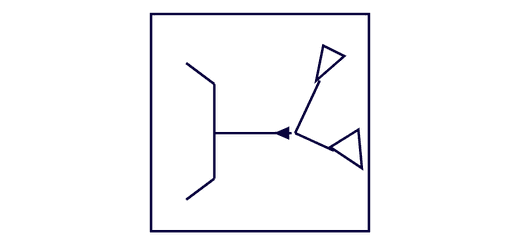
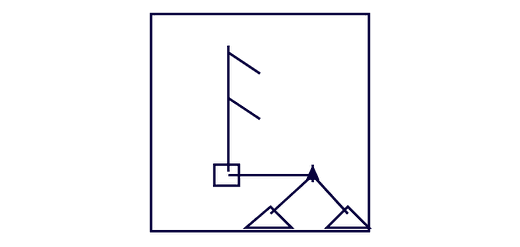
A mirror is placed on the line . Out of the option figures which figure will be the right image of the question figure?
A.
B.
C.
D.
Solution
Mirror image
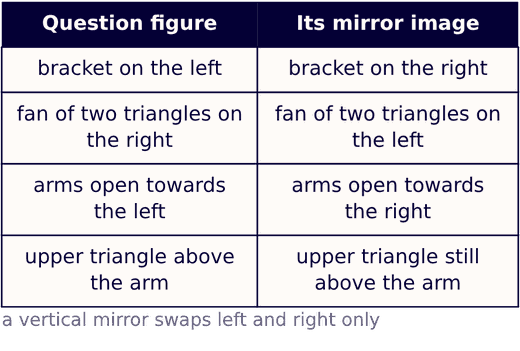
The mirror AB is a vertical line standing to the right of the figure, so the image is turned only from left to right; whatever is on top stays on top and whatever is below stays below.
In the question figure the bracket-shaped part is on the left and the fan of two triangles is on the right, so in the image the fan must move to the left and the bracket to the right.
The two arms of the bracket point away towards the left, so in the image they must point away towards the right, while the two triangles keep their upper and lower places.
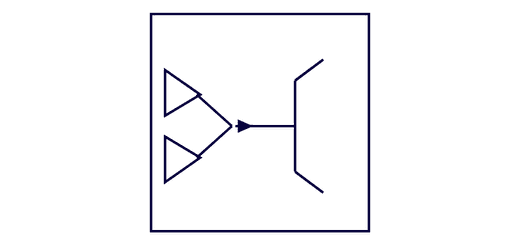
Option (a) shows exactly this left-right interchange with nothing turned upside down.
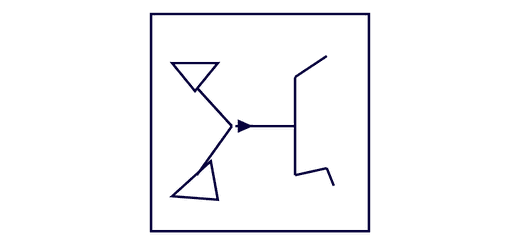
Options (b) and (c) rotate a part of the figure instead of reflecting it, and option (d) turns the whole figure through a quarter turn.
Hence option (a) is the correct answer.
33
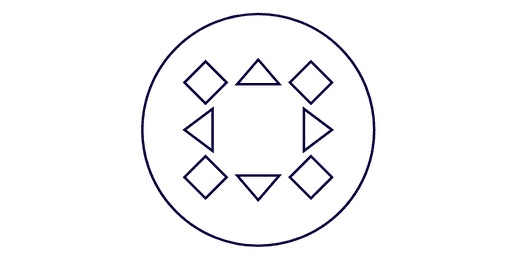
A piece of paper is folded and punched as shown below in the question figures. From the given option figures, indicate how it will appear when opened.
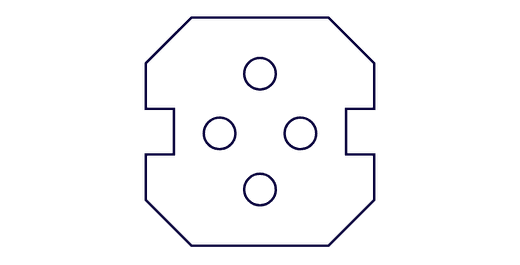
A.
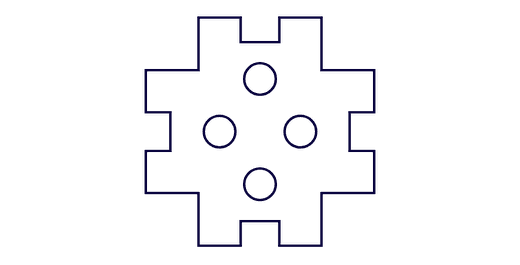
B.
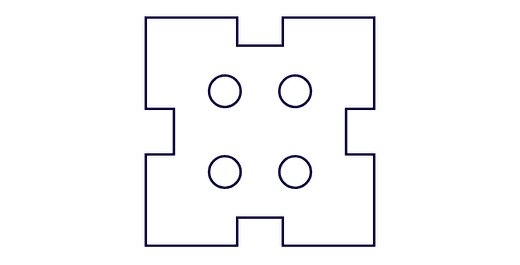
C.
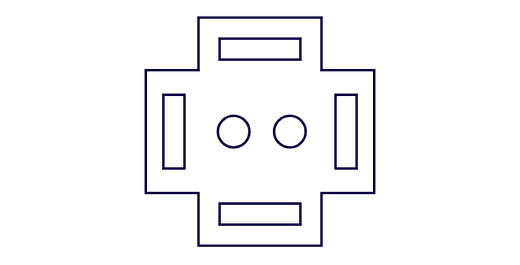
D.
Solution
Paper folding and punching
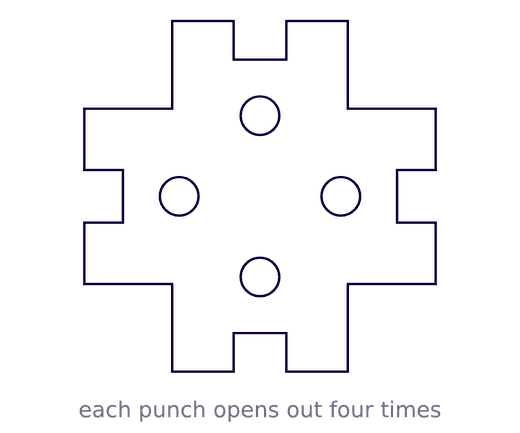
The sheet is folded twice, so the punched piece is one quarter of the square and every complete punch must appear four times when the sheet is opened.
The first fold is along the diagonal and the second along the line joining the top right corner to the middle of that diagonal, so the opened sheet must be symmetrical about both diagonals.
The round punch lies at the middle height of the folded triangle, so it opens out into four circles placed above, below, to the left and to the right of the centre.
The square notch cut into the middle of the outer edge opens out into a notch at the middle of each of the four sides.
The two cuts taken off the corners of the folded piece open out into a square removed at each of the four corners, which turns the sheet into a plus shape.
Option (a) leaves the corners as slanting cuts and shows only two notches; option (c) places the four circles at the corners of a square instead of around the centre; option (d) shows long slots and only two circles.
Hence option (b) is the correct answer.
34
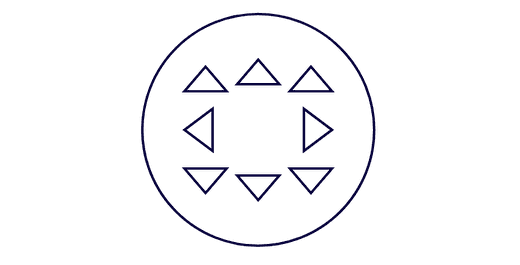
A piece of paper is folded and punched as shown below in the question figures. From the given option figures, indicate how it will appear when opened.
A.
B.
C.
D.
Solution
Paper folding and punching
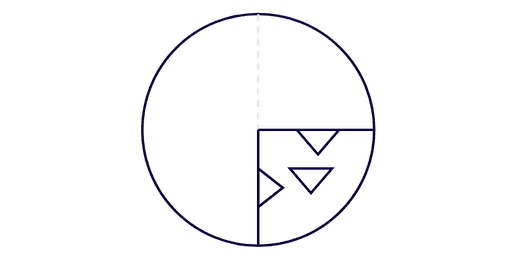
The circular sheet is folded twice — first the left half over the right half along the vertical diameter, then the upper right quarter down over the lower right quarter along the horizontal radius — so the punched piece is one quarter of the circle.
Open the folds in the reverse order: opening the horizontal fold copies every punch into the upper right quarter, and opening the vertical fold copies the whole right half on to the left half.
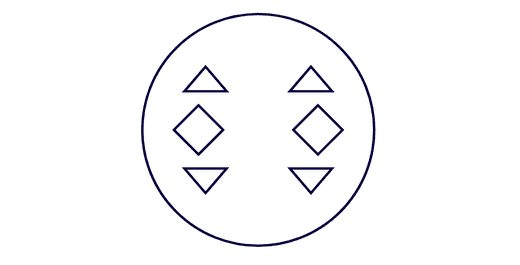
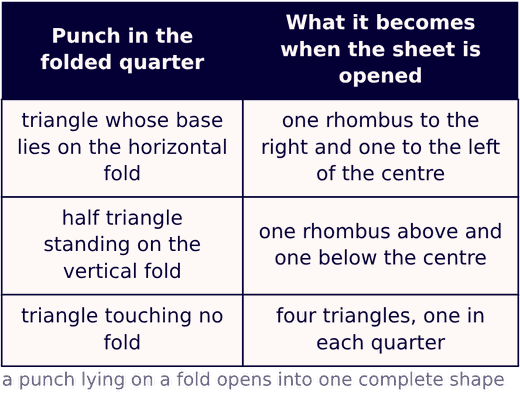
The triangle whose base lies on the horizontal fold meets its own copy when that fold is opened, so the two halves join into one complete rhombus; the vertical fold then repeats it, giving a rhombus to the right and a rhombus to the left of the centre.
The half triangle standing on the vertical fold likewise joins its mirror image into a complete rhombus, and since it is copied upwards as well, one rhombus appears below the centre and one above it.
The third triangle touches no fold, so it is simply reproduced once in every quarter — four triangles lying along the two slanting directions.
The opened sheet therefore carries four rhombi at the top, bottom, left and right, with four triangles in between.
Option (a) loses the two rhombi on the vertical line, option (b) interchanges the places of the rhombi and the triangles, and option (c) shows eight triangles because it forgets that a punch lying on a fold opens into a complete shape.
Hence option (d) is the correct answer.
35
Five persons — P, Q, R, S and T — live in five different cities, namely Hyderabad, Pune, Kolkata, Bangalore and Lucknow, and each of them has a different favourite colour among Green, Red, Black, Blue and Yellow.
P lives in Hyderabad and his favourite colour is Green.
T lives in Lucknow and his favourite colour is Black.
Q lives in Pune.
S does not live in Kolkata.
The person who lives in Kolkata likes Red.
Who among them lives in Kolkata?
A.P
B.S
C.R
D.T
Solution
Table based puzzle
Three of the five persons are placed straight away: P in Hyderabad, T in Lucknow and Q in Pune.
Only Kolkata and Bangalore are then left, and they have to be shared between R and S.
S does not live in Kolkata, so S gets Bangalore and R gets Kolkata.
The person living in Kolkata likes Red, so R is the one whose favourite colour is Red.
Green belongs to P and Black to T, while Blue and Yellow stay divided between Q and S — the question does not need them.
Hence option (c) is the correct answer.
36
Find the next number in the sequence.
3, 7, 15, 31, 63, ?
A.127
B.125
C.129
D.130
Solution
Number series
Each term is twice the previous term increased by 1: and .
The rule holds further: and .
So the next term .
The same numbers are one less than a power of 2, and 128-1=127 confirms it.
Hence option (a) is the correct answer.
37
In the following question, select the number which can be placed at the sign of question mark (?) from the given alternatives.
A.4
B.5
C.9
D.6
Solution
Number matrix
In a matrix of this kind the numbers of every row are tied together by one and the same rule, so the rule has to be read off from the rows that are complete.
Work the first row through: the rule that links its numbers gives its last entry exactly.
Apply the very same working to the second row; it again gives the entry that is printed there, which confirms that the rule is the right one.
Carrying that rule across to the incomplete row, the number that must stand in place of the question mark is 4.
Hence option (a) is the correct answer.
38
Find the number of triangles in the given figure.
A.15
B.13
C.17
D.19
Solution
Counting triangles
The two diagonals of the square and the two lines joining the midpoints of opposite sides all pass through the centre and cut the square into 8 equal triangles.
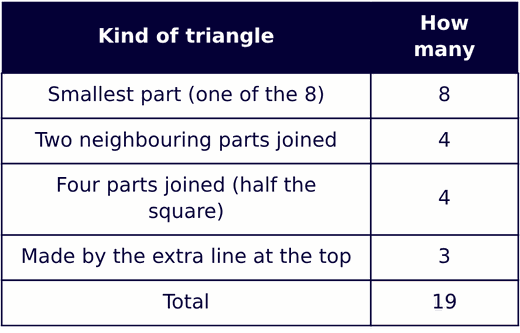
Count them in three sizes: the 8 smallest parts, the 4 triangles each made of two neighbouring parts, and the 4 triangles each made of four parts (a half of the square).
So the square by itself holds 8+4+4=16 triangles.
The extra straight line drawn across the top corner cuts off one more triangle, and the vertical diagonal splits that triangle into two.
That gives 3 additional triangles, so the total is 16+3=19.
Hence option (d) is the correct answer.
39
How many triangles are there in the given figure?
A.16
B.20
C.18
D.22
Solution
Counting triangles
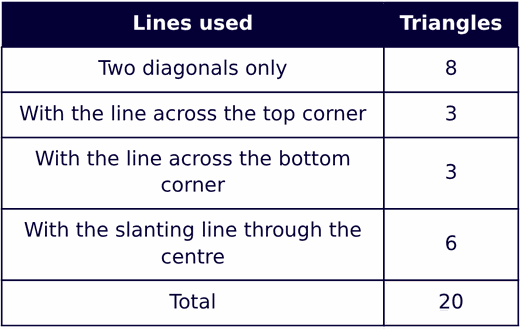
The two diagonals of the rhombus meet at the centre and by themselves give 4 quarter triangles and 4 half triangles, that is 8 triangles.
The straight line drawn across the top corner adds 3 triangles: the two halves that the vertical diagonal makes, and the whole one.
The straight line drawn across the bottom corner adds 3 more in exactly the same way.
The slanting line runs from the right end of the upper line, through the centre, to the left end of the lower line, and it forms 6 further triangles — two with the vertical diagonal and the two short lines, two with the vertical diagonal and a slant side, and two with the horizontal diagonal and a slant side.
Total =8+3+3+6=20.
Hence option (b) is the correct answer.
40
In the figure given below the circle represents yellow, the rectangle represents pink and the triangle represents green. The number in each area represents the number of items in that area.
How many yellow are green?
A.35
B.38
C.30
D.32
Solution
Venn diagram counting
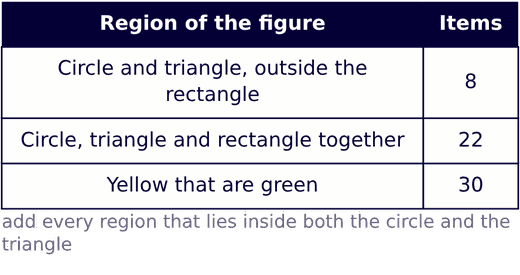
'How many yellow are green' asks for the items that lie inside the circle and inside the triangle at the same time, whether or not they are also inside the rectangle.
Two regions satisfy this condition.
The part of the circle inside the triangle but outside the rectangle holds 8 items.
The part common to the circle, the triangle and the rectangle holds 22 items.
Required number =8+22=30.
Hence option (c) is the correct answer.
41
The thickness of 5 tyres A, B, C, D, and E are compared. No two tyres have the same thickness. A is thicker than C but not thicker than E. B is thicker than D, and D is thicker than E . If the thickness of tyre A is 48, what is the possible thickness of tyre C?
A.57
B.58
C.49
D.47
Solution
Comparison ranking
'A is thicker than C but not thicker than E' means A is thinner than E, so E>A>C.
'B is thicker than D, and D is thicker than E' gives B>D>E.
The two chains share E, so the full order from thickest to thinnest is B>D>E>A>C.
C lies below A in this order, so the thickness of C must be less than the thickness of A, i.e. less than 48.
Among the options only 47 is less than 48, so option (d) is the correct answer.
42
Six boxes A, B, C, D, E, and F have different weights. Weight of is the 4th heaviest. Box A is heavier than B and D but lighter than E and F. Box E is not the heaviest. How many boxes are lighter than A ?
A.1
B.2
C.3
D.4
Solution
Comparison ranking
'A is heavier than B and D but lighter than E and F' gives E,F>A>B,D.
So two boxes (E and F) are above A. Since E is not the heaviest, F is the heaviest and E is the second heaviest.
A is therefore the 3rd heaviest, and C — given as the 4th heaviest — sits just below A.
The remaining boxes B and D take the 5th and 6th places in some order.
The boxes lighter than A are C, B and D, i.e. 3 boxes, so option (c) is the correct answer.
43
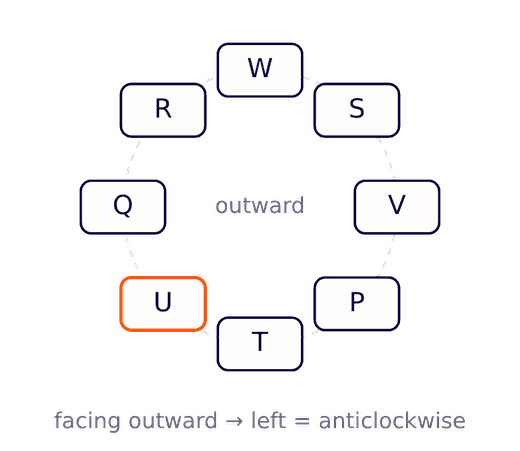
8 women P, Q, R, S, T, U, V and W are sitting around a circular table facing opposite to the centre (not necessarily in the same order). Q is second to the left of W. P is third to the left of Q. S is to the immediate right of is fourth to the left of is the immediate neighbour of W and Q , V is second to the right of W. Who are the immediate neighbours of U ?
A.R and T
B.Q and T
C.V and R
D.W and R
Solution
Circular seating
All eight women face away from the centre, so for each of them 'left' is the anticlockwise direction and 'right' is the clockwise direction.
Fix W at the top. Q is second to the left of W → two seats anticlockwise from W; P is third to the left of Q → three more seats anticlockwise.
S is to the immediate right of W → the seat clockwise next to W, and U is fourth to the left of S → four seats anticlockwise from S.
R has to be a neighbour of both W and Q, which fixes R on the single seat lying between them, and V is second to the right of W.
The only vacant seat is then taken by T.
In the completed circle U has T on one side and Q on the other, so option (b) is the correct answer.
44
After interchanging the given two numbers (not digits), what will be the value of the given equation ?
8 and 4
?
A.25
B.22
C.34
D.40
Solution
Interchange of numbers
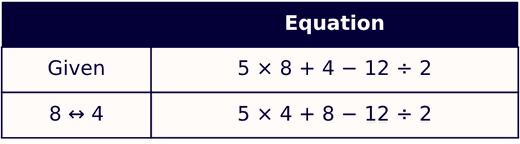
The given equation is ; interchange the numbers 8 and 4 wherever they occur.
The new equation is .
By BODMAS, do division and multiplication first: =20+8-6
=28-6=22
Hence option (b) is the correct answer.
45
Select the correct combination of mathematical signs to replace (*) signs sequentially and to balance the given equation.
A.
B.
C.,,
D.
Solution
Signs substitution
Put the signs of option (b), namely , in place of the four signs in order.
By BODMAS, division and multiplication come first: and .
=7+15-10
=22-10=12, which is exactly the required right-hand side.
Hence option (b) is the correct answer.
46
In the following question, four letter-number pairs are given. The letter-number on the left side of ( - ) is related to the letter-number on the right side of (-) with some Logic/Rule/Relation. Three pairs are similar on the basis of the same Logic/Rule/Relation. Select the odd one out from the given alternatives.
(NOTE: Operations should be performed on the whole numbers, without breaking down the number into its constituent digits. E.g. 13 - Operations on 13 such as adding /subtracting /multiplying etc. to 13 can be performed. Breaking down 13 into 1 and 3 and then performing mathematical operations on 1 and 3 is not allowed)
A.GL120-1060
B.PS440 - RV220
C.EK248 - GN124
D.JW360 - LZ190
Solution
Odd letter-number pair
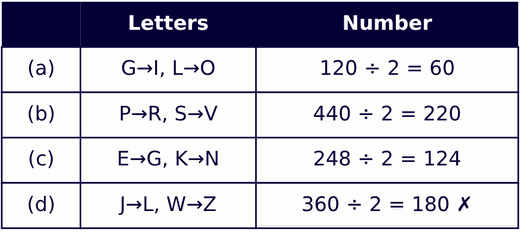
In each pair the first letter moves +2, the second letter moves +3, and the number is halved.
In (a) G+2=I, L+3=O and ; in (b) P+2=R, S+3=V and ; in (c) E+2=G, K+3=N and .
In (d) the letters obey the rule (J+2=L, W+3=Z), but the number does not: , whereas 190 is given.
Hence option (d) is the odd one out and is the correct answer.
47
In a certain coded language 'SMILE' is coded as 'BHFIP' and 'TOWER' is coded as 'OATKQ'. How will 'PLANT' be coded in the same code language ?
A.QJYIN
B.QJXHM
C.PJXIM
D.RKXGN
Solution
Letter coding
The word is first written backwards; then the letters are moved back alternately by 3 and 4 places.
SMILE reversed is ELIMS: E-3=B, L-4=H, I-3=F, M-4=I, S-3=P, giving BHFIP.
TOWER reversed is REWOT: R-3=O, E-4=A, W-3=T, O-4=K, T-3=Q, giving OATKQ, which confirms the rule.
PLANT reversed is TNALP: T-3=Q, N-4=J, A-3=X (counting back past A into Z, Y, X), L-4=H, P-3=M.
So PLANT is coded as QJXHM, and option (b) is the correct answer.
48
In a certain coded language 'SPACE' is coded as 'JMBZX' and 'GHOST' is coded as 'VUNJI'. How will 'BRAIN' be coded in the same code language ?
A.AKBTO
B.OKBTA
C.AOBTK
D.AKTBO
Solution
Letter coding
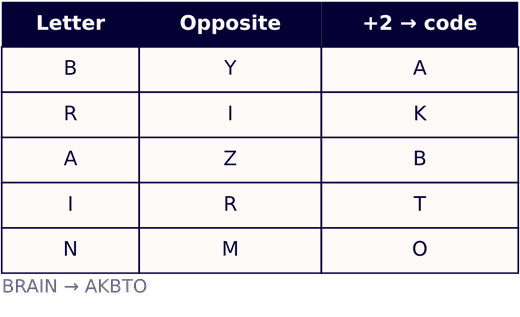
Every letter is first replaced by its opposite letter (A↔Z, B↔Y, C↔X, …) and that opposite letter is then moved +2.
SPACE → opposite letters H, K, Z, X, V → adding 2 gives J, M, B, Z, X, i.e. JMBZX.
GHOST → opposite letters T, S, L, H, G → adding 2 gives V, U, N, J, I, i.e. VUNJI, so the rule is confirmed.
BRAIN → opposite letters Y, I, Z, R, M → adding 2 gives A, K, B, T, O.
So BRAIN is coded as AKBTO, and option (a) is the correct answer.
49
A series is given with one term missing. Select the correct alternative from the given ones that will complete the series.
HS600, GQ550, FO500, EM450, ?
A.DK400
B.DL350
C.CK400
D.DJ400
Solution
Mixed series
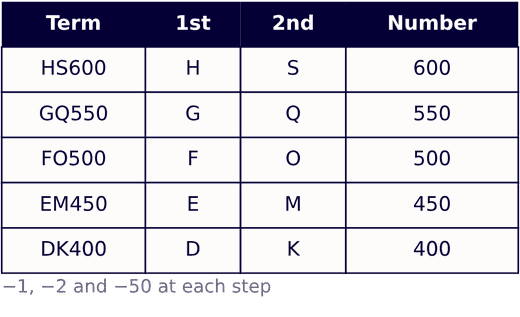
Treat the three parts of each term separately.
First letter: , a fall of 1 each time, so the next is D.
Second letter: , a fall of 2 each time, so the next is K.
Number: , a fall of 50 each time, so the next is 400.
The missing term is DK400, so option (a) is the correct answer.
50
A series is given with one term wrong. Select that wrong term from the given alternatives.
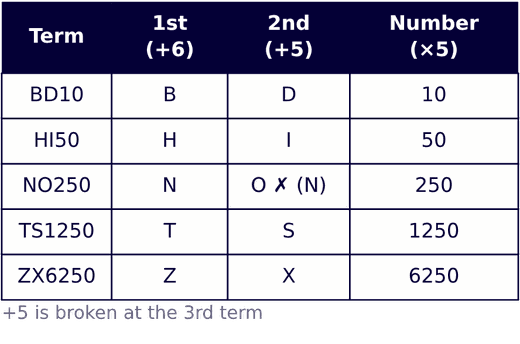
BD10, HI50, NO250, TS1250, ZX6250
A.HI50
B.NO250
C.TS1250
D.ZX6250
Solution
Wrong term in series
First letters: B, H, N, T, Z — each one is 6 places ahead of the previous, so all of them are correct.
Numbers: 10, 50, 250, 1250, 6250 — each one is 5 times the previous, so all of them are correct.
Second letters: D, I, ?, S, X — from D to I is +5 and from S to X is +5, so the step must be +5 throughout.
The third second-letter should therefore be I+5=N, but O is printed.
So the wrong term is NO250 (it should be NN250), and option (b) is the correct answer.
Finished reading? Now test yourself.
The same 25 questions, but with a timer and the answers hidden — 15 minutes.

 Division comes first: .
So the value is .
Hence option (b) is the correct answer.
Division comes first: .
So the value is .
Hence option (b) is the correct answer.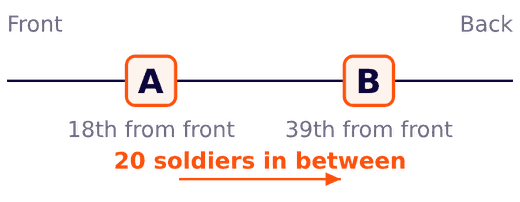 Soldiers strictly between them =39-18-1=20.
Hence option (c) is the correct answer.
Soldiers strictly between them =39-18-1=20.
Hence option (c) is the correct answer.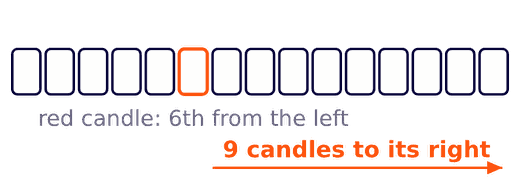 Candles lying to its right =15-6=9.
Hence option (c) is the correct answer.
Candles lying to its right =15-6=9.
Hence option (c) is the correct answer. So the gaps themselves rise by 4 each time: +4,+8,+12,+16,+20,+24.
The missing term =-500+12=-488, and the check -488+16=-472 agrees with the next given term.
Hence option (d) is the correct answer.
So the gaps themselves rise by 4 each time: +4,+8,+12,+16,+20,+24.
The missing term =-500+12=-488, and the check -488+16=-472 agrees with the next given term.
Hence option (d) is the correct answer.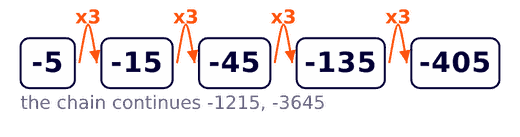 So every term is 3 times the term before it.
Missing term , and the check matches the next given term.
Hence option (b) is the correct answer.
So every term is 3 times the term before it.
Missing term , and the check matches the next given term.
Hence option (b) is the correct answer.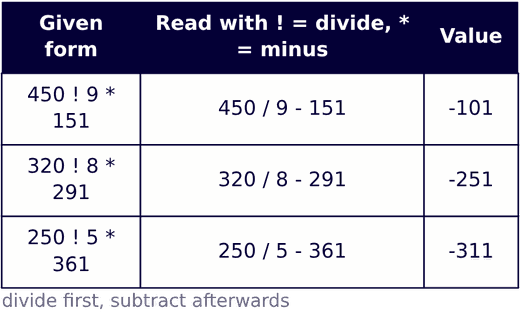 So the same signs apply to the last expression: , then 50-361=-311.
Hence option (c) is the correct answer.
So the same signs apply to the last expression: , then 50-361=-311.
Hence option (c) is the correct answer.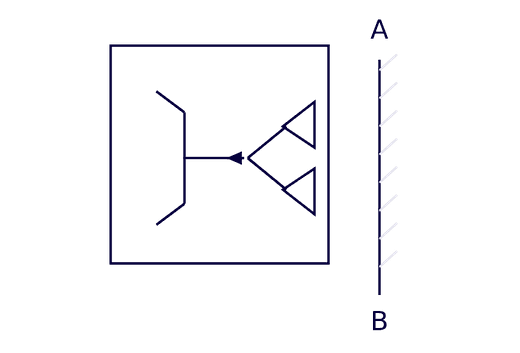
 In the question figure the bracket-shaped part is on the left and the fan of two triangles is on the right, so in the image the fan must move to the left and the bracket to the right.
The two arms of the bracket point away towards the left, so in the image they must point away towards the right, while the two triangles keep their upper and lower places.
Option (a) shows exactly this left-right interchange with nothing turned upside down.
Options (b) and (c) rotate a part of the figure instead of reflecting it, and option (d) turns the whole figure through a quarter turn.
Hence option (a) is the correct answer.
In the question figure the bracket-shaped part is on the left and the fan of two triangles is on the right, so in the image the fan must move to the left and the bracket to the right.
The two arms of the bracket point away towards the left, so in the image they must point away towards the right, while the two triangles keep their upper and lower places.
Option (a) shows exactly this left-right interchange with nothing turned upside down.
Options (b) and (c) rotate a part of the figure instead of reflecting it, and option (d) turns the whole figure through a quarter turn.
Hence option (a) is the correct answer.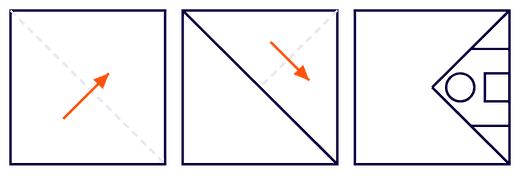
 The round punch lies at the middle height of the folded triangle, so it opens out into four circles placed above, below, to the left and to the right of the centre.
The square notch cut into the middle of the outer edge opens out into a notch at the middle of each of the four sides.
The two cuts taken off the corners of the folded piece open out into a square removed at each of the four corners, which turns the sheet into a plus shape.
Option (a) leaves the corners as slanting cuts and shows only two notches; option (c) places the four circles at the corners of a square instead of around the centre; option (d) shows long slots and only two circles.
Hence option (b) is the correct answer.
The round punch lies at the middle height of the folded triangle, so it opens out into four circles placed above, below, to the left and to the right of the centre.
The square notch cut into the middle of the outer edge opens out into a notch at the middle of each of the four sides.
The two cuts taken off the corners of the folded piece open out into a square removed at each of the four corners, which turns the sheet into a plus shape.
Option (a) leaves the corners as slanting cuts and shows only two notches; option (c) places the four circles at the corners of a square instead of around the centre; option (d) shows long slots and only two circles.
Hence option (b) is the correct answer.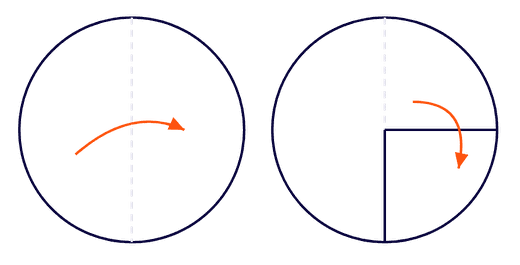

 The triangle whose base lies on the horizontal fold meets its own copy when that fold is opened, so the two halves join into one complete rhombus; the vertical fold then repeats it, giving a rhombus to the right and a rhombus to the left of the centre.
The half triangle standing on the vertical fold likewise joins its mirror image into a complete rhombus, and since it is copied upwards as well, one rhombus appears below the centre and one above it.
The third triangle touches no fold, so it is simply reproduced once in every quarter — four triangles lying along the two slanting directions.
The opened sheet therefore carries four rhombi at the top, bottom, left and right, with four triangles in between.
Option (a) loses the two rhombi on the vertical line, option (b) interchanges the places of the rhombi and the triangles, and option (c) shows eight triangles because it forgets that a punch lying on a fold opens into a complete shape.
Hence option (d) is the correct answer.
The triangle whose base lies on the horizontal fold meets its own copy when that fold is opened, so the two halves join into one complete rhombus; the vertical fold then repeats it, giving a rhombus to the right and a rhombus to the left of the centre.
The half triangle standing on the vertical fold likewise joins its mirror image into a complete rhombus, and since it is copied upwards as well, one rhombus appears below the centre and one above it.
The third triangle touches no fold, so it is simply reproduced once in every quarter — four triangles lying along the two slanting directions.
The opened sheet therefore carries four rhombi at the top, bottom, left and right, with four triangles in between.
Option (a) loses the two rhombi on the vertical line, option (b) interchanges the places of the rhombi and the triangles, and option (c) shows eight triangles because it forgets that a punch lying on a fold opens into a complete shape.
Hence option (d) is the correct answer.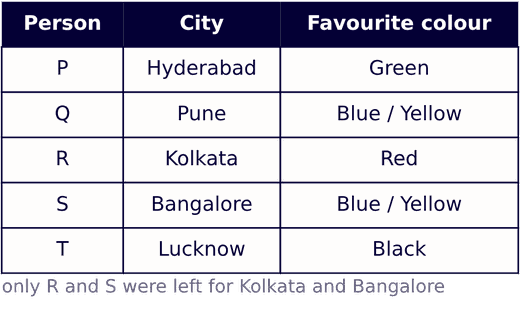 The person living in Kolkata likes Red, so R is the one whose favourite colour is Red.
Green belongs to P and Black to T, while Blue and Yellow stay divided between Q and S — the question does not need them.
Hence option (c) is the correct answer.
The person living in Kolkata likes Red, so R is the one whose favourite colour is Red.
Green belongs to P and Black to T, while Blue and Yellow stay divided between Q and S — the question does not need them.
Hence option (c) is the correct answer.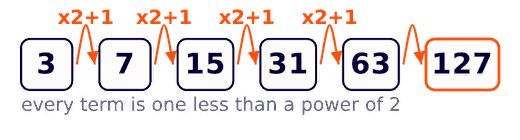 The rule holds further: and .
So the next term .
The same numbers are one less than a power of 2, and 128-1=127 confirms it.
Hence option (a) is the correct answer.
The rule holds further: and .
So the next term .
The same numbers are one less than a power of 2, and 128-1=127 confirms it.
Hence option (a) is the correct answer.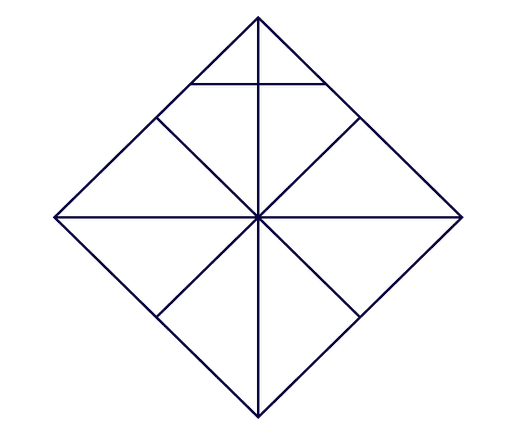
 The extra straight line drawn across the top corner cuts off one more triangle, and the vertical diagonal splits that triangle into two.
That gives 3 additional triangles, so the total is 16+3=19.
Hence option (d) is the correct answer.
The extra straight line drawn across the top corner cuts off one more triangle, and the vertical diagonal splits that triangle into two.
That gives 3 additional triangles, so the total is 16+3=19.
Hence option (d) is the correct answer.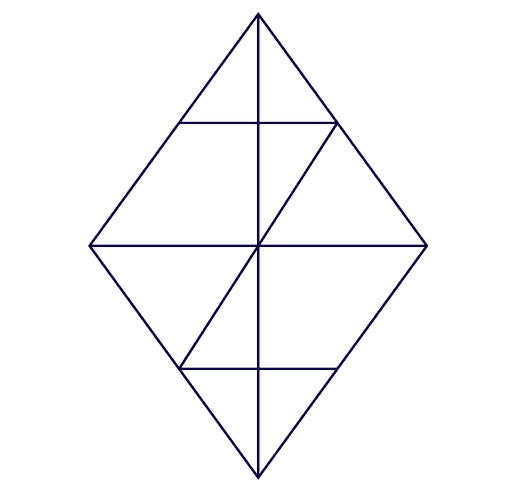
 The straight line drawn across the top corner adds 3 triangles: the two halves that the vertical diagonal makes, and the whole one.
The straight line drawn across the bottom corner adds 3 more in exactly the same way.
The slanting line runs from the right end of the upper line, through the centre, to the left end of the lower line, and it forms 6 further triangles — two with the vertical diagonal and the two short lines, two with the vertical diagonal and a slant side, and two with the horizontal diagonal and a slant side.
Total =8+3+3+6=20.
Hence option (b) is the correct answer.
The straight line drawn across the top corner adds 3 triangles: the two halves that the vertical diagonal makes, and the whole one.
The straight line drawn across the bottom corner adds 3 more in exactly the same way.
The slanting line runs from the right end of the upper line, through the centre, to the left end of the lower line, and it forms 6 further triangles — two with the vertical diagonal and the two short lines, two with the vertical diagonal and a slant side, and two with the horizontal diagonal and a slant side.
Total =8+3+3+6=20.
Hence option (b) is the correct answer.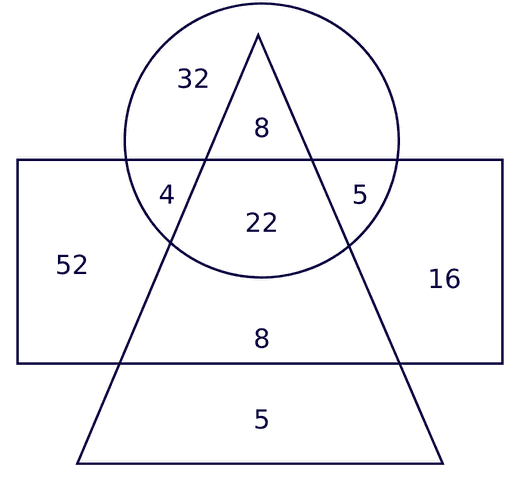 How many yellow are green?
 The part of the circle inside the triangle but outside the rectangle holds 8 items.
The part common to the circle, the triangle and the rectangle holds 22 items.
Required number =8+22=30.
Hence option (c) is the correct answer.
The part of the circle inside the triangle but outside the rectangle holds 8 items.
The part common to the circle, the triangle and the rectangle holds 22 items.
Required number =8+22=30.
Hence option (c) is the correct answer.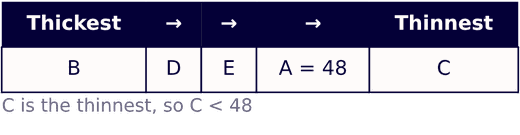 C lies below A in this order, so the thickness of C must be less than the thickness of A, i.e. less than 48.
Among the options only 47 is less than 48, so option (d) is the correct answer.
C lies below A in this order, so the thickness of C must be less than the thickness of A, i.e. less than 48.
Among the options only 47 is less than 48, so option (d) is the correct answer.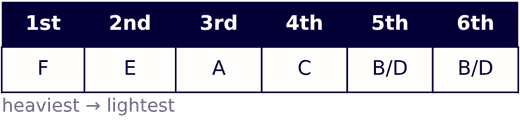 The boxes lighter than A are C, B and D, i.e. 3 boxes, so option (c) is the correct answer.
 In the completed circle U has T on one side and Q on the other, so option (b) is the correct answer.
 The new equation is .
By BODMAS, do division and multiplication first: =20+8-6
=28-6=22
Hence option (b) is the correct answer.
The new equation is .
By BODMAS, do division and multiplication first: =20+8-6
=28-6=22
Hence option (b) is the correct answer.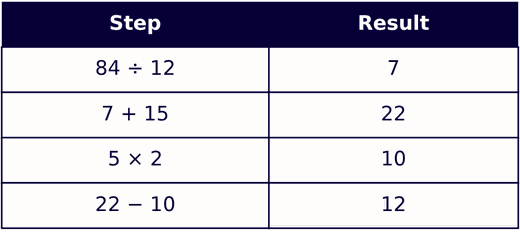 Hence option (b) is the correct answer.
 In (a) G+2=I, L+3=O and ; in (b) P+2=R, S+3=V and ; in (c) E+2=G, K+3=N and .
In (d) the letters obey the rule (J+2=L, W+3=Z), but the number does not: , whereas 190 is given.
Hence option (d) is the odd one out and is the correct answer.
In (a) G+2=I, L+3=O and ; in (b) P+2=R, S+3=V and ; in (c) E+2=G, K+3=N and .
In (d) the letters obey the rule (J+2=L, W+3=Z), but the number does not: , whereas 190 is given.
Hence option (d) is the odd one out and is the correct answer.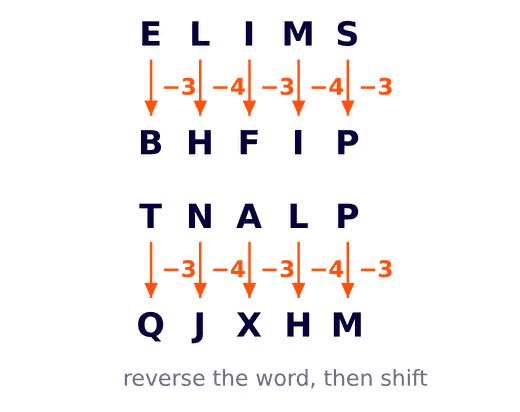 So PLANT is coded as QJXHM, and option (b) is the correct answer.
 So BRAIN is coded as AKBTO, and option (a) is the correct answer.
 The missing term is DK400, so option (a) is the correct answer.
 So the wrong term is NO250 (it should be NN250), and option (b) is the correct answer.