
26
In a row of girls, Reena is 9th from the left and Pooja is 14th from the right. If they interchange their positions, Reena becomes 18th from the left. What is Pooja's new position from the right?
- A.23rd
- B.24 th
- C.25th
- D.26th
Solution
Ranking after interchange
When two girls exchange places, each of them simply takes the seat the other was standing on.
Reena moves from 9th to 18th from the left, so the seat she now occupies — Pooja's original seat — is the 18th from the left.
That very seat is also 14th from the right, so the number of girls in the row =18+14-1=31.
Pooja now stands on Reena's old seat, which is 9th from the left.
Her position from the right =31-9+1=23.
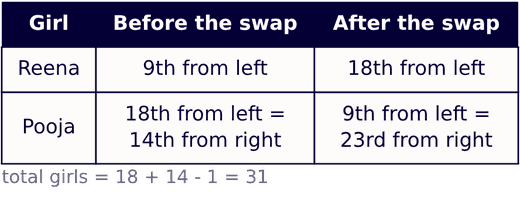 Hence Pooja's new position is 23rd from the right.
Hence Pooja's new position is 23rd from the right.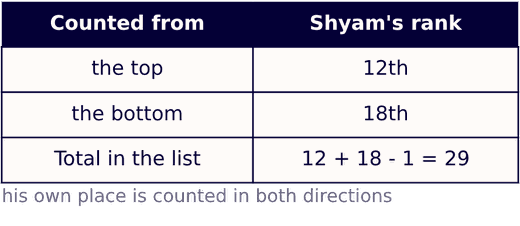 Hence there are 29 students in the list.
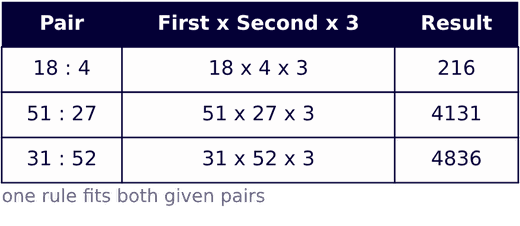 Apply the same rule to the third pair: .
.
Apply the same rule to the third pair: .
.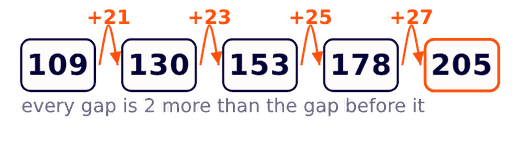 Required term =178+27=205.
The same series can be read as .
Required term =178+27=205.
The same series can be read as .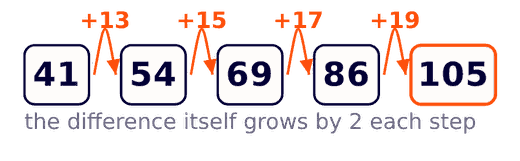 Required term =86+19=105.
Read another way, the terms are .
Required term =86+19=105.
Read another way, the terms are .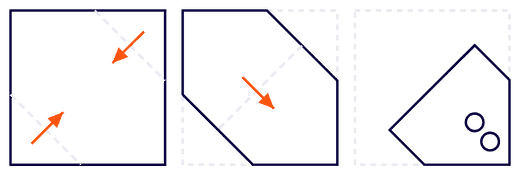
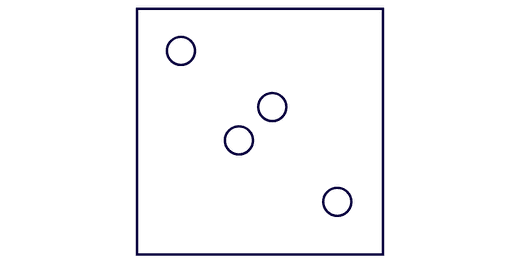
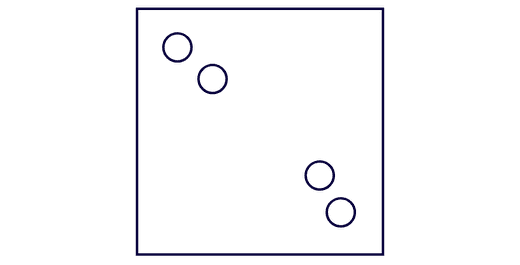
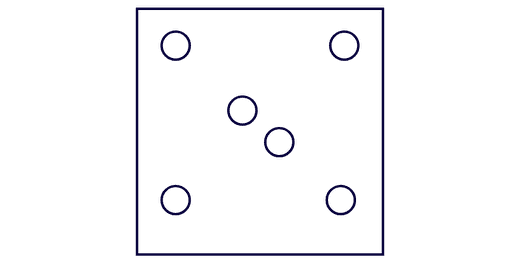
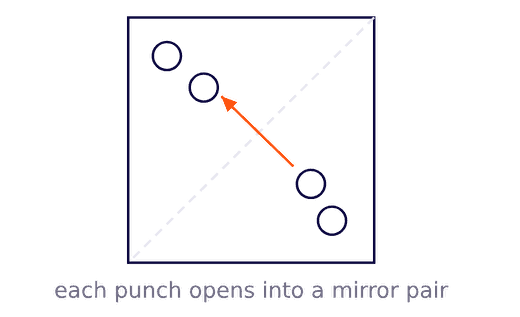 The corner flaps carry no punch, so they add nothing further; the opened sheet shows exactly two holes near the bottom right corner and their mirror images near the top left corner.
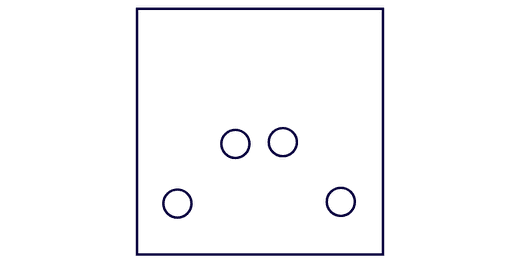
Option (a) strings the four holes along the main diagonal, option (c) shows six holes and option (d) keeps all four holes in the lower half, so only option (b) is correct.
The corner flaps carry no punch, so they add nothing further; the opened sheet shows exactly two holes near the bottom right corner and their mirror images near the top left corner.
Option (a) strings the four holes along the main diagonal, option (c) shows six holes and option (d) keeps all four holes in the lower half, so only option (b) is correct.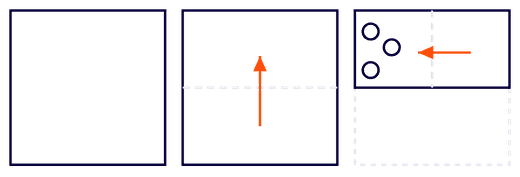
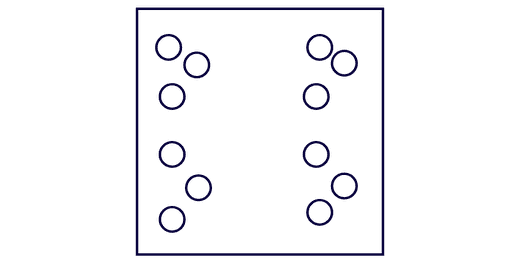
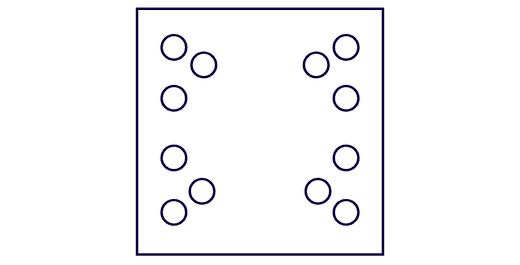
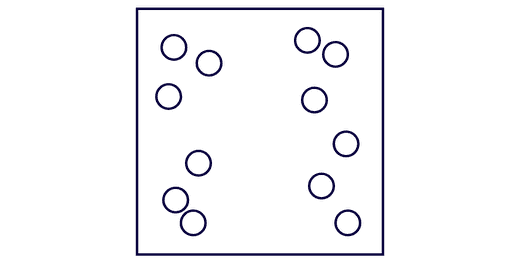
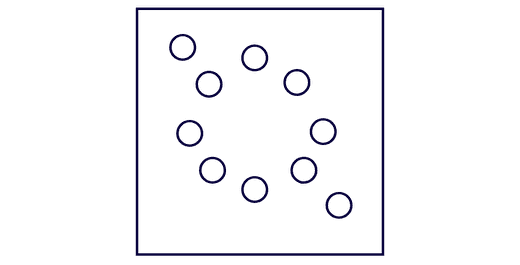
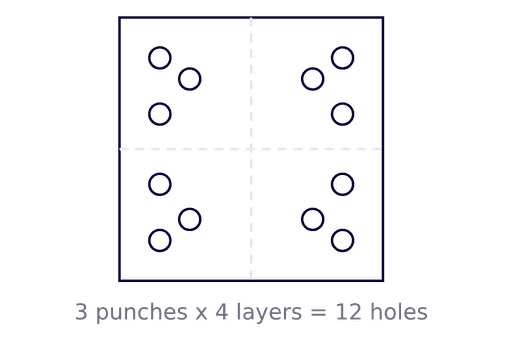 So the opened sheet must carry the same group of three holes near all four corners, each group being the mirror image of the group beside it.
Only option (b) has this double mirror symmetry: (a) repeats the group by sliding it instead of mirroring it, (c) breaks the symmetry in the lower half and (d) scatters the holes with no symmetry at all.
So the opened sheet must carry the same group of three holes near all four corners, each group being the mirror image of the group beside it.
Only option (b) has this double mirror symmetry: (a) repeats the group by sliding it instead of mirroring it, (c) breaks the symmetry in the lower half and (d) scatters the holes with no symmetry at all.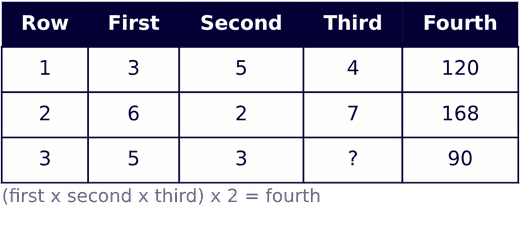 Row 3: let the missing number be x, then .
30x=90
x=3
Row 3: let the missing number be x, then .
30x=90
x=3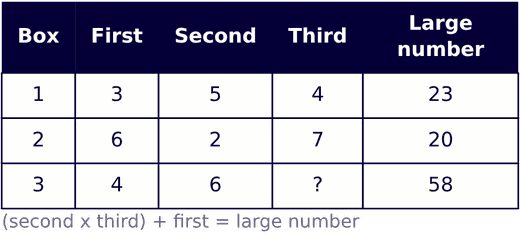 Box 3:
6x=54
x=9
Box 3:
6x=54
x=9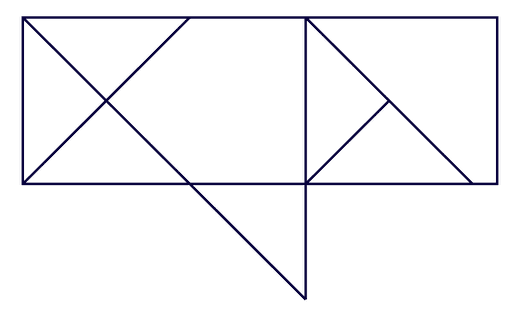
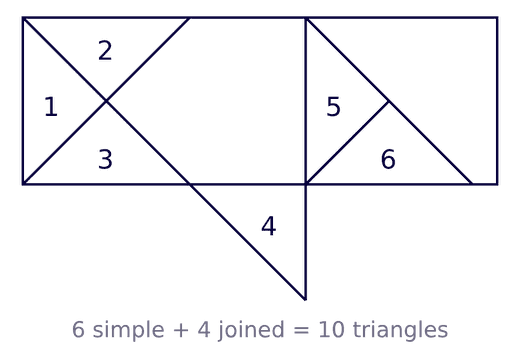 The two crossing diagonals of the left half give the three small triangles 1, 2 and 3; the long diagonal and the vertical line make triangle 4 below the rectangle; the right half is cut into triangles 5 and 6.
That is 6 simple triangles.
Joining neighbours gives three more: 1+2, 1+3 and 5+6 are each a triangle.
One large triangle spans the whole figure — the top edge, the long diagonal from the top left corner and the vertical line close it, and it contains parts 2 and 4.
Total =6+4=10 triangles.
The two crossing diagonals of the left half give the three small triangles 1, 2 and 3; the long diagonal and the vertical line make triangle 4 below the rectangle; the right half is cut into triangles 5 and 6.
That is 6 simple triangles.
Joining neighbours gives three more: 1+2, 1+3 and 5+6 are each a triangle.
One large triangle spans the whole figure — the top edge, the long diagonal from the top left corner and the vertical line close it, and it contains parts 2 and 4.
Total =6+4=10 triangles.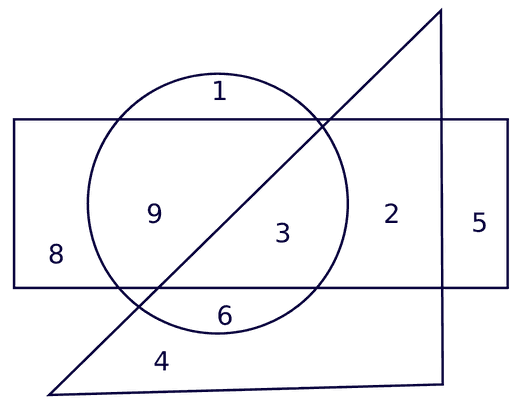 Which of the following statement is NOT correct ?
I. Number of black bike and bus both are 9.
II. Number of bus which are not bike are 24.
Which of the following statement is NOT correct ?
I. Number of black bike and bus both are 9.
II. Number of bus which are not bike are 24.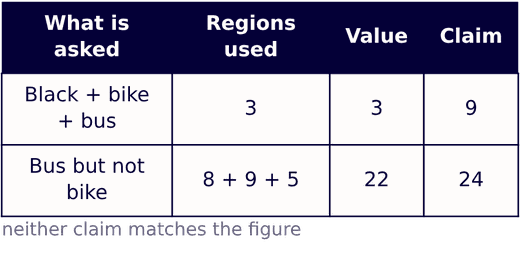 Since both the statements are wrong, the answer is 'Both I and II'.
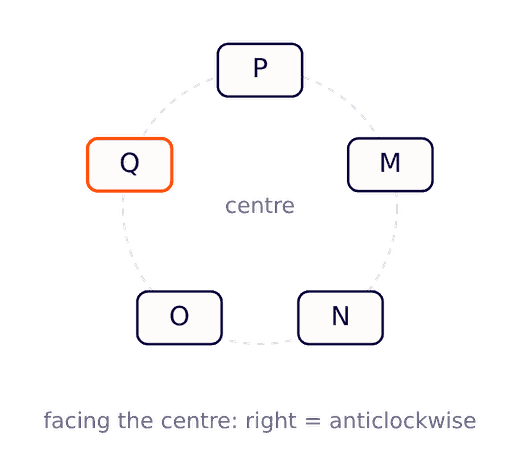 Hence Q sits to the immediate right of P.
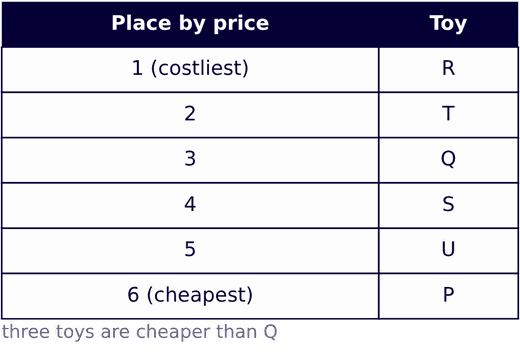 The full order is R>T>Q>S>U>P.
Cheaper than Q are S, U and P, and the only option naming two of these three is 'U and P'.
The full order is R>T>Q>S>U>P.
Cheaper than Q are S, U and P, and the only option naming two of these three is 'U and P'.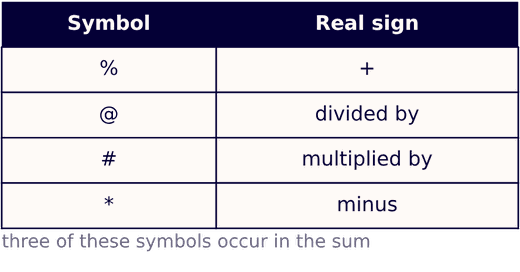 So 6 * 4 # 12 % 8 becomes .
By BODMAS the multiplication is done first: .
6-48+8=14-48
=-34
So 6 * 4 # 12 % 8 becomes .
By BODMAS the multiplication is done first: .
6-48+8=14-48
=-34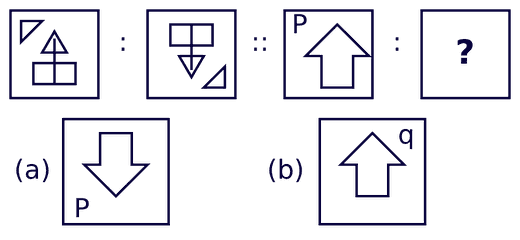
 A capital P given a half turn reads like a small 'd', and that is exactly what option (c) shows.
Option (a) only flips the figure top to bottom and leaves P upright, option (b) mirrors it left to right so the arrow is not turned at all, and option (d) turns the arrow through instead of .
A capital P given a half turn reads like a small 'd', and that is exactly what option (c) shows.
Option (a) only flips the figure top to bottom and leaves P upright, option (b) mirrors it left to right so the arrow is not turned at all, and option (d) turns the arrow through instead of .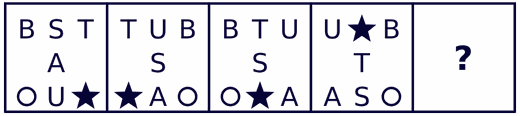




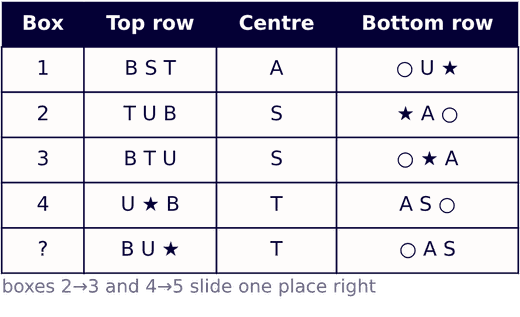 Compare the 2nd box with the 3rd: the top row slides one place to the right and so does the bottom row (the last symbol coming round to the front), while the centre symbol stays where it is.
The 1st box becomes the 2nd by a different move: the two end symbols of the top row change places, the two end symbols of the bottom row change places, and the middle column slides down one step (top-middle goes to the centre, the centre goes to bottom-middle, bottom-middle goes to top-middle).
The 3rd box becomes the 4th by that same second move, so the two moves act turn by turn and the step from the 4th box to the missing one must be the sliding move again.
The 4th box has U, star, B on top and A, S, circle below, so sliding each row one place right gives B, U, star on top and circle, A, S below, with T still in the centre.
That is exactly the figure of option (b), so option (b) is the correct answer.
Compare the 2nd box with the 3rd: the top row slides one place to the right and so does the bottom row (the last symbol coming round to the front), while the centre symbol stays where it is.
The 1st box becomes the 2nd by a different move: the two end symbols of the top row change places, the two end symbols of the bottom row change places, and the middle column slides down one step (top-middle goes to the centre, the centre goes to bottom-middle, bottom-middle goes to top-middle).
The 3rd box becomes the 4th by that same second move, so the two moves act turn by turn and the step from the 4th box to the missing one must be the sliding move again.
The 4th box has U, star, B on top and A, S, circle below, so sliding each row one place right gives B, U, star on top and circle, A, S below, with T still in the centre.
That is exactly the figure of option (b), so option (b) is the correct answer.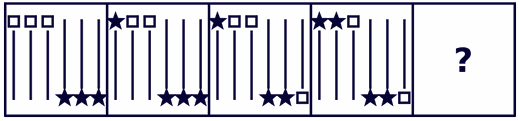




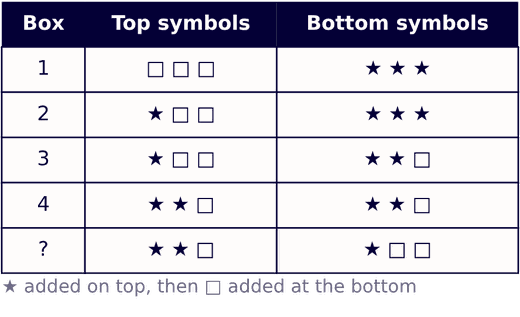 Box 1 to box 2: the first top symbol changes from a square to a star.
Box 2 to box 3: the last bottom symbol changes from a star to a square.
Box 3 to box 4: the second top symbol changes from a square to a star — so one change happens on top from the left and the next at the bottom from the right, turn by turn.
The next change is therefore at the bottom: the second bottom symbol must turn from a star into a square.
The missing figure thus shows star, star, square on top and star, square, square below, which is option (b), so option (b) is the correct answer.
Box 1 to box 2: the first top symbol changes from a square to a star.
Box 2 to box 3: the last bottom symbol changes from a star to a square.
Box 3 to box 4: the second top symbol changes from a square to a star — so one change happens on top from the left and the next at the bottom from the right, turn by turn.
The next change is therefore at the bottom: the second bottom symbol must turn from a star into a square.
The missing figure thus shows star, star, square on top and star, square, square below, which is option (b), so option (b) is the correct answer.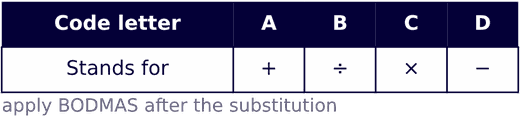 The expression 48 A 12 B 3 D 5 C 2 becomes .
By BODMAS, division and multiplication come first: and .
So the value =48+4-10=42.
Hence option (a) is the correct answer.
The expression 48 A 12 B 3 D 5 C 2 becomes .
By BODMAS, division and multiplication come first: and .
So the value =48+4-10=42.
Hence option (a) is the correct answer.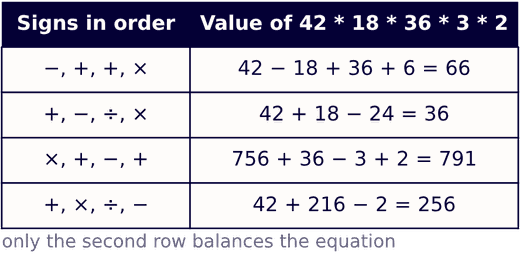 No other set of signs reaches 36, so option (b) is the correct answer.
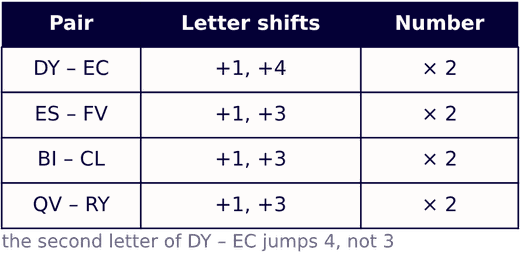 In ES–FV, BI–CL and QV–RY the first letter moves +1 and the second letter moves +3: S(19)+3=V(22), I(9)+3=L(12), V(22)+3=Y(25).
In DY–EC the first letter moves +1 as usual, but the second moves +4, because Y(25)+4=29-26=3=C.
That pair alone breaks the rule, so option (a) is the correct answer.
In ES–FV, BI–CL and QV–RY the first letter moves +1 and the second letter moves +3: S(19)+3=V(22), I(9)+3=L(12), V(22)+3=Y(25).
In DY–EC the first letter moves +1 as usual, but the second moves +4, because Y(25)+4=29-26=3=C.
That pair alone breaks the rule, so option (a) is the correct answer.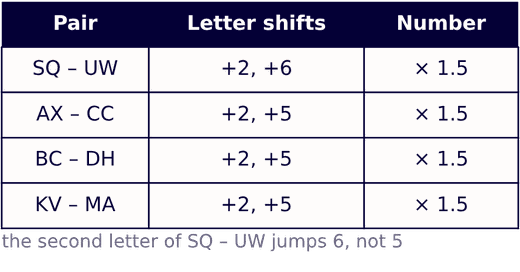 In AX–CC, BC–DH and KV–MA the first letter moves +2 and the second moves +5: X(24)+5=29-26=3=C, C(3)+5=H(8), V(22)+5=27-26=1=A.
In SQ–UW the first letter moves +2 as usual, but the second moves +6, because Q(17)+6=23=W.
That pair is therefore the odd one out, so option (a) is the correct answer.
In AX–CC, BC–DH and KV–MA the first letter moves +2 and the second moves +5: X(24)+5=29-26=3=C, C(3)+5=H(8), V(22)+5=27-26=1=A.
In SQ–UW the first letter moves +2 as usual, but the second moves +6, because Q(17)+6=23=W.
That pair is therefore the odd one out, so option (a) is the correct answer.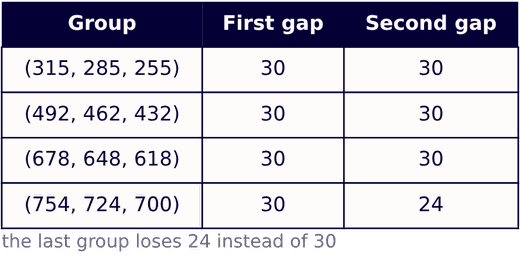 So in three of the groups the numbers fall by a constant 30 each time.
In (754,724,700) the first gap is 754-724=30, but the second is only 724-700=24.
That group breaks the pattern, so option (d) is the correct answer.
So in three of the groups the numbers fall by a constant 30 each time.
In (754,724,700) the first gap is 754-724=30, but the second is only 724-700=24.
That group breaks the pattern, so option (d) is the correct answer.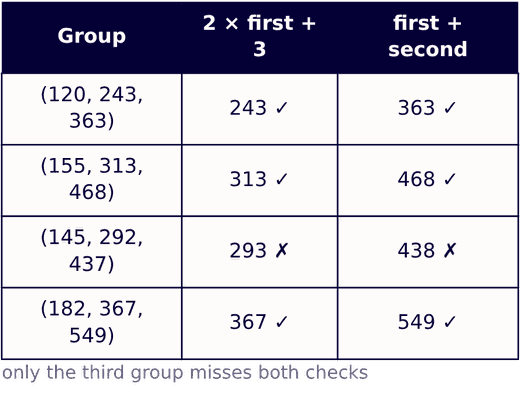 So the rule is: second first , and third = first + second.
Test the remaining group (145,292,437): , but the second number is 292.
The third number fails as well, since 145+293=438, not 437.
This group alone breaks the rule, so option (c) is the correct answer.
So the rule is: second first , and third = first + second.
Test the remaining group (145,292,437): , but the second number is 292.
The third number fails as well, since 145+293=438, not 437.
This group alone breaks the rule, so option (c) is the correct answer.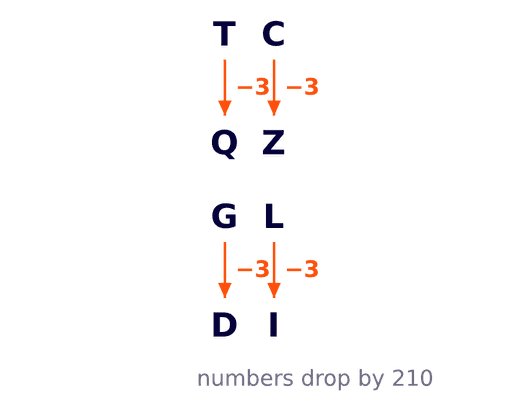 Numbers next: 760-210=550 and 1040-210=830, so every number falls by 210.
For GL840, G(7)-3=D(4) and L(12)-3=I(9), which gives DI.
And 840-210=630, so the required cluster is DI630.
Hence option (c) is the correct answer.
Numbers next: 760-210=550 and 1040-210=830, so every number falls by 210.
For GL840, G(7)-3=D(4) and L(12)-3=I(9), which gives DI.
And 840-210=630, so the required cluster is DI630.
Hence option (c) is the correct answer.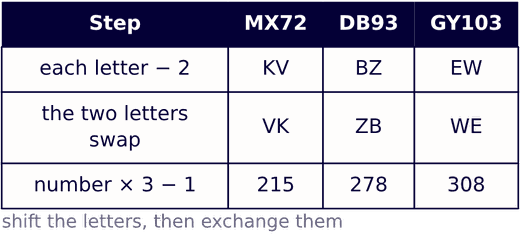 GY: G(7)-2=E(5) and Y(25)-2=W(23), and exchanging gives WE.
So the required cluster is WE308, and option (b) is the correct answer.
GY: G(7)-2=E(5) and Y(25)-2=W(23), and exchanging gives WE.
So the required cluster is WE308, and option (b) is the correct answer.