SSC CHSL 28 November 2025 · Shift 1 · Quantitative Aptitude — questions with answers · ShikshaSphere
Chapter 167 of 200
28 November 2025 · Shift 1
Quantitative Aptitude
25 questions ~25 min readFree
25 questions
A
51
The average of 9 numbers is 83 . If the average of the first 4 is 89 and last 4 is 80 , what is the 5 th number ?
A.95
B.71
C.80
D.73
Solution
Average of numbers
Sum = average count, so the sum of all 9 numbers .
Sum of the first 4 numbers .
Sum of the last 4 numbers .
The first four and the last four together cover every number except the 5th, and they do not overlap.
5th number =747-356-320=747-676=71.
So option (b) is the correct answer.
52
If the price of a product increases by 50%, by what percent should the consumption be reduced to keep the expenditure same ?
A.20.5%
B.
C.21.33%
D.33.33%
Solution
Percentage change
Formula: if the price rises by , the consumption must fall by to keep the expenditure unchanged.
Here R=50, so the reduction .
Check: let the price be ₹100 and the consumption 3 units, so the expenditure is ₹300; after the rise the price is ₹150 and ₹300 buys only 2 units, a drop of 1 unit in 3, i.e. .
So option (d) is the correct answer.
53
A 30% discount on an article brings the price to Rs. 700. What is the original price?
A.Rs. 900
B.Rs. 1500
C.Rs. 1250
D.Rs. 1000
Solution
Discount and price
A discount of 30% is taken off the original price, so what is paid is of it.
Therefore of the original price =700.
Original price , i.e. ₹1,000.
Check: of 1000=300, and 1000-300=700, as given.
So option (d) is the correct answer.
54
A solution contains 60% acid. How much water must be added to 40 liters of this solution to make acid 40% ?
A.44 liters
B.40 liters
C.50 liters
D.55 liters
Solution
Mixture and dilution
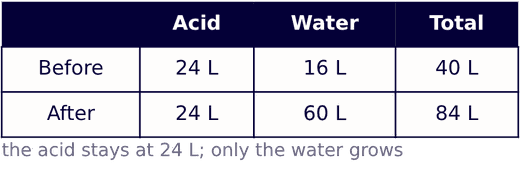
Acid in the 40 litres of litres.
So the water already present =40-24=16 litres.
Only water is poured in, so the 24 litres of acid never changes; the whole change is in the water.
The acid has to end up as measured against the water, i.e. acid : water =40:100=2:5.
So , giving final water litres.
Water to be added =60-16=44 litres, so option (a) is the correct answer.
55
A can do a piece of work in 40 days and B in 60 days. They work together for 10 days. How much work is left ?
A.
B.
C.
D.
Solution
Time and work
Let the whole work be units.
A's one day's work units and B's one day's work units.
Working together they finish 3+2=5 units a day, so in 10 days they finish units.
Work left =120-50=70 units.
As a fraction of the whole work this is , so option (c) is the correct answer.
56
How many cuboid boxes of size 15 can be packed into a carton of size without leaving any space ?
A.40
B.30
C.60
D.50
Solution
Packing cuboids
Match each edge of the carton with an edge of the box so that no space is wasted.
, and — each division is exact, so the boxes fill the carton completely.
Number of boxes .
The volumes confirm it: .
So option (c) is the correct answer.
57
A triangular road sign has angles 40°, 80°, and 60°. Another similar sign has one angle . What are the other two?
A.80° and 40°
B.65° and 45°
C.50° and 60°
D.80° and 80°
Solution
Similar triangles
In two similar triangles the corresponding angles are equal, so the second sign must carry exactly the same three angles as the first.
The three angles of the first sign are , and .
One angle of the similar sign is given as , so the other two can only be and .
The check on the angle sum holds: .
So option (a) is the correct answer.
58
An interior designer uses a regular hexagon shape for a tabletop. What is the measure of each interior angle ?
A.80°
B.120°*
C.90°
D.180°
Solution
Interior angle of polygon
Formula: each interior angle of a regular polygon of n sides .
A regular hexagon has n=6, so each interior angle .
The exterior angle checks it: and .
So option (b) is the correct answer.
59
A trader bought 600 kg of rice, part at ₹20 per kg and the rest at ₹28 per kg. He sold all at ₹25 per kg and made a total profit of ₹1,400. If the quantity bought at ₹20 was twice that bought at ₹28, find the quantity bought at ₹28 per kg.
A.210 kg
B.230 kg
C.240 kg
D.200 kg
Solution
Mixture and profit
Let the quantity bought at ₹28 per kg be x kg; then the quantity bought at ₹20 per kg is 2x kg.
The two parts make up the whole purchase, so 2x+x=600, i.e. 3x=600 and x=200.
So 400 kg came at ₹20 and 200 kg at ₹28, and the cost price .
Selling price , so the profit =15000-13600=1400, exactly the ₹1,400 stated.
Hence the quantity bought at ₹28 per kg is 200 kg, and option (d) is the correct answer.
60
A pipe has a right prism shape with an equilateral triangle base of side 8 cm and length 30 cm . Find its water-holding capacity.
A.
B.
C.
D.
Solution
Volume of a prism
The water a pipe holds is its volume, and for a right prism volume = base area length.
The base is an equilateral triangle of side 8 cm, whose area sq cm.
Volume cubic cm.
Taking , volume cubic cm.
So option (c) is the correct answer.
61
A circular sprinkler is placed inside a triangular garden with sides m , and 30 m . What is the radius of the sprinkler if it touches all three sides of the triangle?
A.8 m
B.7 m
C.9 m
D.10 m
Solution
Inradius of a triangle
The sprinkler touches all three sides, so its circle is the incircle of the triangle and the radius asked for is the inradius r.
Semi-perimeter m.
By Heron's formula the area .
square metres.
For any triangle the inradius is area divided by the semi-perimeter, so m.
So the radius of the sprinkler is 8 m, and option (a) is the correct answer.
62
If Find .
A.
B.40 : 39
C.36 : 39
D.39 : 15
Solution
Combining ratios
b occurs in both ratios, so make the value of b the same in each of them.
In a:b=8:3 multiply both parts by 5, giving a:b=40:15.
In b:c=5:13 multiply both parts by 3, giving b:c=15:39.
Now the two chains join: a:b:c=40:15:39.
Dropping the middle term, a:c=40:39, so option (b) is the correct answer.
63
In triangle is the bisector of and with . What is LTAS ?
A.
B.
C.
D.
Solution
Angle between altitude and bisector
Let the base angles be and ; then .
AS bisects , so .
In the right triangle ABT, .
Since , the foot T lies between B and S, so .
.
.
So option (b) is the correct answer.
64
4 liters of lime syrup are mixed with liters of water. If the lime syrup is of the mixture, find the value of n .
A.34 liters
B.30 liters
C.36 liters
D.37 liters
Solution
Mixture percentage
The mixture is syrup plus water, so its volume is 4+n litres while the syrup in it stays 4 litres.
The syrup is of the mixture, so .
Cross-multiplying, .
n=40-4=36.
So 36 litres of water are added, and option (c) is the correct answer.
65
The angle subtended by a chord at the circumference is 55°. The angle subtended at the center is:
A.105°
B.145°
C.110°
D.100*
Solution
Angle at centre and circumference
The angle a chord subtends at the centre is twice the angle it subtends at any point on the remaining arc of the circle.
Here the chord AB subtends at the circumference.
So .
The angle at the centre is 110°, so option (c) is the correct answer.
66
The question consists of two statements numbered "I and II" given below it. You have to decide whether the data provided in the statements is sufficient to answer the question.
Find the time taken by a 600 -metre-long train to cross a platform of length 1,800 metres.
Statement I: Train can cross a 1,400-metre-long platform in 100 seconds.
Statement II: Train can cross a pole in 30 seconds.
A.The data in statement I alone are sufficient to answer the question, while the data in statement II alone is not sufficient to answer the question.
B.The data in statement II alone is sufficient to answer the question, while the data in statement I alone is not sufficient to answer the question.
C.The data either in statement I alone or in statement II alone is sufficient to answer the question.
D.The data given in both statements I and II together is not sufficient to answer the question.
Solution
Data sufficiency: trains
To cross a platform a train must cover its own length plus the platform, so the distance needed here is 600+1800=2400 m; the only unknown is the speed.
Statement I: crossing a 1,400 m platform means covering 600+1400=2000 m in 100 s, so the speed is m/s and the required time is s.
Hence statement I alone is sufficient.
Statement II: crossing a pole means covering just the length of the train, so the speed is m/s and again the time is s.
Hence statement II alone is also sufficient.
Either statement alone answers the question, so option (c) is the correct answer.
67
Rationalize and simplify.
A.
B.
C.
D.
Solution
Rationalising a surd
To clear the surd from the denominator, multiply the top and the bottom by the conjugate .
.
The denominator is a difference of squares: .
The numerator is .
So the expression equals , and option (a) is the correct answer.
68
A and B invested Rs. 20,000 and Rs. 30,000, respectively. After 6 months, A withdrew Rs. 10,000 . If the total profit after 1 year is Rs. 90,000, how much does A receive?
A.Rs. 28,000
B.Rs. 30,000
C.Rs. 32,000
D.Rs. 14,000
Solution
Partnership with withdrawal
Profit in a partnership is divided in the ratio of capital multiplied by the time for which it stayed in the business.
A keeps ₹20,000 for the first 6 months and only ₹10,000 for the next 6 months, while B keeps ₹30,000 for the whole 12 months.
A's capital-months .
B's capital-months .
So A:B=180000:360000=1:2, and the profit splits into 1+2=3 equal parts.
A's share , that is ₹30,000.
So option (b) is the correct answer.
69
A sum of money, when invested at simple interest, amounts to ₹ 16,000 in 6 years and ₹19,000 in 9 years. What is the original principal amount?
A.₹15,000
B.₹10,000
C.₹17,000
D.₹19,000
Solution
Simple interest principal
Under simple interest the same interest is added every year, so the amount rises by a fixed step each year.
Interest of 9-6=3 years =19000-16000=3000.
Interest of 1 year .
Interest of 6 years .
Principal = amount after 6 years - interest of 6 years =16000-6000=10000.
So the original principal is ₹10,000, and option (b) is the correct answer.
70
If and , find .
A.18
B.16
C.12
D.24
Solution
Algebraic identity
Take 2 common from the expression: .
The bracket is the identity , so the expression is .
Only a-b is needed, and it is given as a-b=3; the value of a+b is not required.
.
So option (a) is the correct answer.
71
Which of the following options will have sum as 100?
A.
B.
C.
D.
Solution
Sum of fractions
Evaluate each option and keep the one whose total is exactly 100.
(a) , which is far below 100.
(b) , again short of 100.
(c) , past 100.
(d) , exactly the required sum.
So option (d) is the correct answer.
72
If , then what is the value of ?
A.150
B.108
C.104
D.97
Solution
Simplifying surds
First bring both surds to the same form: .
So .
Squaring, .
.
So option (b) is the correct answer.
73
A sum is being lent at percent per annum compound interest (compounding annually). What is the ratio of amount at the end of first year to the amount at the end of second year ?
A.8 : 7
B.7 : 8
C.11 : 7
D.8 : 11
Solution
Compound interest ratio
Write the rate as a fraction: of the sum each year.
So in one year the amount becomes times what it was at the start of that year.
Amount at the end of the first year .
Amount at the end of the second year .
Required ratio .
Multiplying both parts by gives 7:8.
So option (b) is the correct answer.
74
The average of 7 consecutive odd natural numbers is 39. Previous 7 consecutive odd natural numbers to these 7 odd natural numbers are also included. What will be the average of newly added numbers ?
A.20
B.26
C.25
D.23
Solution
Average of consecutive odds
An odd number of consecutive terms is symmetric about its middle term, so for 7 such numbers the middle (4th) term is the average.
Hence the 4th number is 39, and the seven numbers are 33, 35, 37, 39, 41, 43, 45.
The seven consecutive odd numbers just before these start two below 33 and run backwards: 19, 21, 23, 25, 27, 29, 31.
The newly added numbers are these seven, and their middle term is 25.
So their average is 25, and option (c) is the correct answer.
75
P, Q and R working alone can complete a work in 16, 36 and 48 days respectively. All three of them started the work together but after 6 days P left the work. Q left the work 4 days before the work was completed. R completed the remaining work alone. In how many days was the total work completed ?
A.
B.
C.
D.
Solution
Time and work, leaving
Take the total work as the LCM of 16, 36 and 48, which is 144 units.
Then P does units, Q does units and R does units in a day.
For the first 6 days all three work: units.
For the last 4 days R works alone: units.
So the middle stretch, worked by Q and R together, covers 144-96-12=36 units.
Q and R together do 4+3=7 units a day, so that stretch lasts days.
Total time days.
So option (b) is the correct answer.
Finished reading? Now test yourself.
The same 25 questions, but with a timer and the answers hidden — 15 minutes.

 So , giving final water litres.
Water to be added =60-16=44 litres, so option (a) is the correct answer.
So , giving final water litres.
Water to be added =60-16=44 litres, so option (a) is the correct answer.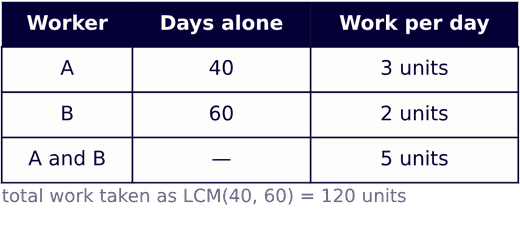 Working together they finish 3+2=5 units a day, so in 10 days they finish units.
Work left =120-50=70 units.
As a fraction of the whole work this is , so option (c) is the correct answer.
Working together they finish 3+2=5 units a day, so in 10 days they finish units.
Work left =120-50=70 units.
As a fraction of the whole work this is , so option (c) is the correct answer.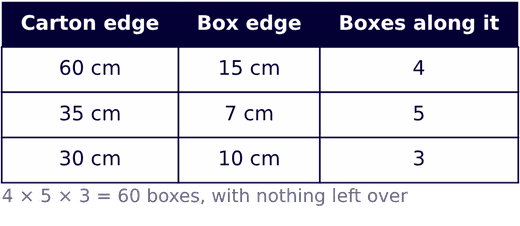 , and — each division is exact, so the boxes fill the carton completely.
Number of boxes .
The volumes confirm it: .
So option (c) is the correct answer.
, and — each division is exact, so the boxes fill the carton completely.
Number of boxes .
The volumes confirm it: .
So option (c) is the correct answer.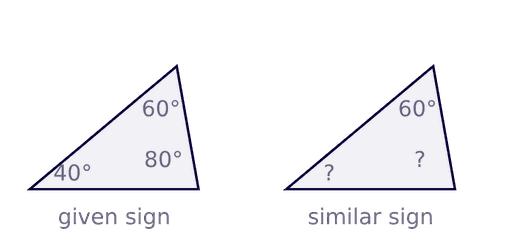 The three angles of the first sign are , and .
One angle of the similar sign is given as , so the other two can only be and .
The check on the angle sum holds: .
So option (a) is the correct answer.
The three angles of the first sign are , and .
One angle of the similar sign is given as , so the other two can only be and .
The check on the angle sum holds: .
So option (a) is the correct answer.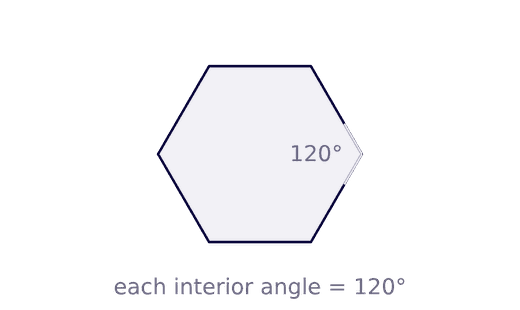 The exterior angle checks it: and .
So option (b) is the correct answer.
The exterior angle checks it: and .
So option (b) is the correct answer.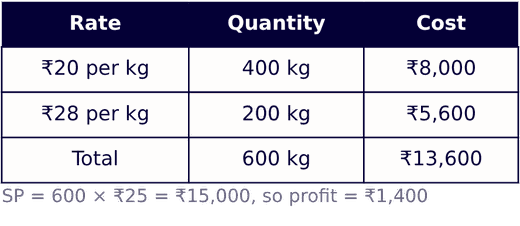 So 400 kg came at ₹20 and 200 kg at ₹28, and the cost price .
Selling price , so the profit =15000-13600=1400, exactly the ₹1,400 stated.
Hence the quantity bought at ₹28 per kg is 200 kg, and option (d) is the correct answer.
So 400 kg came at ₹20 and 200 kg at ₹28, and the cost price .
Selling price , so the profit =15000-13600=1400, exactly the ₹1,400 stated.
Hence the quantity bought at ₹28 per kg is 200 kg, and option (d) is the correct answer.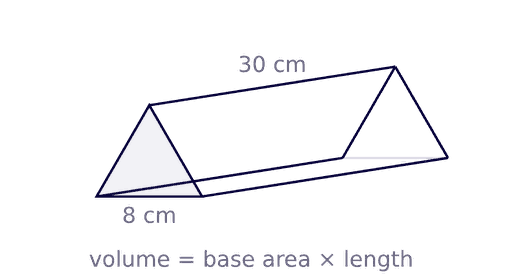 The base is an equilateral triangle of side 8 cm, whose area sq cm.
Volume cubic cm.
Taking , volume cubic cm.
So option (c) is the correct answer.
The base is an equilateral triangle of side 8 cm, whose area sq cm.
Volume cubic cm.
Taking , volume cubic cm.
So option (c) is the correct answer.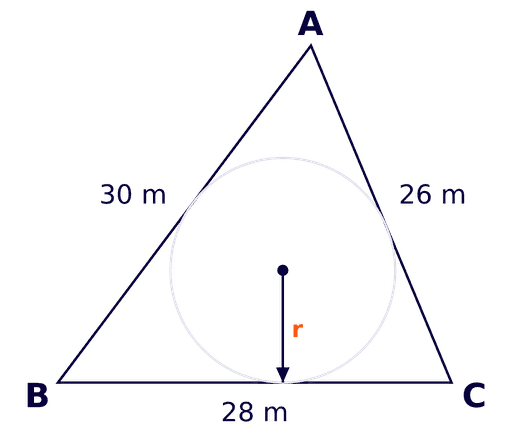 Semi-perimeter m.
By Heron's formula the area .
square metres.
For any triangle the inradius is area divided by the semi-perimeter, so m.
So the radius of the sprinkler is 8 m, and option (a) is the correct answer.
Semi-perimeter m.
By Heron's formula the area .
square metres.
For any triangle the inradius is area divided by the semi-perimeter, so m.
So the radius of the sprinkler is 8 m, and option (a) is the correct answer.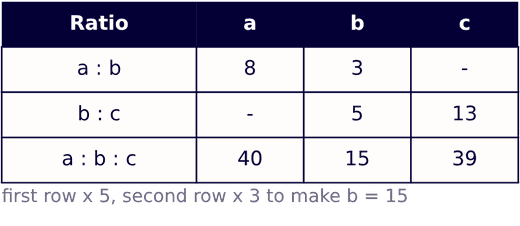 Now the two chains join: a:b:c=40:15:39.
Dropping the middle term, a:c=40:39, so option (b) is the correct answer.
Now the two chains join: a:b:c=40:15:39.
Dropping the middle term, a:c=40:39, so option (b) is the correct answer.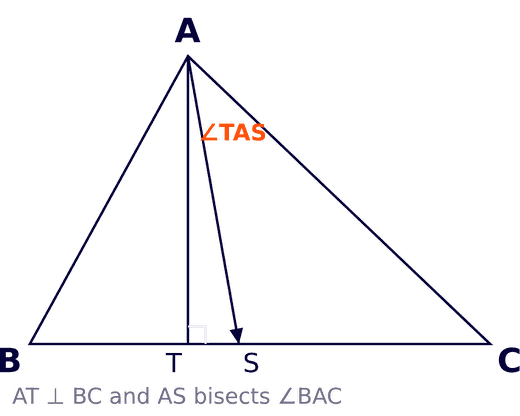 AS bisects , so .
In the right triangle ABT, .
Since , the foot T lies between B and S, so .
.
.
So option (b) is the correct answer.
AS bisects , so .
In the right triangle ABT, .
Since , the foot T lies between B and S, so .
.
.
So option (b) is the correct answer.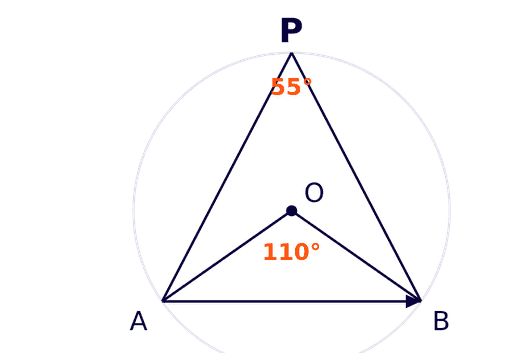 Here the chord AB subtends at the circumference.
So .
The angle at the centre is 110°, so option (c) is the correct answer.
Here the chord AB subtends at the circumference.
So .
The angle at the centre is 110°, so option (c) is the correct answer.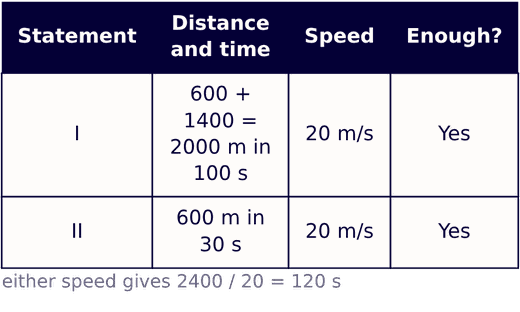 Statement I: crossing a 1,400 m platform means covering 600+1400=2000 m in 100 s, so the speed is m/s and the required time is s.
Hence statement I alone is sufficient.
Statement II: crossing a pole means covering just the length of the train, so the speed is m/s and again the time is s.
Hence statement II alone is also sufficient.
Either statement alone answers the question, so option (c) is the correct answer.
Statement I: crossing a 1,400 m platform means covering 600+1400=2000 m in 100 s, so the speed is m/s and the required time is s.
Hence statement I alone is sufficient.
Statement II: crossing a pole means covering just the length of the train, so the speed is m/s and again the time is s.
Hence statement II alone is also sufficient.
Either statement alone answers the question, so option (c) is the correct answer.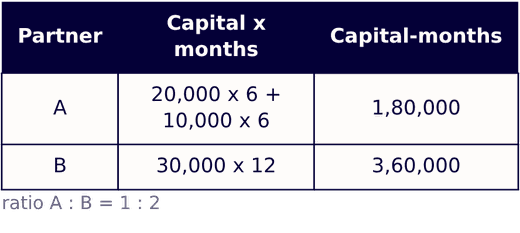 A's capital-months .
B's capital-months .
So A:B=180000:360000=1:2, and the profit splits into 1+2=3 equal parts.
A's share , that is ₹30,000.
So option (b) is the correct answer.
A's capital-months .
B's capital-months .
So A:B=180000:360000=1:2, and the profit splits into 1+2=3 equal parts.
A's share , that is ₹30,000.
So option (b) is the correct answer.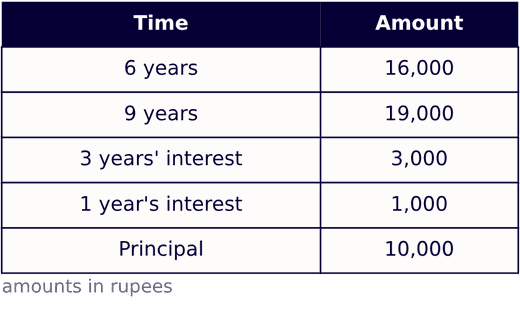 Interest of 9-6=3 years =19000-16000=3000.
Interest of 1 year .
Interest of 6 years .
Principal = amount after 6 years - interest of 6 years =16000-6000=10000.
So the original principal is ₹10,000, and option (b) is the correct answer.
Interest of 9-6=3 years =19000-16000=3000.
Interest of 1 year .
Interest of 6 years .
Principal = amount after 6 years - interest of 6 years =16000-6000=10000.
So the original principal is ₹10,000, and option (b) is the correct answer.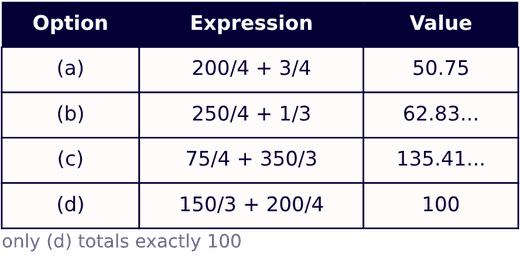 (a) , which is far below 100.
(b) , again short of 100.
(c) , past 100.
(d) , exactly the required sum.
So option (d) is the correct answer.
(a) , which is far below 100.
(b) , again short of 100.
(c) , past 100.
(d) , exactly the required sum.
So option (d) is the correct answer.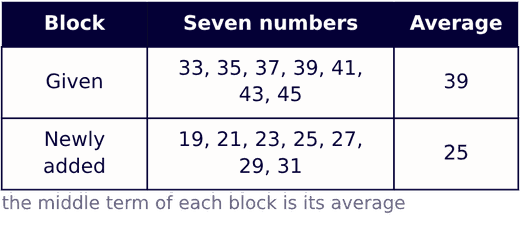 The newly added numbers are these seven, and their middle term is 25.
So their average is 25, and option (c) is the correct answer.
The newly added numbers are these seven, and their middle term is 25.
So their average is 25, and option (c) is the correct answer.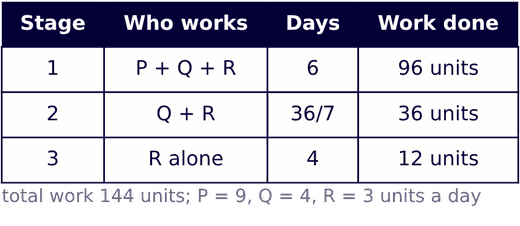 For the first 6 days all three work: units.
For the last 4 days R works alone: units.
So the middle stretch, worked by Q and R together, covers 144-96-12=36 units.
Q and R together do 4+3=7 units a day, so that stretch lasts days.
Total time days.
So option (b) is the correct answer.
For the first 6 days all three work: units.
For the last 4 days R works alone: units.
So the middle stretch, worked by Q and R together, covers 144-96-12=36 units.
Q and R together do 4+3=7 units a day, so that stretch lasts days.
Total time days.
So option (b) is the correct answer.