SSC CHSL 28 November 2025 · Shift 1 · English Language — questions with answers · ShikshaSphere
Chapter 168 of 200
28 November 2025 · Shift 1
English Language
25 questions ~25 min readFree
25 questions
A
1
What do we call a person who operates a machine, especially a machine tool or a sewing machine.
A.Mechanic
B.Engineer
C.Machinist
D.Craftsman
Solution
One-word substitution
The definition given in the question turns on one verb — the person 'operates' the machine; he neither designs it nor repairs it.
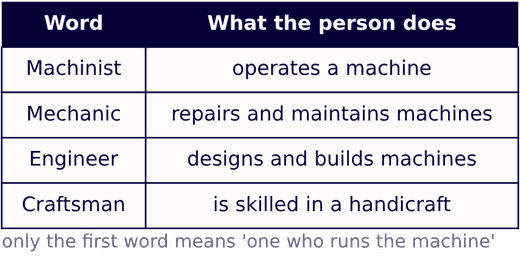
A machinist is exactly that: a worker who runs a machine, especially a machine tool such as a lathe or a sewing machine.
A mechanic repairs and services machines, an engineer designs and builds them, and a craftsman is skilled in a handicraft, so none of these carries the sense of merely operating a machine.
2
Select the idiom which means something that costs a lot of money but has no useful purpose.
A.Fish in a pond
B.A white elephant
C.bell the cat
D.A blue whale
Solution
Idiom meaning
'A white elephant' is a possession that costs a great deal to buy or maintain but serves no useful purpose.
The phrase comes from the sacred white elephants of Siam: a king would gift one to a courtier he disliked, because the animal could not be put to work yet cost a fortune to feed.
Example: The half-finished stadium became a white elephant for the municipality.
'Bell the cat' means to take a dangerous risk on behalf of others, while 'fish in a pond' and 'a blue whale' are not idioms at all.
3
Choose the option that has an error in the sentence.
How useful is verbal communication, such as tone of voice and clarity, during a presentation?
A.How useful is verbal communication,
B.such as tone of voice and clarity,
C.during a presentation?
D.No correction required
Solution
Error spotting
Test each segment against the rule it could possibly break.
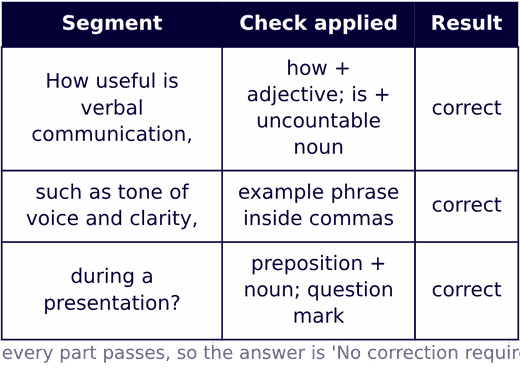
In (a) the question opens with 'How + adjective', and the singular verb 'is' agrees correctly with the uncountable noun 'communication'.
In (b) 'such as tone of voice and clarity' is a parenthetical example phrase, properly enclosed in a pair of commas.
In (c) 'during a presentation' is an ordinary prepositional phrase of time, and the question mark closes the interrogative sentence.
No fault of article, agreement, tense or preposition remains, so no correction is required.
4
Find the grammatically correct sentence from below options.
A.Hardly had she finished her work when the guests arrived.
B.Hardly she had finished her work when the guests arrived.
C.Hardly had she finished her work than the guests arrived.
D.Hardly she finished her work when the guests arrived.
Solution
Inversion after 'hardly'
When a negative or restrictive adverb such as hardly, scarcely, barely, rarely or never opens a sentence, the auxiliary must be placed before the subject. This is the inversion rule.
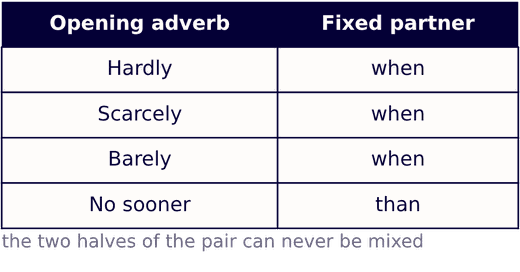
'Hardly' also has a fixed partner: hardly / scarcely / barely take 'when', and 'no sooner' takes 'than'.
The correct frame is therefore: Hardly + had + subject + V3 ... when + simple past.
Option (a) obeys both rules; (b) and (d) keep the normal subject-verb order, and (c) replaces 'when' with 'than'.
5
Fill in the blank with the most appropriate preposition:
The committee conferred the proposal for several days before making a decision.
A.at
B.on
C.with
D.for
Solution
Preposition with 'confer'
'Confer' changes its preposition with its sense: confer on / upon a subject means to hold discussions about it, while confer with a person means to consult that person.
Here the committee discussed the proposal itself, so the object is a thing and the required preposition is 'on'.
The sentence reads: The committee conferred on the proposal for several days before making a decision.
'With' would demand a person after it, and 'at' and 'for' do not collocate with 'confer' at all.
6
Pick the correct homonym to complete the sentence.
I was in London.
A.borne
B.born
C.bourn
D.burn
Solution
Homonyms: born / borne
'Bear' has two past participles that split by meaning.
'Born' is used only for coming into existence — for birth — and almost always in the passive: I was born in London.
'Borne' covers every other sense of bear: carried, endured, or the active use 'she has borne three children'.
'Bourn' is a rare word for a small stream or a boundary and 'burn' means to be on fire, so neither can express birth.
7
Select the incorrectly spelt word.
A.Necessary
B.Accesories
C.Essential
D.Paramount
Solution
Spelling
The correct spelling is 'Accessories' — it takes a double c and a double s: ac-ces-so-ries.
Option (b) writes only one s, so that is the incorrectly spelt word.
Necessary, Essential and Paramount are all spelt correctly. A handy contrast to remember: 'necessary' has one c and two s's, while 'accessories' has two of each.
8
Choose the best option to replace the underlined part to improve the given sentence. If no substitution is required, select 'No substitution.'
My son put out all his books in the cupboard.
A.up
B.away
C.on
D.substitution
Solution
Phrasal verb 'put away'
The cupboard in the sentence shows that the books are being returned to the place where they are normally kept.
'Put away' carries exactly that sense — to store something in its proper place.
The improved sentence is: My son put away all his books in the cupboard.
'Put out' means to extinguish or to inconvenience, 'put up' means to accommodate or to erect, and 'put on' means to wear, so none of them suits a cupboard.
9
Choose the option that is the most appropriate conversion of the following sentence into Active Voice.
The research papers are being reviewed by the experts.
A.The experts review the research papers.
B.The experts are reviewing the research papers.
C.The experts were reviewing the research papers.
D.The experts have reviewed the research papers.
Solution
Passive to active voice
The passive verb 'are being reviewed' is present continuous, so the active verb must also be present continuous.
The agent 'the experts' becomes the subject and the passive subject 'the research papers' becomes the object.
Active: The experts are reviewing the research papers.
Option (a) shifts to simple present, (c) to past continuous and (d) to present perfect, so all three change the tense of the original sentence.
10
Choose the correct indirect narration of the following statement from the given alternatives:
The accused said to the officer, "I am truthful as I did not break the law."
A.The accused told the officer that he is truthful as I had not broken the law.
B.The accused told the officer that he was truthful as I did not break the law.
C.The accused told the officer that he is truthful as I did not break the law.
D.The accused told the officer that he was truthful as he had not broken the law.
Solution
Direct to indirect speech
'Said to' followed by a listener becomes 'told' in indirect speech, and the conjunction 'that' replaces the inverted commas.
Every 'I' spoken by the accused refers to the accused himself, so both occurrences must become 'he'.
The tense moves one step back: present simple 'am' becomes 'was', and past simple 'did not break' becomes past perfect 'had not broken'.
Indirect: The accused told the officer that he was truthful as he had not broken the law.
Options (a), (b) and (c) each leave an 'I' unchanged or leave one verb in its original tense, so each breaks one of these rules.
11
Choose the option that is the most appropriate conversion of the following sentence into Direct Speech.
She suggested that they review the assignment carefully before submission.
A.She suggested, "They will review the assignment carefully before submission."
B.She said, "Review the assignment carefully before submission."
C.She said, "Let's review the assignment carefully before submission."
D.She suggested, "They must review the assignment carefully before submission."
Solution
Indirect to direct speech
The reporting verb 'suggested that they (should) + V1' is the standard indirect form of a proposal made with 'Let's + V1'.
Turning it back into direct speech, the quoted words are 'Let's review the assignment carefully before submission', introduced by 'said'.
Option (b) quotes a plain imperative, which would be reported as 'She told them to review the assignment', not as 'suggested that they review'.
Options (a) and (d) quote statements about 'they' with 'will' and 'must', which would be reported as 'She said that they would / must review', so neither matches the given sentence.
12
The following sentence has two blanks. Choose the most suitable set of prepositions from the given options to fill in the blanks and complete the sentence meaningfully:
He was reprimanded disrespecting the teachers and warned future misconduct.
A.to, of
B.for, against
C.with, about
D.from, with
Solution
Prepositions in collocations
Both blanks are fixed by the verb that stands before them.
'Reprimand somebody for something' — 'for' introduces the offence or the reason for the rebuke.
'Warn somebody against something' — 'against' introduces what the person is being told to avoid.
The sentence reads: He was reprimanded for disrespecting the teachers and warned against future misconduct.
The pairs 'to, of', 'with, about' and 'from, with' each break at least one of these two fixed collocations.
13
Choose the option that is the most appropriate conversion of the following sentence into Direct Speech.
He said that the reports had to be completed by the next morning.
A.He said, "The reports ought to be completed by the next morning."
B.He said, "The reports must be completed by tomorrow morning."
C.He said, "The reports need to be completed by the coming morning."
D.He said, "The reports are to be completed by the following morning."
Solution
Indirect to direct speech
'Must' has no past form of its own, so in indirect speech it is reported as 'had to'. Reversing that, the 'had to' of the given sentence goes back to 'must'.
Time words shift back as well: 'the next morning' of indirect speech corresponds to 'tomorrow morning' in the words actually spoken.
Direct: He said, "The reports must be completed by tomorrow morning."
'Ought to', 'need to' and 'are to' would have been reported as 'ought to', 'needed to' and 'were to' respectively, none of which is 'had to'.
14
Which sentence contains a misspelled word?
A.He is able to articulate his thoughts clearly.
B.They tried to articualte their opinions during the discussion.
C.His explanation was very articulate and convincing.
D.The speaker asked the audience to articulate their concerns.
Solution
Spelling in context
Read the four sentences and compare the one word they share.
The correct spelling is 'articulate' — ar-tic-u-late, with the u before the l.
Option (b) writes 'articualte', in which the u and the l have been transposed, so that sentence contains the misspelt word.
In the other three sentences the word is spelt correctly: as a verb meaning 'to express clearly' in (a) and (d), and as an adjective meaning 'clear and fluent' in (c).
15
Change the following sentence into the Active form.
It had been announced that the annual meeting would not be postponed this week.
A.They had announced that the annual meeting would not be postponed this week.
B.The annual meeting would not be postponed this week, it had been announced.
C.They have announced that the annual meeting would not be postponed this week.
D.The annual meeting was announced not to be postponed this week.
Solution
Impersonal passive to active
'It had been announced that ...' is an impersonal passive: the doer is not named at all.
When such a sentence is made active, an indefinite subject has to be supplied, and the accepted choice is 'They'.
The passive verb is past perfect (had been announced), so the active verb must stay past perfect: 'had announced'.
Active: They had announced that the annual meeting would not be postponed this week.
Option (c) moves the tense to present perfect, while (b) and (d) still keep a passive verb, so none of them is a genuine active form.
16
Choose the most suitable option to replace the highlighted part of the sentence:
The law was passed by the city council on Monday after protests by local residents, who has threat to block the roads.
A.had threats of blocking
B.had threaded to block
C.had threatened to block
D.had threatened to blocking
Solution
Past perfect and 'threaten to'
Two past actions are involved: the residents made their threat first, and the council passed the law afterwards.
Of two past actions, the earlier one takes the past perfect (had + V3) and the later one the simple past. Here the later verb 'was passed' is already simple past, so the earlier one must be 'had threatened'.
'Threaten' is followed by a to-infinitive, which gives 'had threatened to block'.
'Had threats of blocking' turns the verb into a noun, 'threaded' means to pass a thread through something, and 'to blocking' breaks the to-infinitive.
17
Choose the correct passive voice transformation of the sentence:
Did Rohan teach the students?
A.The students did get taught by Rohan?
B.The students were taught by Rohan?
C.Did the students be taught by Rohan?
D.Were the students taught by Rohan?
Solution
Passive of an interrogative
The active sentence begins with the auxiliary 'Did', so the passive must also begin with an auxiliary and keep the question order.
For the simple past, 'did + V1' becomes 'was / were + V3'; the new subject 'the students' is plural, so the auxiliary is 'were'.
Passive: Were the students taught by Rohan?
Option (b) keeps the statement order, (a) invents the form 'did get taught', and (c) wrongly keeps 'Did' along with 'be'.
18
Choose the correct passive voice transformation of the sentence:
Who did they suspect was accountable for spreading the secret data to the public?
A.Who was suspected by them of being accountable for spreading the secret data to the public?
B.By whom was it suspected that the secret data had been spread to the public?
C.Who do they suspect was accountable for the secret data being spread to the public?
D.By whom was the secret data suspected to have been spread to the public?
Solution
Passive of a 'who' question
In the active sentence 'who' is the object of 'suspect' — they suspected somebody — so in the passive that 'who' becomes the subject and still stands at the head of the question.
'Did they suspect' is simple past active, and its passive is 'was suspected by them'.
Once 'who' has been pulled into the main passive verb, the clause 'was accountable for spreading ...' has to be reduced to the phrase 'of being accountable for spreading ...'.
Passive: Who was suspected by them of being accountable for spreading the secret data to the public?
Option (c) is still active, while (b) and (d) make the secret data the focus of the question instead of the person, which changes what is being asked.
19
Directions (Qs. 19-23): Read the following passage carefully and answer the questions that follow.
Throughout the last century, the global workforce has undergone a significant transformation regarding gender equity. In the early 1900s, systemic biases and discriminatory policies often barred women from high-ranking professional roles or restricted them to lower-paid sectors. Deep-rooted patriarchal norms and a lack of legislative protection meant that the economic potential of a massive segment of the population remained largely untapped.
Gradually, the rise of the feminist movement and the introduction of equal pay legislation began to dismantle these structural barriers. International organizations and corporate leaders worked together to launch initiatives aimed at closing the gender pay gap, implementing inclusive hiring practices, and providing mentorship for underrepresented groups. Campaigns advocating for "equal pay for equal work" brought a sense of justice to millions of workers.
Despite this progress, significant hurdles persist in various industries, where the "glass ceiling," unconscious bias, and a lack of childcare support continue to limit professional opportunities for women. However, the success of female CEOs and entrepreneurs who have shattered long-standing barriers inspires a new generation to challenge gender disparity. The evolution of workplace equality proves that eliminating discrimination and fostering diverse leadership through collective action benefits global economies and ensures social stability.
Complete the sentence with the most appropriate preposition:
Corporate leaders worked together to launch programs aimed closing the gender pay gap.
A.On
B.For
C.To
D.At
Solution
Preposition with 'aimed'
The blank needs the preposition that goes with the participle 'aimed'.
The fixed pattern is 'aim at + V-ing': to aim at doing something is to have that thing as one's target.
Here the target of the programmes is 'closing the gender pay gap', an -ing form, so 'at' is the preposition that fits.
Complete sentence: Corporate leaders worked together to launch programs aimed at closing the gender pay gap.
Option (a) 'aimed on' is not an English collocation, (b) 'aimed for' takes a noun as its goal rather than an -ing form, and (c) 'aimed to' must be followed by the base verb ('aimed to close'), not by 'closing'.
20
Directions (Qs. 19-23): Read the following passage carefully and answer the questions that follow.
Throughout the last century, the global workforce has undergone a significant transformation regarding gender equity. In the early 1900s, systemic biases and discriminatory policies often barred women from high-ranking professional roles or restricted them to lower-paid sectors. Deep-rooted patriarchal norms and a lack of legislative protection meant that the economic potential of a massive segment of the population remained largely untapped.
Gradually, the rise of the feminist movement and the introduction of equal pay legislation began to dismantle these structural barriers. International organizations and corporate leaders worked together to launch initiatives aimed at closing the gender pay gap, implementing inclusive hiring practices, and providing mentorship for underrepresented groups. Campaigns advocating for "equal pay for equal work" brought a sense of justice to millions of workers.
Despite this progress, significant hurdles persist in various industries, where the "glass ceiling," unconscious bias, and a lack of childcare support continue to limit professional opportunities for women. However, the success of female CEOs and entrepreneurs who have shattered long-standing barriers inspires a new generation to challenge gender disparity. The evolution of workplace equality proves that eliminating discrimination and fostering diverse leadership through collective action benefits global economies and ensures social stability.
Which of the following is the correct passive voice transformation of this sentence? "International organizations and corporate leaders worked together to launch inclusive initiatives."
A.Inclusive initiatives were launched by international organizations and corporate leaders.
B.To launch initiatives was worked by international organizations and corporate leaders.
C.Inclusive initiatives had launched by international organizations and corporate leaders.
D.International organizations and corporate leaders were being launched by inclusive initiatives.
Solution
Active to passive voice
The verb that actually takes an object is 'launch'; 'worked' is intransitive and cannot be made passive at all.
So the object 'inclusive initiatives' becomes the subject of the passive sentence.
'Worked ... to launch' refers to the simple past, so the passive verb is 'were launched', plural to agree with 'initiatives'.
The two doers move behind 'by': Inclusive initiatives were launched by international organizations and corporate leaders.
Option (b) tries to make the intransitive 'worked' passive, (c) uses the active 'had launched' with the object as subject, and (d) reverses the doer and the deed.
21
Directions (Qs. 19-23): Read the following passage carefully and answer the questions that follow.
Throughout the last century, the global workforce has undergone a significant transformation regarding gender equity. In the early 1900s, systemic biases and discriminatory policies often barred women from high-ranking professional roles or restricted them to lower-paid sectors. Deep-rooted patriarchal norms and a lack of legislative protection meant that the economic potential of a massive segment of the population remained largely untapped.
Gradually, the rise of the feminist movement and the introduction of equal pay legislation began to dismantle these structural barriers. International organizations and corporate leaders worked together to launch initiatives aimed at closing the gender pay gap, implementing inclusive hiring practices, and providing mentorship for underrepresented groups. Campaigns advocating for "equal pay for equal work" brought a sense of justice to millions of workers.
Despite this progress, significant hurdles persist in various industries, where the "glass ceiling," unconscious bias, and a lack of childcare support continue to limit professional opportunities for women. However, the success of female CEOs and entrepreneurs who have shattered long-standing barriers inspires a new generation to challenge gender disparity. The evolution of workplace equality proves that eliminating discrimination and fostering diverse leadership through collective action benefits global economies and ensures social stability.
Which word from the passage means to continue to exist or remain?
A.inspires
B.persist
C.barred
D.inclusive
Solution
Vocabulary from passage
The clue in the question is 'continue to exist or remain' — the passage needs a verb saying that something has not gone away.
The third paragraph reads: 'Despite this progress, significant hurdles persist in various industries', i.e. the hurdles still remain.
So 'persist' is the word asked for.
'Inspires' means fills someone with the urge to act, 'barred' means shut out, and 'inclusive' means open to everyone — none of these carries the sense of continuing to exist.
22
Directions (Qs. 19-23): Read the following passage carefully and answer the questions that follow.
Throughout the last century, the global workforce has undergone a significant transformation regarding gender equity. In the early 1900s, systemic biases and discriminatory policies often barred women from high-ranking professional roles or restricted them to lower-paid sectors. Deep-rooted patriarchal norms and a lack of legislative protection meant that the economic potential of a massive segment of the population remained largely untapped.
Gradually, the rise of the feminist movement and the introduction of equal pay legislation began to dismantle these structural barriers. International organizations and corporate leaders worked together to launch initiatives aimed at closing the gender pay gap, implementing inclusive hiring practices, and providing mentorship for underrepresented groups. Campaigns advocating for "equal pay for equal work" brought a sense of justice to millions of workers.
Despite this progress, significant hurdles persist in various industries, where the "glass ceiling," unconscious bias, and a lack of childcare support continue to limit professional opportunities for women. However, the success of female CEOs and entrepreneurs who have shattered long-standing barriers inspires a new generation to challenge gender disparity. The evolution of workplace equality proves that eliminating discrimination and fostering diverse leadership through collective action benefits global economies and ensures social stability.
Which word from the passage means not yet utilized or realized?
A.restricted
B.eliminating
C.untapped
D.underrepresented
Solution
Vocabulary from passage
'Not yet utilized or realized' describes something whose worth is still lying unused.
The first paragraph says that the economic potential of a massive segment of the population 'remained largely untapped' — that potential had never been drawn upon.
So 'untapped' is the required word.
'Restricted' means kept within limits, 'eliminating' means removing and 'underrepresented' means present in too small a number, so none of them matches the given definition.
23
Directions (Qs. 19-23): Read the following passage carefully and answer the questions that follow.
Throughout the last century, the global workforce has undergone a significant transformation regarding gender equity. In the early 1900s, systemic biases and discriminatory policies often barred women from high-ranking professional roles or restricted them to lower-paid sectors. Deep-rooted patriarchal norms and a lack of legislative protection meant that the economic potential of a massive segment of the population remained largely untapped.
Gradually, the rise of the feminist movement and the introduction of equal pay legislation began to dismantle these structural barriers. International organizations and corporate leaders worked together to launch initiatives aimed at closing the gender pay gap, implementing inclusive hiring practices, and providing mentorship for underrepresented groups. Campaigns advocating for "equal pay for equal work" brought a sense of justice to millions of workers.
Despite this progress, significant hurdles persist in various industries, where the "glass ceiling," unconscious bias, and a lack of childcare support continue to limit professional opportunities for women. However, the success of female CEOs and entrepreneurs who have shattered long-standing barriers inspires a new generation to challenge gender disparity. The evolution of workplace equality proves that eliminating discrimination and fostering diverse leadership through collective action benefits global economies and ensures social stability.
What is the main idea of the passage?
A.Gender discrimination has been completely eliminated in the modern workplace.
B.Economic growth is impossible without increasing taxes on corporations.
C.Workplace equality has improved significantly, but systemic barriers still remain.
D.Only female CEOs are capable of leading international organizations.
Solution
Main idea of passage
A main-idea question is settled by the thread that runs through every paragraph, never by a single detail.
Paragraph 1 describes the old barriers, paragraph 2 the reforms — equal pay laws, inclusive hiring, mentorship — that pulled many of them down, and paragraph 3 the hurdles that still 'persist'.
So the passage records real progress together with the problems that are still left, which is exactly option (c).
(a) contradicts the third paragraph, (b) brings in taxation that the passage never mentions, and (d) turns one supporting example about female CEOs into a sweeping claim.
24
What is the antonym of 'Indolence'?
A.Apathy
B.Enthusiasm
C.Inactivity
D.Ignorance
Solution
Antonym
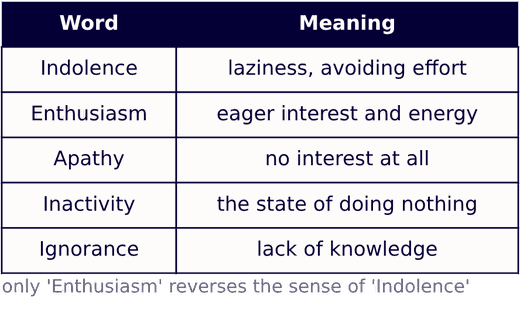
'Indolence' means the habit of avoiding work or exertion — laziness.
Its opposite must therefore express eagerness and energy for doing things.
'Enthusiasm' is exactly that: intense and eager interest.
'Apathy' and 'inactivity' are close in sense to indolence rather than opposite to it, and 'ignorance' concerns knowledge, not effort.
25
What is the antonym of "Scoundrel"?
A.Rascal
B.Virtuous
C.Reprobate
D.Miscreant
Solution
Antonym
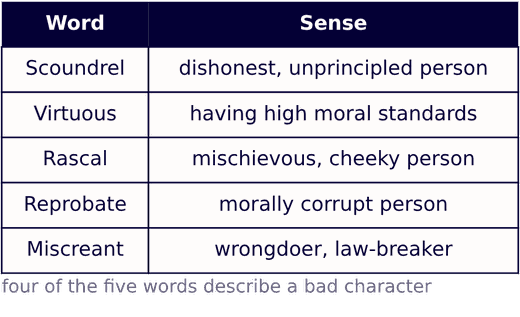
A 'scoundrel' is a dishonest, unprincipled person.
The opposite must describe a person of high moral standards, and that word is 'virtuous'.
'Rascal', 'reprobate' and 'miscreant' each name a wrongdoer of some kind, so they are synonyms of scoundrel and cannot be its antonym.
Finished reading? Now test yourself.
The same 25 questions, but with a timer and the answers hidden — 15 minutes.

 A mechanic repairs and services machines, an engineer designs and builds them, and a craftsman is skilled in a handicraft, so none of these carries the sense of merely operating a machine.
 No fault of article, agreement, tense or preposition remains, so no correction is required.
 The correct frame is therefore: Hardly + had + subject + V3 ... when + simple past.
Option (a) obeys both rules; (b) and (d) keep the normal subject-verb order, and (c) replaces 'when' with 'than'.
The correct frame is therefore: Hardly + had + subject + V3 ... when + simple past.
Option (a) obeys both rules; (b) and (d) keep the normal subject-verb order, and (c) replaces 'when' with 'than'.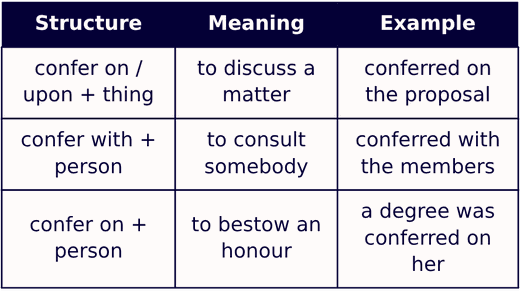 The sentence reads: The committee conferred on the proposal for several days before making a decision.
'With' would demand a person after it, and 'at' and 'for' do not collocate with 'confer' at all.
The sentence reads: The committee conferred on the proposal for several days before making a decision.
'With' would demand a person after it, and 'at' and 'for' do not collocate with 'confer' at all.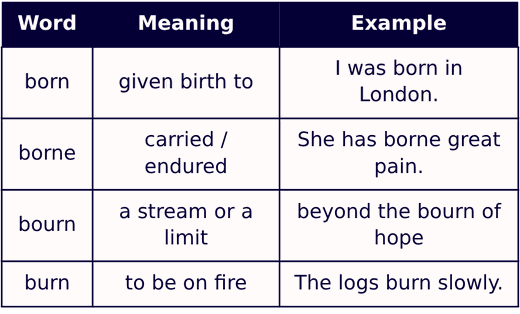 'Borne' covers every other sense of bear: carried, endured, or the active use 'she has borne three children'.
'Bourn' is a rare word for a small stream or a boundary and 'burn' means to be on fire, so neither can express birth.
'Borne' covers every other sense of bear: carried, endured, or the active use 'she has borne three children'.
'Bourn' is a rare word for a small stream or a boundary and 'burn' means to be on fire, so neither can express birth.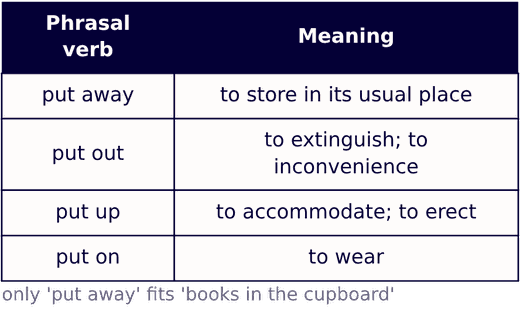 The improved sentence is: My son put away all his books in the cupboard.
'Put out' means to extinguish or to inconvenience, 'put up' means to accommodate or to erect, and 'put on' means to wear, so none of them suits a cupboard.
The improved sentence is: My son put away all his books in the cupboard.
'Put out' means to extinguish or to inconvenience, 'put up' means to accommodate or to erect, and 'put on' means to wear, so none of them suits a cupboard.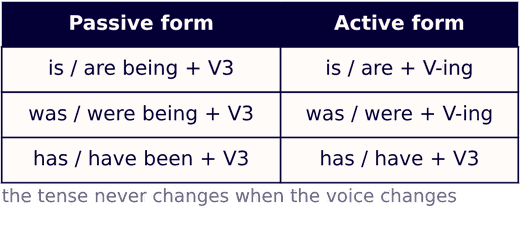 Active: The experts are reviewing the research papers.
Option (a) shifts to simple present, (c) to past continuous and (d) to present perfect, so all three change the tense of the original sentence.
Active: The experts are reviewing the research papers.
Option (a) shifts to simple present, (c) to past continuous and (d) to present perfect, so all three change the tense of the original sentence.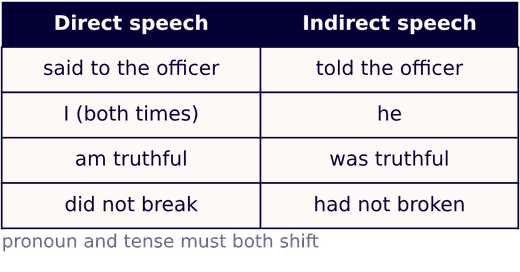 Indirect: The accused told the officer that he was truthful as he had not broken the law.
Options (a), (b) and (c) each leave an 'I' unchanged or leave one verb in its original tense, so each breaks one of these rules.
Indirect: The accused told the officer that he was truthful as he had not broken the law.
Options (a), (b) and (c) each leave an 'I' unchanged or leave one verb in its original tense, so each breaks one of these rules.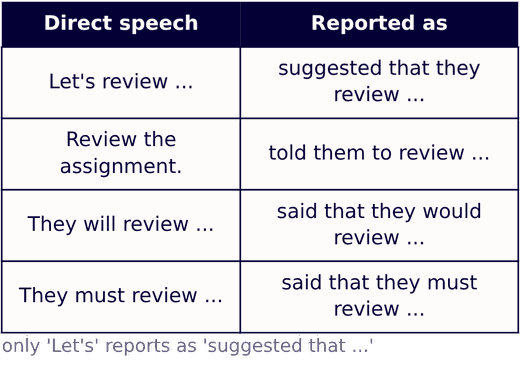 Option (b) quotes a plain imperative, which would be reported as 'She told them to review the assignment', not as 'suggested that they review'.
Options (a) and (d) quote statements about 'they' with 'will' and 'must', which would be reported as 'She said that they would / must review', so neither matches the given sentence.
Option (b) quotes a plain imperative, which would be reported as 'She told them to review the assignment', not as 'suggested that they review'.
Options (a) and (d) quote statements about 'they' with 'will' and 'must', which would be reported as 'She said that they would / must review', so neither matches the given sentence.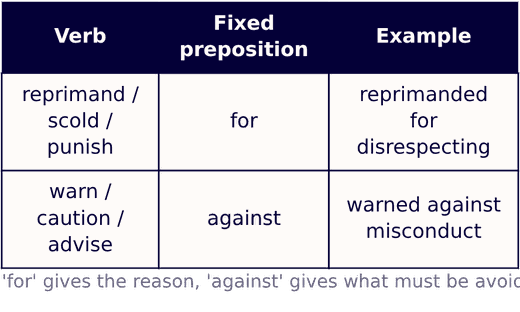 The sentence reads: He was reprimanded for disrespecting the teachers and warned against future misconduct.
The pairs 'to, of', 'with, about' and 'from, with' each break at least one of these two fixed collocations.
The sentence reads: He was reprimanded for disrespecting the teachers and warned against future misconduct.
The pairs 'to, of', 'with, about' and 'from, with' each break at least one of these two fixed collocations.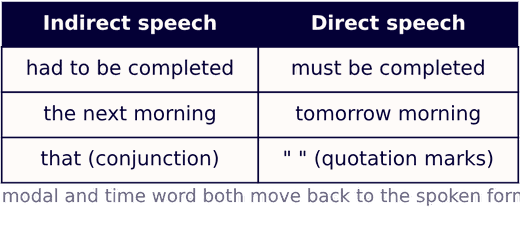 Direct: He said, "The reports must be completed by tomorrow morning."
'Ought to', 'need to' and 'are to' would have been reported as 'ought to', 'needed to' and 'were to' respectively, none of which is 'had to'.
Direct: He said, "The reports must be completed by tomorrow morning."
'Ought to', 'need to' and 'are to' would have been reported as 'ought to', 'needed to' and 'were to' respectively, none of which is 'had to'.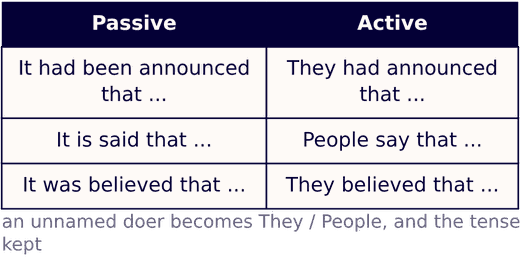 Active: They had announced that the annual meeting would not be postponed this week.
Option (c) moves the tense to present perfect, while (b) and (d) still keep a passive verb, so none of them is a genuine active form.
Active: They had announced that the annual meeting would not be postponed this week.
Option (c) moves the tense to present perfect, while (b) and (d) still keep a passive verb, so none of them is a genuine active form.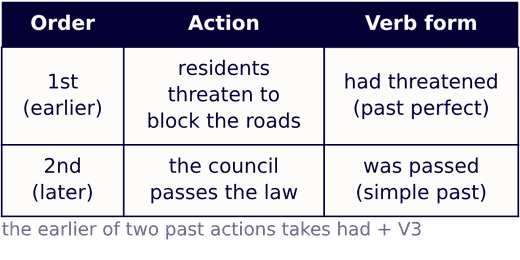 'Threaten' is followed by a to-infinitive, which gives 'had threatened to block'.
'Had threats of blocking' turns the verb into a noun, 'threaded' means to pass a thread through something, and 'to blocking' breaks the to-infinitive.
'Threaten' is followed by a to-infinitive, which gives 'had threatened to block'.
'Had threats of blocking' turns the verb into a noun, 'threaded' means to pass a thread through something, and 'to blocking' breaks the to-infinitive.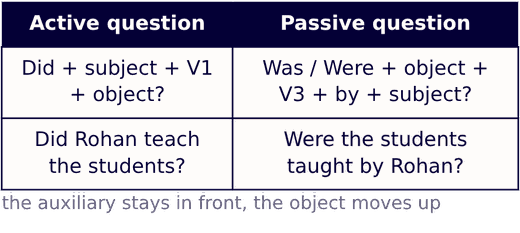 Passive: Were the students taught by Rohan?
Option (b) keeps the statement order, (a) invents the form 'did get taught', and (c) wrongly keeps 'Did' along with 'be'.
Passive: Were the students taught by Rohan?
Option (b) keeps the statement order, (a) invents the form 'did get taught', and (c) wrongly keeps 'Did' along with 'be'.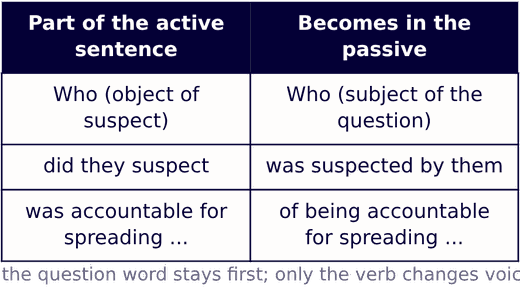 Passive: Who was suspected by them of being accountable for spreading the secret data to the public?
Option (c) is still active, while (b) and (d) make the secret data the focus of the question instead of the person, which changes what is being asked.
Passive: Who was suspected by them of being accountable for spreading the secret data to the public?
Option (c) is still active, while (b) and (d) make the secret data the focus of the question instead of the person, which changes what is being asked.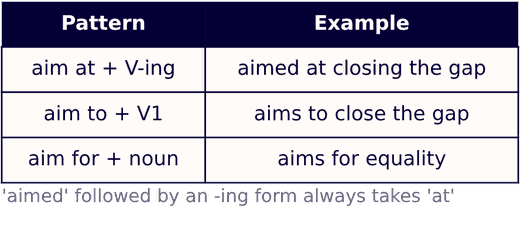 Here the target of the programmes is 'closing the gender pay gap', an -ing form, so 'at' is the preposition that fits.
Complete sentence: Corporate leaders worked together to launch programs aimed at closing the gender pay gap.
Option (a) 'aimed on' is not an English collocation, (b) 'aimed for' takes a noun as its goal rather than an -ing form, and (c) 'aimed to' must be followed by the base verb ('aimed to close'), not by 'closing'.
Here the target of the programmes is 'closing the gender pay gap', an -ing form, so 'at' is the preposition that fits.
Complete sentence: Corporate leaders worked together to launch programs aimed at closing the gender pay gap.
Option (a) 'aimed on' is not an English collocation, (b) 'aimed for' takes a noun as its goal rather than an -ing form, and (c) 'aimed to' must be followed by the base verb ('aimed to close'), not by 'closing'.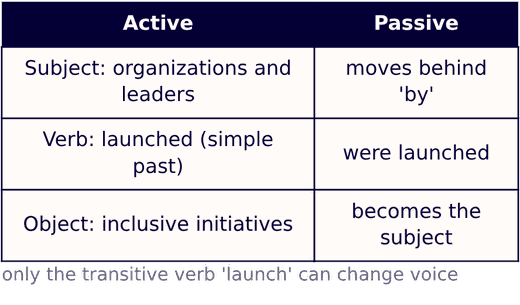 The two doers move behind 'by': Inclusive initiatives were launched by international organizations and corporate leaders.
Option (b) tries to make the intransitive 'worked' passive, (c) uses the active 'had launched' with the object as subject, and (d) reverses the doer and the deed.
The two doers move behind 'by': Inclusive initiatives were launched by international organizations and corporate leaders.
Option (b) tries to make the intransitive 'worked' passive, (c) uses the active 'had launched' with the object as subject, and (d) reverses the doer and the deed.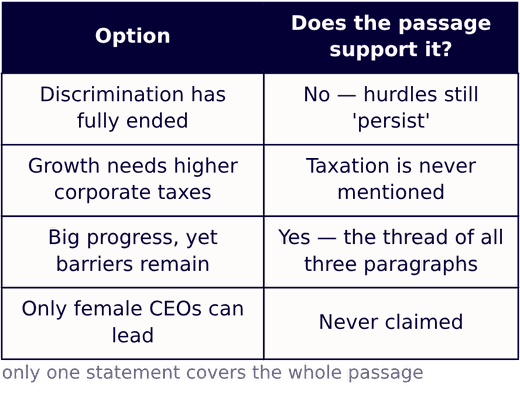 (a) contradicts the third paragraph, (b) brings in taxation that the passage never mentions, and (d) turns one supporting example about female CEOs into a sweeping claim.
 'Apathy' and 'inactivity' are close in sense to indolence rather than opposite to it, and 'ignorance' concerns knowledge, not effort.
 'Rascal', 'reprobate' and 'miscreant' each name a wrongdoer of some kind, so they are synonyms of scoundrel and cannot be its antonym.