SSC CHSL 28 November 2025 · Shift 2 · General Intelligence — questions with answers · ShikshaSphere
Chapter 169 of 200
28 November 2025 · Shift 2
General Intelligence
25 questions ~25 min readFree
25 questions
A
26
Find the next element that replace the ? Logically
5, 15, 35, 75, ?
A.145
B.155
C.160
D.165
Solution
Number series
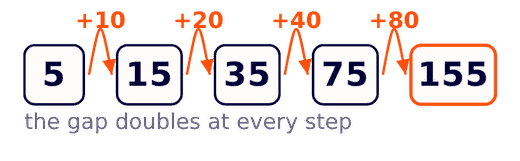
See how much the series grows at each step: 15-5=10, 35-15=20, 75-35=40.
The gaps themselves double every time — — so the next gap must be 80.
Hence the missing term is 75+80=155.
The same pattern can be written as : , , , .
Hence option (b) is correct.
27
If and then find the value of ?
A.-4
B.-6
C.-8
D.4
Solution
Number analogy
Compare the two completed statements and look for one rule that turns the pair of numbers into the result.
For the pair 72 and 24: , which is the value given.
Test the same rule on the second pair: — it holds.
Now apply it to 36 and 48: .
Note that the second number here is the larger one, so the result is negative.
Hence option (a) is correct.
28
If 42 @ and 35 @ 5040 then find the value of 21 @ ?
A.1764
B.2016
C.2940
D.3528
Solution
Symbol operation
Find what the sign @ does by testing the first statement: .
Since , the rule is (first number) (second number) .
Verify it on the second statement: , which matches.
Apply the rule to the asked pair: .
Therefore the value is .
Hence option (a) is correct.
29
Find the next element that replace the ? Logically
72, 145, 252, 395, ?
A.530
B.576
C.525
D.530
Solution
Number series
Write the differences between consecutive terms: 145-72=73, 252-145=107, 395-252=143.
These are not constant, so take their differences in turn: 107-73=34 and 143-107=36.
The second differences rise by 2, so the next one is 38 and the next gap is 143+38=181.
Hence the missing term is 395+181=576.
As a check, , a neat value for an SSC series.
Hence option (b) is correct.
30
Choose the correct options from the alternative. 72 : ? :: 91 : 64
A.24
B.25
C.18
D.26
Solution
Number analogy
Work on the completed pair first, since it is the only one that shows the rule fully.
In 91 the two digits give 9-1=8, and , which is exactly the second number.
So the rule is: second number = (first digit - second digit).
For 72: 7-2=5, and .
Hence option (b) is correct.
31
Pick the correct options from below. 48, 81, 124, 177, 240 ......?
A.395
B.405
C.313
D.130
Solution
Number series
Take the differences of consecutive terms: 81-48=33, 124-81=43, 177-124=53, 240-177=63.
The differences themselves increase by 10 each time, so the next difference is 63+10=73.
Hence the next term is 240+73=313.
Hence option (c) is correct.
32
Which of the following is the odd one out in the given series? B121, D144, F169, H196, J230
A.D144
B.H196
C.F169
D.J230
Solution
Odd one out
Each term is a letter followed by a number, so treat the two parts separately.
The letters run B, D, F, H, J — a steady jump of +2, so no letter is out of place.
The numbers should be consecutive perfect squares: , , , .
The fifth number must therefore be , but the series shows 230.
So J230 is the term that breaks the pattern; it should have been J225.
Hence option (d) is correct.
33
Some letters are missing from the series. From the given alternative choose the best option which follow the pattern of the series. a_a__a__aa_ba_a
A.baaaaab
B.abaaaba
C.baabaaa
D.abababa
Solution
Letter series completion
The series has 15 places, of which 7 are blank — the same as the number of letters in each option.
The only b that is actually printed stands at place 12, and 12 is the second place of the third block of five.
Try blocks of five with b in the second place: a b a a a. Every printed letter agrees with this block.
So the series is a b a a a / a b a a a / a b a a a.
Reading the blanks at places 2, 4, 5, 7, 8, 11, 14 in order gives b, a, a, b, a, a, a.
Hence option (c), baabaaa, is correct.
34
What comes next in the series: 9, 15, 21, 27,?
A.38
B.39
C.33
D.35
Solution
Number series
Check the gaps: 15-9=6, 21-15=6, 27-21=6.
The series simply adds a constant 6 each time.
Hence the next term is 27+6=33.
The same terms are 3 times the odd numbers — — which confirms the answer.
Hence option (c) is correct.
35
Weights of P, Q, R, S and T are compared. Weight of no two persons is the same. Weight of is less than but more than Q . Weight of R is more than P . Weight of is the second lowest. Whose weight is second highest?
A.Q
B.T
C.P
D.S
Solution
Comparison ordering
Turn each clue into an inequality. 'T is less than S but more than Q' gives Q<T<S.
'R is more than P' gives P<R.
R is the second lowest, so exactly one person is lighter than R, and from the previous line that person can only be P.
Then Q, T and S must all be heavier than R, so the complete order is P<R<Q<T<S.
Counting from the heaviest end: S is first and T is second.
Hence option (b) is correct.
36
The prices of 5 mobiles P, Q, R, S and are compared. No two mobiles have the same price. The price of is more than T but less than Q and S . The price of P is the highest.If the price of Q is more than , then how many mobiles are priced less than ?
A.1
B.2
C.3
D.4
Solution
Comparison ordering
'R is more than T but less than Q and S' gives three facts at once: T<R, R<Q and R<S.
'P is the highest' puts P at the top of all five.
The extra condition says Q>S, which fixes the order of the middle three as R<S<Q.
Putting everything together: T<R<S<Q<P.
The mobiles priced lower than Q are T, R and S — that is 3 mobiles.
Hence option (c) is correct.
37
There are 6 flats on a floor in two rows (three in each row opposite to each other). Flats of one row are facing north. Flats of other row are facing south. These flats are alloted to and U. S and U get diagonally opposite flats. U's flat is next to R's flat. R gets a South facing flat. The direction in which the flats of and are facing is same. 's flat is not next to S . Who gets a north facing flat?
A.U
B.P
C.Q
D.R
Solution
Seating arrangement
Draw two rows of three flats facing each other: one row of three faces north, the other three face south.
R has a south-facing flat, and U's flat is next to R's, so U is in the same south row, beside R.
S is diagonally opposite U, which means S is in the north row but not directly across U; so S sits at one end of the north row.
Q and T face the same direction. Only one south flat is still free, so Q and T cannot both be south — they must both take north flats, and P takes the last south flat.
Q's flat is not next to S, so Q takes the north flat farthest from S, and T fills the north flat in between.
The north-facing flats therefore go to S, T and Q, while R, U and P face south.
Among the four names offered only Q has a north-facing flat, so option (c) is correct.
38
Select the option that is related to the third number in the same way as the second number is related to the first number and sixth number is related to fifth number.
(NOTE: Operations should be performed on the whole numbers, without breaking down the numbers into its constituent digits. E.g. 13 - Operations on 13 such as adding /subtracting /multiplying etc. to 13 can be performed. Breaking down 13 into 1 and 3 and then performing mathematical operations on 1 and 3 is not allowed)
3746 : 4697 :: 4821 : ? :: 6159 : 7110
A.5772
B.5769
C.5768
D.5781
Solution
Number analogy
The note forbids splitting the digits, so compare the whole numbers of each completed pair.
First pair: 4697-3746=951.
Third pair: 7110-6159=951 — the very same jump.
So the rule is: second number = first number +951.
Hence the missing number is 4821+951=5772.
Hence option (a) is correct.
39
By interchanging the given two numbers (not digits) which of the following equation will be correct?
4 and 5
I.
II.
A.Only I
B.Only II
C.Both I and II
D.Neither I nor II
Solution
Interchange of numbers
Interchanging the numbers 4 and 5 means every 4 in an equation becomes 5 and every 5 becomes 4; the other numbers and all the signs stay as they are.
Equation I becomes ; by BODMAS, 35+4-6=33, which equals the right-hand side.
Equation II becomes ; by BODMAS, 24+5-7=22, but the right-hand side is 27.
So equation I is correct after the interchange and equation II is not.
Hence option (a) is correct.
40
Select the correct combination of mathematical signs to replace (*) signs sequentially and to balance the given equation.
A.
B., -
C.,
D.,
Solution
Signs substitution
The four signs must be replaced, in order, by +, , - and .
The equation then reads .
By BODMAS, carry out the multiplication and the division first: and .
Now finish with the addition and subtraction: 22+36-6=52, which is exactly the required value.
No other arrangement of the given signs balances the equation, so option (c) is correct.
41
In the following question, select the odd letter-number cluster from the given alternatives.
(NOTE: Operations should be performed on the whole numbers, without breaking down the number into its constituent digits. E.g. 13 - Operations on 13 such as adding /subtracting /multiplying etc. to 13 can be performed. Breaking down 13 into 1 and 3 and then performing mathematical operations on 1 and 3 is not allowed)
A.BCDE14
B.RSTU78
C.MNOP58
D.JKLM48
Solution
Odd letter-number cluster
In each cluster add the alphabetical positions of the four letters and compare the total with the number written after them.
For BCDE, 2+3+4+5=14; for RSTU, 18+19+20+21=78; for MNOP, 13+14+15+16=58 — each total matches its own number.
For JKLM, 10+11+12+13=46, but the cluster carries 48, so the rule breaks here.
Hence option (d) is correct.
42
In the following question, four letter-number pairs are given. The letter-number on the left side of ( - ) is related to the letter-number on the right side of (-) with some Logic/Rule/Relation. Three pairs are similar on the basis of same Logic/Rule/Relation. Select the odd one out from the given alternatives.
(NOTE: Operations should be performed on the whole numbers, without breaking down the number into its constituent digits. E.g. 13 - Operations on 13 such as adding /subtracting /multiplying etc. to 13 can be performed. Breaking down 13 into 1 and 3 and then performing mathematical operations on 1 and 3 is not allowed)
A.DF64-BD8
B.GH216 - EF6
C.JK1000 - HI10
D.LM1728 - JK12
Solution
Letter-number pair analogy
In every pair the two letters move 2 places back in the alphabet: , ; , , and so on — this part is the same everywhere.
So the difference must lie in the numbers; check whether the right number is the cube root of the left number.
, and — three pairs follow the rule exactly.
But , whereas the first pair shows 8, which is the square root instead.
Hence option (a) is correct.
43
In the following question, four number pairs are given. In each pair the number on left side of ( - ) is related to the number of the right side of (-) with some Logic/Rule/Relation. Three pairs are similar on the basis of same Logic/Rule/Relation. Select the odd one out from the given alternatives.
(NOTE: Operations should be performed on the whole numbers, without breaking down the number into its constituent digits. E.g. 13 - Operations on 13 such as adding /subtracting /multiplying etc. to 13 can be performed. Breaking down 13 into 1 and 3 and then performing mathematical operations on 1 and 3 is not allowed)
A.9120-8540
B.7350-6770
C.8460-7880
D.9988-9398
Solution
Odd number pair
In each pair subtract the second number from the first and see whether the gap is the same everywhere.
9120-8540=580, 7350-6770=580 and 8460-7880=580 — three pairs share the same difference.
But 9988-9398=590, which is 10 more than 580.
Hence option (d) is correct.
44
In a certain coded language 'PLAN' is coded as 'TPER'and 'MOVE' is coded as 'QSZI'. How will 'TASK' be coded in the same code language?
A.VCUO
B.VCXP
C.XEWO
D.WDUO
Solution
Letter coding
Compare PLAN with TPER letter by letter: , , , — every letter moves 4 places forward.
MOVE confirms the same shift: , , , .
Apply +4 to TASK: T(20)+4=X, A(1)+4=E, S(19)+4=W, K(11)+4=O.
So TASK is coded as XEWO and option (c) is correct.
45
From the given alternatives, select the word that CAN be formed by using the letters of the given word.
EDUCATION
A.DANCE
B.SOUND
C.TEACH
D.UNION
Solution
Word formation
EDUCATION supplies the letters E, D, U, C, A, T, I, O, N — note that N is available only once.
DANCE needs D, A, N, C and E, and every one of them is present in EDUCATION.
SOUND needs an S and TEACH needs an H, neither of which occurs in EDUCATION, while UNION needs two N's although only one is available.
Hence option (a) is correct.
46
A word has been given in the question. This word CAN be formed by using the letters of the word given in one of the alternatives only. Select that alternative.
STONE
A.TENSES
B.NOTED
C.ESTEEM
D.TONNES
Solution
Word formation
STONE needs the five letters S, T, O, N and E, each of them once.
TONNES is made of T, O, N, N, E, S, so all five letters of STONE can be picked out of it.
TENSES and ESTEEM contain no O at all, and NOTED contains no S, so none of them can give STONE.
Hence option (d) is correct.
47
Select the option that is related to the first letter-number cluster in the same way as the fourth letter-number cluster is related to the third letter-number cluster and sixth letter-number cluster is related to fifth letter-number cluster.
(NOTE: Operations should be performed on the whole numbers, without breaking down the numbers into its constituent digits. E.g. 13 - Operations on 13 such as adding /subtracting /multiplying etc. to 13 can be performed. Breaking down 13 into 1 and 3 and then performing mathematical operations on 1 and 3 is not allowed)
TB180 : ? :: DY256 : BV768 :: MQ110 : KN330
A.Q×540
B.RX540
C.QY540
D.RY540
Solution
Letter-number cluster analogy
Take the model pair DY256 : BV768. The first letter goes 2 back (), the second goes 3 back () and the number is multiplied by 3, since .
MQ110 : KN330 obeys exactly the same rule: , and .
Now apply it to TB180. First letter: T(20)-2=18, which is R.
Second letter: B(2)-3 runs past A and wraps round to Y(25).
Number: , so the missing cluster is RY540.
Hence option (d) is correct.
48
Select the option that is related to the fifth letter-number cluster in the same way as the second letter-number cluster is related to the first letter-number cluster and fourth letter-number cluster is related to third letter-number cluster.
(NOTE: Operations should be performed on the whole numbers, without breaking down the numbers into its constituent digits. E.g. 13 - Operations on 13 such as adding /subtracting /multiplying etc. to 13 can be performed. Breaking down 13 into 1 and 3 and then performing mathematical operations on 1 and 3 is not allowed) PQ52 : KL42 :: ST30 : NO20 :: UV50 : ?
A.PX40
B.PQ40
C.SY31
D.TX31
Solution
Letter-number cluster analogy
In PQ52 : KL42 both letters move 5 places back (, ) and the number falls by 10, since 52-10=42.
ST30 : NO20 repeats the rule: , and 30-10=20.
For UV50, first letter U(21)-5=16, which is P; second letter V(22)-5=17, which is Q.
Number: 50-10=40, so the cluster is PQ40.
Hence option (b) is correct.
49
Select the option that is related to the fifth letter-number cluster in the same way as the second letter-number cluster is related to the first letter-number cluster and fourth letter-number cluster is related to third letter-number cluster.
(NOTE: Operations should be performed on the whole numbers, without breaking down the numbers into its constituent digits. E.g. 13 - Operations on 13 such as adding /subtracting /multiplying etc. to 13 can be performed. Breaking down 13 into 1 and 3 and then performing mathematical operations on 1 and 3 is not allowed)
FH72 : KM504 :: MD48 : RI336 :: PT60 : ?
A.VT209
B.UY420
C.YS207
D.FS196
Solution
Letter-number cluster analogy
In FH72 : KM504 both letters move 5 places forward (, ) and , so the number is multiplied by 7.
MD48 : RI336 confirms it: , and .
For PT60, first letter P(16)+5=21, which is U; second letter T(20)+5=25, which is Y.
Number: , so the cluster is UY420.
Hence option (b) is correct.
50
A series is given with one term wrong. Select that wrong term from the given alternatives.
A M12 , J R48 , S W 192 , B B 768 , KG3075
A.S W 192
B.KG3075
C.B B 768
D.A M12
Solution
Wrong term in series
Read the three parts of every term separately — first letter, second letter and number.
First letters: A(1), J(10), S(19), B(28), K(37) — a steady jump of +9, so this chain is correct.
Second letters: M(13), R(18), W(23), B(28), G(33) — a steady jump of +5, so this chain is correct too.
Numbers: , , , so the last number must be .
The series shows 3075 in place of 3072, so KG3075 is the wrong term.
Hence option (b) is correct.
Finished reading? Now test yourself.
The same 25 questions, but with a timer and the answers hidden — 15 minutes.

 Hence the missing term is 75+80=155.
The same pattern can be written as : , , , .
Hence option (b) is correct.
Hence the missing term is 75+80=155.
The same pattern can be written as : , , , .
Hence option (b) is correct.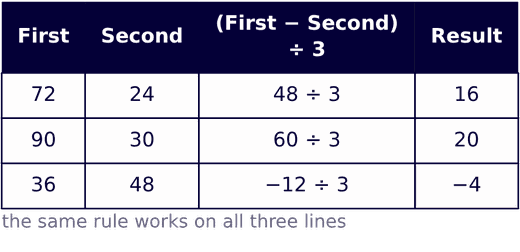 Now apply it to 36 and 48: .
Note that the second number here is the larger one, so the result is negative.
Hence option (a) is correct.
Now apply it to 36 and 48: .
Note that the second number here is the larger one, so the result is negative.
Hence option (a) is correct.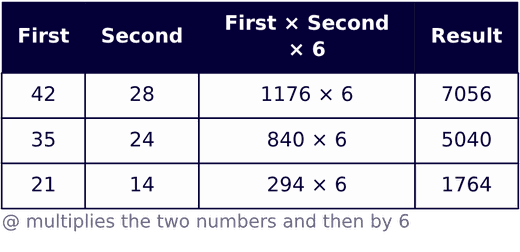 Apply the rule to the asked pair: .
Therefore the value is .
Hence option (a) is correct.
Apply the rule to the asked pair: .
Therefore the value is .
Hence option (a) is correct.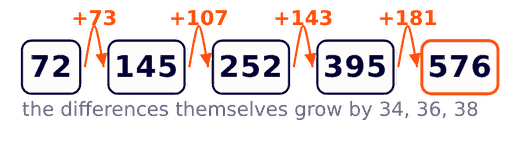 Hence the missing term is 395+181=576.
As a check, , a neat value for an SSC series.
Hence option (b) is correct.
Hence the missing term is 395+181=576.
As a check, , a neat value for an SSC series.
Hence option (b) is correct.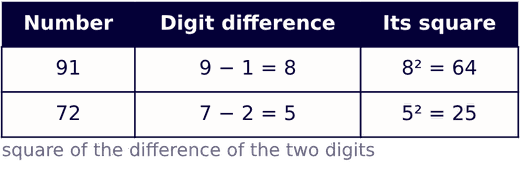 For 72: 7-2=5, and .
Hence option (b) is correct.
For 72: 7-2=5, and .
Hence option (b) is correct.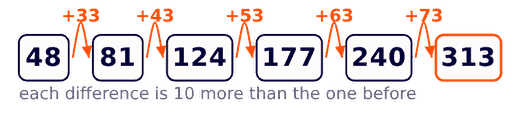 Hence the next term is 240+73=313.
Hence option (c) is correct.
Hence the next term is 240+73=313.
Hence option (c) is correct.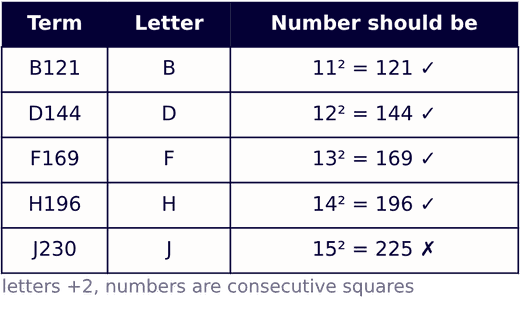 So J230 is the term that breaks the pattern; it should have been J225.
Hence option (d) is correct.
So J230 is the term that breaks the pattern; it should have been J225.
Hence option (d) is correct.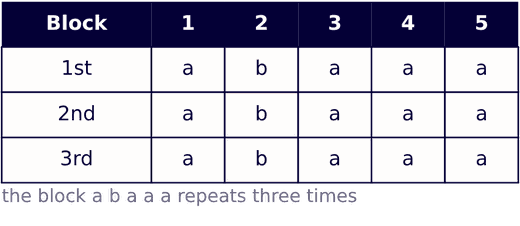 So the series is a b a a a / a b a a a / a b a a a.
Reading the blanks at places 2, 4, 5, 7, 8, 11, 14 in order gives b, a, a, b, a, a, a.
Hence option (c), baabaaa, is correct.
So the series is a b a a a / a b a a a / a b a a a.
Reading the blanks at places 2, 4, 5, 7, 8, 11, 14 in order gives b, a, a, b, a, a, a.
Hence option (c), baabaaa, is correct.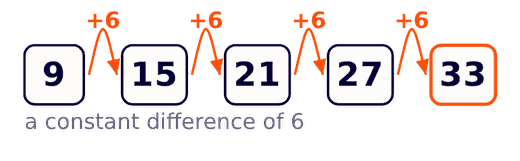 Hence the next term is 27+6=33.
The same terms are 3 times the odd numbers — — which confirms the answer.
Hence option (c) is correct.
Hence the next term is 27+6=33.
The same terms are 3 times the odd numbers — — which confirms the answer.
Hence option (c) is correct.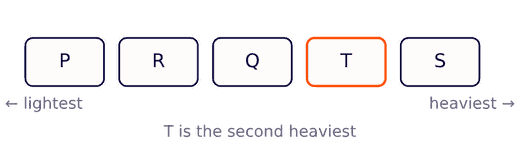 Counting from the heaviest end: S is first and T is second.
Hence option (b) is correct.
Counting from the heaviest end: S is first and T is second.
Hence option (b) is correct.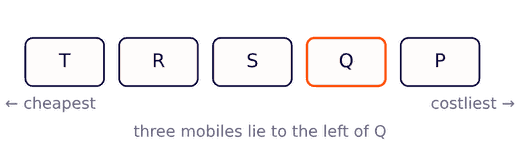 The mobiles priced lower than Q are T, R and S — that is 3 mobiles.
Hence option (c) is correct.
The mobiles priced lower than Q are T, R and S — that is 3 mobiles.
Hence option (c) is correct.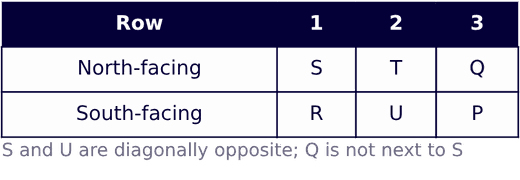 The north-facing flats therefore go to S, T and Q, while R, U and P face south.
Among the four names offered only Q has a north-facing flat, so option (c) is correct.
The north-facing flats therefore go to S, T and Q, while R, U and P face south.
Among the four names offered only Q has a north-facing flat, so option (c) is correct.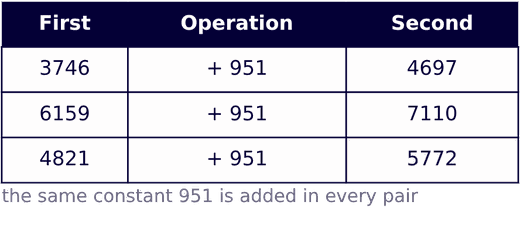 So the rule is: second number = first number +951.
Hence the missing number is 4821+951=5772.
Hence option (a) is correct.
So the rule is: second number = first number +951.
Hence the missing number is 4821+951=5772.
Hence option (a) is correct.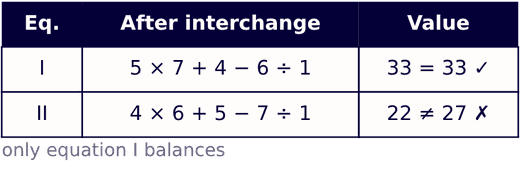 So equation I is correct after the interchange and equation II is not.
Hence option (a) is correct.
So equation I is correct after the interchange and equation II is not.
Hence option (a) is correct.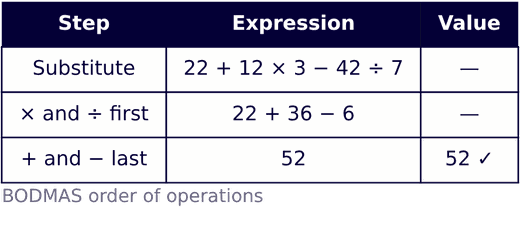 Now finish with the addition and subtraction: 22+36-6=52, which is exactly the required value.
No other arrangement of the given signs balances the equation, so option (c) is correct.
Now finish with the addition and subtraction: 22+36-6=52, which is exactly the required value.
No other arrangement of the given signs balances the equation, so option (c) is correct.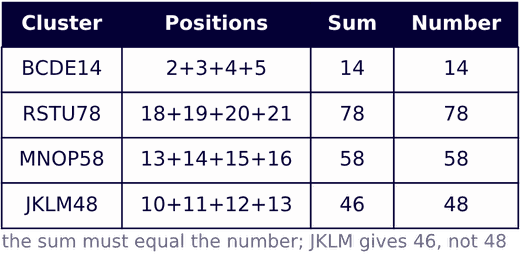 For BCDE, 2+3+4+5=14; for RSTU, 18+19+20+21=78; for MNOP, 13+14+15+16=58 — each total matches its own number.
For JKLM, 10+11+12+13=46, but the cluster carries 48, so the rule breaks here.
Hence option (d) is correct.
For BCDE, 2+3+4+5=14; for RSTU, 18+19+20+21=78; for MNOP, 13+14+15+16=58 — each total matches its own number.
For JKLM, 10+11+12+13=46, but the cluster carries 48, so the rule breaks here.
Hence option (d) is correct.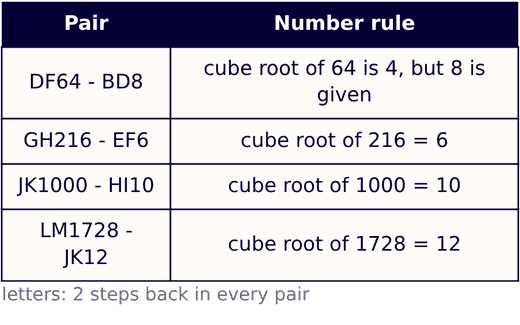 , and — three pairs follow the rule exactly.
But , whereas the first pair shows 8, which is the square root instead.
Hence option (a) is correct.
, and — three pairs follow the rule exactly.
But , whereas the first pair shows 8, which is the square root instead.
Hence option (a) is correct.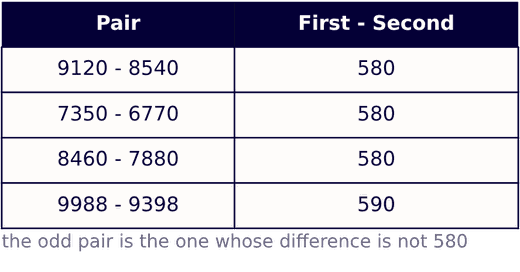 9120-8540=580, 7350-6770=580 and 8460-7880=580 — three pairs share the same difference.
But 9988-9398=590, which is 10 more than 580.
Hence option (d) is correct.
9120-8540=580, 7350-6770=580 and 8460-7880=580 — three pairs share the same difference.
But 9988-9398=590, which is 10 more than 580.
Hence option (d) is correct.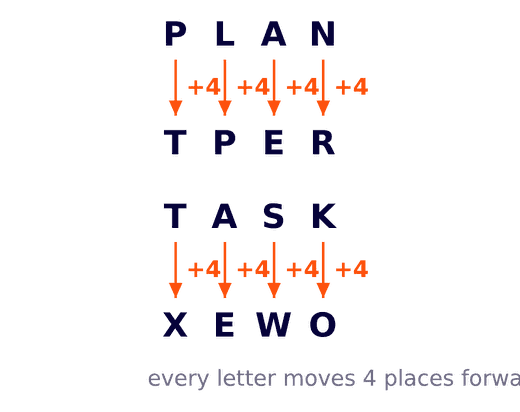 Apply +4 to TASK: T(20)+4=X, A(1)+4=E, S(19)+4=W, K(11)+4=O.
So TASK is coded as XEWO and option (c) is correct.
Apply +4 to TASK: T(20)+4=X, A(1)+4=E, S(19)+4=W, K(11)+4=O.
So TASK is coded as XEWO and option (c) is correct.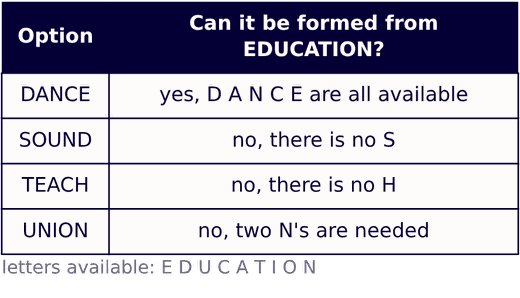 DANCE needs D, A, N, C and E, and every one of them is present in EDUCATION.
SOUND needs an S and TEACH needs an H, neither of which occurs in EDUCATION, while UNION needs two N's although only one is available.
Hence option (a) is correct.
DANCE needs D, A, N, C and E, and every one of them is present in EDUCATION.
SOUND needs an S and TEACH needs an H, neither of which occurs in EDUCATION, while UNION needs two N's although only one is available.
Hence option (a) is correct.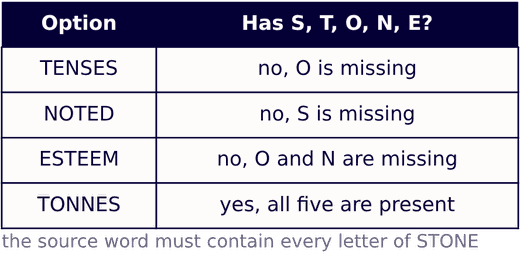 TONNES is made of T, O, N, N, E, S, so all five letters of STONE can be picked out of it.
TENSES and ESTEEM contain no O at all, and NOTED contains no S, so none of them can give STONE.
Hence option (d) is correct.
TONNES is made of T, O, N, N, E, S, so all five letters of STONE can be picked out of it.
TENSES and ESTEEM contain no O at all, and NOTED contains no S, so none of them can give STONE.
Hence option (d) is correct.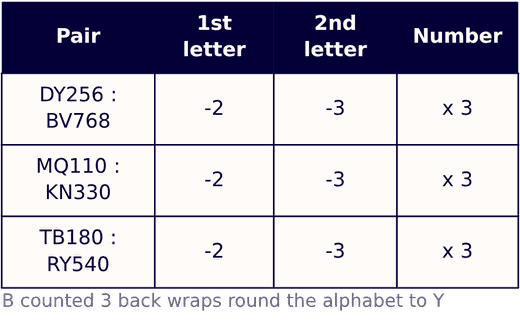 Now apply it to TB180. First letter: T(20)-2=18, which is R.
Second letter: B(2)-3 runs past A and wraps round to Y(25).
Number: , so the missing cluster is RY540.
Hence option (d) is correct.
Now apply it to TB180. First letter: T(20)-2=18, which is R.
Second letter: B(2)-3 runs past A and wraps round to Y(25).
Number: , so the missing cluster is RY540.
Hence option (d) is correct.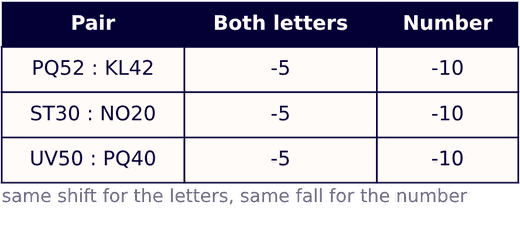 For UV50, first letter U(21)-5=16, which is P; second letter V(22)-5=17, which is Q.
Number: 50-10=40, so the cluster is PQ40.
Hence option (b) is correct.
For UV50, first letter U(21)-5=16, which is P; second letter V(22)-5=17, which is Q.
Number: 50-10=40, so the cluster is PQ40.
Hence option (b) is correct.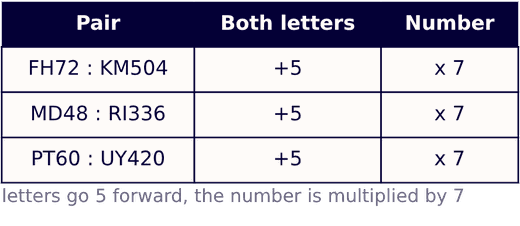 For PT60, first letter P(16)+5=21, which is U; second letter T(20)+5=25, which is Y.
Number: , so the cluster is UY420.
Hence option (b) is correct.
For PT60, first letter P(16)+5=21, which is U; second letter T(20)+5=25, which is Y.
Number: , so the cluster is UY420.
Hence option (b) is correct.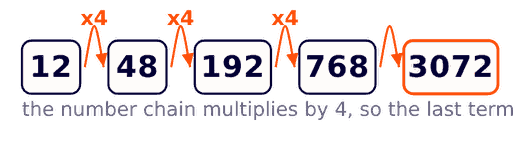 The series shows 3075 in place of 3072, so KG3075 is the wrong term.
Hence option (b) is correct.
The series shows 3075 in place of 3072, so KG3075 is the wrong term.
Hence option (b) is correct.