SSC CHSL 28 November 2025 · Shift 2 · English Language — questions with answers · ShikshaSphere
Chapter 172 of 200
28 November 2025 · Shift 2
English Language
25 questions ~25 min readFree
25 questions
A
1
Choose the option which is similar in meaning to the underlined word.
Galileo was assured that his observations were correct.
A.Convinced
B.Cynical
C.Skeptical
D.Doubtful
Solution
Synonym in context
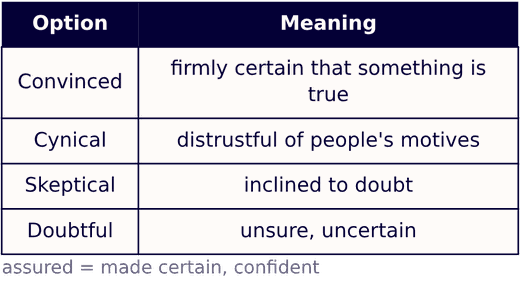
In the sentence 'assured' describes Galileo's state of mind - he was made certain, fully confident that what he saw was right.
'Convinced' means firmly persuaded that something is true, which is exactly that sense.
Cynical, Skeptical and Doubtful all carry doubt or distrust, the very opposite of being assured.
Hence option (a) is correct.
2
Choose the correct option to give a one-word substitution for the sentence given.
A person who talks excessively or continuously.
A.Precipitous
B.Taciturn
C.Garrulous
D.Reserved
Solution
One-word substitution
The clue in the definition is 'talks excessively or continuously' - a habit of endless chatter.
'Garrulous' means excessively talkative, especially about trivial matters.
Taciturn and Reserved mean the opposite - saying very little - and Precipitous describes a steep slope, not a person's speech.
Hence option (c) is correct.
3
Choose the one-word substitute for the sentence given below.
Ananya started her new hobby with great enthusiasm, keen to learn the basics as a beginner.
A.Veteran
B.Apprentice
C.Mentor
D.Expert
Solution
One-word substitution
The key words are 'keen to learn the basics as a beginner' - someone at the start of a skill, still under training.
'Apprentice' is a learner who is being trained in a trade or skill by a more experienced person.
Veteran and Expert both mean long experience, and a Mentor is the one who does the training, not the one who receives it.
Hence option (b) is correct.
4
Identify the grammatical error in the sentence below.
If he had spoken to my father, he would tell him where I was.
A.had spoken
B.tell him
C.where I was
D.If he had
Solution
Third conditional
The if-clause is 'If he had spoken', a past perfect, so the sentence is a third conditional - an unreal condition in the past.
The fixed pattern is: If + had + V3 ... , would have + V3.
The main clause therefore has to read 'he would have told him', not 'he would tell him'.
'If he had', 'had spoken' and 'where I was' are all correct, so the faulty segment is 'tell him'.
Hence option (b) is correct.
5
Choose the correctly spelt word:
A.Exaggerate
B.Exaggarete
C.Exageerate
D.Exaggarate
Solution
Correct spelling
The word comes from Latin 'ex-' + 'aggerare' (to heap up), so it keeps the double 'g' and then ends in '-erate'.
The correct spelling is E-X-A-G-G-E-R-A-T-E.
Options (b) and (d) put an 'a' where the 'e' of '-erate' belongs, and (c) doubles the wrong letter, writing 'ee' instead of 'gg'.
Hence option (a) is correct.
6
Choose the best option to replace the underlined part to improve the given sentence. If no substitution is required, select 'No substitution.'
She doesn't understand why the kitten keeps running over that tree.
A.on that tree
B.across that tree
C.around that tree
D.No substitution
Solution
Preposition of movement
The picture the sentence needs is a kitten circling the trunk of a tree again and again.
'Around' is the preposition for movement in a circular path about an object, so 'running around that tree' is the natural expression.
'Over' would mean passing above the tree, 'on' would place the kitten on its surface, and 'across' needs a flat area to be crossed.
Hence option (c) is correct.
7
Choose the best option to replace the underlined part to improve the given sentence. If no substitution is required, select 'No substitution.'
Naman is good in mathematics but weak in Physics.
A.Good for mathematics
B.Good with mathematics
C.Good at mathematics
D.No substitution
Solution
Adjective + preposition
'Good' takes the fixed preposition 'at' when it names the skill, subject or activity in which a person is proficient.
So we say good at mathematics, good at singing, good at chess.
'Good with' is used of people or things one handles well (good with children), and 'good for' means beneficial or useful.
Hence 'good at mathematics', option (c), is correct.
8
From the alternatives given below, select the correct passive voice of the following sentence.
Cut the red cable all at once; otherwise, you have to throw the entire thing out of the room with your maximum strength.
A.Let the red cable be cut all at once; otherwise, the entire thing has to throw out of the room with your maximum strength.
B.Let the red cable cut all at once; otherwise, the entire thing has to be thrown out of the room by you with your maximum strength.
C.Let the red cable be cut all at once; otherwise, the entire thing has to be thrown out of the room by you with your maximum strength.
D.Let the red cable be cut all at once; otherwise, the entire thing has to be thrown out with your maximum strength of the room by you.
Solution
Active to passive voice
The sentence has two parts - an imperative ('Cut the red cable') and a 'have to' statement - and both must be turned round.
An imperative becomes 'Let + object + be + V3', so 'Cut the red cable' gives 'Let the red cable be cut'.
'have to + V1' becomes 'has/have to be + V3'; the new subject 'the entire thing' is singular, so it takes 'has to be thrown', with 'by you' as the agent.
Option (a) leaves the active 'has to throw' and drops the agent, and option (b) omits 'be' after 'Let the red cable'.
Option (d) has the right verb forms but splits 'thrown out of the room', spoiling the word order.
Hence option (c) is correct.
9
Choose the correct indirect narration of the following statement from the given alternatives:
Akshay said to Riya, 'I have very often informed you that we have to attend the meeting every Monday."
A.Akshay told Riya that he had very often informed her that they had to attend the meeting every Monday.
B.Akshay told Riya that she must very often informed her that they had to attend the meeting every Monday.
C.Akshay told Riya that he had very often been informing her that they had to attend the meeting every Monday.
D.Akshay told Riya that he had very often informed her that they had been attending the meeting every Monday.
Solution
Direct to indirect speech
'Said to + person' becomes 'told + person', and a statement is joined to it by 'that'.
After a past reporting verb the tense moves one step back: 'have informed' becomes 'had informed' and 'have to attend' becomes 'had to attend'.
The pronouns shift with the speakers - 'I' becomes he, 'you' becomes her and 'we' becomes they - while 'every Monday' is a habit and stays as it is.
Option (b) makes the listener the informer, (c) turns the verb into a past perfect continuous and (d) changes 'had to attend' into 'had been attending'.
Hence option (a) is correct.
10
The following sentence has two blanks. Choose the most suitable set of prepositions from the given options to fill in the blanks and complete the sentence meaningfully.
My uncle lives Park Street the post office.
A.at, near
B.on, next to
C.at, besides
D.in, beside
Solution
Prepositions of place
The name of a street takes the preposition 'on' - on Park Street, on Mall Road.
The second blank needs a phrase meaning 'immediately adjacent to', and 'next to' says exactly that.
'Besides' in (c) means 'in addition to' and is not a preposition of place, while 'at' in (a) points to a single address or spot, not to a whole street.
'In' in (d) belongs with enclosed spaces and towns, so it does not suit a street name here.
Hence option (b) is correct.
11
Select the most appropriate antonym of the word: Alleviate
A.Exacerbate
B.Mitigate
C.Allay
D.Assuage
Solution
Antonyms
'Alleviate' means to make a pain, a burden or a problem less severe.
Its antonym must move the other way - make the trouble worse - and that word is 'exacerbate'.
Mitigate, allay and assuage all mean to lessen, soothe or relieve, so they are synonyms of 'alleviate', not antonyms.
Only one option reverses the direction, so option (a) is correct.
12
Change the following sentence into the Active form.
Breakfast is being prepared by my mother.
A.Breakfast prepared my mother.
B.My mother is preparing breakfast.
C.My mother prepares breakfast.
D.My mother was preparing breakfast.
Solution
Passive to active voice
In the active form the agent 'by my mother' becomes the subject and the old subject 'breakfast' becomes the object.
'Is being prepared' is present continuous passive, whose active counterpart is 'is preparing' - the tense must not change.
Option (c) uses the simple present 'prepares' and option (d) the past continuous 'was preparing', so both alter the tense.
Option (a) merely swaps the two nouns and makes breakfast the doer of the action.
Hence option (b) is correct.
13
Choose the option that is the most appropriate conversion of the following sentence into Direct Speech.
She asked me if I had ever been to the Vatican City.
A.She said, 'You have ever been to the Vatican City?'
B.She asked, "Do you ever go to the Vatican City?"
C.She asked me, 'Have you been to the Vatican City?'
D.She said to me, "Have you ever been to the Vatican City?"
Solution
Indirect to direct speech
'Asked me if' shows that the original words were a yes/no question, so in direct speech the auxiliary must come before the subject inside inverted commas.
The reporting verb becomes 'said to me', and the back-shift is undone: the past perfect 'had ever been' returns to the present perfect 'have you ever been'.
'I' in the reported clause stands for the listener, so it becomes 'you'.
Option (a) keeps statement order, (b) replaces 'have been' with 'do you go' and (c) drops 'ever' and the reporting form 'said to me'.
Hence option (d) is correct.
14
The following sentence has two blanks. Choose the most suitable set of prepositions from the given options to complete the sentence meaningfully. He refrained making public statements and instead concentrated
internal discussions.
A.from, on
B.of, in
C.for, by
D.with, to
Solution
Verb + preposition
'Refrain' always takes 'from' before the activity one holds back from - refrain from smoking, refrain from commenting.
'Concentrate' always takes 'on' before the matter one focuses upon - concentrate on the work.
These are fixed verb-preposition pairs, so no other combination offered in the options is possible.
Hence option (a) is correct.
15
One of these words is spelled incorrectly. Which one is it?
A.Government
B.Embellish
C.Concious
D.Percieve
Solution
Incorrect spelling
The spelling rule is 'i before e, except after c': right after a 'c' the pair is written 'ei'.
So the verb meaning 'to become aware of through the senses' is spelt P-E-R-C-E-I-V-E, like receive and deceive.
The option prints 'Percieve', with 'ie' following the 'c', which breaks that rule.
Hence the incorrectly spelt word is option (d).
16
Select the option that expresses the given sentence in indirect voice. Shraddha said to him, 'You were working.'
A.Shraddha told him that he was working.
B.Shraddha told him that he had been working.
C.Shraddha told him that you had been working.
D.Shraddha told him that she had been working.
Solution
Direct to indirect speech
'Said to him' becomes 'told him' and the reported words are joined to it by 'that'.
After a past reporting verb the past continuous back-shifts one step, so 'were working' becomes 'had been working'.
'You' names the listener, who is 'him', so it changes to 'he'.
Option (a) leaves the tense as past continuous, while (c) keeps 'you' and (d) turns the listener into 'she'.
Hence option (b) is correct.
17
One of these words is spelled incorrectly. Which one is it?
A.Magnanimous
B.Vehement
C.Perseverance
D.Recalcitrent
Solution
Incorrect spelling
'Recalcitrant' means stubbornly refusing to obey authority; it comes from the Latin 'calcitrare', to kick back.
Its ending is '-ant', like defiant, tolerant and vigilant, and never '-ent'.
The option prints 'Recalcitrent', which uses the wrong ending.
Magnanimous, Vehement and Perseverance are all written correctly, so the misspelt word is option (d).
18
Directions (Qs. 18-22): Read the following passage carefully and answer the questions that follow.
Schools function as busy communities, and so do the dedicated individuals who keep them running. From teachers and principals to bus drivers, cafeteria staff, and custodians, every school employee plays a vital part in creating a safe learning environment. While parents often view teachers as the primary educators, the consistent efforts of support staff frequently go unappreciated.
The daily routine of a school worker is defined by early mornings, constant noise, and physical demands. Custodians might have to clean entire hallways before the first bell rings, while cafeteria workers ensure that hundreds of meals are prepared on a tight schedule. School employees manage
complex schedules with accuracy, and administrative staff often handle stressful parent interactions throughout the day.
What makes their profession even more demanding is the invisible pressure. School employees absorb the anxieties, behavioral issues, and personal struggles of students regularly. Yet, despite the mental fatigue, most stay dedicated to their roles out of a genuine desire to help children succeed.
In recent times, particularly with the rise of remote learning challenges, appreciation for the stability schools provide has increased. However, adequate funding, emotional resources, and mutual respect are still necessary to guarantee the satisfaction of those who shape the future.
Which sentence from the passage is written in the present perfect tense?
A.Schools function as busy communities.
B.Appreciation for the stability schools provide has increased.
C.Every school employee plays a vital part.
D.Most stay dedicated to their roles.
Solution
Present perfect tense
The present perfect is formed with 'has/have + V3' and ties a completed change to the present moment.
In option (b) 'has increased' is exactly 'has + past participle', showing a rise that has come about by now.
'Function' in (a), 'plays' in (c) and 'stay' in (d) are all simple present forms with no auxiliary at all.
Hence option (b) is correct.
19
Directions (Qs. 18-22): Read the following passage carefully and answer the questions that follow.
Schools function as busy communities, and so do the dedicated individuals who keep them running. From teachers and principals to bus drivers, cafeteria staff, and custodians, every school employee plays a vital part in creating a safe learning environment. While parents often view teachers as the primary educators, the consistent efforts of support staff frequently go unappreciated.
The daily routine of a school worker is defined by early mornings, constant noise, and physical demands. Custodians might have to clean entire hallways before the first bell rings, while cafeteria workers ensure that hundreds of meals are prepared on a tight schedule. School employees manage
complex schedules with accuracy, and administrative staff often handle stressful parent interactions throughout the day.
What makes their profession even more demanding is the invisible pressure. School employees absorb the anxieties, behavioral issues, and personal struggles of students regularly. Yet, despite the mental fatigue, most stay dedicated to their roles out of a genuine desire to help children succeed.
In recent times, particularly with the rise of remote learning challenges, appreciation for the stability schools provide has increased. However, adequate funding, emotional resources, and mutual respect are still necessary to guarantee the satisfaction of those who shape the future.
Which sentence from the passage contains a modal verb?
A.Custodians might have to clean entire hallways before the first bell rings.
B.School employees manage complex schedules with accuracy.
C.The daily routine of a school worker is defined by early mornings.
D.School employees absorb the anxieties of students.
Solution
Modal verbs
A modal verb - can, could, may, might, shall, should, will, would, must - stands before a main verb in its base form and adds a shade of ability, permission, obligation or possibility.
In option (a) 'might' comes before 'have to clean' and expresses possibility, so it is the modal.
'Manage', 'is defined' and 'absorb' in the other options are ordinary verbs with no modal in front of them.
Hence option (a) is correct.
20
Directions (Qs. 18-22): Read the following passage carefully and answer the questions that follow.
Schools function as busy communities, and so do the dedicated individuals who keep them running. From teachers and principals to bus drivers, cafeteria staff, and custodians, every school employee plays a vital part in creating a safe learning environment. While parents often view teachers as the primary educators, the consistent efforts of support staff frequently go unappreciated.
The daily routine of a school worker is defined by early mornings, constant noise, and physical demands. Custodians might have to clean entire hallways before the first bell rings, while cafeteria workers ensure that hundreds of meals are prepared on a tight schedule. School employees manage
complex schedules with accuracy, and administrative staff often handle stressful parent interactions throughout the day.
What makes their profession even more demanding is the invisible pressure. School employees absorb the anxieties, behavioral issues, and personal struggles of students regularly. Yet, despite the mental fatigue, most stay dedicated to their roles out of a genuine desire to help children succeed.
In recent times, particularly with the rise of remote learning challenges, appreciation for the stability schools provide has increased. However, adequate funding, emotional resources, and mutual respect are still necessary to guarantee the satisfaction of those who shape the future.
What does the word 'demands' mean in the context of the sentence "...constant noise, and physical demands'?
A.A strict order given by a boss
B.An economic need for a product
C.Physical requirements or labor
D.A question asked forcefully
Solution
Word meaning in context
Read the whole list - 'early mornings, constant noise, and physical demands' - all three name burdens that the job places on the worker.
In that company 'demands' must mean the physical requirements and labour the work calls for, such as cleaning hallways and preparing hundreds of meals.
'A strict order' and 'a question asked forcefully' belong to the verb 'demand'; nobody is ordering anyone in this sentence.
'An economic need for a product' is the sense used in economics, which has nothing to do with a school worker's routine.
Hence option (c) is correct.
21
Directions (Qs. 18-22): Read the following passage carefully and answer the questions that follow.
Schools function as busy communities, and so do the dedicated individuals who keep them running. From teachers and principals to bus drivers, cafeteria staff, and custodians, every school employee plays a vital part in creating a safe learning environment. While parents often view teachers as the primary educators, the consistent efforts of support staff frequently go unappreciated.
The daily routine of a school worker is defined by early mornings, constant noise, and physical demands. Custodians might have to clean entire hallways before the first bell rings, while cafeteria workers ensure that hundreds of meals are prepared on a tight schedule. School employees manage
complex schedules with accuracy, and administrative staff often handle stressful parent interactions throughout the day.
What makes their profession even more demanding is the invisible pressure. School employees absorb the anxieties, behavioral issues, and personal struggles of students regularly. Yet, despite the mental fatigue, most stay dedicated to their roles out of a genuine desire to help children succeed.
In recent times, particularly with the rise of remote learning challenges, appreciation for the stability schools provide has increased. However, adequate funding, emotional resources, and mutual respect are still necessary to guarantee the satisfaction of those who shape the future.
In the sentence below, what does the word "pressure" most closely imply? "What makes their profession even more demanding is the invisible pressure."
A.Atmospheric force
B.Physical weight on the body
C.Mental stress or expectations
D.A tight handshake
Solution
Contextual meaning
Read the word in its own paragraph: the pressure is called invisible, and the very next sentence explains it as absorbing the anxieties, behavioural issues and personal struggles of students.
Something invisible that produces mental fatigue cannot be a physical force; it must be a psychological burden — stress and the expectations people place on the staff.
Options (a) and (b) take 'pressure' in its literal, physical sense of atmospheric force or bodily weight, which the word 'invisible' rules out.
Option (d), 'a tight handshake', has no connection with the passage at all.
Hence option (c) is correct.
22
Directions (Qs. 18-22): Read the following passage carefully and answer the questions that follow.
Schools function as busy communities, and so do the dedicated individuals who keep them running. From teachers and principals to bus drivers, cafeteria staff, and custodians, every school employee plays a vital part in creating a safe learning environment. While parents often view teachers as the primary educators, the consistent efforts of support staff frequently go unappreciated.
The daily routine of a school worker is defined by early mornings, constant noise, and physical demands. Custodians might have to clean entire hallways before the first bell rings, while cafeteria workers ensure that hundreds of meals are prepared on a tight schedule. School employees manage
complex schedules with accuracy, and administrative staff often handle stressful parent interactions throughout the day.
What makes their profession even more demanding is the invisible pressure. School employees absorb the anxieties, behavioral issues, and personal struggles of students regularly. Yet, despite the mental fatigue, most stay dedicated to their roles out of a genuine desire to help children succeed.
In recent times, particularly with the rise of remote learning challenges, appreciation for the stability schools provide has increased. However, adequate funding, emotional resources, and mutual respect are still necessary to guarantee the satisfaction of those who shape the future.
What is the main message of the passage?
A.Only teachers are important in a school setting
B.Working in a school is easy and quiet
C.All school staff contribute significantly and deserve better support
D.Parents should do the teaching at home
Solution
Central idea
The opening paragraph states that every school employee — not only teachers — plays a vital part, and that the efforts of support staff frequently go unappreciated.
The middle paragraphs then list the physical demands, the tight schedules and the invisible emotional strain that the staff carry.
The closing sentence asks for adequate funding, emotional resources and mutual respect for these people.
Those two ideas together — everybody contributes, and everybody deserves better support — are exactly what option (c) says.
Option (a) contradicts the first paragraph, (b) contradicts the whole description of the workload, and (d) is never suggested anywhere.
Hence option (c) is correct.
23
Rearrange the following sentence parts to form a meaningful and grammatically correct paragraph:
P. She created mockups of each screen the user would view in order to build the user interface.
Q. She programmed the app's features and response, writing the fundamental logic.
R. She fixed errors and made sure the app ran well by testing it on a variety of devices.
S. She made the finished product available for download by uploading it to the app store.
A.P, Q, R, S
B.Q, P, R, S
C.S, Q, R, P
D.R, Q, P, S
Solution
Sentence rearrangement
The four parts describe the stages of building an app, so put them in the order in which the work is actually done.
P is the opening step: the screens are drawn as mockups first, before a single line of code exists.
Q follows P, because the features and the underlying logic are programmed only after the interface has been designed.
R comes next — testing on a variety of devices and fixing errors is possible only once the app actually runs.
S is the natural close: the finished, tested product is uploaded to the app store for download.
The sequence is therefore P, Q, R, S, i.e. option (a).
24
Rearrange the following sentences to form a meaningful and grammatically correct paragraph:
P. A device designed to solve a complex problem served as the trainees' final project.
Q. The program that allowed the system to navigate an obstacle course was developed over several weeks.
R. Their skills in engineering, coding, and design combined to build it.
S. The flawless operation of the device reflected their dedication and teamwork.
A.S, R, Q, P
B.Q, R, P, S
C.P, R, Q, S
D.S, R, P, Q
Solution
Sentence rearrangement
First find the opening sentence: only P introduces the subject with a fresh noun — 'A device designed to solve a complex problem served as the trainees' final project'.
R must follow P, because 'to build it' has no meaning until the device has been mentioned.
Q then adds one further detail about the building work: the program that let the system navigate an obstacle course.
S is clearly the conclusion, since it looks back at the finished device and judges what its flawless operation showed.
Sentences beginning with 'S' or 'Q' cannot open the paragraph, which removes options (a), (b) and (d) at once.
The order is P, R, Q, S, i.e. option (c).
25
What is the antonym of "Sociable"?
A.Misanthropic
B.Uncynical
C.Optimistic
D.Sentimental
Solution
Antonym
'Sociable' means fond of company — a person who enjoys mixing with other people.
Its opposite must describe someone who dislikes and avoids people, and that is exactly 'misanthropic' (from Greek misein 'to hate' + anthropos 'man').
'Uncynical' means sincere and trusting; it is the opposite of cynical, not of sociable.
'Optimistic' means expecting good outcomes, which is the opposite of pessimistic.
'Sentimental' means governed by emotion, and has nothing to do with how much company a person seeks.
Hence option (a) is correct.
Finished reading? Now test yourself.
The same 25 questions, but with a timer and the answers hidden — 15 minutes.

 Cynical, Skeptical and Doubtful all carry doubt or distrust, the very opposite of being assured.
Hence option (a) is correct.
Cynical, Skeptical and Doubtful all carry doubt or distrust, the very opposite of being assured.
Hence option (a) is correct.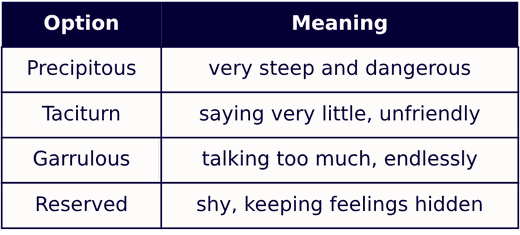 Taciturn and Reserved mean the opposite - saying very little - and Precipitous describes a steep slope, not a person's speech.
Hence option (c) is correct.
Taciturn and Reserved mean the opposite - saying very little - and Precipitous describes a steep slope, not a person's speech.
Hence option (c) is correct.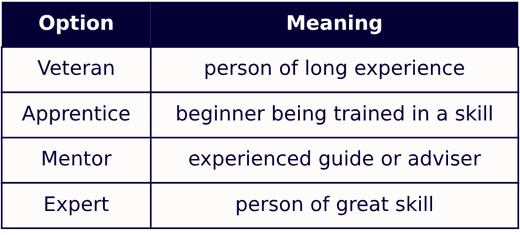 Veteran and Expert both mean long experience, and a Mentor is the one who does the training, not the one who receives it.
Hence option (b) is correct.
Veteran and Expert both mean long experience, and a Mentor is the one who does the training, not the one who receives it.
Hence option (b) is correct.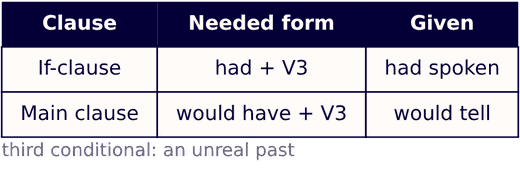 The main clause therefore has to read 'he would have told him', not 'he would tell him'.
'If he had', 'had spoken' and 'where I was' are all correct, so the faulty segment is 'tell him'.
Hence option (b) is correct.
The main clause therefore has to read 'he would have told him', not 'he would tell him'.
'If he had', 'had spoken' and 'where I was' are all correct, so the faulty segment is 'tell him'.
Hence option (b) is correct.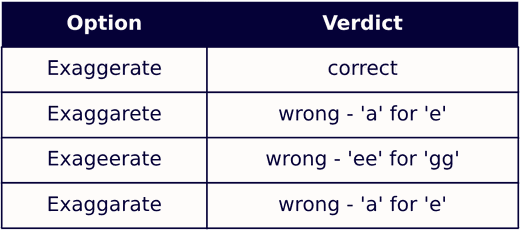 Options (b) and (d) put an 'a' where the 'e' of '-erate' belongs, and (c) doubles the wrong letter, writing 'ee' instead of 'gg'.
Hence option (a) is correct.
Options (b) and (d) put an 'a' where the 'e' of '-erate' belongs, and (c) doubles the wrong letter, writing 'ee' instead of 'gg'.
Hence option (a) is correct.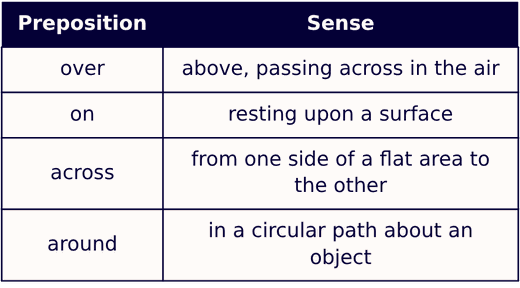 'Over' would mean passing above the tree, 'on' would place the kitten on its surface, and 'across' needs a flat area to be crossed.
Hence option (c) is correct.
'Over' would mean passing above the tree, 'on' would place the kitten on its surface, and 'across' needs a flat area to be crossed.
Hence option (c) is correct.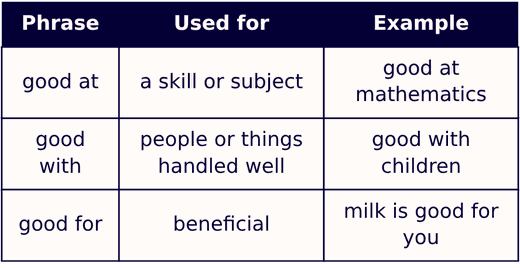 'Good with' is used of people or things one handles well (good with children), and 'good for' means beneficial or useful.
Hence 'good at mathematics', option (c), is correct.
'Good with' is used of people or things one handles well (good with children), and 'good for' means beneficial or useful.
Hence 'good at mathematics', option (c), is correct.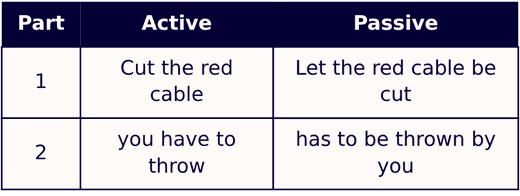 'have to + V1' becomes 'has/have to be + V3'; the new subject 'the entire thing' is singular, so it takes 'has to be thrown', with 'by you' as the agent.
Option (a) leaves the active 'has to throw' and drops the agent, and option (b) omits 'be' after 'Let the red cable'.
Option (d) has the right verb forms but splits 'thrown out of the room', spoiling the word order.
Hence option (c) is correct.
'have to + V1' becomes 'has/have to be + V3'; the new subject 'the entire thing' is singular, so it takes 'has to be thrown', with 'by you' as the agent.
Option (a) leaves the active 'has to throw' and drops the agent, and option (b) omits 'be' after 'Let the red cable'.
Option (d) has the right verb forms but splits 'thrown out of the room', spoiling the word order.
Hence option (c) is correct.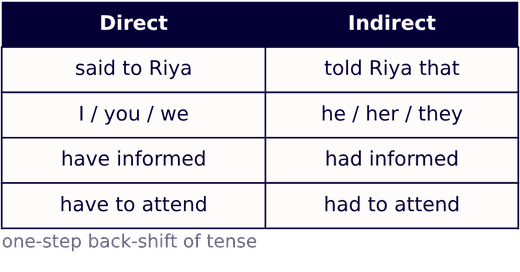 The pronouns shift with the speakers - 'I' becomes he, 'you' becomes her and 'we' becomes they - while 'every Monday' is a habit and stays as it is.
Option (b) makes the listener the informer, (c) turns the verb into a past perfect continuous and (d) changes 'had to attend' into 'had been attending'.
Hence option (a) is correct.
The pronouns shift with the speakers - 'I' becomes he, 'you' becomes her and 'we' becomes they - while 'every Monday' is a habit and stays as it is.
Option (b) makes the listener the informer, (c) turns the verb into a past perfect continuous and (d) changes 'had to attend' into 'had been attending'.
Hence option (a) is correct.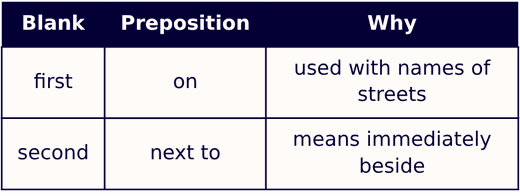 'Besides' in (c) means 'in addition to' and is not a preposition of place, while 'at' in (a) points to a single address or spot, not to a whole street.
'In' in (d) belongs with enclosed spaces and towns, so it does not suit a street name here.
Hence option (b) is correct.
'Besides' in (c) means 'in addition to' and is not a preposition of place, while 'at' in (a) points to a single address or spot, not to a whole street.
'In' in (d) belongs with enclosed spaces and towns, so it does not suit a street name here.
Hence option (b) is correct.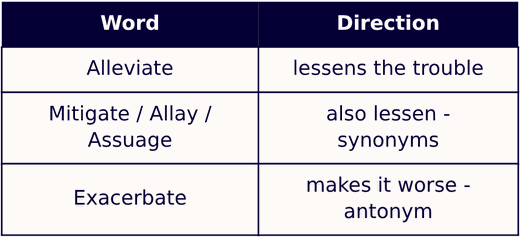 Mitigate, allay and assuage all mean to lessen, soothe or relieve, so they are synonyms of 'alleviate', not antonyms.
Only one option reverses the direction, so option (a) is correct.
Mitigate, allay and assuage all mean to lessen, soothe or relieve, so they are synonyms of 'alleviate', not antonyms.
Only one option reverses the direction, so option (a) is correct.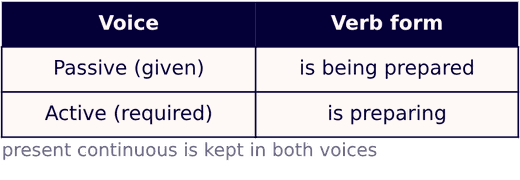 Option (c) uses the simple present 'prepares' and option (d) the past continuous 'was preparing', so both alter the tense.
Option (a) merely swaps the two nouns and makes breakfast the doer of the action.
Hence option (b) is correct.
Option (c) uses the simple present 'prepares' and option (d) the past continuous 'was preparing', so both alter the tense.
Option (a) merely swaps the two nouns and makes breakfast the doer of the action.
Hence option (b) is correct.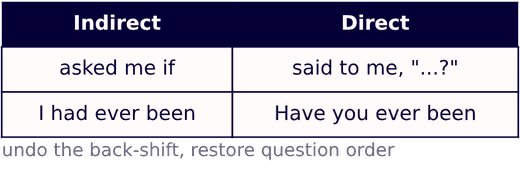 'I' in the reported clause stands for the listener, so it becomes 'you'.
Option (a) keeps statement order, (b) replaces 'have been' with 'do you go' and (c) drops 'ever' and the reporting form 'said to me'.
Hence option (d) is correct.
'I' in the reported clause stands for the listener, so it becomes 'you'.
Option (a) keeps statement order, (b) replaces 'have been' with 'do you go' and (c) drops 'ever' and the reporting form 'said to me'.
Hence option (d) is correct.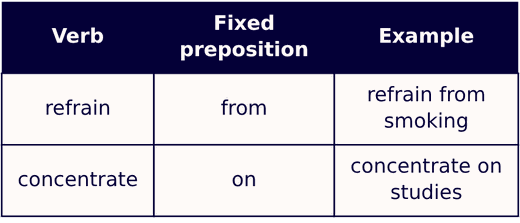 These are fixed verb-preposition pairs, so no other combination offered in the options is possible.
Hence option (a) is correct.
These are fixed verb-preposition pairs, so no other combination offered in the options is possible.
Hence option (a) is correct.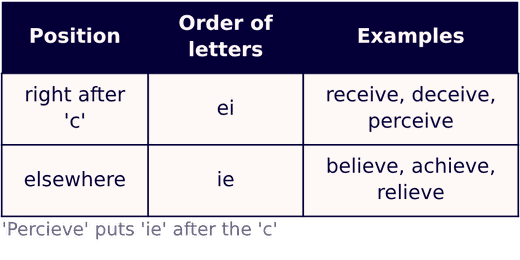 The option prints 'Percieve', with 'ie' following the 'c', which breaks that rule.
Hence the incorrectly spelt word is option (d).
The option prints 'Percieve', with 'ie' following the 'c', which breaks that rule.
Hence the incorrectly spelt word is option (d).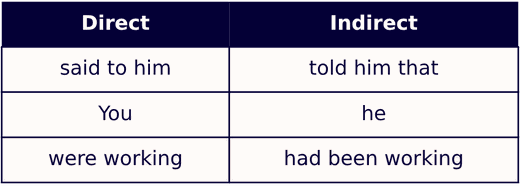 'You' names the listener, who is 'him', so it changes to 'he'.
Option (a) leaves the tense as past continuous, while (c) keeps 'you' and (d) turns the listener into 'she'.
Hence option (b) is correct.
'You' names the listener, who is 'him', so it changes to 'he'.
Option (a) leaves the tense as past continuous, while (c) keeps 'you' and (d) turns the listener into 'she'.
Hence option (b) is correct.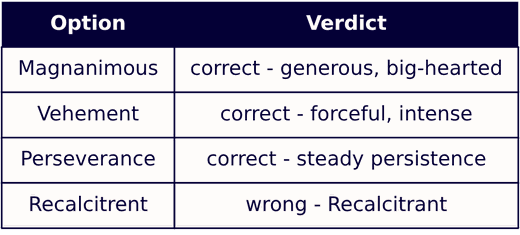 The option prints 'Recalcitrent', which uses the wrong ending.
Magnanimous, Vehement and Perseverance are all written correctly, so the misspelt word is option (d).
The option prints 'Recalcitrent', which uses the wrong ending.
Magnanimous, Vehement and Perseverance are all written correctly, so the misspelt word is option (d).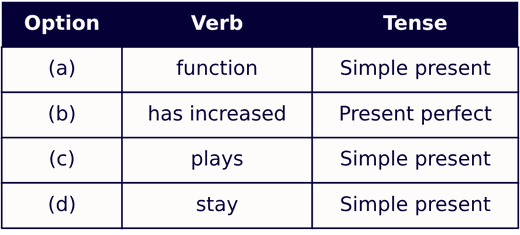 'Function' in (a), 'plays' in (c) and 'stay' in (d) are all simple present forms with no auxiliary at all.
Hence option (b) is correct.
'Function' in (a), 'plays' in (c) and 'stay' in (d) are all simple present forms with no auxiliary at all.
Hence option (b) is correct.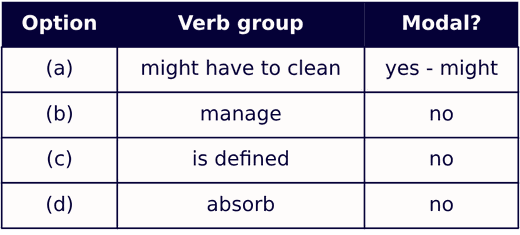 'Manage', 'is defined' and 'absorb' in the other options are ordinary verbs with no modal in front of them.
Hence option (a) is correct.
'Manage', 'is defined' and 'absorb' in the other options are ordinary verbs with no modal in front of them.
Hence option (a) is correct.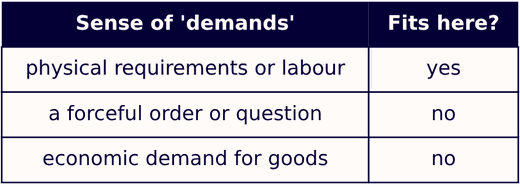 'A strict order' and 'a question asked forcefully' belong to the verb 'demand'; nobody is ordering anyone in this sentence.
'An economic need for a product' is the sense used in economics, which has nothing to do with a school worker's routine.
Hence option (c) is correct.
'A strict order' and 'a question asked forcefully' belong to the verb 'demand'; nobody is ordering anyone in this sentence.
'An economic need for a product' is the sense used in economics, which has nothing to do with a school worker's routine.
Hence option (c) is correct.