
26
In a row of students, Ravi is 10th from the left and Sumit is 15th from the right. If they exchange their positions, Ravi becomes 24th from the left. What will be the position of Sumit from the right ?
- A.28th
- B.29th
- C.30th
- D.31st
Solution
Ranking after exchange
When two students exchange places, each simply takes the seat the other was standing on.
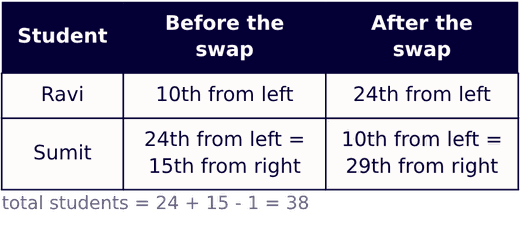
Ravi moves from 10th to 24th from the left, so the seat he now occupies — Sumit's original seat — is 24th from the left.
That same seat is 15th from the right, so the total number of students =24+15-1=38.
Sumit now stands on Ravi's old seat, which is 10th from the left.
His position from the right =38-10+1=29.
 Hence option (b) is correct.
Hence option (b) is correct. Hence option (c) is correct.
 Hence option (c) is correct.
 Hence option (b) is correct.
 Hence option (b) is correct.
 Hence option (d) is correct.
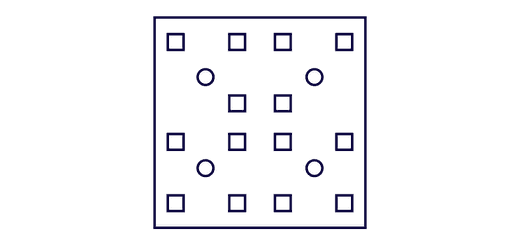
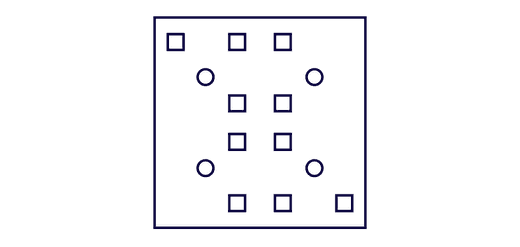
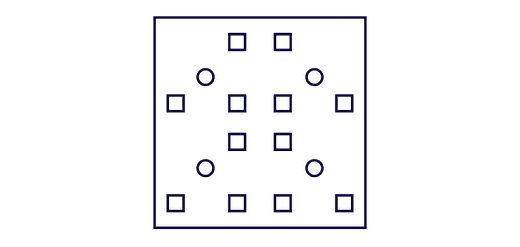
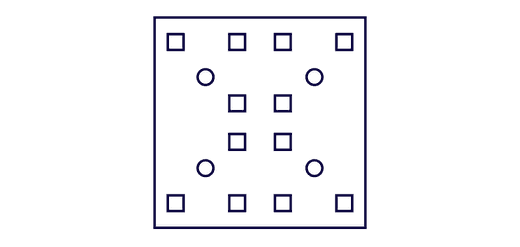
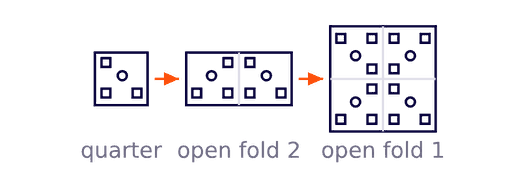 Opening the second fold mirrors all four cuts upwards across the horizontal centre line, and opening the first fold mirrors everything sideways across the vertical centre line.
So each cut appears four times and the opened sheet carries squares and circles.
The squares form a ring of four along the top edge, four along the bottom edge and a block of four at the centre, with the four circles set in between.
Hence option (d) is correct.
Opening the second fold mirrors all four cuts upwards across the horizontal centre line, and opening the first fold mirrors everything sideways across the vertical centre line.
So each cut appears four times and the opened sheet carries squares and circles.
The squares form a ring of four along the top edge, four along the bottom edge and a block of four at the centre, with the four circles set in between.
Hence option (d) is correct.
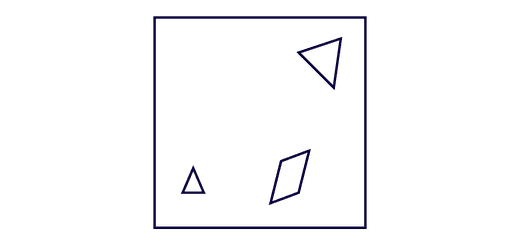
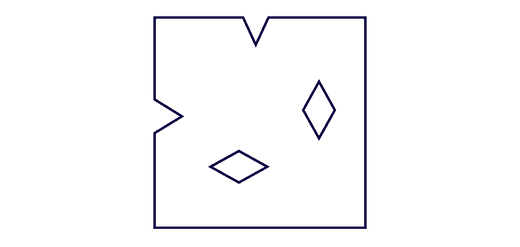
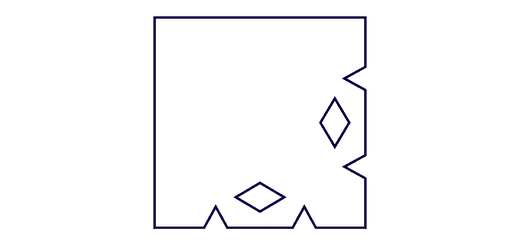
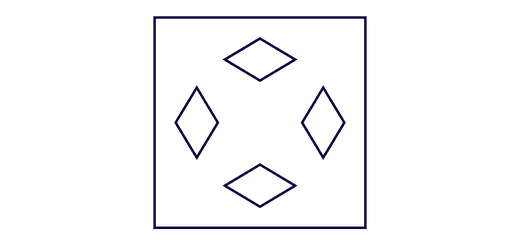
 Opening the second fold doubles them — the bite that sat on the fold line becomes a complete diamond hole, and the bite on the bottom edge becomes two notches placed symmetrically about the centre of that edge.
Opening the diagonal fold copies the whole bottom pattern on to the right edge, because a mirror in that diagonal turns the bottom edge into the right edge.
The opened sheet therefore shows two notches on the bottom edge with a wide diamond hole between them, and two notches on the right edge with a tall diamond hole between them.
Hence option (c) is correct.
Opening the second fold doubles them — the bite that sat on the fold line becomes a complete diamond hole, and the bite on the bottom edge becomes two notches placed symmetrically about the centre of that edge.
Opening the diagonal fold copies the whole bottom pattern on to the right edge, because a mirror in that diagonal turns the bottom edge into the right edge.
The opened sheet therefore shows two notches on the bottom edge with a wide diamond hole between them, and two notches on the right edge with a tall diamond hole between them.
Hence option (c) is correct.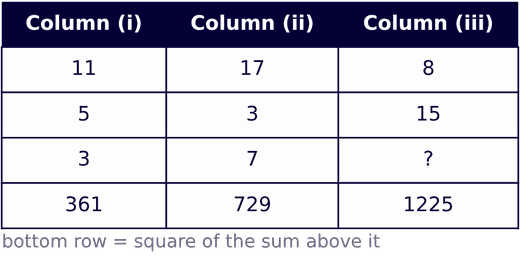 Read the grid column by column: the number in the bottom row is the square of the sum of the three numbers above it.
First column: 11+5+3=19 and .
Second column: 17+3+7=27 and .
Third column: , so the three numbers of that column must add up to 35.
Therefore 8+15+?=35, which gives ?=35-23=12.
Hence option (c) is correct.
Read the grid column by column: the number in the bottom row is the square of the sum of the three numbers above it.
First column: 11+5+3=19 and .
Second column: 17+3+7=27 and .
Third column: , so the three numbers of that column must add up to 35.
Therefore 8+15+?=35, which gives ?=35-23=12.
Hence option (c) is correct.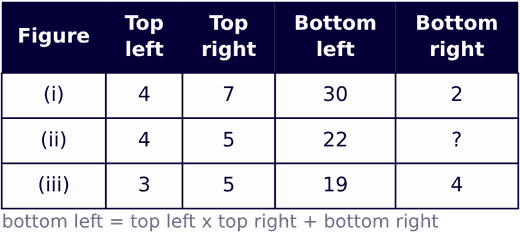 In each figure the bottom-left number equals the product of the two top numbers increased by the bottom-right number.
Figure (i): .
Figure (iii): .
Applying the same rule to figure (ii): , i.e. 20+?=22.
Therefore ?=22-20=2.
Hence option (a) is correct.
In each figure the bottom-left number equals the product of the two top numbers increased by the bottom-right number.
Figure (i): .
Figure (iii): .
Applying the same rule to figure (ii): , i.e. 20+?=22.
Therefore ?=22-20=2.
Hence option (a) is correct.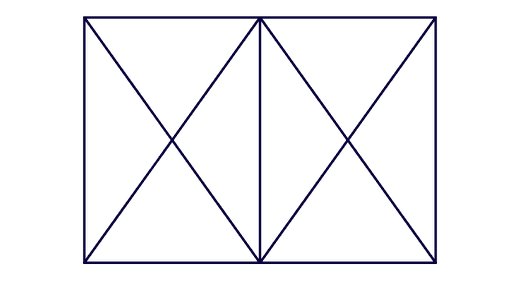
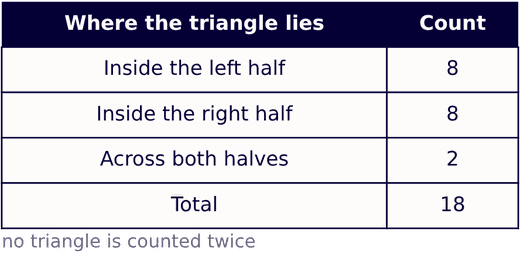 Total number of triangles =16+2=18.
Hence option (c) is correct.
Total number of triangles =16+2=18.
Hence option (c) is correct.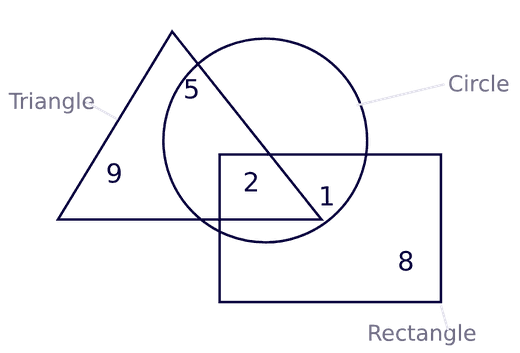 Which of the following statements is/are correct?
I. The number of leather items which are not brown is 14 .
II. The number of brown items which are only bags is 4.
Which of the following statements is/are correct?
I. The number of leather items which are not brown is 14 .
II. The number of brown items which are only bags is 4.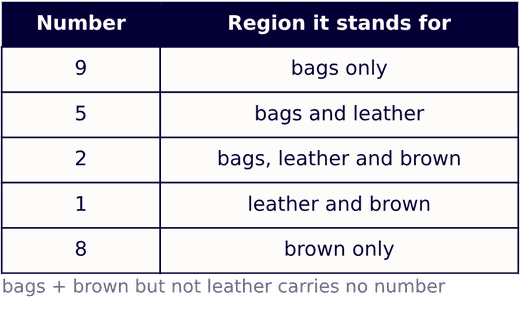 Leather items that are not brown lie inside the circle but outside the rectangle — that is only the region marked 5.
So their number is 5 and not 14, which makes statement I false.
Brown items which are only bags lie inside the rectangle and the triangle but outside the circle; no number is written in that region, so the count there is 0 and not 4.
Statement II is therefore false as well.
Hence option (d) is correct.
Leather items that are not brown lie inside the circle but outside the rectangle — that is only the region marked 5.
So their number is 5 and not 14, which makes statement I false.
Brown items which are only bags lie inside the rectangle and the triangle but outside the circle; no number is written in that region, so the count there is 0 and not 4.
Statement II is therefore false as well.
Hence option (d) is correct.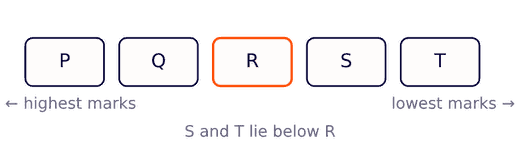 Only S and T score less than R, so the required number is 2.
Hence option (b) is correct.
Only S and T score less than R, so the required number is 2.
Hence option (b) is correct.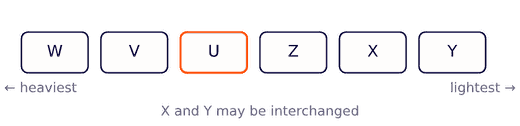 Below U stand Z, X and Y — three friends in all.
Hence option (c) is correct.
Below U stand Z, X and Y — three friends in all.
Hence option (c) is correct.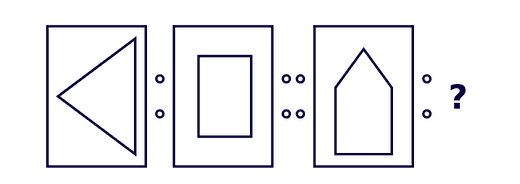




 Hence option (b) is correct.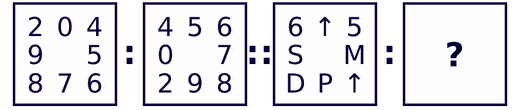




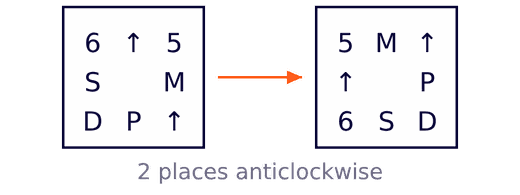 Placed back on the border this reads 5, M, ↑ in the top row, ↑ and P in the middle row and 6, S, D in the bottom row.
Hence the correct option is (b).
Placed back on the border this reads 5, M, ↑ in the top row, ↑ and P in the middle row and 6, S, D in the bottom row.
Hence the correct option is (b).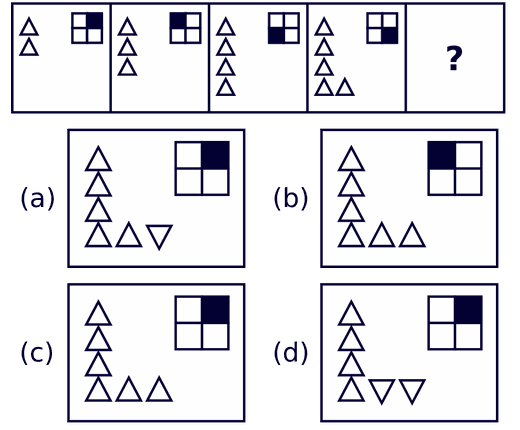
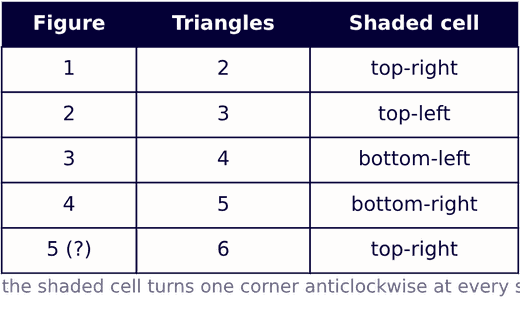 The corner that follows bottom-right in the anticlockwise round is the top-right corner again.
So the missing figure has 6 upward triangles with the top-right cell shaded, which is option (c).
The corner that follows bottom-right in the anticlockwise round is the top-right corner again.
So the missing figure has 6 upward triangles with the top-right cell shaded, which is option (c).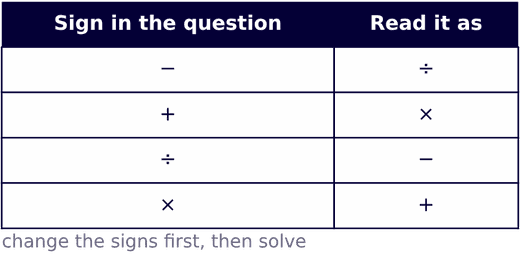 So becomes .
28-15+5=13+5=18
Hence the required value is 18, option (c).
So becomes .
28-15+5=13+5=18
Hence the required value is 18, option (c).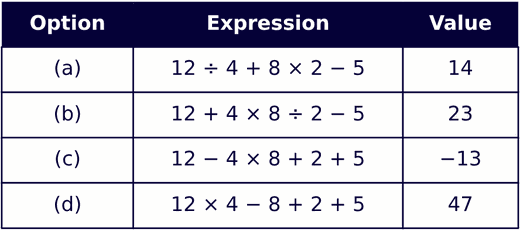 Option (b) gives .
, so the expression is .
12+16-5=23, which is exactly the right-hand side.
Hence the correct combination is , option (b).
Option (b) gives .
, so the expression is .
12+16-5=23, which is exactly the right-hand side.
Hence the correct combination is , option (b).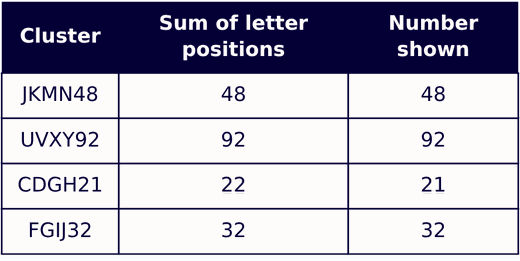 J+K+M+N=10+11+13+14=48
U+V+X+Y=21+22+24+25=92
F+G+I+J=6+7+9+10=32
C+D+G+H=3+4+7+8=22, while the cluster carries 21.
So CDGH21 does not obey the rule, option (c).
J+K+M+N=10+11+13+14=48
U+V+X+Y=21+22+24+25=92
F+G+I+J=6+7+9+10=32
C+D+G+H=3+4+7+8=22, while the cluster carries 21.
So CDGH21 does not obey the rule, option (c).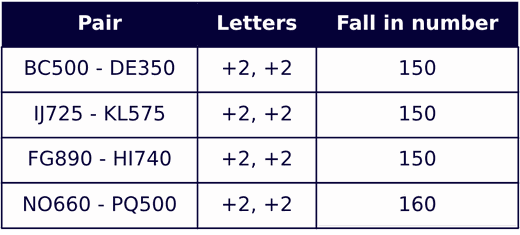 500-350=150, 725-575=150 and 890-740=150.
660-500=160, which is 10 more than the common fall.
So NO660 – PQ500 is the odd pair, option (d).
500-350=150, 725-575=150 and 890-740=150.
660-500=160, which is 10 more than the common fall.
So NO660 – PQ500 is the odd pair, option (d).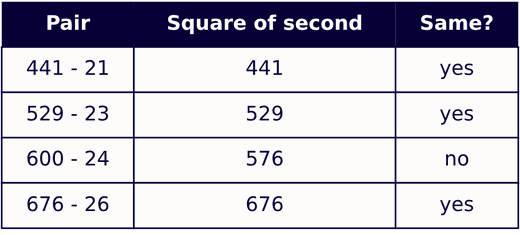 So 600 – 24 breaks the rule, option (c).
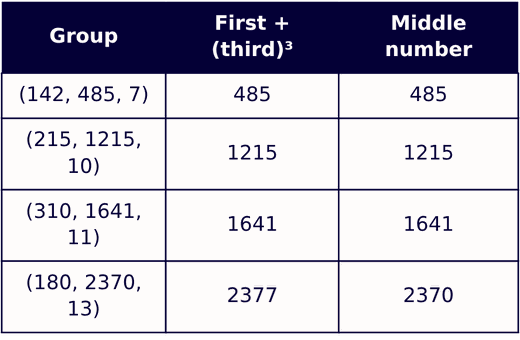 , but the group shows 2370.
So (180, 2370, 13) does not follow the rule, option (d).
, but the group shows 2370.
So (180, 2370, 13) does not follow the rule, option (d).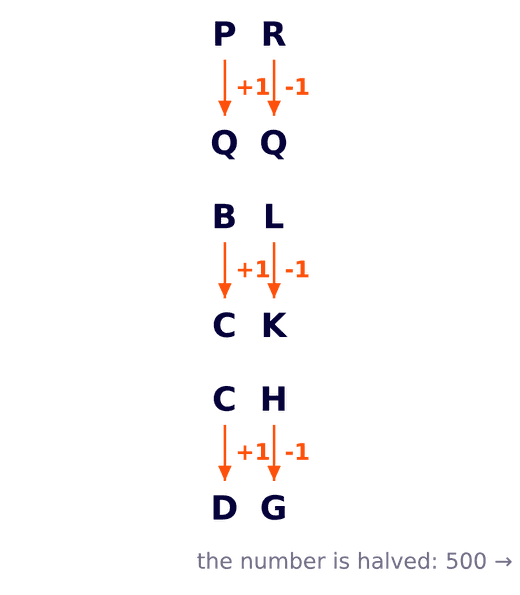 The number is halved: and .
The missing cluster stands first, so work backwards from DG200: D-1=C and G+1=H.
For the number, 200 is the half, so the original is .
So the missing cluster is CH400, option (b).
The number is halved: and .
The missing cluster stands first, so work backwards from DG200: D-1=C and G+1=H.
For the number, 200 is the half, so the original is .
So the missing cluster is CH400, option (b).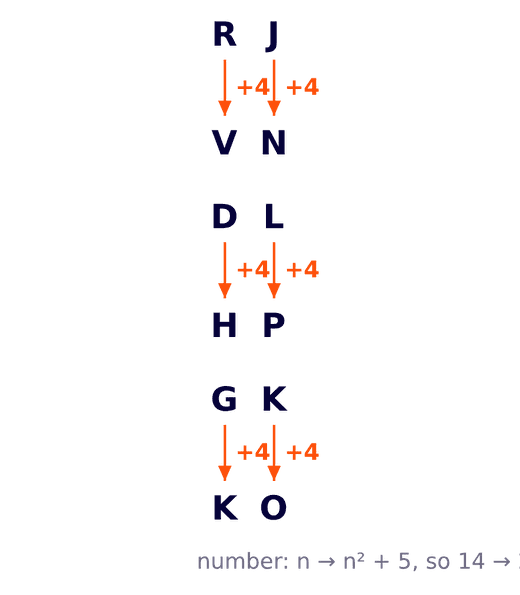 The new number is the square of the old number increased by 5.
and .
For GK14: G+4=K and K+4=O, while .
So the required cluster is KO201, option (a).
The new number is the square of the old number increased by 5.
and .
For GK14: G+4=K and K+4=O, while .
So the required cluster is KO201, option (a).