SSC CHSL 29 November 2025 · Shift 1 · English Language — questions with answers · ShikshaSphere
Chapter 180 of 200
29 November 2025 · Shift 1
English Language
25 questions ~25 min readFree
25 questions
A
1
Choose the correct option to give a one-word substitution for the sentence given.
Killing of one person by another.
A.Homicide
B.Paternity
C.Maternity
D.Foeticide
Solution
One-word substitution
One-word substitution: the killing of one human being by another is called homicide.
'Homicide' is built from Latin homo (man) + caedere (to kill), so the word itself carries the sense 'killing of a man'.
Paternity = the state of being a father; maternity = the state of being a mother; foeticide = killing of an unborn child.
Hence the correct option is (a).
2
Select the alternative that best expresses the meaning of the given idiom/phrase:
Look before you leap
A.Conceal something
B.Show humility toward people of lower rank
C.Rely on others to complete tasks
D.Analyze the consequences before making a decision
Solution
Idiom meaning
The idiom 'Look before you leap' advises a person to weigh the risks and the consequences before acting.
Option (d) 'Analyze the consequences before making a decision' states exactly this sense.
The other options speak of concealing, of showing humility and of depending on others — none of which the idiom expresses.
Hence the correct option is (d).
3
Choose the option that has an error in the sentence.
I'm fortunate that I have been doing a profession I enjoy, all my working life.
A.I'm fortunate that
B.I have been doing a profession
C.I enjoy all my working life.
D.No correction required
Solution
Sentence error detection
Test the sentence part by part for tense, structure and agreement.
The time expression 'all my working life' covers a stretch that began in the past and still continues, and the present perfect continuous 'have been doing' is exactly the tense used for such a stretch.
The relative clause 'I enjoy' rightly uses the simple present for a lasting state, and 'fortunate that …' is the standard adjective + that-clause pattern.
No part of the sentence therefore breaks a rule of grammar, so nothing has to be replaced.
Hence the correct option is (d).
4
Identify the part of the sentence that contains an error.
"No sooner had he entered the hall when the bell rang."
A.No sooner
B.had he entered
C.the hall when
D.the bell rang
Solution
Correlative conjunction
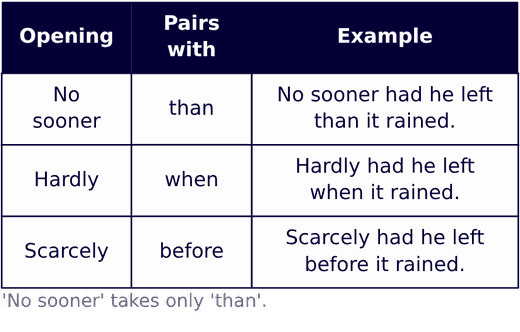
The correlative pair is 'No sooner … than', never 'No sooner … when'.
So 'the hall when' must become 'the hall than': No sooner had he entered the hall than the bell rang.
Note also the inversion that 'No sooner' forces at the head of a sentence — 'had he entered', which the sentence already has right.
Hence the error lies in part (c).
5
Fill in the blank with the most appropriate preposition:
The supervisor was taken aback the unexpected departure of several senior staff members.
A.by
B.at
C.for
D.over
Solution
Preposition after phrasal verb
'Take aback' is a phrasal verb meaning to be shocked or startled by something unexpected.
When the cause of that shock is named, the fixed preposition after it is 'by': was taken aback by the news.
'At' collocates with 'surprised' or 'astonished', not with 'taken aback', which is why option (b) is tempting but wrong.
Hence the correct option is (a).
6
Choose the correct word to complete the sentence.
They constructed a to cross the stream.
A.brige
B.bridg
C.bridge
D.breidge
Solution
Correct spelling
The blank needs the word for a structure built to cross a stream.
Of the four forms only 'bridge' is a real English word; 'brige' drops the d, 'bridg' drops the final e and 'breidge' adds a stray e.
Hence the correct option is (c).
7
Choose the correctly spelt word:
A.Sacrilege
B.Sacrelige
C.Sacrilage
D.Sasrilege
Solution
Correct spelling
The correct spelling is 'Sacrilege' — from sacri- (sacred) + -lege, meaning the violation of something holy.
Fix the vowel order i–e in the last two syllables: sac-ri-lege; 'Sacrelige', 'Sacrilage' and 'Sasrilege' all disturb that order.
Hence the correct option is (a).
8
Choose the best option to replace the underlined part to improve the given sentence. If no substitution is required, select 'No substitution.'
The helicopter flew on the city, providing a clear aerial view.
A.over the city
B.in the city
C.at the city
D.No substitution
Solution
Preposition of place
The underlined part is 'on the city'.
'On' shows contact with a surface, but a helicopter in flight is above the city, not touching it.
'Over' is the preposition for movement or position above something, and that is precisely what makes a clear aerial view possible.
Hence the correct option is (a).
9
Choose the best option to replace the underlined part to improve the given sentence. If no substitution is required, select 'No substitution.'
The organization has done away for redundant procedures by adopting a fully online system.
A.Done off
B.Done away with
C.Done in for
D.No substitution
Solution
Phrasal verb
The underlined part is 'done away for'.
The phrasal verb is 'do away with', meaning to abolish or get rid of something; its particle 'with' can never be replaced by 'for'.
So the sentence must read: The organization has done away with redundant procedures.
'Done off' and 'done in for' are not standard phrasal verbs at all, so no substitution other than (b) works.
Hence the correct option is (b).
10
From the alternatives given below, select the correct passive voice of the following sentence.
The trainees were imitating the way of the description by the instructor.
A.The way of the description by the instructor was imitated by the trainees.
B.The way of the description by the instructor were being imitated by the trainees.
C.The way of the description by the instructor had been imitated by the trainees.
D.The way of the description by the instructor was being imitated by the trainees.
Solution
Passive voice
The active sentence is in the past continuous: 'The trainees were imitating …'.
The past continuous takes 'was/were + being + V3' in the passive.
The object 'the way of the description by the instructor' becomes the subject; it is singular ('the way'), so the verb is 'was being imitated', and the doer takes 'by the trainees'.
Hence the correct option is (d).
11
Choose the option that is the most appropriate conversion of the following sentence into Active Voice.
All the preparations had been completed by the committee before we arrived.
A.The committee completed all the preparations before we arrived.
B.The committee will have completed all the preparations before we arrive.
C.The committee had completed all the preparations before we arrived.
D.The committee have completed all the preparations before we arrived.
Solution
Active voice
The given sentence is passive: 'had been completed by the committee'.
In the active voice the agent 'by the committee' becomes the subject and 'all the preparations' becomes the object.
The past perfect passive 'had been + V3' turns into the past perfect active 'had + V3', so the tense must stay past perfect.
The active form is therefore: The committee had completed all the preparations before we arrived.
Hence the correct option is (c).
12
Choose the correct indirect narration of the following statement from the given alternatives:
Rohit said, "What a beautiful day today is!"
A.Rohit exclaimed that that day has been a very beautiful day.
B.Rohit exclaimed that that day a very beautiful day was.
C.Rohit exclaimed that day was a very beautiful day.
D.Rohit exclaimed that that day was a very beautiful day.
Solution
Narration: exclamatory
'What a beautiful day today is!' is an exclamatory sentence, so the reporting verb 'said' changes to 'exclaimed that'.
The exclamatory pattern 'What a + adjective + noun' is rewritten as a plain statement with 'very': 'a very beautiful day'.
'Today' becomes 'that day' and the present 'is' is back-shifted to 'was', giving '… that that day was a very beautiful day' — the first 'that' is the conjunction, the second the demonstrative, so neither can be dropped.
Hence the correct option is (d).
13
Choose the option that is the most appropriate conversion of the following sentence into Direct Speech.
He asked if I knew the way to the library.
A.He asked, "Do you know the way to the library?"
B.He asked, "Did you know the way to the library?"
C.He ask, "If I know the way to the library?"
D.He said, "Did you knew the way to the library?"
Solution
Direct speech
In 'He asked if I knew …', the word 'if' shows that the original utterance was a yes/no question.
Turning it back into direct speech, 'if' is dropped and the interrogative word order with the question mark returns.
The back-shifted past 'knew' goes back to the present 'know', and the reported 'I' becomes 'you', because the speaker was addressing the listener.
The direct form is therefore: He asked, "Do you know the way to the library?"
Hence the correct option is (a).
14
The following sentence has two blanks. Choose the most suitable set of prepositions from the given options to fill in the blanks and complete the sentence meaningfully:
Her familiarity data analysis increased hands-on experience.
A.of, by
B.with, through
C.for, from
D.at, under
Solution
Prepositions
The noun 'familiarity' takes the fixed preposition 'with': familiarity with data analysis.
The second blank names the means by which that familiarity grew, and 'through' is the preposition of means or process: increased through hands-on experience.
'Of', 'for' and 'at' do not collocate with 'familiarity', so only one pair satisfies both blanks at once.
Hence the correct option is (b).
15
Choose the option that is the most appropriate conversion of the following sentence into Direct Speech.
Ravi said that by the time Meera arrived, the visitors had already started leaving.
A.Ravi said, "By the time Meera has arrived, the visitors were already leaving."
B.Ravi said, "By the time Meera had arrived, the visitors had already started leaving."
C.Ravi said, "By the time Meera arrived, the visitors had already started leaving."
D.Ravi said, "By the time Meera arrived, the visitors had already started to leave."
Solution
Direct speech
The reported sentence carries two clauses: 'by the time Meera arrived' and 'the visitors had already started leaving'.
Only 'said that' is removed and the speaker's own words are put inside quotation marks.
The past perfect 'had already started' is already the earliest tense possible, so it cannot be pushed back any further and stays unchanged; the simple past 'arrived' in the time clause also stays as it is.
The direct form is therefore: Ravi said, "By the time Meera arrived, the visitors had already started leaving."
Hence the correct option is (c).
16
Change the following sentence into the Active form.
It was widely believed that the ancient monuments had been built by a previously unknown civilization.
A.They widely believed that a previously unknown civilization had built the ancient monuments.
B.People widely believe that a previously unknown civilization had built the ancient monuments.
C.People widely believed that a previously unknown civilization had built the ancient monuments.
D.It was believed that a previously unknown civilization had built the ancient monuments widely.
Solution
Active voice
'It was widely believed that …' is an impersonal passive, and its active form needs a general subject supplied from outside the sentence.
The standard general subject for such structures is 'People', and the past 'was believed' becomes the past 'believed'.
The inner clause 'the ancient monuments had been built by a previously unknown civilization' becomes 'a previously unknown civilization had built the ancient monuments'.
Option (b) wrongly shifts to the present 'believe', and option (a) uses 'They', a pronoun with no antecedent anywhere in the sentence.
Hence the correct option is (c).
17
One of these words is spelled incorrectly. Which one is it ?
A.Acknowledgment
B.Proficiancy
C.Perseverance
D.Reputable
Solution
Spelling error
Compare each word with its dictionary form.
'Proficiancy' is wrong: the noun formed from 'proficient' is spelt 'Proficiency', with the ending -ency, like efficiency and sufficiency.
'Acknowledgment', 'Perseverance' and 'Reputable' are all spelt correctly.
Hence the correct option is (b).
18
Choose the correct passive voice transformation of the sentence:
Amit was painting the mural.
A.The mural is being painted by Amit.
B.The mural was being painted by Amit.
C.The mural has been painted by Amit.
D.The mural was painted by Amit.
Solution
Passive voice
'Amit was painting the mural' is active and in the past continuous tense.
The passive of the past continuous is 'was/were + being + V3'.
The object 'the mural' becomes the subject and is singular, so the verb is 'was being painted', and the doer takes 'by Amit'.
Dropping 'being' would give the simple past passive (option d), which changes the tense.
Hence the correct option is (b).
19
Directions (Qs. 19-23): Read the following passage carefully and answer the questions that follow.
Sweden is widely recognized across the globe for its deep connection to nature and environmental care. From a young age, Swedish citizens are encouraged to enjoy the outdoors, value sustainability, and prioritise ecological balance over convenience. This cultural dedication to nature has played a significant part in Sweden's ecological success and high quality of life.
One can observe evidence of this care in daily routines; locals recycle diligently at home, forests are preserved despite urban expansion, and green energy is widely used. The Swedish government also heavily invests in renewable resources, conservation projects, and public parks. Such practices help build a mindset of environmental stewardship among residents.
During global challenges, such as climate change discussions, the commitment of Swedish people becomes even more apparent. They remain proactive, innovative, and determined, which makes their contributions impactful and lasting. This social norm has not only preserved their landscapes beautifully but has also gained Sweden a status of leadership and influence in the modern world.
In the sentence:
"From a young age, Swedish citizens are encouraged to enjoy the outdoors, value sustainability, and prioritise ecological balance over convenience,"
What is the part of speech of the word "sustainability"?
A.Verb
B.Adjective
C.Noun
D.Adverb
Solution
Parts of speech
In 'value sustainability', the verb is 'value' and the word after it answers the question 'value what?', so it is the object.
A word that names a quality, an idea or a concept and can stand as the object of a verb is a noun; 'sustainability' is an abstract noun formed from the adjective 'sustainable'.
It shows no action, so it is not a verb; it describes no noun, so it is not an adjective; and it modifies no verb, so it is not an adverb.
Hence the correct option is (c).
20
Directions (Qs. 19-23): Read the following passage carefully and answer the questions that follow.
Sweden is widely recognized across the globe for its deep connection to nature and environmental care. From a young age, Swedish citizens are encouraged to enjoy the outdoors, value sustainability, and prioritise ecological balance over convenience. This cultural dedication to nature has played a significant part in Sweden's ecological success and high quality of life.
One can observe evidence of this care in daily routines; locals recycle diligently at home, forests are preserved despite urban expansion, and green energy is widely used. The Swedish government also heavily invests in renewable resources, conservation projects, and public parks. Such practices help build a mindset of environmental stewardship among residents.
During global challenges, such as climate change discussions, the commitment of Swedish people becomes even more apparent. They remain proactive, innovative, and determined, which makes their contributions impactful and lasting. This social norm has not only preserved their landscapes beautifully but has also gained Sweden a status of leadership and influence in the modern world.
In the sentence:
"The Swedish government also heavily invests in renewable resources, conservation projects, and public parks," Why is the verb "invests" used instead of "invest"?
A.Because "resources" is plural
B.Because "government" is a singular subject
C.Because 'heavily' is an adverb
D.Because the sentence is in the past tense
Solution
Subject-verb agreement
Find the real subject of the verb: it is 'The Swedish government', a collective noun used here as one single body.
In the simple present a singular subject takes the -s form of the verb, which is why 'invests' and not 'invest' is used.
'Resources' is only part of the prepositional phrase 'in renewable resources' and can never govern the verb, and an adverb such as 'heavily' has no effect on agreement.
Hence the correct option is (b).
21
Directions (Qs. 19-23): Read the following passage carefully and answer the questions that follow.
Sweden is widely recognized across the globe for its deep connection to nature and environmental care. From a young age, Swedish citizens are encouraged to enjoy the outdoors, value sustainability, and prioritise ecological balance over convenience. This cultural dedication to nature has played a significant part in Sweden's ecological success and high quality of life.
One can observe evidence of this care in daily routines; locals recycle diligently at home, forests are preserved despite urban expansion, and green energy is widely used. The Swedish government also heavily invests in renewable resources, conservation projects, and public parks. Such practices help build a mindset of environmental stewardship among residents.
During global challenges, such as climate change discussions, the commitment of Swedish people becomes even more apparent. They remain proactive, innovative, and determined, which makes their contributions impactful and lasting. This social norm has not only preserved their landscapes beautifully but has also gained Sweden a status of leadership and influence in the modern world.
In the sentence:
"This social norm has not only preserved their landscapes beautifully but has also gained Sweden a status of leadership and influence in the modern world,"
What is the closest synonym for the word "influence"?
A.Weakness
B.Impact
C.Silence
D.Confusion
Solution
Synonym in context
The last sentence says that the Swedish attitude to nature has gained the country 'a status of leadership and influence in the modern world'.
Here 'influence' means the power to affect the thinking and the actions of others, and that is exactly what 'impact' expresses.
'Weakness' is lack of strength, 'silence' is absence of sound and 'confusion' is lack of clarity — none of them can stand beside 'leadership'.
Hence the correct option is (b).
22
Directions (Qs. 19-23): Read the following passage carefully and answer the questions that follow.
Sweden is widely recognized across the globe for its deep connection to nature and environmental care. From a young age, Swedish citizens are encouraged to enjoy the outdoors, value sustainability, and prioritise ecological balance over convenience. This cultural dedication to nature has played a significant part in Sweden's ecological success and high quality of life.
One can observe evidence of this care in daily routines; locals recycle diligently at home, forests are preserved despite urban expansion, and green energy is widely used. The Swedish government also heavily invests in renewable resources, conservation projects, and public parks. Such practices help build a mindset of environmental stewardship among residents.
During global challenges, such as climate change discussions, the commitment of Swedish people becomes even more apparent. They remain proactive, innovative, and determined, which makes their contributions impactful and lasting. This social norm has not only preserved their landscapes beautifully but has also gained Sweden a status of leadership and influence in the modern world.
In the sentence:
"This cultural dedication to nature has played a significant part in Sweden's ecological success and high quality of life,"
What does the word "dedication" most likely mean in this context?
A.Dislike
B.Indifference
C.Devoted commitment
D.Lack of knowledge
Solution
Word meaning in context
'Dedication' means whole-hearted devotion and commitment to a cause.
The passage says Swedish citizens are trained from a young age to value sustainability and to place ecological balance above their own convenience — that is devotion, not a passing interest.
'Dislike' and 'indifference' are the very opposite of such a feeling, and 'lack of knowledge' has nothing to do with commitment.
Hence the correct option is (c).
23
Directions (Qs. 19-23): Read the following passage carefully and answer the questions that follow.
Sweden is widely recognized across the globe for its deep connection to nature and environmental care. From a young age, Swedish citizens are encouraged to enjoy the outdoors, value sustainability, and prioritise ecological balance over convenience. This cultural dedication to nature has played a significant part in Sweden's ecological success and high quality of life.
One can observe evidence of this care in daily routines; locals recycle diligently at home, forests are preserved despite urban expansion, and green energy is widely used. The Swedish government also heavily invests in renewable resources, conservation projects, and public parks. Such practices help build a mindset of environmental stewardship among residents.
During global challenges, such as climate change discussions, the commitment of Swedish people becomes even more apparent. They remain proactive, innovative, and determined, which makes their contributions impactful and lasting. This social norm has not only preserved their landscapes beautifully but has also gained Sweden a status of leadership and influence in the modern world.
What is the main idea of the passage?
A.Sweden focuses on building factories over parks
B.Environmental care is deeply rooted in Swedish culture and benefits their society
C.Swedish people rarely go outside
D.Sweden struggles to maintain renewable energy
Solution
Main idea of passage
The main idea must cover the whole passage, not one detail taken from it.
All three paragraphs make a single point — care for nature is part of Swedish upbringing, of daily habit and of government policy, and it has brought the country ecological success, a high quality of life and standing in the world.
Option (b) states precisely this, so it is the main idea.
Options (a) and (d) contradict the passage, and (c) is never stated — the text says citizens are encouraged to enjoy the outdoors.
Hence the correct option is (b).
24
What is the antonym of "Overt" ?
A.Evident
B.Broad
C.Surreptitious
D.Palpable
Solution
Antonym
'Overt' means done openly, in full view of everybody.
Its opposite must mean 'done by stealth', and that is 'surreptitious'.
'Evident' and 'palpable' both mean easily seen or felt, so they are synonyms of 'overt' rather than antonyms.
'Broad' means wide in extent and has no bearing on openness or secrecy.
Hence the correct option is (c).
25
What is the antonym of "Fragrant"?
A.Noisome
B.Alluring
C.Pleasant
D.Luscious
Solution
Antonym
'Fragrant' means having a sweet, pleasant smell.
Its opposite must describe a foul smell, and 'noisome' means having an offensive, disgusting smell.
'Alluring' (tempting), 'pleasant' (agreeable) and 'luscious' (richly delicious) all carry a positive sense, so none of them can be the antonym.
Hence the correct option is (a).
Finished reading? Now test yourself.
The same 25 questions, but with a timer and the answers hidden — 15 minutes.

 Note also the inversion that 'No sooner' forces at the head of a sentence — 'had he entered', which the sentence already has right.
Hence the error lies in part (c).
Note also the inversion that 'No sooner' forces at the head of a sentence — 'had he entered', which the sentence already has right.
Hence the error lies in part (c).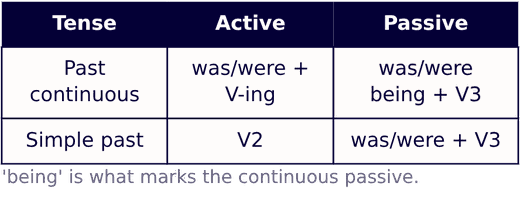 The object 'the way of the description by the instructor' becomes the subject; it is singular ('the way'), so the verb is 'was being imitated', and the doer takes 'by the trainees'.
Hence the correct option is (d).
The object 'the way of the description by the instructor' becomes the subject; it is singular ('the way'), so the verb is 'was being imitated', and the doer takes 'by the trainees'.
Hence the correct option is (d).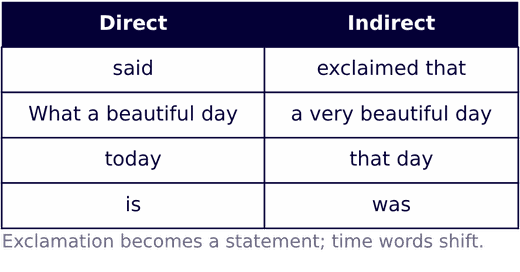 'Today' becomes 'that day' and the present 'is' is back-shifted to 'was', giving '… that that day was a very beautiful day' — the first 'that' is the conjunction, the second the demonstrative, so neither can be dropped.
Hence the correct option is (d).
'Today' becomes 'that day' and the present 'is' is back-shifted to 'was', giving '… that that day was a very beautiful day' — the first 'that' is the conjunction, the second the demonstrative, so neither can be dropped.
Hence the correct option is (d).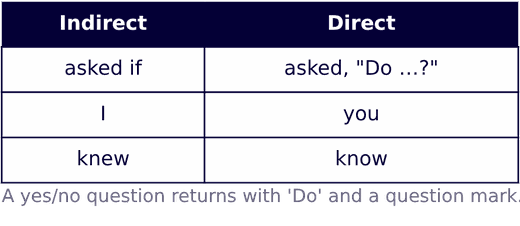 The back-shifted past 'knew' goes back to the present 'know', and the reported 'I' becomes 'you', because the speaker was addressing the listener.
The direct form is therefore: He asked, "Do you know the way to the library?"
Hence the correct option is (a).
The back-shifted past 'knew' goes back to the present 'know', and the reported 'I' becomes 'you', because the speaker was addressing the listener.
The direct form is therefore: He asked, "Do you know the way to the library?"
Hence the correct option is (a).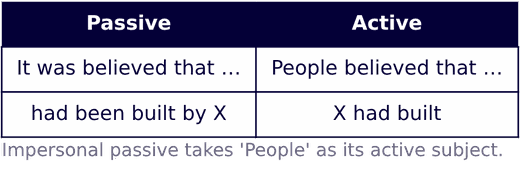 The inner clause 'the ancient monuments had been built by a previously unknown civilization' becomes 'a previously unknown civilization had built the ancient monuments'.
Option (b) wrongly shifts to the present 'believe', and option (a) uses 'They', a pronoun with no antecedent anywhere in the sentence.
Hence the correct option is (c).
The inner clause 'the ancient monuments had been built by a previously unknown civilization' becomes 'a previously unknown civilization had built the ancient monuments'.
Option (b) wrongly shifts to the present 'believe', and option (a) uses 'They', a pronoun with no antecedent anywhere in the sentence.
Hence the correct option is (c).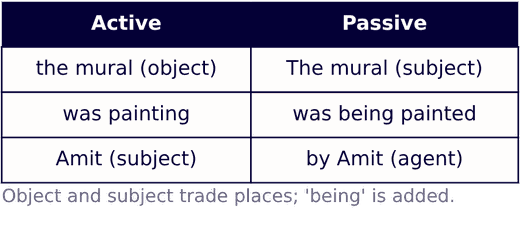 The object 'the mural' becomes the subject and is singular, so the verb is 'was being painted', and the doer takes 'by Amit'.
Dropping 'being' would give the simple past passive (option d), which changes the tense.
Hence the correct option is (b).
The object 'the mural' becomes the subject and is singular, so the verb is 'was being painted', and the doer takes 'by Amit'.
Dropping 'being' would give the simple past passive (option d), which changes the tense.
Hence the correct option is (b).