SSC CHSL 29 November 2025 · Shift 2 · General Intelligence — questions with answers · ShikshaSphere
Chapter 181 of 200
29 November 2025 · Shift 2
General Intelligence
25 questions ~25 min readFree
25 questions
A
26
A series is given with one term missing. Select the correct alternative from the given ones that will complete the series.
5, 9, 17, 33,65, ?, 257
A.122
B.129
C.124
D.126
Solution
Number series
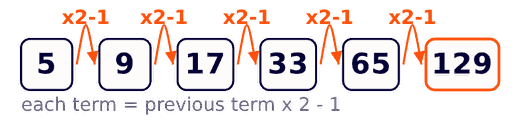
First look at the gaps: 9-5=4, 17-9=8, 33-17=16, 65-33=32 — every gap doubles.
The same rule written as one operation is , since , , and .
So the missing term .
Check the last term: , exactly as given.
Hence option (b) is correct.
27
If and , then what is the value of ?
A.-60
B.-95
C.-90
D.-85
Solution
Coded operation
Look for one rule that turns the two given numbers into the stated result.
For the first pair, 25-30=-5 and , which is the given value.
For the second pair, 8-24=-16 and , again the given value.
So the rule is (first number - second number) .
Applying it, the required value .
Hence option (a) is correct.
28
If and , then what is the value of ?
A.4520
B.4512
C.4000
D.4508
Solution
Coded operation
Multiply the two given numbers first and compare the product with the stated result.
First pair: and .
Second pair: and .
So the rule is (first number second number) .
Therefore the required value .
Hence option (c) is correct.
29
Find the next element that replace the ? Logically
8, 19, 41, 85, ?
A.128
B.173
C.132
D.131
Solution
Number series
The gaps are 19-8=11, 41-19=22 and 85-41=44, so each gap is double the one before.
Written as a single operation the rule is : , , .
So the next term .
The same answer follows from the gaps: next gap and 85+88=173.
Hence option (b) is correct.
30
Find the next element that replace the ? Logically
20, 84, 340, 1364, ?
A.5908
B.5460
C.5900
D.5890
Solution
Number series
Each term is roughly four times the previous one, since , so test with a small correction.
, , — the rule holds at every step.
Therefore the next term .
Hence option (b) is correct.
31
Which of the following will come next to the series ?
A, B, D, H, ?
A.X
B.P
C.U
D.M
Solution
Letter series
Replace each letter by its place in the alphabet: A = 1, B = 2, D = 4, H = 8.
Every place value is double the one before it, so the next place value .
The 16th letter of the alphabet is P.
Hence option (b) is correct.
32
Five people A, B, C, D, and E have different heights. C is taller than only two people. E is the tallest. B is taller than D but shorter than E. How many people are taller than C but shorter than the tallest person?
A.1
B.2
C.3
D.0
Solution
Order and ranking
Arrange the five from tallest to shortest.
'C is taller than only two people' means exactly two people stand below C, so C is 3rd from the top.
E is the tallest, so E takes the 1st place; the 2nd place must be filled by one of A, B or D.
B>D and B<E are consistent with either A or B occupying that 2nd place, so the order is not fully fixed.
But only one place lies between E and C, so exactly one person is taller than C and yet shorter than the tallest.
Hence option (a) is correct.
33
5 persons P, Q, R, S and T are sitting around a circular table facing towards the centre (not necessarily in the same order). R is not an immediate neighbour of or is sitting second to the left of T. P is sitting second to the left of R. Who is sitting fourth to the left of Q?
A.Q
B.P
C.R
D.S
Solution
Circular seating
All five face the centre, so each person's left hand points in the clockwise direction of the table.
Fix T at the top seat. 'Q is second to the left of T' puts Q two seats clockwise from T, leaving three seats for P, R and S.
'P is second to the left of R' means P sits two seats clockwise from R.
Try R in the seat next to T: then P falls two seats clockwise from R and S takes the last seat, and R's neighbours are only T and Q, which satisfies 'R is not next to S or P'.
The clockwise order is therefore T, R, Q, P, S.
With only five seats, going four seats to the left is the same as going one seat to the right, and one seat to Q's right is R.
Hence option (c) is correct.
34
There are 6 flats on a floor in two rows (three in each row opposite to each other). Flats of one row are facing north. Flats of other row are facing south. These flats are alloted to P, Q, R, S, T and U. S and U get diagonally opposite flats. U's flat is next to R's flat. R gets a north facing flat. The direction in which the flats of Q and T are facing is same. Q's flat is not next to S. Which of the following pair represents people having a north facing flat ?
A.QT
B.UT
C.UP
D.QS
Solution
Row arrangement
Draw two rows of three facing each other and number the columns 1, 2 and 3.
R has a north-facing flat, and U's flat is next to R's, so U is in the same row, i.e. the north row as well.
Q and T face the same direction; they cannot both be in the north row, which already holds R and U, so Q and T are both in the south row.
S is diagonally opposite U, so S is in the south row too; the south row is therefore Q, T, S and the north row is R, U, P.
Fixing the columns: S at one end of the south row, U diagonally across from it, R beside U, and P in the remaining north flat; Q is not next to S, so T takes the middle south flat and Q the far end.
The people with north-facing flats are R, U and P, so the pair offered is U and P.
Hence option (c) is correct.
35
Select the option that is related to the fourth number in the same way as the first number is related to the second number and fifth number is related to sixth number.
(NOTE: Operations should be performed on the whole numbers, without breaking down the numbers into its constituent digits. E.g. 13 - Operations on 13 such as adding /subtracting /multiplying etc. to 13 can be performed. Breaking down 13 into 1 and 3 and then performing mathematical operations on 1 and 3 is not allowed)
2511 : 3461 :: ? : 4874 :: 7674 : 8624
A.3035
B.3047
C.3924
D.3076
Solution
Number analogy
Use the two complete pairs to find the rule, working on the whole numbers.
First pair: 3461-2511=950.
Third pair: 8624-7674=950 — the same constant difference.
So the rule is (first number +950) = second number.
For the middle pair, the missing number =4874-950=3924.
Hence option (c) is correct.
36
Select the option that is related to the fifth number in the same way as the second number is related to the first number and fourth number is related to third number.
(NOTE: Operations should be performed on the whole numbers, without breaking down the numbers into its constituent digits. E.g. 13 - Operations on 13 such as adding /subtracting /multiplying etc. to 13 can be performed. Breaking down 13 into 1 and 3 and then performing mathematical operations on 1 and 3 is not allowed)
3480 : 577 :: 4206 : 698 : 2160 : ?
A.357
B.360
C.354
D.352
Solution
Number analogy
The second number is about one-sixth of the first, since , which is close to 577.
Test 'divide by 6, then subtract 3': and 580-3=577.
Check on the second pair: and 701-3=698.
So the rule is (number ) -3.
Therefore and 360-3=357.
Hence option (a) is correct.
37
By interchanging the given two signs which of the following equation will NOT be correct?
and ÷
l.
li.
A.Only I
B.Only II
C.Both I and II
D.Neither I nor II
Solution
Sign interchange
Swap the signs - and wherever they occur, then simplify each side by the BODMAS order.
Equation I becomes , i.e. 50+2-30=22, which is exactly the value stated, so I is correct.
Equation II becomes ; here and .
So the left side of II is 20+40-6=54, while the equation claims 63.
Only equation II fails to balance after the interchange.
Hence option (b) is correct.
38
Select the correct combination of mathematical signs to replace (*) signs sequentially and to balance the given equation.
A.
B.,
C.
D.,
Solution
Signs in equation
Put each option's signs into the four places of and simplify by BODMAS.
Taking in order gives .
Division and multiplication come first, from left to right: and .
Then the addition and subtraction: 150+50-20=200-20=180.
This equals the required value 180, while no other arrangement of the given signs produces 180.
Hence option (c) is correct.
39
In the following question, select the odd letter-number cluster from the given alternatives.
(NOTE: Operations should be performed on the whole numbers, without breaking down the number into its constituent digits. E.g. 13 - Operations on 13 such as adding /subtracting /multiplying etc. to 13 can be performed. Breaking down 13 into 1 and 3 and then performing mathematical operations on 1 and 3 is not allowed)
A.SDTR61
B.QTVS78
C.GTRD49
D.TFRE50
Solution
Odd letter-number cluster
In each cluster add the alphabetical place values of the four letters and compare the total with the number attached.
SDTR: 19+4+20+18=61, which matches 61.
QTVS: 17+20+22+19=78, which matches 78; GTRD: 7+20+18+4=49, which matches 49.
TFRE: 20+6+18+5=49, but this cluster carries 50, so the rule breaks here.
Hence option (d) is correct.
40
In the following question, four letter-number pairs are given. The letter-number on the left side of ( - ) is related to the letter-number on the right side of with some Logic / Rule /Relation. Three pairs are similar on the basis of same Logic/Rule/Relation. Select the odd one out from the given alternatives.
(NOTE: Operations should be performed on the whole numbers, without breaking down the number into its constituent digits. E.g. 13 - Operations on 13 such as adding /subtracting /multiplying etc. to 13 can be performed. Breaking down 13 into 1 and 3 and then performing mathematical operations on 1 and 3 is not allowed)
A.WE240 - BK610
B.MQ310 - RW680
C.TL420 - YR770
D.CI370 - HO740
Solution
Odd letter-number pair
In every pair check two things: how far each letter moves, and how much the number changes.
WE to BK: W+5=B and E+6=K, counting round the alphabet, while 610-240=370.
MQ to RW: M+5=R and Q+6=W, while 680-310=370.
CI to HO: C+5=H and I+6=O, while 740-370=370.
TL to YR also has the shifts +5 and +6, but 770-420=350, not 370, so this pair breaks the rule.
Hence option (c) is correct.
41
In the following question, four number pairs are given. In each pair the number on left side of (-) is related to the number of the right side of (-) with some Logic/Rule/Relation. Three pairs are similar on the basis of same Logic/Rule/Relation. Select the odd one out from the given alternatives.
(NOTE: Operations should be performed on the whole numbers, without breaking down the number into its constituent digits. E.g. 13 - Operations on 13 such as adding /subtracting /multiplying etc. to 13 can be performed. Breaking down 13 into 1 and 3 and then performing mathematical operations on 1 and 3 is not allowed)
A.3375-15
B.4913-17
C.4096-16
D.5833-18
Solution
Odd number pair (cubes)
Compare the two numbers of each pair: the number on the left should be the cube of the number on the right.
, and , so those three pairs obey one and the same rule.
, but the fourth pair shows 5833, which is one more than the cube.
So 5833-18 is the pair that does not fit.
Hence option (d) is correct.
42
In the following question, four number pairs are given. In each pair the number on left side of (-) is related to the number of the right side of (-) with some Logic/Rule/Relation. Three pairs are similar on the basis of same Logic / Rule/Relation. Select the odd one out from the given alternatives.
(NOTE: Operations should be performed on the whole numbers, without breaking down the number into its constituent digits. E.g. 13 - Operations on 13 such as adding /subtracting /multiplying etc. to 13 can be performed. Breaking down 13 into 1 and 3 and then performing mathematical operations on 1 and 3 is not allowed)
A.12-196
B.15-289
C.18-400
D.21-530
Solution
Odd number pair (squares)
Here the left number is small and the right one is large, so try adding a fixed number and then squaring.
, and , so the rule is: add 2, then square.
, but the fourth pair shows 530, which is one more than the square.
So 21-530 breaks the rule.
Hence option (d) is correct.
43
In a certain code language, 'STAR' is coded as '59', 'MOON' is coded as '58'. How will 'PLANT' be coded in that code language?
A.60
B.63
C.68
D.64
Solution
Word coding by letter sum
Add the positional values of the letters of the word and compare the total with the code.
For STAR: 19+20+1+18=58, and the code is 59, i.e. the sum plus 1.
For MOON: 13+15+15+14=57, and the code is 58, again the sum plus 1.
For PLANT: 16+12+1+14+20=63, so the code is 63+1=64.
Hence option (d) is correct.
44
From the given alternatives, select the word that CAN be formed by using the letters of the given word.
EDUCATION
A.DANGER
B.ACTIONS
C.CAUTION
D.UNITY
Solution
Word formation from letters
EDUCATION is made of the letters E, D, U, C, A, T, I, O, N, each of them once.
A word can be formed only if every letter it needs is present in this list.
DANGER needs G and R, ACTIONS needs S, and UNITY needs Y - none of these letters occurs in EDUCATION.
CAUTION needs C, A, U, T, I, O, N, and all seven are available, so it can be formed.
Hence option (c) is correct.
45
A word has been given in the question. This word CAN be formed by using the letters of the word given in one of the alternatives only. Select that alternative.
GARDEN
A.DANGER
B.RANGE
C.ENDAR
D.GRAND
Solution
Word formation from letters
GARDEN uses the six letters G, A, R, D, E, N, so the correct option must contain all six of them.
RANGE has no D, ENDAR has no G, and GRAND has no E, so none of these three can give GARDEN.
DANGER contains exactly D, A, N, G, E, R, which is the same set of six letters.
Rearranging the letters of DANGER therefore gives GARDEN.
Hence option (a) is correct.
46
Select the option that is related to the second letter-number cluster in the same way as the third letter-number cluster is related to the fourth letter-number cluster and fifth letter-number cluster is related to sixth letter-number cluster.
(NOTE: Operations should be performed on the whole numbers, without breaking down the number into its constituent digits. E.g. 13 - Operations on 13 such as adding /subtracting /multiplying etc. to 13 can be performed. Breaking down 13 into 1 and 3 and then performing mathematical operations on 1 and 3 is not allowed)
? : LN720 :: KP910 : LQ1100 :: CD340 : DE530
A.LK530
B.KM530
C.MK540
D.KM540
Solution
Letter-number cluster analogy
Read the two complete analogies first, because they fix the rule.
In KP910 : LQ1100 each letter moves one step forward (, ) and the number rises by 1100-910=190.
In CD340 : DE530 the letters again move one step forward (, ) and the number again rises by 530-340=190.
The missing cluster must give LN720 under this same rule, so work backwards.
Its letters are one step behind L and N, that is K and M, and its number is 720-190=530.
So the missing cluster is KM530.
Hence option (b) is correct.
47
Select the option that is related to the third letter-number cluster in the same way as the second letter-number cluster is related to the first letter-number cluster and sixth letter-number cluster is related to fifth letter-number cluster.
(NOTE: Operations should be performed on the whole numbers, without breaking down the number into its constituent digits. E.g. 13 - Operations on 13 such as adding /subtracting /multiplying etc. to 13 can be performed. Breaking down 13 into 1 and 3 and then performing mathematical operations on 1 and 3 is not allowed)
MT180 : PW270 :: FK120 : ? :: CZ240 : FC360
A.IM140
B.IN180
C.KW260
D.MV340
Solution
Letter-number cluster analogy
In MT180 : PW270 both letters move three steps forward (, ) and .
In CZ240 : FC360 the letters again move three steps forward (, and counting past Z) and .
So the rule is: each letter +3, and the number multiplied by .
Apply it to FK120: F+3=I and K+3=N.
The number becomes .
So the required cluster is IN180.
Hence option (b) is correct.
48
Select the option that is related to the fifth letter-number cluster in the same way as the second letter-number cluster is related to the first letter-number cluster and fourth letter-number cluster is related to third letter-number cluster.
(NOTE: Operations should be performed on the whole numbers, without breaking down the number into its constituent digits. E.g. 13 - Operations on 13 such as adding /subtracting /multiplying etc. to 13 can be performed. Breaking down 13 into 1 and 3 and then performing mathematical operations on 1 and 3 is not allowed)
AB14 : BC26 :: PQ35 : QR47 :: LM22 : ?
A.MN34
B.MN36
C.NO34
D.NO36
Solution
Letter-number cluster analogy
In AB14 : BC26 each letter moves one step forward (, ) and the number rises by 26-14=12.
The second analogy confirms it: in PQ35 : QR47, , and 47-35=12.
Apply the rule to LM22: L+1=M and M+1=N.
The number becomes 22+12=34.
So the required cluster is MN34.
Hence option (a) is correct.
49
A series is given with one term missing. Select the correct alternative from the given ones that will complete the series.
BF12, EK25, HP51, KU103, ?
A.NZ207
B.NY207
C.MX207
D.MY207
Solution
Mixed letter-number series
Break each term into its first letter, its second letter and its number, and treat the three parts separately.
First letters: B, E, H, K move forward by 3 each time, so the next is K+3=N.
Second letters: F, K, P, U move forward by 5 each time, so the next is U+5=Z.
Numbers: , and , so the rule is .
The next number is .
So the missing term is NZ207.
Hence option (a) is correct.
50
A series is given with one term wrong. Select that wrong term from the given alternatives.
BD24, JH75, RL228, ZP687, HT2060
A.JH75
B.RL228
C.ZP687
D.HT2060
Solution
Wrong term in a series
Check the letters first: B, J, R, Z, H move forward by 8 each time (after Z the count starts again from A), so the first letters are correct.
The second letters D, H, L, P, T move forward by 4 each time, so they are correct too; the error must be in a number.
Numbers: , and , so the rule is .
The fifth number should be , but the series shows 2060.
So the wrong term is HT2060.
Hence option (d) is correct.
Finished reading? Now test yourself.
The same 25 questions, but with a timer and the answers hidden — 15 minutes.

 So the missing term .
Check the last term: , exactly as given.
Hence option (b) is correct.
So the missing term .
Check the last term: , exactly as given.
Hence option (b) is correct.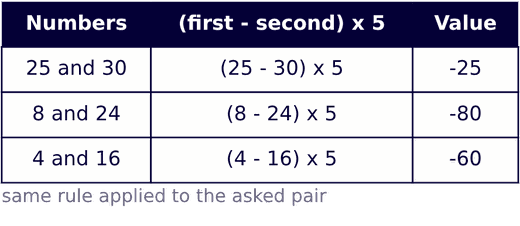 So the rule is (first number - second number) .
Applying it, the required value .
Hence option (a) is correct.
So the rule is (first number - second number) .
Applying it, the required value .
Hence option (a) is correct.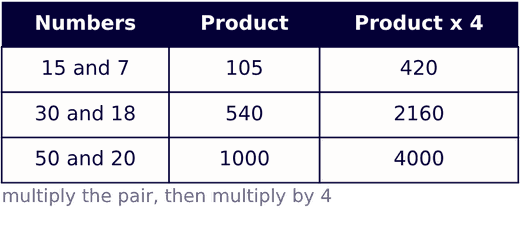 So the rule is (first number second number) .
Therefore the required value .
Hence option (c) is correct.
So the rule is (first number second number) .
Therefore the required value .
Hence option (c) is correct.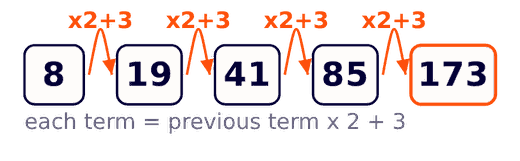 So the next term .
The same answer follows from the gaps: next gap and 85+88=173.
Hence option (b) is correct.
So the next term .
The same answer follows from the gaps: next gap and 85+88=173.
Hence option (b) is correct.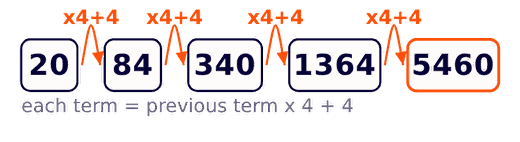 Therefore the next term .
Hence option (b) is correct.
Therefore the next term .
Hence option (b) is correct.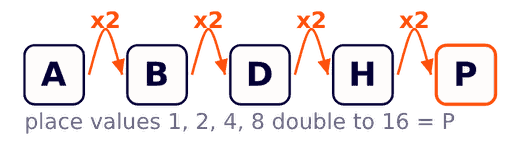 The 16th letter of the alphabet is P.
Hence option (b) is correct.
The 16th letter of the alphabet is P.
Hence option (b) is correct.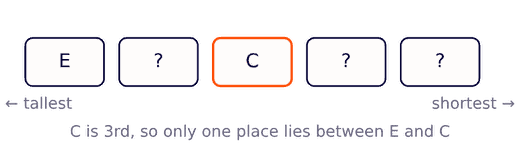 B>D and B<E are consistent with either A or B occupying that 2nd place, so the order is not fully fixed.
But only one place lies between E and C, so exactly one person is taller than C and yet shorter than the tallest.
Hence option (a) is correct.
B>D and B<E are consistent with either A or B occupying that 2nd place, so the order is not fully fixed.
But only one place lies between E and C, so exactly one person is taller than C and yet shorter than the tallest.
Hence option (a) is correct.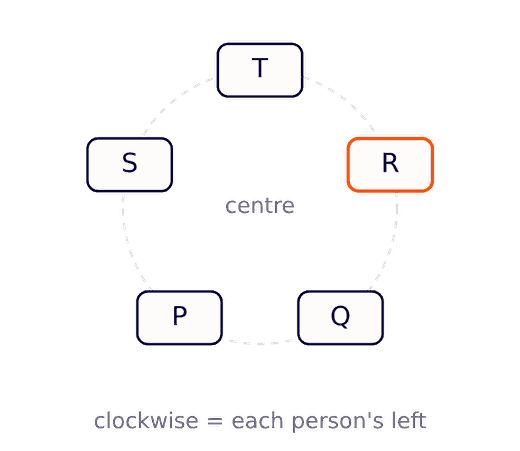 The clockwise order is therefore T, R, Q, P, S.
With only five seats, going four seats to the left is the same as going one seat to the right, and one seat to Q's right is R.
Hence option (c) is correct.
The clockwise order is therefore T, R, Q, P, S.
With only five seats, going four seats to the left is the same as going one seat to the right, and one seat to Q's right is R.
Hence option (c) is correct.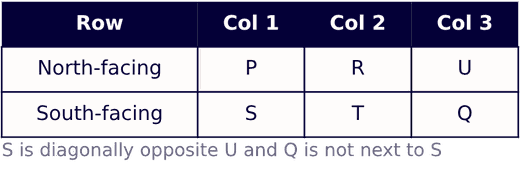 Fixing the columns: S at one end of the south row, U diagonally across from it, R beside U, and P in the remaining north flat; Q is not next to S, so T takes the middle south flat and Q the far end.
The people with north-facing flats are R, U and P, so the pair offered is U and P.
Hence option (c) is correct.
Fixing the columns: S at one end of the south row, U diagonally across from it, R beside U, and P in the remaining north flat; Q is not next to S, so T takes the middle south flat and Q the far end.
The people with north-facing flats are R, U and P, so the pair offered is U and P.
Hence option (c) is correct.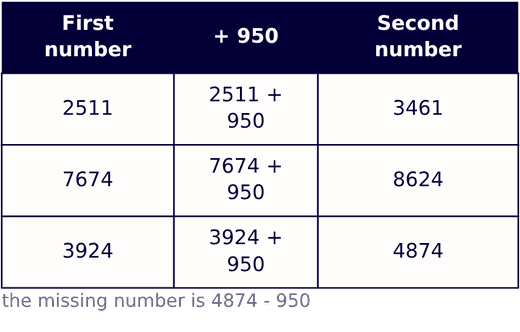 So the rule is (first number +950) = second number.
For the middle pair, the missing number =4874-950=3924.
Hence option (c) is correct.
So the rule is (first number +950) = second number.
For the middle pair, the missing number =4874-950=3924.
Hence option (c) is correct.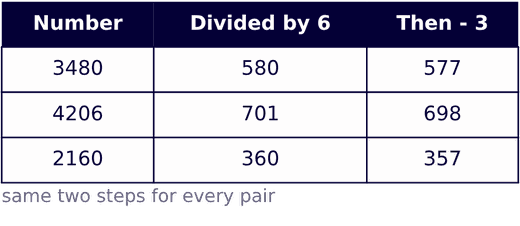 So the rule is (number ) -3.
Therefore and 360-3=357.
Hence option (a) is correct.
So the rule is (number ) -3.
Therefore and 360-3=357.
Hence option (a) is correct.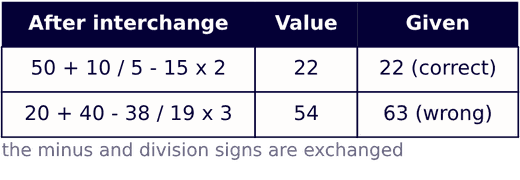 Only equation II fails to balance after the interchange.
Hence option (b) is correct.
Only equation II fails to balance after the interchange.
Hence option (b) is correct.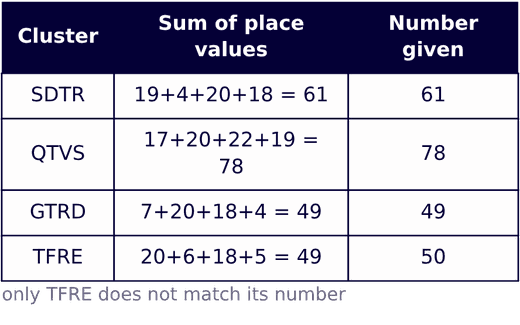 TFRE: 20+6+18+5=49, but this cluster carries 50, so the rule breaks here.
Hence option (d) is correct.
TFRE: 20+6+18+5=49, but this cluster carries 50, so the rule breaks here.
Hence option (d) is correct.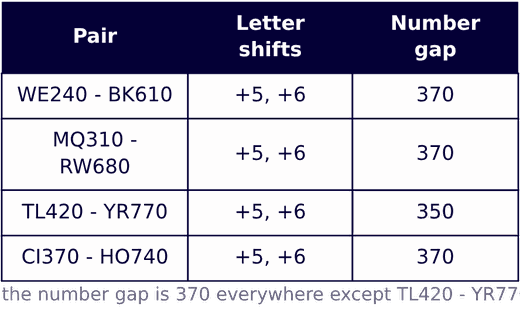 TL to YR also has the shifts +5 and +6, but 770-420=350, not 370, so this pair breaks the rule.
Hence option (c) is correct.
TL to YR also has the shifts +5 and +6, but 770-420=350, not 370, so this pair breaks the rule.
Hence option (c) is correct.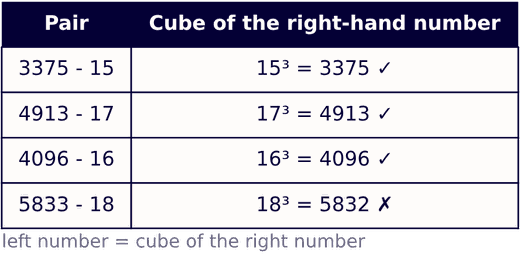 , and , so those three pairs obey one and the same rule.
, but the fourth pair shows 5833, which is one more than the cube.
So 5833-18 is the pair that does not fit.
Hence option (d) is correct.
, and , so those three pairs obey one and the same rule.
, but the fourth pair shows 5833, which is one more than the cube.
So 5833-18 is the pair that does not fit.
Hence option (d) is correct.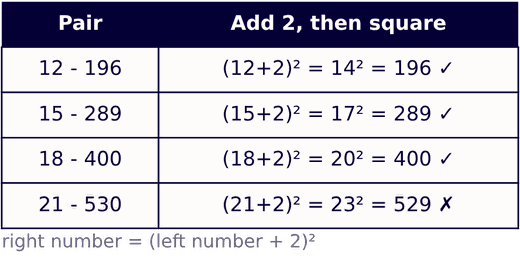 , and , so the rule is: add 2, then square.
, but the fourth pair shows 530, which is one more than the square.
So 21-530 breaks the rule.
Hence option (d) is correct.
, and , so the rule is: add 2, then square.
, but the fourth pair shows 530, which is one more than the square.
So 21-530 breaks the rule.
Hence option (d) is correct.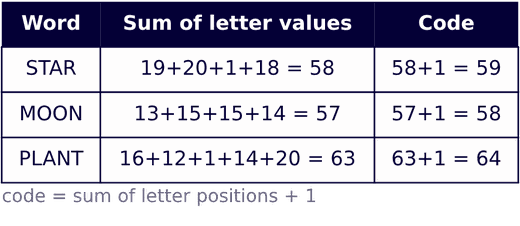 For STAR: 19+20+1+18=58, and the code is 59, i.e. the sum plus 1.
For MOON: 13+15+15+14=57, and the code is 58, again the sum plus 1.
For PLANT: 16+12+1+14+20=63, so the code is 63+1=64.
Hence option (d) is correct.
For STAR: 19+20+1+18=58, and the code is 59, i.e. the sum plus 1.
For MOON: 13+15+15+14=57, and the code is 58, again the sum plus 1.
For PLANT: 16+12+1+14+20=63, so the code is 63+1=64.
Hence option (d) is correct.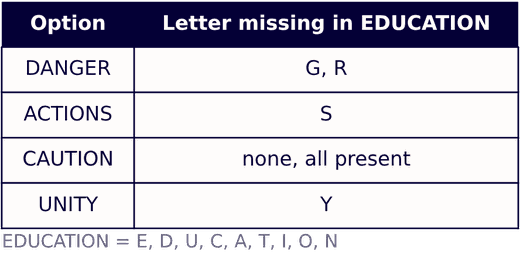 DANGER needs G and R, ACTIONS needs S, and UNITY needs Y - none of these letters occurs in EDUCATION.
CAUTION needs C, A, U, T, I, O, N, and all seven are available, so it can be formed.
Hence option (c) is correct.
DANGER needs G and R, ACTIONS needs S, and UNITY needs Y - none of these letters occurs in EDUCATION.
CAUTION needs C, A, U, T, I, O, N, and all seven are available, so it can be formed.
Hence option (c) is correct.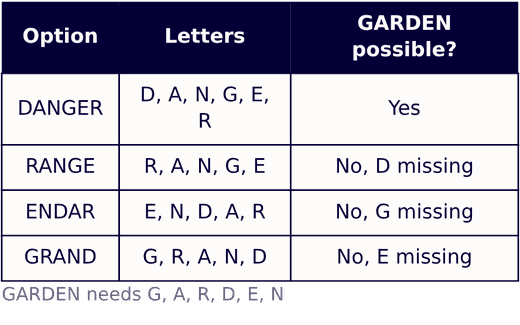 RANGE has no D, ENDAR has no G, and GRAND has no E, so none of these three can give GARDEN.
DANGER contains exactly D, A, N, G, E, R, which is the same set of six letters.
Rearranging the letters of DANGER therefore gives GARDEN.
Hence option (a) is correct.
RANGE has no D, ENDAR has no G, and GRAND has no E, so none of these three can give GARDEN.
DANGER contains exactly D, A, N, G, E, R, which is the same set of six letters.
Rearranging the letters of DANGER therefore gives GARDEN.
Hence option (a) is correct.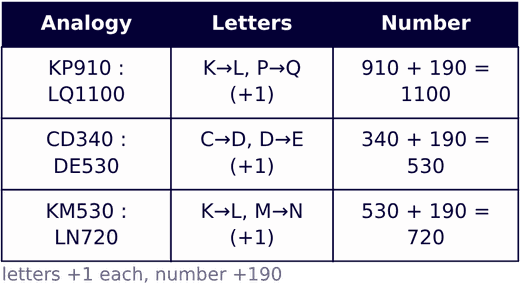 The missing cluster must give LN720 under this same rule, so work backwards.
Its letters are one step behind L and N, that is K and M, and its number is 720-190=530.
So the missing cluster is KM530.
Hence option (b) is correct.
The missing cluster must give LN720 under this same rule, so work backwards.
Its letters are one step behind L and N, that is K and M, and its number is 720-190=530.
So the missing cluster is KM530.
Hence option (b) is correct.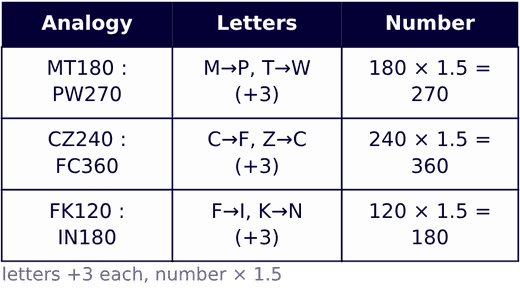 Apply it to FK120: F+3=I and K+3=N.
The number becomes .
So the required cluster is IN180.
Hence option (b) is correct.
Apply it to FK120: F+3=I and K+3=N.
The number becomes .
So the required cluster is IN180.
Hence option (b) is correct.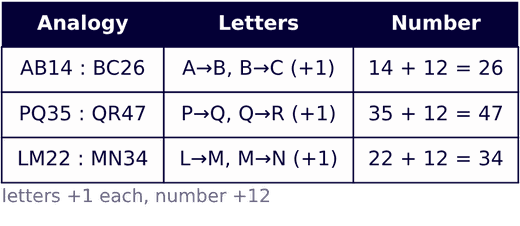 Apply the rule to LM22: L+1=M and M+1=N.
The number becomes 22+12=34.
So the required cluster is MN34.
Hence option (a) is correct.
Apply the rule to LM22: L+1=M and M+1=N.
The number becomes 22+12=34.
So the required cluster is MN34.
Hence option (a) is correct.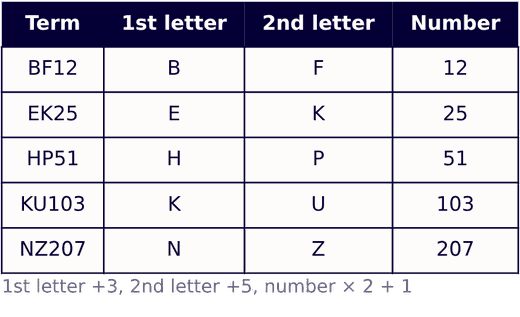 So the missing term is NZ207.
Hence option (a) is correct.
So the missing term is NZ207.
Hence option (a) is correct.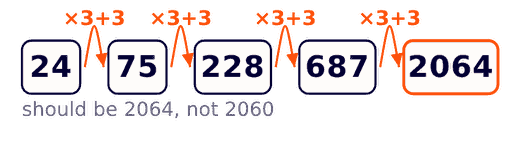 The fifth number should be , but the series shows 2060.
So the wrong term is HT2060.
Hence option (d) is correct.
The fifth number should be , but the series shows 2060.
So the wrong term is HT2060.
Hence option (d) is correct.