
76
The Nayanar saints of South India were primarily associated with devotion to which deity ?
- A.Vishnu
- B.Surya
- C.Shiva
- D.Agni
Solution
Bhakti movement saints
The Nayanars were the 63 Tamil poet-saints of South India who sang in devotion to Lord Shiva.
They flourished roughly between the 6th and 9th centuries and led the Bhakti movement in the Tamil country; their hymns are collected in the Tevaram, which forms part of the Tirumurai.
An easy way to remember: Nayanars go with Shiva, Alvars go with Vishnu, and the two groups were contemporaries.
That contrast rules out option (a), while Surya and Agni are Vedic deities with no Nayanar tradition attached to them.
Hence option (c) is correct.
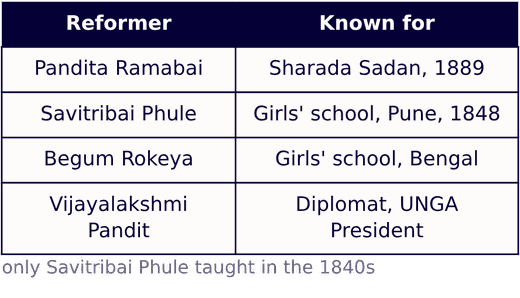 The other three worked in different fields or later times, so none of them is called India's first woman teacher.
Hence option (b) is correct.
The other three worked in different fields or later times, so none of them is called India's first woman teacher.
Hence option (b) is correct.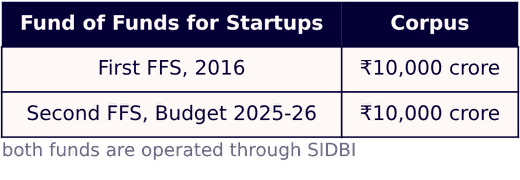 The first Fund of Funds for Startups, announced in 2016 under the Startup India initiative, also carried a corpus of ₹10,000 crore, so the second fund doubles the government's commitment to this route.
The fund is operated by SIDBI, which does not invest in a startup directly; it puts money into SEBI-registered Alternative Investment Funds, and each such fund must invest at least twice the amount drawn in eligible startups.
The second fund is aimed at deep-tech, early-stage and long-gestation ventures, and was announced together with a proposed ₹20,000 crore outlay for research, development and innovation.
Hence option (b) is correct.
The first Fund of Funds for Startups, announced in 2016 under the Startup India initiative, also carried a corpus of ₹10,000 crore, so the second fund doubles the government's commitment to this route.
The fund is operated by SIDBI, which does not invest in a startup directly; it puts money into SEBI-registered Alternative Investment Funds, and each such fund must invest at least twice the amount drawn in eligible startups.
The second fund is aimed at deep-tech, early-stage and long-gestation ventures, and was announced together with a proposed ₹20,000 crore outlay for research, development and innovation.
Hence option (b) is correct.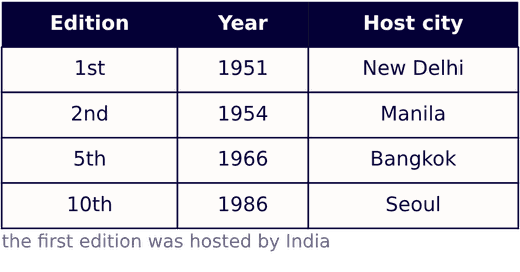 The Games grew out of the Asian Relations Conference of 1947 and the efforts of Guru Dutt Sondhi; their motto is "Ever Onward" and they are now held every four years under the Olympic Council of Asia.
New Delhi hosted them a second time in 1982, with Appu the elephant as mascot; Manila, Bangkok and Seoul hosted later editions, not the first.
Hence option (c) is correct.
The Games grew out of the Asian Relations Conference of 1947 and the efforts of Guru Dutt Sondhi; their motto is "Ever Onward" and they are now held every four years under the Olympic Council of Asia.
New Delhi hosted them a second time in 1982, with Appu the elephant as mascot; Manila, Bangkok and Seoul hosted later editions, not the first.
Hence option (c) is correct.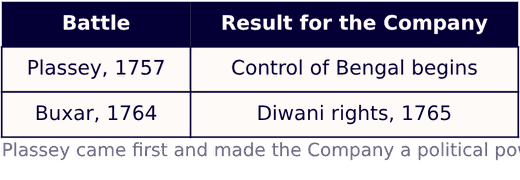 The victory handed the Company control of the revenues of the richest province in India and turned a trading body into a political power - which is why Plassey, not a bigger battle, is called the turning point.
The Battle of Buxar in 1764 came later and only confirmed that power; it led to the Treaty of Allahabad of 1765, by which the Company obtained the Diwani of Bengal, Bihar and Odisha.
Hence option (b) is correct.
The victory handed the Company control of the revenues of the richest province in India and turned a trading body into a political power - which is why Plassey, not a bigger battle, is called the turning point.
The Battle of Buxar in 1764 came later and only confirmed that power; it led to the Treaty of Allahabad of 1765, by which the Company obtained the Diwani of Bengal, Bihar and Odisha.
Hence option (b) is correct.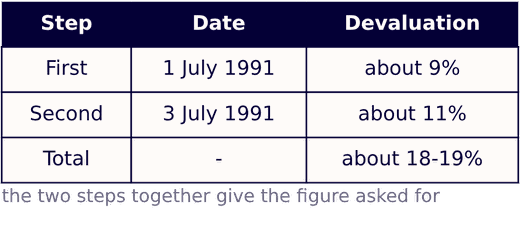 Taken together the two steps came to roughly to against the US dollar, which is the "around 18%" of option (a).
The exercise, carried out by Governor S. Venkitaramanan under Finance Minister Manmohan Singh and nicknamed the "hop, skip and jump" devaluation, was meant to make exports competitive and stop the drain on reserves.
It was followed by the dual exchange rate under LERMS in 1992 and by full convertibility on the current account in 1994.
Hence option (a) is correct.
Taken together the two steps came to roughly to against the US dollar, which is the "around 18%" of option (a).
The exercise, carried out by Governor S. Venkitaramanan under Finance Minister Manmohan Singh and nicknamed the "hop, skip and jump" devaluation, was meant to make exports competitive and stop the drain on reserves.
It was followed by the dual exchange rate under LERMS in 1992 and by full convertibility on the current account in 1994.
Hence option (a) is correct.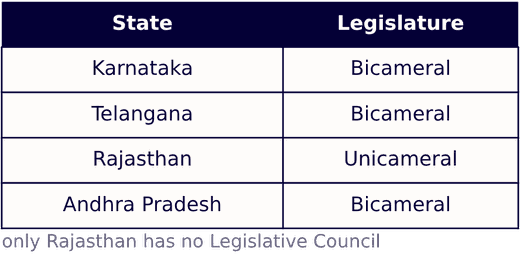 At present only six States have a Legislative Council - Andhra Pradesh, Bihar, Karnataka, Maharashtra, Telangana and Uttar Pradesh - and the three other options are all in that list.
Article 169 allows Parliament to create or abolish a Council, but only after the Assembly of the State passes a resolution by a majority of its total membership and by two-thirds of the members present and voting.
A Council may not be larger than one-third of the Assembly and never smaller than 40 members; it is a continuing house, one-third of whose members retire every two years.
Hence option (c) is correct.
At present only six States have a Legislative Council - Andhra Pradesh, Bihar, Karnataka, Maharashtra, Telangana and Uttar Pradesh - and the three other options are all in that list.
Article 169 allows Parliament to create or abolish a Council, but only after the Assembly of the State passes a resolution by a majority of its total membership and by two-thirds of the members present and voting.
A Council may not be larger than one-third of the Assembly and never smaller than 40 members; it is a continuing house, one-third of whose members retire every two years.
Hence option (c) is correct.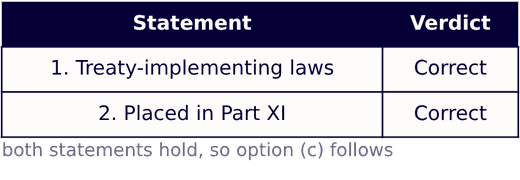 The Environment (Protection) Act, 1986, enacted to give effect to the decisions of the Stockholm Conference of 1972, is the standard example of a law made under this Article.
Both statements being correct, option (c) is correct.
The Environment (Protection) Act, 1986, enacted to give effect to the decisions of the Stockholm Conference of 1972, is the standard example of a law made under this Article.
Both statements being correct, option (c) is correct.