SSC CHSL 29 November 2025 · Shift 1 · General Awareness — questions with answers · ShikshaSphere
Chapter 178 of 200
29 November 2025 · Shift 1
General Awareness
25 questions ~25 min readFree
25 questions
A
76
At the 71st National Film Awards, which actor received the Best Actor (Male) honour for his performance in a Hindi film?
A.Vicky Kaushal
B.Shah Rukh Khan
C.Ayushmann Khurrana
D.Ranveer Singh
Solution
National Film Awards
Shah Rukh Khan received the Best Actor honour at the 71st National Film Awards for his performance in the Hindi film Jawan — his first National Film Award.
He shared the award with Vikrant Massey, who was honoured for 12th Fail; the awards, announced on 1 August 2025, covered films certified in 2023.
At the same ceremony Rani Mukerji was named Best Actress, 12th Fail won Best Feature Film and Mohanlal received the Dadasaheb Phalke Award.
इसलिए सही विकल्प (b) है।
77
In early 2025 , who took charge as the new Chairperson of the Indian National Trust for Art and Cultural Heritage?
A.Aviral Jain
B.Rakesh Verma
C.Ashok Singh Thakur
D.Sunil Mehta
Solution
INTACH leadership
Ashok Singh Thakur was elected Chairman of INTACH at its Annual General Meeting in New Delhi on 22 March 2025, for a three-year term.
INTACH — the Indian National Trust for Art and Cultural Heritage — was founded in 1984 and is India's largest non-profit heritage body, registered under the Societies Registration Act, 1860.
It works on built, natural, material and intangible heritage through more than 200 chapters, guided by the INTACH Charter of 2004.
इसलिए सही विकल्प (c) है।
78
On 1 January 2025, Sanjiv Ranjan assumed office as Secretary-General of the Indian Ocean Rim Association (IORA) Secretariat in Mauritius. What is the duration of his tenure?
A.Four years
B.Three years
C.Five years
D.One year
Solution
IORA Secretary-General
Sanjiv Ranjan took charge as Secretary-General of the Indian Ocean Rim Association on 1 January 2025 for a tenure of three years.
He is the first Indian to hold this post; the IORA Secretariat is located at Ebene, Mauritius.
IORA was formed in 1997, has 23 member states, and works on maritime safety and security, trade facilitation, fisheries management, disaster risk management and the blue economy.
इसलिए सही विकल्प (b) है।
79
In May 2025, the Supreme Court of India overturned a ruling of which High Court that had refused maternity leave to a government school teacher on the ground that it was her third child?
A.Kerala High Court
B.Madras High Court
C.Punjab and Haryana High Court
D.Gujarat High Court
Solution
Supreme Court on maternity leave
In May 2025 the Supreme Court set aside a Madras High Court order that had refused maternity leave to a government school teacher because the child was her third.
The bench of Justices Abhay S. Oka and Ujjal Bhuyan held that maternity leave is part of the right to life and personal liberty under Article 21 and flows from a woman's reproductive autonomy and dignity.
The Court ruled that the Tamil Nadu service rule limiting the benefit to two children could not override this constitutional protection.
इसलिए सही विकल्प (b) है।
80
By the end of 2024, how many million women in India were actively tracking or monitoring their credit profiles, indicating a rise in financial awareness?
A.27 million
B.33 million
C.38 million
D.28 million
Solution
Women and credit awareness
About 27 million women in India were actively monitoring their credit profiles by December 2024, a rise of 42% over the previous year.
The figure appears in the report “From Borrowers to Builders: Women's Role in India's Financial Growth Story”.
It was released jointly by TransUnion CIBIL, NITI Aayog's Women Entrepreneurship Platform and MicroSave Consulting; credit-monitoring growth was faster in non-metro regions (48%) than in metros.
इसलिए सही विकल्प (a) है।
81
Which central government initiative focuses on traditional artisans and craftspeople, providing them with skill training support, a daily stipend of ₹500, and assistance for toolkits?
A.PM Garib Kalyan Yojana
B.PM Vishwakarma Scheme
C.Deen Dayal Antyodaya Yojana
D.Stand-Up India Scheme
Solution
PM Vishwakarma Scheme
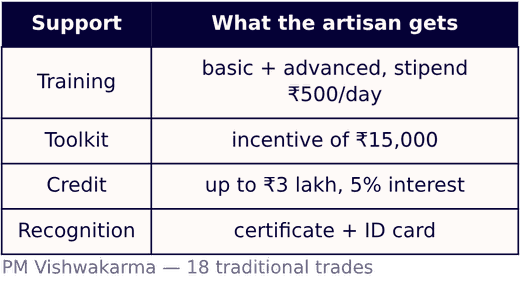
The three benefits named in the question — skill training, a ₹500 daily stipend and toolkit assistance — together identify the PM Vishwakarma Scheme, launched on 17 September 2023.
It is a central sector scheme of the Ministry of Micro, Small and Medium Enterprises covering 18 traditional family-based trades such as carpenter, blacksmith, goldsmith, potter, cobbler, mason and barber.
Besides training and the toolkit grant, a registered artisan gets collateral-free enterprise credit up to ₹3 lakh at a concessional interest rate of , along with a PM Vishwakarma certificate and ID card.
The other options do not fit: PM Garib Kalyan Yojana is a free-foodgrain relief package, Deen Dayal Antyodaya Yojana works through self-help groups for the rural and urban poor, and Stand-Up India funds SC/ST and women entrepreneurs.
Hence the correct option is (b).
82
According to the Fiscal Health Index (FHI) 2025, which Indian state secured the top position for maintaining strong fiscal discipline and financial management?
A.Kerala
B.Goa
C.Tamil Nadu
D.Odisha
Solution
Fiscal Health Index 2025
Odisha secured the first rank in the Fiscal Health Index (FHI) 2025.
The FHI is a new NITI Aayog report, released on 24 January 2025, that ranks 18 major States on five sub-indices — quality of expenditure, revenue mobilisation, fiscal prudence, debt index and debt sustainability.
Odisha topped the list with an overall score of 67.8, helped by a low debt-to-GSDP ratio and strong own-revenue mobilisation from mining.
Chhattisgarh and Goa took the second and third places; Kerala, Punjab, West Bengal and Andhra Pradesh were placed in the 'aspirational' group because of high fiscal stress.
Hence the correct option is (d).
83
The Hesaraghatta grasslands, known for their rich biodiversity and open savanna landscape, are located near which Indian city?
A.Bengaluru
B.Pune
C.Chennai
D.Nagpur
Solution
Hesaraghatta grasslands
The Hesaraghatta grasslands lie on the north-western outskirts of Bengaluru, in Bengaluru Rural district of Karnataka, around the old Hesaraghatta lake on the Arkavathi river.
They are the last large stretch of open savanna-type grassland left near the city and shelter more than 130 bird species along with the Indian grey wolf, slender loris, leopard and the rare lesser florican.
After a long conservation campaign the Karnataka government notified about 5,678 acres of this tract as the Greater Hesaraghatta Grassland Conservation Reserve.
The other cities are wrong simply because this named grassland belongs to the Bengaluru landscape, not to Pune, Chennai or Nagpur.
Hence the correct option is (a).
84
Mangroves are classified under which ecosystem in EnviStats India 2024?
A.Forest ecosystem
B.Inland wetland ecosystem
C.Ocean ecosystem
D.Grassland ecosystem
Solution
EnviStats India 2024
EnviStats India 2024: Environment Accounts is the seventh issue of the environment-accounting publication of the Ministry of Statistics and Programme Implementation (MoSPI).
Its new feature is a set of Ocean Accounts prepared on the UN System of Environmental-Economic Accounting (SEEA) framework, and mangroves are placed there as an important sub-ecosystem of the ocean ecosystem.
The report shows that mangrove cover rose by about between 2013 and 2021, the gain being credited to their role in coastal protection, fish breeding and carbon storage.
The forest-ecosystem option is the tempting one because the Forest Survey of India counts mangroves inside forest cover; EnviStats, however, reads them as a land-sea interface and books them under the ocean.
Hence the correct option is (c).
85
Which of the following Indian musical instruments is classified under Ghana Vadya ?
A.Pakhawaj
B.Pava
C.Jhanjh
D.Nagara
Solution
Classification of instruments
The Natya Shastra divides Indian instruments into four classes by the way the sound is produced: Tata (stretched strings), Sushira (hollow, blown), Avanaddha (covered with a stretched skin) and Ghana (solid, self-sounding).
Ghana Vadya are solid pieces of metal or wood that ring by their own vibration and need neither a string, nor a membrane, nor a column of air.
Jhanjh is a pair of large metal cymbals struck against each other in bhajan, aarti and folk processions, so it belongs to the Ghana class.
Pakhawaj and Nagara are drums with a stretched skin, hence Avanaddha Vadya, while Pava is a small folk flute blown into, hence Sushira Vadya.
Hence the correct option is (c).
86
In Buddhist architectural tradition, what was the primary purpose served by a Chaitya?
A.Residential cells meant for monks
B.Storage spaces for food and supplies
C.Congregational halls for teaching and interaction
D.Ornamental entrance structures of viharas
Solution
Buddhist rock-cut architecture
A chaitya (chaitya-griha) is the prayer hall of a Buddhist establishment — a long hall with a rounded apse at the far end in which a votive stupa is placed, flanked by rows of pillars forming aisles for circumambulation.
The whole sangha gathered here for worship, sermons and discussion, so its purpose was congregational: teaching and collective interaction.
The residential half of a monastery was the vihara, a courtyard ringed by small cells for individual monks, which is why option (a) describes the vihara and not the chaitya.
The rock-cut chaityas at Karle, Bhaja, Bedsa and Ajanta, with their barrel-vaulted roofs and horseshoe-shaped chaitya windows, are the classic surviving examples.
Hence the correct option is (c).
87
The traditional folk dance 'Dekhni', often associated with which Indian state?
A.Maharashtra
B.Goa
C.Odisha
D.Rajasthan
Solution
Folk dances — Dekhni
Dekhni is a semi-classical folk dance of Goa, performed by women.
The word comes from Konkani and means 'bewitching beauty'; the dancers move in slow, graceful steps, often carrying lamps (panttis), to the beat of the ghumat drum.
Its songs blend an Indian melody with a Western harmony, a mixture typical of Goa's Indo-Portuguese culture, and they usually retell episodes from the life of the temple dancers.
Other well known Goan folk forms are Fugdi, Dhalo, Goff, Dhangar, Kunbi, Ghodemodni and Corredinho.
Hence the correct option is (b).
88
The MACE Telescope was formally inaugurated at which high-altitude Himalayan location in October 2024 ?
A.Leh
B.Hanle
C.Dehradun
D.Shimla
Solution
MACE gamma-ray telescope
The Major Atmospheric Cherenkov Experiment (MACE) telescope was formally inaugurated on 4 October 2024 at the Indian Astronomical Observatory, Hanle, in the Changthang region of Ladakh.
Hanle sits at about 4,270 m above sea level, which makes MACE the highest imaging Cherenkov telescope in the world and, with a 21 m reflector, the largest of its kind in Asia.
It was designed and built indigenously by the Bhabha Atomic Research Centre with Indian industry, and it observes the faint blue Cherenkov flashes produced when very-high-energy gamma rays from black holes, pulsars and supernova remnants strike the atmosphere.
Leh is the district headquarters and only the gateway town; Dehradun and Shimla lie far lower in the outer Himalaya and host no such observatory.
Hence the correct option is (b).
89
In 2024, astronomers reported a temporarily captured near-Earth object that behaved like a "mini-moon", orbiting Earth for roughly two months. What was this object designated as?
A.2023 FW13
B.2024 PT5
C.2022 NX1
D.2024 XR12
Solution
Mini-moon 2024 PT5
The object was the small asteroid 2024 PT5, discovered in August 2024 by the ATLAS survey.
Earth's gravity held it from 29 September to 25 November 2024 — about 57 days — so the newspapers called it a 'mini-moon'.
It is only about 10 m across and belongs to the Arjuna group of asteroids, whose orbits are very like Earth's own.
Because it was captured weakly, it never completed a full loop around Earth; it traced a horseshoe-shaped path and then returned to its solar orbit.
Hence the correct option is (b).
90
The Government of India constituted a high-level committee to examine and recommend reforms in both direct and indirect taxation in 2002-2003. Who headed this committee?
A.Montek Singh Ahluwalia
B.Nandan Nilekani
C.Y. V. Reddy
D.Vijay Kelkar
Solution
Kelkar Task Force
The two Task Forces on direct taxes and on indirect taxes set up by the Finance Ministry in 2002 were both chaired by Vijay Kelkar, then adviser to the Finance Minister, and are together remembered as the Kelkar Task Force.
Their reports asked for a broad base with few exemptions, lower and simpler rates, better use of information technology in tax administration, and a shift of effort from the tax rate to tax compliance.
The indirect-tax report is the one that first sketched a full national Goods and Services Tax to replace the tangle of excise, service tax and State sales taxes — the idea that finally took shape as GST in July 2017.
Vijay Kelkar later chaired the Thirteenth Finance Commission, which is a useful cross-check for remembering him; Montek Singh Ahluwalia headed the Planning Commission, Nandan Nilekani the UIDAI, and Y. V. Reddy was Governor of the RBI.
Hence the correct option is (d).
91
Which expansionist policy was introduced during the tenure of Lord Dalhousie to annex princely states that lacked a natural heir?
A.Subsidiary Alliance
B.Policy of Paramountcy
C.Doctrine of Lapse
D.Ring Fence Policy
Solution
Doctrine of Lapse
The policy is the Doctrine of Lapse, applied by Lord Dalhousie, Governor-General from 1848 to 1856.
Under it a dependent princely state whose ruler died without a natural male heir 'lapsed' to the East India Company, because the Company refused to recognise an adopted son as a lawful successor.
Awadh was a separate case, annexed in 1856 on the plea of misgovernance rather than lapse, and the resentment of the dispossessed rulers — Rani Lakshmibai of Jhansi above all — became one of the causes of the Revolt of 1857.
The Subsidiary Alliance was Wellesley's earlier device of stationing Company troops in a state at its own cost, while the Ring Fence policy of Warren Hastings only created buffer zones around Company territory.
Hence the correct option is (c).
92
National Stock Exchange of India commence its trading operations in which year ?
A.1992
B.1994
C.1997
D.2000
Solution
National Stock Exchange
The National Stock Exchange of India (NSE) was incorporated in 1992 on the recommendation of the Pherwani Committee, but it began actual trading only in 1994.
Trading opened with the Wholesale Debt Market segment in June 1994 and the Capital Market (equities) segment followed in November 1994.
NSE was the first exchange in India to run a fully automated, screen-based electronic order-matching system with nationwide terminals, which ended the open-outcry floor and made prices transparent.
1992 is only the year of incorporation, 1997 and 2000 are later — 2000 being the year NSE started index futures.
Hence the correct option is (b).
93
Consider the following statements regarding the South-Western Plateau mineral belt of India :
1. This mineral belt extends over parts of Karnataka, Goa, and contiguous Tamil Nadu uplands and Kerala.
2. The region is rich in ferrous minerals and bauxite deposits.
3. It is known for the presence of high-grade iron ore.
4. The belt contains extensive coal reserves.
Which of the statements given above is/are correct ?
A.1 and 2 only
B.4 only
C.1,2 and 3 only
D.1, 3 and 4
Solution
South-Western Plateau belt
The South-Western Plateau is one of the four mineral belts of India, and it does run across Karnataka, Goa and the adjoining uplands of Tamil Nadu and Kerala, so statement 1 is correct.
The belt is rich in ferrous minerals, and Kerala's Plateau margin adds monazite, thorium sands and bauxite, so statement 2 is correct.
Its best known resource is the high-grade iron ore of the Bababudan, Kudremukh and Sandur ranges and the Goa fields, which feeds the Bhadravati and Vijayanagar steel plants and the ore exports from Marmagao; statement 3 is correct.
The belt is, however, notably poor in coal — the only fossil-fuel deposit of the whole south is the lignite of Neyveli — so statement 4 is wrong.
Statements 1, 2 and 3 are therefore correct and 4 is not.
Hence the correct option is (c).
94
Consider the following statements regarding the disruption in India's third five year plan:
1. The plan period was adversely affected due to armed conflict with Pakistan.
2. Consecutive drought years led to severe agricultural shortfalls and economic stress.
Which of the statements given above is/are correct?
A.Statement 1 only
B.Statement 2 only
C.Both statements 1 and 2
D.Neither statement 1 nor 2
Solution
Third Five Year Plan
The Third Five Year Plan ran from 1961 to 1966 and aimed at a self-reliant, self-generating economy with a growth target of .
Statement 1 is correct: the Indo-Pak War of 1965 (following the Chinese aggression of 1962) forced a heavy diversion of resources from development to defence.
Statement 2 is correct as well: the successive droughts of 1965-66 caused a severe fall in foodgrain output, sharp inflation and dependence on PL-480 imports.
Together these shocks pulled actual growth down to about , and the plan is treated as a failure — so much so that the next plan was postponed and 1966-69 became the period of Plan Holidays with three annual plans.
Hence the correct option is (c).
95
What average annual economic growth rate was envisaged as the target during India's Twelfth Five Year Plan (2012-17) ?
A.6%
B.8%
C.10%
D.12%
Solution
Twelfth Five Year Plan
The Twelfth Five Year Plan (2012-17), the last of India's five year plans, carried the theme 'Faster, More Inclusive and Sustainable Growth'.
The Approach Paper had proposed a target of , but in view of the global slowdown the National Development Council finally approved an average annual growth target of .
Its other goals were 4 per cent growth in agriculture, 10 per cent in manufacturing, electricity for every village, 50 million new non-farm jobs and a rise in green cover of one million hectares a year.
The Planning Commission was wound up in 2015 and replaced by NITI Aayog, so no thirteenth plan followed.
Hence the correct option is (b).
96
According to data shared by the Ministry of External Affairs (MEA) in September 2024, approximately how many million people of Indian origin, including NRIs and OCIs, were living abroad ?
A.32 million
B.40 million
C.55 million
D.65 million
Solution
Indian diaspora abroad
The Ministry of External Affairs put the overseas Indian population at roughly 32 million, that is about 3.2 crore, counting Non-Resident Indians together with Persons of Indian Origin and Overseas Citizens of India.
This is the largest diaspora of any country in the world, spread over more than 200 countries; the biggest concentrations are in the United States, the United Arab Emirates, Malaysia, Saudi Arabia and Myanmar.
The diaspora sends home more than $120 billion of remittances a year, the highest inflow received by any country, which is why the figure is asked about so often.
The larger figures in the other options — 40, 55 and 65 million — exceed even the most generous estimates of people of Indian origin abroad.
Hence the correct option is (a).
97
At the time of its launch, Mission Parivar Vikas targeted how many high-focus states to improve family planning outcomes?
A.Five
B.Seven
C.Eight
D.Ten
Solution
Mission Parivar Vikas
Mission Parivar Vikas was launched by the Ministry of Health and Family Welfare in 2016 and at the start it covered seven high-focus States.
These were Uttar Pradesh, Bihar, Rajasthan, Madhya Pradesh, Chhattisgarh, Jharkhand and Assam, chosen because 146 districts in them had a Total Fertility Rate of 3.0 or more; together these States account for about 44 per cent of India's population.
The mission works by making contraceptives easily available, holding Saas-Bahu Sammelans and Nayi Pehel kits for newly married couples, and appointing ASHA workers to deliver supplies at the doorstep.
Its aim is to bring the country to the replacement level fertility of 2.1, and the scheme was later extended to more States.
Hence the correct option is (b).
98
In the human body, haemoglobin, the oxygen-carrying respiratory pigment, is primarily present in which type of cell?
A.Neurons
B.Lymphocytes
C.Thrombocytes
D.Erythrocytes
Solution
Haemoglobin in blood
Haemoglobin is carried by the erythrocytes, that is, the red blood cells.
It is an iron-containing protein made of four globin chains, each holding a haem group; the iron of the haem binds oxygen in the lungs to form oxyhaemoglobin and releases it in the tissues, and it is this pigment that makes blood red.
A mature human red cell has no nucleus and no mitochondria, which leaves the whole cell free to be packed with roughly 250 million haemoglobin molecules.
Lymphocytes are white cells that fight infection, thrombocytes (platelets) help the blood to clot, and neurons carry nerve impulses — none of them carries the respiratory pigment.
Hence the correct option is (d).
99
When a plant experiences a touch stimulus, how is the signal transmitted from one part of the plant to another?
A.By emitting acoustic vibrations
B.Via nerve fibres similar to animals
C.By rapid pigment change in leaves
D.Through electro-chemical signals
Solution
Signalling in plants
Plants have no nervous system, yet they must pass information from the touched part to the part that moves, and they do it by electro-chemical signals travelling from cell to cell.
The touch is sensed by mechano-sensitive channels in the cell membrane; ions such as calcium, potassium and chloride rush across the membrane and set up a change of electrical potential very like an action potential.
This wave spreads through the tissue and reaches the pulvinus at the base of the leaflet, where cells lose potassium and then water, so their turgor pressure falls and the leaflet folds — the familiar response of Mimosa pudica, the touch-me-not.
Option (b) is wrong because there are no nerve fibres in plants; the signal is chemical and electrical, not acoustic or a change of pigment.
Hence the correct option is (d).
100
The ancient seat of learning known as Taxila served as the political centre of which Mahajanapada in early Indian history?
A.Gandhara
B.Magadha
C.Vajji
D.Kashi
Solution
Mahajanapadas — Gandhara
Taxila (Takshashila) was the capital of Gandhara, one of the sixteen mahajanapadas of the sixth century BCE, lying in the north-west between the Indus and the Jhelum.
Its position on the trade route from Central Asia and Persia into the Ganga plain made it both a commercial centre and a meeting place of Indian, Iranian and later Greek ideas.
It grew into the earliest famous seat of higher learning in India, where students came for the Vedas, medicine, law, archery and statecraft; Chanakya, Panini, Charaka and Jivaka are all linked to it by tradition.
The capitals of the other options are different — Rajagriha (later Pataliputra) for Magadha, Vaishali for Vajji and Varanasi for Kashi.
Hence the correct option is (a).
Finished reading? Now test yourself.
The same 25 questions, but with a timer and the answers hidden — 15 minutes.

 Besides training and the toolkit grant, a registered artisan gets collateral-free enterprise credit up to ₹3 lakh at a concessional interest rate of , along with a PM Vishwakarma certificate and ID card.
The other options do not fit: PM Garib Kalyan Yojana is a free-foodgrain relief package, Deen Dayal Antyodaya Yojana works through self-help groups for the rural and urban poor, and Stand-Up India funds SC/ST and women entrepreneurs.
Hence the correct option is (b).
Besides training and the toolkit grant, a registered artisan gets collateral-free enterprise credit up to ₹3 lakh at a concessional interest rate of , along with a PM Vishwakarma certificate and ID card.
The other options do not fit: PM Garib Kalyan Yojana is a free-foodgrain relief package, Deen Dayal Antyodaya Yojana works through self-help groups for the rural and urban poor, and Stand-Up India funds SC/ST and women entrepreneurs.
Hence the correct option is (b).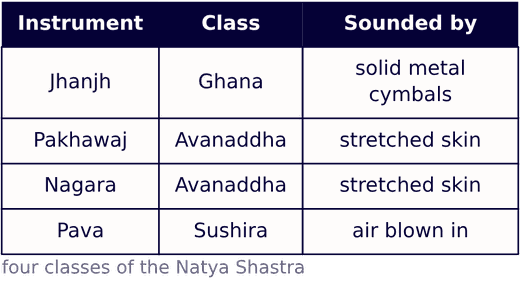 Pakhawaj and Nagara are drums with a stretched skin, hence Avanaddha Vadya, while Pava is a small folk flute blown into, hence Sushira Vadya.
Hence the correct option is (c).
Pakhawaj and Nagara are drums with a stretched skin, hence Avanaddha Vadya, while Pava is a small folk flute blown into, hence Sushira Vadya.
Hence the correct option is (c).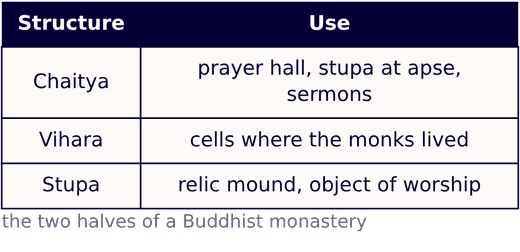 The residential half of a monastery was the vihara, a courtyard ringed by small cells for individual monks, which is why option (a) describes the vihara and not the chaitya.
The rock-cut chaityas at Karle, Bhaja, Bedsa and Ajanta, with their barrel-vaulted roofs and horseshoe-shaped chaitya windows, are the classic surviving examples.
Hence the correct option is (c).
The residential half of a monastery was the vihara, a courtyard ringed by small cells for individual monks, which is why option (a) describes the vihara and not the chaitya.
The rock-cut chaityas at Karle, Bhaja, Bedsa and Ajanta, with their barrel-vaulted roofs and horseshoe-shaped chaitya windows, are the classic surviving examples.
Hence the correct option is (c).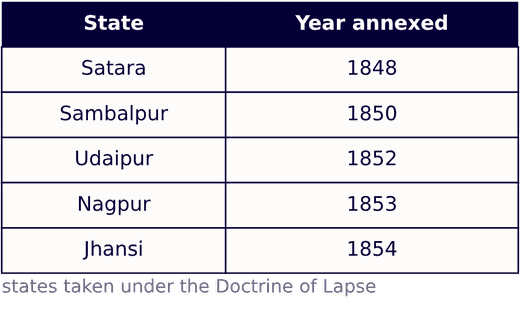 Awadh was a separate case, annexed in 1856 on the plea of misgovernance rather than lapse, and the resentment of the dispossessed rulers — Rani Lakshmibai of Jhansi above all — became one of the causes of the Revolt of 1857.
The Subsidiary Alliance was Wellesley's earlier device of stationing Company troops in a state at its own cost, while the Ring Fence policy of Warren Hastings only created buffer zones around Company territory.
Hence the correct option is (c).
Awadh was a separate case, annexed in 1856 on the plea of misgovernance rather than lapse, and the resentment of the dispossessed rulers — Rani Lakshmibai of Jhansi above all — became one of the causes of the Revolt of 1857.
The Subsidiary Alliance was Wellesley's earlier device of stationing Company troops in a state at its own cost, while the Ring Fence policy of Warren Hastings only created buffer zones around Company territory.
Hence the correct option is (c).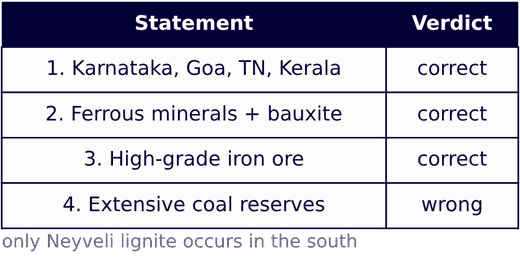 Statements 1, 2 and 3 are therefore correct and 4 is not.
Hence the correct option is (c).
Statements 1, 2 and 3 are therefore correct and 4 is not.
Hence the correct option is (c).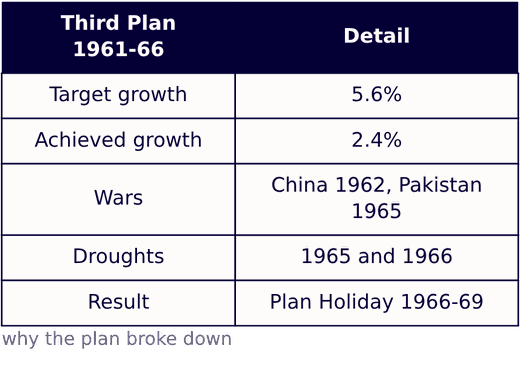 Together these shocks pulled actual growth down to about , and the plan is treated as a failure — so much so that the next plan was postponed and 1966-69 became the period of Plan Holidays with three annual plans.
Hence the correct option is (c).
Together these shocks pulled actual growth down to about , and the plan is treated as a failure — so much so that the next plan was postponed and 1966-69 became the period of Plan Holidays with three annual plans.
Hence the correct option is (c).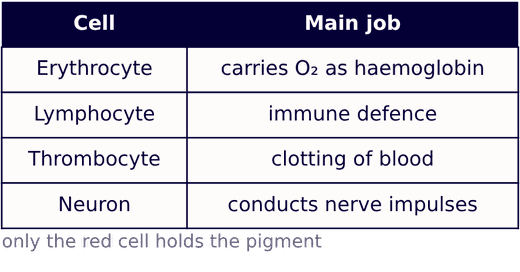 Lymphocytes are white cells that fight infection, thrombocytes (platelets) help the blood to clot, and neurons carry nerve impulses — none of them carries the respiratory pigment.
Hence the correct option is (d).
Lymphocytes are white cells that fight infection, thrombocytes (platelets) help the blood to clot, and neurons carry nerve impulses — none of them carries the respiratory pigment.
Hence the correct option is (d).