SSC CHSL 29 November 2025 · Shift 3 · English Language — questions with answers · ShikshaSphere
Chapter 188 of 200
29 November 2025 · Shift 3
English Language
25 questions ~25 min readFree
25 questions
A
1
Choose the correct option to fill in the blank in the sentence given: When completing registration forms, it is
to provide your full address and contact number.
A.mandatory
B.unnecessary
C.customary
D.choice
Solution
Vocabulary: word in context
The blank needs a word saying that the address and the contact number are compulsory, not optional — a registration form demands them.
'Mandatory' means required by a rule or a law, so 'it is mandatory to provide your full address and contact number' carries exactly that force.
'Unnecessary' says the opposite; 'customary' means only usual by habit, which does not bind anyone; and 'choice' is a noun that cannot stand after 'it is … to provide'.
2
Select the alternative which best expresses the meaning of the highlighted idiom/phrase:
I was completely at sixes and sevens about which university to attend until I received the scholarship offer.
A.nervous
B.feeling sad and low
C.in a state of confusion
D.extremely delighted
Solution
Idiom meaning
'At sixes and sevens' describes a state of complete disorder — either things lying in a muddle or a mind unable to settle on anything.
In the sentence the speaker could not decide which university to attend until the scholarship offer resolved it, so the mind was in confusion.
(a) 'nervous' names fear, (b) 'feeling sad and low' names sorrow and (d) 'extremely delighted' names joy; none of the three is disorder of thought.
3
Choose the option that has an error in the sentence.
On the bright side, if the condition are improving, the local communities will prosper.
A.On the brighter side,
B.if the condition are improving,
C.the local communities will prosper.
D.No correction required
Solution
Subject-verb agreement
Read the sentence part by part and test each one for grammar.
'The condition' is a singular subject, so it must take the singular verb 'is'; the sentence instead writes 'the condition are improving', pairing a singular subject with the plural 'are'.
Corrected: 'On the bright side, if the condition is improving, the local communities will prosper.'
The remaining parts are grammatically sound, so the error lies in 'if the condition are improving,'.
4
Examine the given sentence and pick out the error.
In order to overcome emotional anxiety and pressure (1) adopting relaxation techniques, exercise or (2) other similar practices (3) can be helped (4)
A.adopting relaxation techniques, exercise or
B.can be helped
C.in order to overcome emotional anxiety and pressure
D.other similar practices
Solution
Error spotting: adjective form
Parts (1), (2) and (3) are free of error; the fault lies in part (4).
The subject of the verb is 'adopting relaxation techniques, exercise or other similar practices' — these are the things that do the helping, not things that receive help, so a passive 'can be helped' is wrong here.
After 'can be' the sentence needs the adjective 'helpful', which means useful: '… other similar practices can be helpful.'
So the erroneous part is 'can be helped'.
5
Fill in the blank with the most appropriate preposition:
The application was cancelled_grounds of incomplete documents.
A.at
B.on
C.in
D.over
Solution
Preposition in a fixed phrase
The fixed phrase for stating the reason behind a decision is 'on grounds of' (also 'on the grounds of').
So the sentence reads: 'The application was cancelled on grounds of incomplete documents.'
'At', 'in' and 'over' never collocate with 'grounds' in the sense of a reason, so all three are ruled out.
6
Pick the one that is different from the others.
A.Wright
B.Right
C.Nite
D.rite
Solution
Odd one out: homophones
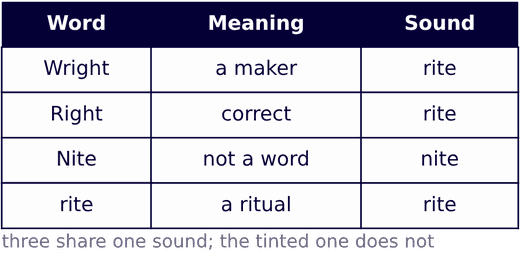
Wright (a maker or builder, as in playwright), right (correct) and rite (a ritual) are three different words that are pronounced identically — they are homophones, and each is a standard English word.
'Nite' is only an informal, non-standard respelling of 'night'; it is not a standard English word and it does not even share the sound of the other three.
So the odd one out is 'Nite'.
7
Select the incorrectly spelt word
A.Simile
B.Family
C.Facsimily
D.Mile
Solution
Incorrect spelling
'Facsimile' — an exact copy of a document — ends in '-mile', like the word 'mile' itself; the option spells it 'Facsimily'.
'Simile' (a figure of speech), 'Family' and 'Mile' are all spelt correctly.
So the incorrectly spelt word is 'Facsimily'.
8
Choose the best option to replace the underlined part to improve the given sentence. If no substitution is required, select 'No substitution.'
The two friends agreed to distribute the chocolates among themselves.
A.around themselves
B.between themselves
C.to themselves
D.No substitution
Solution
Between vs among
'Between' is used when only two parties share or divide something; 'among' is kept for three or more.
The sentence names exactly 'the two friends', so the division is two-way and 'between themselves' is required.
Improved sentence: 'The two friends agreed to distribute the chocolates between themselves.'
'Around themselves' and 'to themselves' do not express a two-way division, so 'No substitution' cannot be chosen either.
9
Choose the best option to replace the underlined part to improve the given sentence. If no substitution is required, select 'No substitution.'
She believed he was cut out on a career in teaching because of his excellent communication skills.
A.cut down on
B.cut out to
C.cut out for
D.No substitution
Solution
Phrasal verb
The fixed expression is 'be cut out for something' — to have exactly the qualities that a particular job or role needs.
Improved sentence: 'She believed he was cut out for a career in teaching because of his excellent communication skills.'
'Cut down on' means to reduce the amount of something, which does not fit here, and 'cut out to' is not an accepted form of the idiom.
10
From the alternatives given below, select the correct passive voice of the following sentence.
The violent storm blew down the lamp of the garden within minutes.
A.The lamp of the garden was blown within minutes by the violent storm.
B.The lamp of the garden was blown down within minutes by the violent storm.
C.The lamp of the garden had blown down within minutes by the violent storm.
D.The lamp of the garden had been blown down within minutes by the violent storm.
Solution
Active to passive voice
In the active sentence 'the violent storm' is the subject, 'blew down' is the simple past verb and 'the lamp of the garden' is the object.
The object becomes the subject and the verb becomes 'was + blown': 'The lamp of the garden was blown down within minutes by the violent storm.'
The particle 'down' belongs to the phrasal verb 'blow down' and must be kept, which rules out (a); (c) and (d) shift the sentence to the past perfect and so change the tense of the original.
11
Choose the option that is the most appropriate conversion of the following sentence into Active Voice.
The secret had never been revealed by anyone before the journalist arrived.
A.No one never revealed the secret before the journalist arrived.
B.No one had revealed the secret before the journalist arrived.
C.No one reveals the secret before the journalist arrived.
D.No one has revealed the secret before the journalist arrived.
Solution
Passive to active voice
In the passive sentence the agent is 'anyone' and the verb 'had been revealed' is the past perfect passive ('had been + V3').
In the active the agent becomes the subject; 'anyone' carrying the negative 'never' is expressed by the single subject 'No one', and the past perfect active is 'had + V3'.
So the active form is: 'No one had revealed the secret before the journalist arrived.'
(a) keeps 'never' alongside 'No one', giving a double negative; (c) and (d) drop the past perfect and change the tense.
12
Choose the correct indirect narration of the following statement from the given alternatives:
Rohit said, "He has to come to Mumbai to me within the next few hours to seek help to resolve the issue he described."
A.Rohit said that he had to come to Mumbai to him within the following few hours to seek help to resolve the issue he had described.
B.Rohit said that he had to go to Mumbai to him within the next few hours to bring help to resolve the issue he had described.
C.Rohit said that he has to go to Mumbai to him within the next few hours to seek help to resolve the issue he described.
D.Rohit said that he had to go to Mumbai to him within the following few hours to seek help to resolve the issue he had described.
Solution
Direct to indirect speech
The reporting verb 'said' is in the past, so every element inside the quotation shifts one step back.
'Come … to me' is spoken from where Rohit stands; once reported it must become 'go … to him', and the time phrase 'the next few hours' becomes 'the following few hours'.
Only (d) makes all four changes: 'Rohit said that he had to go to Mumbai to him within the following few hours to seek help to resolve the issue he had described.'
(a) keeps 'come', (b) replaces 'seek' with 'bring' and so changes the meaning, and (c) keeps the present 'has' along with 'next' and 'described'.
13
Choose the option that is the most appropriate conversion of the following sentence into Direct Speech.
She exclaimed with regret that she had misplaced her phone at the office.
A.She exclaimed, *Hey! I had misplaced my phone at the office."
B.She said, "Oh no! I have misplaced my phone at the office."
C.She exclaimed, 'Ah! I have misplace my phone at the office."
D.She said, "I regret I have misplaced my phone at the office."
Solution
Indirect to direct speech
'Exclaimed with regret' tells us that the direct speech must open with an interjection that expresses regret.
Turning the report back into speech, 'that' is dropped, 'she … her' becomes 'I … my', and the past perfect 'had misplaced' moves one step forward to the present perfect 'have misplaced'.
So the direct form is: She said, "Oh no! I have misplaced my phone at the office." — 'Oh no!' is exactly the interjection of regret.
(a) uses 'Hey!', which shows surprise and not regret, and keeps 'had misplaced'; (c) writes the ungrammatical 'have misplace'; (d) supplies no interjection at all.
14
The following sentence has two blanks. Choose the most suitable set of prepositions from the given options to fill in the blanks and complete the sentence meaningfully:
The manager distanced herself the error and put the blame her assistant.
A.off, to
B.from, onto
C.with, over
D.by, upon
Solution
Prepositions: two blanks
Verbs of separation take 'from' — distance from, detach from, dissociate from, separate from, abstain from. So the first blank is 'from'.
'Put the blame onto somebody' pictures the blame being moved from one person and set down on another, so 'onto' fits the second blank.
Complete sentence: 'The manager distanced herself from the error and put the blame onto her assistant.'
'Off, to', 'with, over' and 'by, upon' each break at least one of these two collocations.
15
Choose the option that is the most appropriate conversion of the following sentence into Direct Speech.
He told the guard that he had been studying when the burglars had entered.
A.He said to the guard, "I had studied when the burglars had entered."
B.He said to the guard, '1 had been studying when the burglars had entered."
C.He told the guard, "I had been studying when the burglars entered.'
D.He told the guard, "I had been studying when the burglars were entering."
Solution
Indirect to direct speech
The reporting clause 'He told the guard' already has an object, so it stays as it is; only options beginning 'He told the guard' can be right.
Inside the speech, the past perfect continuous 'had been studying' stays unchanged, but the second past perfect 'had entered' goes back to the simple past 'entered', because that clause only marks the point at which the studying was interrupted.
So the direct form is: He told the guard, "I had been studying when the burglars entered."
(a) and (b) change 'told the guard' to 'said to the guard', and (d) wrongly turns the interruption into the past continuous 'were entering'.
16
Change the following sentence into the Active form.
The innovative medical procedure should not have been dismissed as mere experimentation by the health authorities.
A.The health authorities should not have been dismissing the innovative medical procedure as mere experimentation.
B.The health authorities should not have dismissed the innovative medical procedure as mere experimentation.
C.The innovative medical procedure should not be dismissed as mere experimentation by the health authorities.
D.The health authorities should not be dismissing the innovative medical procedure as mere experimentation.
Solution
Passive to active voice
In the passive sentence the agent is 'the health authorities', so in the active form that phrase becomes the subject.
The passive 'should not have been + V3' becomes the active 'should not have + V3' — the modal perfect is kept and only the passive 'been' is dropped.
So the active form is: 'The health authorities should not have dismissed the innovative medical procedure as mere experimentation.'
(a) and (d) replace the perfect form with a continuous one, and (c) is still in the passive voice.
17
Select the incorrect spelling.
A.Commend
B.Occassion
C.Deadline
D.Intimidate
Solution
Incorrect spelling
'Occasion' carries a double 'c' but only a single 's'; the option writes 'Occassion' with a double 's', which is wrong.
'Commend' (to praise), 'Deadline' and 'Intimidate' are all spelt correctly.
So the incorrectly spelt option is 'Occassion'.
18
Choose the correct passive voice transformation of the sentence:
We had not completed the assignment before the due date.
A.The assignment was not completed by us before the due date.
B.The assignment has not been completed by us before the due date.
C.The assignment had not been completed by us before the due date.
D.The assignment was not being completed by us before the due date.
Solution
Active to passive voice
'We had not completed' is the past perfect, whose passive is formed as 'had + not + been + V3'.
The object 'the assignment' becomes the subject and the subject 'we' becomes the agent 'by us'.
So the passive form is: 'The assignment had not been completed by us before the due date.'
(a) uses the simple past, (b) the present perfect and (d) the past continuous, so each of the three changes the tense of the original sentence.
19
Directions (Qs. 19-23): Read the following passage carefully and answer the questions that follow.
For a significant period, pursuing an MBA was once regarded as the definitive gateway to the upper echelons of the corporate world. Ambitious professionals across various sectors sought management degrees, convinced that such credentials would automatically unlock high-level leadership positions and lucrative salary packages. However, the contemporary corporate landscape has witnessed a shift as recruiters move away from valuing mere degrees toward valuing specific competencies.
The primary challenge facing traditional management education is the oversaturation of the talent pool. With an explosion of management institutes, the sheer volume of graduates has far outpaced the actual demand for mid-level managers. Consequently, many degree holders find themselves competing for entry-level roles that do not align with their academic investment. Furthermore, the rise of automation and digital transformation has rendered many legacy management techniques obsolete, creating a gap between academic theory and corporate reality. To remain competitive, professionals are now turning toward continuous upskilling in niche areas such as Digital Transformation, Strategic Analytics, and Crisis Management. Companies now prioritise graduates who demonstrate agility and a commitment to lifelong learning over those who rely solely on a static qualification. Ultimately, the future of corporate success lies in the ability to adapt to a rapidly changing environment through constant self-improvement and practical application.
In the sentence: "For a significant period, pursuing an MBA was once regarded as the definitive gateway..." what is the tense of the verb "was regarded"?
A.Present continuous
B.Past simple
C.Past perfect
D.Future simple
Solution
Identifying tense
'Was regarded' is made of the past form 'was' plus the past participle 'regarded', which is the passive of the simple past tense.
Its active equivalent is 'people once regarded pursuing an MBA as …', a plain simple past; the time word 'once' also points to a finished stretch of past time.
The past perfect would need 'had been regarded', the present continuous 'is being regarded' and the future simple 'will be regarded', so none of those three fits.
20
Directions (Qs. 19-23): Read the following passage carefully and answer the questions that follow.
For a significant period, pursuing an MBA was once regarded as the definitive gateway to the upper echelons of the corporate world. Ambitious professionals across various sectors sought management degrees, convinced that such credentials would automatically unlock high-level leadership positions and lucrative salary packages. However, the contemporary corporate landscape has witnessed a shift as recruiters move away from valuing mere degrees toward valuing specific competencies.
The primary challenge facing traditional management education is the oversaturation of the talent pool. With an explosion of management institutes, the sheer volume of graduates has far outpaced the actual demand for mid-level managers. Consequently, many degree holders find themselves competing for entry-level roles that do not align with their academic investment. Furthermore, the rise of automation and digital transformation has rendered many legacy management techniques obsolete, creating a gap between academic theory and corporate reality. To remain competitive, professionals are now turning toward continuous upskilling in niche areas such as Digital Transformation, Strategic Analytics, and Crisis Management. Companies now prioritise graduates who demonstrate agility and a commitment to lifelong learning over those who rely solely on a static qualification. Ultimately, the future of corporate success lies in the ability to adapt to a rapidly changing environment through constant self-improvement and practical application.
In the sentence: "Companies now prioritise graduates who demonstrate agility and a commitment to lifelong learning over those who rely solely on a static qualification."
Why is the verb "prioritise" used and not "prioritises"?
A.Because "graduates" is a plural noun
B.Because "Companies" is the plural subject
C.Because "agility" is an abstract noun
D.Because the sentence is in the passive voice
Solution
Subject-verb agreement
By the rule of subject-verb agreement the verb answers to the subject of its own clause, never to the nearest noun.
The subject of 'prioritise' is 'Companies', a plural noun, and a plural subject takes the base form of the verb without '-s'; 'prioritises' would need a singular subject such as 'The company'.
'Graduates' is only the object, 'agility' sits inside a relative clause, and the sentence is in the active voice, so (a), (c) and (d) are all beside the point.
21
Directions (Qs. 19-23): Read the following passage carefully and answer the questions that follow.
For a significant period, pursuing an MBA was once regarded as the definitive gateway to the upper echelons of the corporate world. Ambitious professionals across various sectors sought management degrees, convinced that such credentials would automatically unlock high-level leadership positions and lucrative salary packages. However, the contemporary corporate landscape has witnessed a shift as recruiters move away from valuing mere degrees toward valuing specific competencies.
The primary challenge facing traditional management education is the oversaturation of the talent pool. With an explosion of management institutes, the sheer volume of graduates has far outpaced the actual demand for mid-level managers. Consequently, many degree holders find themselves competing for entry-level roles that do not align with their academic investment. Furthermore, the rise of automation and digital transformation has rendered many legacy management techniques obsolete, creating a gap between academic theory and corporate reality. To remain competitive, professionals are now turning toward continuous upskilling in niche areas such as Digital Transformation, Strategic Analytics, and Crisis Management. Companies now prioritise graduates who demonstrate agility and a commitment to lifelong learning over those who rely solely on a static qualification. Ultimately, the future of corporate success lies in the ability to adapt to a rapidly changing environment through constant self-improvement and practical application.
Which words from the passage means "too many professionals in the market"?
A.strategic
B.corporate
C.oversaturation
D.traditional
Solution
Vocabulary from the passage
The words asked for must describe a market that already holds far more trained professionals than it can absorb.
The second paragraph names that very problem: 'The primary challenge facing traditional management education is the oversaturation of the talent pool.'
'Oversaturation' literally means filled beyond capacity, which is exactly 'too many professionals in the market'.
'Strategic', 'corporate' and 'traditional' only describe a kind of thinking, a sector or an old style; none of them carries the idea of excess supply. Hence option (c).
22
Directions (Qs. 19-23): Read the following passage carefully and answer the questions that follow.
For a significant period, pursuing an MBA was once regarded as the definitive gateway to the upper echelons of the corporate world. Ambitious professionals across various sectors sought management degrees, convinced that such credentials would automatically unlock high-level leadership positions and lucrative salary packages. However, the contemporary corporate landscape has witnessed a shift as recruiters move away from valuing mere degrees toward valuing specific competencies.
The primary challenge facing traditional management education is the oversaturation of the talent pool. With an explosion of management institutes, the sheer volume of graduates has far outpaced the actual demand for mid-level managers. Consequently, many degree holders find themselves competing for entry-level roles that do not align with their academic investment. Furthermore, the rise of automation and digital transformation has rendered many legacy management techniques obsolete, creating a gap between academic theory and corporate reality. To remain competitive, professionals are now turning toward continuous upskilling in niche areas such as Digital Transformation, Strategic Analytics, and Crisis Management. Companies now prioritise graduates who demonstrate agility and a commitment to lifelong learning over those who rely solely on a static qualification. Ultimately, the future of corporate success lies in the ability to adapt to a rapidly changing environment through constant self-improvement and practical application.
Which word from the passage means "learning new and enhanced skills to fulfil rising demands" ?
A.significant
B.upskilling
C.adapt
D.witnessed
Solution
Vocabulary from the passage
The clue words are 'new and enhanced skills' and 'rising demands' — a word for adding fresh skills so as to keep pace with the market.
The passage says professionals are 'turning toward continuous upskilling in niche areas such as Digital Transformation, Strategic Analytics, and Crisis Management'.
'Upskilling' is precisely the act of learning higher or newer skills to meet growing demands.
'Significant' means important, 'adapt' means to adjust oneself to change and 'witnessed' means saw; none of them names the learning of new skills. Hence option (b).
23
Directions (Qs. 19-23): Read the following passage carefully and answer the questions that follow.
For a significant period, pursuing an MBA was once regarded as the definitive gateway to the upper echelons of the corporate world. Ambitious professionals across various sectors sought management degrees, convinced that such credentials would automatically unlock high-level leadership positions and lucrative salary packages. However, the contemporary corporate landscape has witnessed a shift as recruiters move away from valuing mere degrees toward valuing specific competencies.
The primary challenge facing traditional management education is the oversaturation of the talent pool. With an explosion of management institutes, the sheer volume of graduates has far outpaced the actual demand for mid-level managers. Consequently, many degree holders find themselves competing for entry-level roles that do not align with their academic investment. Furthermore, the rise of automation and digital transformation has rendered many legacy management techniques obsolete, creating a gap between academic theory and corporate reality. To remain competitive, professionals are now turning toward continuous upskilling in niche areas such as Digital Transformation, Strategic Analytics, and Crisis Management. Companies now prioritise graduates who demonstrate agility and a commitment to lifelong learning over those who rely solely on a static qualification. Ultimately, the future of corporate success lies in the ability to adapt to a rapidly changing environment through constant self-improvement and practical application.
As per the passage, what is the primary reason for limited opportunities in the management sector ?
A.Declining student interest
B.Lack of corporate growth
C.Too many graduates and outdated skills
D.Excessive salary expectations
Solution
Reading comprehension: cause
The passage gives two forces that together shrink the openings for management graduates.
First, supply: 'the sheer volume of graduates has far outpaced the actual demand for mid-level managers', so many end up 'competing for entry-level roles'.
Second, skills: 'the rise of automation and digital transformation has rendered many legacy management techniques obsolete'.
Put together, the reason is too many graduates plus outdated skills.
The passage never says that student interest is falling, that corporate growth has stopped, or that salary expectations are the barrier. Hence option (c).
24
What is the antonym of 'Peaceful'?
A.Fraud
B.Turbulent
C.Modest
D.Calm
Solution
Antonym
'Peaceful' means calm and free from disturbance, so its antonym must suggest disorder and unrest.
'Turbulent' means marked by conflict, confusion and instability — the exact opposite of peaceful.
'Calm' is a synonym of 'peaceful', not an antonym, which is the trap here.
'Fraud' means criminal deception and 'modest' means humble; neither is connected with peace at all. Hence option (b).
25
What is the antonym of "Biased"?
A.Partial
B.Egalitarian
C.Favour
D.Discrimination
Solution
Antonym
'Biased' means unfairly favouring one side, so the antonym must mean treating everybody equally.
'Egalitarian' means believing in equal rights and equal opportunity for all, which is the opposite of showing prejudice.
'Partial' and 'favour' both mean leaning towards one side, so they agree with 'biased' rather than oppose it.
'Discrimination' is unfair treatment, which is the result of bias, not its opposite. Hence option (b).
Finished reading? Now test yourself.
The same 25 questions, but with a timer and the answers hidden — 15 minutes.

 'Nite' is only an informal, non-standard respelling of 'night'; it is not a standard English word and it does not even share the sound of the other three.
So the odd one out is 'Nite'.
'Nite' is only an informal, non-standard respelling of 'night'; it is not a standard English word and it does not even share the sound of the other three.
So the odd one out is 'Nite'.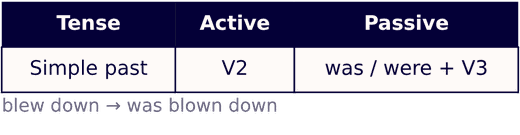 The object becomes the subject and the verb becomes 'was + blown': 'The lamp of the garden was blown down within minutes by the violent storm.'
The particle 'down' belongs to the phrasal verb 'blow down' and must be kept, which rules out (a); (c) and (d) shift the sentence to the past perfect and so change the tense of the original.
The object becomes the subject and the verb becomes 'was + blown': 'The lamp of the garden was blown down within minutes by the violent storm.'
The particle 'down' belongs to the phrasal verb 'blow down' and must be kept, which rules out (a); (c) and (d) shift the sentence to the past perfect and so change the tense of the original.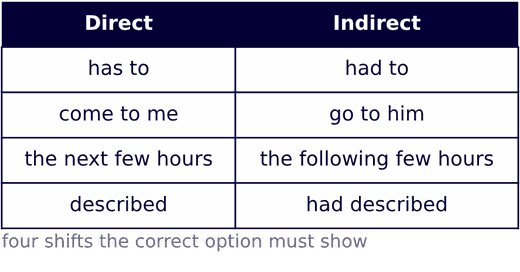 'Come … to me' is spoken from where Rohit stands; once reported it must become 'go … to him', and the time phrase 'the next few hours' becomes 'the following few hours'.
Only (d) makes all four changes: 'Rohit said that he had to go to Mumbai to him within the following few hours to seek help to resolve the issue he had described.'
(a) keeps 'come', (b) replaces 'seek' with 'bring' and so changes the meaning, and (c) keeps the present 'has' along with 'next' and 'described'.
'Come … to me' is spoken from where Rohit stands; once reported it must become 'go … to him', and the time phrase 'the next few hours' becomes 'the following few hours'.
Only (d) makes all four changes: 'Rohit said that he had to go to Mumbai to him within the following few hours to seek help to resolve the issue he had described.'
(a) keeps 'come', (b) replaces 'seek' with 'bring' and so changes the meaning, and (c) keeps the present 'has' along with 'next' and 'described'.